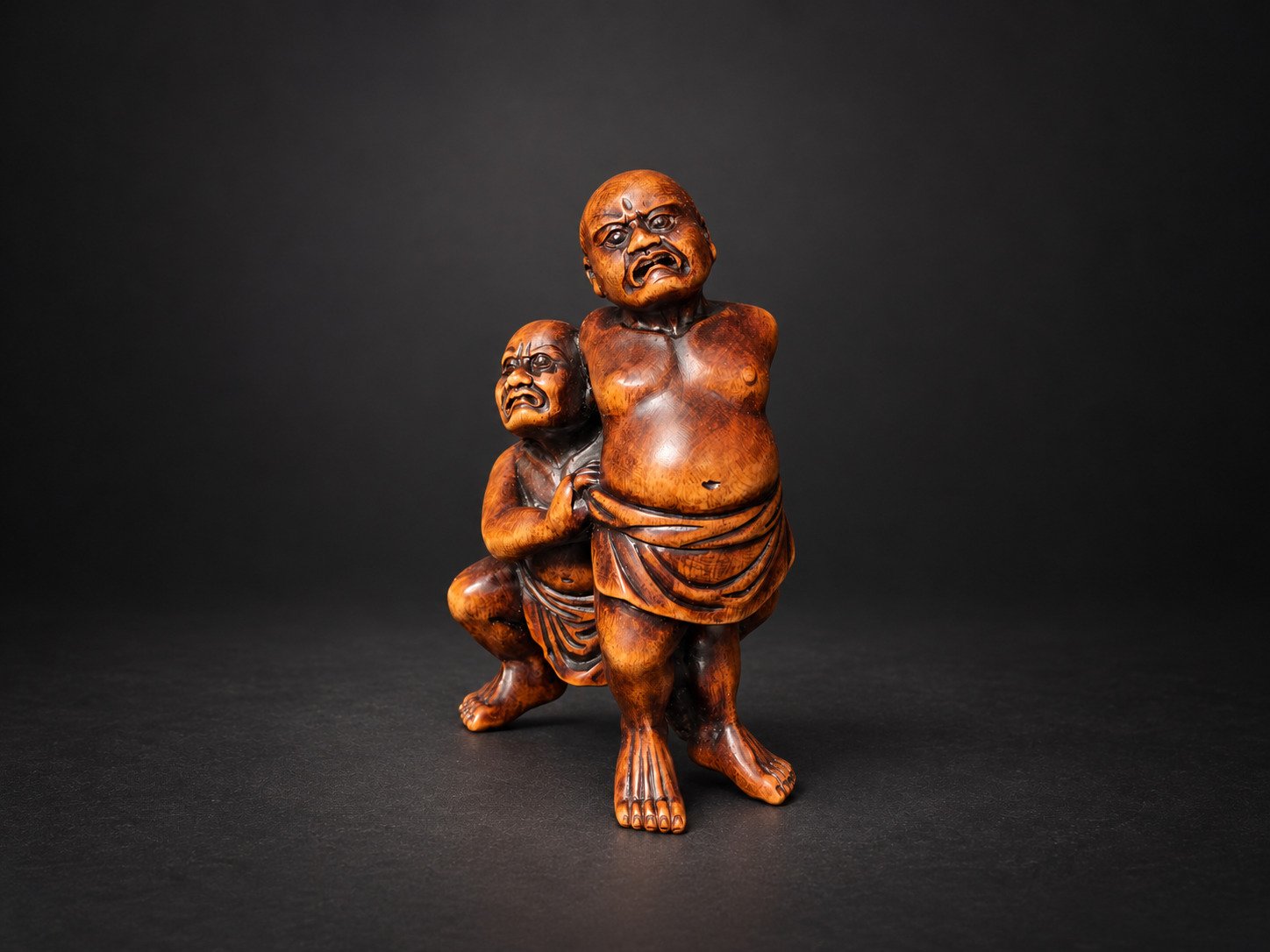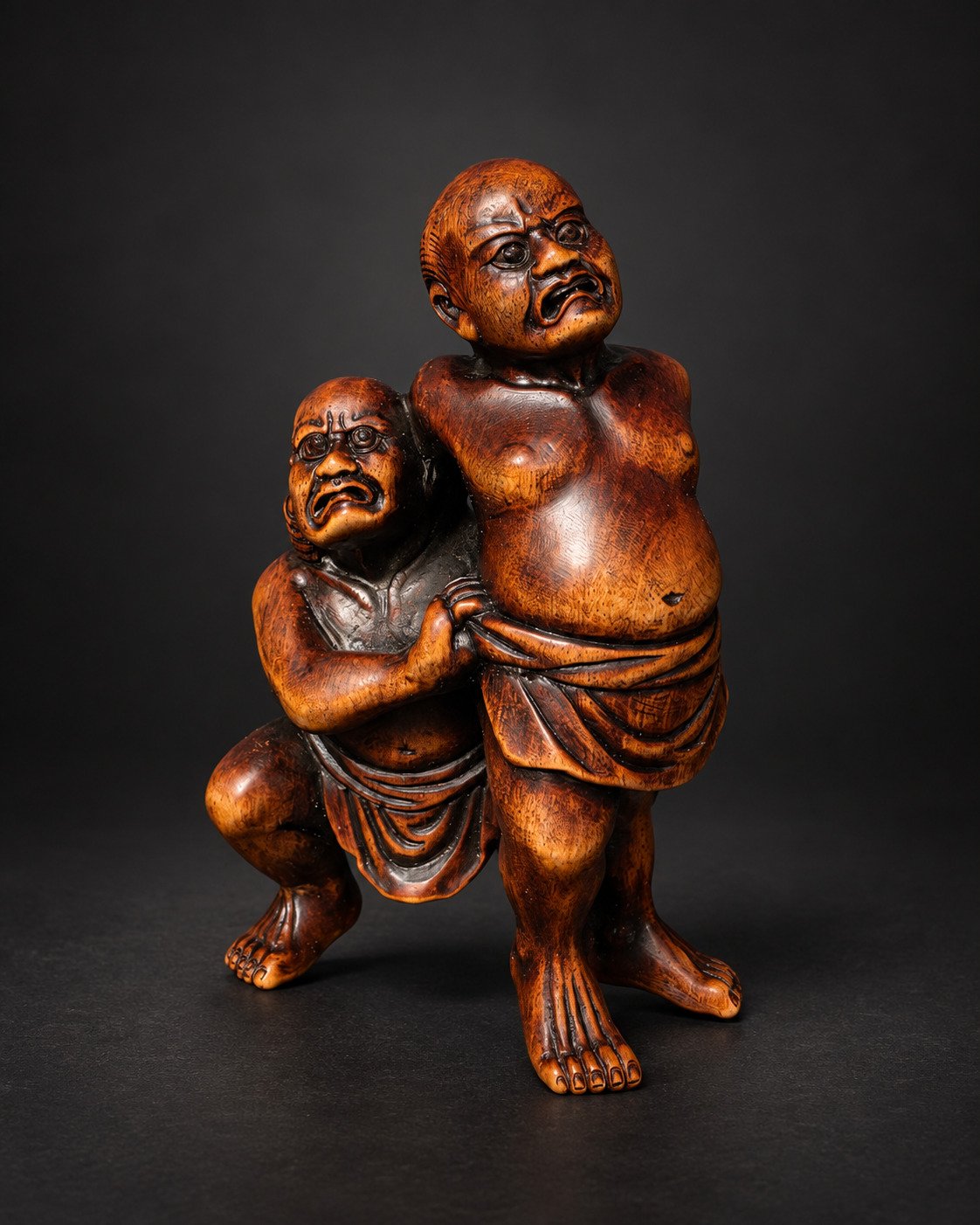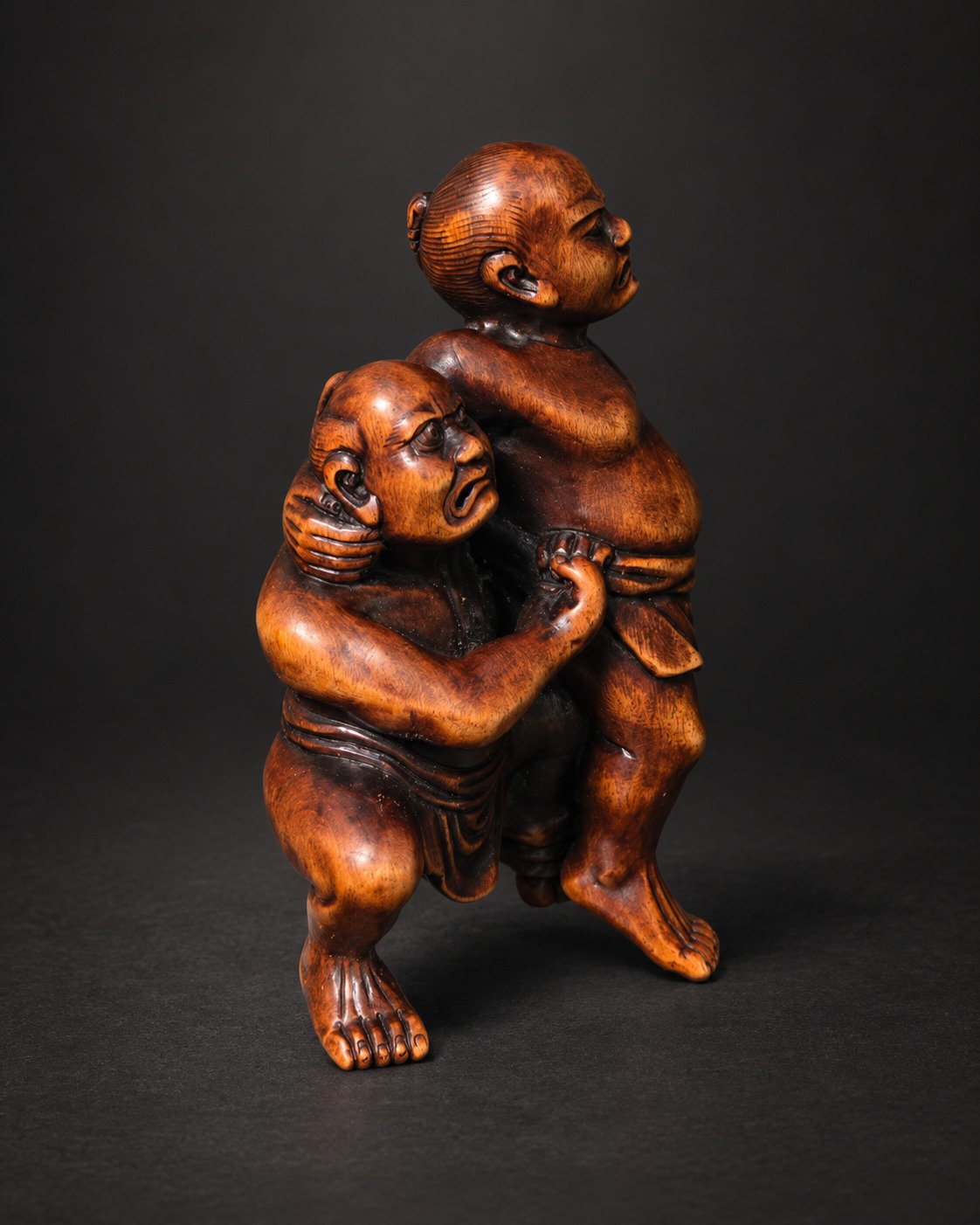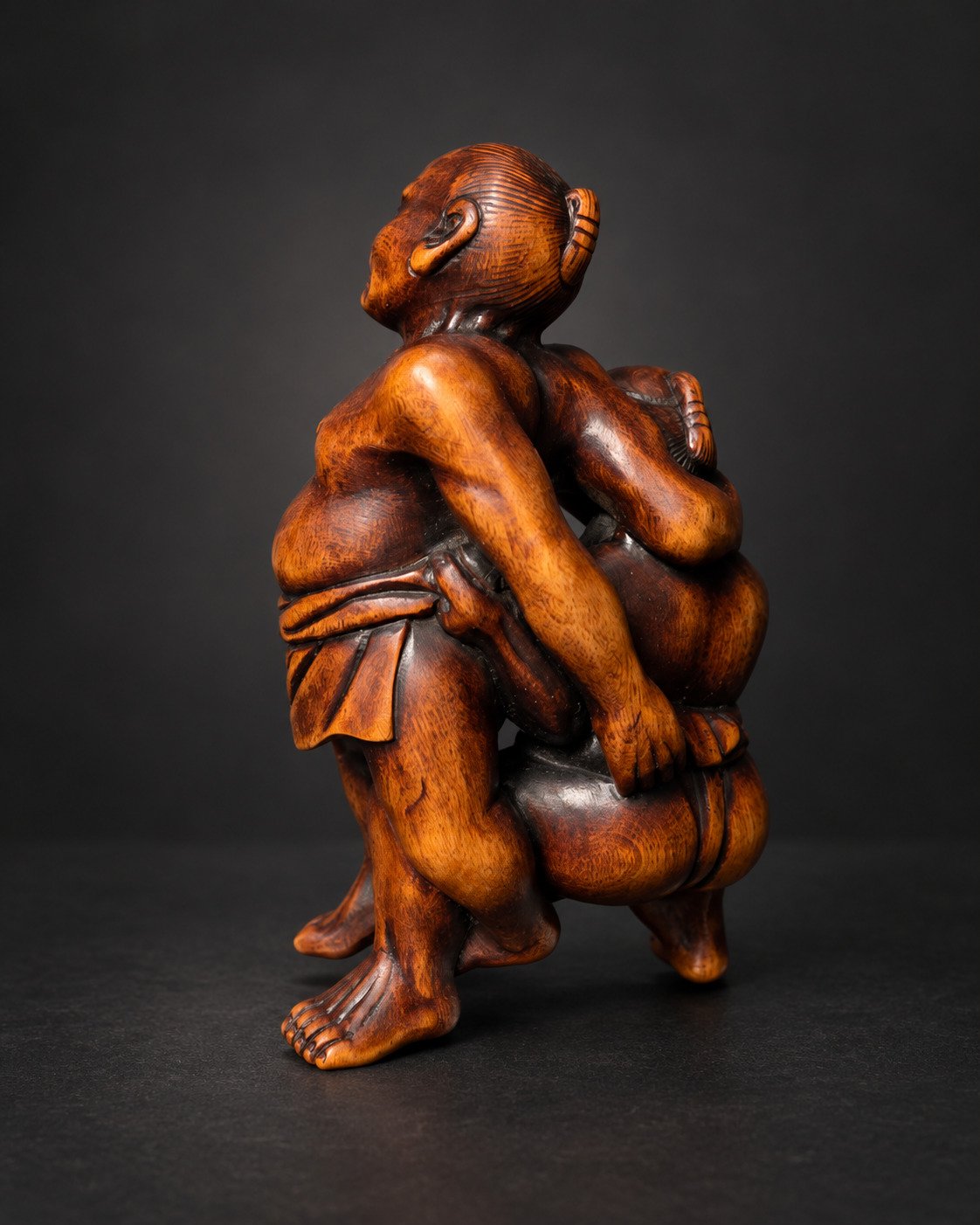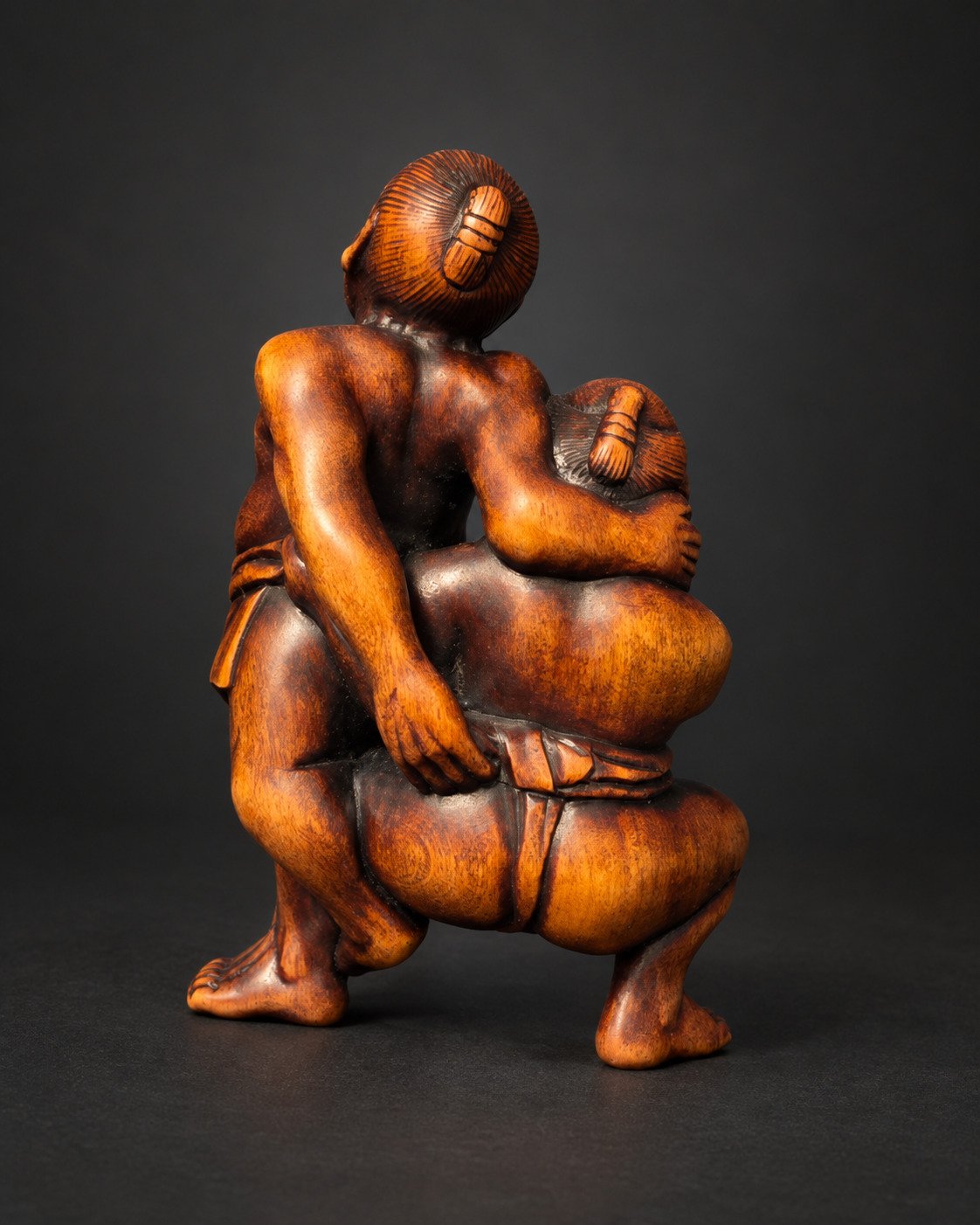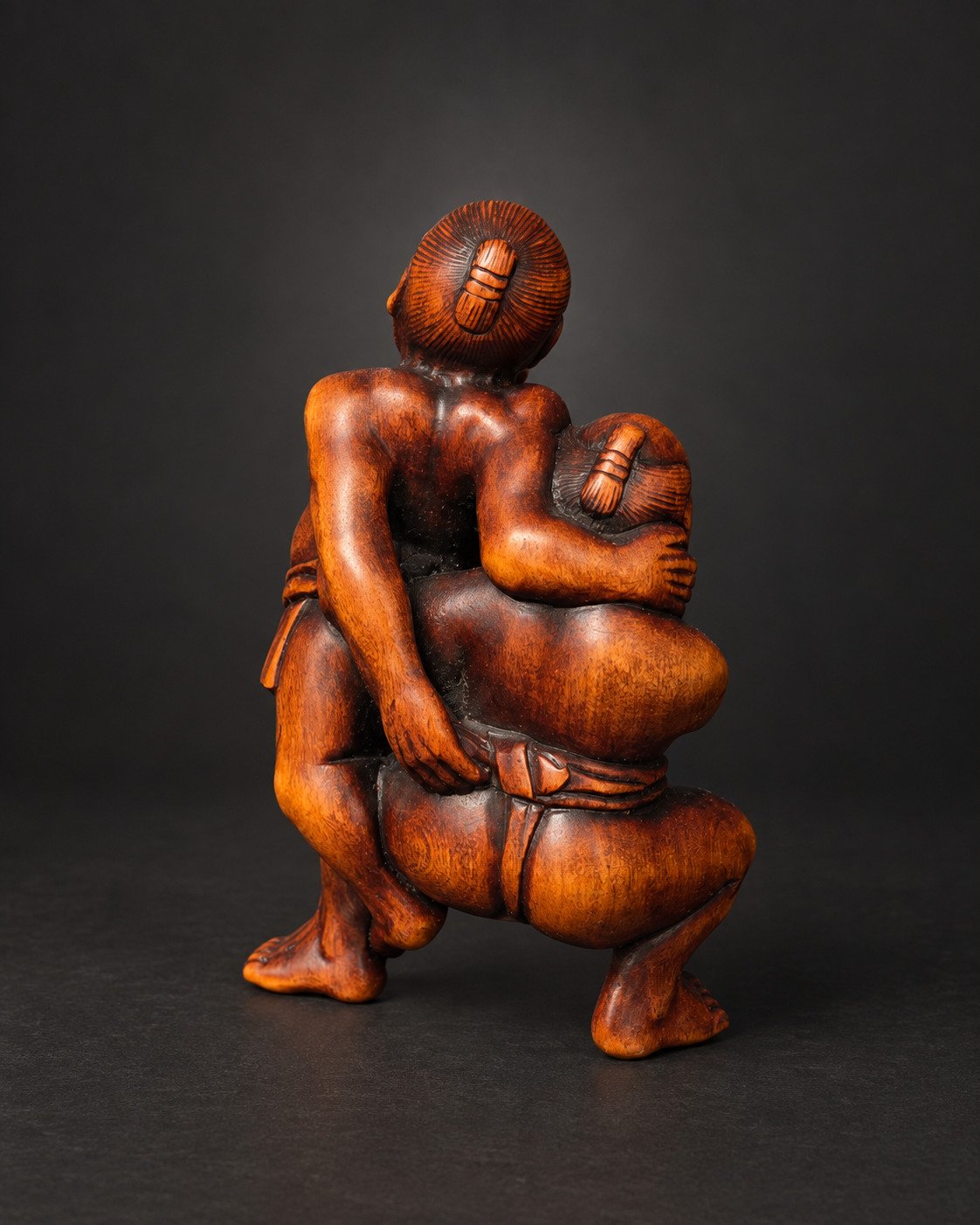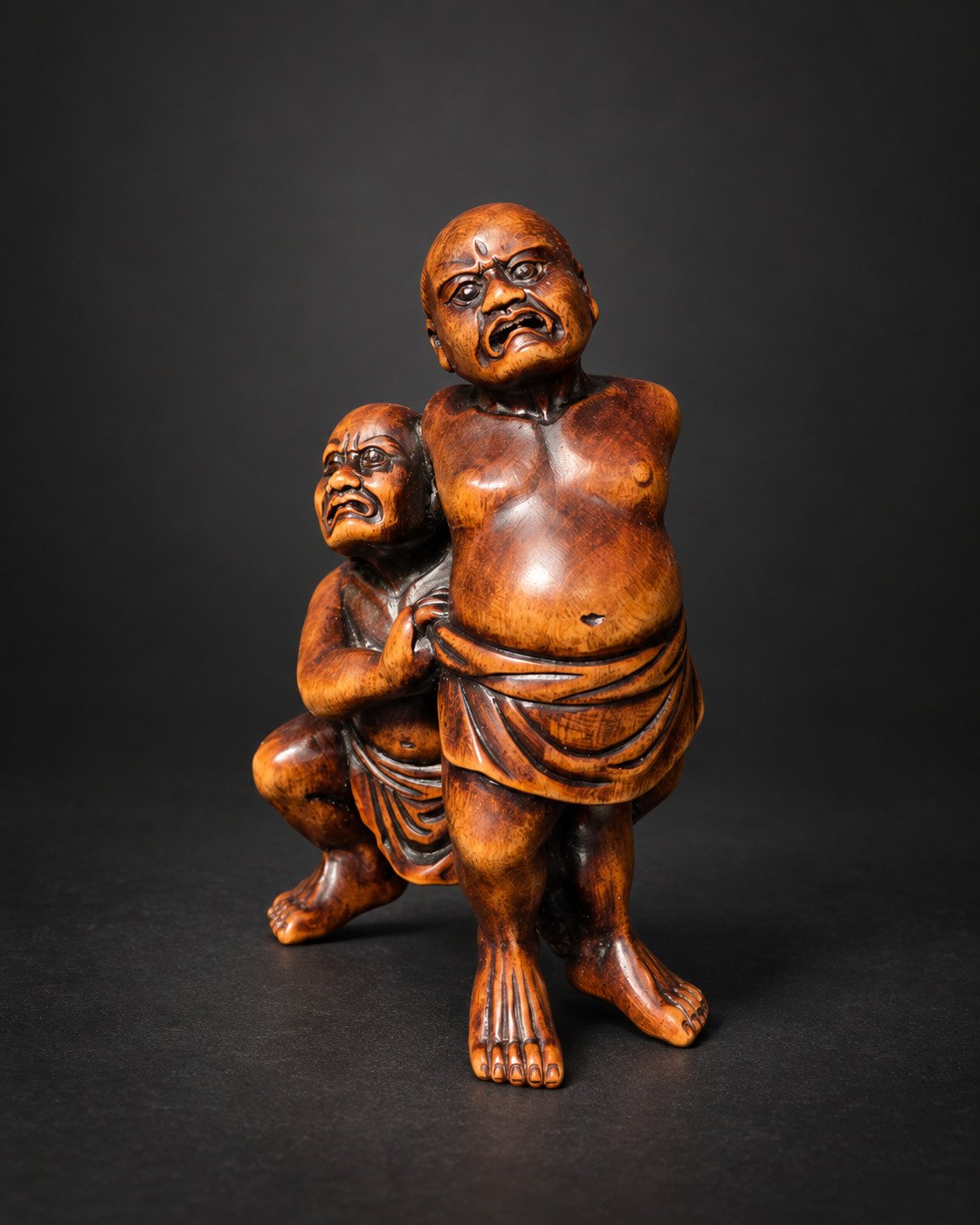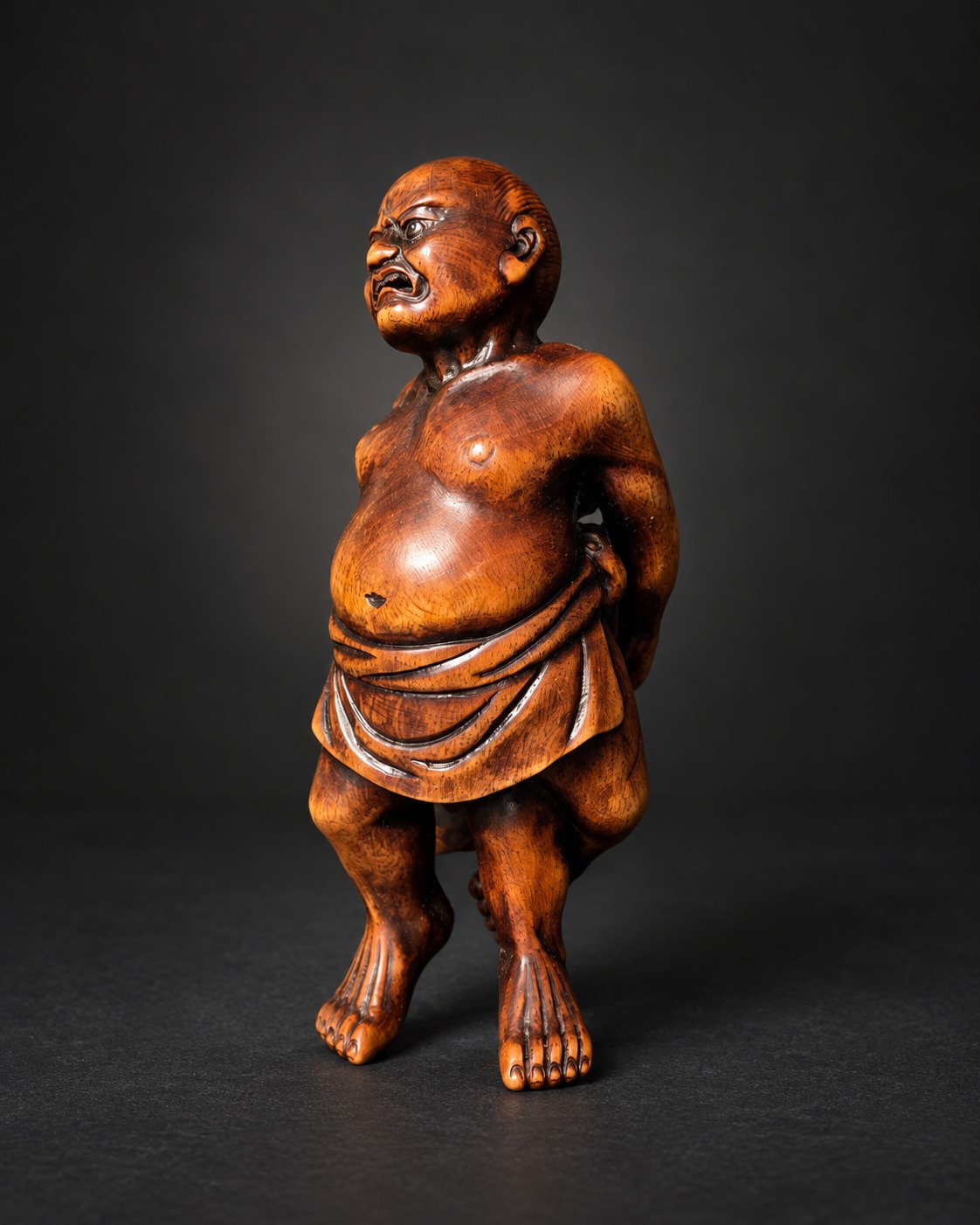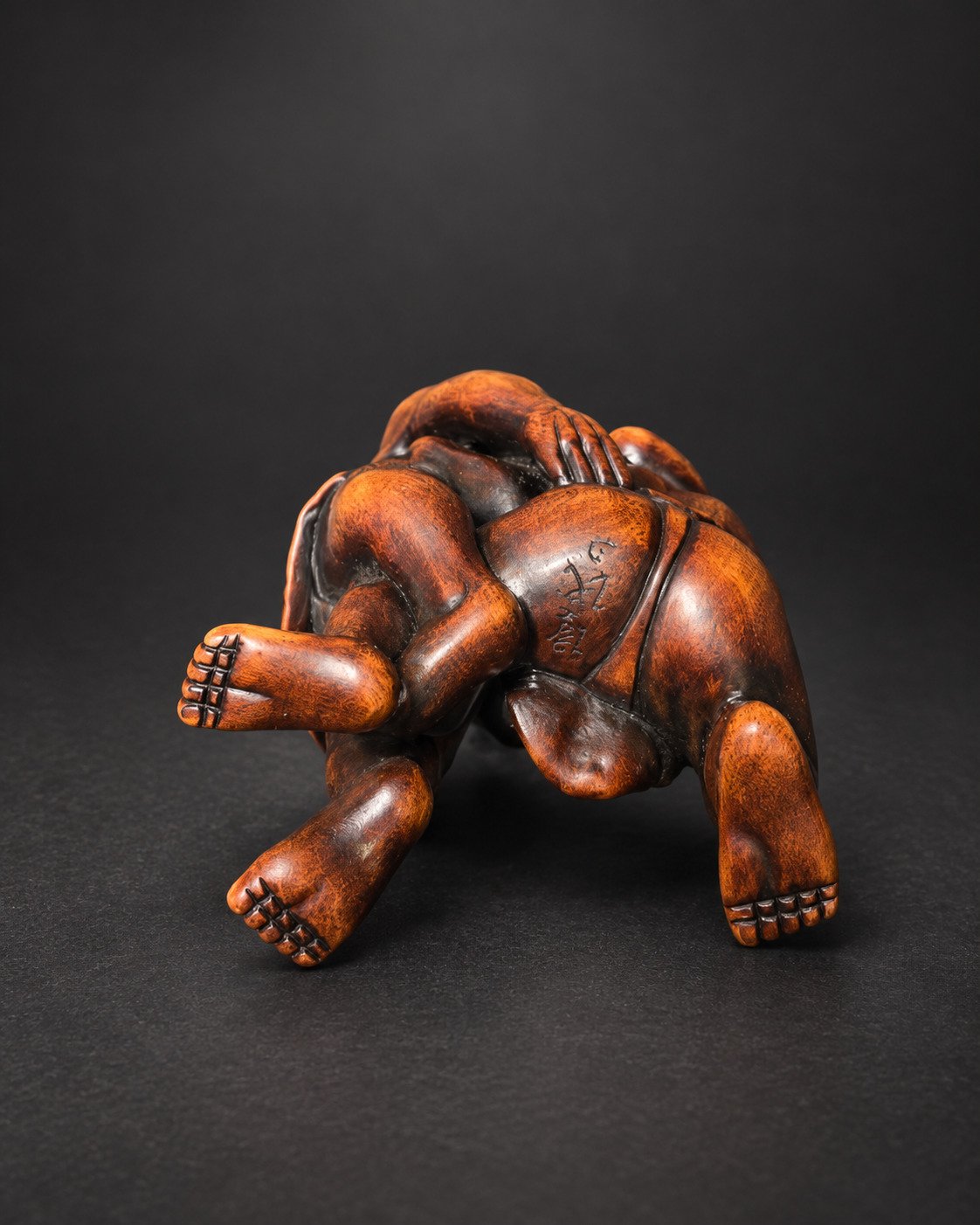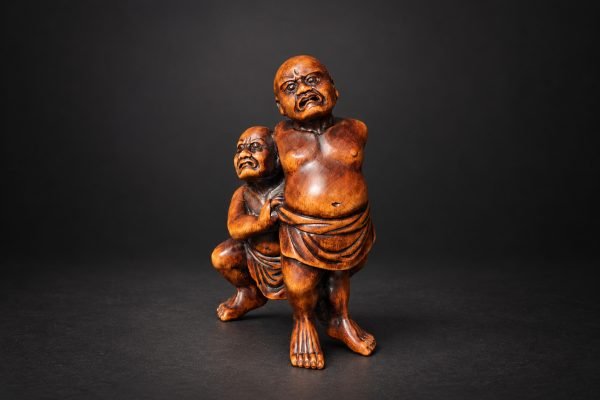
A powerful Japanese netsuke depicting two sumō wrestlers locked in the dramatic kawazu-gake, the traditional hooking throw. The standing wrestler is being dragged violently off balance and bends backward with his face turned toward the sky, while his crouching opponent hooks a leg around his and grips his mawashi. The entire group is conceived as a single compact knot of straining bodies, combining physical tension, humor, movement, and remarkable sculptural complexity.
The expressions are among the most striking elements of the carving.
Both wrestlers grimace under the strain of the contest, their exaggerated faces animated by eyes inlaid in horn.
The contrasting poses — one figure rising and arching backward, the other compressed close to the ground — create a remarkably dynamic composition.
The piece bears the signature Hōkyūdō Itsumin and is finely carved after a celebrated model associated with this carver.
The composition is additionally connected to one of the most famous martial legends in medieval Japanese history: the story of Kawazu Saburō Sukeyasu and the origins of the Soga brothers’ revenge.
The subject depicts the sumō technique known as kawazu-gake, traditionally translated as a hooking throw.
The technique involves hooking one leg around an opponent’s leg while destabilizing the upper body.
In this carving, the movement has been captured at its most dramatic instant.
The taller wrestler has already lost his balance.
His torso bends backward, his chest opens upward, and his head is thrown toward the sky.
His opponent remains low and compact, using his own leg to hook the standing wrestler while gripping the loincloth for leverage.
The result is not a static representation of two athletes posing.
It is a precise moment within a violent movement.
The figures appear caught between balance and collapse.
One of the most successful aspects of the composition is the way the two wrestlers are joined into a single sculptural mass.
Their legs overlap.
Their arms cross and press against one another.
The crouching wrestler disappears partially behind the body of his opponent, while the standing wrestler dominates the front of the group.
Despite the complexity of the pose, the composition remains compact and visually coherent.
The interlocking limbs allow the sculptor to create movement without producing fragile projections.
From different angles, new relationships between the two bodies become visible.
The object therefore rewards being viewed and handled in the round, as expected of a traditional netsuke.
The principal standing figure is represented at the instant his balance begins to fail.
His broad torso twists and arches backward.
The chest and abdomen are modeled with large, powerful volumes, while the legs remain planted below.
His head is dramatically inclined upward.
The face is transformed by strain.
The brows contract, the eyes widen, the nose wrinkles, and the mouth opens into an exaggerated grimace.
The effect is intentionally theatrical.
Rather than presenting an idealized athlete, the carver emphasizes the physical and emotional intensity of the bout.
The large torso provides the dominant mass of the composition and creates an effective visual contrast with the crouching wrestler behind him.
The second wrestler is compressed close to the standing figure.
His lower posture is essential to the mechanics of the throw.
One leg hooks around that of his opponent while his hands engage the wrestler’s loincloth and body.
His face is equally expressive.
The features are drawn into a grimace of effort, reinforcing the sense that the technique requires concentration and considerable physical force.
Although partially concealed, the crouching wrestler is not secondary.
His body forms the structural counterweight of the entire composition.
Without him, the standing figure’s backward movement would lose its visual logic.
The eyes of both wrestlers are inlaid in horn.
This material detail gives the expressions extraordinary immediacy.
The polished inlays catch the light differently from the surrounding carved surface, causing the eyes to remain visually prominent even within the densely modeled faces.
Combined with the furrowed brows, open mouths, and exaggerated muscular tension, the inlaid eyes give each wrestler an almost startling vitality.
Their expressions become one of the principal focal points of the netsuke.
The use of contrasting material also adds refinement to a subject that might otherwise appear purely humorous or vigorous.
Sumō provided netsuke carvers with an ideal subject for exploring anatomy, humor, physical tension, and movement.
The wrestlers’ powerful bodies could be compressed into compact compositions, while throws and grappling techniques created complex interlocking forms.
This example is particularly ambitious because it does not show wrestlers merely standing or preparing for a bout.
It captures the actual mechanics of a throw.
The success of the carving depends upon the viewer being able to understand the relationship between the two bodies.
The hooked leg, backward arch, grip on the mawashi, and opposing directions of force are all essential to the composition.
According to Japanese tradition, the throw takes its name from the twelfth-century warrior Kawazu Saburō Sukeyasu of Izu.
The story relates that Kawazu used the technique during a sumō bout against the powerful Matano Gorō Kagehisa at a lord’s banquet.
By successfully applying the hooking throw, Kawazu defeated his formidable opponent.
The technique subsequently became associated with his name.
The historical and legendary importance of this episode extends far beyond the world of sumō.
Kawazu Saburō would become the father of two figures central to one of Japan’s most celebrated revenge narratives.
Kawazu Saburō Sukeyasu was remembered not only for the wrestling technique associated with his name but also for the violent circumstances surrounding his death.
According to the tradition supplied with the piece, Kawazu was ambushed and killed while returning from a hunt.
The attackers were men associated with Kudō Suketsune, an enemy of his family.
Kawazu’s death left two young sons.
Their names in childhood were Ichimanmaru and Hakoō.
These children would later become known as Soga Jūrō Sukenari and Soga Gorō Tokimune.
Their eventual revenge for their father’s death became one of the most famous episodes in Japanese history, literature, and theater.
The sons of Kawazu Saburō grew up with the memory of their father’s death.
They later became known collectively as the Soga brothers.
In 1193, during the great hunt held at the foot of Mount Fuji, the brothers carried out their revenge against Kudō Suketsune.
The episode became celebrated throughout Japan.
Over the centuries, the story was retold through chronicles, theater, prints, paintings, and decorative arts.
Its themes of filial duty, perseverance, loyalty, revenge, and tragic destiny gave it an enduring place within Japanese culture.
The connection between kawazu-gake and Kawazu Saburō therefore gives this wrestling subject a narrative dimension that extends well beyond sport.
At first glance, the netsuke appears to be an energetic and humorous scene of two sumō wrestlers struggling for control.
Its traditional subject, however, carries a deeper historical association.
The name of the technique links the carving to Kawazu Saburō, and through him to the story of the Soga brothers.
This allows the small sculptural group to operate on several levels.
It is simultaneously a representation of sumō technique, a study of physical strain, a humorous figural carving, and an indirect reference to one of medieval Japan’s most famous family revenge stories.
Such layered associations were particularly well suited to netsuke, where a compact object could reward viewers familiar with literary, theatrical, and historical references.
The netsuke bears the signature Hōkyūdō Itsumin.
The supplied information describes the carving as executed after a celebrated model associated with this carver.
This distinction is important.
The presence of a signature is recorded as an observable characteristic of the piece, while questions of authorship, workshop, period attribution, and authenticity should be considered separately when assessing an antique netsuke.
The sculptural model itself is known from other examples bearing the Hōkyūdō Itsumin signature.
The present carving follows this striking composition of two wrestlers performing kawazu-gake.
The subject is especially effective as a netsuke because the throwing technique naturally brings the two figures together.
Instead of creating two independent bodies, the sculptor has constructed a single compact composition.
The crouching wrestler anchors the group.
The standing wrestler provides vertical movement.
The curved torso, hooked legs, crossing arms, and layered garments create continuous movement around the sculpture.
This spatial complexity makes the piece visually engaging from the front, sides, and back.
The design demonstrates how an action scene can be reduced to the compact scale required of a netsuke without losing clarity.
Both faces are strongly individualized through expression.
The wrestler in front looks upward with an open mouth and sharply contracted features.
The wrestler behind him displays a similarly intense expression.
The eyes, brows, nose, cheeks, and mouth all contribute to the impression of extreme effort.
These expressions introduce an element of humor without reducing the physical seriousness of the struggle.
The result belongs to a long tradition of Japanese figural carving in which exaggerated facial expression could simultaneously communicate movement, character, and entertainment.
The wrestlers are modeled with heavy, rounded volumes appropriate to the subject.
The leading figure’s abdomen and chest dominate the center of the composition.
The legs are thick and strongly planted.
Behind him, the second wrestler folds into a lower compact pose.
The difference in height between the two figures creates a dramatic diagonal movement through the group.
The larger forms are smooth and rounded, while deeper incisions define the loincloths, facial details, fingers, toes, and areas where the bodies overlap.
This contrast between broad mass and concentrated detail is essential to the visual strength of the carving.
Both wrestlers wear the traditional sumō loincloth or mawashi.
The cloth is represented through deeply carved folds wrapped around the hips and upper thighs.
The crouching wrestler grips the clothing of his opponent as part of the throw.
These folds provide visual structure around the lower torso and help separate the intertwined bodies.
They also introduce strong linear rhythms that contrast with the smooth rounded surfaces of the chest, abdomen, arms, and legs.
The hands and feet are carefully articulated throughout the composition.
Individual fingers are visible around the grip.
The feet are fully modeled, with clearly separated toes.
These anatomical details are especially important in a wrestling subject because the entire narrative depends upon physical contact, leverage, and balance.
The prominently carved feet give the composition a strong foundation.
At the same time, the hooked legs communicate the specific mechanics of the kawazu-gake technique.
The carved surface displays warm brown and reddish-brown tones with darker color in recessed areas.
The larger rounded portions of the bodies catch the light strongly, while the deeper cuts around the faces, garments, limbs, and overlapping forms remain darker.
This contrast enhances the three-dimensionality of the carving.
The varied surface also makes the complex arrangement of the two figures easier to read.
Any detailed assessment of age-related wear, restoration, or surface treatment should be made from direct examination and the complete photographic record.
A notable reference exists for the same subject.
A netsuke depicting two sumō wrestlers performing the kawazu-gake, signed Hōkyūdō Itsumin and cataloged as Edo period, 19th century, was offered by Christie’s on 4 November 2009.
That example measured 6.5 cm in height and sold for GBP 32,450.
The Christie’s example provides an important market and iconographic reference for the composition.
It should not, however, be treated as evidence that the present netsuke is the same object or that it carries the same attribution, provenance, or market value.
The comparison is relevant because both works share the same distinctive subject and Hōkyūdō Itsumin signature.
The present netsuke is larger than many compact figural netsuke and allows the complex wrestling composition to develop with considerable physical presence.
The substantial dimensions provide space for the overlapping anatomy, strongly modeled torsos, facial expressions, hooked legs, and deeply carved garments.
Despite this size, the figures remain tightly joined within a single coherent sculptural group.
The piece is described as a carved Japanese netsuke dating to the 19th or early 20th century.
It bears the signature Hōkyūdō Itsumin.
The eyes are inlaid in horn.
The carving retains clearly defined facial features, hands, feet, garments, and interlocking limbs.
The supplied information does not provide a documented provenance, authentication certificate, restoration history, or independent scholarly attribution.
Accordingly, the signature and stylistic relationship to the known Itsumin model are reported as characteristics of the object without extending them into unsupported claims of authorship.
Prospective buyers should examine all available photographs carefully when assessing exact condition, surface wear, signature, and age-related characteristics.
This netsuke combines an exceptionally dynamic sumō subject with a celebrated historical association and a complex two-figure composition.
The kawazu-gake offers the carver an ideal opportunity to explore movement.
The standing wrestler arches backward while his opponent remains low and anchored, creating opposing forces within a single compact sculptural mass.
The horn-inlaid eyes and intensely grimacing faces give the wrestlers remarkable personality.
Close examination reveals how carefully the figures have been integrated: overlapping limbs, gripping hands, hooked legs, strongly modeled feet, and deeply carved mawashi all contribute to the narrative.
The historical tradition surrounding Kawazu Saburō adds another layer of significance.
Through the name of the wrestling technique, the composition connects indirectly with the Soga brothers and one of the most enduring revenge narratives in Japanese cultural history.
The Hōkyūdō Itsumin signature and the existence of a closely related signed composition sold at Christie’s further make the model particularly interesting for the study of netsuke carving and collecting history.
For collectors of sumō subjects, Japanese figural netsuke, martial imagery, Soga-related iconography, or signed netsuke, the piece offers an unusually rich combination of physical drama, historical narrative, expressive carving, and sculptural complexity.
A powerful Japanese netsuke depicting two sumō wrestlers performing kawazu-gake, the dramatic hooking throw traditionally associated with the twelfth-century warrior Kawazu Saburō Sukeyasu. The standing wrestler is dragged backward and off balance while his crouching opponent hooks a leg around his and grips the mawashi, compressing both figures into a single knot of straining bodies. Horn-inlaid eyes intensify the strongly carved grimacing expressions. The piece bears the signature Hōkyūdō Itsumin and follows a celebrated model associated with this carver. Through the history of Kawazu Saburō, the subject is also linked to the famous revenge of his sons, the Soga brothers. A comparable signed example of the same subject was sold by Christie’s in 2009 for GBP 32,450.
| Época | Edo |
|---|

Order above 1.000,00 € gets free shipping.

Secure and hassle-free payment process.

Certificate of authenticity included.

Have questions? Contact us via WhatsApp.
Contact