Out of stock
Out of stock
Add to Compare
Add to Wishlist
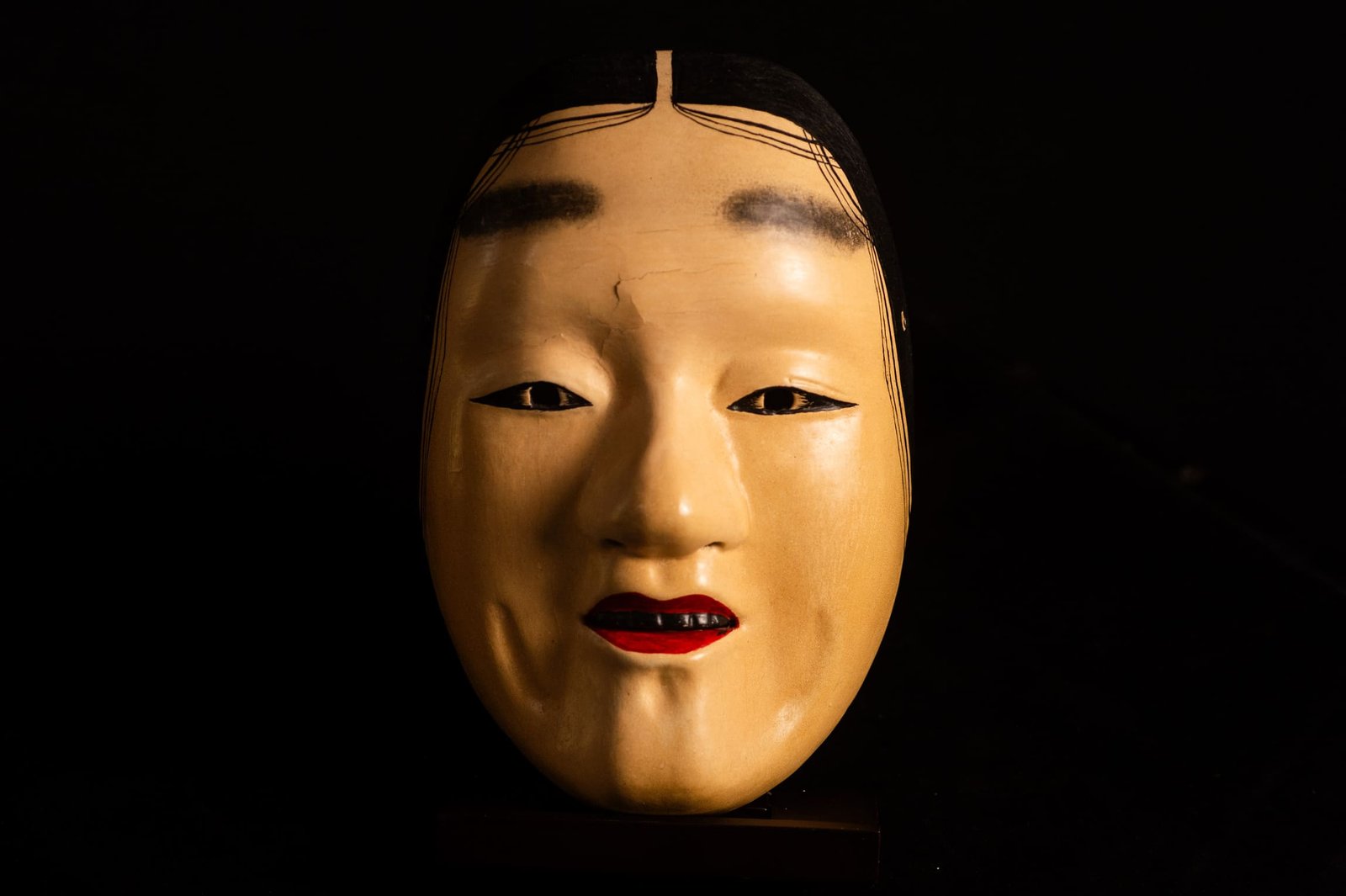
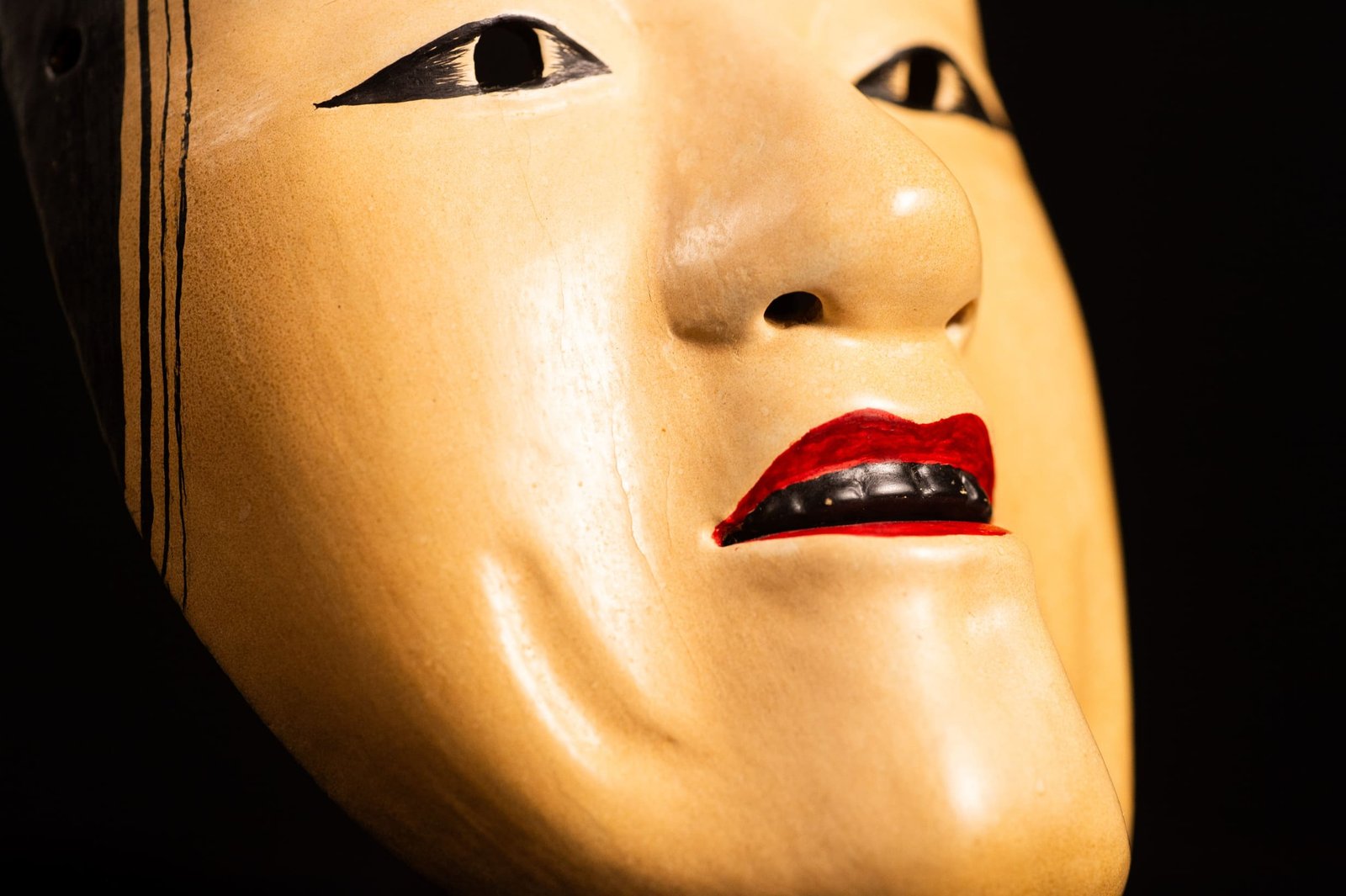
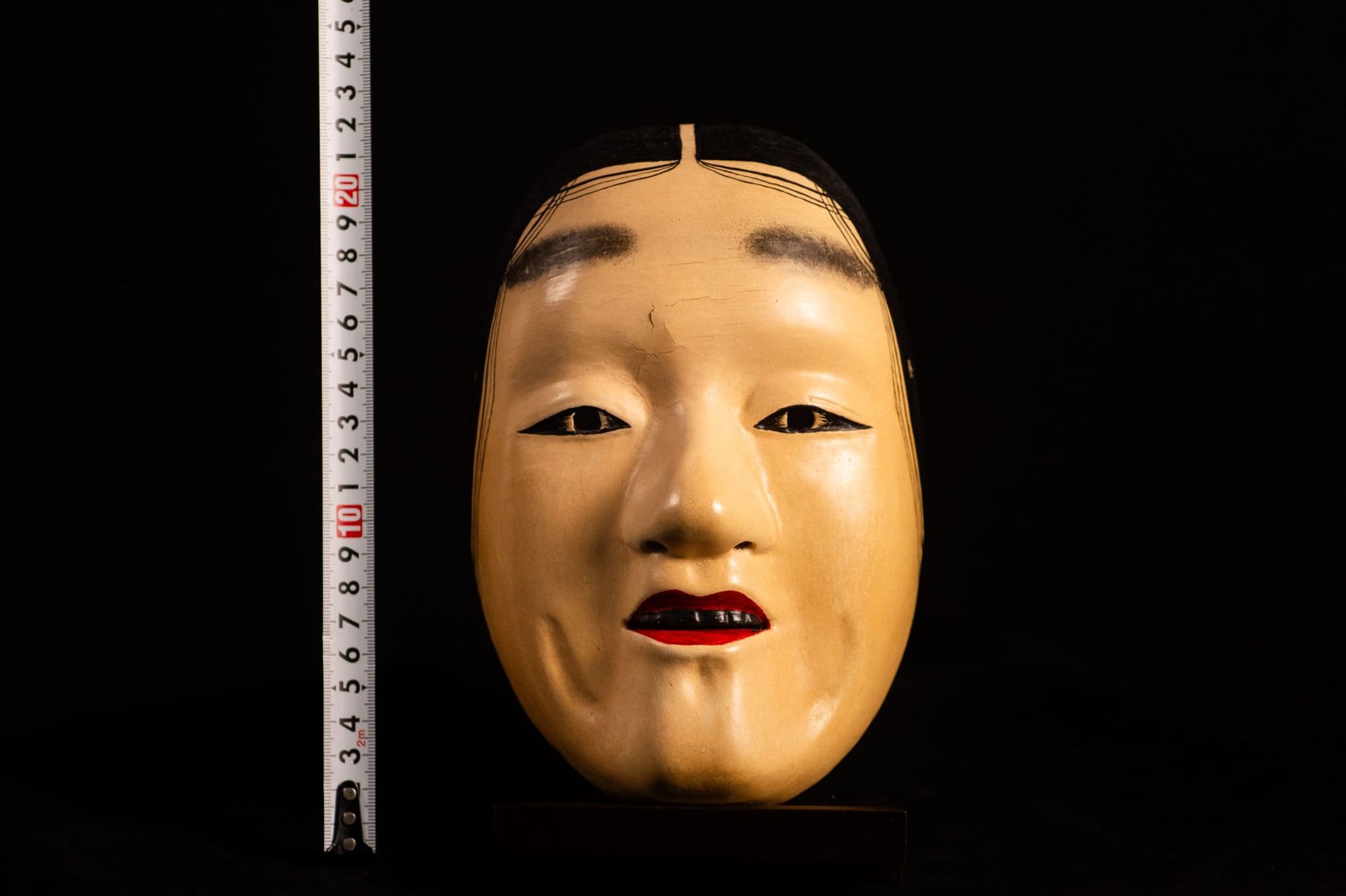
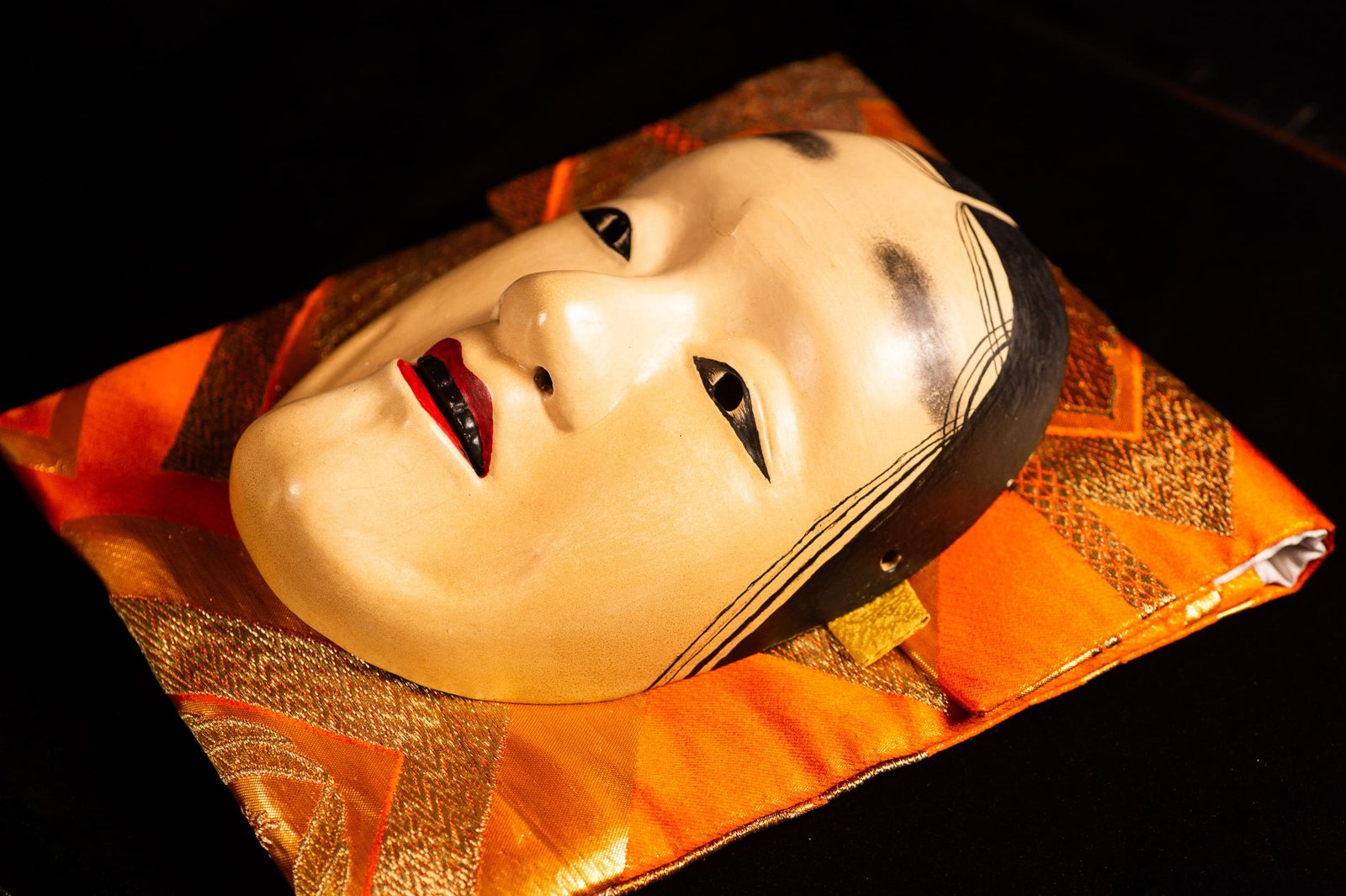
An elegant antique Japanese wooden mask representing Ko-omote, one of the most recognisable young-woman character types associated with the Noh theatre. The name combines ko, evoking tenderness, youth and beauty, with omote, meaning face. Carved at approximately life size, the mask presents an idealised young woman whose expression is calm, refined and serene.
The face is finished with a finely painted pale ground that creates a smooth, luminous appearance beneath theatrical lighting.
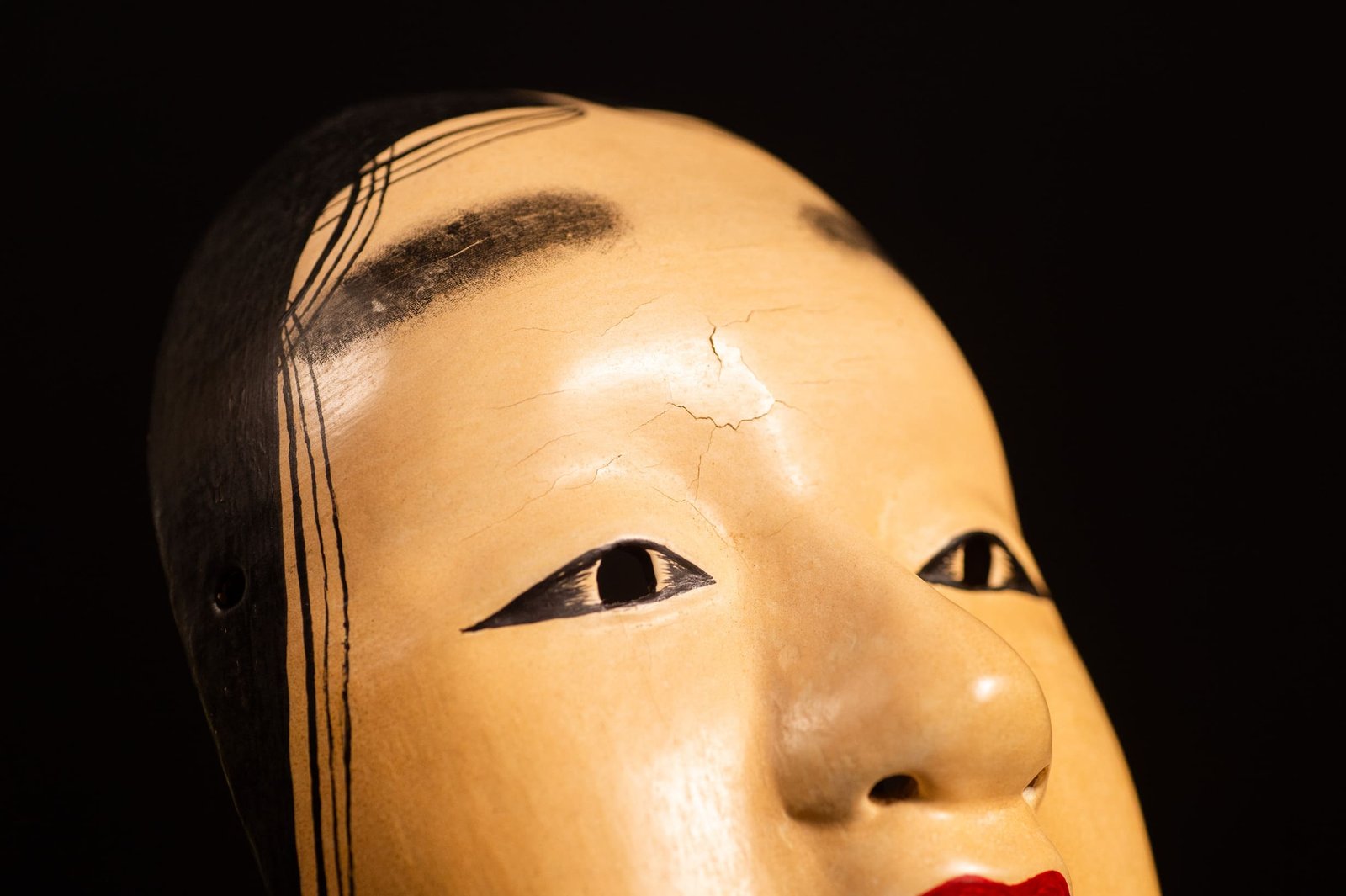
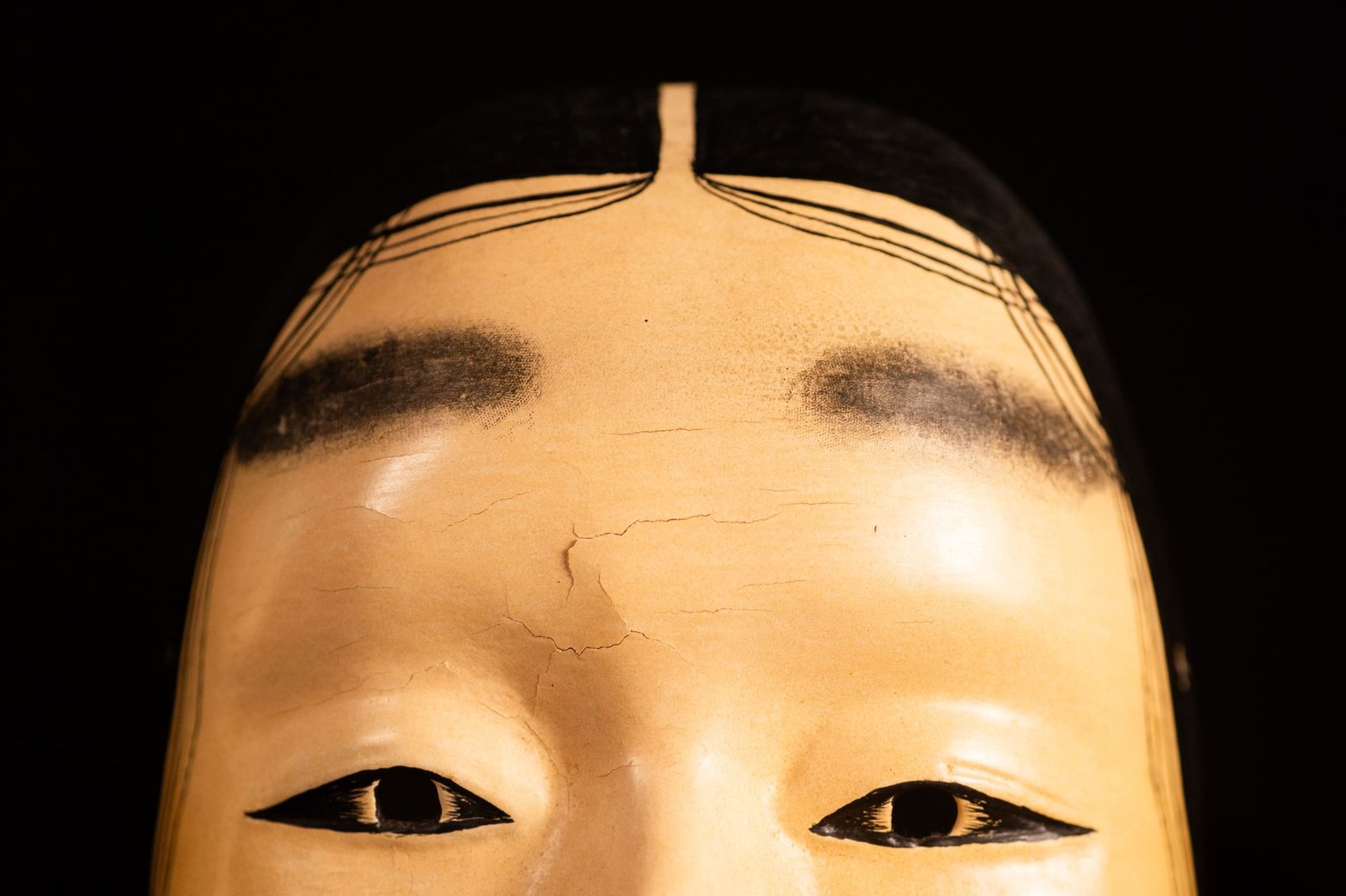
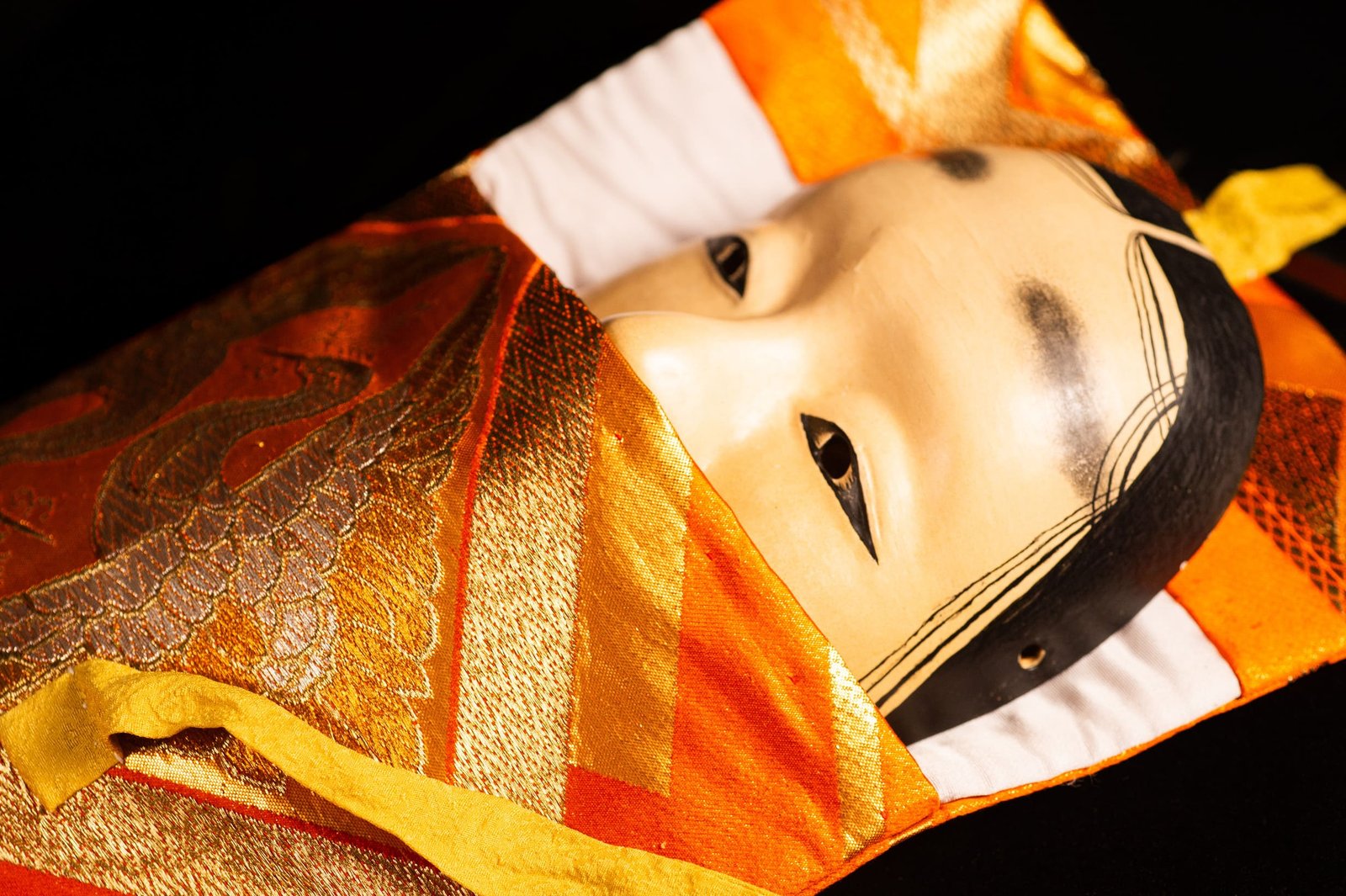
Soft, high-set eyebrows hover above narrow painted eyes, while fine black lines define the centre-parted hair and frame the face with restrained graphic precision.
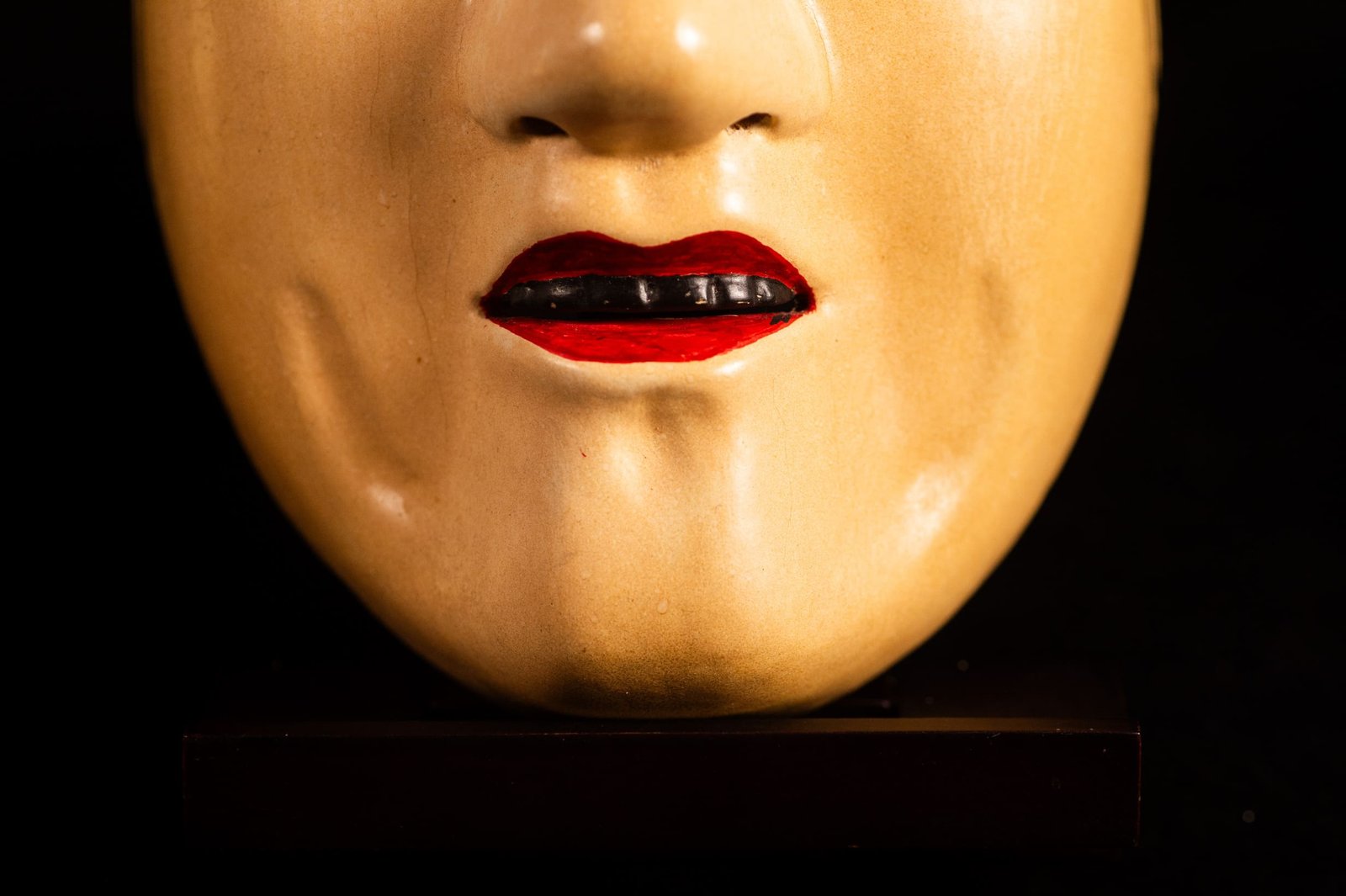
The gently smiling mouth is accentuated with vivid red-painted lips, creating a subtle contrast with the pale complexion and dark hair.
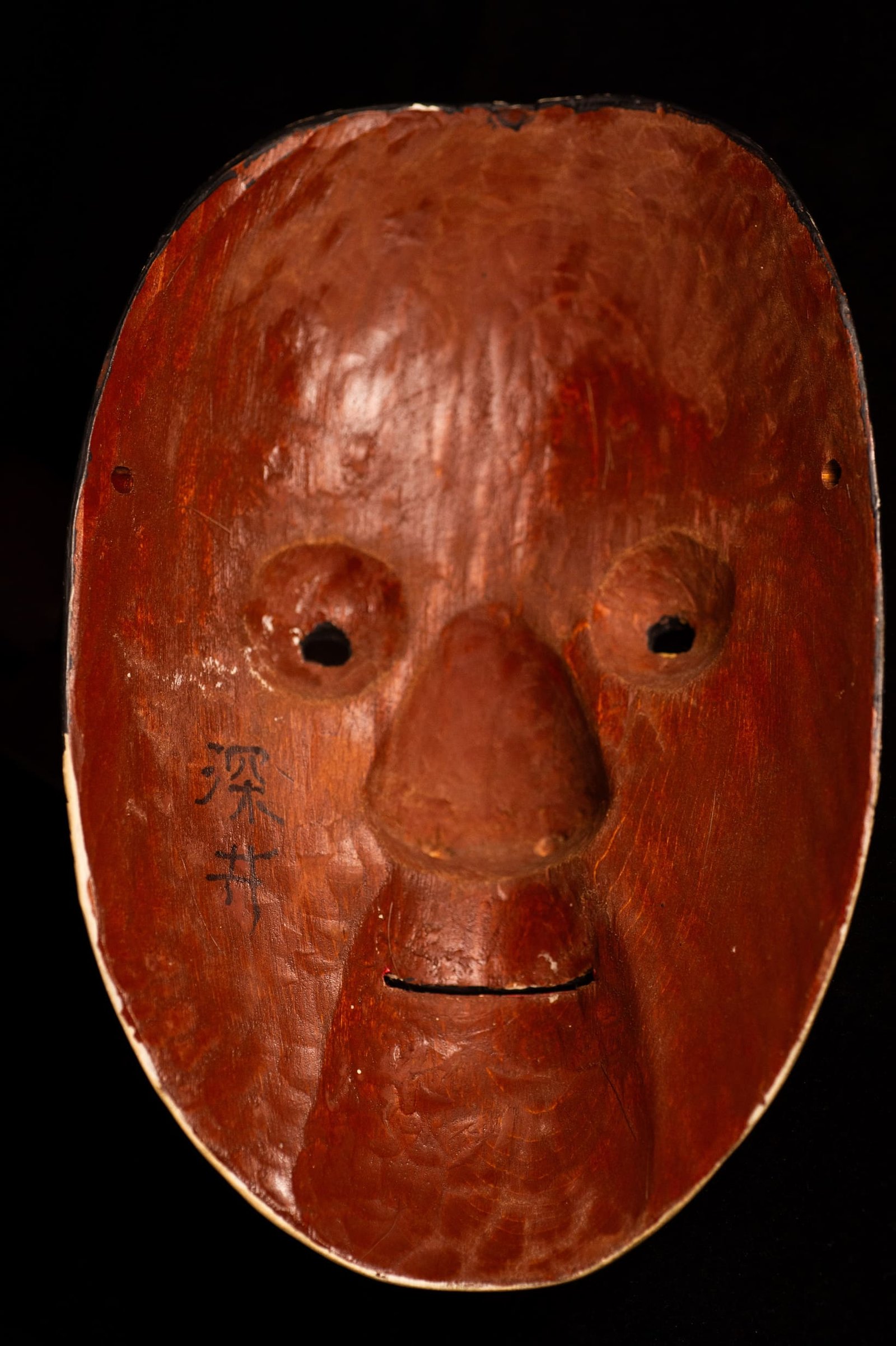
An ink inscription reading 深井, transliterated as Fukai, is reported on the reverse of the mask.
The supplied information does not establish whether the inscription identifies the maker, a former owner, a workshop, a character reference or another historical association. It should therefore be presented as an inscription rather than treated as a confirmed attribution without further documentation.
Ko-omote represents the idealised face of a young woman within the visual language of Noh theatre.
The character is associated with tenderness, youth, beauty, innocence and emotional restraint.
Unlike masks intended to communicate fierce supernatural power, extreme age or overt anguish, Ko-omote depends upon delicacy.
Its expression is composed through minimal changes in the eyes, mouth, cheeks and angle of the head.
The present mask displays the principal visual qualities associated with this character type: a smooth youthful face, softly placed eyebrows, narrow eyes, delicately formed features and a restrained smile.
The result is not a portrait of a specific individual, but a theatrical embodiment of serene young femininity.
The expression is intentionally subtle.
The mouth appears to form a faint smile, yet the eyes remain composed and contemplative.
This balance allows the mask to communicate several emotional states without changing its carved features.
Viewed frontally, the face appears calm, dignified and self-contained.
When the mask is inclined slightly upward, the illuminated cheeks and red lips may make the expression appear more open, youthful or hopeful.
When inclined downward, shadows around the eyes and beneath the nose may produce a more introspective, reserved or melancholic presence.
This capacity for emotional variation is fundamental to Noh performance.
The mask does not display a single fixed emotion in the manner of a conventional portrait. Instead, its expression is activated through movement, lighting and the disciplined posture of the performer.
The face is covered with a finely painted pale ground.
This light surface establishes the youthful character of the mask and provides a restrained background for the black hair, eyebrows, eyes and red lips.
The pale colouring is not entirely uniform.
The supplied photographs show tonal variation, surface patina and age-related irregularities that contribute to the antique appearance of the piece.
Under directional light, the forehead, nose, cheeks and chin reflect illumination differently, allowing the fixed wooden face to appear subtly animated.
The smooth facial planes contrast with the dark painted hair surrounding the upper and side edges of the mask.
This opposition between pale skin and black hair creates a strong but controlled visual structure that remains legible from a distance.
The eyebrows are painted high on the forehead as soft, diffused dark forms.
Their elevated placement is a distinctive feature of the mask’s idealised appearance.
Rather than following the natural anatomical position of the brow ridge, they contribute to a stylised image of refinement and aristocratic beauty.
The soft-edged application prevents the brows from appearing severe.
Instead, they introduce delicacy and balance across the broad upper forehead.
Their muted tone also creates continuity with the black-painted hair while remaining visually lighter and less sharply defined.
Together with the narrow eyes, the high-set eyebrows reinforce the mask’s quiet and contemplative character.
The eyes are carved as narrow openings and outlined with dark paint.
Their elongated shape gives the face a restrained, introspective gaze.
Fine painted details around the openings strengthen the impression of eyelids and lashes without overwhelming the youthful simplicity of the expression.
The eyes do not appear fully open or directly confrontational.
Instead, they suggest composure, modesty and emotional control.
Because the eye openings are narrow, small changes in the angle of the mask significantly affect the direction and intensity of the gaze.
Under brighter frontal illumination, the face may appear attentive and serene.
Under lower or more directional light, the eyes may seem more distant or inward-looking.
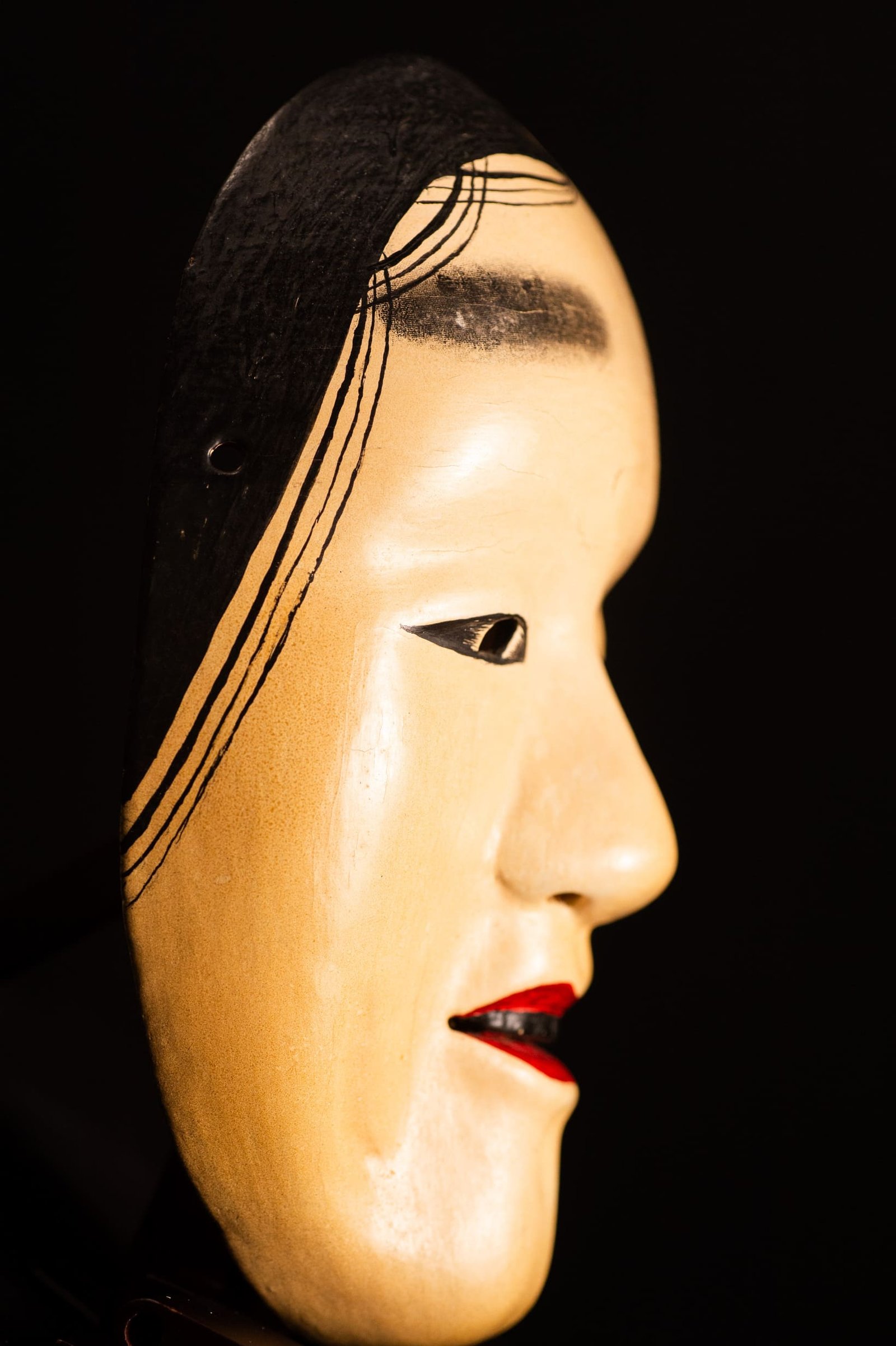
Black-painted hair frames the face and is parted at the centre.
A narrow pale division runs down from the top of the forehead, while fine parallel black lines describe individual sections of hair along both sides.
These linear details are especially visible near the temples, where the painted strands curve and descend toward the edges of the mask.
The treatment of the hair is stylised rather than naturalistic.
Broad black areas establish the overall hairstyle, while the finer lines provide rhythm and refinement.
The symmetry of the centre part reinforces the calm, balanced composition of the face.
The dark hair also functions as a visual border, concentrating attention on the luminous facial surface.
The mouth is carved with a restrained opening and a slight upward softness that creates the impression of a gentle smile.
The lips are painted a vivid red, providing the strongest colour accent on the face.
This red contrasts with the pale ground, black hair and dark eye details.
The supplied photographs also show dark-painted dental detailing within the mouth.
These darker elements create depth and make the red lips more visually prominent.
The smile remains deliberately ambiguous.
It is neither openly joyful nor overtly dramatic.
Instead, it contributes to the mask’s composed and youthful beauty.
Depending on the angle of the head, the mouth may appear more animated, reserved or quietly melancholic.
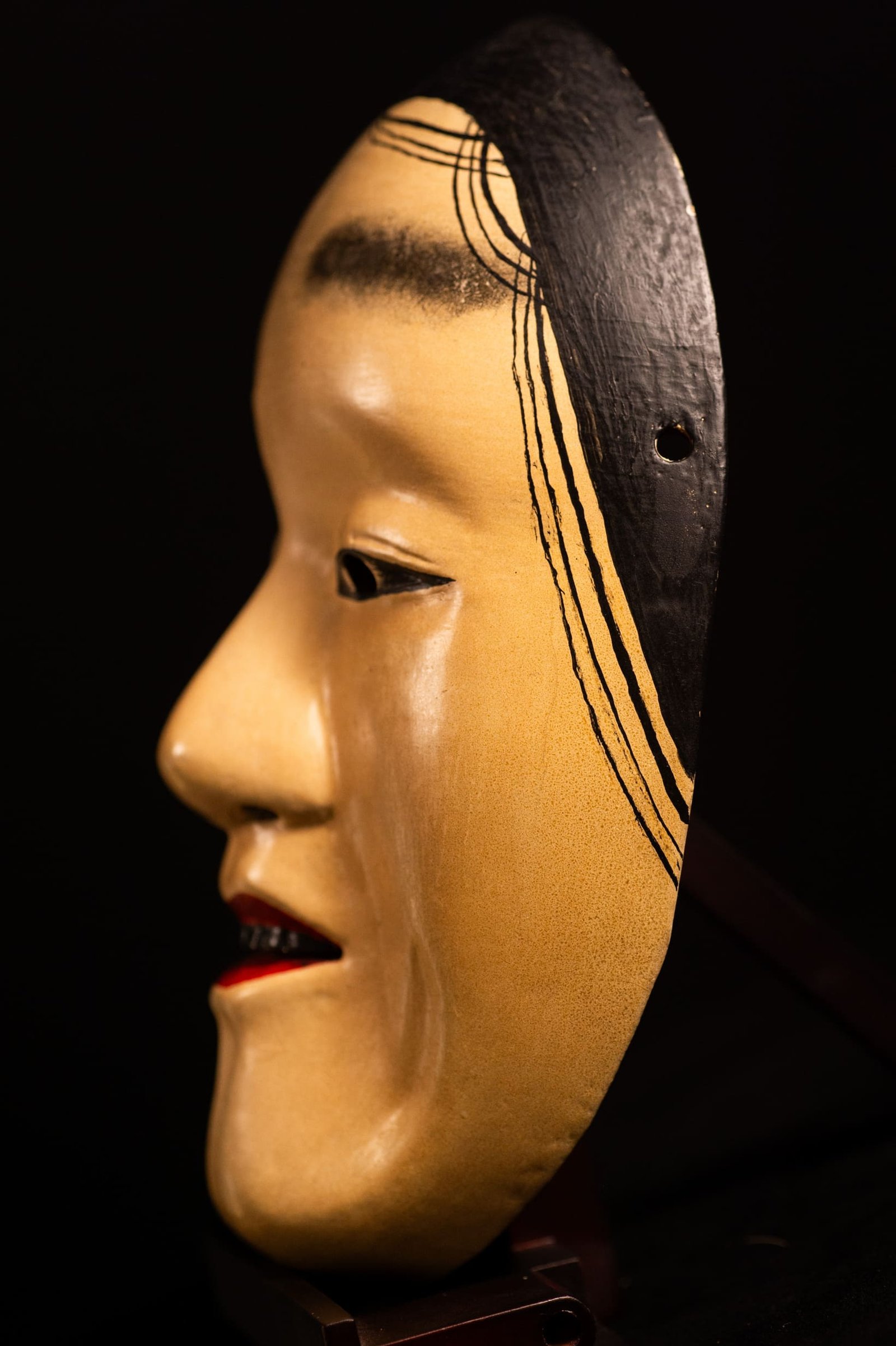
The mask is carved with smooth, softly rounded facial planes.
The forehead is broad, the cheeks are full but restrained and the chin is gently formed without the pronounced lines associated with older character types.
The nose projects clearly in profile while remaining harmonious with the overall delicacy of the face.
From the front, the features appear symmetrical and balanced.
From the side, the depth of the forehead, nose, lips and chin becomes more apparent, revealing the mask as a carefully conceived sculptural object rather than a flat image.
The facial modelling avoids exaggerated emotion and instead creates a neutral foundation upon which performance can project changing psychological states.
The mask is carved from wood as a functional three-dimensional theatrical form.
Its face is designed to be viewed not only frontally but also in profile and from changing angles during performance.
Openings at the eyes allow the wearer to see, while holes at the sides are associated with the attachment and securing of a Noh mask.
The outer edges are painted dark, visually separating the pale face from the performer’s costume and surrounding stage environment.
The photographs reveal the depth of the carved structure, particularly around the nose, cheeks, mouth and lateral edges.
The form is carefully balanced so that the youthful expression remains coherent across different viewing positions.
The reverse is described as bearing the ink inscription 深井, read as Fukai.
This is an important recorded feature of the object.
However, the meaning of the inscription has not been independently documented in the supplied information.
It may potentially refer to a name, workshop association, ownership mark, historical identification or another context, but none of these interpretations can be confirmed from the available material.
For accuracy, the mask should therefore be described as bearing an ink inscription reading 深井 (Fukai), without presenting the inscription as a verified signature of a particular carver.
No documented biography, workshop history or secure attribution has been supplied.
Noh masks are central to one of Japan’s most refined theatrical traditions.
The mask does not simply conceal the performer’s individual face.
It enables the actor to embody another identity through the interaction of carving, costume, movement, chant, music and controlled lighting.
Because the carved expression remains fixed, emotional transformation is created through subtle physical technique.
A slight change in head angle can alter the shadows beneath the brows, around the eyes and beside the mouth.
This creates the impression that the face is changing even though the wooden form remains still.
The restrained design of Ko-omote is particularly suited to this practice.
Its neutral serenity allows the performer to evoke innocence, happiness, tenderness, uncertainty, longing or sorrow without changing the mask itself.
Female characters in traditional Noh theatre have historically been performed through a combination of mask, costume, voice and highly codified movement.
The mask establishes the age, social character and emotional register of the represented woman.
Ko-omote belongs to the category of youthful female masks.
Its smooth features and serene expression distinguish it from masks representing mature women, older women, jealous spirits or supernatural female beings.
The identity of the character would not have depended on the mask alone.
Costume, narrative, posture and musical context would have determined the precise role being performed.
No particular Noh play or documented performance has been supplied for this object.
It should therefore be described as a Ko-omote character type rather than assigned to a specific named role.
Masks have played an important role in Japanese religious rituals, festivals and theatrical traditions.
Within certain contexts, the act of wearing a mask could symbolise transformation, embodiment or temporary possession by the represented identity.
The performer’s individual appearance receded, allowing another human, spiritual or supernatural presence to become visible.
Japanese religious traditions include spiritual presences commonly referred to as kami.
However, not every theatrical mask represents a named kami or deity.
Ko-omote is primarily a youthful female theatrical character type.
The supplied information does not identify this particular mask as a named spirit, goddess or historical individual.
It should therefore be understood within the broader transformative and ritual history of Japanese masking without assigning it an unsupported divine identity.
The supplied photographs show visible age-related surface characteristics.
Fine craquelure and small areas of cracking are apparent across the forehead, including a more concentrated irregular area near the centre.
There are also tonal variations, light rubbing and minor surface marks across the pale painted ground.
These features are consistent with the antique description of the mask and contribute to its historical visual character.
The black-painted hair and linear hair details remain clearly legible, although natural variation and wear are visible in several areas.
The red lips and dark mouth details retain strong colour contrast.
No comprehensive professional condition or restoration report has been supplied.
The photographs should therefore be reviewed carefully when assessing the precise state of the painted surface, wooden structure and any historical interventions.
The mask is carved at a 1:1 or life-size scale, corresponding to the proportions of a functional theatrical mask.
Its restrained symmetry makes it especially effective when displayed frontally.
A three-quarter or profile presentation reveals the depth of the carving and the projection of the nose, mouth and chin.
Soft directional illumination is recommended for display, as it allows the expression to change subtly without producing excessive glare across the pale painted ground.
The mask should be supported without pressure on the nose, lips, chin, edges or side attachment holes.
Direct sunlight, excessive humidity, very dry conditions and sudden environmental changes should be avoided.
The painted surface should not be cleaned with water, solvents, abrasives or household products.
Any conservation work should be undertaken by a qualified specialist familiar with painted wooden objects.
The mask is described as antique.
Visible age-related surface characteristics include patina, tonal variation, fine craquelure, cracking on the forehead, light rubbing and minor irregularities to the painted finish.
These observations are based solely on the supplied photographs.
No detailed conservation report, restoration history or structural assessment has been provided.
An exact date, named carver, confirmed workshop attribution, documented performance history and provenance have not been supplied.
The reverse bears an ink inscription reading 深井 (Fukai), but the historical significance of this inscription has not been independently established.
Prospective buyers should examine all available photographs carefully when evaluating the mask’s condition.
This antique Ko-omote mask offers an elegant example of the restrained emotional language associated with young-woman masks in the Noh theatre.
Its appeal lies in the precision of its subtle expression rather than in dramatic exaggeration.
The softly elevated eyebrows, narrow contemplative eyes, centre-parted black hair and delicately smiling red mouth create a balanced image of youthful serenity.
The mask also retains visible age-related surface character, including patina and craquelure across the pale painted ground.
These features reinforce its presence as an antique theatrical object rather than a modern decorative reproduction.
The ink inscription 深井 (Fukai) on the reverse adds an additional point of historical and collecting interest, although its precise significance remains undocumented.
For collectors of Noh theatre, Japanese masks, carved wooden sculpture or traditional performing arts, the piece combines recognisable iconography, refined craftsmanship and an exceptionally calm visual presence.
An elegant antique Japanese Noh mask representing Ko-omote, the serene and idealised face of a beautiful young woman. Carved from wood at life size, the mask is finished with a luminous pale ground, softly elevated dark eyebrows, narrow contemplative eyes, centre-parted black hair and a gently smiling mouth with vivid red-painted lips. The reverse bears an ink inscription reading 深井, or Fukai. Visible patina, craquelure and age-related surface variation reinforce the antique character of the object. With its balanced composition and emotionally restrained expression, the mask is a refined example of Japanese theatrical sculpture and an evocative work for a collection of Noh masks, Japanese art or traditional performance material.
| Época | Edo |
|---|

Order above 1.000,00 € gets free shipping.

Secure and hassle-free payment process.

Certificate of authenticity included.

Have questions? Contact us via WhatsApp.
Contact