October 8, 2026
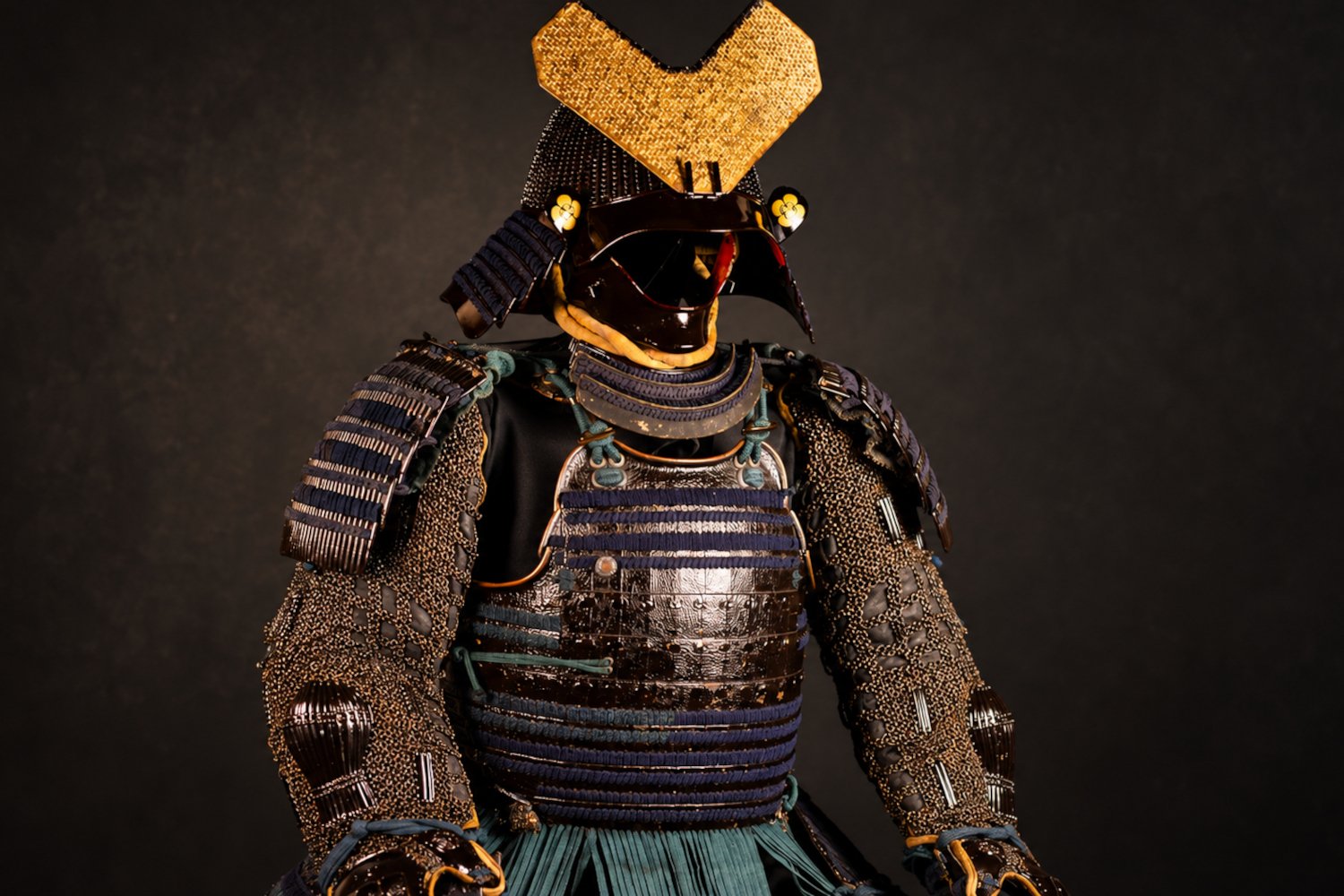
Japanese samurai armour is often pictured as a system of lacquered plates linked by colourful lacing. But some surviving pieces also incorporate kusari, a form of Japanese chain mail. Museum collections show it in armoured sleeves, mail-and-plate suits and chain-mail garments. These objects reveal how flexible linked metal formed part of a wider armour system.
Kusari means “chain.” In armour, the term refers to linked metal rings used either as a component within a larger piece or as the main protective material of a garment. The exact construction and role depend on the object: the word alone does not tell us how much mail it contains, how it is attached, or what other materials were used.
This distinction matters when describing an antique. A sleeve that combines mail, iron and silk is not the same construction as a garment made predominantly from mail. Museum records document both kinds of object, so it is more accurate to describe the specific piece than to assume there was one standard form of Japanese chain armour.
Mail offered flexibility in areas where a rigid plate could restrict movement. It could be combined with plates or attached to a textile foundation, bringing different materials together in one protective component. The surviving objects in museum collections show that these combinations varied.
The Metropolitan Museum of Art, for example, catalogues an early 18th-century pair of kotē—armoured sleeves—made from iron, chain mail and silk. Another Japanese armour in the Met’s collection, dated to the 18th century, combines mail and plates and is recorded as made from steel, textile and lacquer. The records provide specific examples; they do not establish that every suit used the same arrangement. The Metropolitan Museum of Art
The kotē protected the arms and could include more than one type of defence. In the Met’s early 18th-century example, the catalogued materials—iron, chain mail and silk—make the combination explicit. The pair is recorded as two separate sleeves, each measuring around 84 centimetres in height.
For anyone studying a surviving sleeve, this is a useful reminder to look at the whole construction. The mail is one part of the object; its relationship to the fabric and any plates also matters. A photograph or short label may not show every layer, so conclusions about the original structure should follow the evidence available for that specific piece.
Kusari did not appear only in sleeves. The Met also records an 18th-century Japanese “Armour of Mail and Plate,” made from steel, textile and lacquer. Separately, the Edo-Tokyo Museum’s collection includes a chain-mail object measuring 81.7 by 120.6 centimetres. These records demonstrate that Japanese collections preserve different forms and scales of mail armour.
The Minneapolis Institute of Art describes a Japanese chain-mail coat with linked mail attached to layers of indigo-dyed cloth and decorated with family crests in gold. Its collection note also points out that not every person in the Edo period wore a complete suit of armour; it mentions rōnin and urban samurai police officials among those who used chain mail for protection. That is useful context for this documented coat, not proof that every chain-mail garment had the same wearer or purpose.
When looking at kusari, start with what can be observed: where the mail sits, whether it is combined with plates, and how it relates to any textile backing. Then consider condition. Look for missing or distorted links, breaks, later repairs, corrosion and areas where the textile or stitching has weakened.
These observations can help describe the current object, but they do not by themselves establish its age, originality or history. A collector should compare the whole piece with its documentation and avoid drawing broad conclusions from a single feature. The Met’s records, for instance, identify materials and dates for particular objects; each piece still needs to be understood on its own terms.
Kusari is best understood as one material within a varied armour tradition. A suit could bring together rigid elements, flexible sections, textiles, lacquer and lacing. Its construction depended on the particular object, so chain mail should not be treated as a universal feature of samurai armour.
For more context, see our guide to samurai armour and the article on sode, the shoulder guards. You can also explore the Japanese armour collection.
Kusari means “chain” and is used for linked metal armour. The term does not, by itself, specify the object’s complete construction.
No. Museum collections document it in sleeves, mail-and-plate armour and a chain-mail coat. Those records illustrate different uses, rather than a single standard design. The Metropolitan Museum of Art
No. The museum examples show that kusari was used in particular objects and combinations. Its presence should be confirmed by examining and documenting the individual piece.

CEO of SupeinNihonto, dealer and collector of ancient Japanese art and weapons from Canillo, Andorra.
Contact