November 20, 2026

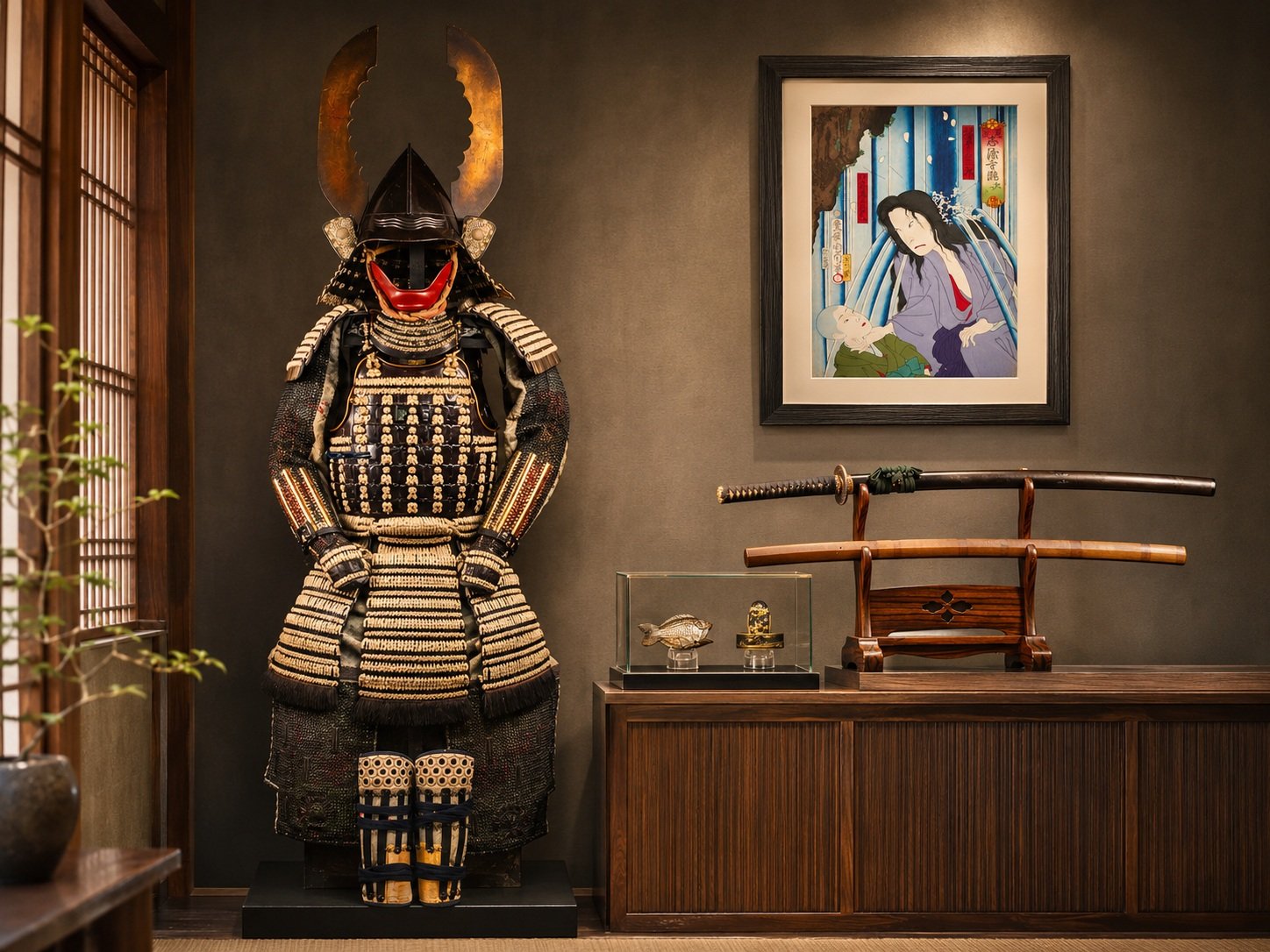
Sometimes I wish everyone who visits Supein Nihonto could see our pieces in person.
Not because photographs aren’t useful. We spend a lot of time taking them, and we try to show every detail as clearly as possible.
But there’s something about standing in front of a real Japanese samurai armor, holding an old tsuba, or examining a Noh mask that photographs can’t quite capture.
You suddenly realize you’re looking at something that existed long before you were born.
Something that someone made, used, cared for, perhaps repaired, and eventually passed on.
And now, somehow, it’s still here.
I think that’s what makes collecting Japanese antiques so special. We’re not simply collecting beautiful objects. We’re taking care of little pieces of history.
Today, you can find almost anything online.
Search for a samurai helmet, a katana, a Japanese mask, or even a complete set of armor, and you’ll see hundreds of results.
Some look quite impressive in photographs. Others are obviously decorative. You can find them on Amazon, AliExpress, Temu, or in specialized stores selling modern reproductions.
And there’s nothing necessarily wrong with that.
If someone wants a decorative katana for their living room, that’s perfectly fine. Not everyone wants to become a collector of historical Japanese art.
But there’s an important difference that sometimes gets lost when everything appears next to everything else in an online search.
A reproduction is made to look like something from the past. An authentic antique actually comes from that past.
It sounds obvious, but I think it’s worth saying.
A newly manufactured samurai helmet might reproduce the shape of a historical kabuto. It might even look beautiful.
But an original helmet from the Edo period was made in a completely different world, by craftsmen working within the traditions of their time.
That doesn’t automatically make every antique a masterpiece. But it gives the object something a reproduction can never have: its own history.
One of the things I find most fascinating about Japanese armor is how much you can discover simply by looking more closely.
From a distance, a complete gusoku is imposing.
You notice the helmet, the face mask, the colors, perhaps a spectacular crest.
Then you get closer.
You begin to see how the lacquer has aged. How the silk cords pass through the plates. How the iron sections fit together. How different materials have survived centuries of wear, storage, and careful maintenance.
And you start wondering about the people who made it.
Take, for example, this certified Early Edo samurai armor from our collection.
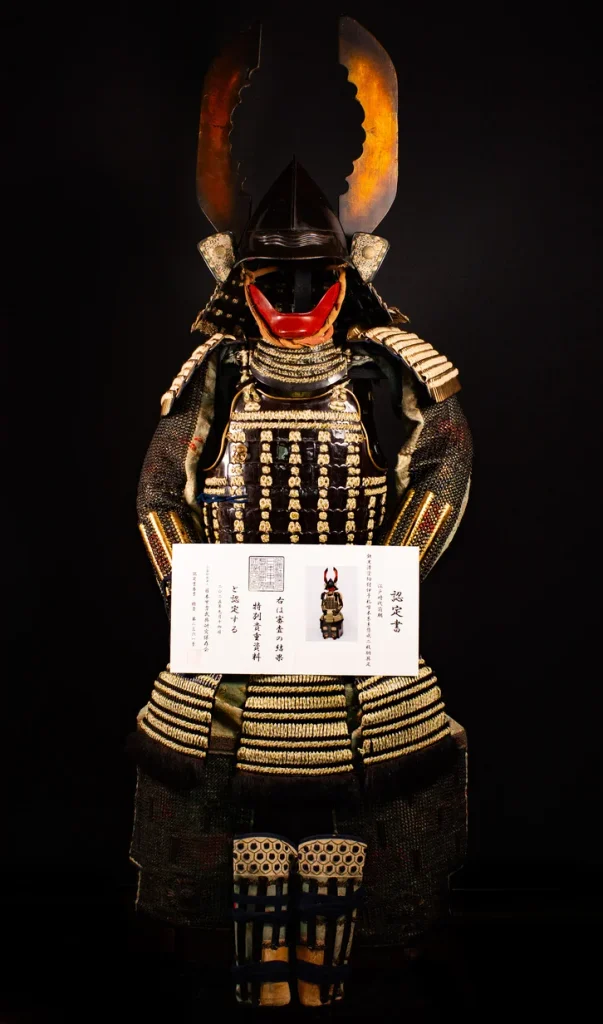
It dates to the 17th century and features a striking kabuto with large gilded ōkuwagata crests, a vermilion menpō, and a two-piece nimai-dō cuirass.
It’s difficult not to be impressed by its appearance.
But what I find particularly interesting is its construction. The cuirass uses iron plates shaped to imitate individual scales, bringing together an older visual tradition and a later approach to armor making.
This is the kind of detail that makes you realize how much knowledge went into these objects.
And there’s something else about this particular armor: it comes with Tokubetsu Kichō Shiryō certification from the Nihon Katchū Bugu Kenkyū Hozon Kai, a Japanese organization dedicated to studying and preserving historical armor.
That’s not just a nice addition to the description.
It means the piece has been examined and documented within a specialist Japanese framework.
When we talk about objects worthy of museum study, this is the kind of thing we mean.
Not simply something large or impressive, but an object that preserves craftsmanship, historical information, and evidence of a remarkable artistic tradition.
I sometimes think Japanese swords suffer from being too famous.
Almost everyone recognizes a katana.
Unfortunately, that also means many people associate them with movies, anime, video games, and mass-produced decorative swords.
A genuine nihontō is something very different.
It’s a historical blade, but it’s also a work of craftsmanship that can take years to learn to appreciate properly.
The more you study Japanese swords, the more you begin noticing things you probably wouldn’t have seen at first.
The subtle patterns in the steel.
The shape of the temper line.
The proportions of the blade.
The work of a particular smith.
And sometimes, the centuries of study that have followed it.
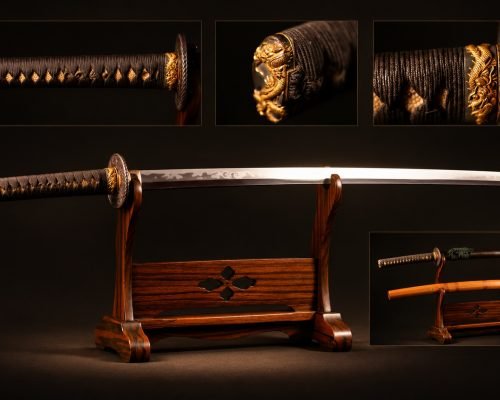
A wonderful example is our Hizen Masahiro katana, attributed to the second generation.
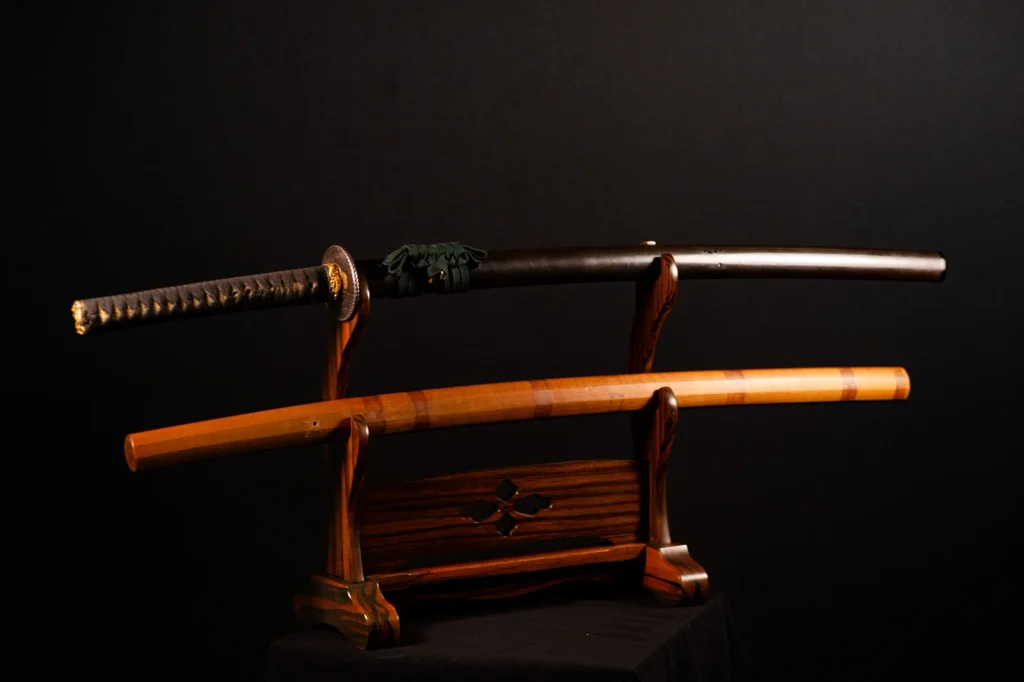
This sword comes with NBTHK Tokubetsu Hozon certification, a recognition that goes well beyond someone simply saying, “It’s a beautiful old katana.”
What makes this particular sword interesting isn’t only its appearance. It’s that we can study it within a documented swordmaking tradition, connect it with an identified smith, and appreciate details that specialists have spent generations learning to recognize.
I find that extraordinary.
A blade originally created within Japan’s historical swordmaking culture can still be examined and understood today.
And I think that is a much more interesting story than simply owning something sharp and shiny.
Not everything has to be a full suit of armor or a famous sword to be fascinating.
Sometimes a tiny object makes you stop and look twice.
I particularly enjoy Japanese sword fittings for this reason.
Take this Edo-period shakudō fuchi-kashira.
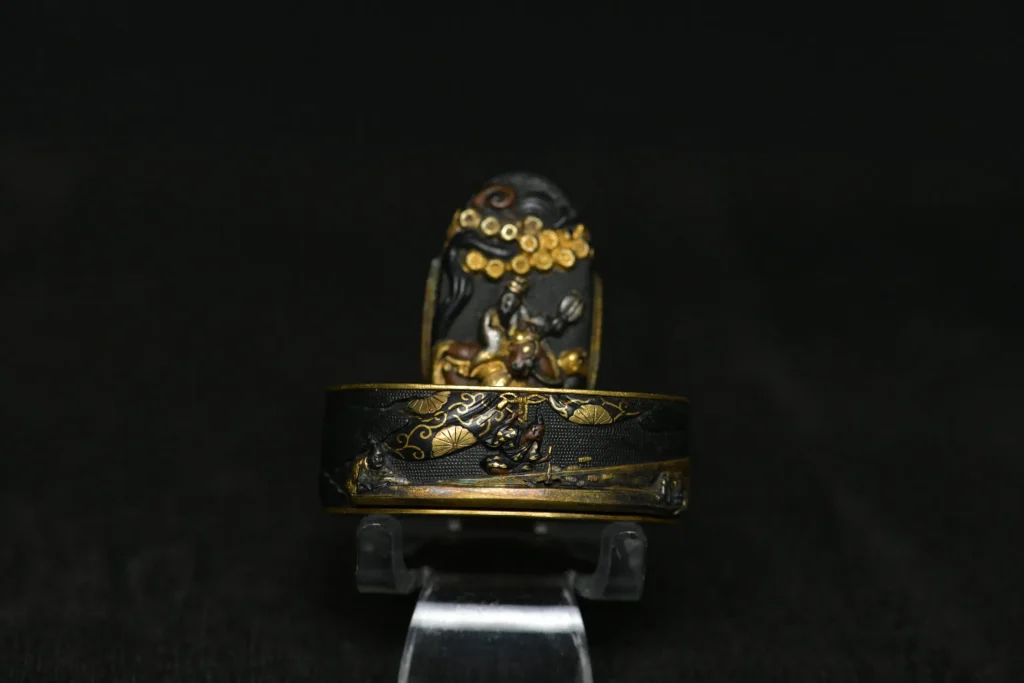
At first glance, it’s a pair of small metal fittings that would have formed part of a Japanese sword handle.
Nothing particularly monumental.
But look at the decoration.
On the fuchi, we find carpenters working around a large wooden beam.
On the kashira, a Chinese mounted warrior.
Two little scenes, worked in relief with gold details against dark shakudō.
And suddenly these tiny objects are telling us something about the imagination of the craftsman who made them.
Why those subjects?
What did they mean to the person who commissioned the fittings?
How much work went into creating scenes like these on such small surfaces?
We may not be able to answer every question.
But that’s part of the pleasure.
A museum might display sword fittings like these in a cabinet, with a label explaining their materials, period, and decoration.
A private collector can enjoy studying the same kinds of details at home.
The object doesn’t become less interesting because it isn’t behind museum glass.
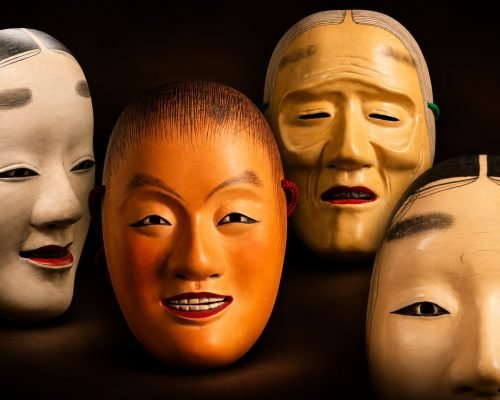
Japanese Noh masks are another good example.
I understand why people are initially attracted to them as decorative objects.
Some are beautiful. Some are unsettling. Others have expressions that seem almost impossible to describe.
But once you begin learning about Noh theater, you discover that those expressions are anything but accidental.
The shape of the eyes, the mouth, the eyebrows, the hairline, even the angle at which a mask is viewed can help communicate a particular character or emotion.
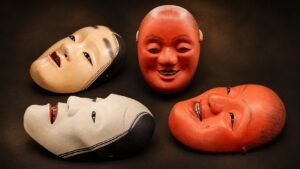
We recently examined an antique Ko-omote Noh mask with an inscription reading Fukai.
It’s a lovely example of the restrained expression associated with the young female Ko-omote type.
But something particularly interesting appears on the reverse.
An ink inscription reading 深井 — Fukai.
Now, Fukai is also the name of another female Noh mask type.
Does that mean this Ko-omote is actually a Fukai?
Not necessarily.
And that’s precisely why I enjoy objects like this.
The inscription gives us something to investigate, but it doesn’t give us permission to invent an explanation.
We have to look at the carving, the proportions, the character type, and the available documentation.
Sometimes studying an antique is as much about knowing what we don’t know as recognizing what we do.
And personally, I find that far more rewarding than buying a decorative mask whose entire story begins at a modern factory.
We also have several original ukiyo-e prints by Toyohara Kunichika.
I love Kunichika’s work because of the colors, the theatrical expressions, and the way he could give a kabuki actor such an extraordinary presence on paper.
Look at this original ukiyo-e depicting Bandō Hikosaburō as Otsuji.
It’s a beautiful image in its own right.
But it’s also connected to the world of Japanese kabuki theater, the popularity of particular actors, the visual culture of the period, and the incredible technical skill involved in traditional woodblock printing.
These prints were not simply created to hang in modern living rooms.
They belonged to the culture of their time.
And when we look at them today, we see not only the artist’s work but a little window into the society that produced it.
I find the idea of owning something like that rather wonderful.
One thing I don’t particularly like about collecting is the idea that an object needs to be large, famous, or extraordinarily expensive to be worth appreciating.
That simply isn’t true.
Sometimes the most charming piece in a collection is a netsuke that fits in the palm of your hand.
A good example is this 19th-century wooden netsuke depicting a fish.
It’s a small carving, with carefully worked details and a signature on an inset copper plate.
Originally, netsuke had a practical purpose: they helped secure objects suspended from the sash of traditional Japanese clothing.
But over time, these functional little objects became miniature sculptures.
I love that transformation.
Something intended for everyday use became an opportunity for a craftsman to demonstrate humor, imagination, observation, and technical ability.
When you look at a good netsuke, it almost invites you to pick it up, turn it around, and discover the details hidden on the other side.
To me, that is every bit as interesting as a much larger artwork.
This is something I think deserves a clear explanation.
Some of the pieces we handle come with important Japanese specialist certificates.
For swords, that may include documentation issued by the NBTHK.
For armor, it may include certificates from organizations dedicated to the study and preservation of Japanese armor.
Those documents matter.
They allow us to understand what a specialist organization has examined, how a piece has been classified, and what conclusions were reached.
But not every authentic Japanese antique comes with an independent specialist certificate.
A Noh mask, tsuba, netsuke, or ukiyo-e may need to be evaluated through completely different kinds of evidence.
Signatures, materials, craftsmanship, inscriptions, historical comparisons, provenance, and condition all have their place.
A certificate should also never be confused with a guarantee that an object is perfect, untouched, or beyond further study.
And we should be careful not to confuse a seller’s certificate of authenticity with an independent Japanese specialist appraisal. They are different things.
We believe the best approach is to explain clearly what is known about an object, what documentation accompanies it, and where questions remain.
That’s how a collector can make an informed decision.
This is probably the part I think about most.
Imagine an Edo-period craftsman finishing a suit of armor.
Or someone carving a small netsuke.
Or a swordsmith examining the blade he has just forged.
None of them could possibly have imagined that, centuries later, someone on the other side of the world would be studying their work through a computer screen.
Yet here we are.
Many of these objects have survived extraordinary changes.
They may have passed through families, workshops, collections, and different countries.
Some have been repaired.
Some have been carefully preserved.
Some have lost part of their original context.
And others still retain inscriptions, signatures, boxes, or documents that help us understand their journey.
When we find one of these pieces, I sometimes wonder how many people have held it before us.
And how many more will enjoy it in the future.
We often think of historical objects as things that belong in museums.
And of course, museums do an extraordinary job of preserving and studying them.
But private collectors have also helped preserve Japanese art for generations.
Some collections eventually become part of museums. Others remain in families or pass from one collector to another.
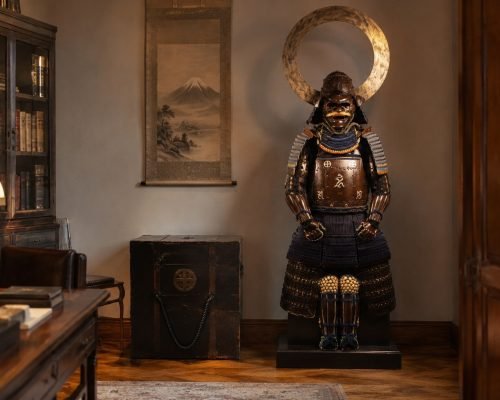
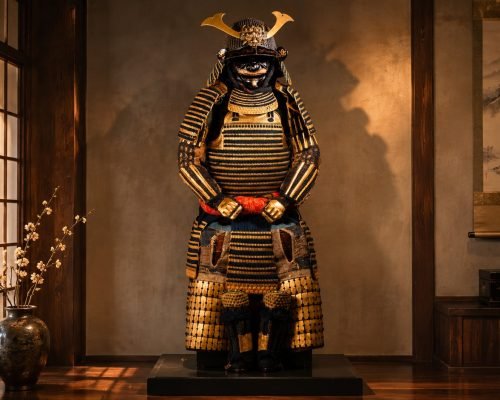
Recently, a collector who acquired several pieces from Supein Nihonto shared photographs of his home with us.
Seeing an original samurai armor surrounded by Japanese masks and hanging scrolls in a contemporary living room was genuinely satisfying.
Not because it looked expensive.
But because someone had taken the time to create a space where these objects could be appreciated every day.
It was a reminder that the story of an antique doesn’t end when it leaves our hands.
It continues somewhere else.
And that brings me back to something I said at the beginning.
We know that, on a website, everything needs a category.
A sword goes under Nihontō.
An armor goes under Gusoku.
A mask goes under Noh Masks.
And of course, each item has photographs, a description, and a price.
But I hope that when someone visits Supein Nihonto, they can see a little beyond that.
Because the historical pieces we specialize in are not mass-produced objects designed to resemble Japanese history.
They are authentic objects connected to that history.
Some are certified by specialist Japanese organizations.
Some bear signatures or inscriptions.
Some are remarkable for their workmanship.
Others are fascinating because they preserve something about daily life, theater, art, or craftsmanship in Japan.
Not every object is a museum masterpiece, and we would never want to pretend otherwise.
But many deserve the same curiosity, care, and respect that we give objects in museum collections.
And perhaps that is the simplest way to explain what we love about what we do.
We don’t just see an old sword, an armor, a mask, or a little wooden carving.
We see the people who made them, the traditions they came from, and all the years they’ve managed to survive.
And when someone decides to make one of these objects part of their own collection, we like to think they’re helping that story continue.
That’s what makes these pieces special to us.
Not simply what they are worth.
But everything they carry with them.
A few things worth knowing about original Japanese art, historical objects, certifications, and collecting.
The biggest difference is history. An authentic Japanese antique was created within the artistic and cultural traditions of its own time. A modern replica is made to reproduce the appearance of those objects.
There’s nothing wrong with reproductions, but owning a historical samurai armor, nihontō, Noh mask, or tsuba means owning an object that has actually survived from the past. Its materials, craftsmanship, and signs of age are part of that story.
Not necessarily, and we think it’s important to be clear about that. Authenticity and museum significance are two different things.
Museums preserve objects for many reasons, including historical importance, craftsmanship, rarity, provenance, and what they can teach us about the past.
Some privately owned Japanese antiques have exceptional historical or artistic interest, while others are more modest examples of traditional craftsmanship. Both can be worth studying and preserving.
No. Not every genuine Japanese antique has an independent certificate, and not all types of objects are evaluated through the same certification systems.
Some Japanese swords and armor have documentation from specialist organizations, while Noh masks, netsuke, ukiyo-e, and sword fittings may be studied through their materials, signatures, inscriptions, workmanship, provenance, and historical comparisons.
What matters is understanding what can be established about each individual piece and what evidence supports its description.
The NBTHK is a Japanese organization dedicated to the preservation and study of Japanese art swords.
Certifications such as Hozon and Tokubetsu Hozon document specialist assessments of a blade and its attribution or characteristics.
These documents can be valuable when studying a nihontō, but they don’t replace examining the sword itself, understanding its condition, or researching its history.
There isn’t one simple test that works for every Japanese antique. Specialists look at different characteristics depending on the type of object.
With a samurai armor, construction, lacquer, ironwork, and lacing are important. With a Japanese sword, the blade’s shape, steel, tempering, tang, and possible signature provide different clues. With a Noh mask or netsuke, carving techniques, materials, painting, and inscriptions may be especially revealing.
Good photographs and documentation help, but some questions require direct examination by an experienced specialist.
Not at all. An object that has survived for two or three centuries may naturally show wear, fading, repairs, or changes to its surface.
That doesn’t mean condition is unimportant. Damage, restoration, and replacement parts can affect both historical interpretation and value.
But signs of age are not automatically something negative. Sometimes they help us understand how an object was used, maintained, and preserved over time.
Because even a small functional object can preserve extraordinary craftsmanship and cultural information.
A tsuba may reveal sophisticated metalworking techniques, artistic schools, and traditional symbolism. A netsuke, originally used as a practical clothing accessory, can also be a remarkable miniature sculpture.
These objects help us understand not only Japanese art, but also the people who made and used them.
Absolutely. Museums play an essential role in preserving historical objects, but private collectors can also contribute through careful conservation, research, and documentation.
A historical Japanese object may pass through several collections during its lifetime. Each responsible owner becomes part of its continuing story.
We particularly enjoy seeing pieces that have left Supein Nihonto displayed and appreciated in private collections. It’s a lovely reminder that the history of an antique doesn’t end when it changes hands.
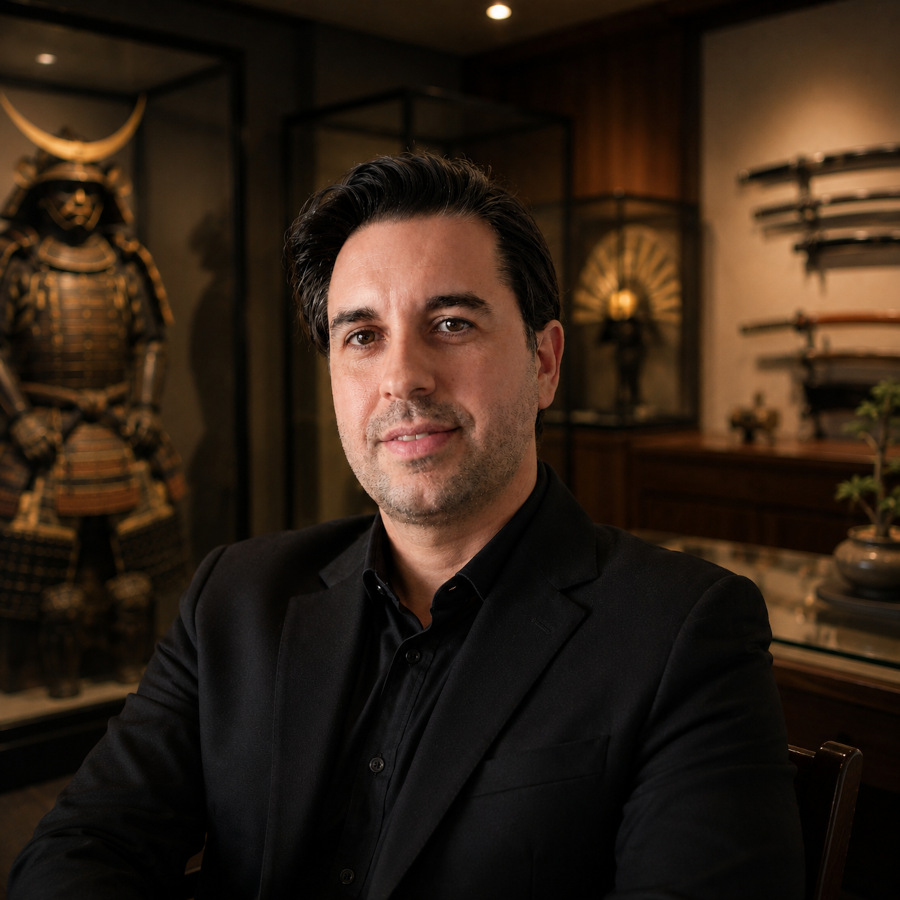
CEO of SupeinNihonto, dealer and collector of ancient Japanese art and weapons from Canillo, Andorra.