November 20, 2026

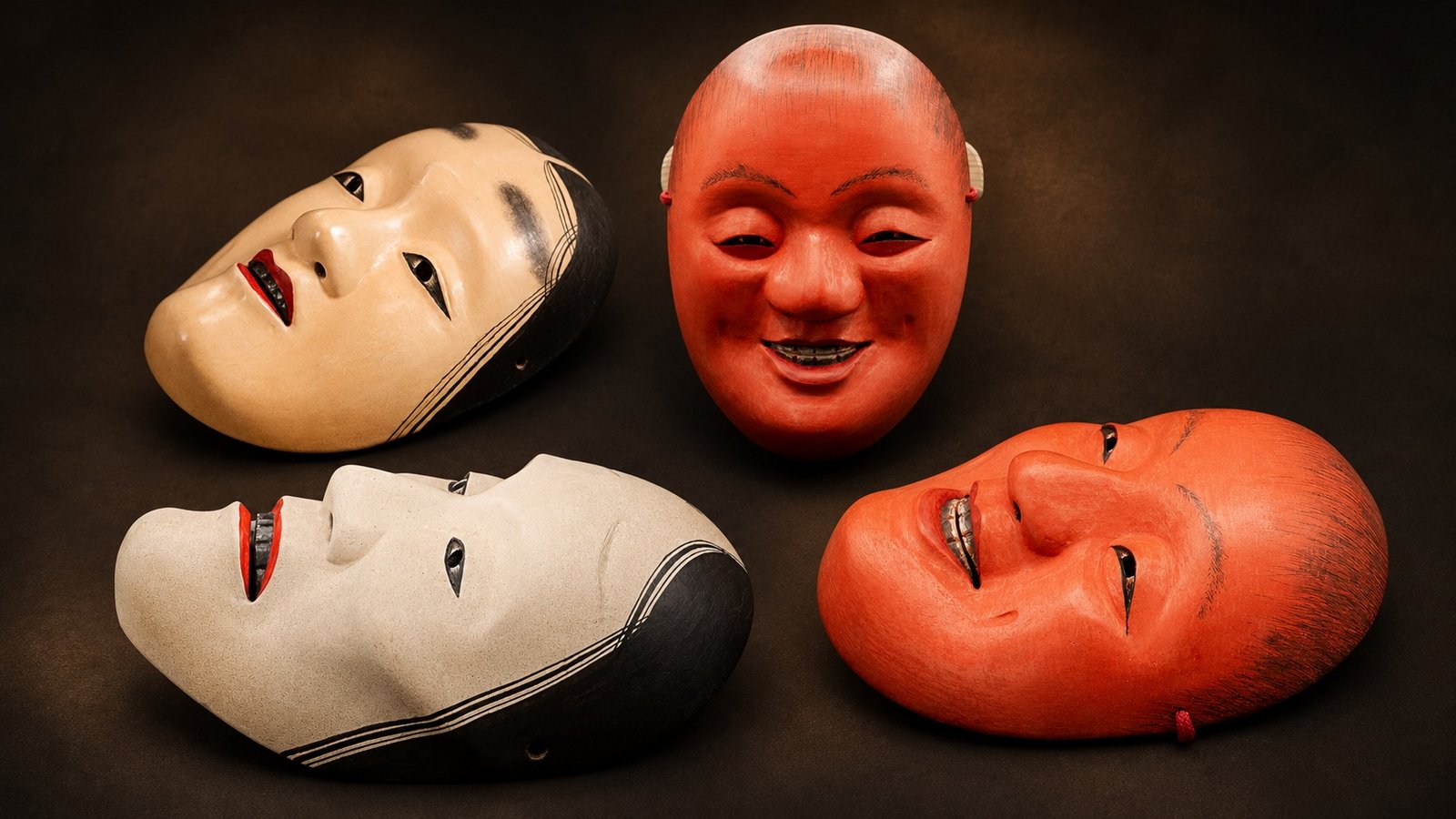
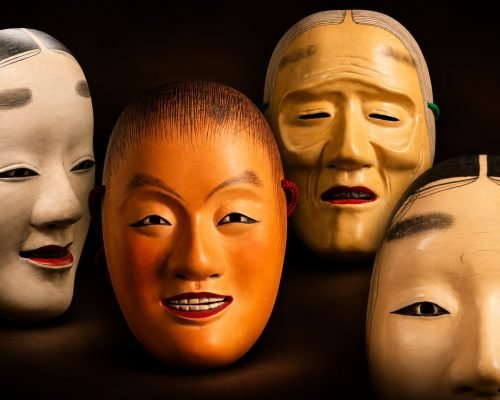
At first glance, many female Noh masks can look remarkably similar.
A pale face. Narrow eyes. High eyebrows. Black hair. A small red mouth.
That similarity is intentional.
Noh does not depend on exaggerated facial differences to tell us who a character is. Instead, very small changes in age, carving, expression, hairline, eyes and mouth can completely change the emotional presence of a mask.
Once you start noticing those differences, masks such as Ko-omote, Fukai and Deigan stop looking like variations of the same face.
They begin to represent three very different emotional worlds.
One of the easiest mistakes to make when first looking at Noh masks is to treat them like portraits.
They are not.
A Ko-omote does not represent one particular young woman, and Fukai does not represent one historical middle-aged woman.
They are theatrical types.
Their features establish a framework that allows the actor, through posture, movement and light, to create a character on stage.
This is particularly important with female masks because the differences can be extremely restrained.
The official Noh reference site describes young-woman types such as Ko-omote, Wakaonna and Zō separately from Fukai and Shakumi, which represent more mature women. Deigan moves further again, introducing an otherworldly quality through details such as its gilded eyes.
The transition is therefore not simply:
young → older → oldest.
It is much more psychological than that.
Ko-omote is probably one of the easiest female Noh masks to recognize once you know what to look for.
The name is commonly associated with a young woman, and the face is intentionally idealized.
The Metropolitan Museum of Art describes Ko-omote as conveying innocent beauty, with a pale face, stylized eyebrows, arranged black hair and blackened teeth derived from aristocratic beauty conventions.
What interests me most about Ko-omote, however, is how little the face appears to be doing.
There is no dramatic sadness.
No obvious anger.
No supernatural transformation.
The expression is contained.
The cheeks remain relatively smooth and full.
The mouth is small.
The eyes are narrow without appearing deeply tired or hollow.
The result is a face that feels emotionally open precisely because so little has been fixed into the carving.
That neutrality is what gives Ko-omote much of its power.
A slight change in angle can make the same face seem brighter, more distant or unexpectedly melancholy.
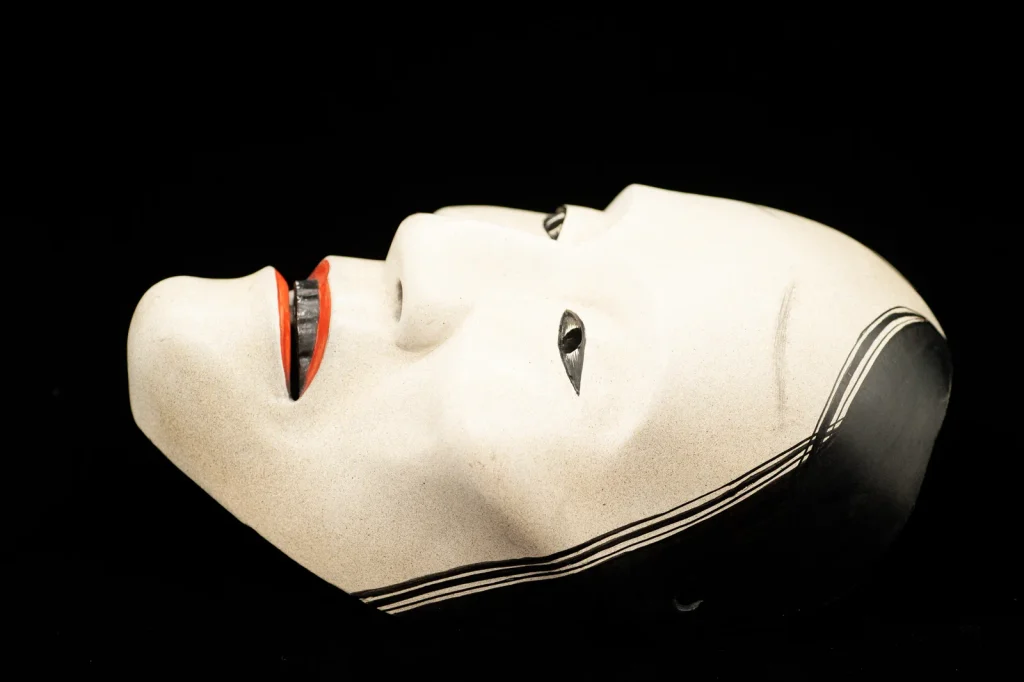
One useful example is this Noh mask Ko-omote signed Seiun 静雲.
It is a Shōwa-period carved wooden mask representing the calm, serene young-woman type associated with Ko-omote.
When looking at it, I would pay particular attention to the relationship between the eyes and mouth.
Neither feature is strongly expressive by itself.
Together, however, they create the restrained presence that makes Ko-omote recognizable.
Fukai occupies a very different emotional space.
It is generally associated with a mature or middle-aged woman, but age alone does not really explain the mask.
Fukai is not simply Ko-omote with wrinkles added.
The entire face feels heavier.
More experienced.
The Noh reference material groups Fukai with elegant mature female characters and distinguishes it from the younger-woman masks.
The changes can be subtle.
The face often feels slightly longer or more weighted.
The cheeks lose some of the youthful softness associated with Ko-omote.
The eyes can seem more inward-looking.
The mouth may carry a greater sense of emotional restraint or accumulated sadness.
What changes most is not necessarily one anatomical feature.
It is the emotional center of gravity.
Ko-omote feels as though life is still largely ahead of the character.
Fukai often feels as though something has already happened.
That difference becomes particularly powerful in plays involving separation, longing or grief.
In Kinuta, for example, Fukai is listed for the living middle-aged woman, while Deigan can appear later in the drama when the emotional and supernatural register has changed.
That is a much more useful way of thinking about these masks than simply memorizing age categories.
This is where one mask currently in the Supein Nihonto collection becomes especially interesting.
The Antique Japanese Ko-omote Noh Mask with Fukai Ink Inscription is clearly cataloged as Ko-omote on the basis of its facial type.
But on the reverse appears the inscription:
深井
read as:
Fukai
That is worth documenting.
But it does not mean we should automatically reclassify the mask as a Fukai.
An inscription on the reverse of a Noh mask might relate to many things: classification, ownership, workshop practice, inventory, a historical association or another context that has since been lost.
Without documentation establishing what that writing means, the safest description is exactly what we have:
a Ko-omote mask bearing an ink inscription reading 深井 (Fukai).
The product itself is deliberately cataloged that way rather than turning the inscription into an unsupported attribution.
I think this is a good example of an important rule when studying Japanese antiques:
read what is there before deciding what you want it to mean.
Deigan is where things become particularly interesting.
At first sight, a Deigan can still retain much of the visual language of a female Noh mask.
It is not necessarily monstrous.
It does not have the horns and extreme transformation we associate with Hannya.
But something has changed.
The clearest detail is the treatment of the eyes.
Traditional descriptions of Deigan emphasize gold around the eyes, a feature indicating that the character is no longer entirely ordinary or human.
That single change has an enormous effect.
The familiar female face begins to feel unstable.
There is still beauty.
There may still be restraint.
But the supernatural has entered.
This is one reason I find Deigan more unsettling than many overtly demonic masks.
A Hannya announces itself immediately.
Deigan can make you look twice.
Reducing Deigan to a frightening mask misses the point.
The face can express emotional states connected with attachment, longing, jealousy, suffering or spiritual transformation without becoming completely demonic.
The Noh repertoire itself shows how flexible the type can be.
In Kinuta, Deigan is used for the transformed later appearance of the woman, and the official play database describes it in relation to a woman whose attachment to a loved one persists beyond ordinary life.
This puts Deigan somewhere particularly interesting in the emotional vocabulary of Noh.
It is not the innocence of Ko-omote.
It is not merely the mature humanity of Fukai.
And it is not yet the full visual violence of Hannya.
It occupies the space between human emotion and supernatural transformation.
If you place several female Noh masks side by side, I would begin with the eyes.
Ko-omote usually gives us a relatively calm and restrained gaze.
Fukai introduces more emotional weight.
Deigan changes the relationship entirely when gilding appears around the eyes.
But do not look only at the openings themselves.
Look at:
the angle of the eyelids,
the depth beneath the eyes,
the relationship between the eyes and cheeks,
and how shadows form when the mask is tilted.
A few millimeters of carving can make an enormous difference.
The mouth is equally important.
With Ko-omote, it may appear almost gently smiling.
But that smile is never completely stable.
Tilt the mask downward and the same mouth can suddenly feel much less cheerful.
With more mature masks, the lower face can become heavier and the mouth more psychologically complex.
This is where photographs can sometimes be misleading.
A single frontal image freezes a mask at one angle.
Noh masks were designed to move.
The expression exists partly in the carving and partly in what the performer does with it.
One of the more technical details worth learning is the hairline.
Female Noh masks can be extremely similar in their general proportions, but specialists also use differences in the painted hairline when distinguishing types.
Comparative studies identify distinct hairline patterns for masks including Ko-omote, Fukai and Shakumi.
This is the kind of feature that is easy to ignore when you first start looking at masks.
Your eye naturally goes to the mouth or eyes.
But once you begin comparing hairlines, eyebrows and the placement of painted strands around the forehead, the differences between types become easier to recognize.
This is also why good frontal photography is so useful when documenting a Noh mask.
It is tempting to create a simple sequence:
Ko-omote → Fukai → Uba
young woman → mature woman → old woman.
And at a very basic level, that progression is useful.
Supein currently has an Antique Japanese Uba Noh Mask that makes the contrast particularly clear.
Its sunken cheeks, deeply carved wrinkles and narrow eyes establish advanced age much more explicitly than the subtle transition between Ko-omote and Fukai.
But Deigan reminds us why age alone is not enough.
Deigan belongs to another axis entirely.
It introduces transformation.
The supernatural.
A psychological state becoming visible through the mask.
That is why female Noh masks are much more interesting than a simple sequence of ages.
Another useful comparison in the current collection is the Noh mask Yaseonna signed Seiun 静雲.
Yaseonna represents the suffering spirit of a woman and belongs to a much more overtly spectral emotional world.
I would not use Yaseonna as a substitute for Deigan.
They are different types.
But placing photographs of Yaseonna, Ko-omote and Uba together is a very effective way of seeing just how broad the visual vocabulary of female masks can become.
Youth.
Maturity.
Age.
Suffering.
Transformation.
The differences are not random decoration.
They are theatrical language.
This is probably the most useful practical point.
A pale young-looking face is not automatically Ko-omote.
Gold near the eyes should make you investigate Deigan, but one detail should never carry the entire classification.
An inscription reading Fukai does not automatically make the mask a Fukai.
A very old-looking surface does not tell you the character type.
Instead, look at the whole face.
Hairline.
Eyebrows.
Eyes.
Cheeks.
Nose.
Mouth.
Teeth.
Paint.
Proportions.
And then, whenever possible, compare the object with documented examples.
Noh masks reward slow looking.
If I had to reduce the difference between these three masks to something simple, I would describe them like this:
Ko-omote is youth before experience.
Fukai is maturity carrying experience.
Deigan is emotion beginning to cross into another world.
That is obviously an interpretation rather than a formal classification system.
But I think it is a useful way to remember what the masks are doing.
The differences are not dramatic because Noh itself does not need them to be.
A small shift in the eyelid.
A heavier cheek.
A different hairline.
A trace of gold around an eye.
Those changes can be enough.
And once you begin to recognize them, female Noh masks stop looking almost identical.
They become some of the most psychologically precise objects in Japanese theatre.
Common questions about Ko-omote, Fukai, Deigan and the subtle differences between female masks in Noh theatre.
Ko-omote is one of the best-known young-woman masks in Noh theatre. It represents an idealized youthful face associated with beauty, innocence, refinement and emotional restraint.
Fukai is generally used for mature or middle-aged female characters. Compared with younger masks such as Ko-omote, its expression tends to carry greater emotional weight and maturity while retaining elegance and restraint.
Deigan is a female Noh mask associated with an otherworldly or supernatural character. One of its most recognizable features is the use of gold around the eyes, which distinguishes it from more purely human female mask types.
Ko-omote represents an idealized young woman, while Fukai generally represents a more mature woman. The difference is expressed through subtle changes in facial proportions, eyes, cheeks, mouth and overall emotional presence rather than through dramatic signs of age.
Deigan can suggest supernatural transformation while retaining the basic appearance of a female face. Hannya represents a much more dramatic transformation, with horns, a pronounced mouth and overtly demonic features. Deigan therefore occupies a subtler space between human emotion and the supernatural.
Not necessarily. An inscription may relate to a mask type, maker, workshop, owner, inventory system or another historical context. The mask itself should still be classified through its physical and stylistic characteristics unless documentary evidence establishes the meaning of the inscription.
Noh relies on controlled stylization rather than exaggerated facial differences. Small variations in the eyes, mouth, cheeks, hairline, proportions and painted details can indicate age, character and emotional state.
Look at the hairline, eyebrows, eye shape, cheeks, mouth, teeth, facial proportions, painted surface and any inscriptions on the reverse. It is better to consider all of these features together rather than identifying a mask from one detail alone.
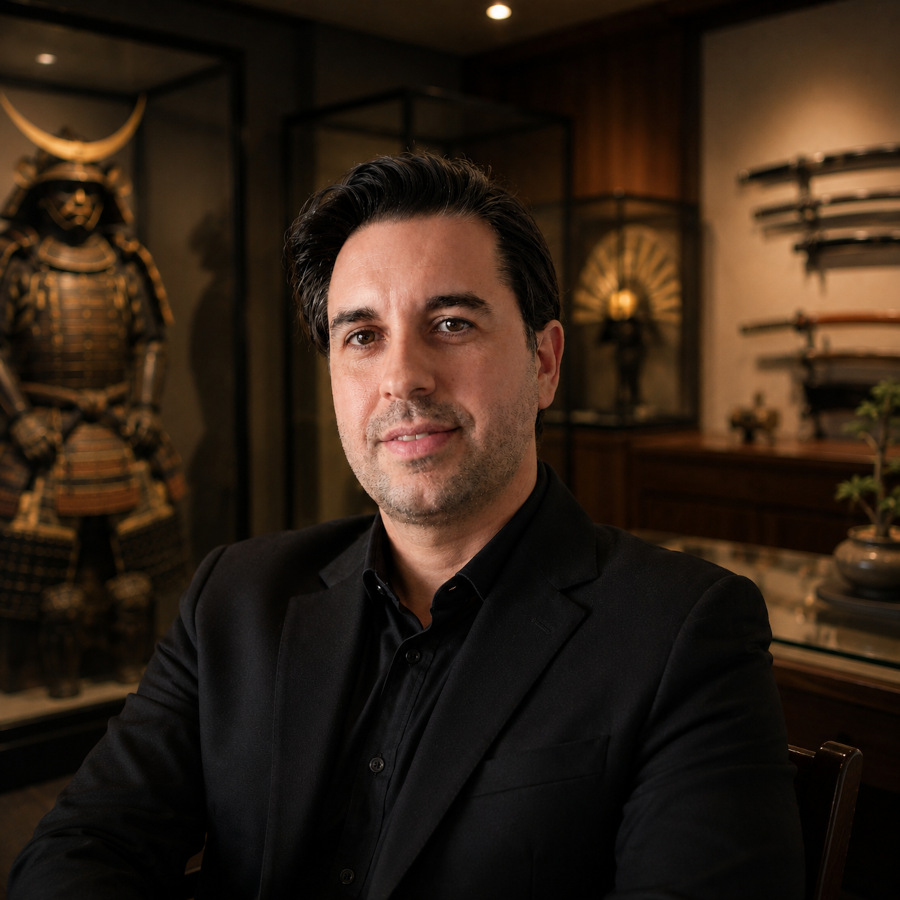
CEO of SupeinNihonto, dealer and collector of ancient Japanese art and weapons from Canillo, Andorra.