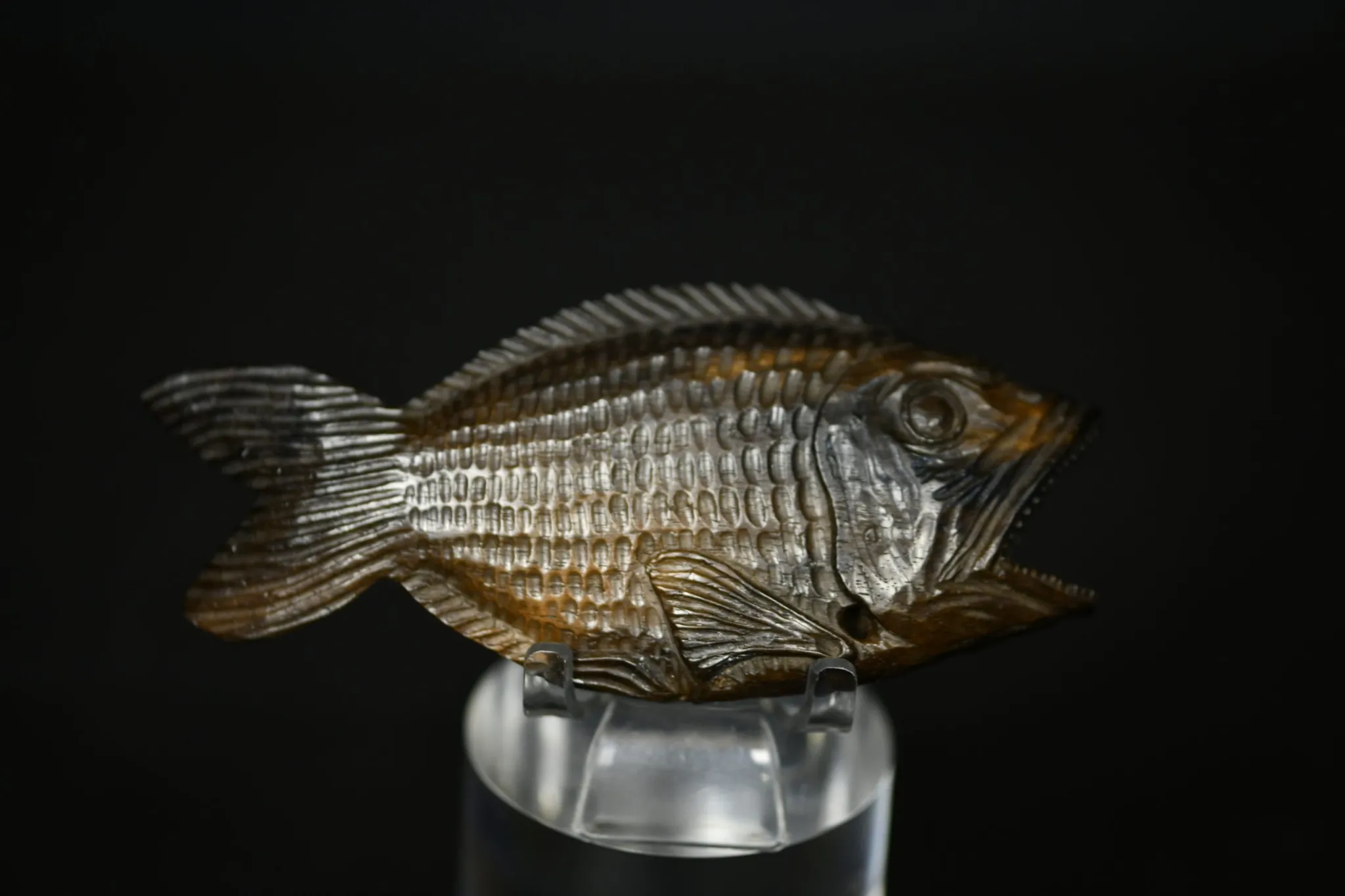
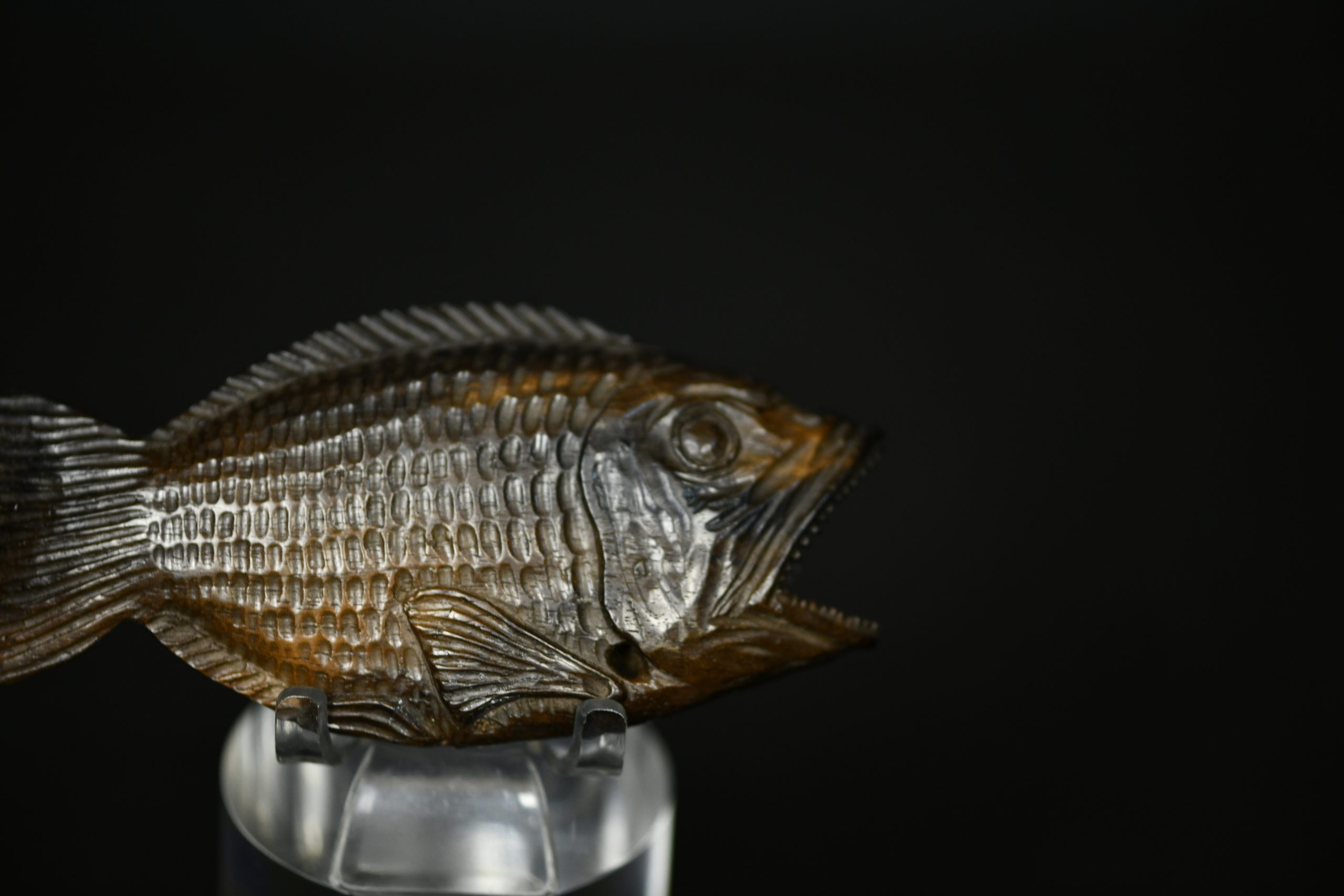
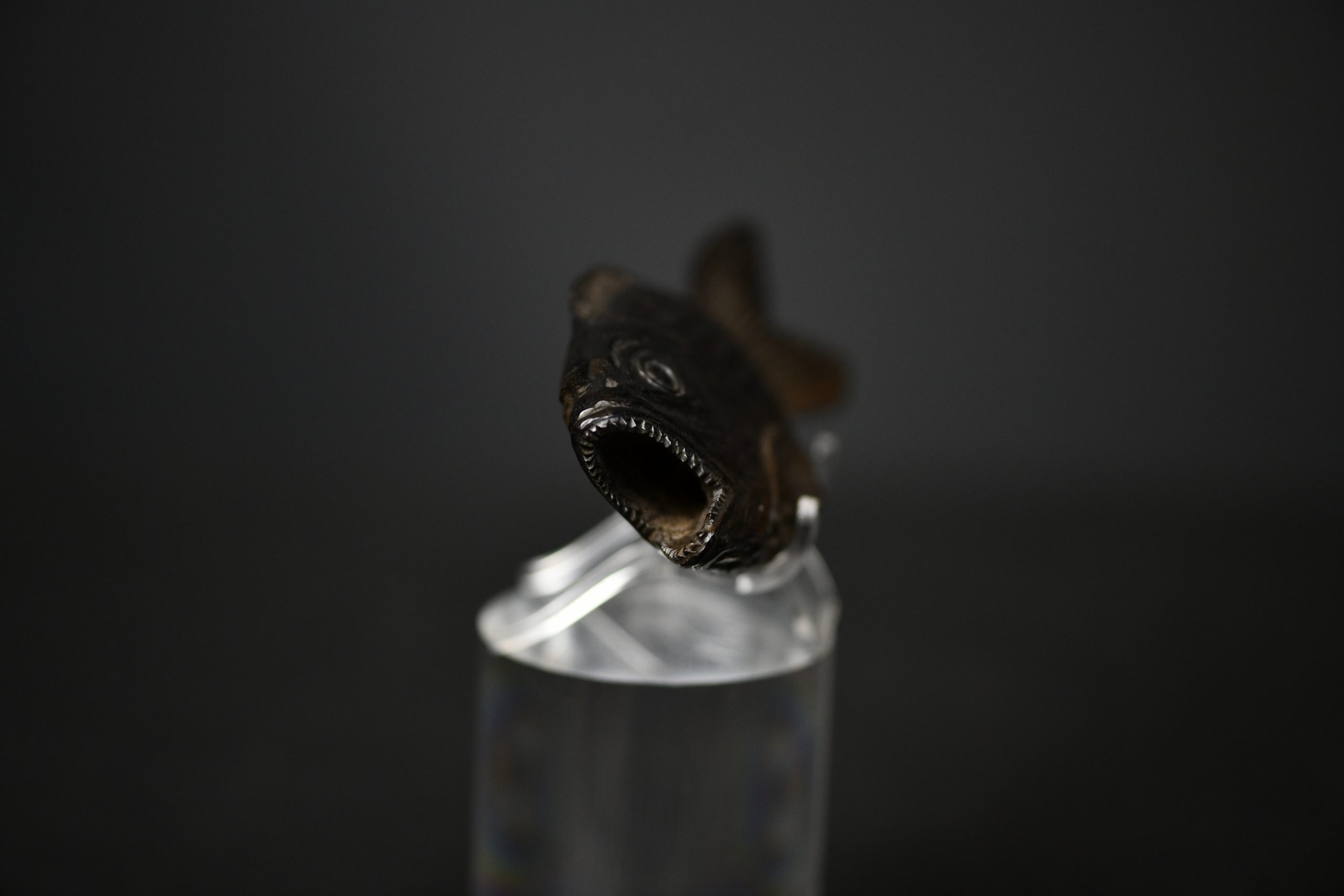
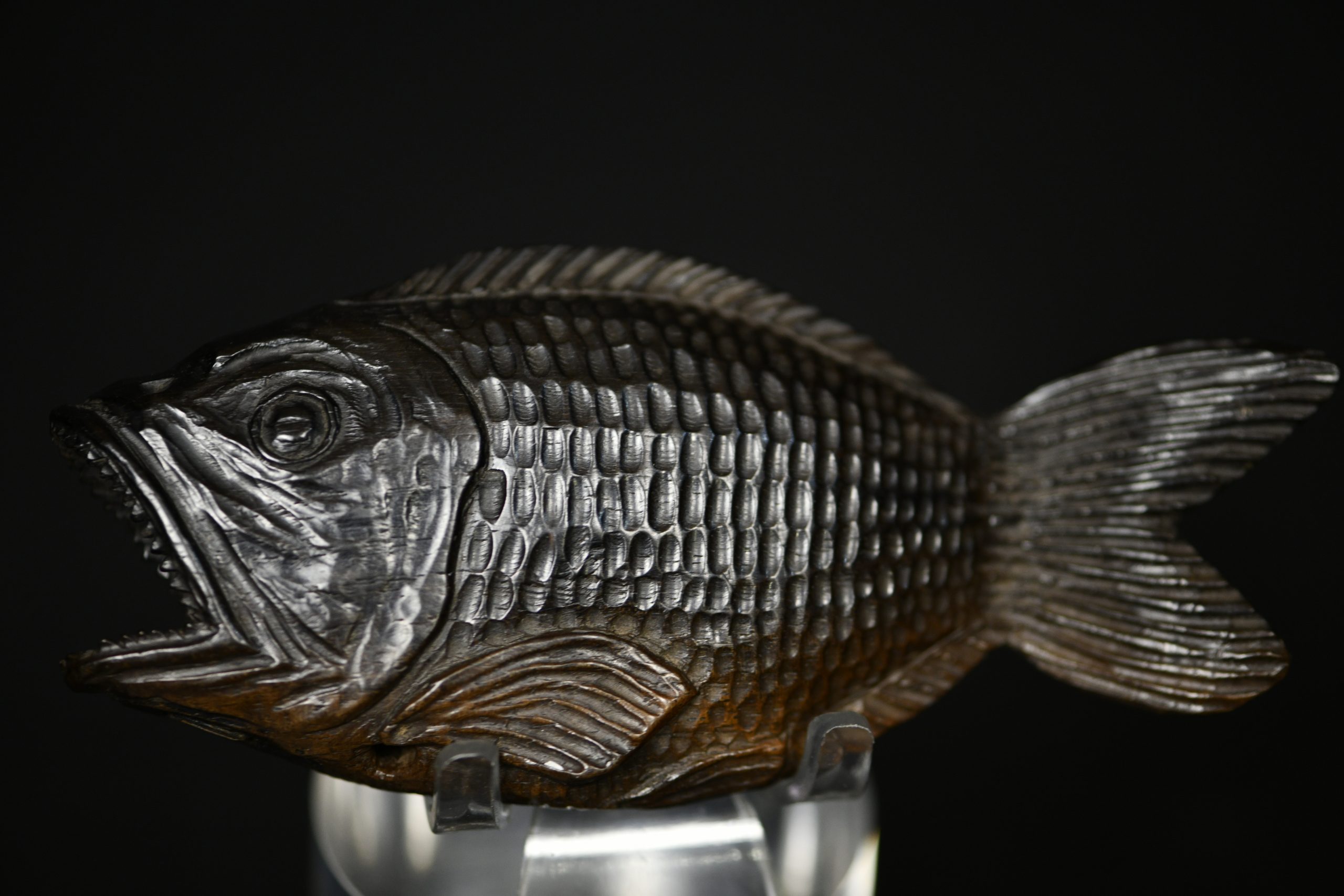
A distinctive Japanese wood netsuke depicting a large fish, dating to the 19th century. With substantial dimensions of 12.5 × 6.5 × 2 cm, the carving has an elongated sculptural format that gives the fish a particularly strong visual presence.
The body is carefully worked with considerable attention to detail, allowing the form, fins and surface treatment of the fish to define the character of the sculpture.
A particularly interesting feature is the signature placed on an inset copper plate, introducing a contrasting material element into the otherwise wooden carving. No reading or maker attribution is proposed here without reliable supporting documentation.
The netsuke represents a single large fish in a fully sculptural composition.
Its elongated body creates a very different visual rhythm from the compact spherical or tightly folded forms often encountered in animal netsuke.
The fish occupies almost the entire sculptural volume, allowing the carver to focus attention on its anatomy and surface rather than on a broader narrative scene.
The result is direct and immediately recognizable, with the animal itself forming the complete subject of the carving.
The piece is notable for the amount of detail worked into the wooden surface.
The body, fins and other anatomical elements are individually articulated while remaining integrated into the overall form of the fish.
This balance between descriptive carving and sculptural unity allows the subject to remain clearly legible from different viewpoints.
Rather than relying on additional materials or elaborate narrative elements, the visual interest of the piece comes principally from the treatment of the fish itself.
With dimensions of 12.5 × 6.5 × 2 cm, this is a notably substantial netsuke in comparison with many smaller miniature carvings.
The elongated proportions allow the full body of the fish to be represented with considerable visual impact.
At the same time, the relatively shallow overall form keeps the sculpture contained and coherent.
The dimensions contribute significantly to the character of the piece and distinguish it from more compact animal netsuke.
Despite its elongated format, the netsuke is conceived as a three-dimensional sculptural object rather than as a simple relief.
The contours of the body and the articulation of the fins allow the form to be appreciated from multiple viewpoints.
The carving remains centered on the silhouette of the fish, with the anatomy providing both structure and visual movement.
This gives the object a strong sculptural identity while retaining the intimate scale associated with Japanese netsuke.
One of the most distinctive features of the piece is the inset copper plate bearing the signature.
Rather than being cut directly into the wood, the signature is associated with a separate metal element incorporated into the carving.
The copper creates a visual and material contrast with the surrounding wood and provides an important point for future identification and study.
As no confirmed reading of the signature has been provided, the catalogue description remains deliberately conservative and does not attribute the work to a particular artist or school.
The netsuke should be described as signed on an inset copper plate.
The presence of a signature is an important documentary feature, but a signature alone should not be used to establish authorship without a reliable reading and supporting evidence.
For this reason, no maker, workshop or regional attribution is proposed here.
A clear photograph of the copper plate may allow the inscription to be studied separately in the future.
The netsuke is carved from wood.
The precise wood species has not been identified and should therefore remain unspecified without material analysis.
Wood was particularly well suited to animal netsuke because it allowed carvers to combine broad sculptural modelling with finer incised and carved details.
In the present example, the material supports the long continuous form of the fish while allowing smaller anatomical features to remain clearly defined.
Fish appear widely throughout Japanese visual culture, from painting and prints to ceramics, lacquerwork, metalwork and miniature sculpture.
Their flowing bodies and varied anatomical forms offered artists considerable possibilities for representing movement, texture and natural observation.
Within a netsuke, the elongated structure of a fish could present a particular compositional challenge because the subject needed to remain cohesive within a relatively small object.
This example embraces that elongated form rather than compressing the animal into a more conventional rounded composition.
The netsuke dates to the 19th century.
This dating spans a period of considerable development and change in Japanese decorative arts, including the later Edo period and the beginning of the Meiji era.
Without more precise documentation, the piece should remain catalogued simply as 19th century rather than being assigned to a narrower period.
This conservative dating avoids making an unsupported chronological attribution while preserving the information supplied with the object.
Traditional netsuke were conceived as functional objects associated with Japanese dress, while also developing into highly sophisticated miniature sculptures.
Their scale required carvers to balance sculptural detail with a form capable of being handled.
The present fish stands out for its elongated proportions and substantial size while still belonging to this broader tradition of portable Japanese carving.
Its strong silhouette and detailed surface treatment make it particularly effective as an object intended to be examined closely.
The netsuke should be evaluated in the context of its 19th-century dating and historical use.
No specific condition defects beyond the information supplied have been added to this catalogue description.
Please examine the detailed photographs carefully, as they form an important part of the description and provide the best record of the carving, wooden surface, copper signature plate and overall condition.
Dimensions: 12.5 × 6.5 × 2 cm
This netsuke combines several features that make it an especially distinctive example of Japanese animal carving.
Its substantial 12.5 cm format gives the fish considerably more visual presence than many smaller netsuke, while the elongated composition allows the full form of the animal to dominate the sculpture.
The detailed wooden carving provides the primary visual interest, while the inset copper signature plate introduces an unusual contrasting material element.
The unsigned attribution remains deliberately open, allowing the signature itself to serve as an important subject for future study rather than attaching the piece to an unsupported maker or school.
Its 19th-century dating, large sculptural format and distinctive copper signature plate make the piece an interesting example of Japanese netsuke carving with a notably individual character.
A distinctive 19th-century Japanese wood netsuke depicting a large fish, carved in an elongated format with carefully worked anatomical detail and a strong three-dimensional presence. Measuring 12.5 × 6.5 × 2 cm, the piece is particularly notable for its substantial scale and for the signature set into an inset copper plate. With no unsupported maker attribution, the carving can be appreciated for its individual sculptural character, detailed workmanship and unusual combination of wood and copper.

Order above 1.000,00 € gets free shipping.

Secure and hassle-free payment process.

Certificate of authenticity included.

Have questions? Contact us via WhatsApp.
Contact