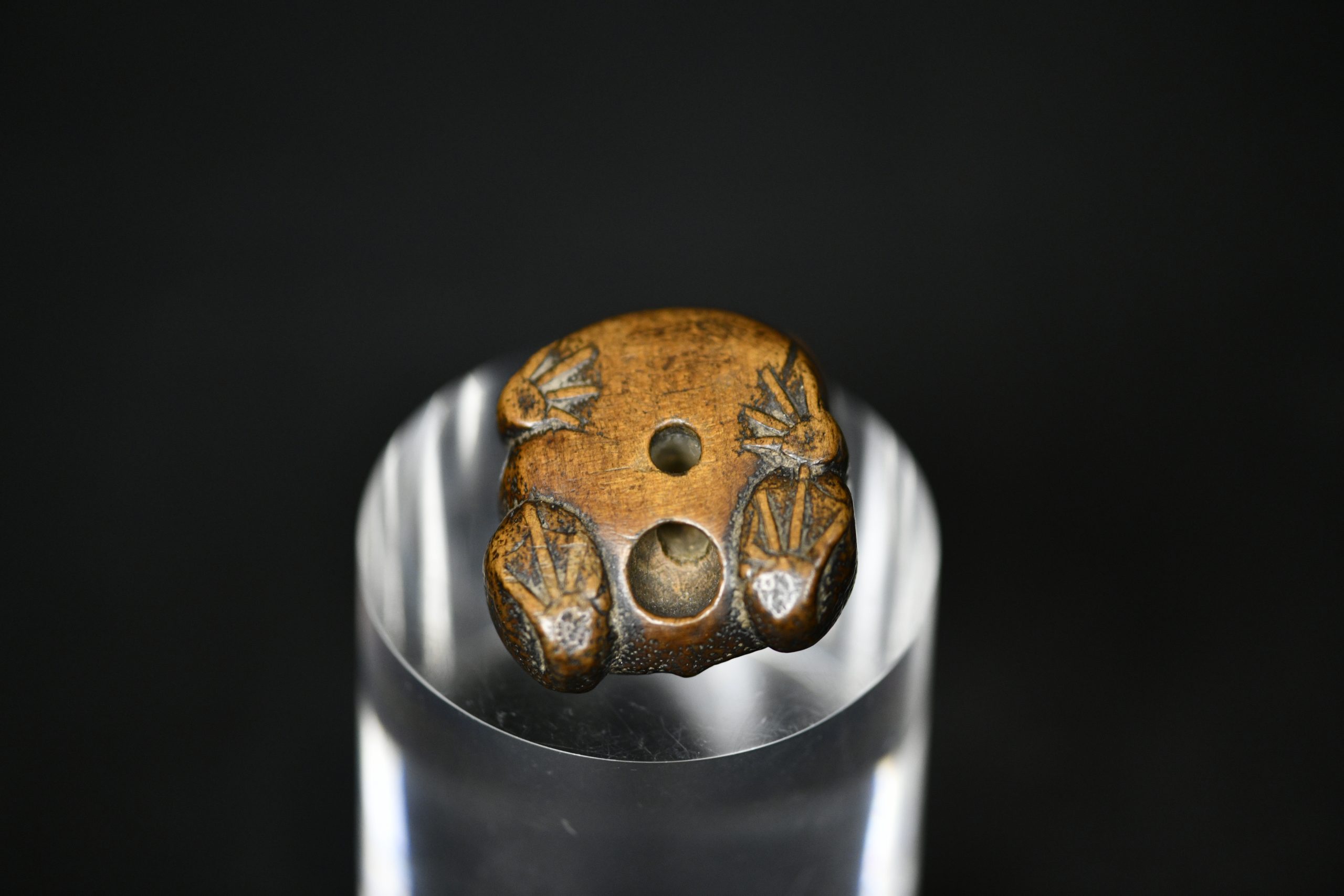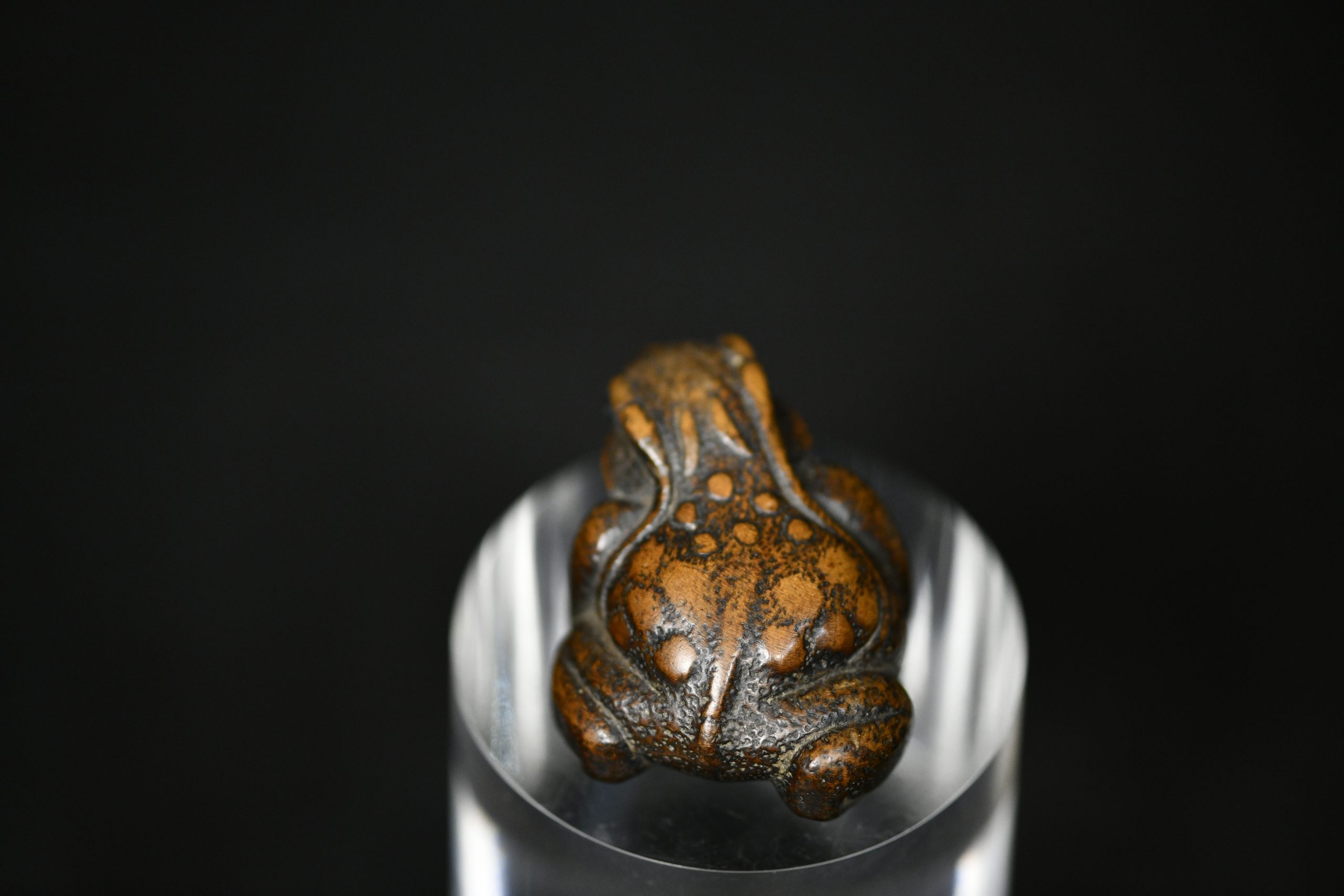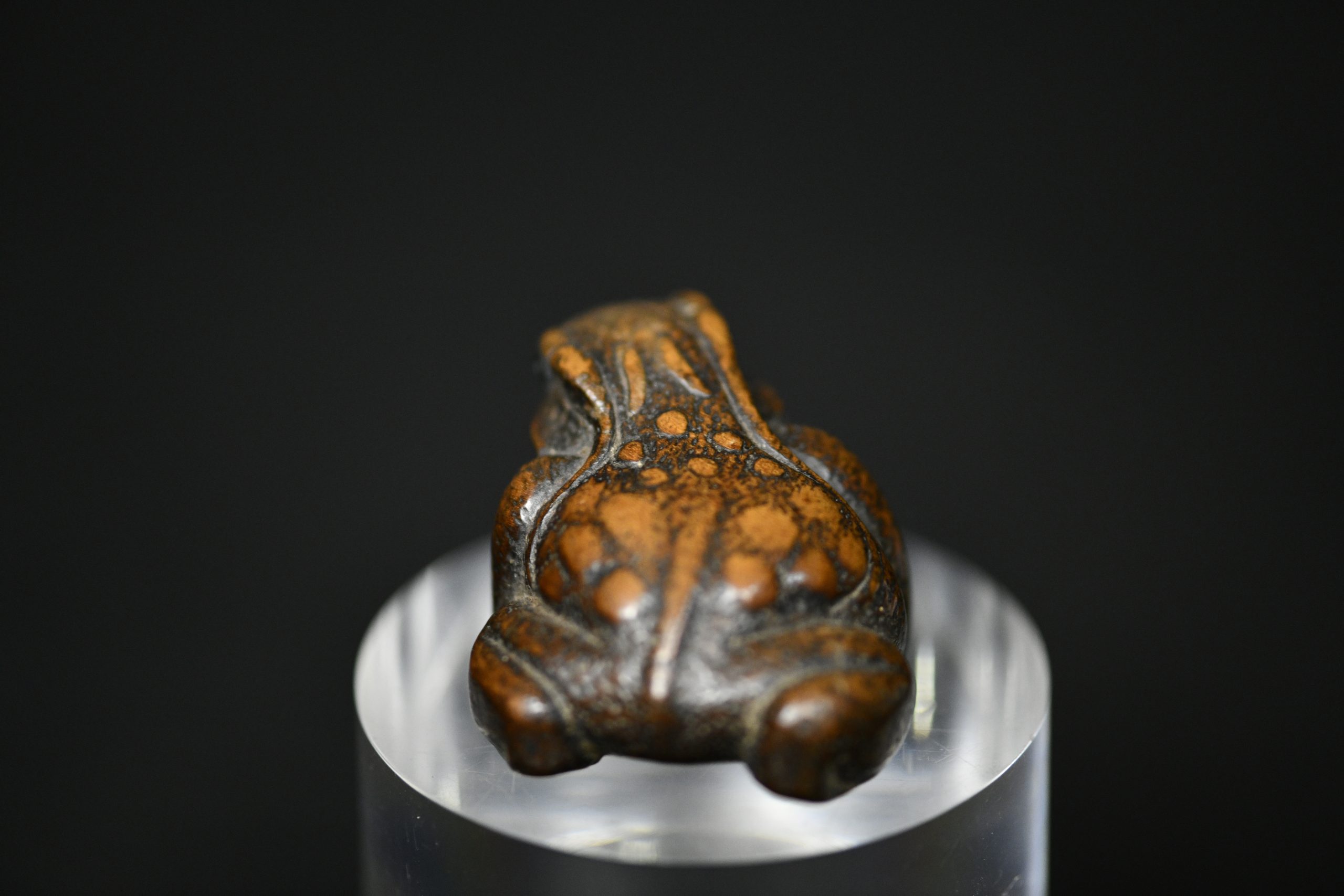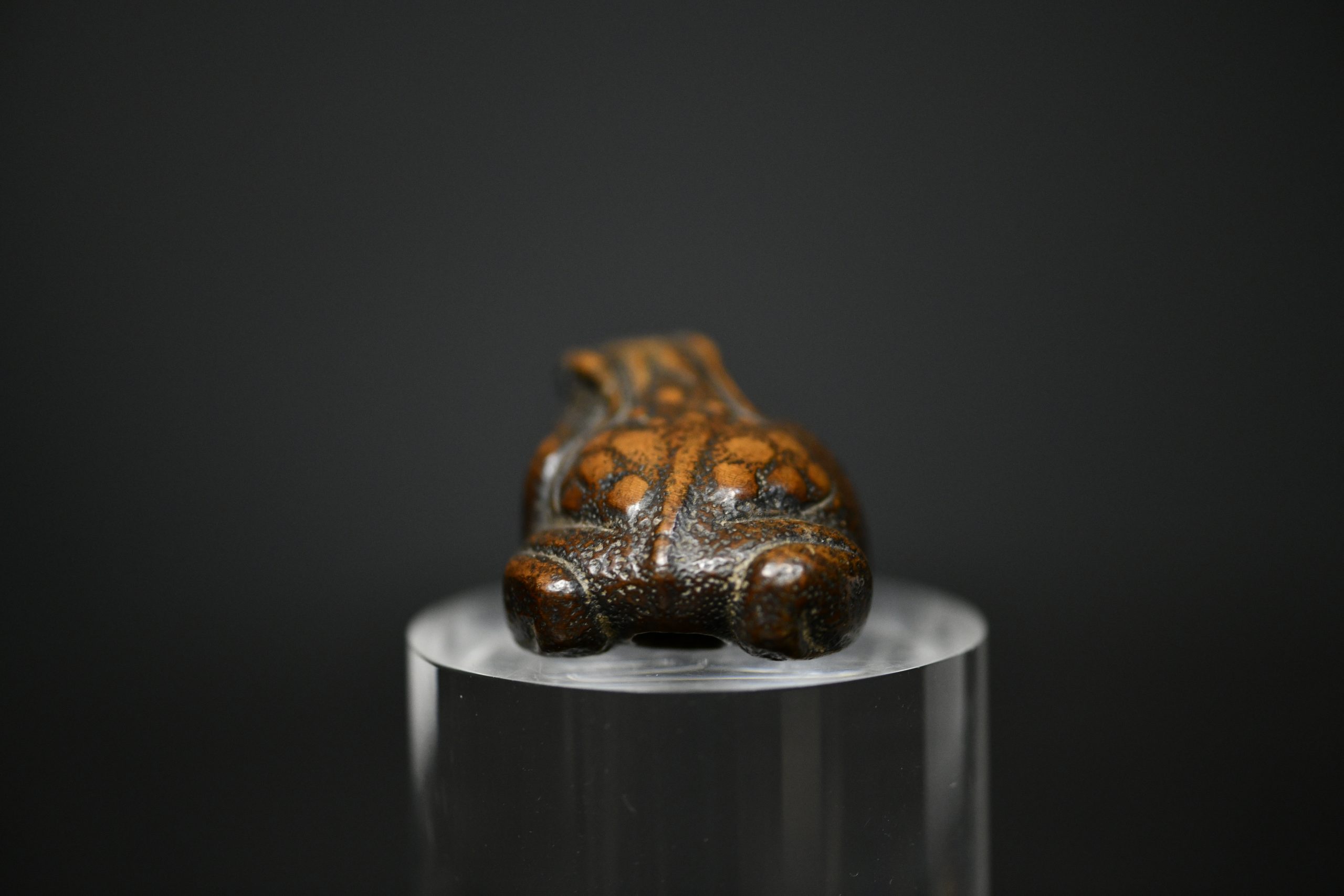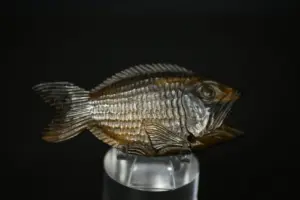

A characterful Japanese wood netsuke depicting a toad, dating to the Edo period. The animal is carved as a compact, fully three-dimensional form, with a broad body, strongly modelled limbs and distinctive silver-inlaid eyes that immediately animate the expression.
The wood has developed a particularly attractive mature patina, with rich tonal variation and a smooth surface character consistent with age and historical handling.
A clearly defined functional himotoshi is incorporated into the carving, confirming its traditional conception as a netsuke.
The toad is represented in a low, compact posture, its broad body forming the principal sculptural mass of the composition.
The animal’s naturally squat anatomy lends itself particularly well to netsuke carving, allowing the body and limbs to remain closely contained within a rounded volume.
Rather than relying on an elaborate narrative, the carving draws its character from the physical presence of the animal itself: the heavy body, crouched stance and alert face create an immediately recognizable and engaging subject.
The result is a small sculpture that feels both naturalistic and strongly tactile.
One of the most distinctive features of the netsuke is the use of silver inlays for the eyes.
The metallic surface introduces a clear visual contrast with the warm brown tones of the wood and directs attention toward the face.
Although small in scale, the eye inlays have a significant effect on the character of the sculpture, giving the toad a more alert and vivid expression.
The combination of carved wood and contrasting metal demonstrates how a limited use of another material could transform the visual impact of a compact netsuke.
Measuring 5.5 × 4 × 3 cm, the netsuke forms a compact sculptural volume particularly suited to its traditional function.
The broad body of the toad allows the composition to remain visually substantial without relying on fragile projecting elements.
The limbs are integrated closely into the overall silhouette, maintaining a cohesive form that can be appreciated from several viewpoints.
This concentration of the animal into a self-contained three-dimensional mass is one of the defining strengths of traditional netsuke carving.
The carving is built around the rounded volume of the body, with the head and limbs emerging naturally from the central mass.
The sculptural modelling gives the animal a convincing sense of weight while retaining the compact proportions required of a functional netsuke.
Broader surfaces contrast with more carefully defined details around the face and limbs, producing visual variety without making the design unnecessarily complex.
The carving remains legible from different angles, reinforcing its conception as a fully three-dimensional object rather than a single-view miniature.
Toads and frogs form part of the wide range of animals represented by Japanese netsuke carvers.
Their distinctive anatomy — broad bodies, folded limbs and expressive faces — made them particularly suitable for compact miniature sculpture.
Such subjects allowed carvers to combine close observation of the natural world with the humor and personality frequently encountered in Japanese animal netsuke.
The present example is especially effective because the naturally compact form of the toad translates directly into the rounded, tactile structure required of a netsuke.
The piece is carved from wood displaying warm brown tones and a rich, mature surface.
The precise wood species has not been identified and should therefore remain unspecified without material analysis.
The surface has developed a particularly attractive patina through age and handling, giving the carving additional depth and tonal richness.
Areas exposed to repeated contact can gradually become smoother, while deeper or less accessible parts often retain darker coloration, creating subtle contrasts across an antique wooden netsuke.
These characteristics contribute significantly to the visual and tactile appeal of the piece.
The netsuke retains a clearly formed himotoshi, the cord opening associated with the traditional function of a netsuke.
The himotoshi forms an important functional component of the carving and demonstrates that the object was conceived to be worn rather than created solely as a decorative miniature.
Its integration into the sculptural form allows the practical function of the piece to coexist with the overall visual design.
Traditional netsuke were small functional sculptures designed to be worn with Japanese clothing and regularly handled.
Their form therefore needed to balance visual detail with durability, compact proportions and tactile comfort.
The rounded body of this toad is particularly well suited to that purpose.
The sculpture sits naturally within the hand, while the mature wood surface reinforces the tactile qualities associated with antique netsuke.
The netsuke dates to the Edo period (1603–1868), when netsuke served an important practical role in traditional Japanese dress while also developing into a sophisticated form of miniature sculpture.
Because garments such as the kimono did not incorporate pockets in the modern sense, personal containers and accessories could be suspended from the obi.
The netsuke acted as a toggle, preventing the suspension cord from slipping through the sash.
Over time, these practical objects became increasingly refined sculptural works, with animal subjects forming an important part of the repertoire.
The netsuke should be considered in the context of its age and historical use as a handled object.
The wood displays a rich mature patina and natural tonal variation, while the silver eye inlays remain an important visual feature of the composition.
Any minor surface variation or traces of historical handling visible in the photographs should be evaluated as part of the preserved condition and history of the piece.
Please examine the detailed photographs carefully, as they form an important part of the description and provide the best record of the carving, silver inlays, himotoshi, surface and overall condition.
This netsuke brings together several qualities that make Japanese animal carvings particularly appealing to collectors.
The toad provides a naturally compact and expressive subject, while the silver-inlaid eyes introduce a refined contrasting detail that immediately distinguishes the face.
The mature patina gives the wood considerable depth and tactile appeal, and the clearly preserved himotoshi reflects the object’s traditional functional purpose.
Its Edo-period dating, compact sculptural form and combination of wood with silver details make the piece an attractive example of traditional Japanese animal netsuke carving.
A characterful Edo-period Japanese wood netsuke depicting a compact toad, distinguished by vivid silver-inlaid eyes, a rich mature patina and a clearly formed functional himotoshi. Measuring 5.5 × 4 × 3 cm, the carving combines strong three-dimensional modelling, tactile surface quality and the expressive naturalism associated with traditional Japanese animal netsuke.

Order above 1.000,00 € gets free shipping.

Secure and hassle-free payment process.

Certificate of authenticity included.

Have questions? Contact us via WhatsApp.
Contact