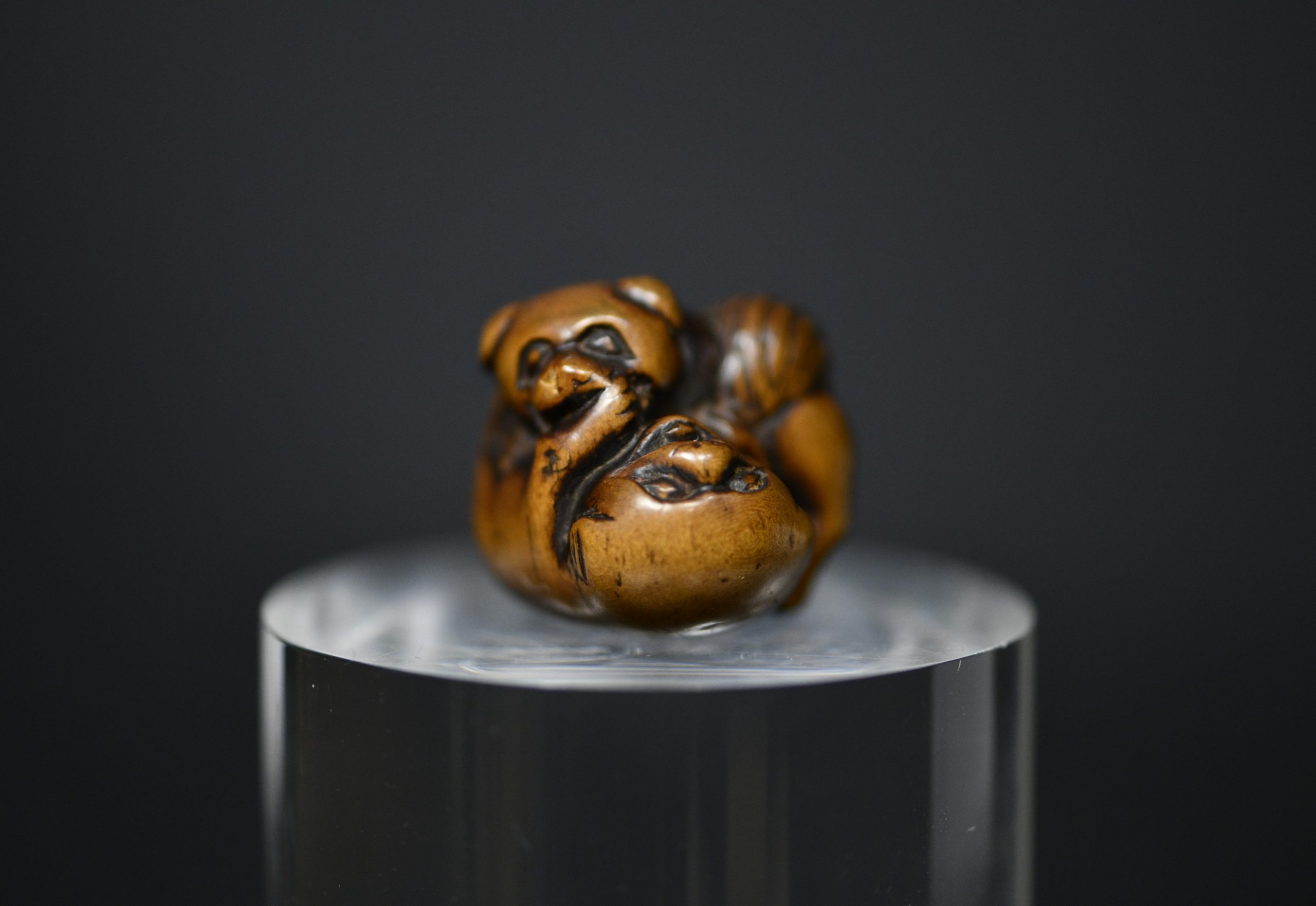
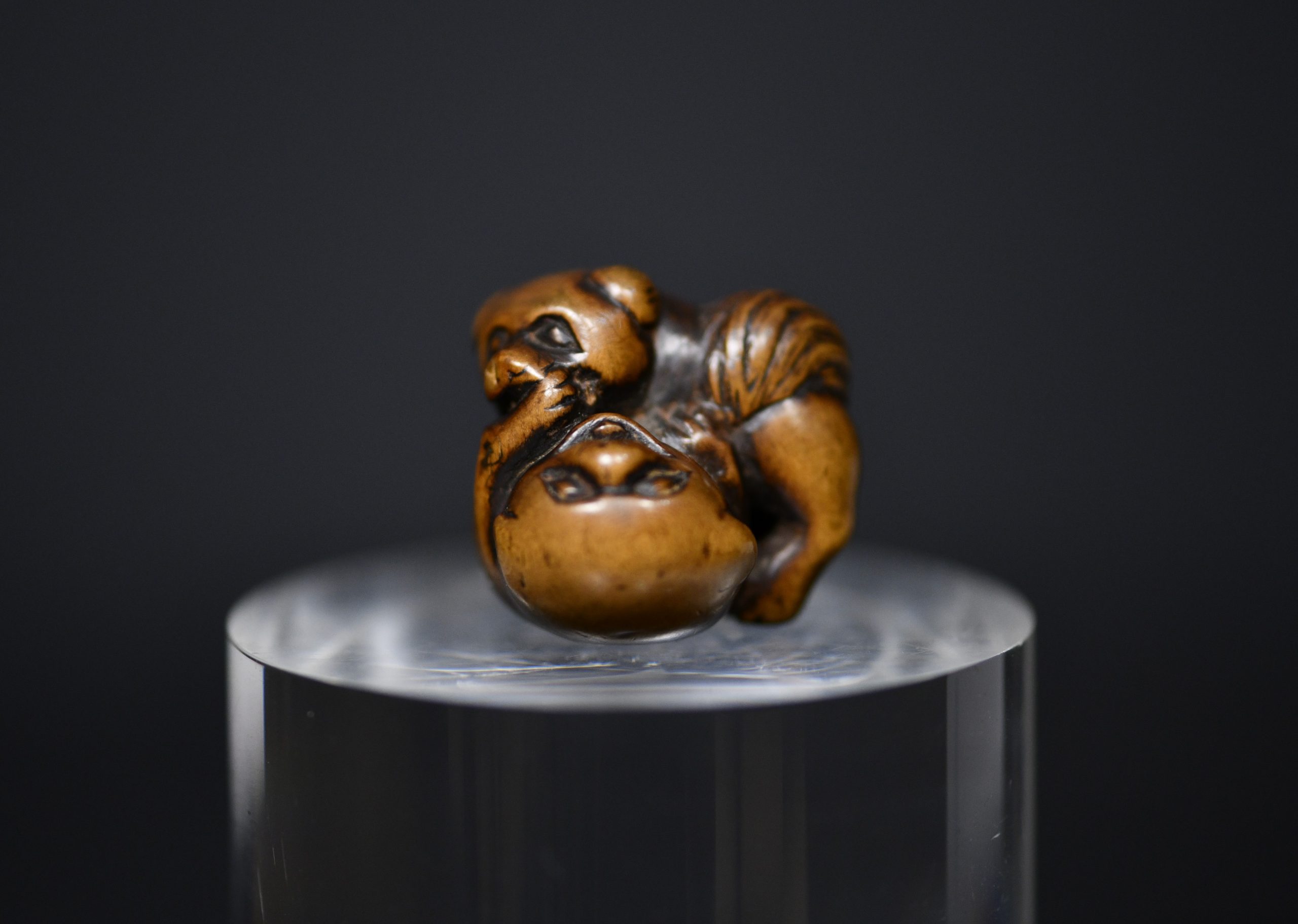
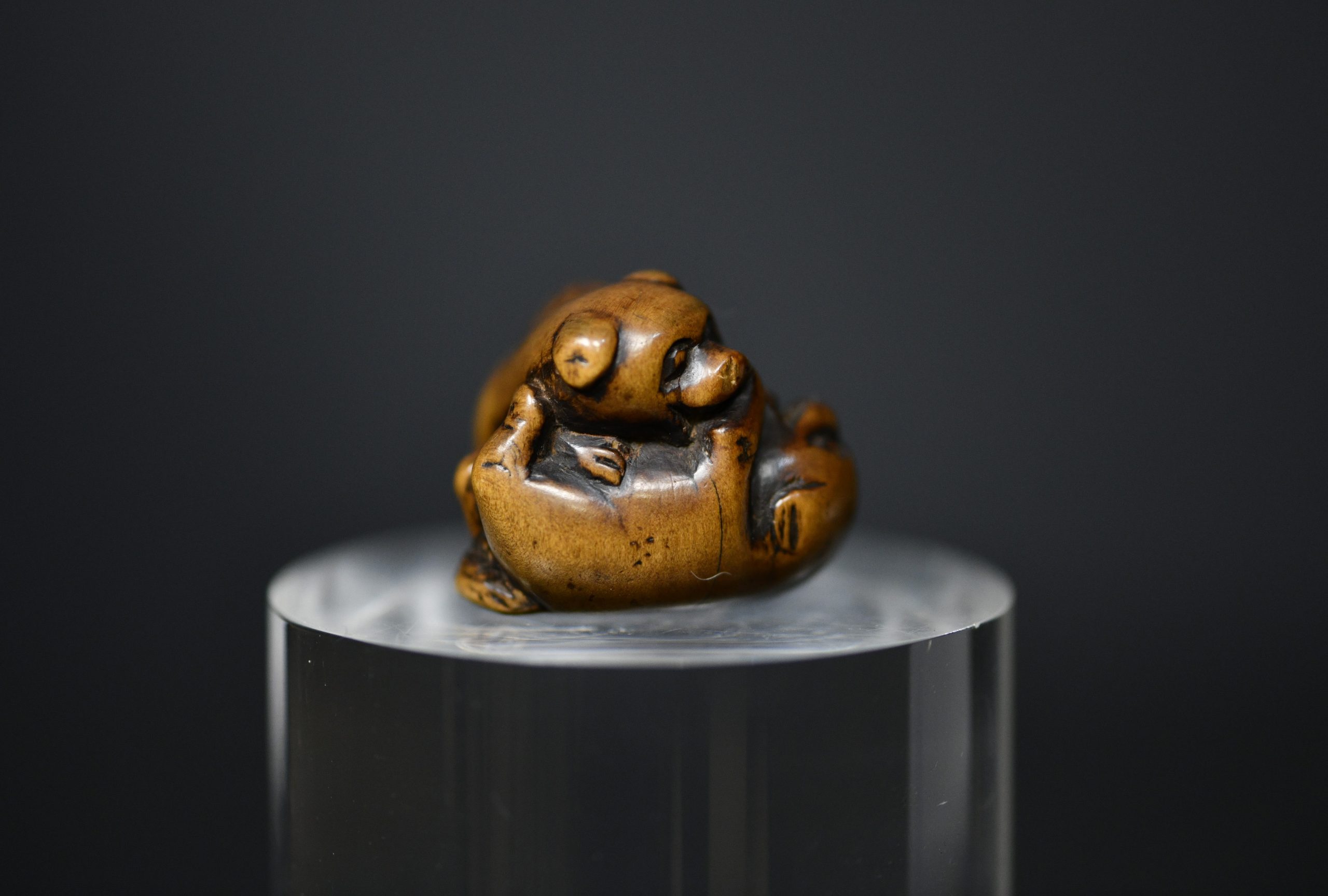
A charming Japanese wood netsuke depicting two dogs at play, dating to the Edo period. The two animals are closely intertwined in a compact, rounded composition that gives the carving a lively sense of interaction while preserving the tactile, self-contained form associated with traditional netsuke.
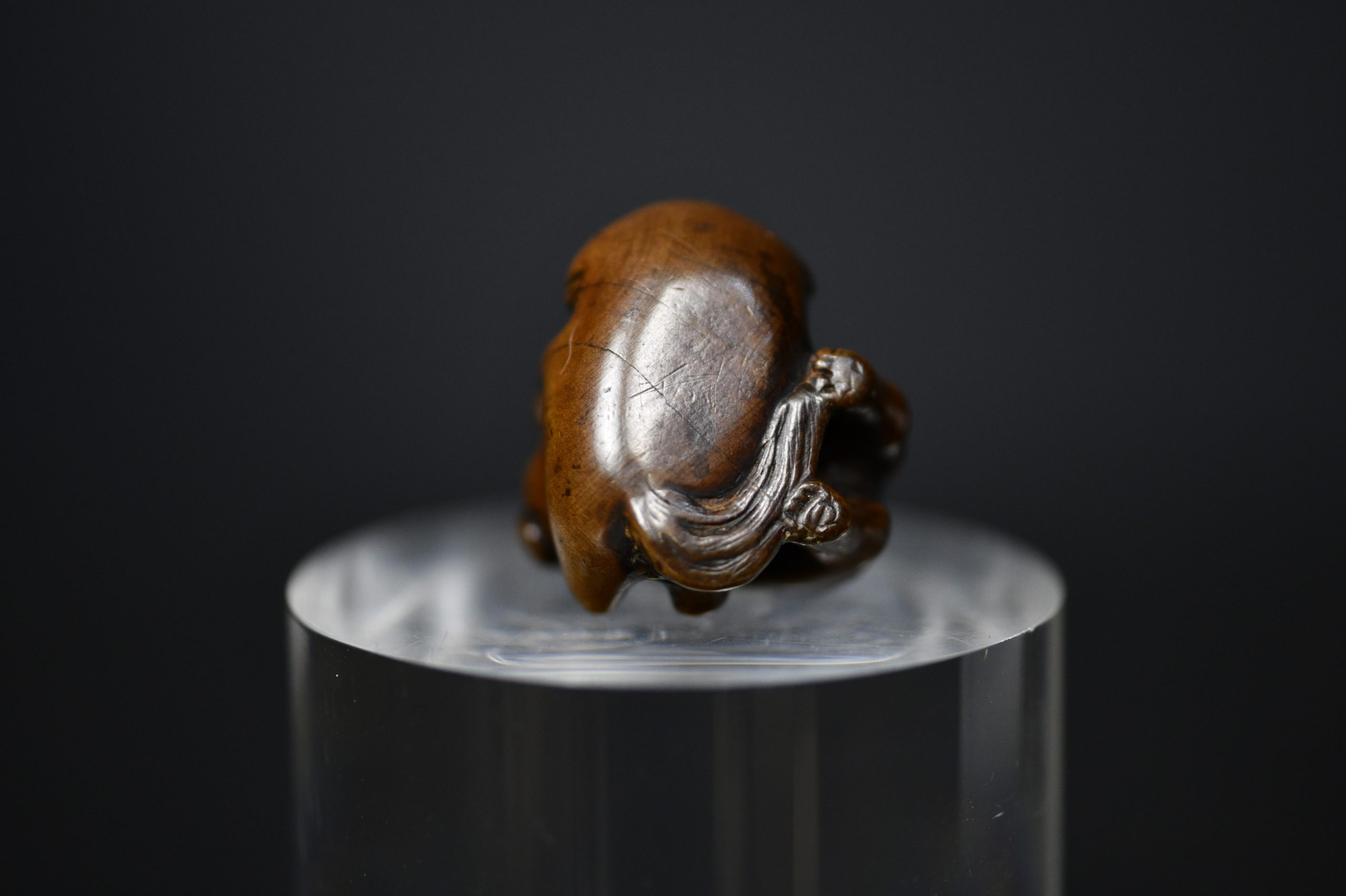
The wood displays a particularly attractive mature patina and visible wear from age and handling, giving the surface considerable tonal depth and character.
The carving is described as being in the style of Kokei (虎渓). This should be understood as a stylistic comparison rather than as a direct attribution to Kokei himself.
The subject shows two dogs engaged in playful interaction, their bodies closely arranged within a compact sculptural group.
Rather than separating the animals into distinct figures, the carver has integrated them into a single rounded volume, allowing their overlapping bodies and limbs to create movement without disrupting the overall unity of the netsuke.
The playful subject gives the carving an immediate sense of warmth and personality.
The interaction between the two animals transforms the piece from a simple animal study into a small narrative scene, capturing a recognizable moment of energetic but affectionate behavior.
Measuring only 3.4 × 3 × 2.4 cm, the netsuke condenses both animals into a particularly compact form.
The rounded silhouette minimizes fragile projecting elements while preserving a strong three-dimensional presence.
The two bodies are arranged closely together, creating a balanced sculptural mass that can be appreciated from multiple viewpoints.
This type of concentrated composition is especially effective in netsuke carving, where visual complexity had to coexist with a form suitable for regular handling.
The carving is characterized by soft, rounded modelling rather than sharp or excessively angular forms.
The dogs’ bodies are treated as closely connected volumes, with the limbs, heads and backs integrated into the overall compact structure.
This rounded treatment contributes strongly to the tactile quality of the netsuke and allows the two animals to remain visually distinct without fragmenting the composition.
The result is a cohesive miniature sculpture that feels natural in the hand while retaining a lively sense of movement.
Dogs appear regularly among the animal subjects represented by Japanese netsuke carvers.
Their familiar behavior, expressive bodies and close relationship with people made them particularly suitable for intimate and humorous miniature compositions.
Pairs of animals also gave carvers the opportunity to explore interaction and movement within a very limited space.
In the present example, the playful relationship between the two dogs becomes the central focus of the sculpture.
The netsuke has been described as carved in the style of Kokei (虎渓).
The comparison relates to the rounded sculptural treatment, compact animal grouping and strongly unified form of the carving.
This description should be understood as a stylistic reference only and not as an attribution to Kokei.
No signature or documentary evidence identifying the maker has been provided, so the catalogue description remains deliberately conservative.
The netsuke is carved from wood displaying warm brown tones and a richly developed surface.
The precise wood species has not been identified and should therefore remain unspecified without material analysis.
The piece has developed a particularly attractive mature patina, enhanced by natural wear and repeated handling over time.
Exposed areas have acquired a smoother appearance, while deeper or less accessible parts retain darker coloration, creating subtle tonal contrasts across the carving.
These surface qualities add considerable visual depth and reinforce the tactile character of the netsuke.
The carving retains visible wear associated with age and historical use.
Rather than detracting from the piece, this wear contributes to the character of the wood and helps communicate its history as an object intended to be handled.
Traditional netsuke were practical objects as well as miniature sculptures, and repeated contact could gradually soften exposed surfaces and contribute to the development of patina.
The preserved wear and surface variation should therefore be considered within the context of an antique Edo-period netsuke.
Traditional netsuke were conceived as functional objects to be worn and regularly handled.
Their small size encouraged carvers to create compact, durable forms that remained comfortable in the hand while still offering complete three-dimensional compositions.
The present pair of dogs is particularly successful in this respect.
The rounded bodies and intertwined arrangement create a self-contained volume with few vulnerable projecting elements, while still providing visual interest from different angles.
The netsuke dates to the Edo period (1603–1868), when netsuke served an important practical role in traditional Japanese dress while also becoming increasingly sophisticated miniature sculptures.
Because garments such as the kimono did not contain pockets in the modern sense, personal containers and accessories could be suspended from the obi.
The netsuke functioned as a toggle, preventing the suspension cord from slipping through the sash.
Animal subjects formed an important part of the netsuke repertoire, ranging from highly naturalistic studies to humorous and affectionate scenes of familiar creatures.
The netsuke should be evaluated in the context of its age and historical use as a handled object.
The wood displays a rich mature patina together with visible wear and natural tonal variation.
These characteristics contribute significantly to the visual and tactile character of the carving.
Please examine the detailed photographs carefully, as they form an important part of the description and provide the best record of the preserved carving, surface, patina, wear and overall condition.
This netsuke combines several qualities that make Japanese animal carvings particularly appealing to collectors.
The pair of playing dogs creates an engaging and affectionate subject, while the tightly integrated composition allows both animals to form a single balanced sculptural volume.
The richly developed wood patina and visible historical wear give the surface notable depth and tactile character.
The stylistic comparison with Kokei (虎渓) adds an additional area of interest while remaining clearly separate from any direct maker attribution.
Its Edo-period dating, compact dimensions, rounded modelling and playful animal subject make the piece an attractive example of traditional Japanese netsuke carving.
A charming Edo-period Japanese wood netsuke depicting two dogs at play, carved as a compact and softly rounded sculptural group. The piece displays a rich mature patina and visible wear from historical handling, while its treatment is described as being in the style of Kokei (虎渓). Measuring 3.4 × 3 × 2.4 cm, the netsuke combines playful character, tactile form and the intimate scale associated with traditional Japanese animal carving.

Order above 1.000,00 € gets free shipping.

Secure and hassle-free payment process.

Certificate of authenticity included.

Have questions? Contact us via WhatsApp.
Contact