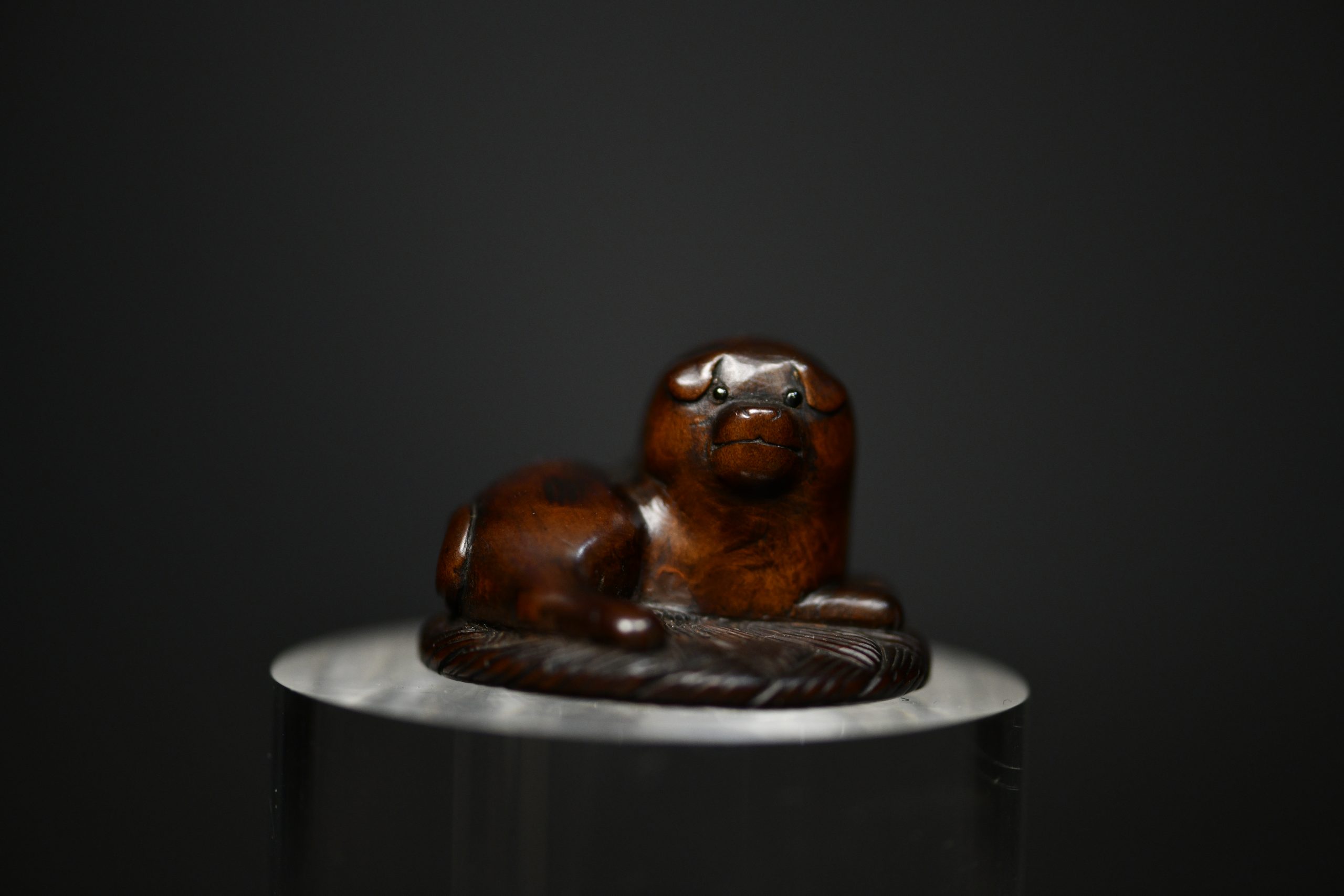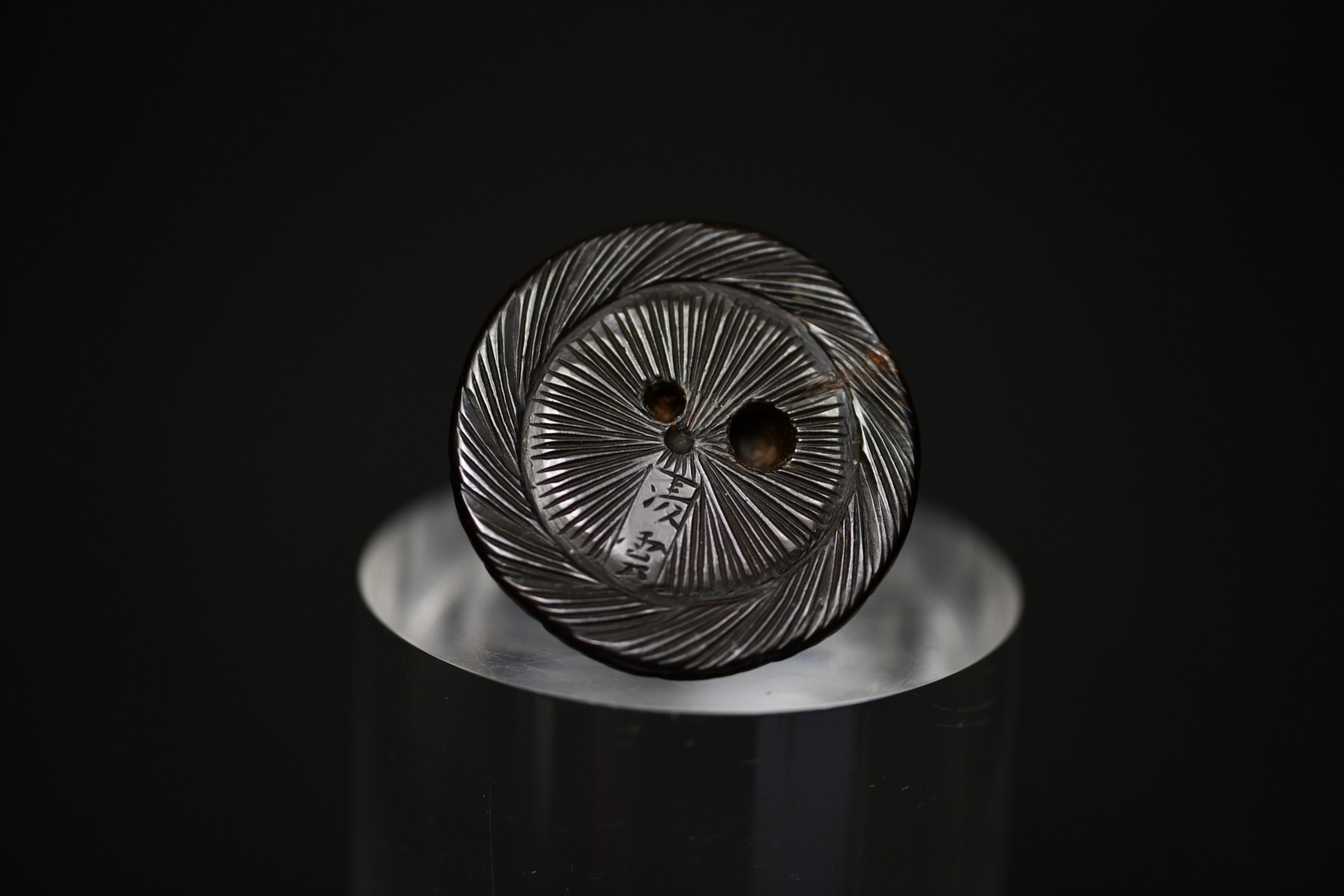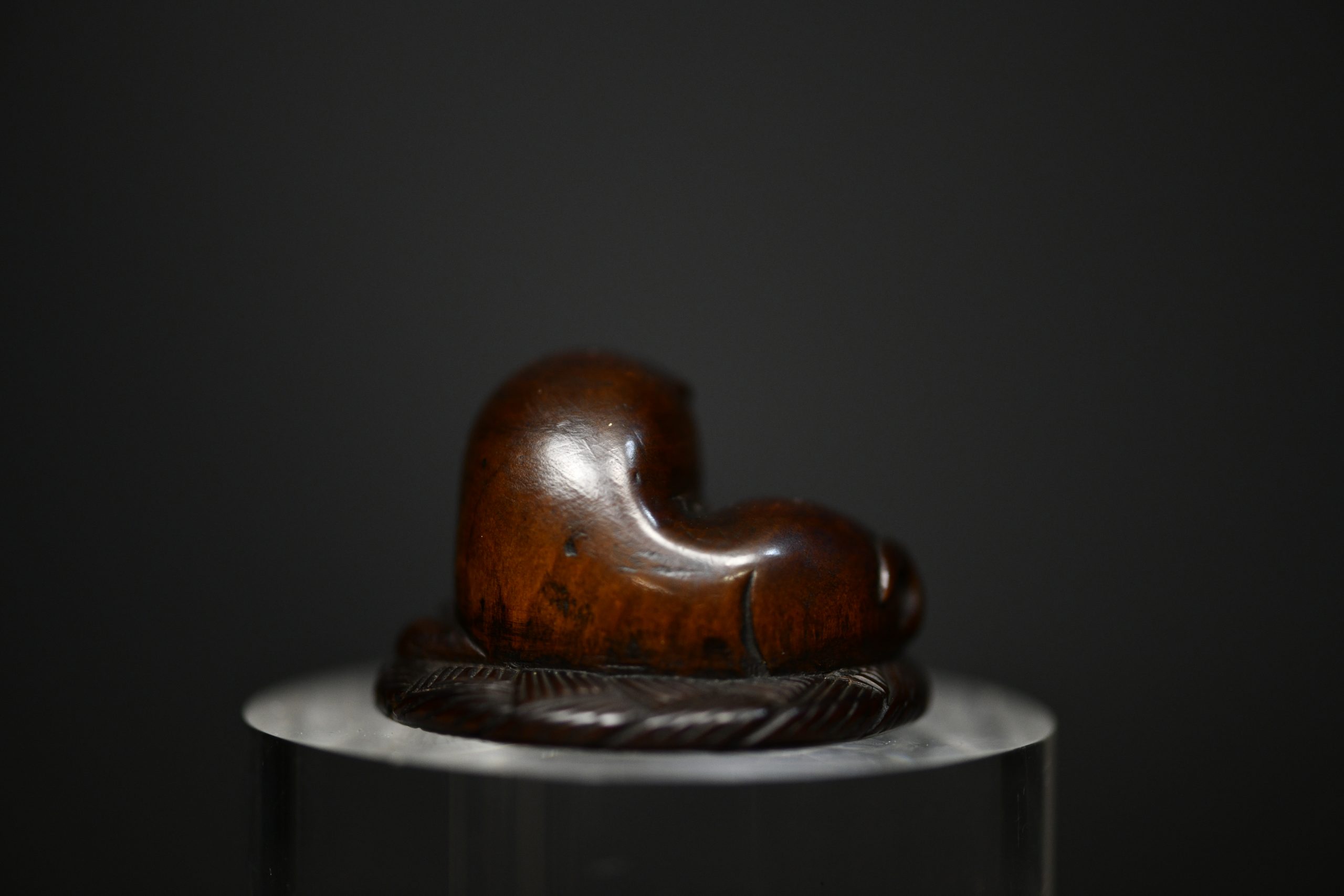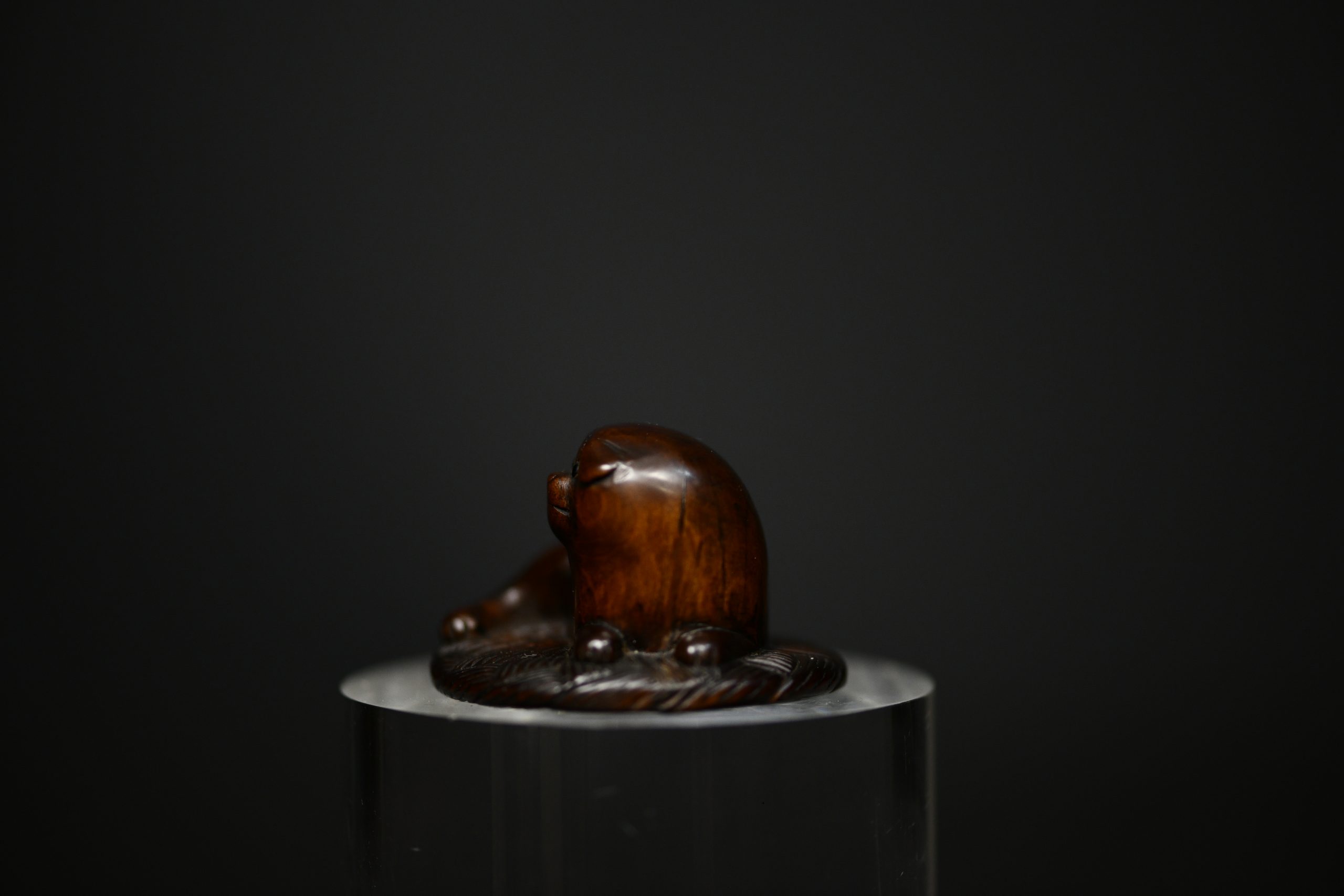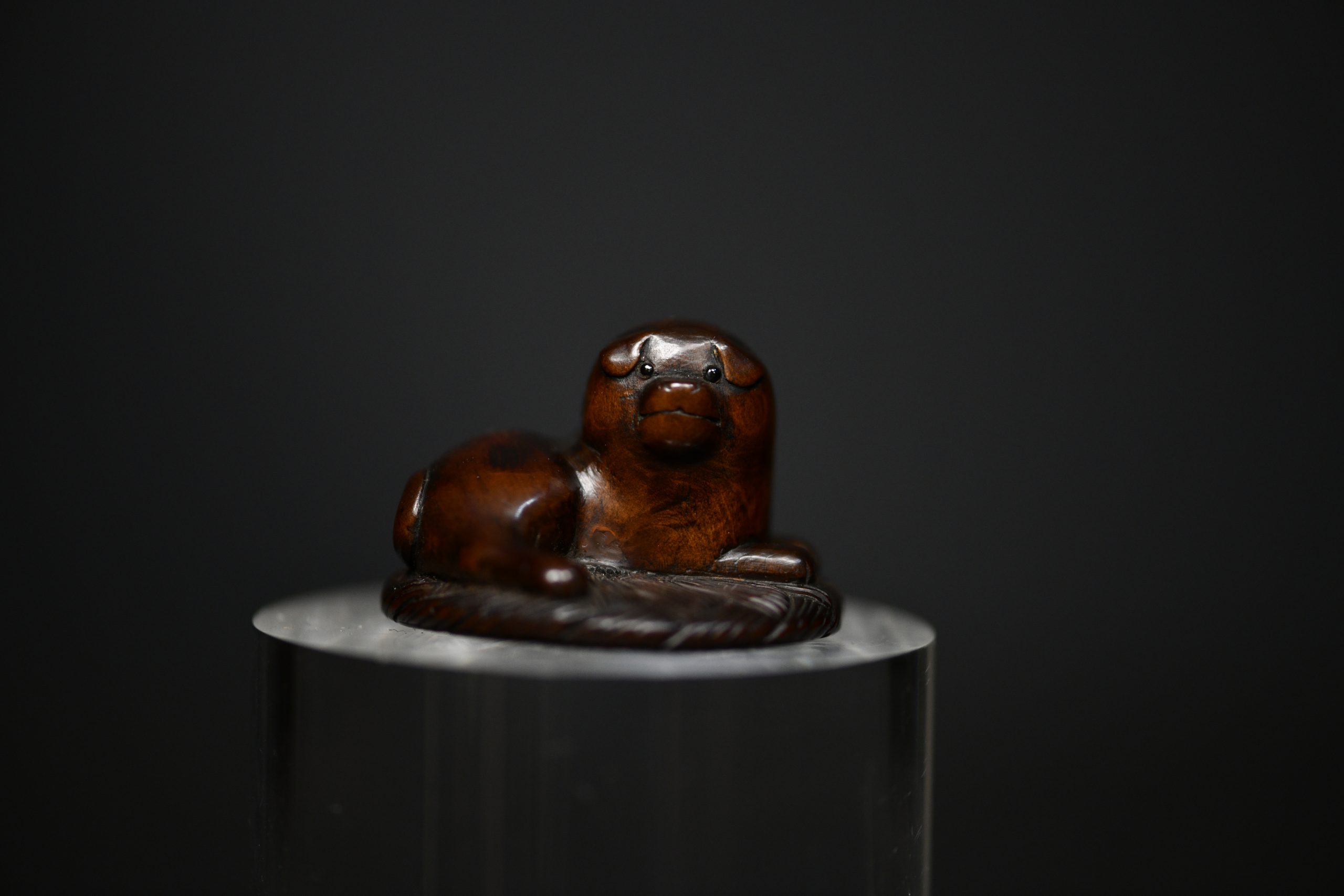
A charming signed Japanese wood netsuke depicting a resting dog, carved during the second half of the 19th century. The animal lies comfortably upon a mat in a compact and gently humorous composition, combining natural observation with the tactile, rounded qualities characteristic of traditional netsuke carving.
The dog’s relaxed posture and expressive face give the piece an immediate sense of personality. Its eyes are set with black horn inlays, providing a striking contrast against the warm tone of the wood and bringing additional life to the expression.
The surface has developed an attractive mature patina and rich coloration through age and handling. The base bears an incised signature, although no specific reading or maker attribution is introduced here without reliable supporting documentation.
The netsuke depicts a dog in a calm resting position, its body settled closely onto the mat beneath it.
Rather than portraying the animal in motion, the carver has chosen a quiet domestic moment. The relaxed posture creates a softer and more intimate character than the energetic or alert poses frequently encountered in animal sculpture.
The result is both affectionate and slightly comical, with the compact body, expressive head and low horizontal composition giving the dog a strong sense of individuality.
Dogs occupy a long-standing place in Japanese visual culture as familiar domestic animals associated with companionship, loyalty and protection.
In miniature carving, they offered artists an opportunity to explore both naturalistic observation and humorous character.
The present example emphasizes the more intimate side of the subject: the animal is shown at rest rather than performing a dramatic action, making the sculpture feel particularly approachable and personal.
This quality is especially appropriate for a netsuke, an object historically intended to be handled at close range rather than viewed only from a distance.
The dog rests upon a clearly defined mat, which forms an important part of the overall composition.
The mat creates a stable visual base beneath the animal and reinforces the impression of a quiet domestic scene.
It also helps organize the carving into a compact, nearly square format, allowing the dog’s body to remain closely contained within the overall silhouette.
The relationship between animal and mat transforms the netsuke from a simple isolated animal study into a small narrative scene.
One of the most attractive details of the carving is the use of black horn inlays for the eyes.
The dark material contrasts clearly with the warmer brown surface of the wood, immediately drawing attention to the face.
This small but effective detail gives the dog’s expression additional depth and vitality without overwhelming the restrained character of the carving.
Inset eyes were frequently used by netsuke carvers to animate animal subjects, allowing a very small area of contrasting material to transform the expression of the entire figure.
Measuring only 4.2 × 4.2 × 3 cm, the netsuke condenses the resting animal and its mat into a compact sculptural volume.
The nearly equal length and width create a balanced, almost square footprint, while the relatively low height reinforces the relaxed posture of the dog.
This compact arrangement is particularly well suited to netsuke carving, minimizing fragile projecting elements while maintaining a fully three-dimensional composition.
The dog can be appreciated from multiple viewpoints, with the rounded body and base working together as a unified sculptural object.
The carving combines smoothly rounded surfaces with more precisely worked details around the face, limbs and mat.
The body is modelled with a soft, compact volume appropriate to the resting pose, while the face receives greater emphasis through the dark horn eyes and carefully defined features.
This contrast between broad sculptural modelling and smaller detailed areas gives the netsuke visual richness despite its limited scale.
The overall treatment remains controlled and cohesive, with no single element distracting from the relaxed character of the animal.
The netsuke is carved from wood with an attractive warm brown coloration.
The precise wood species has not been identified and should therefore remain unspecified without material analysis.
The surface displays a pleasing mature patina, with tonal variation that contributes significantly to the character of the piece.
Repeated handling over time can gradually polish exposed areas of a wooden netsuke, creating subtle differences in color and surface texture.
These qualities give antique wooden netsuke much of their distinctive tactile appeal.
Netsuke were originally functional objects rather than purely decorative miniatures.
Their compact size and rounded forms reflect the fact that they were intended to be worn with traditional Japanese clothing and regularly handled.
This resting dog is particularly successful as a tactile object because the body, mat and overall silhouette form a smooth, self-contained volume.
The warm patina further reinforces the connection between the object and its history of handling.
The netsuke bears an incised signature on the base.
The presence of the signature adds an important element for identification and future study.
However, no definitive reading or maker attribution is stated here without a reliable transcription or independent supporting documentation.
Until the inscription can be securely identified, the most accurate description is simply that the piece is signed on the base.
The netsuke dates to the second half of the 19th century.
This was a period of major change in Japan, during which traditional crafts continued to develop while the country moved from the late Edo era into the Meiji period.
Netsuke carving remained an important field of miniature sculpture, with artists continuing to produce animal, human, mythological and everyday-life subjects in wood and other materials.
The present dog belongs to this rich tradition of small-scale Japanese carving in which familiar subjects were transformed into highly personal sculptural objects.
One of the strongest qualities of the piece is its personality.
The resting posture immediately gives the animal a relaxed and almost humorous presence, while the black horn eyes intensify the expression.
Rather than relying on an elaborate narrative, the netsuke succeeds through observation of a simple everyday subject.
This ability to transform an ordinary animal into a memorable miniature sculpture is one of the enduring attractions of Japanese netsuke carving.
The netsuke should be considered in the context of its age and historical function as a handled object.
The wood shows an attractive mature patina and natural color variation consistent with an antique carving.
Any minor wear, surface variation or traces of historical handling visible in the photographs should be evaluated as part of the object’s preserved condition and history.
Please examine the detailed photographs carefully, as they form an important part of the description and provide the best record of the carving, signature, horn inlays, surface and overall condition.
This netsuke combines several qualities that make it particularly appealing to collectors of Japanese animal carving.
The resting dog provides an immediately engaging subject, balancing naturalistic observation with a gentle sense of humor.
The black horn eyes give the face strong character, while the mat transforms the animal into a complete miniature scene rather than an isolated figure.
Its warm mature patina adds tactile and historical appeal, while the signature on the base provides an additional point of interest for future study.
The compact dimensions and self-contained composition make it an especially successful example of how Japanese netsuke carvers transformed familiar domestic animals into expressive miniature sculptures.
A charming signed Japanese wood netsuke of a dog resting on a mat, dating to the second half of the 19th century. The relaxed and slightly comical animal is enhanced by black horn eye inlays, a warm mature wood patina and a compact sculptural composition measuring 4.2 × 4.2 × 3 cm. Signed on the base, the piece combines domestic intimacy, expressive character and the tactile qualities associated with traditional Japanese netsuke carving.

Order above 1.000,00 € gets free shipping.

Secure and hassle-free payment process.

Certificate of authenticity included.

Have questions? Contact us via WhatsApp.
Contact