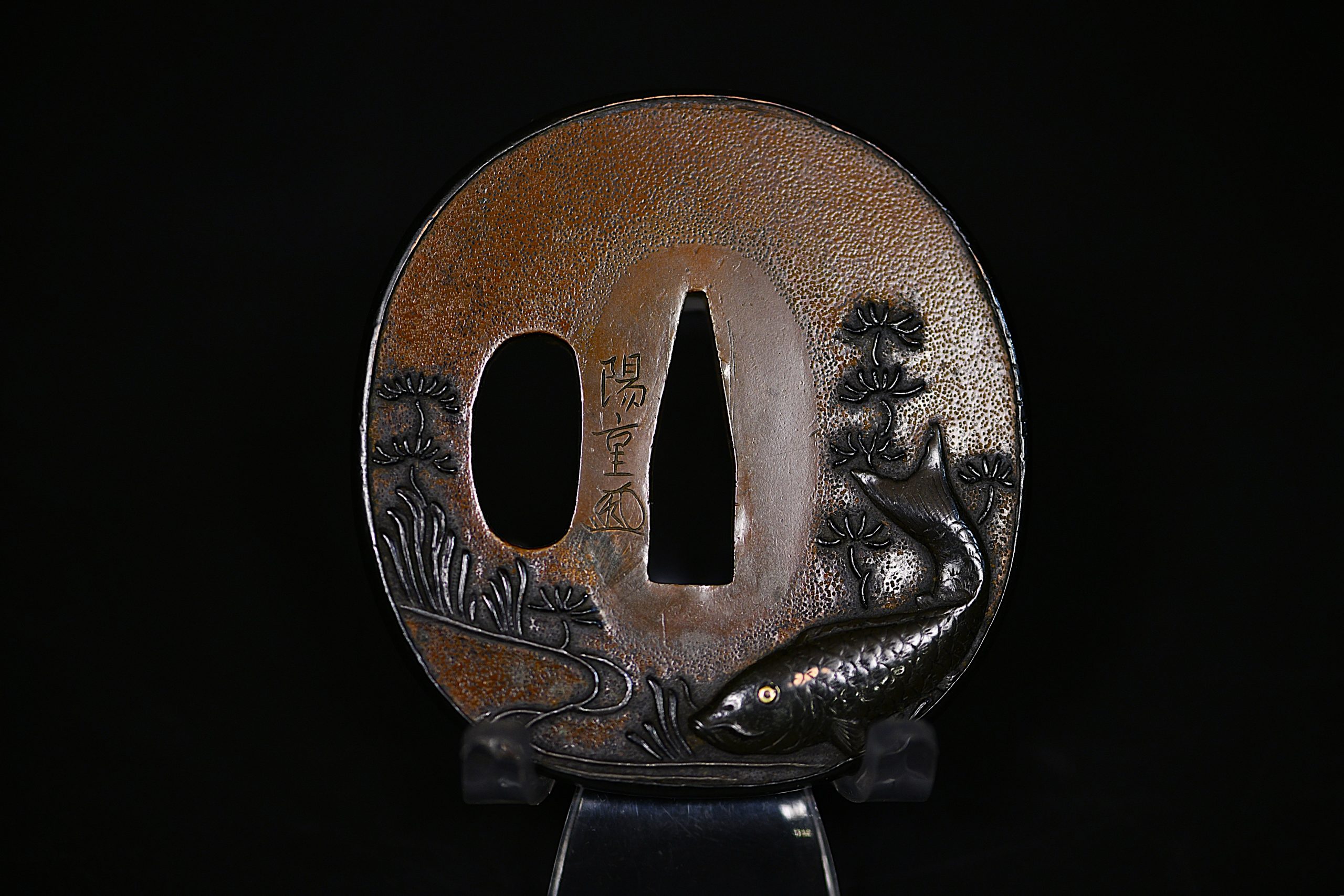
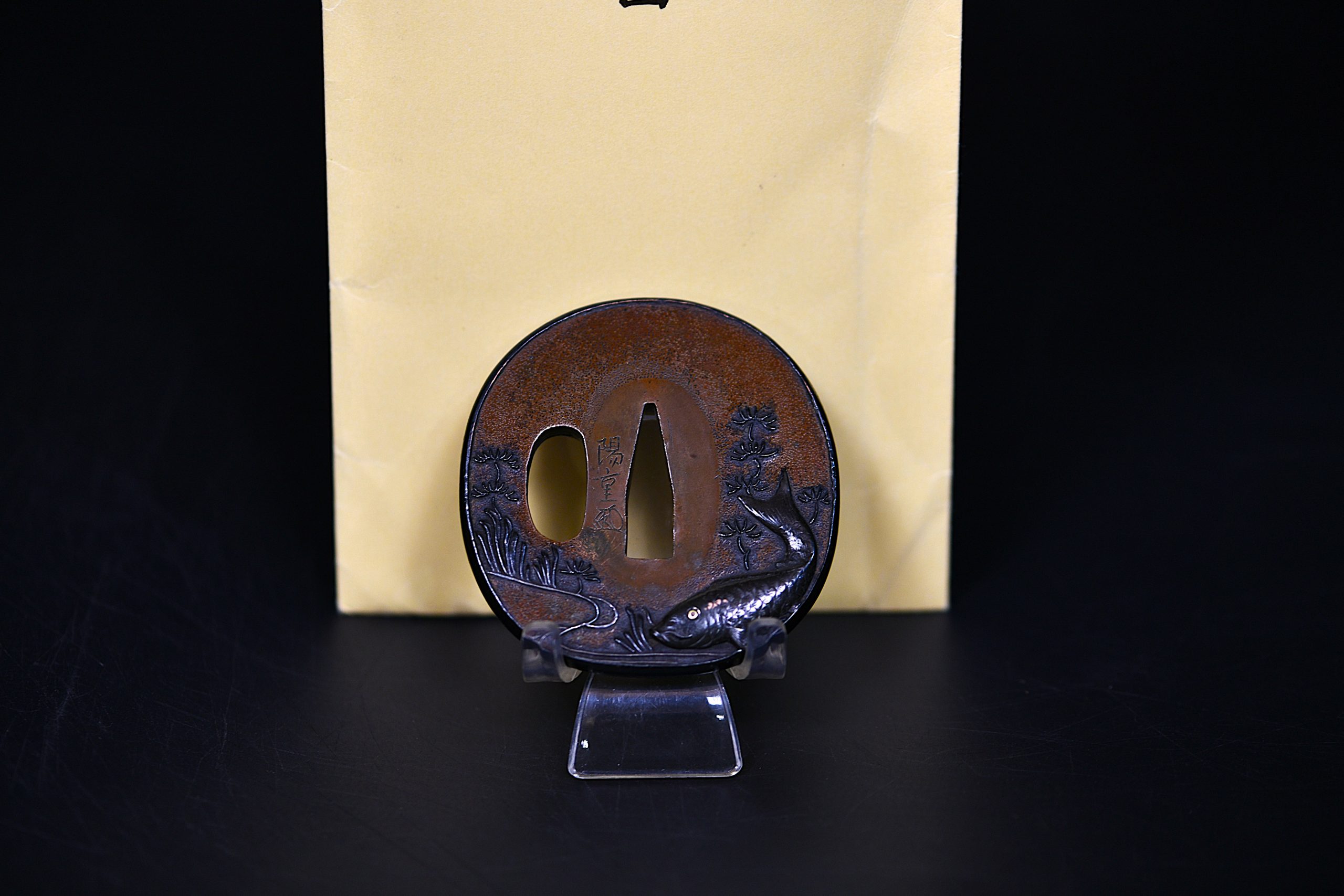
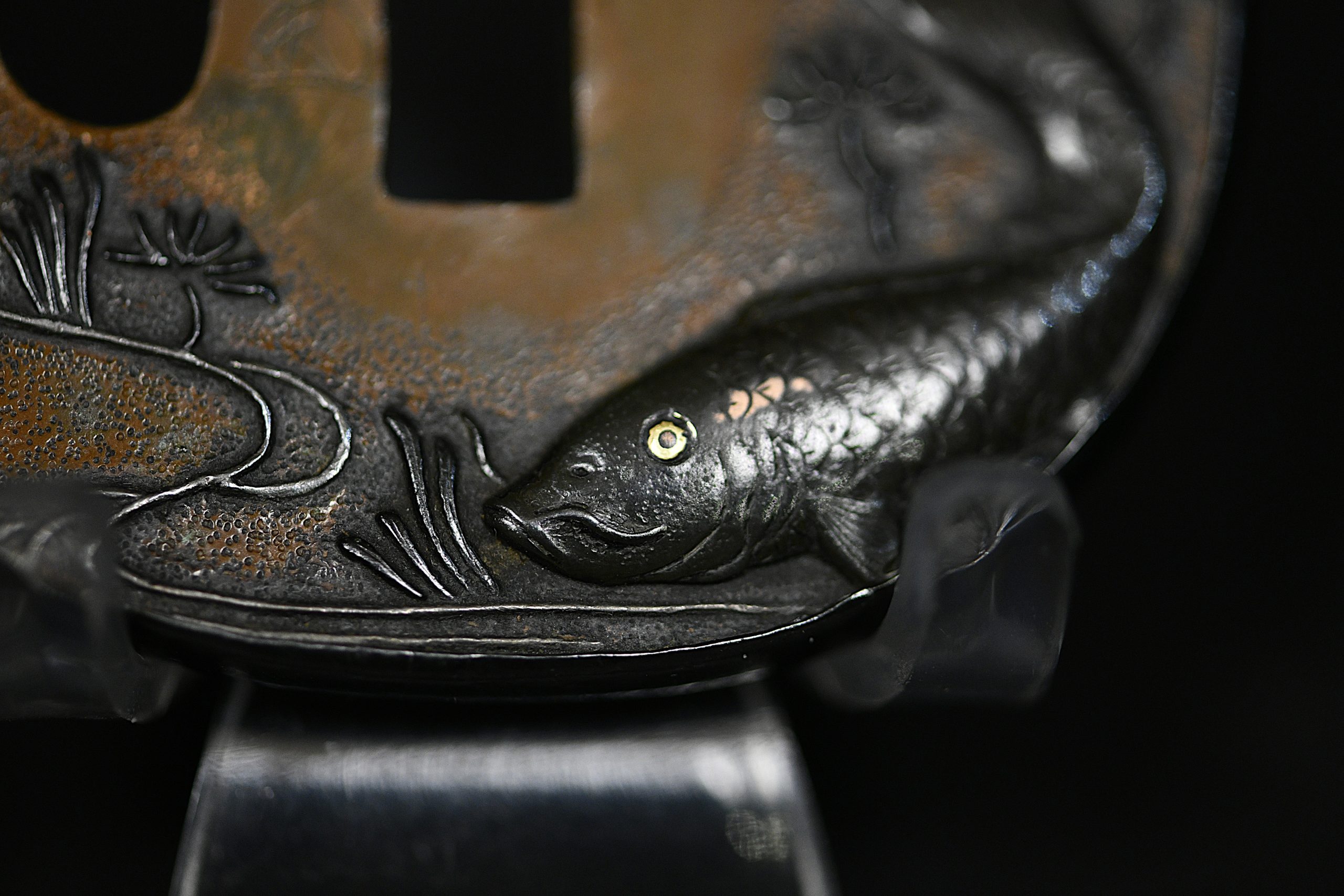
An exceptional signed Japanese marugata tsuba from the 19th century, worked in warm copper and surrounded by a contrasting shakudō rim. The plate is decorated with a finely modeled koi carp in relief, its eyes highlighted in gold, creating a sophisticated interplay between copper, dark shakudō and precious-metal detail.
The composition is both restrained and highly expressive. Rather than filling the entire surface with ornament, the artist allows the natural color and texture of the copper to become an important part of the design, while the koi emerges sculpturally from the plate.
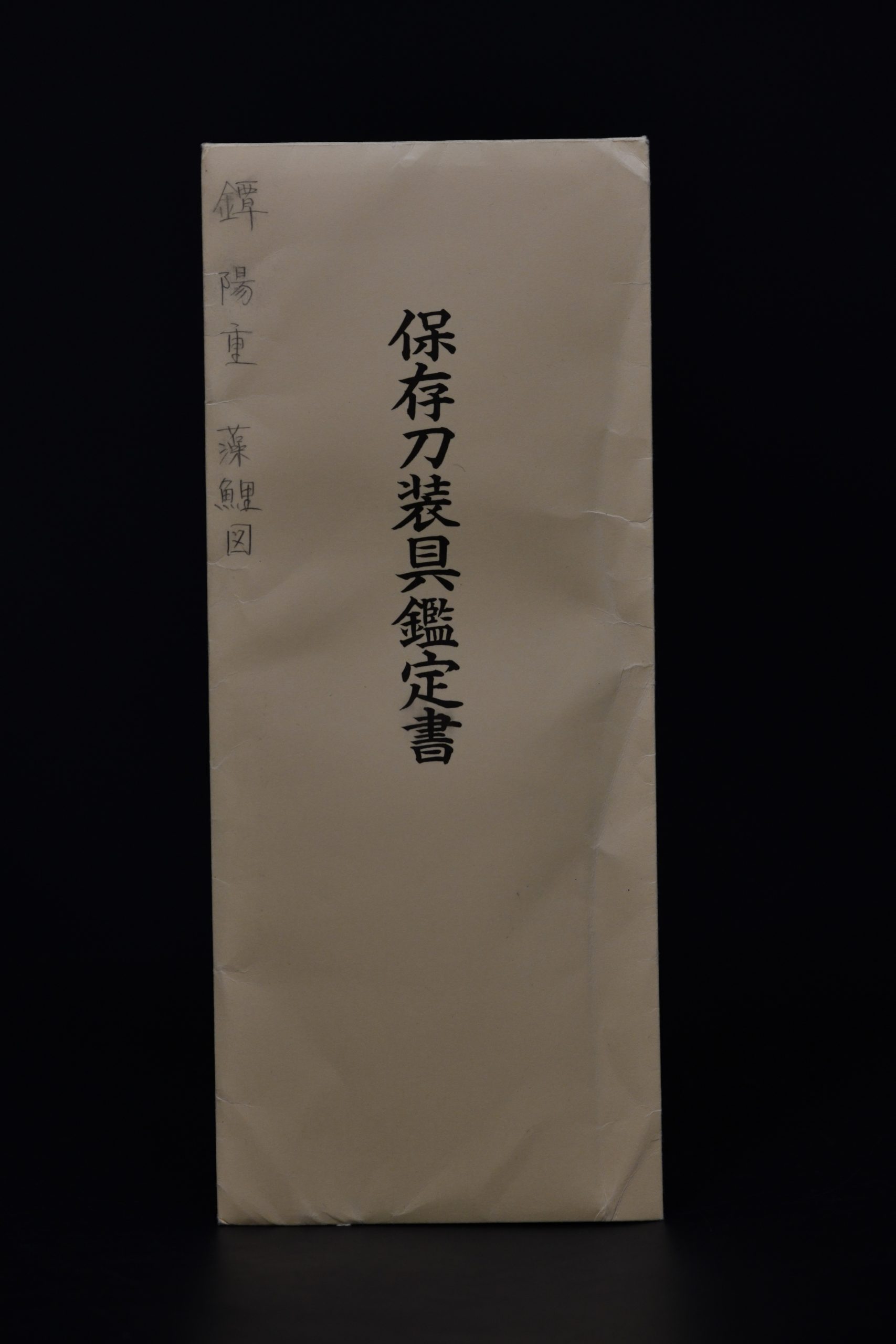
The tsuba is accompanied by an NBTHK Hozon certificate, a wooden storage box and a Supein Nihonto certificate of authenticity.
The koi carp is one of the most recognizable and enduring motifs in Japanese visual culture.
Carp are admired for their strength, persistence and ability to move against powerful currents. For this reason, they became closely associated with qualities such as perseverance, determination and resilience.
Within Japanese art, the koi appears in paintings, woodblock prints, lacquerware, ceramics, textiles and sword fittings.
Its flowing body and powerful movement make it especially well suited to metalwork, where the sculptor can use relief, surface texture and changing depth to suggest movement through water.
The cultural significance of the carp is also connected with the East Asian legend of a carp that succeeds in swimming upstream and passing the Dragon Gate, after which it transforms into a dragon.
The story made the carp an enduring symbol of perseverance rewarded through transformation.
For a samurai object, these associations with endurance, resolve and overcoming adversity would have made the koi an especially appropriate decorative subject.
The motif should therefore be understood not simply as an image of a fish, but as part of a broader artistic vocabulary of strength and persistence.
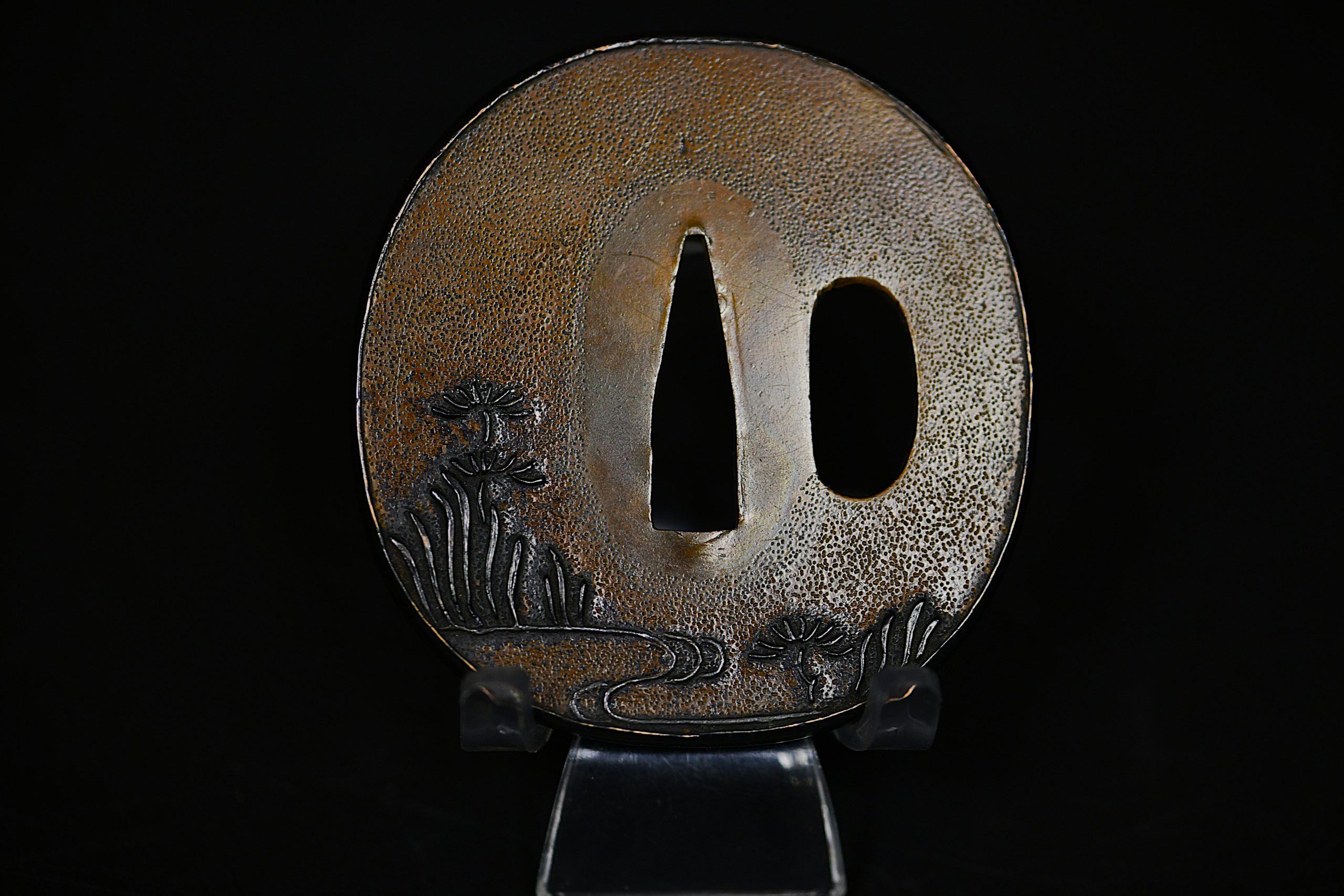
The tsuba is of marugata form, meaning that the overall outline is essentially circular.
This classical shape creates a balanced visual field for the decoration.
The circular profile allows the koi to become the principal sculptural element without competing with an elaborate outer silhouette.
The dark shakudō rim further emphasizes this geometry by clearly defining the perimeter of the copper plate.
The main body of the tsuba is fashioned from copper.
Copper was highly valued in Japanese sword fittings for its warm natural coloration and its ability to be worked into finely modeled surfaces.
In this example, the copper ground provides a rich visual contrast with the darker rim and the small areas of gold.
The material also gives the surface a softer and warmer character than an iron tsuba, allowing the relief decoration to emerge with particular subtlety.
The copper plate is surrounded by a shakudō rim.
Shakudō is a traditional Japanese copper-based alloy containing a small proportion of gold and is particularly valued for the deep dark surface that can be achieved through patination.
The dark border creates a strong but elegant frame around the warmer copper center.
This contrast between materials is one of the most successful aspects of the composition, giving the tsuba visual depth without excessive ornamentation.
The koi is worked in pronounced relief, allowing its body to rise physically from the surface of the plate.
This treatment gives the fish a sculptural presence and allows light to move across the body differently depending on the viewing angle.
The curvature of the body creates a sense of movement, suggesting the carp swimming through an implied aquatic environment even without an extensively detailed background.
The relief therefore becomes both decorative and spatial, transforming the otherwise flat guard into a miniature sculptural composition.
The eyes of the koi are highlighted in gold.
Although these details are small, they become immediate focal points because of the contrast between the bright metal and the surrounding copper.
Such restrained use of precious-metal detail is particularly effective on Japanese sword fittings.
Rather than covering the object in gold, the maker uses it selectively to animate the subject and direct the viewer’s attention toward the fish’s face.
One of the defining qualities of the tsuba is the controlled combination of three distinct metallic appearances.
The warm copper forms the principal visual field.
The dark shakudō rim provides structure and contrast.
The gold details introduce small points of brilliance.
Together, these materials create a sophisticated palette that is characteristic of the refined metalworking tradition associated with Japanese sword fittings.
The tsuba is signed.
The presence of a signature forms an important part of the object’s study and documentation.
No specific reading or maker attribution is introduced here beyond the information supported by the supplied documentation.
The signature should therefore be considered together with the accompanying NBTHK Hozon certificate when assessing the piece.
The tsuba dates to the 19th century, a period during which Japanese metalworkers continued to produce highly sophisticated sword fittings combining functional design with increasingly refined artistic expression.
Tsuba were originally an integral component of the Japanese sword, positioned between the blade and the hilt to protect the hand.
Over centuries, however, their surfaces also became an important field for artistic experimentation.
Metalworkers developed complex combinations of alloys, relief carving, inlay, patination and symbolic imagery, transforming functional sword guards into highly accomplished miniature works of art.
The term tosogu refers collectively to the metal fittings associated with the Japanese sword.
Within this tradition, the tsuba is often the largest and most visually prominent individual component.
Its relatively broad surface allowed craftsmen to explore subjects drawn from nature, mythology, literature, religion and everyday life.
The present koi design belongs firmly within this tradition of translating culturally meaningful natural subjects into sophisticated metalwork.
The tsuba is accompanied by an NBTHK Hozon certificate.
The Nihon Bijutsu Tōken Hozon Kyōkai (NBTHK) is the Japanese organization dedicated to the preservation and study of Japanese art swords and related sword fittings.
Japanese sword fittings may be submitted to the NBTHK for formal examination, or shinsa.
The Hozon designation identifies the piece as worthy of preservation under the organization’s certification system.
This distinction should not be confused with Tokubetsu Hozon, which represents a separate and higher certification category.
The presence of NBTHK documentation provides an important independent reference for the study and collection of the tsuba.
The tsuba is accompanied by a wooden storage box.
Traditional boxes provide a practical method of protecting Japanese sword fittings when they are not mounted or displayed.
The inclusion of the box also allows the tsuba and its documentation to be kept together as a complete collectible ensemble.
These proportions create an almost circular profile typical of the marugata form.
As an original 19th-century Japanese sword fitting, the tsuba should be evaluated in the context of its age and historical use.
Natural surface variation, patination and minor signs of handling are consistent with an antique metalwork object and contribute to its historical character.
Please examine the detailed photographs carefully, as they form an important part of the description and provide the best record of the preserved surface, relief work, signature and overall condition.
This tsuba combines several qualities that make it particularly attractive to collectors of Japanese sword fittings.
The koi subject provides immediate visual appeal while connecting the work with one of the enduring symbolic motifs of Japanese art.
The copper plate, dark shakudō rim and restrained gold highlights create an elegant and sophisticated material contrast.
The relief carving gives the carp a strong sculptural presence, while the nearly circular marugata form keeps the overall composition balanced and harmonious.
Its signed status and accompanying NBTHK Hozon certificate add an important documentary dimension, while the wooden box and Supein Nihonto certificate complete the presentation.
The result is a refined example of 19th-century Japanese metalwork in which subject, material and technique are carefully integrated into a compact work of art.
A refined signed Japanese marugata tsuba from the 19th century, fashioned from warm copper and bordered by a contrasting shakudō rim. A koi carp emerges from the surface in sculptural relief, with its eyes selectively highlighted in gold. The composition combines one of the most enduring motifs of Japanese art with the sophisticated metalworking techniques of the tosogu tradition. Measuring 7.4 × 7.2 cm, the piece is accompanied by an NBTHK Hozon certificate, a wooden storage box and a Supein Nihonto certificate of authenticity.

Order above 1.000,00 € gets free shipping.

Secure and hassle-free payment process.

Certificate of authenticity included.

Have questions? Contact us via WhatsApp.
Contact