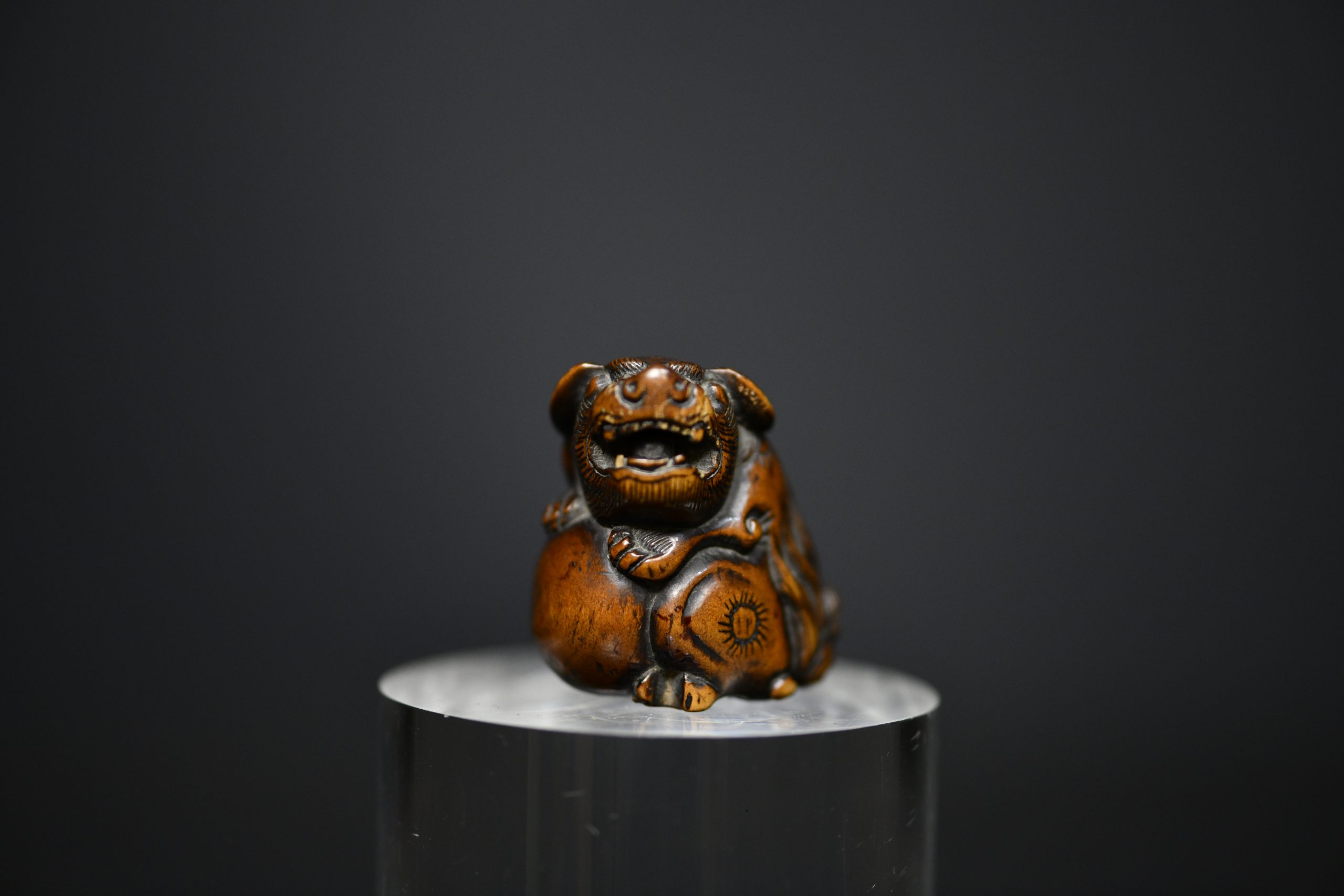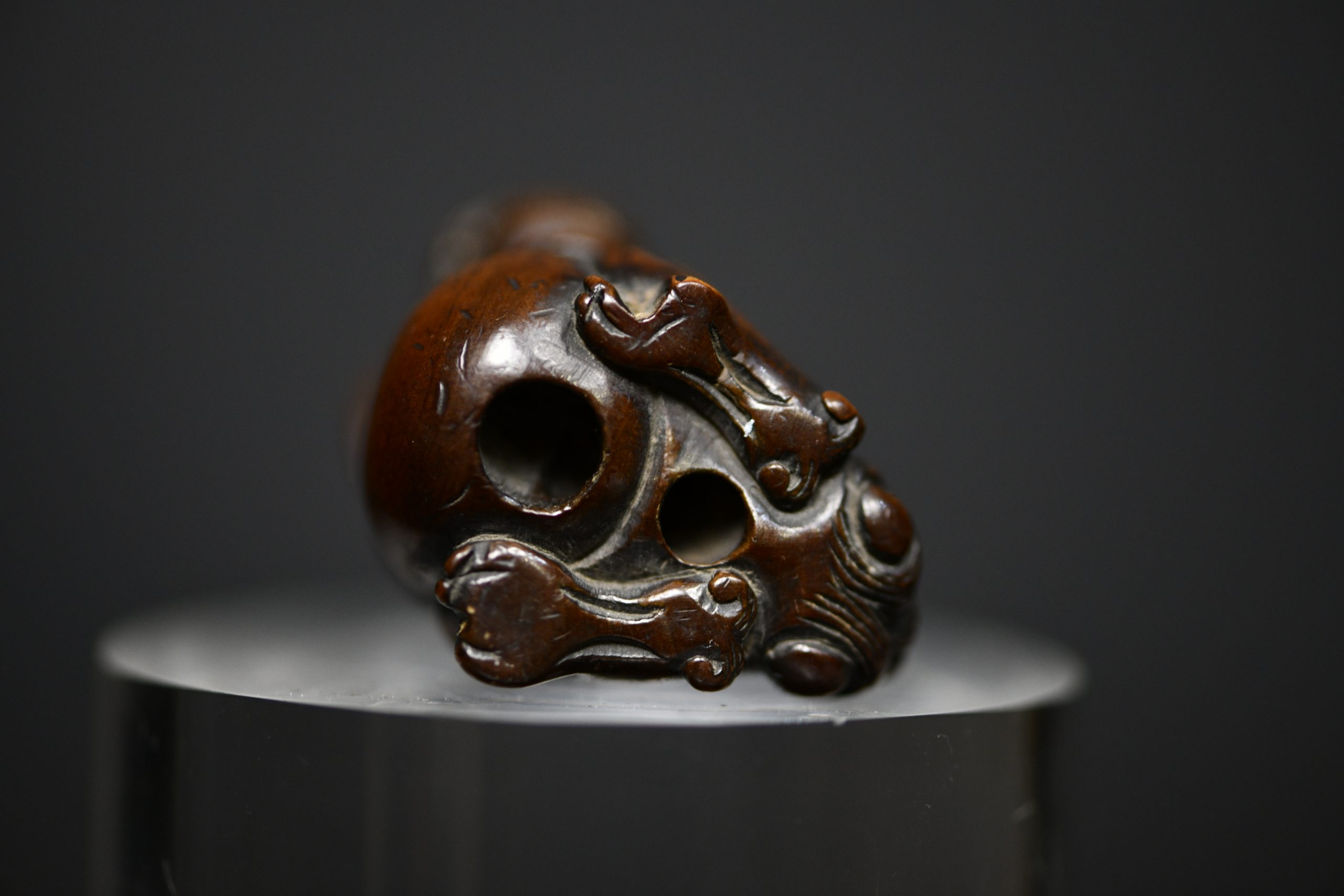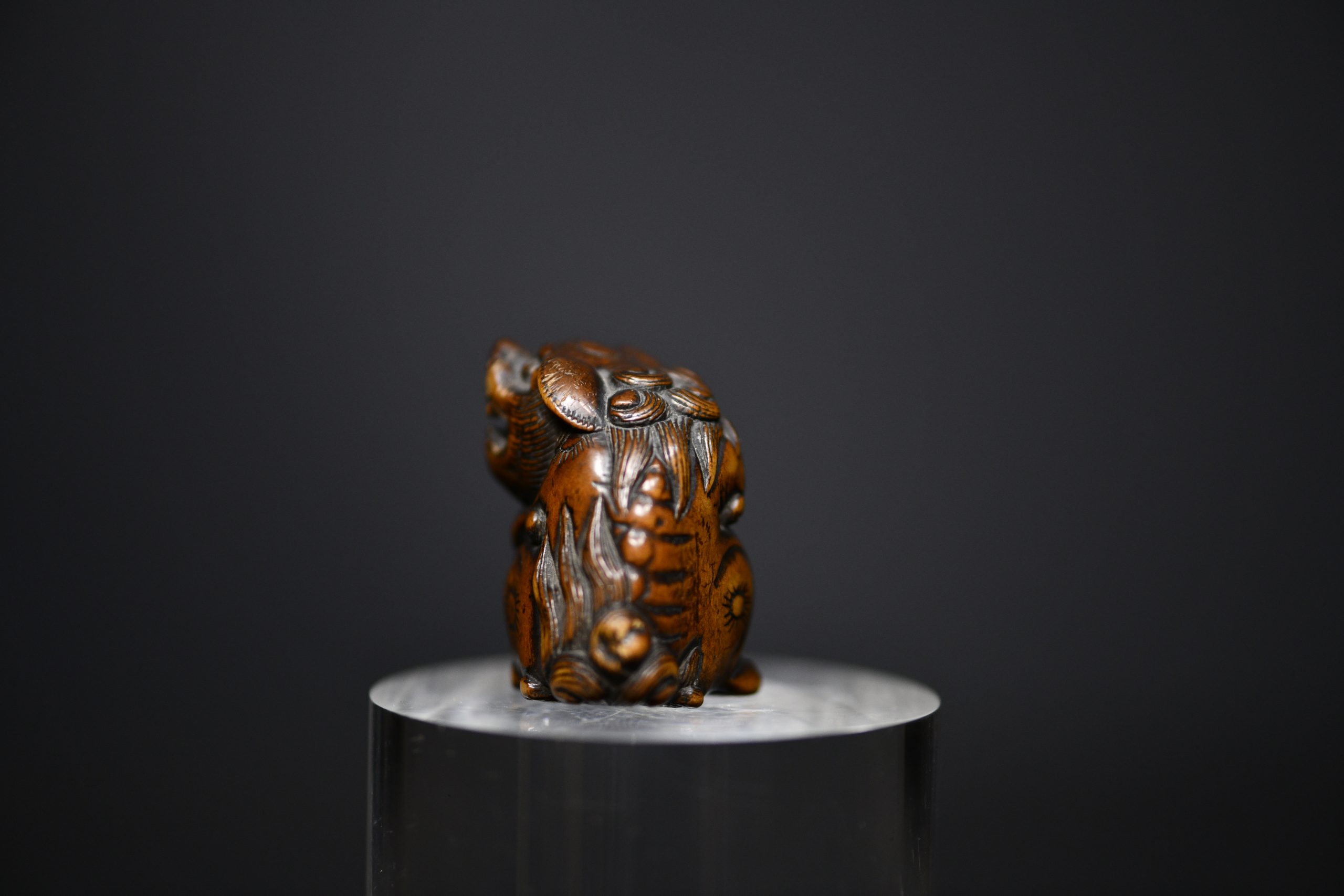

A charming antique Japanese wood netsuke depicting a shishi with a ball, dating to the Edo period. Compact, expressive and strongly sculptural, the carving combines one of the most recognizable protective creatures in Japanese art with the intimate scale and tactile qualities characteristic of traditional netsuke.
The piece has developed a particularly attractive warm patina through age and handling and remains in good overall condition.
One of its most engaging details is the small wooden ball positioned within the open mouth, giving the carving an additional sense of playfulness and movement.
The shishi is a mythical lion-like guardian that occupies an important place in Japanese Buddhist and decorative art.
Derived ultimately from traditions of lion imagery transmitted across Asia, the shishi became deeply integrated into Japanese visual culture and appears in temple architecture, sculpture, painting, lacquerware, metalwork and netsuke.
Shishi are generally represented as powerful, energetic creatures with broad heads, curling manes and expressive features.
Their appearance is not intended as a naturalistic representation of a real lion. Instead, the form developed into a highly stylized supernatural guardian combining strength, vitality and protective symbolism.
In Japanese art, shishi are strongly associated with protection and the repelling of harmful influences.
Pairs of lion-like guardians are frequently encountered at religious sites and entrances, where their presence traditionally signifies protection of sacred or important spaces.
When translated into the much smaller format of a netsuke, this powerful protective imagery becomes a personal and tactile object.
The result is an appealing combination of symbolic strength and miniature craftsmanship.
The association of a shishi with a ball is an established decorative theme within East Asian art.
The spherical form provides an effective visual counterpoint to the organic, animated body of the guardian lion.
In miniature sculpture, the combination is particularly successful because the rounded ball helps create a compact and balanced composition.
In the present netsuke, this theme is complemented by the unusual small wooden ball held within the mouth, adding another playful element to the design.
A distinctive feature of this carving is the small wooden ball visible inside the shishi’s open mouth.
This detail draws immediate attention to the expressive head and introduces an element of technical interest into the carving.
The contrast between the open jaws and the rounded ball gives the face additional depth and helps emphasize the animated character of the creature.
Rather than appearing static, the shishi feels active and playful, qualities frequently associated with successful netsuke carving.
At only 3.8 cm in height, the netsuke demonstrates how a complex subject could be condensed into a remarkably small sculptural format.
The compact dimensions are particularly appropriate for the shishi, whose powerful body can be arranged into a tightly unified form.
This concentration of volume makes the carving visually effective from close range and gives it the tactile quality expected from a traditional netsuke.
As with many successful netsuke, the piece is conceived as a three-dimensional object rather than simply as an image viewed from one direction.
Wood was one of the most important materials used by Japanese netsuke carvers.
It offered sufficient strength for practical use while allowing the artist to create subtle modeling, expressive facial features and carefully rounded forms.
Wood also changes gradually through prolonged handling.
Over generations, contact with the hand and clothing can soften the surface and produce a deeper, richer tone.
The attractive patina visible on this example contributes significantly to its character as an antique object.
The netsuke displays a pleasant mature patina associated with age and historical handling.
For collectors of Japanese miniature sculpture, such surface development is an important part of the visual and tactile character of an antique wooden netsuke.
A naturally developed patina can emphasize the high points of the carving, soften transitions and create subtle differences in tone across the surface.
These characteristics contribute to the sense that the piece has existed as a handled object rather than merely as a static decorative sculpture.
The piece dates to the Edo period (1603–1868), the great historical period during which netsuke developed into one of Japan’s most distinctive forms of miniature sculpture.
Traditional Japanese garments such as the kimono did not contain pockets in the modern sense.
Small personal containers and accessories could therefore be suspended from the obi, with the netsuke functioning as the compact toggle that prevented the cord from slipping through the sash.
From this practical function developed an extraordinary artistic tradition in which carvers explored an enormous variety of subjects.
Although netsuke originated as functional objects, their small surfaces quickly became an important field for artistic expression.
Animals and mythological creatures were especially well suited to the format because their bodies could be compressed, curled or folded into compact sculptural compositions.
The shishi is a particularly successful netsuke subject because its naturally energetic form, stylized mane and expressive face can be adapted to a wide variety of poses.
The present example combines this established subject with the playful motif of the ball.
One of the most appealing qualities of shishi netsuke is the combination of power and playfulness.
Although the creature derives from protective religious imagery, netsuke carvers frequently emphasized exaggerated expressions and lively gestures.
The result can appear simultaneously fierce, humorous and animated.
The small ball within the mouth reinforces this lively quality and gives the carving an especially engaging personality.
Netsuke were designed to be experienced not only visually but physically.
Their rounded surfaces, compact scale and carefully carved details encouraged close examination and handling.
Wooden examples are particularly satisfying in this respect because the material gradually responds to contact over time.
The mature surface of this netsuke therefore forms part of its history and contributes to the character that distinguishes an antique carving from a newly produced decorative object.
The netsuke remains in good overall condition.
The wood displays an attractive patina consistent with age and handling.
Any minor variations or surface traces visible in the photographs should be considered within the context of an antique Edo-period object that was historically intended to be handled.
Please examine the detailed photographs carefully, as they form an important part of the description and provide the best record of the preserved carving, surface and condition.
These compact proportions are entirely suited to the traditional netsuke format and give the carving a strong sense of concentrated volume.
This netsuke combines several features that make it particularly appealing to collectors of Japanese miniature sculpture.
The shishi is one of the classic supernatural animals of Japanese art, immediately recognizable through its powerful guardian imagery and expressive character.
The ball motif adds an established decorative theme, while the small wooden ball contained within the mouth gives the carving an unusual and memorable detail.
The warm patina provides visible evidence of age and handling and enhances the tactile quality of the wooden surface.
Its compact dimensions, Edo-period dating and lively subject make it an attractive example of the ability of netsuke carvers to transform powerful religious and mythological imagery into highly personal miniature objects.
A charming antique Japanese wood netsuke depicting a shishi with a ball, dating to the Edo period. The guardian lion is presented in a compact sculptural composition with an attractive mature patina and a distinctive small wooden ball held within its open mouth. Combining protective symbolism, playful character and the tactile qualities of traditional Japanese miniature carving, the piece remains in good overall condition and measures 3.8 × 3.5 × 2.8 cm.

Order above 1.000,00 € gets free shipping.

Secure and hassle-free payment process.

Certificate of authenticity included.

Have questions? Contact us via WhatsApp.
Contact