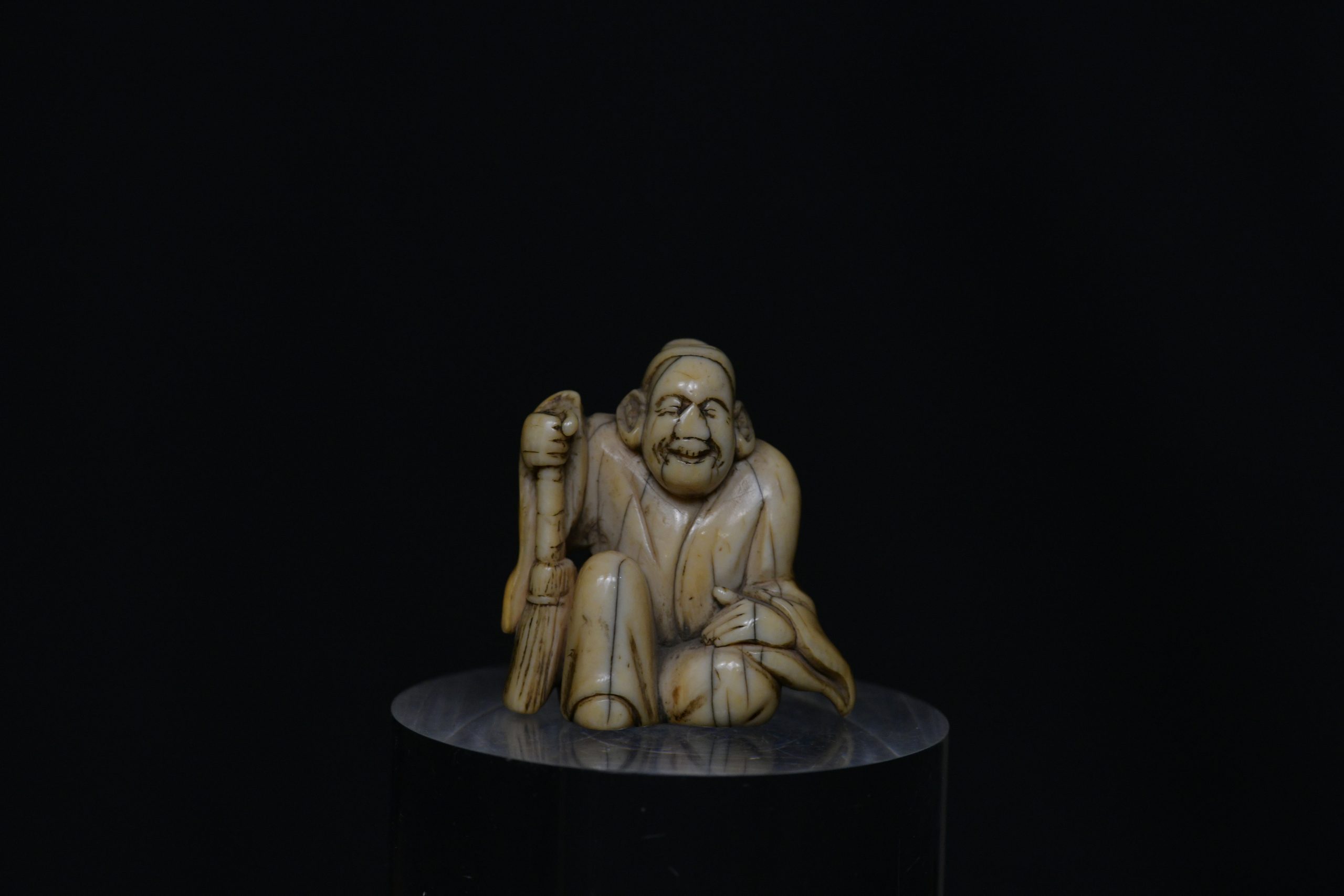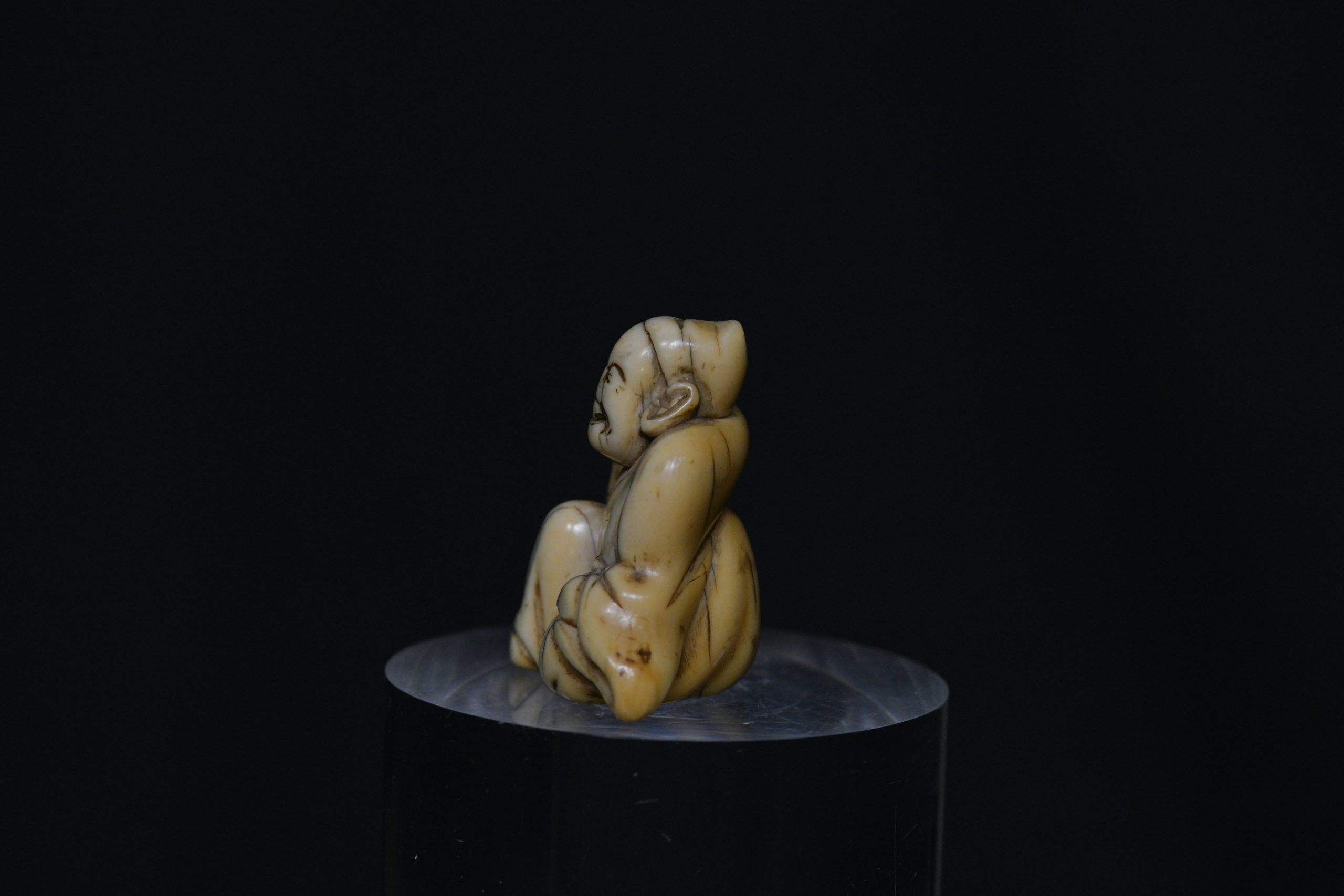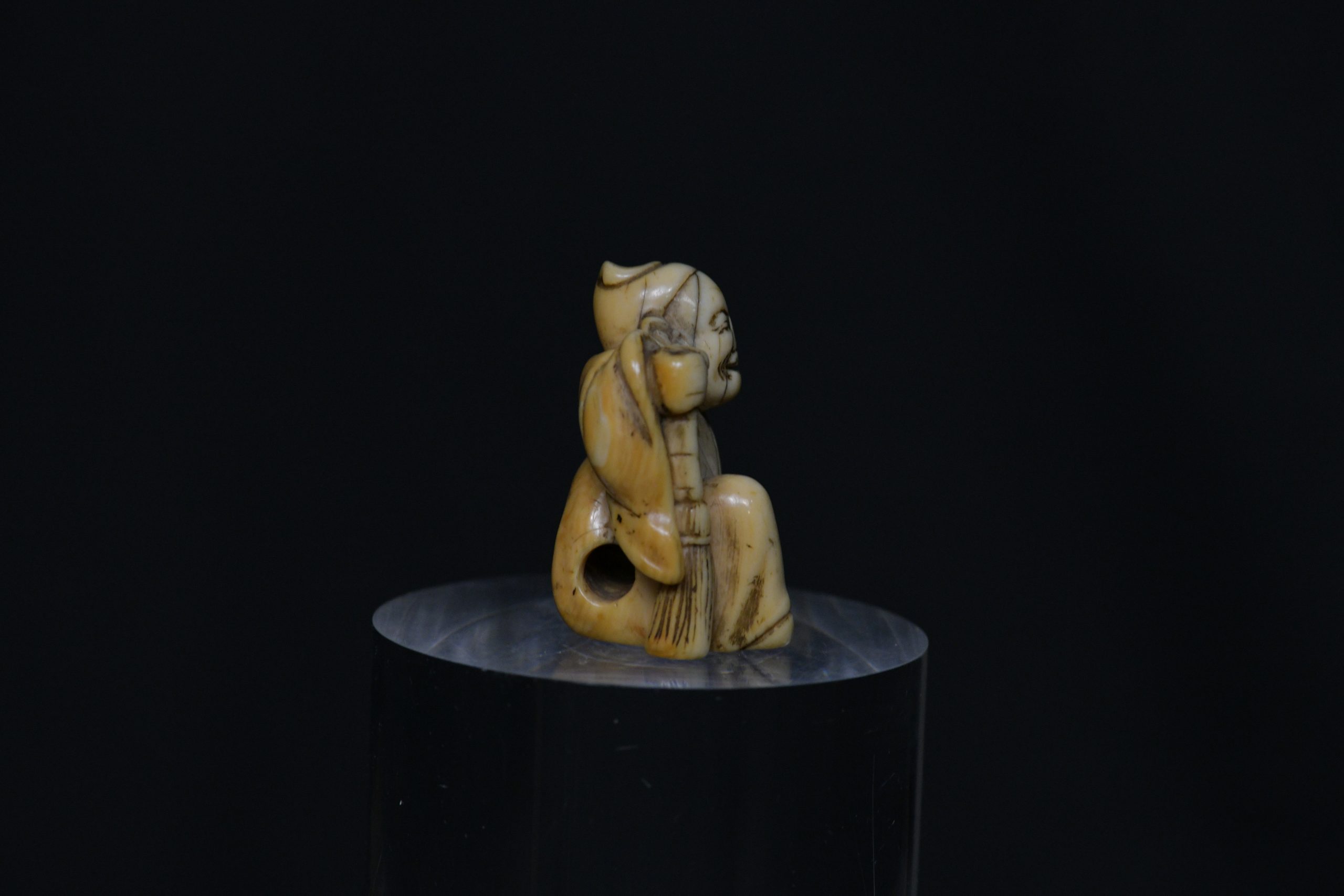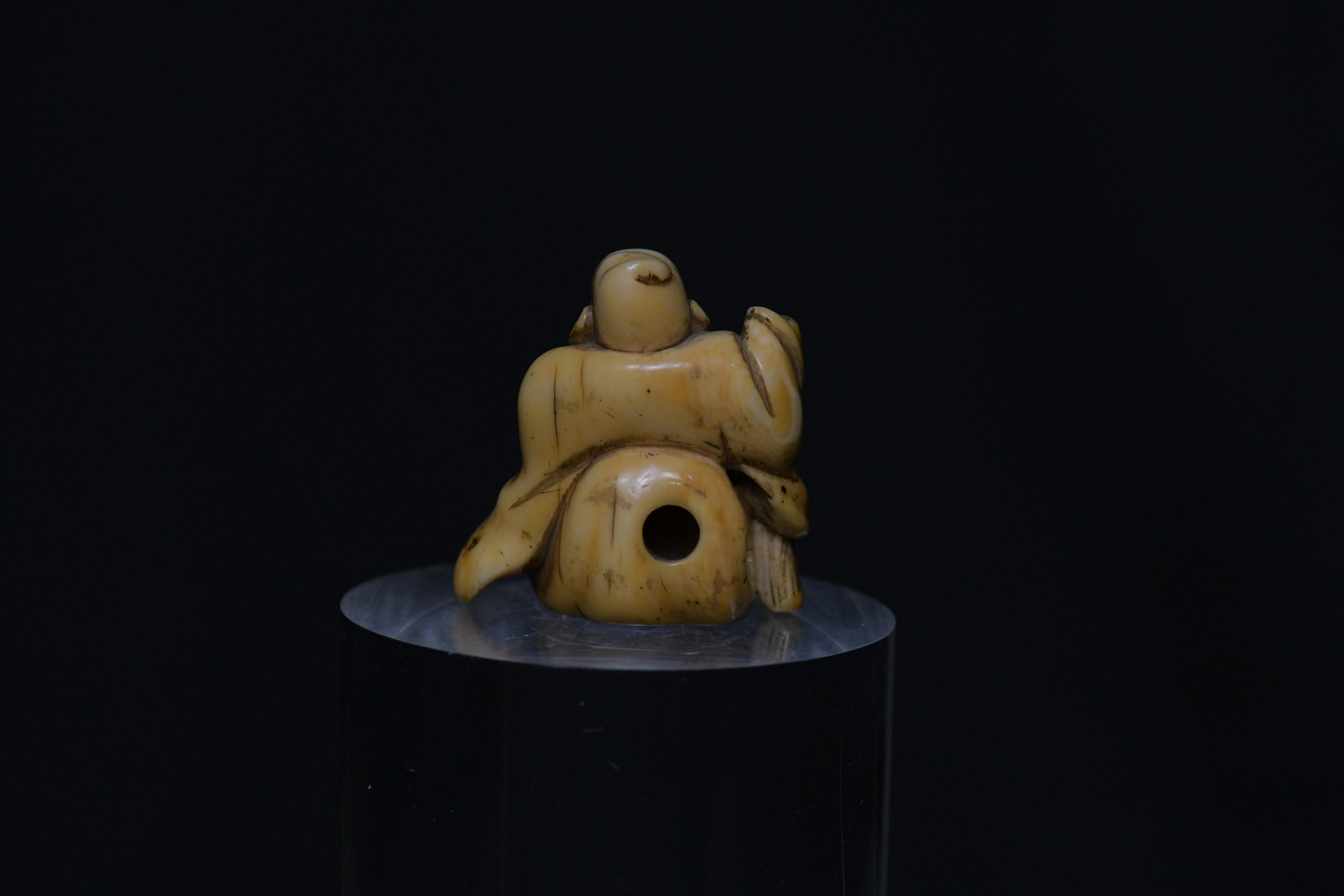
A distinctive antique Japanese ivory netsuke depicting a seated elderly man, holding what appears to be a fly whisk or fly-scaring implement. The piece dates to the Edo period and is recorded in its CITES documentation as a 19th-century object.
The ivory has developed a particularly attractive warm mature patina, together with natural markings and tonal variation that give the carving considerable visual depth. The face and other exposed areas display noticeable smoothing and wear consistent with prolonged historical handling.
A seal-like stamp or device is present on the base. This is an important feature of the piece and may indicate an additional practical function, although its precise historical use should remain open unless supported by further documentary evidence.
The netsuke is accompanied by both a certificate of appraisal and CITES documentation.
The subject is an elderly man represented in a seated position, his compact body arranged close to the base in a composition well suited to the small scale of a netsuke.
The face carries much of the character of the piece, with the effects of age and repeated handling softening some of the exposed details and giving the figure a distinctly lived-in appearance.
Rather than relying on an elaborate narrative, the carving draws much of its expressive power from the elderly figure’s posture, facial character and the object held in his hand.
The result is an intimate figural sculpture with a strong sense of age and personality.
The elderly figure holds a long implement described as a fly-scaring tool.
It can be conservatively described as a fly whisk or similar implement without assigning a more specific ritual or professional identity to the figure unless further evidence is available.
The accessory contributes significantly to the silhouette and gives the figure an additional narrative element.
Its inclusion distinguishes the subject from a simple seated portrait and suggests a specific activity or role, even if that precise identity cannot currently be established.
Measuring 4 × 3.7 × 2.5 cm, the netsuke condenses the seated figure and his implement into a compact sculptural volume.
The low seated posture allows the body to remain closely contained within the overall silhouette, reducing fragile projecting elements while preserving a fully three-dimensional composition.
This type of compact construction is particularly appropriate for netsuke, which were historically conceived as functional objects intended to be worn and regularly handled.
The figure remains engaging from multiple viewpoints, with the base, back and sides contributing to the complete sculptural form.
The netsuke is carved from ivory displaying a richly aged surface.
The material shows a warm patina together with visible natural markings and tonal variation, contributing significantly to the visual character of the piece.
Areas exposed to repeated handling, particularly the face and other projecting parts, show greater smoothing and wear.
These changes in surface texture are consistent with the history of a small object intended to be repeatedly touched and handled.
No more specific identification of the ivory source is proposed here without supporting material analysis or documentation.
One of the most notable characteristics of the netsuke is the visible wear on the face and other exposed areas.
This wear should be understood in the context of the object’s traditional function rather than treated simply as surface loss.
Repeated contact over long periods can gradually soften high points, polish exposed areas and create differences in tone between raised and recessed surfaces.
In this piece, these effects contribute to the mature appearance and tactile character of the carving.
The base bears a stamp or seal-like device, an unusual and particularly interesting feature.
Some early Japanese netsuke and related small personal objects could incorporate seal functions, allowing a sculptural object to serve more than one practical purpose.
In the present case, the presence of the base stamp raises the possibility that the piece may also have functioned as a seal.
However, without documentary evidence confirming how this particular object was used, it is preferable to describe the feature as a seal-like stamp rather than state definitively that it was used to sign official documents.
The combination of a figural netsuke with a seal-like element on the base makes the piece especially interesting from a functional perspective.
Netsuke were already practical objects within traditional Japanese dress, serving as toggles associated with items suspended from the obi.
If the base stamp was indeed used as a seal, the object may have combined this conventional netsuke function with an additional personal use.
This interpretation remains plausible but should be treated as a possibility rather than a documented certainty.
The accompanying CITES documentation records the piece as dating to the 19th century.
The netsuke is therefore catalogued here as an Edo-period work, probably from the early 19th century.
Its heavily aged appearance, mature patina and pronounced handling wear may visually suggest considerable age, and an earlier date has been considered possible.
However, appearance alone is not sufficient to establish an earlier chronology, so the documented 19th-century dating should remain the principal reference.
During the Edo period (1603–1868), netsuke served an important practical function within traditional Japanese dress while also developing into a sophisticated form of miniature sculpture.
Because garments such as the kimono did not contain pockets in the modern sense, small containers and personal accessories could be suspended from the obi.
The netsuke acted as a toggle, preventing the suspension cord from slipping through the sash.
Human figures were among the broad range of subjects explored by netsuke carvers, from everyday characters to figures drawn from religion, folklore, literature and popular culture.
The physical appearance of this piece reflects the tactile nature of traditional netsuke.
Its compact dimensions, rounded surfaces and evident wear all correspond to an object intended to be held and handled repeatedly.
The worn facial details and smooth exposed areas therefore form an important part of its preserved material history.
These qualities give the netsuke a visual character quite different from a miniature sculpture created exclusively for display.
The netsuke should be evaluated in the context of its age and historical use.
The ivory displays a mature patina, natural markings and visible wear to the face and other exposed areas from prolonged handling.
These characteristics are important to the appearance and history of the piece.
Please examine all detailed photographs carefully, as they form an essential part of the description and provide the best record of the carving, ivory surface, wear, base stamp and overall condition.
Dimensions: 4 × 3.7 × 2.5 cm
The piece is accompanied by a certificate of appraisal.
This documentation forms part of the current record of the object and should be retained together with the netsuke and its CITES documentation.
The netsuke is accompanied by CITES documentation.
Regulations governing the sale, import, export and shipment of ivory vary according to destination and applicable legislation.
CITES documentation does not automatically guarantee that sale, shipment or import is permitted in every country or jurisdiction.
Please contact us before purchasing so that shipping availability and any applicable documentation requirements can be reviewed for the destination country.
This netsuke combines several features of particular interest to collectors of early Japanese miniature carving.
The seated elderly figure is expressive and highly tactile, while the warm ivory patina and extensive handling wear give the surface considerable age and character.
The seal-like device on the base adds an unusual functional dimension and raises the possibility that the object may have served more than one practical role.
The certificate of appraisal and accompanying CITES documentation also form important parts of the piece’s current documentary record.
Its Edo-period dating, distinctive figural subject, richly aged ivory and unusual base stamp make it a particularly interesting example of Japanese figural netsuke carving.
A distinctive Edo-period Japanese ivory netsuke depicting a seated elderly man holding a fly whisk or fly-scaring implement. Recorded by its CITES documentation as a 19th-century object, the carving displays a richly developed patina, natural ivory markings and pronounced wear from historical handling. A seal-like stamp on the base adds an unusual possible secondary function, while the accompanying appraisal certificate and CITES documentation form an important part of the object’s current record. Dimensions: 4 × 3.7 × 2.5 cm.

Order above 1.000,00 € gets free shipping.

Secure and hassle-free payment process.

Certificate of authenticity included.

Have questions? Contact us via WhatsApp.
Contact