Personal thoughts on a small ivory carving, its expression, and the pleasure of looking slowly.
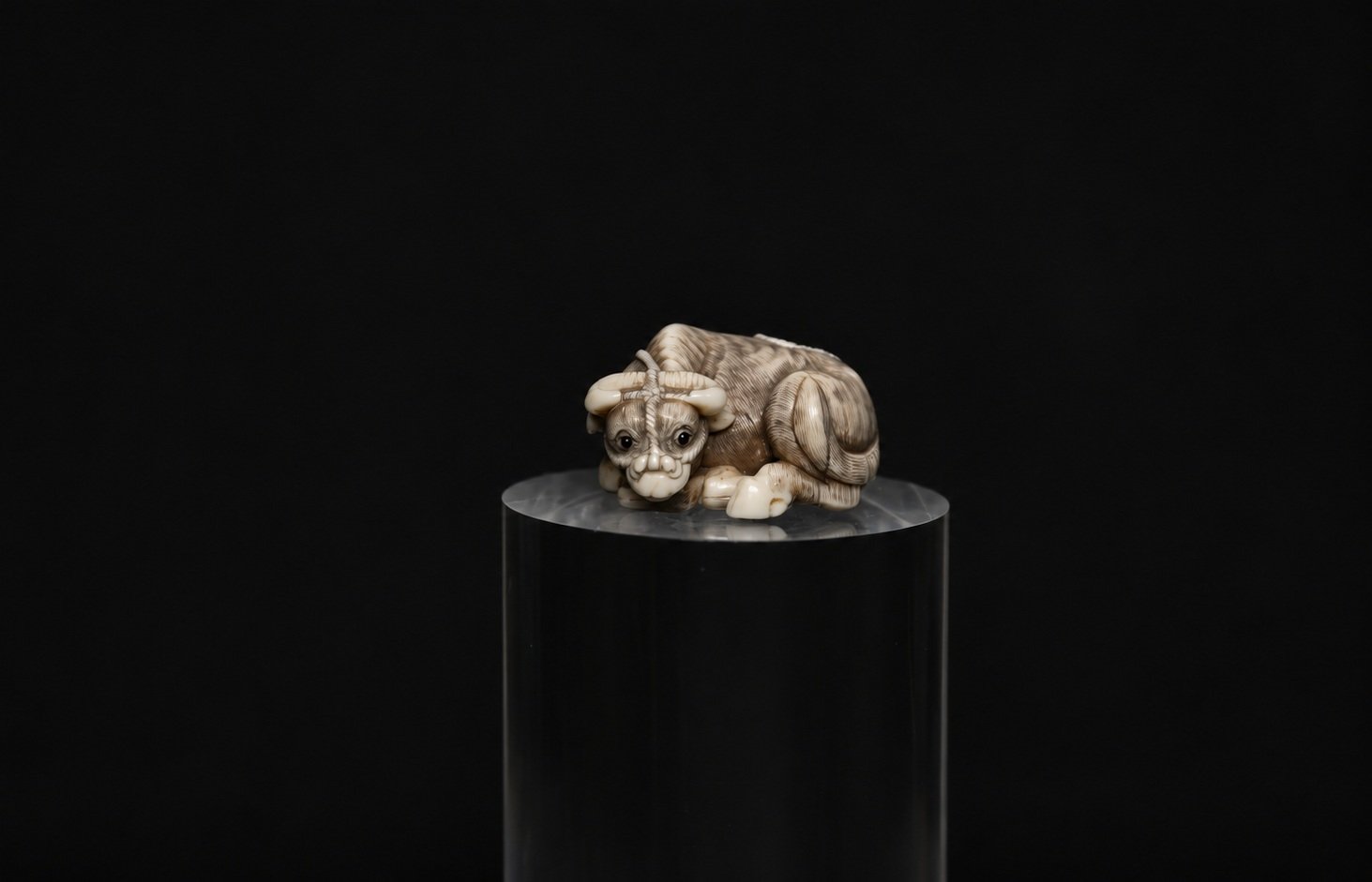
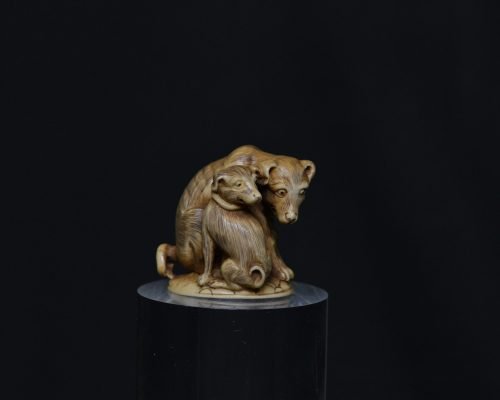
The first thing I notice is how still the ox feels.
It is not standing, moving forward, or turning dramatically. The body is folded into itself, the legs tucked close, the head lowered and drawn toward the rest of the animal.
Everything feels compact.
That is probably what I enjoy most about this netsuke.
There is no attempt to make the subject grander than it is. It is simply an animal at rest, contained within a form measuring only 4 × 3.3 × 2.3 cm.
And yet, when I look at it for a while, it does not feel small.
My attention eventually returns to the face.
The eyes are particularly effective.
They are inlaid in black buffalo horn, and the contrast with the pale ivory immediately gives them more presence. They are small details, but visually they change the entire sculpture.
Without them, I imagine the face would feel much quieter.
With them, the ox seems to look back.
I do not mean that in an overly sentimental way. It is simply one of those effects that can happen in netsuke carving, where a very small change in material or color suddenly gives much more definition to an expression.
The dark eyes stand out against the ivory, while the surrounding carving remains relatively restrained.
I find myself returning to them again and again.
What interests me almost as much as the face is the way the body has been organized.
The ox is reclining, but the composition is not loose.
The body curves inward. The head stays close to the front. The legs remain gathered around the lower part of the sculpture.
From the side, the animal becomes almost a single rounded mass.
This compactness works especially well at netsuke scale.
There is something satisfying about seeing a complete animal compressed into such a small volume without losing the sense of its anatomy.
The back, the haunches, the head and the folded limbs still read clearly, but they also belong to one continuous shape.
That balance between recognizable anatomy and compact form is one of the things I find most enjoyable when looking at Japanese netsuke.
The ivory surface also rewards close observation.
From a distance, the carving appears relatively simple: a reclining ox, pale in color, with darker eyes.
Up close, much more begins to appear.
The carved lines across the body help define the animal’s surface and structure. Different areas catch the light in different ways, particularly around the face, shoulders and folded legs.
Because the composition is so compact, even small changes in texture become important.
The smoother areas stand beside more heavily worked sections, and the darker lines within the carving help separate different parts of the body.
It is one of those objects where the photograph gives an immediate impression, but looking slowly reveals how much information has been fitted into a very small space.
The use of two contrasting materials is simple but effective.
The main body is carved in ivory, while the eyes are inset with black buffalo horn.
There is no complicated palette.
Just the pale carving and those two dark points.
I like that restraint.
The contrast does not overwhelm the sculpture. Instead, it concentrates attention exactly where it matters most: the face.
This is a very small decorative decision, but it has a disproportionate effect on how the entire netsuke is perceived.
There is something particularly calm about animals represented in this position.
The ox is not shown performing an action.
Nothing dramatic is happening.
It is simply lying down.
That lack of movement makes me spend more time with the details.
I begin noticing the relationship between the head and the body, the curve of the back, the position of the legs and the way the face sits close to the ground.
The sculpture becomes less about action and more about presence.
For me, that is where much of its charm lies.
One of the pleasures of netsuke is that they force you to look differently.
A large object can often be understood from several steps away.
A netsuke asks you to come closer.
At only a few centimeters across, details that might be insignificant elsewhere become central to the experience of the piece.
The position of an eye.
The line separating a leg from the body.
The way the head turns.
A small change in surface texture.
This reclining ox is a good example of that.
At first glance, it is easy to understand.
It is an ox at rest.
But the longer I look, the more the compactness of the carving becomes the real subject.
For readers unfamiliar with these objects, our guide What Is a Netsuke? provides a broader introduction to their historical function and place within Japanese material culture.
The netsuke is dated to the Meiji–Taishō period and is signed.
I prefer not to go further than that without additional information.
A signature is an important part of an object, but it should not automatically become a confirmed attribution without supporting documentation.
For me, the visual interest of this piece does not depend on making a larger claim about its maker.
The carving itself already gives us plenty to look at.
The piece is accompanied by a certificate and CITES documentation.
That matters particularly with ivory objects.
Documentation should always be considered separately from the aesthetic qualities of a piece, but it remains an essential part of how such an object is recorded and handled today.
CITES documentation does not mean that ivory can automatically be imported or exported anywhere in the world. Regulations vary according to destination, and the relevant requirements should always be checked before transport or purchase.
When I finish looking at this netsuke, I keep returning to the same three things.
The compact posture.
The dark eyes.
And the extraordinary amount of presence contained in such a small object.
There is no elaborate narrative here.
No crowded scene.
No attempt to impress through scale.
Just a reclining ox, carved in ivory, with its body drawn closely together and two dark inlaid eyes that give the face an unexpected intensity.
Sometimes that is enough.
In fact, with netsuke, it often is.
CEO of SupeinNihonto, dealer and collector of ancient Japanese art and weapons from Canillo, Andorra.
Contact