1 in stock
1 in stock
Add to Compare
Add to Wishlist
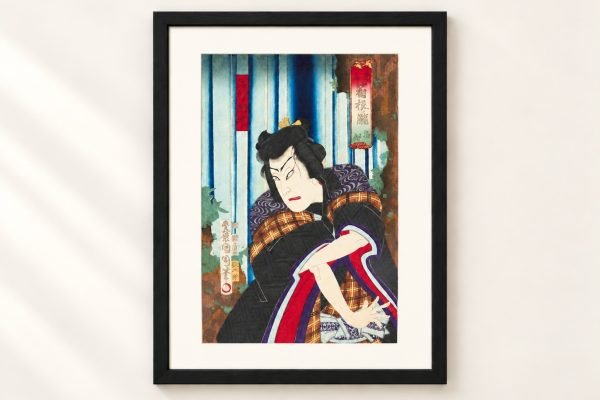
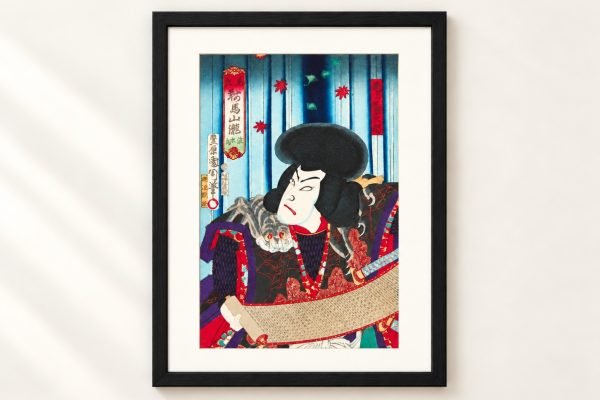
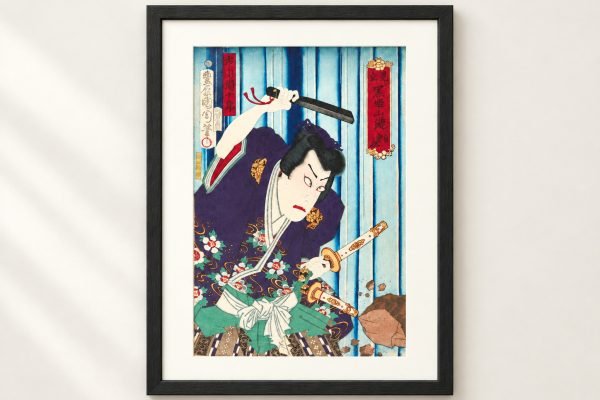
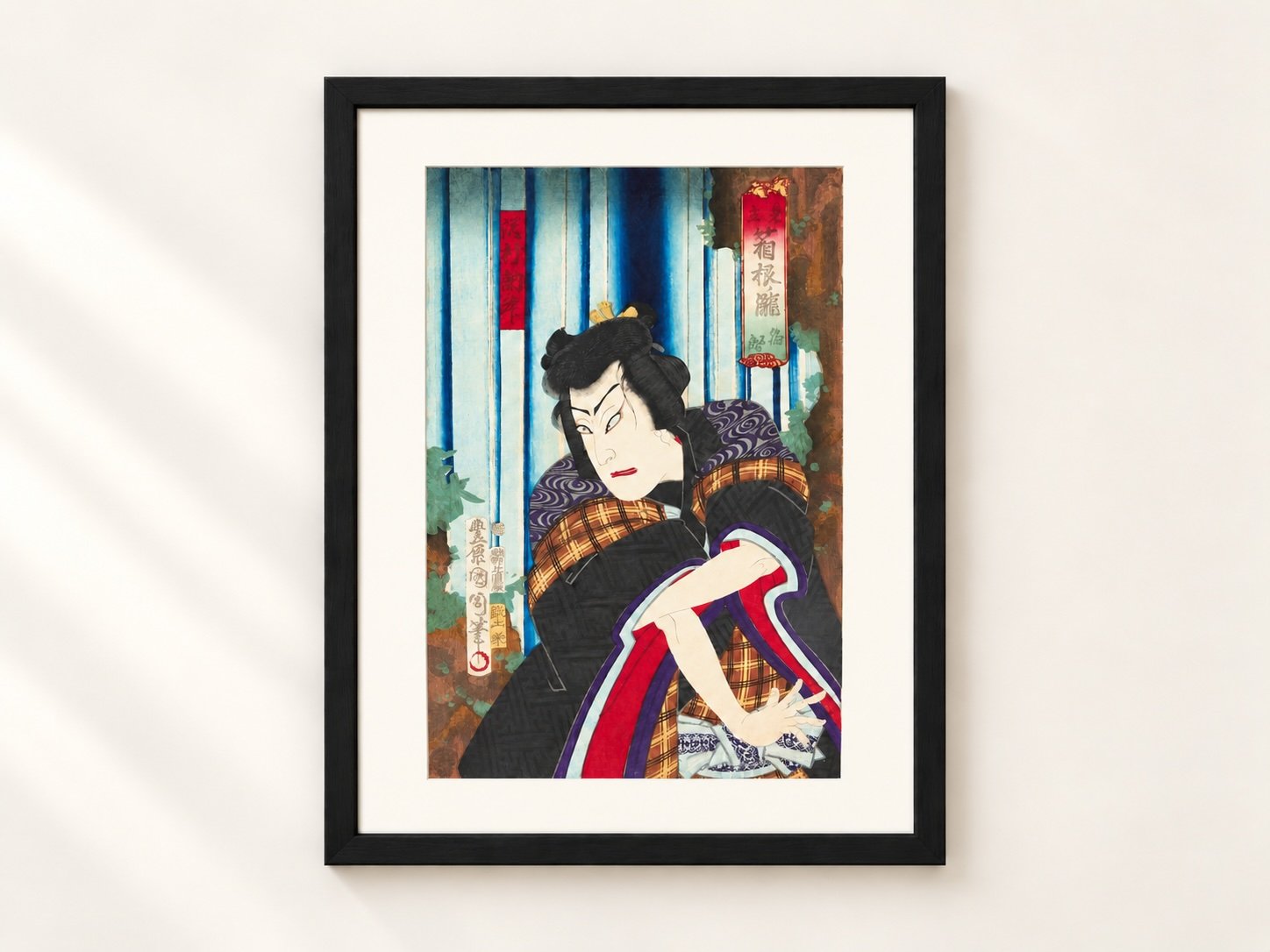
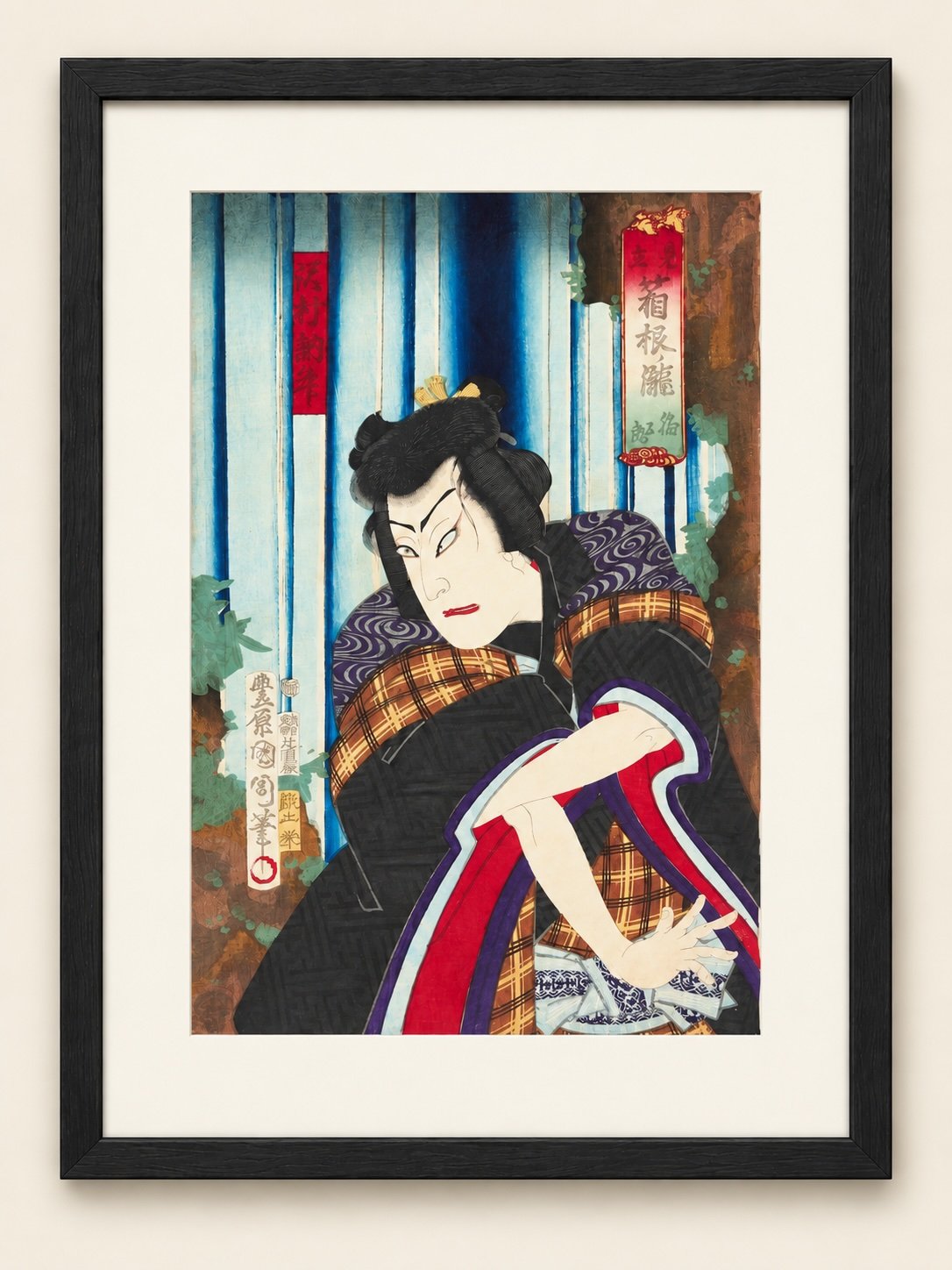
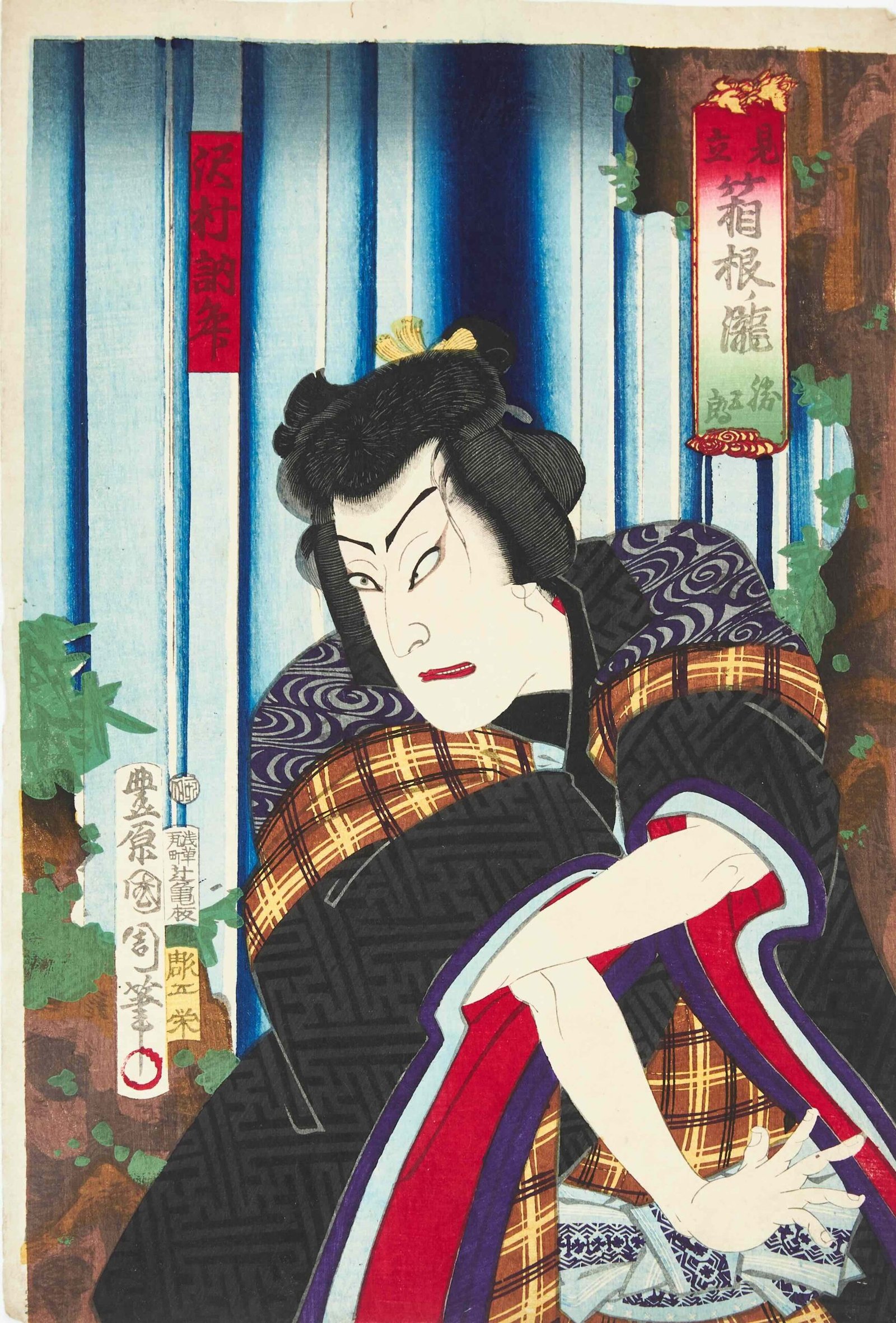
An original antique Japanese ukiyo-e woodblock print by Toyohara Kunichika (1835–1900), depicting the kabuki actor Sawamura Tosshō in Mitate Hakone no Taki (見立 箱根の滝, “Comparison with the Hakone Waterfall”). Executed as an ōban tate-e nishiki-e, the print belongs to a Meiji-period mitate-e series pairing individual kabuki actors with celebrated waterfalls from around Japan. Sawamura Tosshō is shown half-length in three-quarter profile, turning sharply over his shoulder in a black-and-ochre checked kimono over a richly patterned indigo underrobe, framed by jagged brown rock and deep graduated blue bands representing the waters of Hakone.
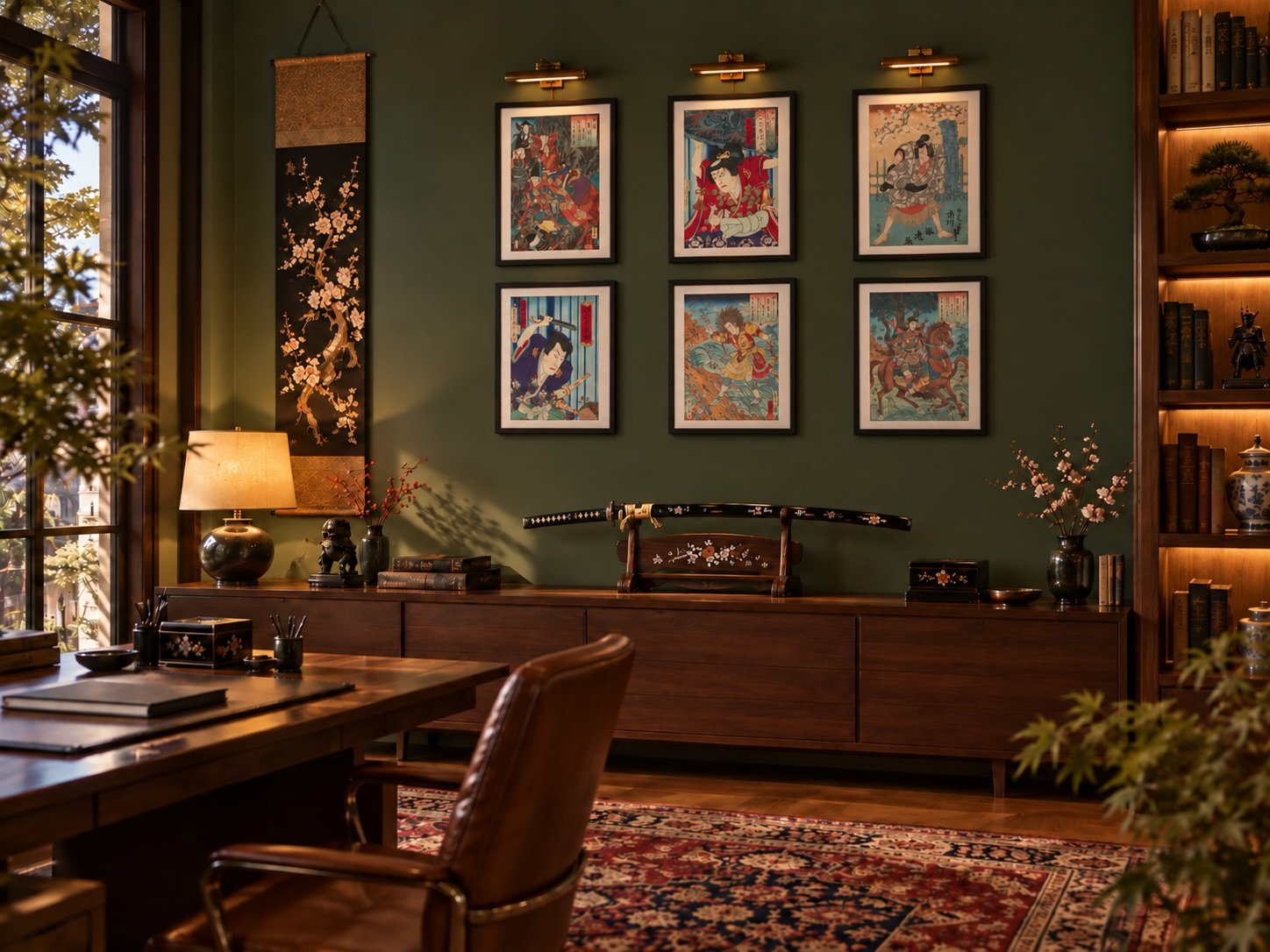
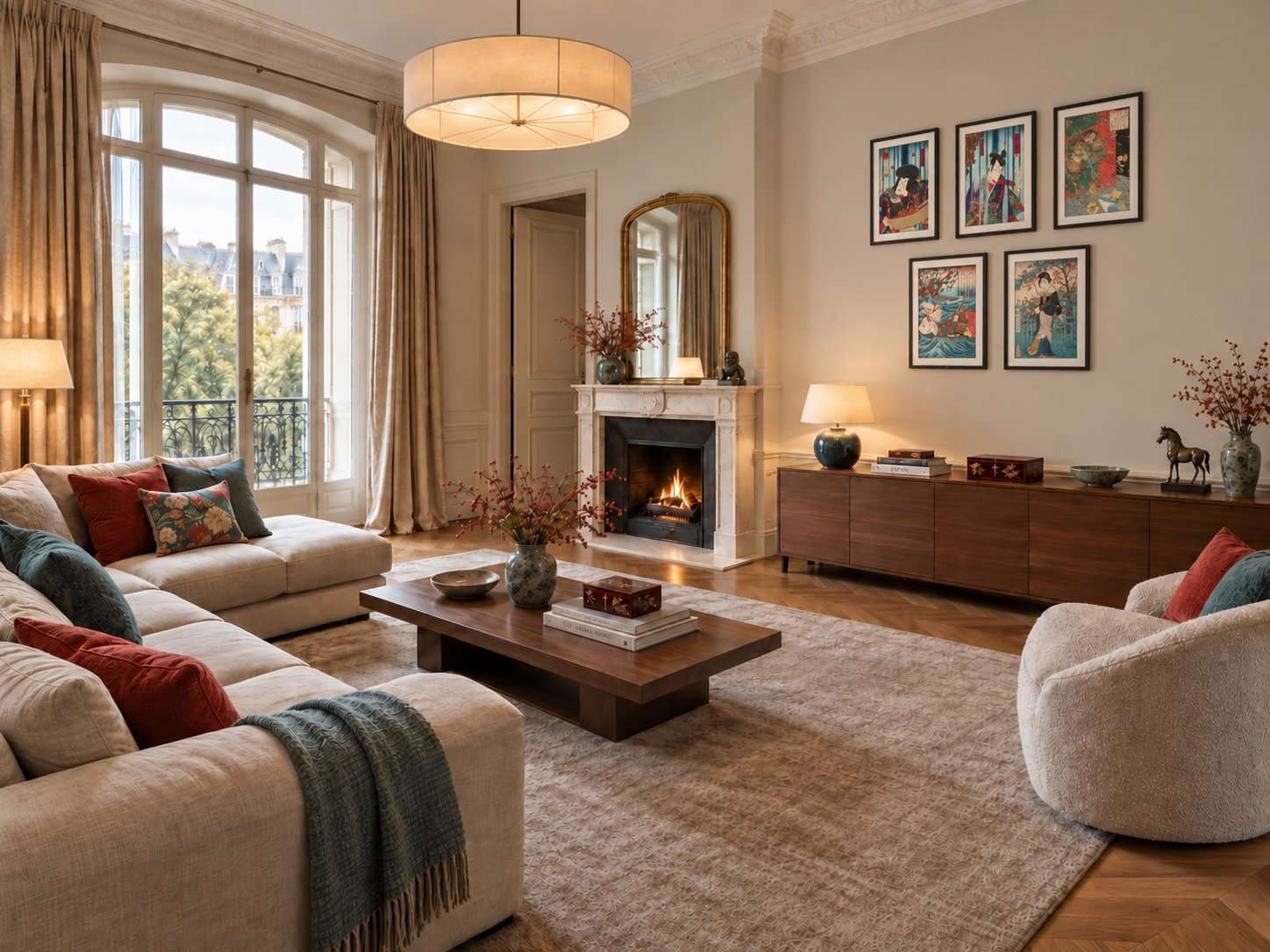
The ukiyo-e comes framed and ready to hang.
Sawamura Tosshō dominates the composition with a sharply turned pose and concentrated expression.
The black outer robe creates a strong visual mass across the lower half of the image.
Warm ochre check patterning crosses the shoulders and torso, while purple, red and pale blue borders add further theatrical color.
Behind him, the stylised waterfall is rendered through bold vertical bands of deep and pale blue.
Brown rock surfaces rise along the edge of the composition, giving the actor a dramatic natural setting without distracting from the force of the portrait.
The print presents the kabuki actor Sawamura Tosshō in a dynamic half-length portrait.
Rather than facing directly outward, the actor turns sharply in three-quarter profile and glances back over his shoulder.
This twisting pose gives the image immediate theatrical tension.
Kunichika frequently used strong directional gestures and dramatic turns of the body to give his actor portraits a sense of movement even when the figure remained confined to a relatively close composition.
Here, the turn of Tosshō’s head and shoulders creates a powerful diagonal movement through the image.
His face remains the visual focus, framed by the dark hair, black robe and saturated blue background.
The title Mitate Hakone no Taki (見立 箱根の滝) connects the actor with the waterfall of Hakone, west of Edo/Tokyo.
The term mitate refers to a visual or conceptual comparison.
In this series, individual kabuki actors are associated with named waterfalls from different parts of Japan.
Rather than presenting straightforward landscape views, Kunichika combines theatrical portraiture with evocative geographical references.
The result is both an actor print and a playful cultural association.
The waterfall does not function as a realistic landscape.
Instead, it becomes a stylised visual setting for the performer.
Hakone, situated west of Edo/Tokyo, was already well known in Japanese visual and travel culture.
In the present print, however, Kunichika does not attempt to provide a literal topographical description.
The waterfall is reduced to striking vertical bands of blue.
Deep saturated tones alternate with paler areas, suggesting falling water through rhythm and gradation rather than detailed naturalism.
The result gives the background an almost architectural quality.
It simultaneously evokes water, height and movement while keeping the actor firmly at the centre of the composition.
The blue waterfall background is one of the defining features of the print.
Kunichika uses bokashi, graduated color printing, to create shifts between dark and lighter blue.
This produces depth within what might otherwise be a flat series of vertical bands.
The saturated blue also creates a powerful contrast with the warm ochre and brown tones of the costume and rocks.
Against this cool background, the pale face and red lips of the actor become particularly prominent.
The effect is theatrical, decorative and immediately recognisable across the wider waterfall series.
Sawamura Tosshō wears a striking black-and-ochre checked kimono.
The pattern introduces warmth into a composition otherwise dominated by blue, black and brown.
The check design runs across the shoulders and upper body, creating a clear visual structure around the figure.
Kunichika inherited from the Utagawa tradition a strong interest in bold textile pattern.
In his actor prints, costume is rarely secondary.
Pattern, color and fabric become essential tools for communicating theatrical identity.
Here, the checked textile gives the actor a strong visual presence even before the viewer focuses on his expression.
Beneath the checked outer garment, a richly patterned indigo underrobe is visible.
Its swirling forms introduce a second layer of textile decoration.
The curved pattern contrasts with the rigid geometry of the check above it.
Purple, red and pale blue borders add further color and complexity around the sleeves.
This layering of patterns is characteristic of Kunichika’s theatrical imagery.
The costume becomes a field of visual rhythm in which different textures and shapes interact.
The result reflects the elaborate clothing and heightened visual language of the kabuki stage.
Tosshō’s expression is tense and alert.
The sharply angled eyebrows and sideways glance reinforce the sense that the actor has turned in response to something occurring outside the visible scene.
Kunichika does not provide the larger theatrical context.
Instead, he isolates the actor at a moment of emotional intensity.
This close focus is one of the strengths of yakusha-e.
The viewer is invited to recognise not only the performer but also the theatrical attitude associated with the role.
Gesture, gaze, costume and posture together create the drama.
Brown rock rises along the right edge and lower left of the image.
Irregular surfaces contrast with the smooth vertical rhythm of the waterfall.
Small green areas of foliage soften the transition between rock and water.
The rocks act as a framing device around the actor.
They also reinforce the idea that the figure has been placed within a famous natural site even though the landscape itself remains highly stylised.
The combination of rock and waterfall creates enough environmental context to establish Hakone while preserving the dominant role of the theatrical portrait.
The print belongs to a Meiji-period series in which Kunichika paired individual kabuki actors with named waterfalls from around Japan.
Each actor appears half-length against a related waterfall setting.
The concept allowed Kunichika to combine two highly popular forms of visual culture: celebrity actor portraiture and famous-place imagery.
The series is therefore neither purely theatrical nor purely landscape-based.
It uses the logic of mitate to create associations between performer, role and place.
The stylised waterfall background also creates a strong visual identity that connects the individual sheets across the series.
The work belongs to the tradition of yakusha-e, ukiyo-e prints devoted to kabuki actors.
Actor prints were among the most popular genres of Japanese woodblock printing.
They allowed audiences to collect images of leading performers in memorable roles, costumes and poses.
Such prints functioned partly as portraits and partly as theatrical souvenirs.
Kunichika became one of the last major specialists in this genre.
His images capture the heightened visual language of the kabuki stage through exaggerated gesture, concentrated expression and richly patterned costume.
Toyohara Kunichika (1835–1900) was born Ōshima Yasohachi in Edo.
He trained within the Utagawa school before becoming a pupil of Utagawa Kunisada (Toyokuni III).
Kunisada was one of the dominant ukiyo-e artists of the nineteenth century and a major designer of kabuki actor portraits.
Kunichika inherited from him a strong taste for theatrical gesture, bold close-up composition and extravagant textile pattern.
These qualities became central to Kunichika’s own mature style.
Kunichika worked closely with the kabuki world of Edo and later Tokyo.
He spent extensive time backstage and sketched leading actors directly from life.
Among the celebrated performers he portrayed were Ichikawa Danjūrō IX, Onoe Kikugorō V and Bandō Hikosaburō V.
This familiarity with performers gave Kunichika’s actor prints a particularly direct theatrical character.
He understood not only facial likeness but also costume, pose, gesture and stage presence.
The present image of Sawamura Tosshō demonstrates that approach clearly.
The actor is presented not as a static sitter but as a performer caught in a dramatic instant.
Kunichika’s apprenticeship under Utagawa Kunisada strongly shaped his artistic language.
Kunisada had developed a highly successful form of actor portraiture characterised by bold composition, elaborate textiles and immediately recognisable performers.
Kunichika carried these qualities into the Meiji period.
In the present print, the close cropping, dramatic turn of the body, patterned clothing and concentrated expression all reflect that inherited theatrical approach.
At the same time, Kunichika’s intense Meiji-era colors give the print a distinctly later visual character.
Kunichika was among the early ukiyo-e designers to embrace newly imported synthetic aniline dyes during the Meiji era.
These pigments allowed for particularly intense reds, purples and blues.
The deep blue waterfall in the present print is especially important to the overall effect.
Bright red and purple details around the sleeves provide smaller flashes of saturated color.
The black robe and warm ochre check create a strong counterbalance.
Together, these colors produce the bold theatrical impact associated with Kunichika’s mature work.
The print is executed as a nishiki-e, or full-color Japanese woodblock print.
Traditional polychrome printing required multiple carved woodblocks.
A principal key block established the main black outlines.
Additional blocks supplied the different areas of color.
In this image, separate impressions create the deep blue waterfall, brown rock, green foliage, black clothing, ochre check pattern, purple textile details, red borders and pale flesh tones.
The complexity of the finished composition depends on the careful alignment of these separately printed blocks.
The work is produced in the vertical ōban tate-e format.
This format was particularly well suited to half-length actor portraits.
It allowed Kunichika to bring the performer close to the viewer while still providing enough room for costume and environmental context.
Sawamura Tosshō fills most of the lower and central areas of the composition.
The vertical waterfall bands strengthen the tall format.
The result is compact, direct and visually powerful.
The print bears Kunichika’s signature in the cartouche as Toyohara Kunichika (豊原国周筆).
The signature identifies the design as the work of Kunichika.
As with other actor prints of the period, the cartouches also form an important part of the overall visual design.
Their vertical format echoes the waterfall bands and helps structure the upper area of the composition.
The combination of calligraphy, decorative framing and figurative imagery is characteristic of nineteenth-century Japanese print design.
This is an original antique Japanese woodblock print, not a modern reproduction or later reprint.
Its age is an essential part of its historical character and authenticity.
Original ukiyo-e of this period have survived through generations of ownership, handling, storage and display.
With works on paper of this age, gentle toning, occasional small spots, minor creasing or faint handling marks are normal and expected.
These characteristics are consistent with genuine period prints.
They should be understood within the context of an original historical object rather than compared with a newly manufactured decorative reproduction.
The print comes from the collection of Dr. Eugen Milch (1889–1958), an Austrian physician and artist.
Milch served as a medical officer during the First World War.
During the early 1920s, he travelled through Europe on a combined study and painting journey.
In 1924, he married Emma Bormann.
The couple visited Sweden that same year.
Together with the artist Oskar Bergman, they exhibited several paintings at Liljevalchs in Stockholm.
In 1937, Eugen Milch travelled to China with other Austrian physicians at the invitation of the Chinese government.
His wife joined him two years later.
Although the original posting did not materialise as planned, Milch became superintendent of a hospital in Beihai in 1938.
His years in East Asia combined his medical work with his continuing interest in art, travel and international culture.
In 1941, Japanese forces occupied parts of the southern Chinese coast, including Beihai.
The Milch family managed to relocate to Shanghai.
During their years in China, Eugen and Emma decided to separate.
Eugen subsequently assisted British forces in China.
For that service, he was granted British citizenship.
His life therefore intersected directly with many of the major political and military transformations affecting East Asia during the first half of the twentieth century.
Continuing his travels, Eugen Milch later went to Japan to study the aftermath of the war.
According to the provenance associated with the collection, it is likely that he acquired the present group of Japanese woodblock prints during this period.
Milch died in Hong Kong in 1958.
The collection subsequently passed by descent within the family.
This provenance adds another historical dimension to the print, linking a nineteenth-century kabuki image with the international life of a twentieth-century physician, artist, traveller and collector.
The print shows some signs of wear consistent with age, together with light handling creases.
It remains in good general condition.
As with original Japanese works on paper of this age, gentle toning, occasional small marks, light creasing and faint handling traces are normal and expected.
These characteristics are consistent with an authentic antique print that has survived for well over a century.
The condition information is provided for transparency and should not be interpreted as suggesting that the work is in poor condition.
The ukiyo-e is individually framed and sold complete with its frame.
It arrives ready to hang.
The dark frame and light mount create a clean presentation that keeps the original image as the primary visual focus.
The neutral framing works particularly well with the intense blue waterfall, black-and-ochre checked costume, brown rock and saturated purple and red textile details.
The print can therefore be displayed immediately while preserving the visual presence of the original antique artwork.
This print brings together many of the qualities for which Toyohara Kunichika is particularly admired.
It is a forceful kabuki actor portrait, a sophisticated exercise in textile pattern, and part of an inventive mitate-e series linking performers with famous waterfalls around Japan.
Sawamura Tosshō’s sharp turn and backward glance give the composition immediate theatrical tension.
The black-and-ochre check of the robe contrasts powerfully with the deep blue waterfall.
The swirling indigo textile, purple and red borders and jagged brown rock add further layers of visual complexity.
The waterfall series also demonstrates Kunichika’s ability to combine actor portraiture with another established ukiyo-e tradition: imagery of famous places.
The documented provenance from the collection of Dr. Eugen Milch adds a further historical layer to the work.
As an original Meiji-period yakusha-e, the print represents the final major phase of traditional kabuki actor portraiture before photography increasingly displaced the woodblock image.
An original antique Japanese ukiyo-e woodblock print by Toyohara Kunichika (1835–1900), depicting the kabuki actor Sawamura Tosshō in Mitate Hakone no Taki (見立 箱根の滝). Part of Kunichika’s Meiji-period mitate-e waterfall series, the print pairs a half-length actor portrait with a stylised representation of the famous Hakone waterfall. Tosshō appears in three-quarter profile, turning sharply over his shoulder in a black-and-ochre checked kimono over a swirl-patterned indigo underrobe. Deep graduated blue bands evoke the falling water, while jagged brown rock frames the actor at the edge of the composition. Executed as an ōban tate-e nishiki-e, the work combines bold textile pattern, concentrated theatrical gesture and intense Meiji-era color. From the collection of Dr. Eugen Milch (1889–1958), subsequently by descent within the family. In good general condition with age-related wear and light handling creases. Original antique Japanese woodblock print, not a modern reproduction. Individually framed and supplied ready to hang.

Order above 1.000,00 € gets free shipping.

Secure and hassle-free payment process.

Certificate of authenticity included.

Have questions? Contact us via WhatsApp.
Contact