1 in stock
1 in stock
Add to Compare
Add to Wishlist
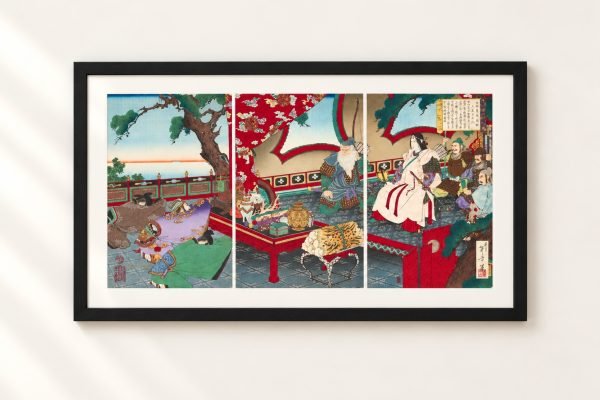
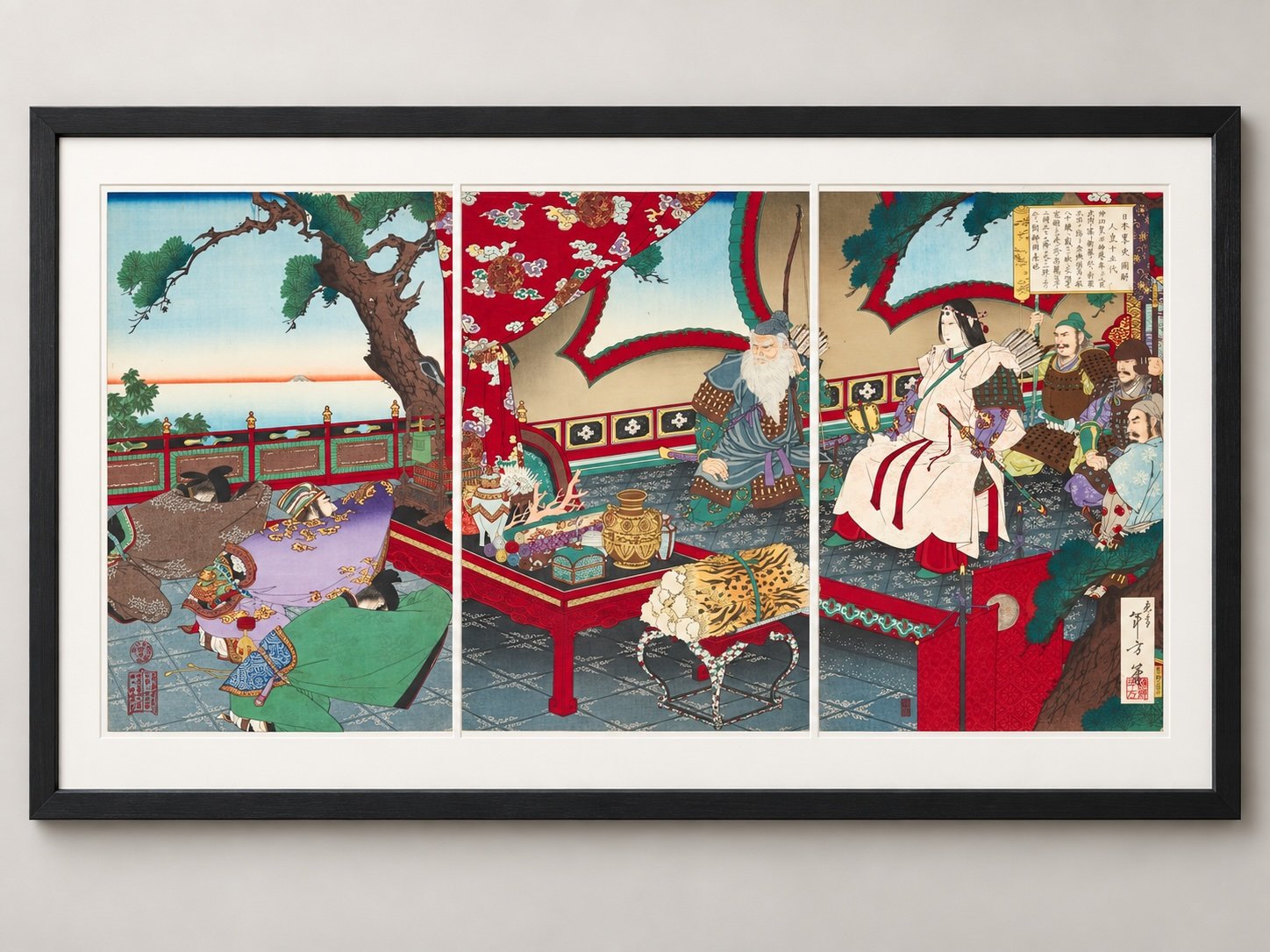
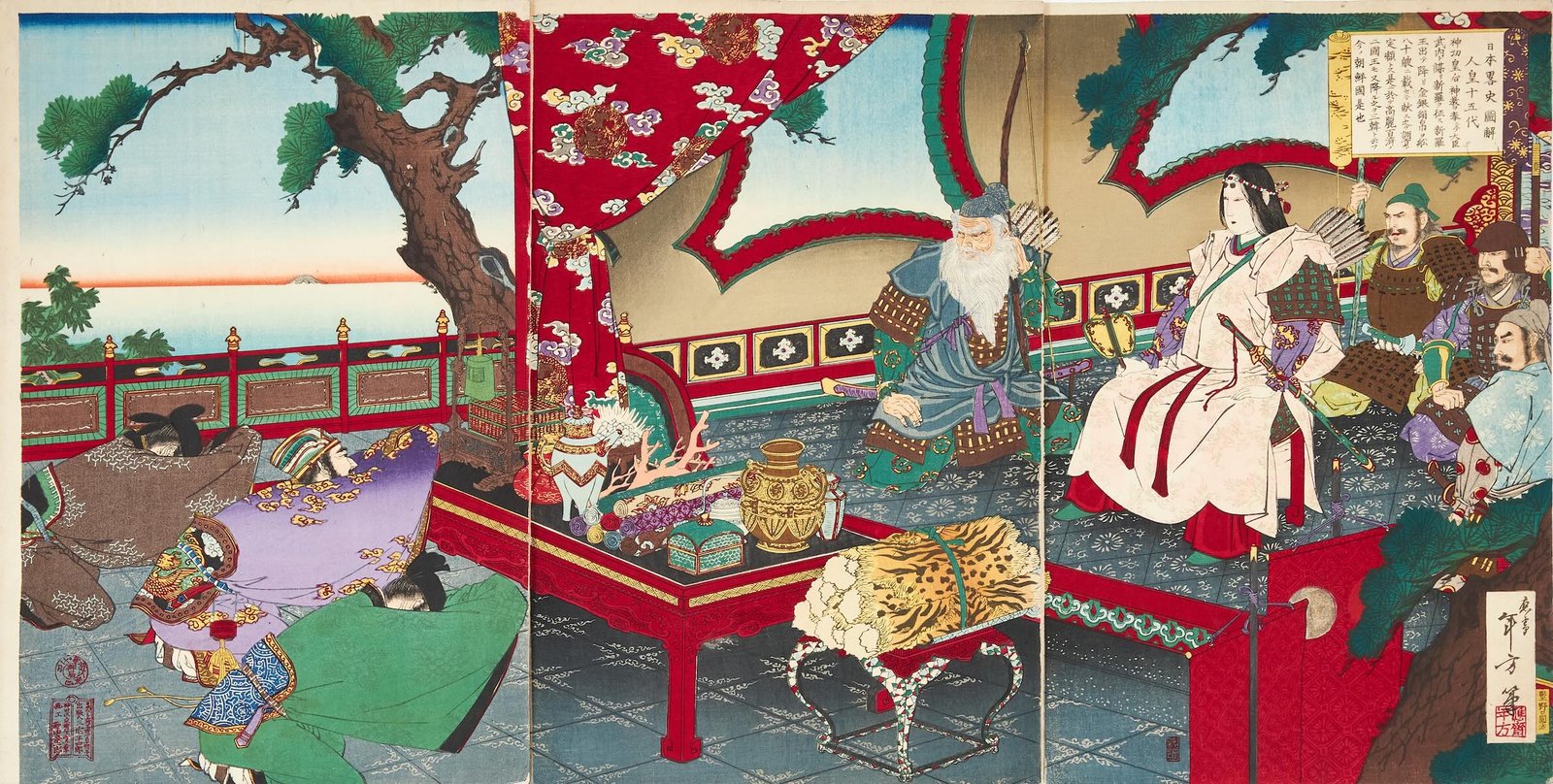
An original antique Japanese colour woodblock print triptych by Toshikata Mizuno (1866–1908), depicting the legendary Empress Jingū receiving envoys in Korea. Published by Miyake Hanshirō in 1885, the three-sheet composition measures approximately 37.3 × 74.4 cm overall. Created near the beginning of Toshikata’s independent career, the work combines historical legend, courtly spectacle and Meiji-period political resonance within a carefully structured panoramic composition.
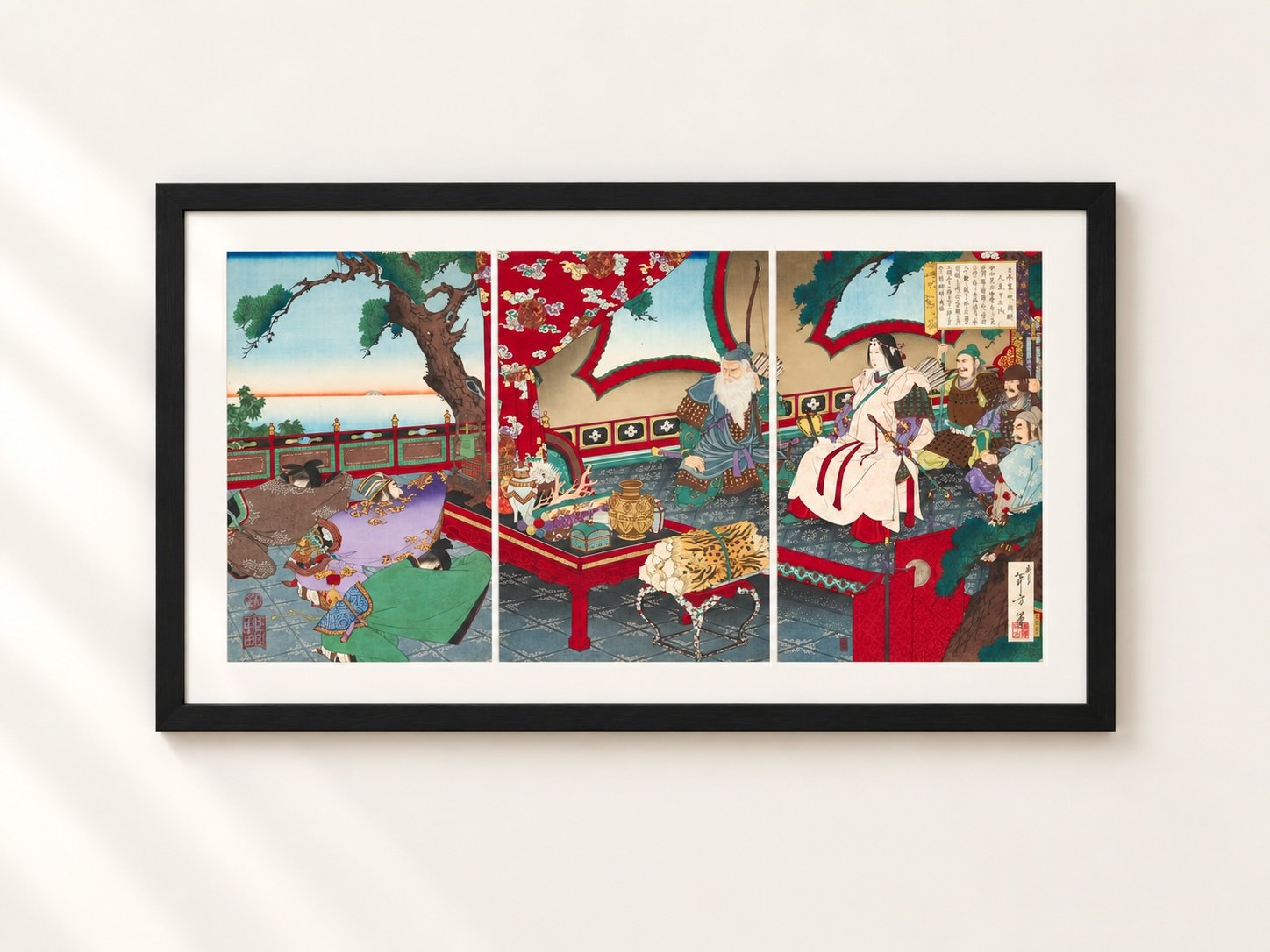
The triptych presents Empress Jingū in a formal military and diplomatic setting, surrounded by attendants, warriors and envoys beneath richly decorated canopies and pine trees.
Across the three sheets, Toshikata constructs a continuous narrative space.
The left panel opens toward a distant seascape and a large pine tree, with kneeling figures gathered before the central pavilion.
The middle panel introduces an elderly warrior and ceremonial objects arranged around a low table, including a tiger skin placed prominently in the foreground.
On the right, Empress Jingū sits as the commanding figure of the scene, dressed in pale robes and surrounded by armed retainers and visiting envoys.
Together, the three sheets create a broad horizontal composition designed to be read as a single narrative image.
The subject is the legendary Empress Jingū, one of the most enduring figures in Japan’s early historical tradition.
According to the ancient chronicles, Jingū was the wife of Emperor Chūai.
When he died in the year 200, she is said to have assumed power as regent on behalf of the son she was carrying, the future Emperor Ōjin.
The legend describes an extraordinary pregnancy lasting three years.
During that period, Jingū supposedly led a military expedition across the sea to Korea before eventually giving birth.
The story became one of the most famous narratives of female authority and military leadership in early Japanese legend.
According to the traditional account, Empress Jingū possessed two magical jewels with the power to control the tides.
She was said to have used them first to calm the sea for the passage of her fleet.
The same supernatural power was then used against the forces opposing her landing.
The legend states that the rulers of the Korean kingdoms submitted following this display of power.
Tribute and envoys were subsequently sent to Japan.
The present triptych represents this diplomatic moment rather than the military conflict itself.
The emphasis is therefore on hierarchy, submission and ceremony.
Jingū appears seated in authority while envoys and attendants gather before her.
For centuries, Jingū occupied an exceptional place within traditional Japanese accounts of early sovereignty.
She was long counted among Japan’s sovereigns.
In 1881, she became the first woman to appear on a Japanese banknote.
Modern historians, however, generally treat the narrative surrounding her Korean campaign as legendary rather than verified historical fact.
During the twentieth century, Jingū was reclassified as a regent rather than a reigning empress.
The triptych should therefore be understood as a representation of an influential historical legend rather than as a documentary image of a verified event.
The print was published in 1885, during the Meiji period.
At that time, Japan’s political and military interest in Korea was increasing significantly.
Within this context, the old legend of Empress Jingū carried an obvious contemporary resonance.
A story presenting a legendary precedent for Japanese authority over Korea could be read differently in the late nineteenth century than it had in earlier periods.
The subject linked an ancient imperial legend with modern concerns surrounding Japan’s expanding influence in East Asia.
The triptych therefore operates simultaneously as historical illustration, legendary narrative and a work shaped by the political atmosphere of the Meiji era.
Toshikata designed the work as a continuous three-sheet panorama.
Rather than treating the sheets as independent images, he connects them through architecture, textiles, pine branches, flooring and the arrangement of the figures.
The left sheet creates spatial depth through the open view toward the sea.
A massive pine tree rises diagonally above the kneeling figures.
The central sheet acts as the visual bridge between the two groups.
Ceremonial vessels, a tiger skin and the seated elderly warrior occupy the middle of the composition.
On the right, Empress Jingū becomes the principal focus.
Her pale clothing contrasts with the darker armour and costumes surrounding her.
This gradual movement from exterior landscape to ceremonial authority creates a clear visual narrative from left to right.
Empress Jingū occupies the right section of the triptych.
She is seated above the surrounding figures and distinguished by her pale robes.
Her position establishes the hierarchy of the scene immediately.
Armed retainers and officials surround her.
Their darker costumes, armour and headwear frame her lighter figure and make her the dominant visual presence.
The composition therefore communicates authority not through dramatic physical action but through placement, costume and the ordered arrangement of the court.
The figures surrounding Jingū create a mixture of military and ceremonial atmosphere.
Several retainers wear armour.
Weapons and martial equipment remain visible.
At the same time, the meeting itself is represented as a formal audience rather than an active battle scene.
The envoys approach within an ordered courtly environment.
Low tables, ceremonial vessels, decorated textiles and architectural details reinforce the importance of the event.
This combination of military power and diplomatic ceremony reflects the legendary narrative in which conquest is followed by submission and tribute.
One of the strongest details in the central sheet is the tiger skin spread prominently near the foreground.
Its yellow and black pattern creates a sharp visual contrast with the dark flooring and red furniture.
Nearby, Toshikata includes ornamental vessels, boxes and other objects associated with ceremonial display.
These details enrich the setting and contribute to the atmosphere of rank and authority.
They also help structure the transition between the kneeling figures on the left and the principal court group on the right.
Large pine trees frame the composition and extend across the three sheets.
Their twisting trunks and dense blue-green foliage create a powerful natural structure around the human figures.
In Japanese visual culture, pine is traditionally associated with endurance and longevity.
Here, however, the trees also perform a compositional function.
The broad branches connect different sections of the triptych and prevent the three sheets from reading as isolated scenes.
They visually unite landscape, architecture and courtly figures into a single panoramic image.
The left side of the triptych opens onto a calm expanse of water.
A narrow red-orange horizon separates the sea from the pale blue sky.
This distant maritime view is particularly significant in a work concerned with Jingū’s legendary expedition across the sea to Korea.
The open horizon expands the visual space beyond the immediate court setting.
It also provides a quiet counterpoint to the dense ceremonial scene occupying the center and right sections of the triptych.
Toshikata Mizuno (1866–1908) was born in Tokyo under the name Nonaka Kumejirō.
His father was a master plasterer.
As a boy, Toshikata wanted to study under Tsukioka Yoshitoshi, the last great master of ukiyo-e.
His father initially opposed the idea and instead arranged for him to study with other artists.
His early training included instruction from the Western-style painter Yamada Ryūtō as well as artists working in the Kanō and Shijō traditions.
Eventually, however, Toshikata succeeded in becoming one of Yoshitoshi’s pupils.
That artistic lineage would become the most important influence on his mature work.
Yoshitoshi’s influence helped shape Toshikata’s dramatic and carefully composed approach to narrative imagery.
Toshikata belonged to a generation working at a moment when the traditional ukiyo-e world was changing rapidly.
Photography and Western art were already transforming visual culture in Japan.
Rather than abandoning the woodblock tradition, Toshikata helped carry many of its compositional and narrative qualities into the Meiji period.
His work therefore stands at an important transition between late ukiyo-e and newer forms of modern Japanese printmaking.
Toshikata worked as a newspaper illustrator and created designs dealing with contemporary and historical subjects.
He later produced prints connected with the Sino-Japanese War.
At the same time, he became particularly known for bijin-ga, or images of beautiful women.
Historical and legendary scenes remained another important part of his work.
The present triptych belongs to that historical mode.
Created near the beginning of his independent career, it already demonstrates an ability to organize large groups of figures within an ambitious multi-sheet composition.
Although the present work is primarily historical, Toshikata became especially celebrated for his representations of women.
His bijin-ga combined the elegance of older ukiyo-e traditions with the changing visual language of the Meiji period.
The treatment of Empress Jingū in this triptych reflects that interest.
Even within a military and diplomatic scene, she is distinguished through posture, costume and carefully controlled elegance.
Her pale figure becomes the emotional and visual center of the right-hand sheet.
Toshikata was also an influential teacher.
His students, and the artists trained by those students, carried aspects of his approach into the early twentieth century.
This artistic lineage contributed to the development of the shin-hanga movement.
Toshikata therefore occupies an important position between the late ukiyo-e tradition represented by Yoshitoshi and the renewed Japanese print culture of the following generation.
His career illustrates how traditional woodblock techniques and subject matter continued to evolve rather than simply disappear with the arrival of photography and Western art.
The triptych was published by Miyake Hanshirō in 1885.
Like other Japanese woodblock prints, works of this type were collaborative productions.
The artist produced the design, while the finished print depended upon the coordinated work of carvers, printers and the publisher responsible for production and distribution.
The presence of the publisher is therefore an essential part of the work’s historical identity.
The triptych is executed as a colour woodblock print.
Multiple carved blocks were required to build the image through successive impressions.
The surviving work displays a wide range of colours.
Deep red textiles and architectural elements contrast with blue-green pine foliage.
Pale blue sky and water open the left side of the composition.
Armour, patterned robes, decorative vessels, tiger skin and the pale costume of Jingū introduce further layers of colour and texture.
Across all three sheets, the printing creates a rich visual field while maintaining continuity between the separate sections.
The complete work measures approximately 37.3 × 74.4 cm overall.
Its horizontal format is produced by three vertically oriented woodblock sheets intended to be viewed together.
This triptych structure gives Toshikata a much broader field than a single print would allow.
The landscape can open on the left.
The ceremonial setting can occupy the centre.
The principal figure can dominate the right.
The resulting panoramic format is particularly effective for a subject involving multiple groups of figures and a large courtly setting.
This is an original antique Japanese woodblock triptych, not a modern reproduction or later reprint.
Its age forms an important part of its historical character and authenticity.
Original Japanese prints of this period have survived through generations of ownership, handling, storage and display.
Gentle toning, occasional small spots, light creasing and faint handling marks are normal characteristics of antique works on paper.
Such features should be understood within the context of an original historical object rather than compared with the appearance of a newly manufactured reproduction.
The triptych comes from the collection of Dr. Eugen Milch (1889–1958), an Austrian physician and artist.
Milch served as a medical officer during the First World War.
During the early 1920s, he travelled extensively through Europe on a journey combining study and painting.
In 1924, he married the artist Emma Bormann.
The couple visited Sweden that same year.
Together with the artist Oskar Bergman, they exhibited several paintings at Liljevalchs in Stockholm.
In 1937, Eugen Milch travelled to China with other Austrian doctors at the invitation of the Chinese government.
Emma joined him two years later.
Although the original destination did not materialise as planned, Milch became superintendent of a hospital in Beihai in 1938.
His years in East Asia combined his medical career with his continuing interest in travel and art.
In 1941, Japanese forces occupied parts of the southern Chinese coast, including Beihai.
The Milch family managed to relocate to Shanghai.
During their time in China, Eugen and Emma separated.
Eugen later assisted British forces in China.
For this service, he was granted British citizenship.
His life and career therefore placed him directly within some of the major historical transformations affecting East Asia during the first half of the twentieth century.
Continuing his travels, Eugen Milch later went to Japan to study the aftermath of the war.
According to the provenance associated with the collection, it is likely that he acquired the present group of Japanese woodblock prints during this period.
He died in Hong Kong in 1958.
The collection subsequently passed by descent within the family.
This provenance adds a further historical dimension to the triptych, connecting a Meiji-period Japanese print with the international life of a twentieth-century physician, artist, traveller and collector.
The three sheets are not attached to one another.
The triptych shows some wear consistent with age.
The colours remain in good condition.
As with any antique work on paper, gentle toning, occasional small marks, minor creasing or faint handling traces may naturally be present.
These characteristics are consistent with the age and history of an original Japanese woodblock print.
The condition information is provided for transparency and should not be interpreted as suggesting that the work is in poor condition.
This triptych occupies an interesting position at the intersection of late ukiyo-e tradition, Meiji-period historical imagery and the early career of Toshikata Mizuno.
The panoramic composition is particularly ambitious.
Three separate sheets are visually unified through pine branches, architecture, flooring and the distribution of figures.
The subject of Empress Jingū gives the work additional historical and political significance.
Her legendary Korean campaign had been represented for centuries, but in 1885 the story acquired renewed meaning in the context of Japan’s increasing political involvement with Korea.
The work therefore offers more than a decorative historical scene.
It reflects the way ancient legends could be reinterpreted within the rapidly changing political culture of Meiji Japan.
The triptych also documents Toshikata at a formative point in a career that would connect the late ukiyo-e world of Yoshitoshi with the artistic developments that eventually contributed to twentieth-century shin-hanga.
Its provenance from the collection of Dr. Eugen Milch adds a further layer of collecting history.
An original antique Japanese colour woodblock triptych by Toshikata Mizuno (1866–1908), depicting the legendary Empress Jingū receiving envoys in Korea. Published by Miyake Hanshirō in 1885 and measuring approximately 37.3 × 74.4 cm overall, the three-sheet composition presents Jingū as the commanding figure within a richly detailed ceremonial and military setting of warriors, envoys, pine trees, decorated architecture, ceremonial objects and a distant maritime landscape. The subject derives from the ancient legend of Jingū’s expedition to Korea and the subsequent submission of Korean rulers, a story that carried renewed political resonance during the Meiji period. Created near the beginning of Toshikata’s independent career, the triptych reflects the influence of his teacher Tsukioka Yoshitoshi while anticipating Toshikata’s later importance as an artist and teacher bridging late ukiyo-e and early modern Japanese printmaking. From the collection of Dr. Eugen Milch (1889–1958), subsequently by descent within the family. The three sheets remain unattached and show some age-related wear, with the colours in good condition. Original antique Japanese woodblock print, not a modern reproduction or reprint.

Order above 1.000,00 € gets free shipping.

Secure and hassle-free payment process.

Certificate of authenticity included.

Have questions? Contact us via WhatsApp.
Contact