
1 in stock
1 in stock
Add to Compare
Add to Wishlist
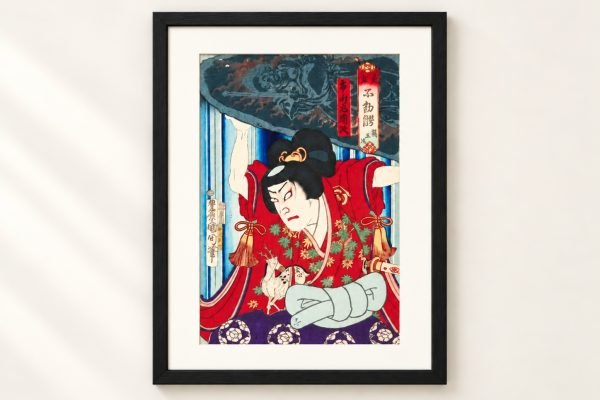
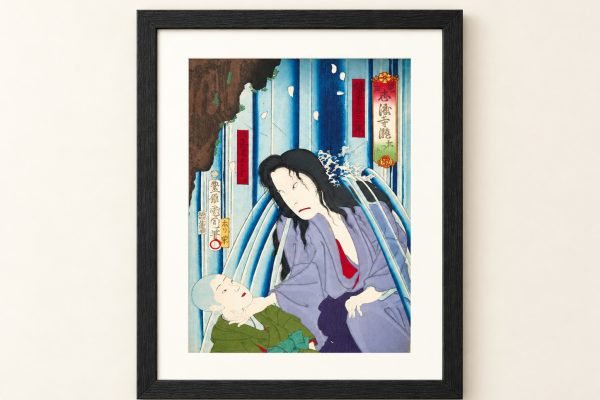
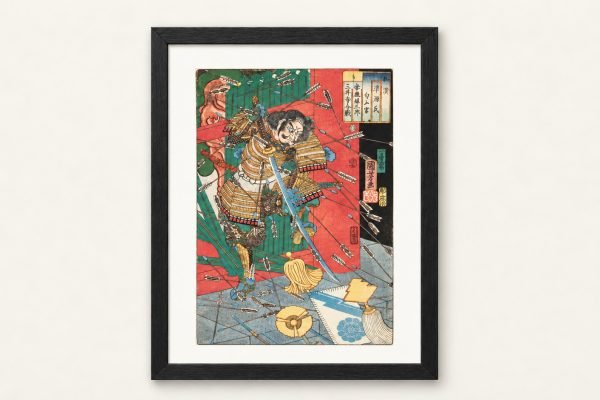
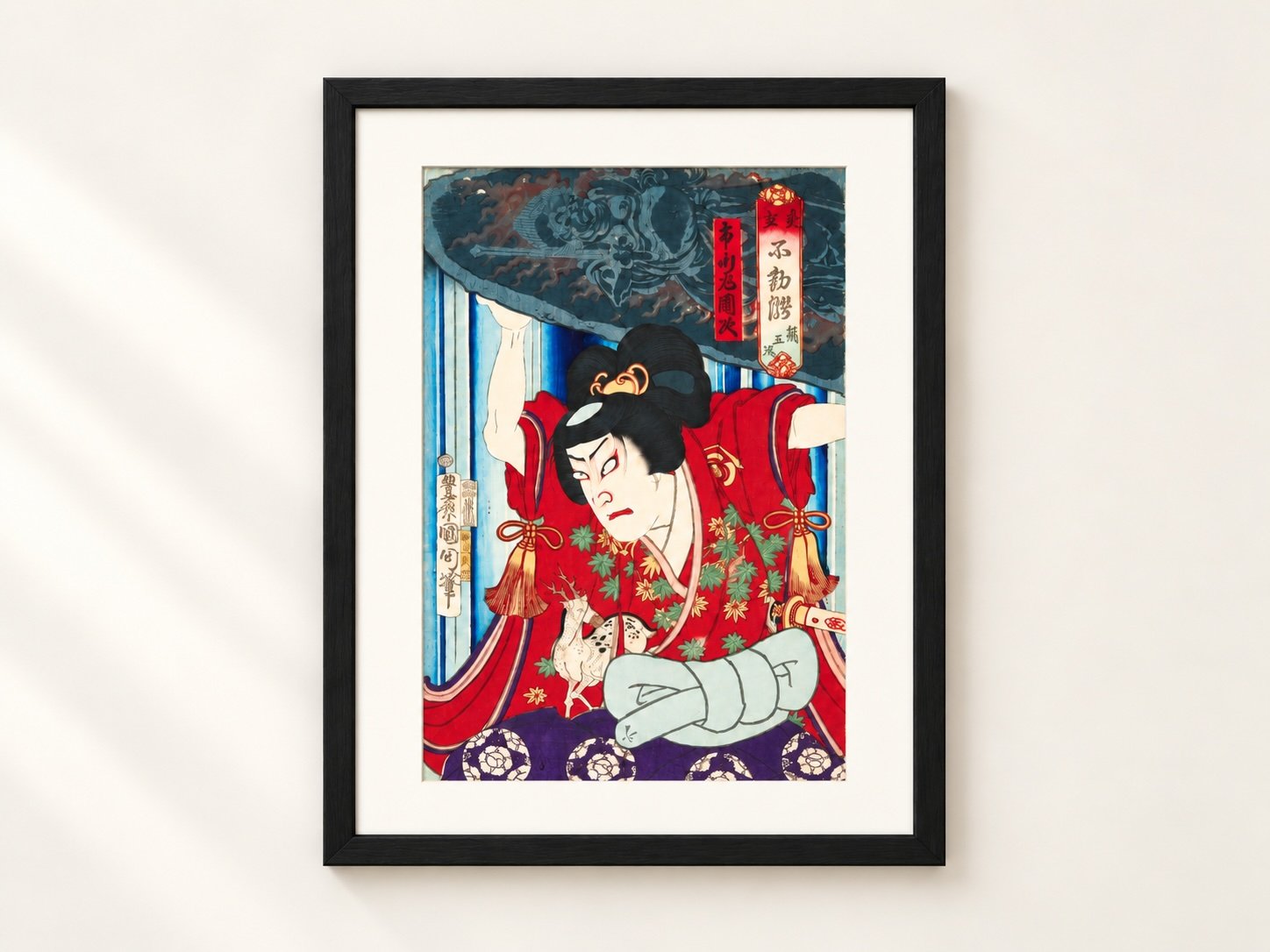
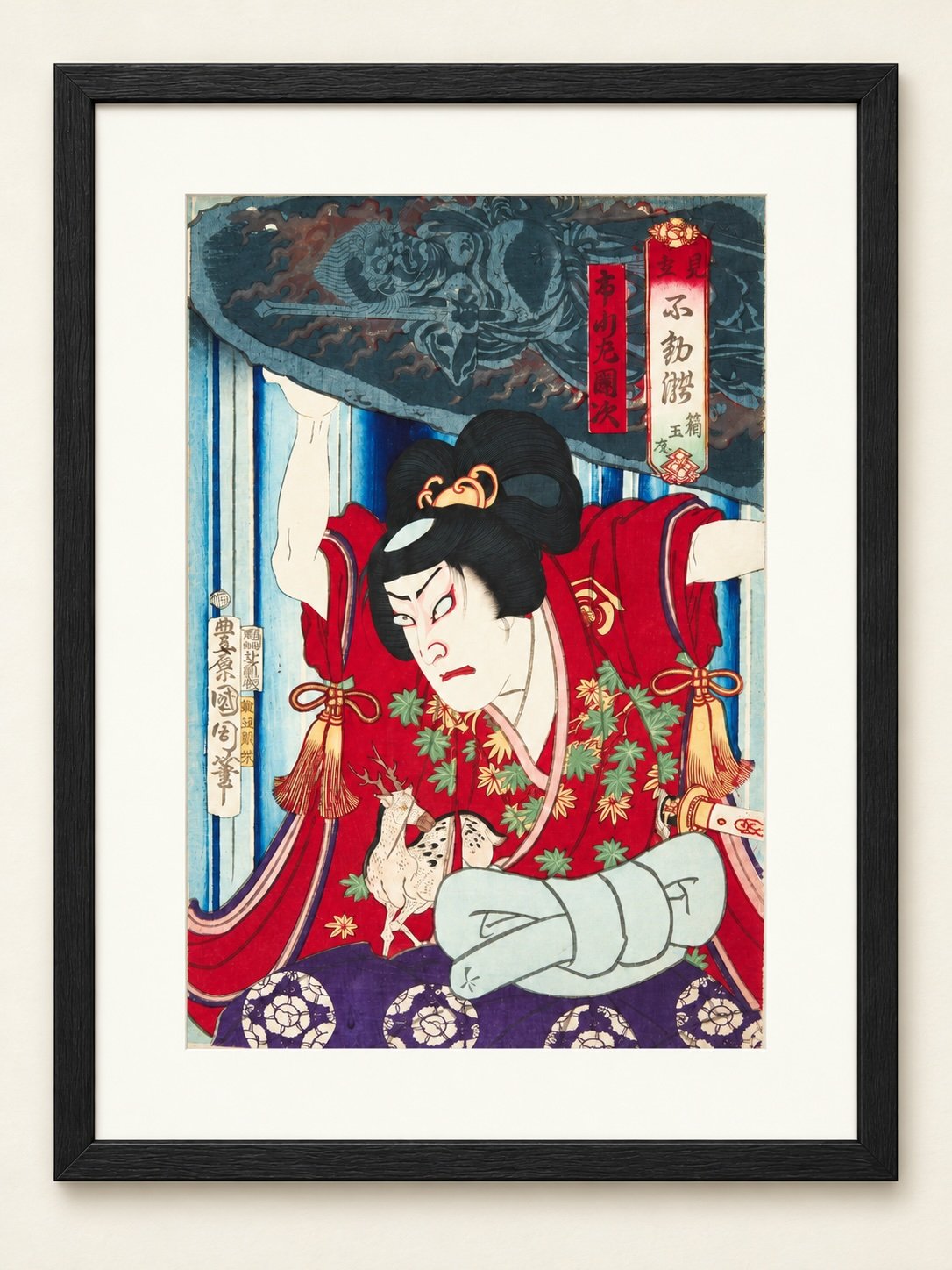
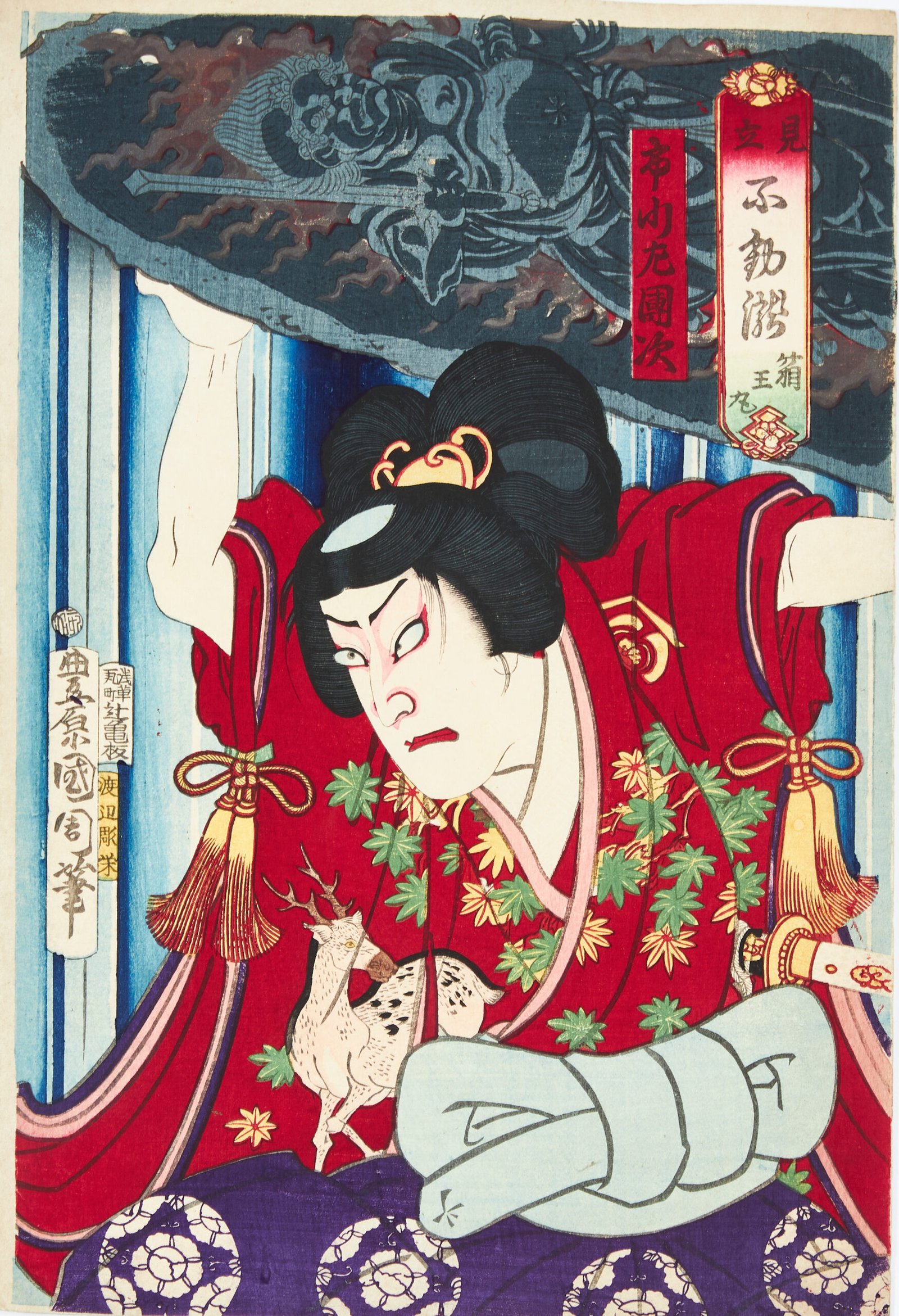
An original antique Japanese ukiyo-e woodblock print by Toyohara Kunichika (1835–1900), depicting the kabuki actor Ichikawa Sadanji in the role of Hakuōmaru in Mitate Fudō-ga-fuchi (見立 不動が淵). Part of Kunichika’s mitate-e waterfall series, the print presents the actor in a moment of dramatic movement, wearing a vivid red kimono patterned with maple leaves while pulling back a dark curtain or robe overhead. A small white deer stands at his feet, adding an unusual and distinctive element to the composition.
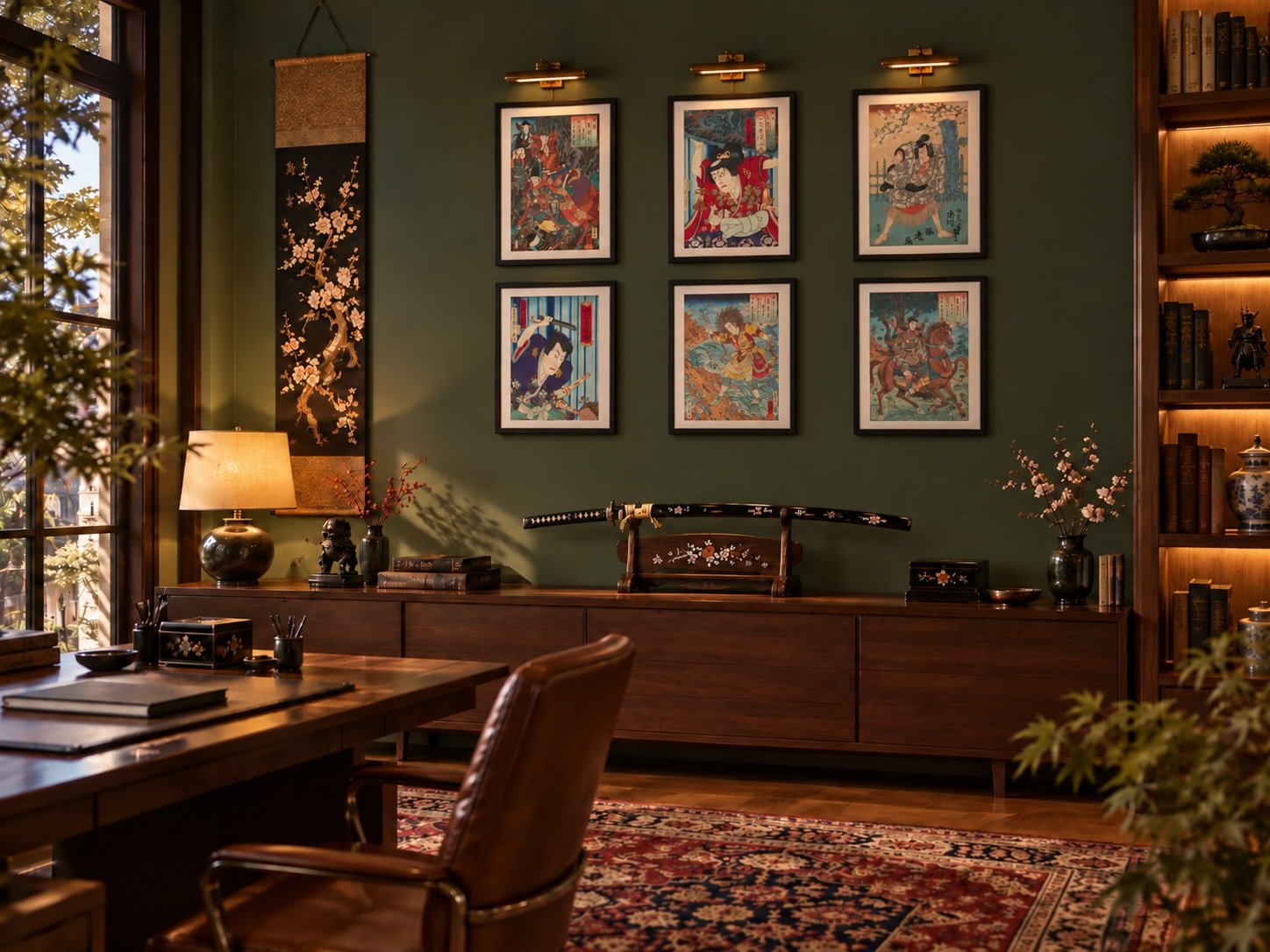
The ukiyo-e comes framed and ready to hang.
Ichikawa Sadanji is shown mid-gesture, with one leg raised and one arm extended upward as he pulls back the heavy dark form above him.
The vivid red kimono immediately dominates the composition.
Its scattered maple-leaf motifs in green and warm tones create a striking contrast with the cool blues behind the actor and the dark mass occupying the upper part of the image.
The small white deer at his feet introduces a delicate counterpoint to the actor’s forceful movement.
The role name Hakuōmaru appears in the title cartouche alongside the reference to Fudō-ga-fuchi, or “Fudō’s Deep Pool.”
The print presents Ichikawa Sadanji in the role of Hakuōmaru.
Kunichika captures the actor in a strongly theatrical pose rather than in a static portrait.
One leg rises as the body leans forward.
One arm reaches upward, pulling back the heavy dark curtain or robe that stretches across the upper part of the composition.
The actor’s face is sharply focused, with the heightened expression and stylized makeup associated with kabuki performance.
His bright red kimono expands across much of the image, giving the figure an immediate visual presence.
The pose creates the impression of an action unfolding before the viewer, as though a moment from the stage has been suddenly frozen.
The title connects the scene with Fudō-ga-fuchi, literally “Fudō’s Deep Pool.”
This reference links the composition to Fudō Myōō, the wrathful guardian deity of Japanese Buddhism.
Fudō Myōō has long been associated with practices of religious austerity, including waterfall discipline known as takigyō.
In this practice, devotees stand beneath falling water as an act of purification, endurance and spiritual discipline.
The association between Fudō and waterfall austerities makes the reference particularly appropriate within Kunichika’s mitate-e waterfall series.
The title therefore gives the image a religious and symbolic dimension beyond its immediate theatrical subject.
The print belongs to the same mitate-e waterfall series in which Kunichika placed celebrated kabuki actors and theatrical characters in compositions associated with named waterfalls, pools and dramatic water settings.
The idea of mitate depends upon visual or conceptual association.
Rather than simply reproducing a theatrical scene literally, the artist creates a relationship between actor, role and setting.
Here, the reference to Fudō’s Pool connects Hakuōmaru with a place and religious tradition strongly associated with water austerities.
The result combines actor portraiture, theatrical narrative and symbolic landscape association within a single image.
Movement is central to the design.
The actor is not shown standing passively within the frame.
His raised leg, extended arm and forward-leaning body create multiple diagonal lines.
These movements contrast with the strong vertical blue bands behind him.
The dark form pulled across the top of the image creates a further visual weight, pressing downward against the actor’s upward gesture.
The result is a composition built around tension between opposing directions.
At the same time, the small white deer remains comparatively still beneath the actor, providing a visual pause within the surrounding theatrical action.
The actor’s costume is one of the most striking elements of the print.
A brilliant red kimono occupies much of the central composition.
Across its surface, green maple leaves and smaller warm-toned leaves create a repeating natural motif.
The intense red contrasts strongly with the pale skin of the actor, the black hair, the cool blue background and the pale form of the deer.
Decorative cords and tassels introduce additional gold and warm tones.
The bold color and complex textile design demonstrate Kunichika’s ability to use costume not simply as ornament, but as a major structural element within the composition.
A small white deer appears close to the actor’s body.
Its pale coloration distinguishes it immediately from the saturated red kimono and blue background.
The animal introduces an unexpected note of delicacy into an otherwise forceful theatrical image.
Its compact form also helps organize the lower central area of the composition.
Rather than competing with the actor, the deer acts as a secondary visual focus, drawing the eye toward the center before attention returns to the actor’s face and dramatic upward gesture.
Toyohara Kunichika (1835–1900) was born Ōshima Yasohachi in Edo.
He trained within the Utagawa artistic tradition before becoming a pupil of Utagawa Kunisada, also known as Toyokuni III.
Kunichika became one of the artists most closely associated with the kabuki theatres of Edo and later Tokyo.
He spent much of his artistic life around the theatrical world, sketching leading performers directly from life.
Among the actors he portrayed were Ichikawa Danjūrō IX, Onoe Kikugorō V and Bandō Hikosaburō V.
This direct contact with actors and performances became fundamental to his approach to yakusha-e.
Kunichika is widely regarded as one of the final major masters of yakusha-e, the tradition of ukiyo-e actor portraiture.
His work developed during a period of major transformation in Japanese visual culture.
Photography was increasingly changing the way actors and celebrities could be represented.
Kunichika nevertheless continued to explore possibilities unique to woodblock printing.
His actor portraits use exaggerated gesture, powerful facial expression, elaborate textile design and intense color to convey the heightened visual language of kabuki.
The present print exemplifies that approach.
Ichikawa Sadanji is recognizable as an actor, but the dramatic pose, costume and symbolic setting transform him fully into the character of Hakuōmaru.
Kunichika was among the early ukiyo-e artists to make use of the newly available synthetic aniline dyes introduced into Japan during the Meiji period.
These pigments enabled particularly intense reds, purples and blues.
The strong red of Hakuōmaru’s kimono is one of the dominant features of the present composition.
It contrasts dramatically with the blue vertical background and dark upper curtain.
The green maple leaves provide another layer of color, while the pale grey-blue form across the lower part of the composition and the white deer soften the palette.
The result is the kind of vivid chromatic impact closely associated with Kunichika’s mature theatrical work.
The print is executed as a nishiki-e, or full-color Japanese woodblock print.
This technique required the coordinated use of multiple carved woodblocks.
A principal key block established the major contours of the composition.
Additional blocks supplied individual areas of color.
In the present work, separate impressions create the vivid red costume, green maple leaves, blue background, dark upper elements, flesh tones, decorative cords, pale garments and the white deer.
The result demonstrates the sophisticated color registration and visual complexity achievable through traditional Japanese polychrome woodblock printing.
The work is presented in vertical ōban tate-e format.
This format was particularly effective for actor portraiture.
It allowed a single figure to dominate the image while leaving enough vertical space for gesture, costume, inscriptions and theatrical surroundings.
Kunichika uses the format dynamically here.
The actor’s body fills much of the central area, while his arms and raised leg push outward toward the edges of the composition.
The dark form above compresses the upper space, intensifying the sensation that Hakuōmaru is physically interacting with the environment around him.
This is an original antique Japanese woodblock print, not a modern reproduction or later decorative reprint.
Its age is an important part of its historical character and authenticity.
Original ukiyo-e of this period have survived through generations of ownership, handling, storage and display.
With works on paper that have survived for well over a century, gentle toning, occasional small marks, minor creasing or faint traces of handling are normal and expected.
These characteristics are consistent with genuine antique works.
They should be understood in the context of an original historical print rather than compared with the appearance of a newly manufactured reproduction.
The print comes from the collection of Dr. Eugen Milch (1889–1958), an Austrian physician and artist whose life was marked by extensive international travel.
Milch served as a medical officer during the First World War.
During the early 1920s, he travelled throughout Europe on a combined study and painting journey.
In 1924 he married the artist Emma Bormann.
The couple visited Sweden that same year and, together with the artist Oskar Bergman, exhibited several paintings at Liljevalchs in Stockholm.
In 1937, Eugen Milch travelled to China with other Austrian physicians following an invitation from the Chinese government.
Emma joined him two years later.
Although the original posting did not materialise as planned, Milch became superintendent of a hospital in Beihai in 1938.
His years in East Asia combined his medical career with his continuing interests in art and travel.
In 1941, Japanese forces occupied parts of the southern Chinese coast, including Beihai.
The Milch family managed to relocate to Shanghai.
During their time in China, Eugen and Emma eventually decided to separate.
Eugen later assisted British forces in China, service for which he was granted British citizenship.
His life and career therefore placed him directly within some of the major historical transformations affecting East Asia during the first half of the twentieth century.
Continuing his travels, Eugen Milch later went to Japan to study the aftermath of the war.
According to the provenance associated with the collection, it is considered likely that he acquired the present group of Japanese woodblock prints during this period.
He died in Hong Kong in 1958.
The collection subsequently passed by descent within the family.
This provenance adds another historical dimension to the print, connecting a nineteenth-century Japanese theatrical work with the international life of a twentieth-century physician, artist, traveller and collector.
The print shows some signs of wear consistent with age together with light handling creases.
It remains in good general condition.
As with original Japanese works on paper of this age, gentle toning, occasional small marks, light creasing or faint traces of handling are normal and expected.
Such characteristics are consistent with an authentic antique print that has survived for well over a century.
They should not be interpreted as evidence that the work is in poor condition.
The condition information is provided for transparency and to allow collectors to understand the preserved state of the original print.
The ukiyo-e is individually framed and sold complete with its frame.
It arrives ready to hang.
The dark frame and light mount provide a clean presentation that places full emphasis on Kunichika’s vivid composition.
The neutral framing contrasts particularly well with the brilliant red kimono, deep black hair, blue background and pale tones of the deer and lower garments.
The work can therefore be displayed immediately while retaining the visual presence of the original antique print.
This print brings together several qualities for which Toyohara Kunichika is particularly valued: a dynamic kabuki actor portrait, powerful theatrical gesture, intense Meiji-era color and an unusual symbolic setting connected with Fudō Myōō.
The vivid red maple-leaf kimono gives the composition exceptional visual presence.
Its color contrasts powerfully with the cool blue background and the dark form drawn across the upper section of the image.
The small white deer provides another distinctive feature, introducing a quieter visual element beneath the actor’s dramatic movement.
The reference to Fudō-ga-fuchi also places the print within the broader conceptual structure of Kunichika’s waterfall series and connects the theatrical image with the long-standing Buddhist association between Fudō Myōō and waterfall austerities.
The print is also representative of Kunichika’s importance within the final major phase of the yakusha-e tradition.
Its provenance from the collection of Dr. Eugen Milch adds an additional layer of twentieth-century collecting history.
An original antique Japanese ukiyo-e by Toyohara Kunichika depicting Ichikawa Sadanji as Hakuōmaru in Mitate Fudō-ga-fuchi (見立 不動が淵). The actor is captured in a dramatic moment with one leg raised and one arm pulling back a dark curtain or robe overhead, wearing a vivid red kimono patterned with maple leaves. A small white deer stands at his feet. The title connects the scene with “Fudō’s Deep Pool” and Fudō Myōō, the wrathful Buddhist guardian deity traditionally associated with waterfall austerities. Executed as an ōban tate-e nishiki-e, the print displays the bold color and theatrical immediacy characteristic of Kunichika’s celebrated yakusha-e. From the collection of Dr. Eugen Milch (1889–1958), subsequently by descent within the family. In good general condition with age-appropriate wear and light handling creases. Original antique Japanese woodblock print, not a modern reproduction. Individually framed and supplied ready to hang.

Order above 1.000,00 € gets free shipping.

Secure and hassle-free payment process.

Certificate of authenticity included.

Have questions? Contact us via WhatsApp.
Contact