

1 in stock
1 in stock
Add to Compare
Add to Wishlist
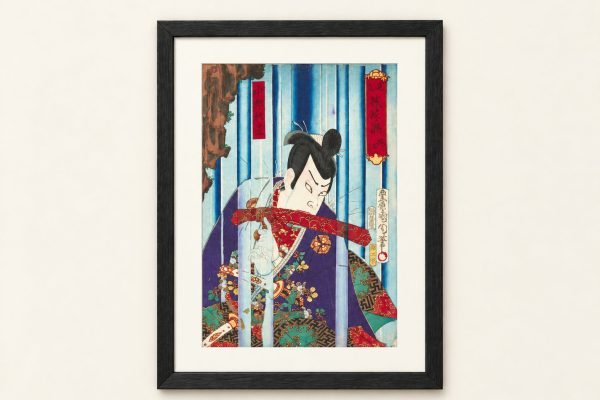
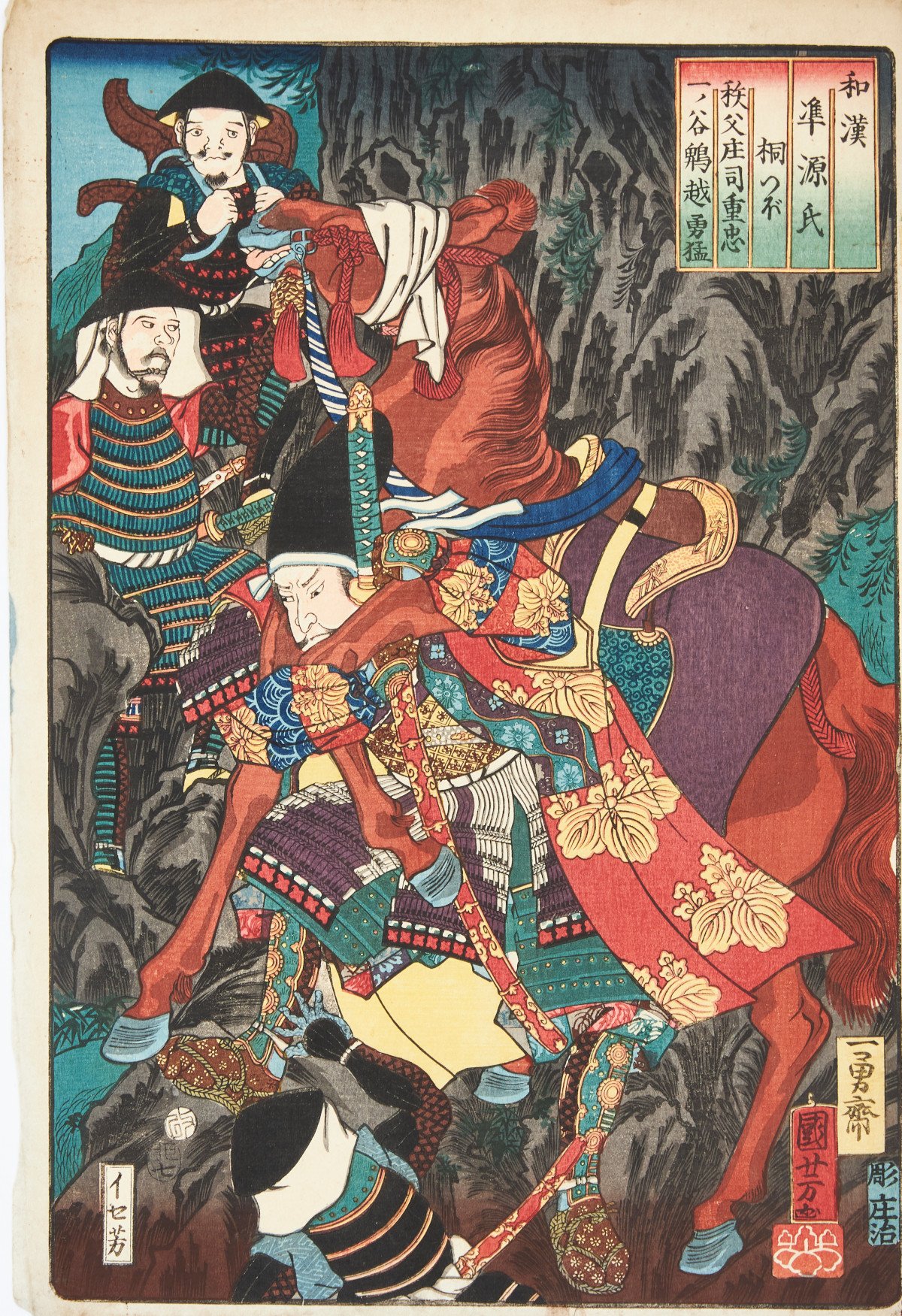
An original Japanese nishiki-e color woodblock print by Utagawa Kuniyoshi (1797–1861), from the celebrated series Wakan Nazorae Genji (和漢准源氏, “Japanese and Chinese Comparisons for the Chapters of Genji”), published by Ise-Yoshi in 1855–1856.
This sheet corresponds to Chapter One of The Tale of Genji, “Kiritsubo” (桐壺, “Paulownia Court”). Rather than illustrating Murasaki Shikibu’s novel literally, Kuniyoshi uses a mitate — an imaginative literary and visual comparison — to associate the chapter with a famous episode from Japanese warrior history.
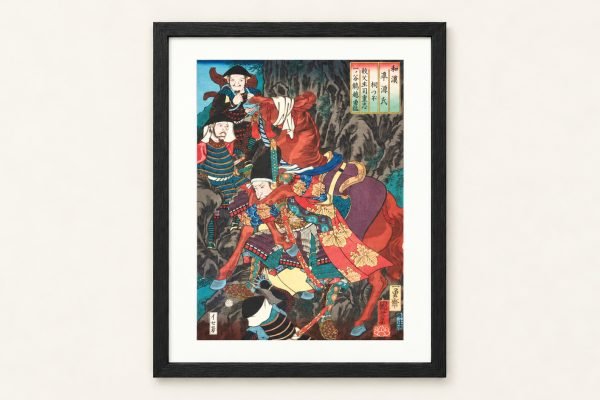
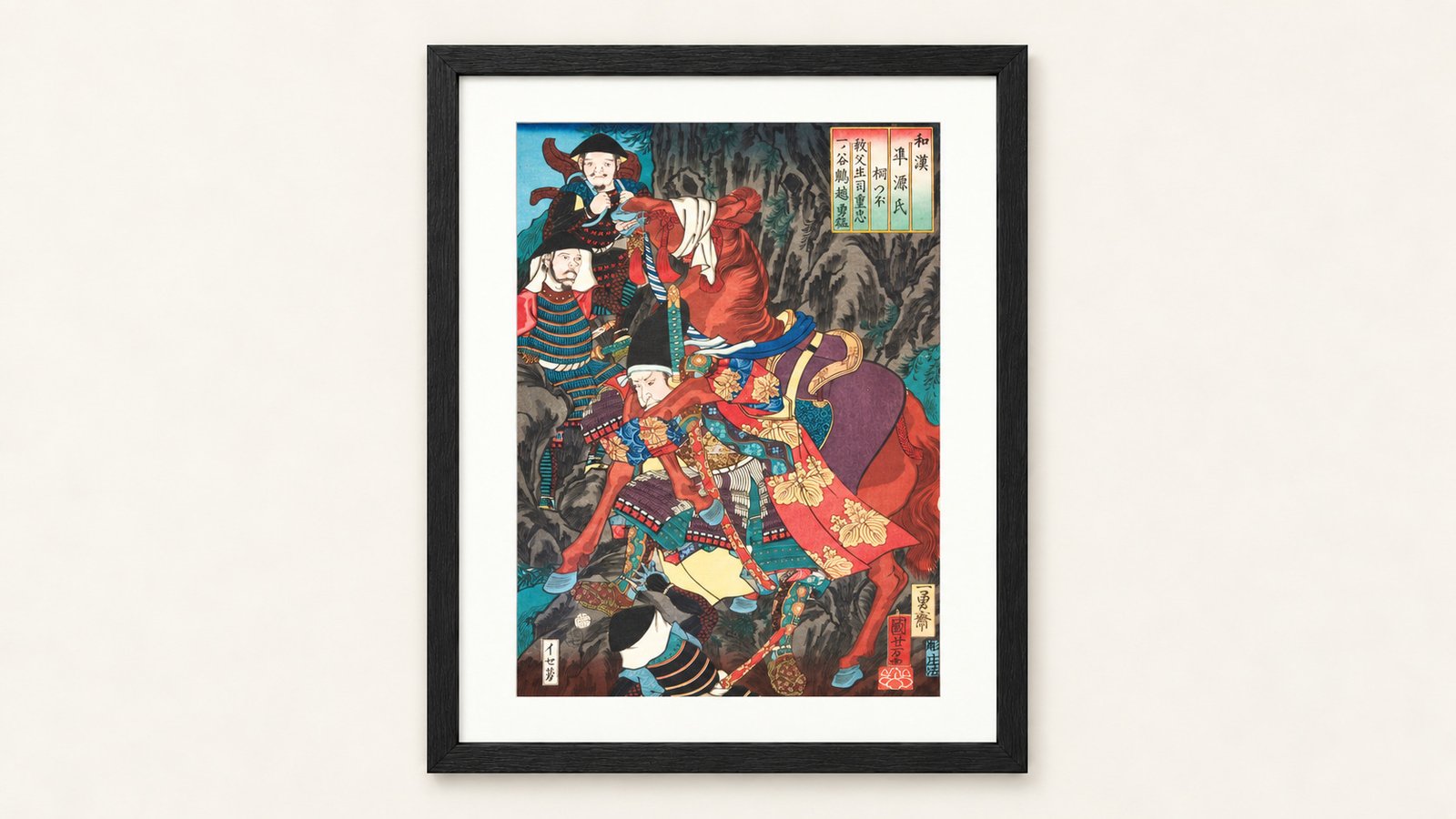
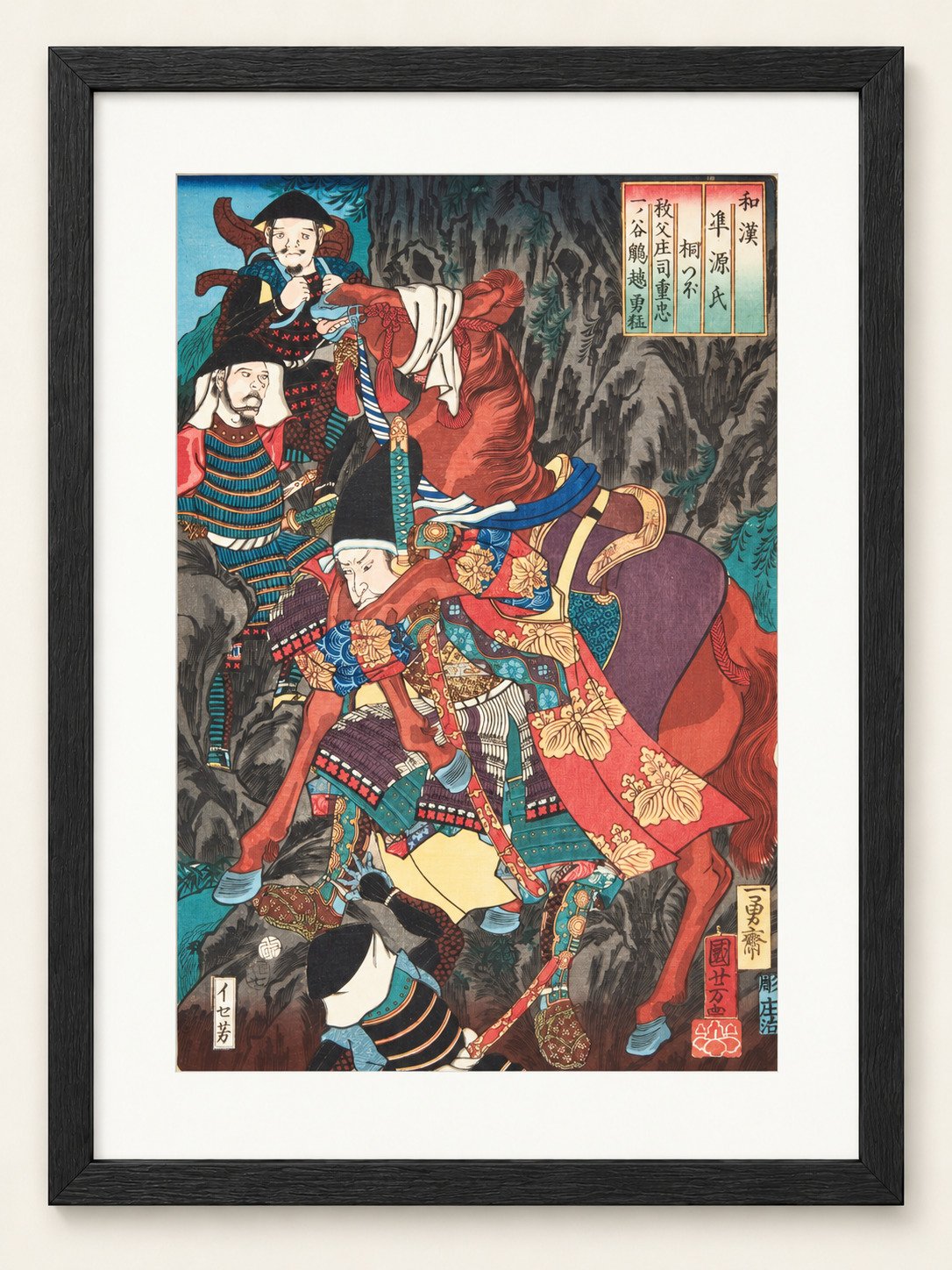
The scene depicts Chichibu Shōji Shigetada, better known historically as Hatakeyama Shigetada, carefully leading his horse down the precipitous slope of Hiyodorigoe during the Genpei War. The animal’s legs are bound to help steady it during the dangerous descent, while armored warriors negotiate the steep and rugged terrain around them.
The ukiyo-e comes individually framed and ready to hang.
Kiritsubo (桐壺), often translated as “Paulownia Court,” is the opening chapter of The Tale of Genji.
It introduces the refined courtly world in which Murasaki Shikibu’s narrative unfolds. Kuniyoshi, however, does not directly illustrate the events of the chapter.
Instead, he uses the chapter title as the basis for a mitate, pairing it with a separate historical or legendary episode. Here, the elegant world of the Heian court is set against the physical danger and martial heroism of the Genpei War.
The print belongs to Kuniyoshi’s important series Wakan Nazorae Genji (和漢准源氏), generally translated as “Japanese and Chinese Comparisons for the Chapters of Genji.”
The series uses the chapters of The Tale of Genji as a framework while introducing episodes drawn from Japanese and Chinese history, literature and legend.
Rather than producing straightforward illustrations of Murasaki Shikibu’s novel, Kuniyoshi creates sophisticated visual comparisons, linking the chapter titles with celebrated warriors, historical episodes, legends and classical narratives.
This sheet is catalogued as Robinson S88.1.
The central warrior is identified as Chichibu Shōji Shigetada (秩父庄司重忠), better known to history as Hatakeyama Shigetada.
Shigetada became one of the most admired warrior figures in Japanese tradition, remembered not only for his physical strength and military ability, but also for his loyalty, discipline and unusual reputation for gentleness.
Kuniyoshi depicts him during the legendary descent of Hiyodorigoe, carefully guiding his horse down the dangerous mountain slope.
The horse’s legs are bound to help control and stabilize the animal, emphasizing the extreme difficulty of the descent.
The episode belongs to the Genpei War (1180–1185), the great conflict between the Minamoto and Taira clans.
In 1184, during the Battle of Ichi-no-Tani, Minamoto no Yoshitsune led a small force of mounted warriors down the precipitous slopes above the fortified Taira position.
The maneuver was so dangerous and unexpected that it became one of the most famous episodes associated with Yoshitsune’s military career and was later retold in Japanese literature, theater and visual art.
Kuniyoshi conveys the danger through the steep rocky landscape, the compressed arrangement of the figures and the strong diagonal movement created by the horse and descending warriors.
Hatakeyama Shigetada became particularly associated with a story emphasizing his compassion toward his horse.
According to tradition, rather than forcing the animal down the most dangerous part of the slope, Shigetada carried it himself for part of the descent.
The anecdote became emblematic of a warrior whose extraordinary physical strength was balanced by kindness and concern for the animal that served him.
This unusual combination of martial courage and compassion helped establish Shigetada as an enduring figure within Japanese warrior legend.
The Genpei War was fought between the Minamoto and Taira clans from 1180 to 1185 and played a decisive role in the political transformation of medieval Japan.
The Battle of Ichi-no-Tani in 1184 ended in a major Minamoto victory. Yoshitsune’s descent from the cliffs above the Taira position became legendary for its extraordinary risk and tactical audacity.
Episodes from the Genpei War remained immensely popular for centuries, appearing in chronicles, illustrated books, Kabuki, storytelling traditions and ukiyo-e.
For Kuniyoshi, one of the great masters of the warrior print, such stories provided ideal material for dramatic compositions filled with movement and heroic action.
The Tale of Genji (Genji Monogatari) was written by the court lady Murasaki Shikibu in the early 11th century.
It is one of the foundational masterpieces of classical Japanese literature and is frequently described as the world’s first novel.
Across its fifty-four chapters, the work explores court life, relationships, status, beauty, memory, loss and the emotional world of the Heian aristocracy.
Kuniyoshi approaches this literary monument through comparison rather than direct illustration, using the individual chapter titles as starting points for historical, literary and legendary associations.
Utagawa Kuniyoshi (1797–1861), born Yoshisaburō in Edo, was the son of a silk dyer and entered the Utagawa school around 1811 as a pupil of Utagawa Toyokuni I.
After struggling for recognition during the early part of his career, Kuniyoshi achieved major success with his 1827 series depicting the 108 heroes of the Chinese novel Suikoden.
The success of these prints established him as one of the leading designers of musha-e, or warrior prints.
His reputation was built on dynamic compositions, powerful figures, dramatic landscapes and an extraordinary ability to transform historical and legendary narratives into visually compelling scenes.
Alongside Hiroshige and Kunisada, Kuniyoshi is regarded as one of the last great masters of ukiyo-e.
Musha-e are woodblock prints devoted to warriors, battles and legendary heroes.
Kuniyoshi became one of the defining artists of the genre, frequently presenting his heroes against turbulent landscapes, supernatural enemies or scenes of exceptional physical danger.
This print displays many of the qualities associated with his mature warrior imagery: overlapping figures, elaborate armor, dramatic terrain and a powerful sense of movement.
The combination of the descending horse, armored warriors and jagged rocks creates a composition perfectly suited to the legendary danger of Hiyodorigoe.
The large red horse is one of the strongest visual elements in the print.
Its body curves through the center of the composition, establishing a powerful diagonal rhythm that follows the descent of the mountainside.
Shigetada’s richly decorated armor and garments introduce turquoise, blue, red, yellow and gold tones, while the darker rocky landscape makes the principal figures stand out dramatically.
Additional armored warriors occupy the upper and lower portions of the sheet, reinforcing the impression of a group compressed into an extremely narrow and dangerous route.
The work is a nishiki-e, or full-color Japanese woodblock print.
This technique required multiple carved woodblocks, with separate blocks prepared for the key outlines and individual areas of color. Each block had to be printed in precise registration to create the completed image.
The surviving colors remain an important part of the visual impact of the print, particularly the vivid red of the horse, the turquoise and blue armor, the gold details and the contrasting dark mountain landscape.
Wakan Nazorae Genji was published by Ise-Yoshi in 1855–1856, during the final years of the Edo period.
The print therefore belongs to the mature phase of Kuniyoshi’s career, when his reputation as one of the great designers of warrior imagery was already firmly established.
Its combination of literary reference, historical narrative and dramatic musha-e design demonstrates the sophistication of Kuniyoshi’s later work.
This print comes from the collection of Dr. Eugen Milch (1889–1958), an Austrian physician and artist whose life involved extensive travel throughout Europe and Asia.
Milch served as a medical officer during the First World War and traveled widely in the early 1920s on combined study and painting journeys. In 1924 he married the artist Emma Bormann, and the couple visited Sweden that same year. Together with the artist Oskar Bergman, they exhibited several paintings at Liljevalchs in Stockholm.
In 1937, Eugen Milch traveled to China with other Austrian physicians at the invitation of the Chinese government. In 1938 he became superintendent of a hospital in Beihai, China.
Following the Japanese occupation of parts of the southern Chinese coast, including Beihai, the Milch family relocated to Shanghai in 1941.
Eugen later assisted British forces in China and was granted British citizenship. He subsequently traveled to Japan to study the aftermath of the war, and it is considered likely that he acquired the present collection of Japanese woodblock prints during this period.
He died in Hong Kong in 1958. The collection subsequently passed by descent within the family.
This is an original antique Japanese woodblock print (ukiyo-e), not a modern reproduction or later reprint.
Dating from 1855–1856, it is a genuine late Edo-period work preserving the paper, pigments, printing characteristics and natural aging associated with an original Japanese woodblock impression.
As with any work on paper of this age, some light wear is normal and expected. Gentle toning of the paper, occasional small spots or creases, surface soiling and faint handling marks may be present as part of the natural history of a print that has survived for approximately 170 years.
These characteristics are typical of genuine period ukiyo-e and should be understood within the context of the work’s age. Individual condition notes are provided for transparency and do not imply that the print is in poor condition.
The print remains in good overall antique condition.
There is wear consistent with age, some surface soiling and handling creases. The colors remain generally well preserved and retain considerable visual strength.
Please examine the detailed photographs carefully, as they form an important part of the condition description and provide a close view of the paper, colors, margins and surviving surface.
The print is individually framed and sold complete with its frame, ready to hang.
A dramatic original late Edo-period ukiyo-e by Utagawa Kuniyoshi from the 1855–1856 series Wakan Nazorae Genji, pairing Chapter One of The Tale of Genji, “Kiritsubo,” with the legendary descent of Hatakeyama Shigetada at Hiyodorigoe during the Genpei War. The powerful red horse, richly armored warriors and steep rocky landscape demonstrate the dynamic visual storytelling that established Kuniyoshi as one of the greatest masters of musha-e. Published by Ise-Yoshi, catalogued as Robinson S88.1 and preserved with provenance from the collection of Dr. Eugen Milch, this original framed print combines literary association, warrior legend and mature Edo-period woodblock craftsmanship in a single compelling composition.

Order above 1.000,00 € gets free shipping.

Secure and hassle-free payment process.

Certificate of authenticity included.

Have questions? Contact us via WhatsApp.
Contact