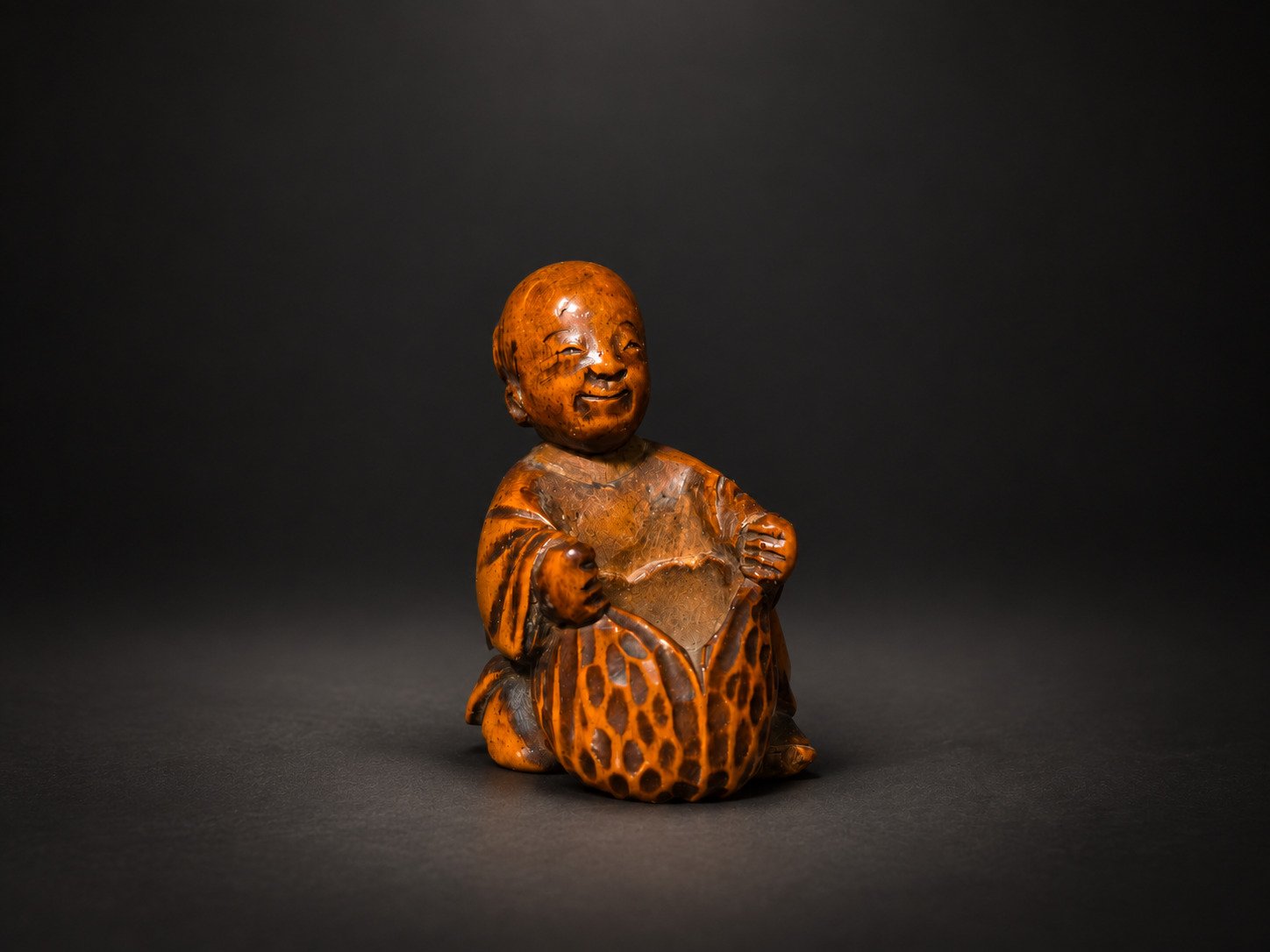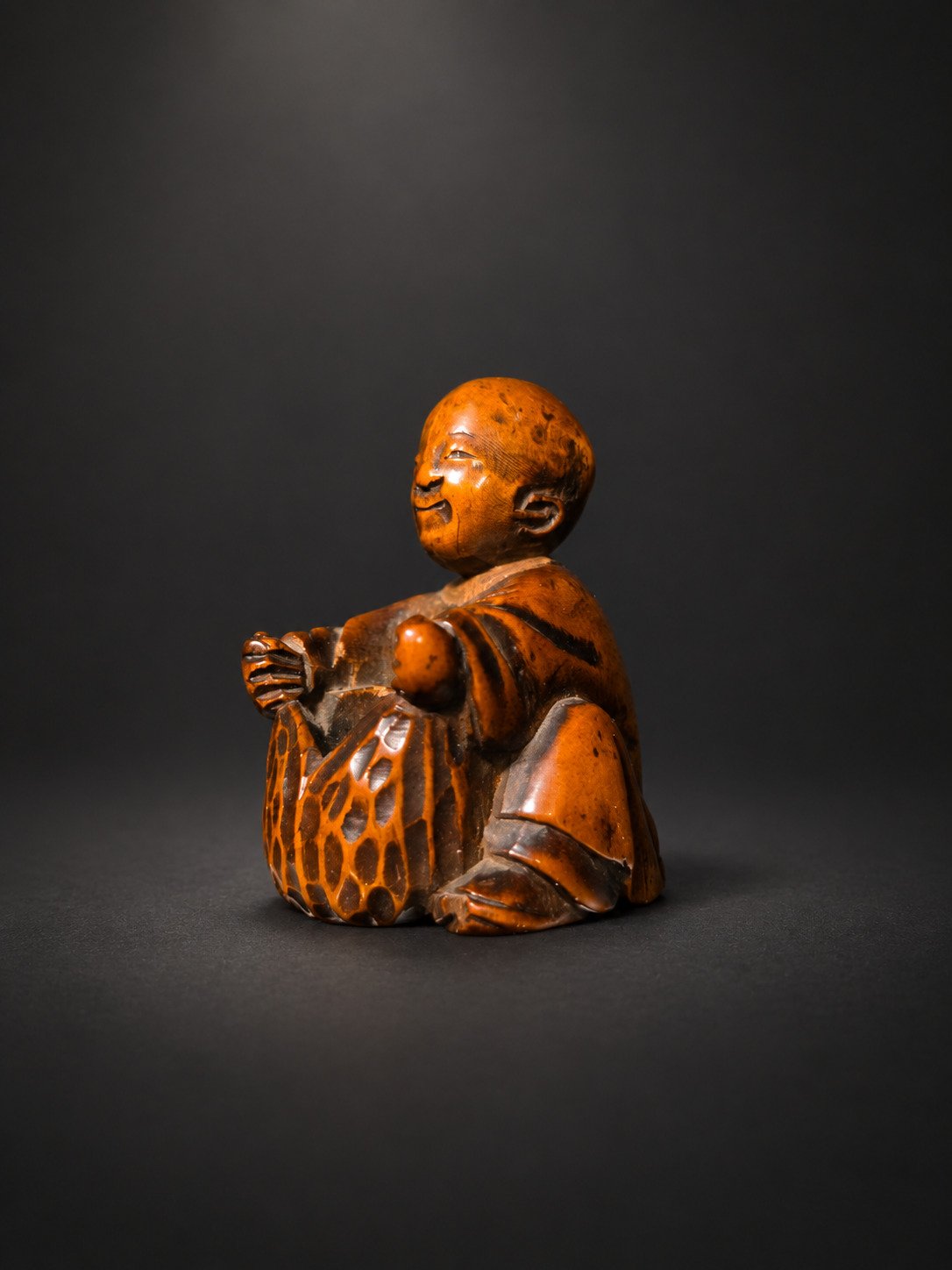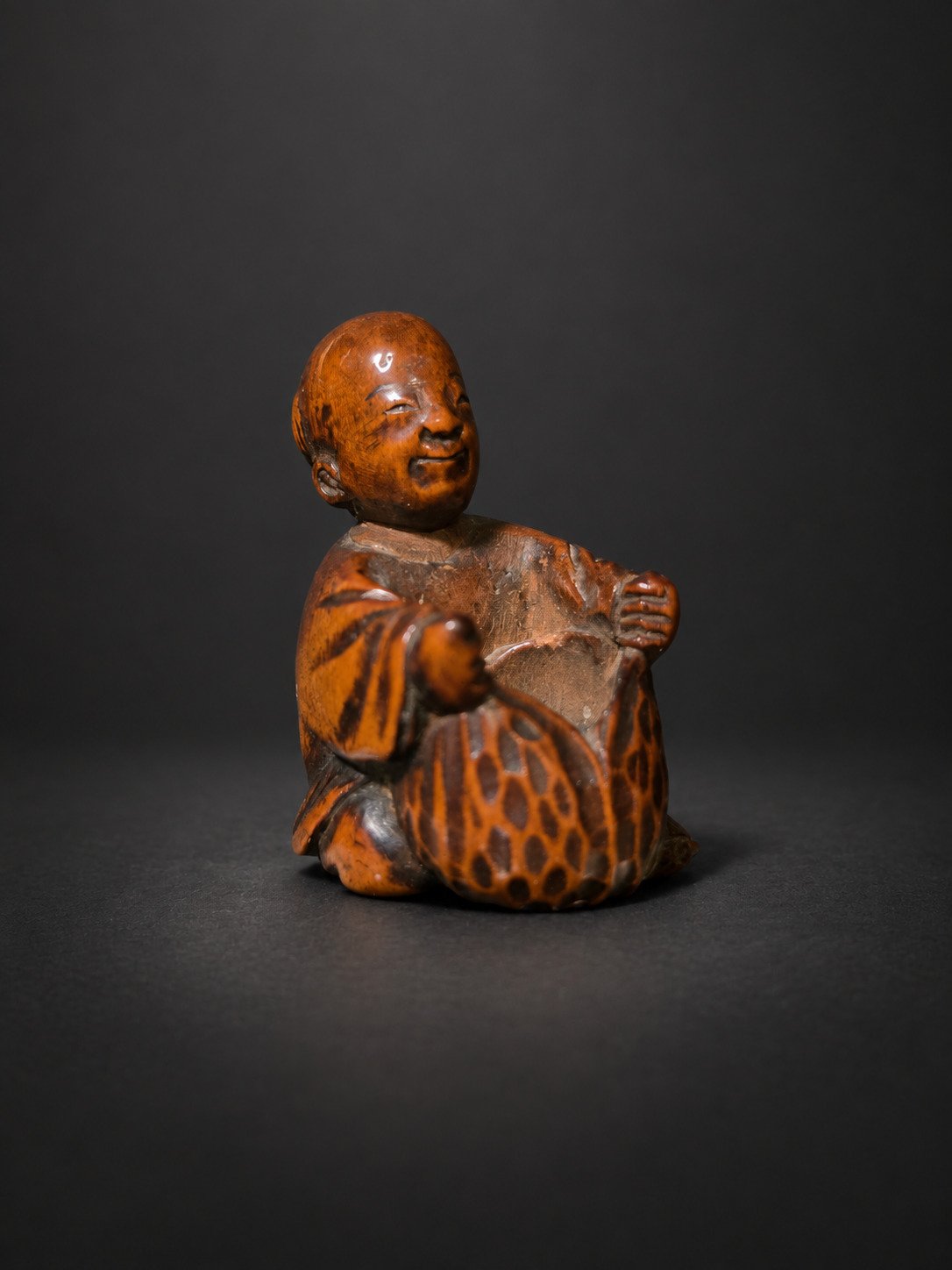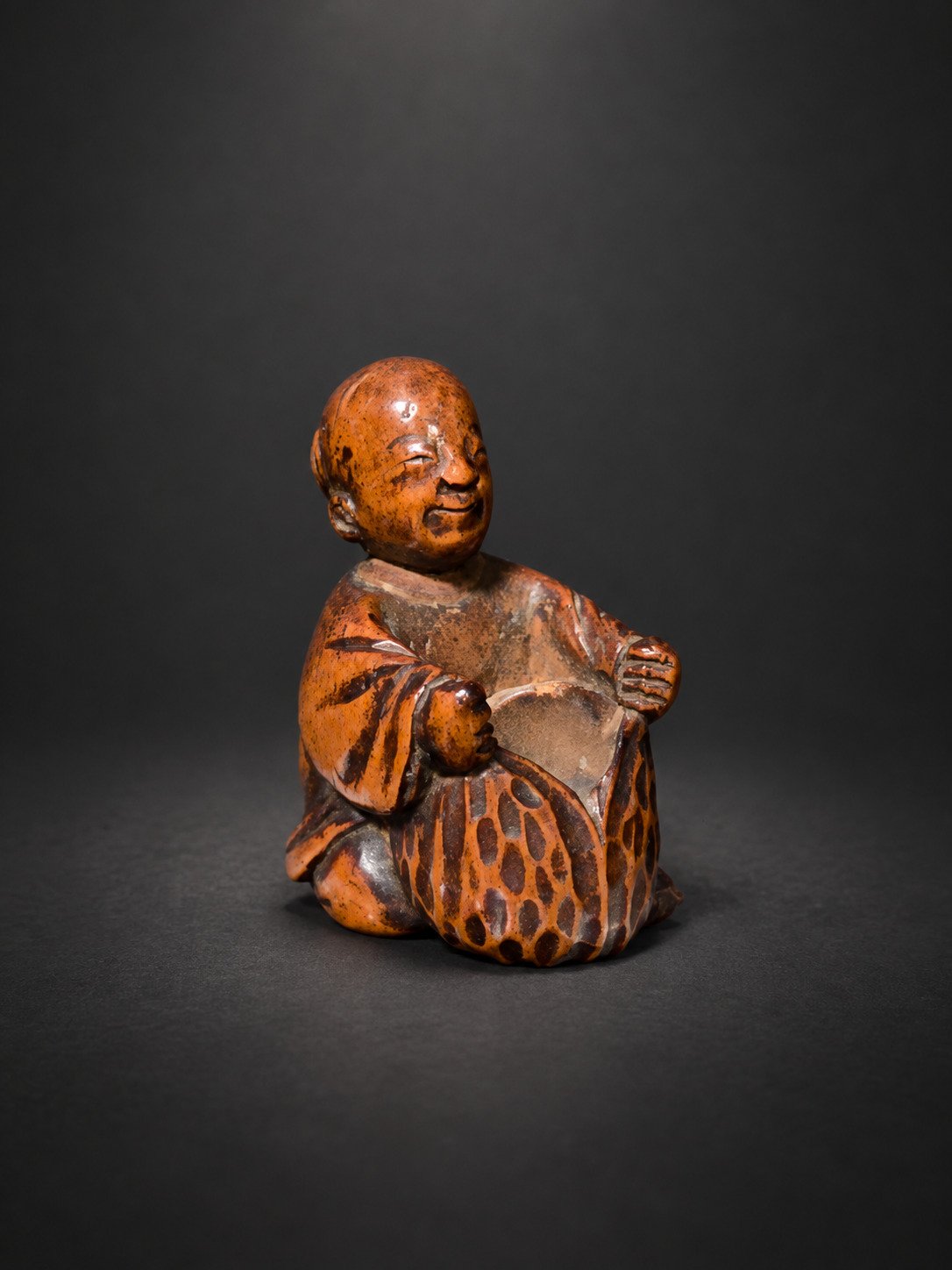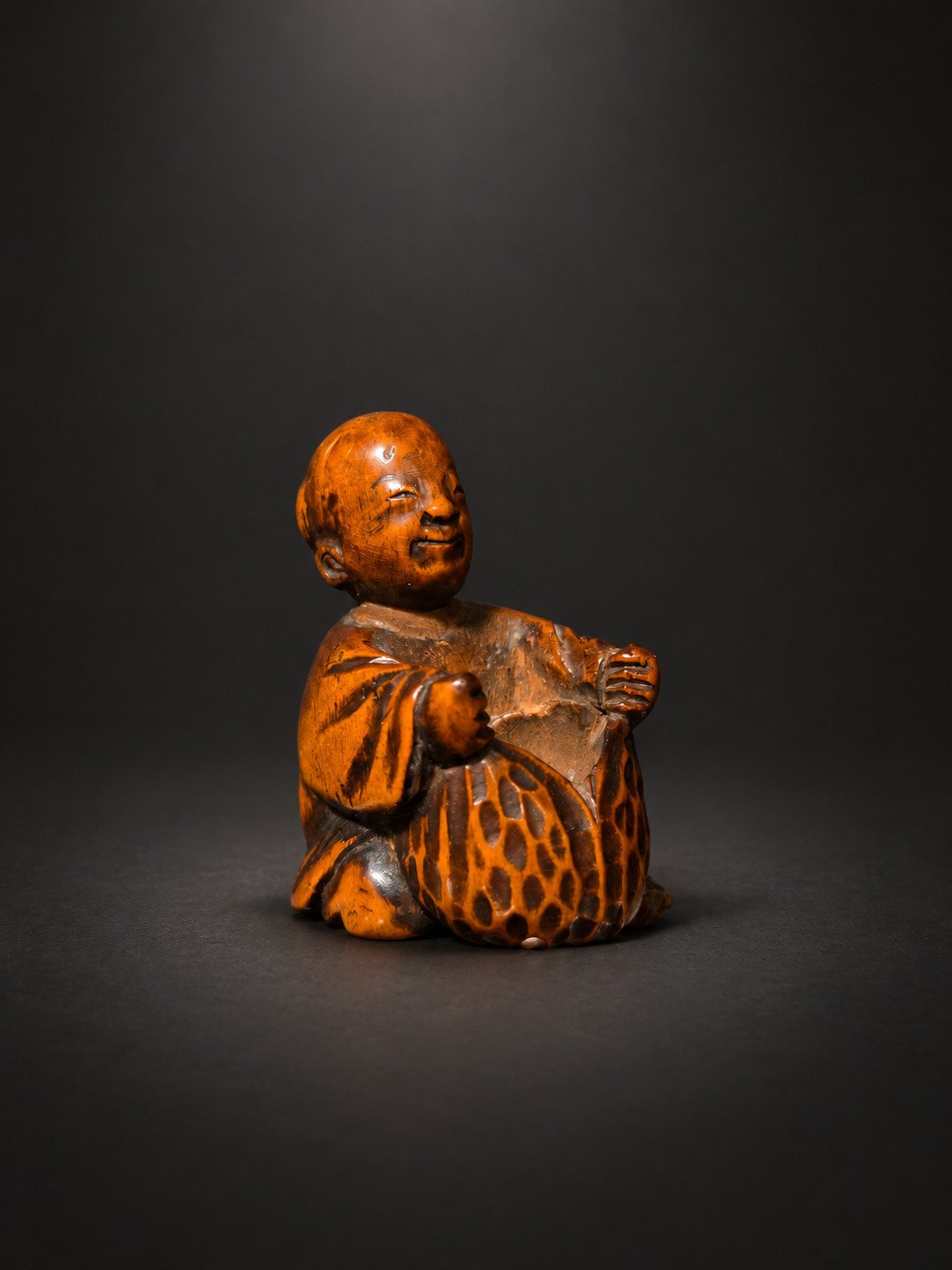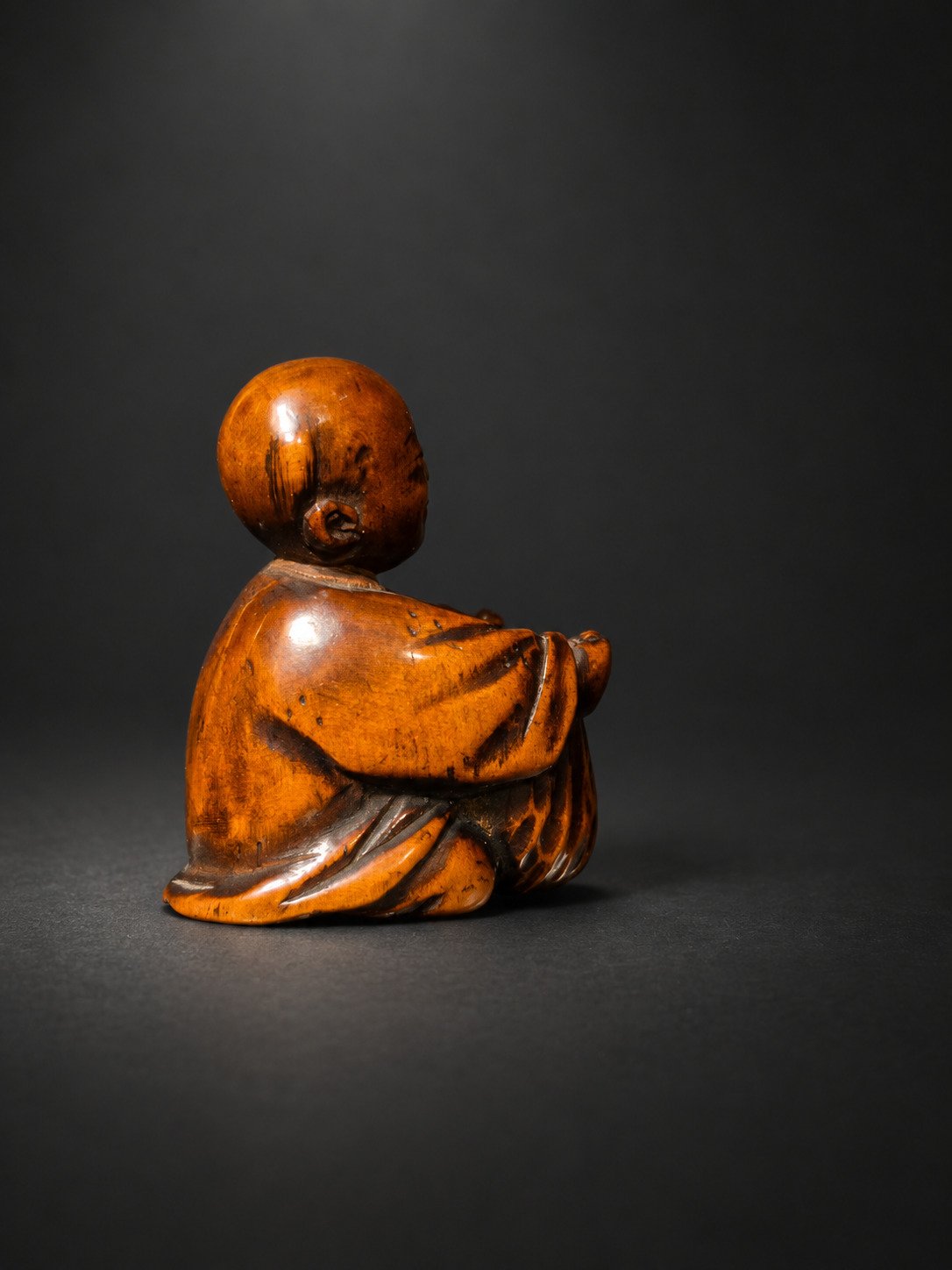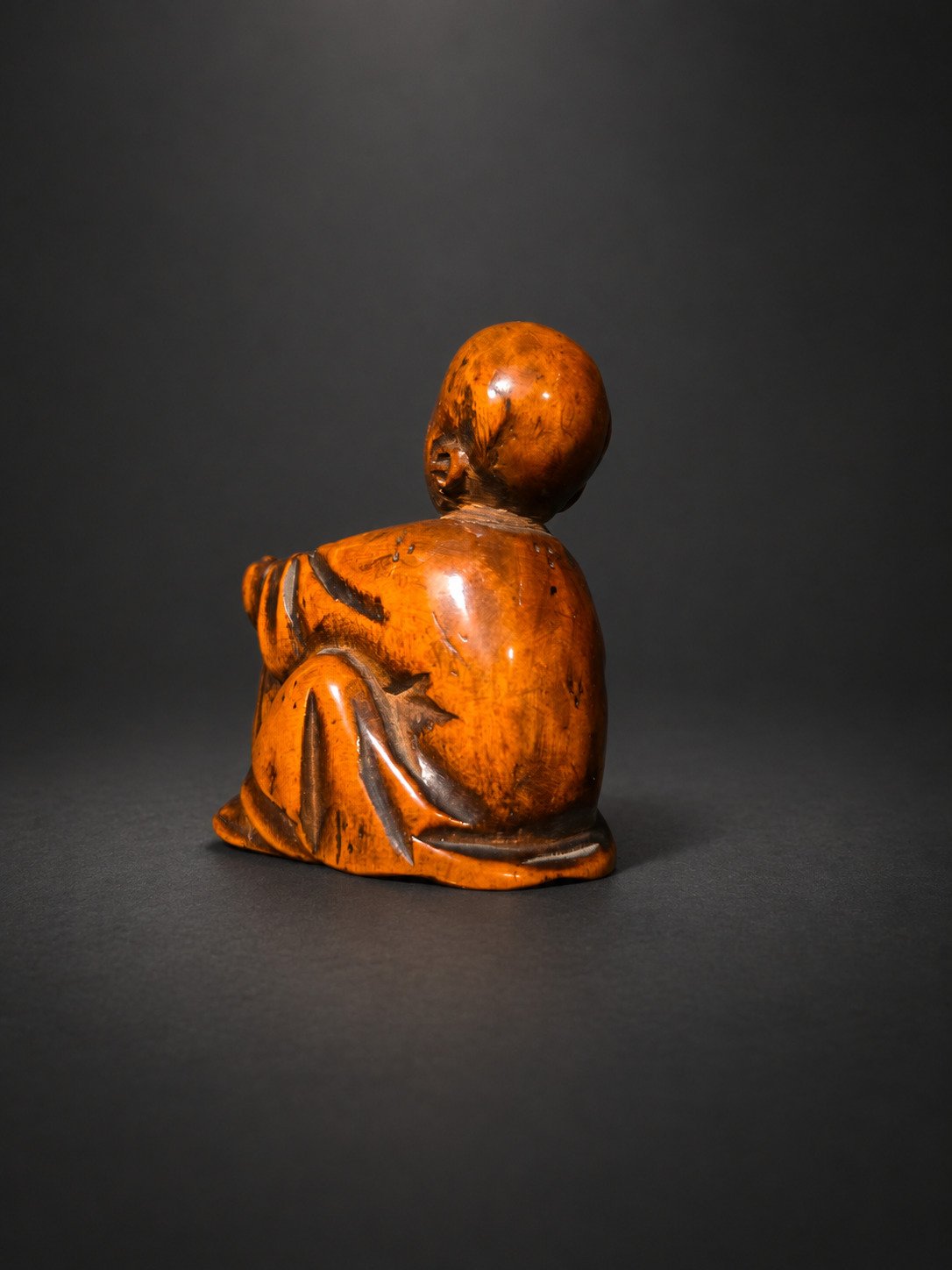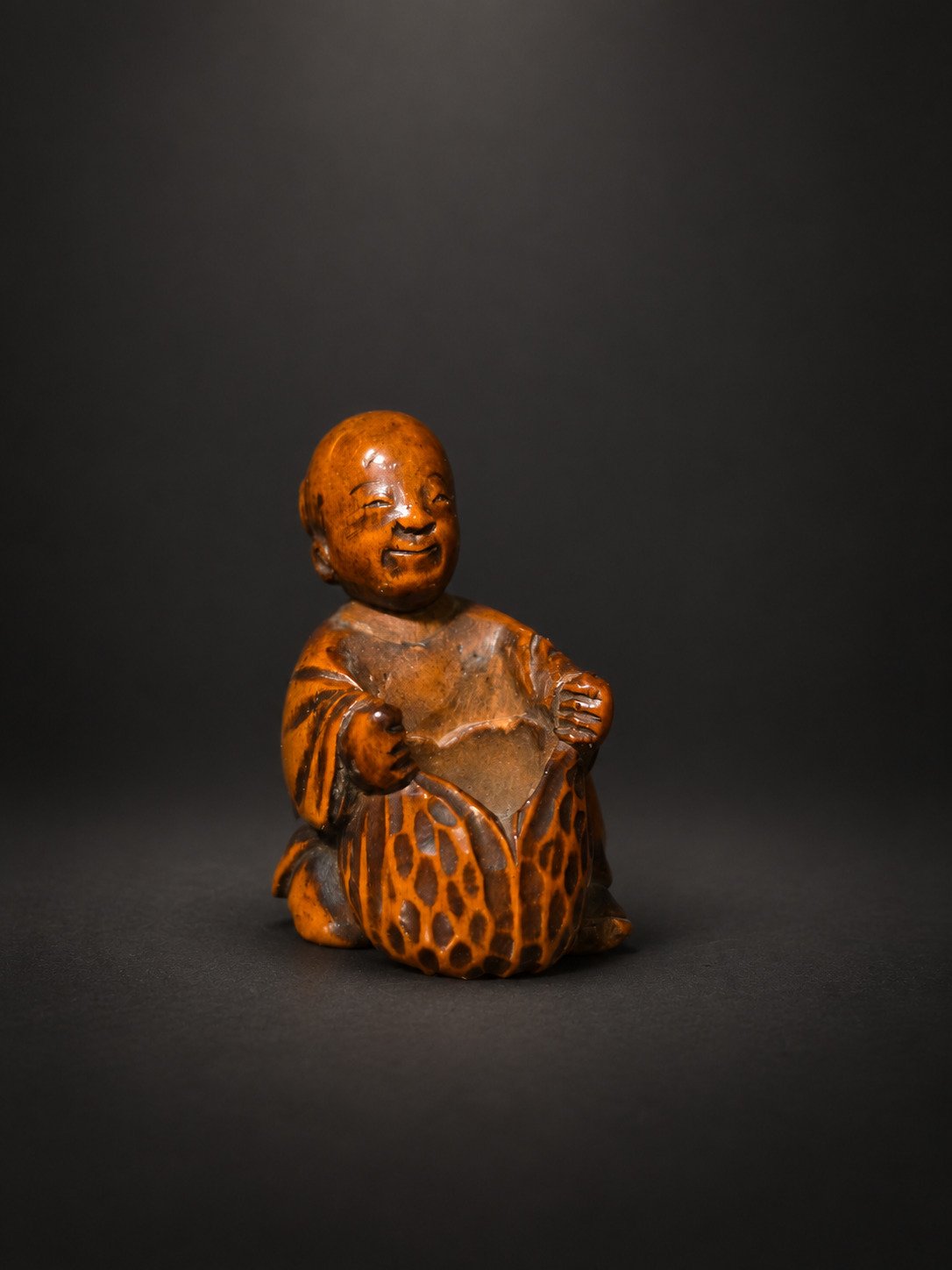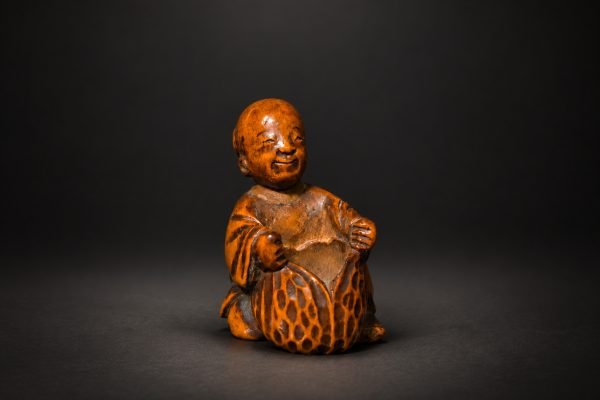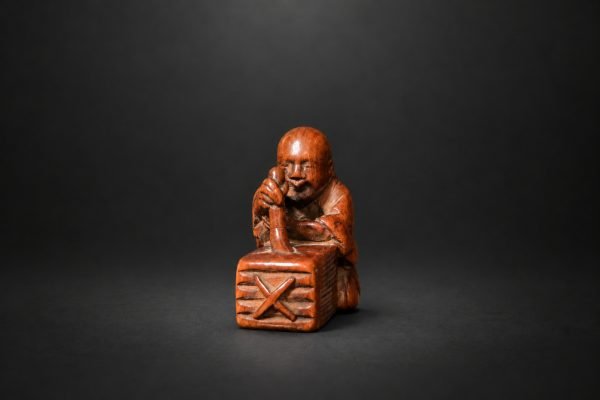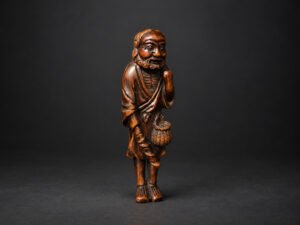
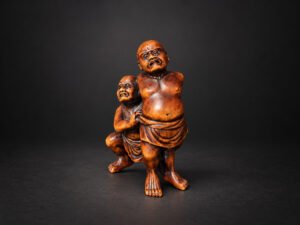
A charming antique Japanese boxwood netsuke depicting a bald, smiling figure kneeling on the ground while opening a large rounded pod or fruit with both hands. The compact composition is immediately engaging: the figure leans over the object with an expression of unmistakable delight, his broad face creased around the eyes as he holds the pod open before him.
The figure wears a loose Chinese-style robe whose broad sleeves and softly folded fabric surround the compact body.
The large pod or fruit dominates the lower half of the composition. Its surface is carved with repeated oval hollows, while the upper section separates and opens like a bud.
Playful subjects involving figures, fruits, gourds, pods, and other symbols of plenty were popular within Japanese decorative arts and often drew upon Chinese auspicious imagery associated with abundance, fertility, prosperity, and numerous descendants.
The carving is compact and assured, with an expressive face, rounded volumes, and a pleasing balance between figural detail and the unusual fruit held at the center of the composition.
The boxwood has matured to a warm honey-orange color with a lustrous natural patina created by age and handling.
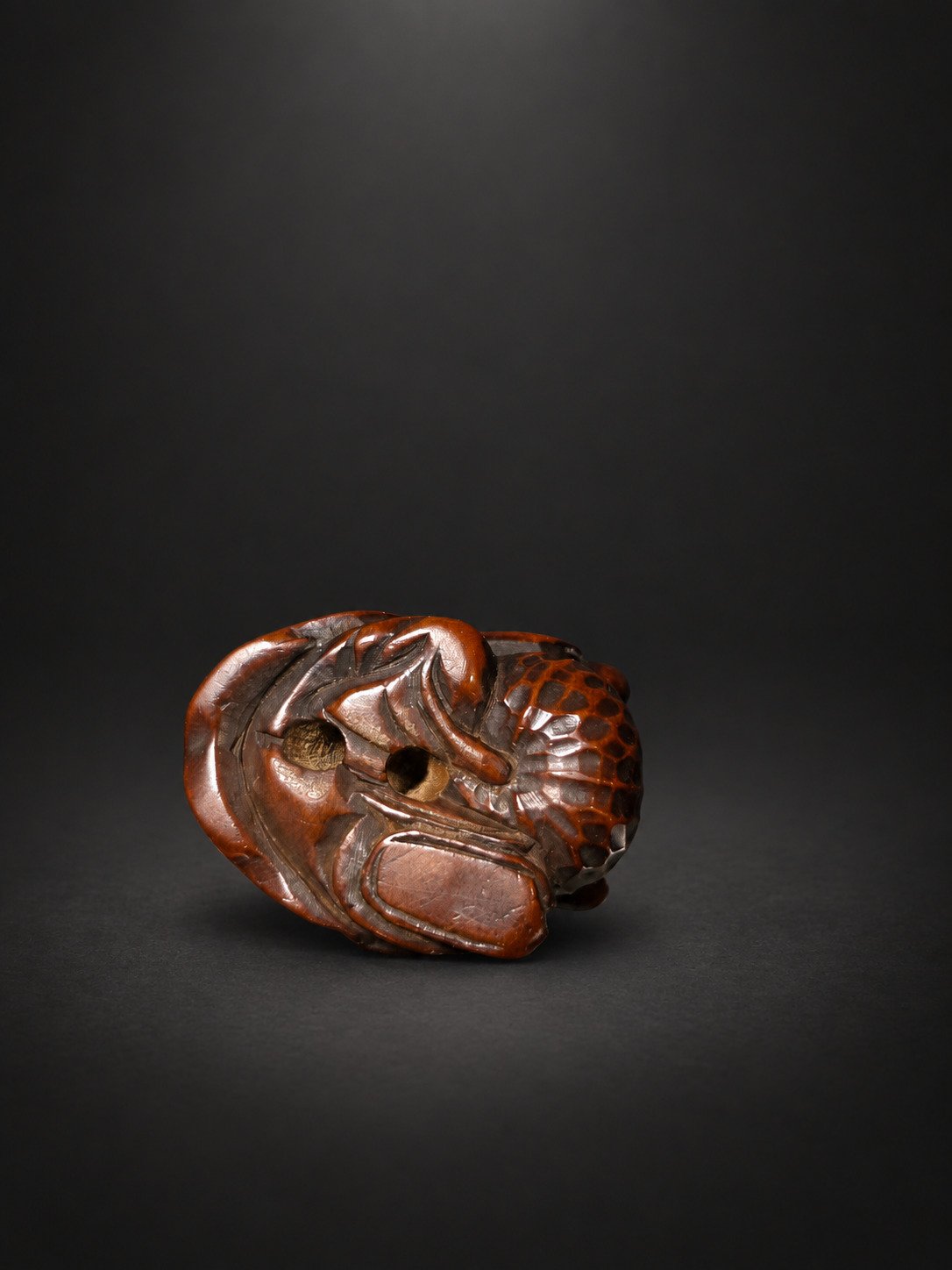
The himotoshi, or cord holes, are located in the base.
The defining characteristic of this netsuke is the figure’s expression.
The bald head, broad cheeks, narrowed eyes, and open smile combine to produce an impression of spontaneous amusement and pleasure.
The face is not treated as a formal portrait.
Instead, the carver concentrates on emotional clarity.
The eyes curve with the smile, the cheeks appear full and animated, and the mouth is shaped to reinforce the sense of laughter.
This cheerful expression gives the small sculpture a strong visual personality despite its modest dimensions.
Viewed from the front, the figure appears almost to share his discovery with the viewer as he holds the pod open between his hands.
The large rounded object held by the figure is one of the most distinctive elements of the carving.
It is shaped like an oversized pod or fruit and occupies much of the lower center of the composition.
Its surface is covered with repeated oval hollows or recessed forms.
At the upper edge, the form appears to split open like a flower bud or ripening pod.
This unusual treatment gives the object both decorative texture and narrative importance.
The figure is not merely holding the fruit.
He appears to be actively opening or revealing it.
That action creates a playful relationship between the figure and the object and gives the otherwise compact carving a clear sense of story.
Figures shown interacting with fruits, gourds, pods, and similar natural forms were recurring subjects in Japanese decorative arts.
Such imagery frequently drew upon Chinese auspicious traditions in which fruits and seed-filled pods could represent abundance, fertility, prosperity, and the wish for many descendants.
The pod in this netsuke is therefore visually appropriate to a broader vocabulary of good fortune and multiplication.
Its numerous oval hollows strengthen this association with richness and abundance.
The cheerful expression of the figure complements the symbolism.
Rather than presenting the theme solemnly, the carver transforms it into a humorous and approachable scene.
No specific fruit species or named auspicious figure has been supplied for this netsuke, so the object is best described conservatively as a large pod or fruit and the person simply as a laughing figure.
The figure wears a loose robe with broad sleeves and an overlapping construction characteristic of Chinese-inspired figural imagery in Japanese art.
Chinese historical, legendary, religious, and popular subjects had a profound influence on Japanese netsuke design during the Edo period.
Netsuke carvers frequently depicted Chinese sages, immortals, children, scholars, eccentrics, and humorous figures.
In this example, however, no specific named identity is supplied.
The Chinese-style clothing should therefore be understood as an important visual characteristic rather than evidence for identifying the figure as a particular deity, immortal, or historical character.
This distinction preserves the charm of the subject without imposing an unsupported attribution.
The figure is represented kneeling close to the ground.
This low posture allows the carver to organize the body, robe, hands, and large fruit into a compact and stable mass.
The knees and garment form a broad base, while the rounded head rises above the central object.
The resulting silhouette is compact in every direction.
This is particularly effective for a netsuke, where a balanced shape and comfortable handling were important functional qualities.
The kneeling pose also brings the figure physically close to the pod.
His hands, torso, and face all converge around the object, making it the center of the scene.
Both hands participate directly in the action.
The figure grips opposite sides of the pod or its opening, creating a sense that he has just pulled it apart or is in the process of revealing its contents.
Although the composition is small, the positioning of the hands clearly communicates this action.
The gesture also prevents the figure from appearing static.
The viewer’s attention moves naturally from the smiling face down through the arms toward the pod.
This creates a simple but effective visual narrative: discovery, opening, and delight.
The face is one of the strongest aspects of the netsuke.
The features are softly rounded but clearly defined.
The bald head flows directly into the broad forehead and full cheeks.
The eyes are narrow and slightly curved, reinforcing the laughing expression.
The mouth is open in a broad smile, while the surrounding facial modeling suggests the folds and creases created by laughter.
Rather than relying on excessive detail, the carver achieves expression through carefully controlled volumes.
The simplicity of the face gives it considerable immediacy.
It remains legible even when the netsuke is viewed from a short distance, while closer inspection reveals the subtler modeling around the eyes and mouth.
The carving is characterized by clean, rounded volumes.
The head, shoulders, sleeves, knees, and pod all possess soft transitions rather than sharply angular modeling.
This gives the object a tactile quality appropriate to a netsuke intended to be handled.
The rounded shapes also help unify the composition.
Although the sculpture contains several distinct elements — head, robe, hands, knees, and fruit — they remain visually connected within a compact mass.
The result is a carving that feels substantial without appearing heavy.
The loose robe provides much of the structural framework for the lower body.
Broad sleeves surround the arms and fall toward the knees in deep but controlled folds.
The garment is treated more simply than the face or the textured pod, allowing the eye to distinguish different materials and surfaces.
The larger folds create areas of shadow that enhance the three-dimensional quality of the figure.
They also contribute to the stable pyramidal structure of the composition, with the broad lower garment supporting the head and shoulders above.
The netsuke is carved from boxwood, a material widely suited to small-scale carving because of its fine grain and ability to hold precise detail.
In this piece, the wood supports both the expressive modeling of the face and the smaller repeated details across the pod.
The natural tone has matured into a rich honey-orange color.
Darker areas appear in recesses and around deeply carved details, while raised surfaces display a warmer glow.
This variation contributes significantly to the visual depth of the object.
The mature surface is one of the most attractive features of the netsuke.
The boxwood has developed a warm honey-orange coloration with darker brown variation in recessed areas.
Raised points and surfaces exposed to repeated contact have acquired a soft luster.
This natural patina is consistent with an object that has aged and been handled over time.
On antique netsuke, such surface development can enhance both color and sculptural definition.
Light catches the smoother high points while remaining darker in the hollows, folds, facial details, and patterned areas of the fruit.
The result is a visually rich surface that changes depending on the direction of illumination.
The visible surface character reflects age and use.
The polished quality of the boxwood does not appear uniform.
Some areas are more lustrous, while deeper recesses retain darker tones and more visible carved texture.
This variation helps preserve the readability of the carving.
The supplied information does not mention restoration, replacement components, a signature, or structural repair.
Any detailed condition assessment should therefore be based on examination of all available photographs and, where possible, inspection of the object itself.
The himotoshi, or cord holes, are cut into the base of the netsuke.
These openings are essential to the original function of a netsuke as a toggle used with objects suspended from the sash.
Placing the himotoshi underneath allows the principal figural composition to remain visually uninterrupted.
The base placement is especially suitable for this compact kneeling form.
It allows the cord to pass through the object while preserving the rounded silhouette of the figure when viewed from the front and sides.
With dimensions of only 3.8 × 3.1 × 2.4 cm, the netsuke is notably compact.
Its proportions are close to the rounded, easily handled format associated with many traditional netsuke.
Unlike elongated sashi types, this example organizes the entire subject into a small, dense form.
The kneeling position of the figure and the large central pod make this possible.
Nothing projects excessively from the body.
The arms remain close to the torso, while the knees and robe create a stable lower mass.
This compactness contributes to both the practical and aesthetic success of the carving.
Humor and visual play were important aspects of netsuke culture.
Carvers frequently transformed familiar figures, legends, animals, daily activities, and auspicious motifs into small objects with strong personality.
The subject here is particularly effective because it combines good-humored expression with an unusual object.
The viewer is encouraged to wonder what the figure has discovered inside the pod and why he reacts with such evident pleasure.
That small narrative ambiguity is part of the charm.
The netsuke can be appreciated as a compact carving, an auspicious image of abundance, and a playful miniature scene.
Japanese artists of the Edo period drew extensively from Chinese visual and literary traditions.
Themes associated with longevity, fertility, prosperity, scholarship, immortality, and good fortune became especially adaptable to small decorative objects.
Fruits and seed-bearing forms could function as symbols of multiplication and abundance.
When combined with a cheerful human figure, such motifs could communicate these wishes in a light and approachable manner.
The present netsuke belongs comfortably within this wider artistic environment.
However, no specific Chinese legend, named figure, or identified fruit has been provided for the piece.
The description therefore retains a broader interpretation rather than assigning a more precise iconography that cannot be established from the supplied information.
The compact dimensions reinforce the intimate character of the carving.
The netsuke is described as an antique boxwood carving from the Edo period, dating to the 18th–19th century.
The wood has developed a warm honey-orange color and a lustrous natural patina through age and handling.
The facial expression, robe, hands, and recessed decoration of the pod remain clearly legible.
The supplied information does not mention a signature, named carver, restoration history, provenance, replacement elements, or additional documentation.
The himotoshi are located in the base.
Prospective buyers should examine all available photographs carefully when assessing exact condition, surface wear, and age-related characteristics.
This netsuke combines several qualities that make Edo-period figural carvings particularly appealing: a humorous human subject, compact functional design, expressive facial carving, auspicious symbolism, and a mature natural surface.
The smiling figure is immediately engaging, while the unusual pod gives the composition a distinctive narrative focus.
The relationship between the face and the object is especially effective.
Both hands lead toward the pod, while the figure’s laughing expression makes the viewer instinctively connect his delight with whatever the fruit represents or contains.
The broader association of pods and fruits with abundance and numerous descendants adds another level of meaning without overwhelming the playful nature of the scene.
The compact boxwood carving also benefits greatly from its warm honey-orange color and lustrous patina.
Rounded high points catch the light, while deeper details remain darker, emphasizing the expression, folds, hands, and patterned fruit.
For collectors of Edo-period netsuke, humorous Japanese carvings, Chinese-inspired subjects, auspicious imagery, or antique boxwood miniatures, the piece offers an appealing combination of character, symbolism, tactile surface, and compact sculptural design.
A charming antique Japanese boxwood netsuke from the Edo period depicting a bald, laughing figure kneeling while opening a large rounded pod or fruit with both hands. Dressed in a loose Chinese-style robe, he has a broad expressive face creased with laughter around the eyes. The unusual pod is carved with repeated oval hollows and opens at the top like a bud, recalling auspicious imagery of abundance and numerous descendants. The compact carving is confidently modeled with clean, softly rounded volumes, while the boxwood has matured to a rich honey-orange tone with a lustrous natural patina from age and handling. The himotoshi are cut into the base.
| Época | Edo |
|---|

Order above 1.000,00 € gets free shipping.

Secure and hassle-free payment process.

Certificate of authenticity included.

Have questions? Contact us via WhatsApp.
Contact