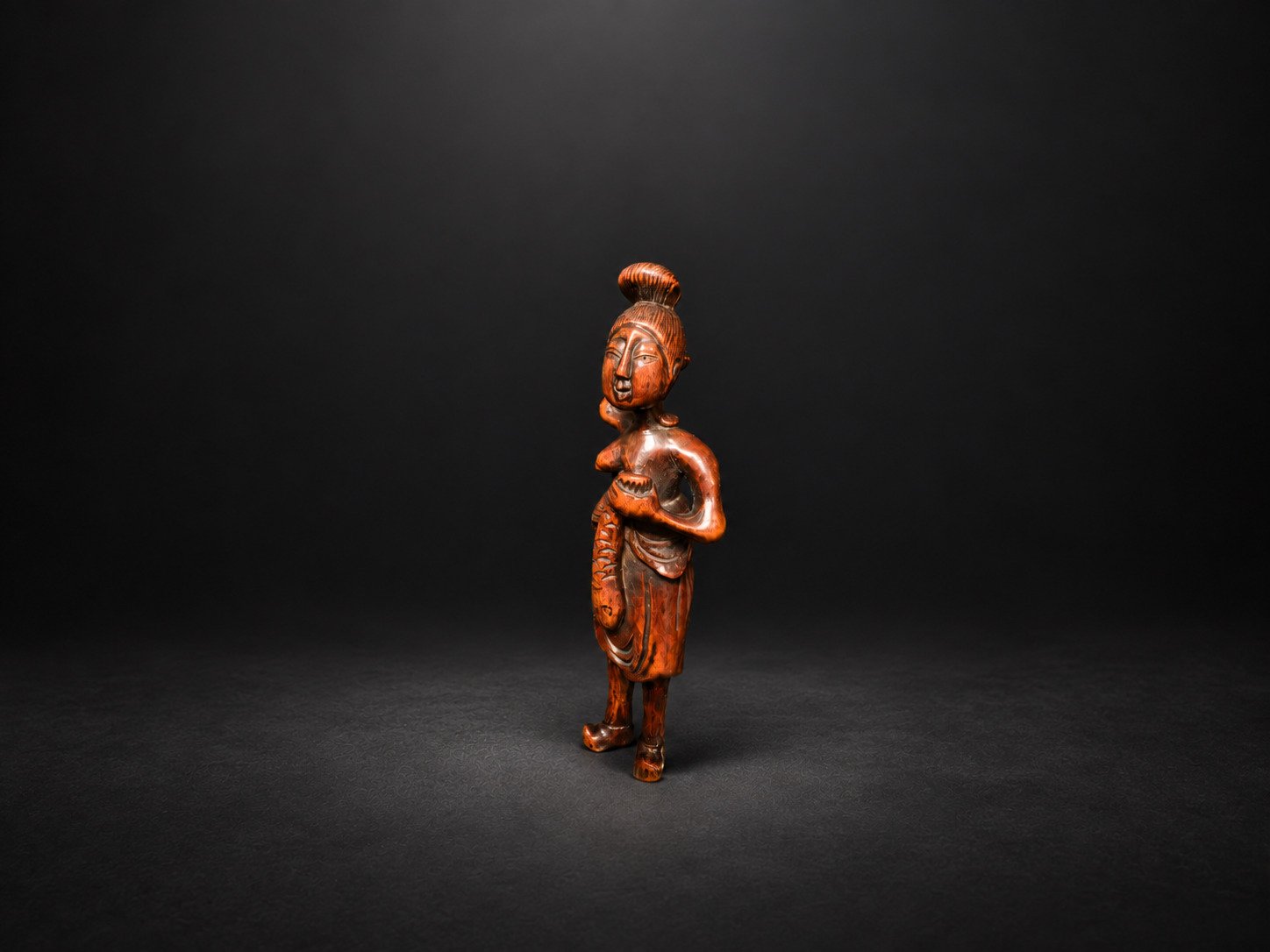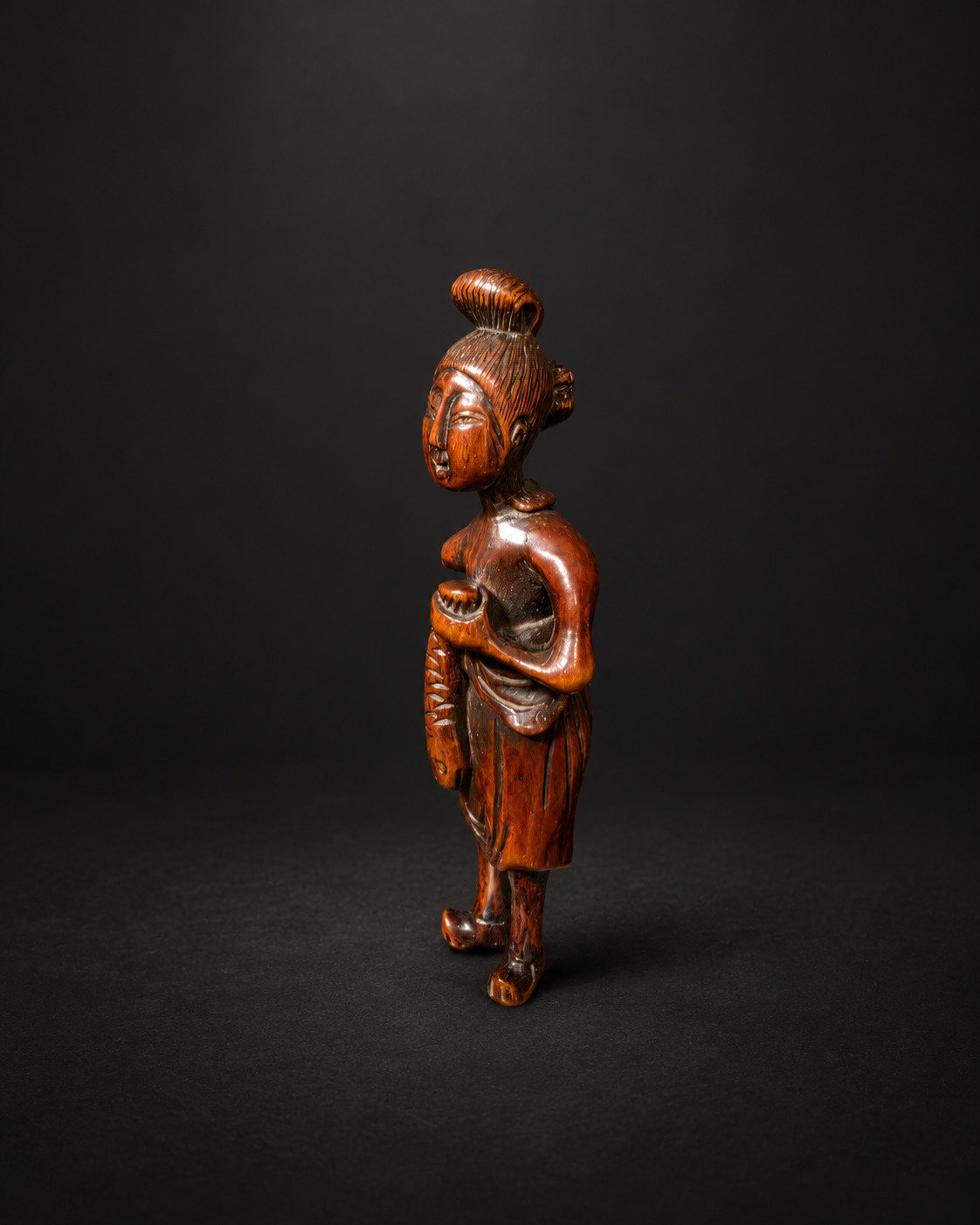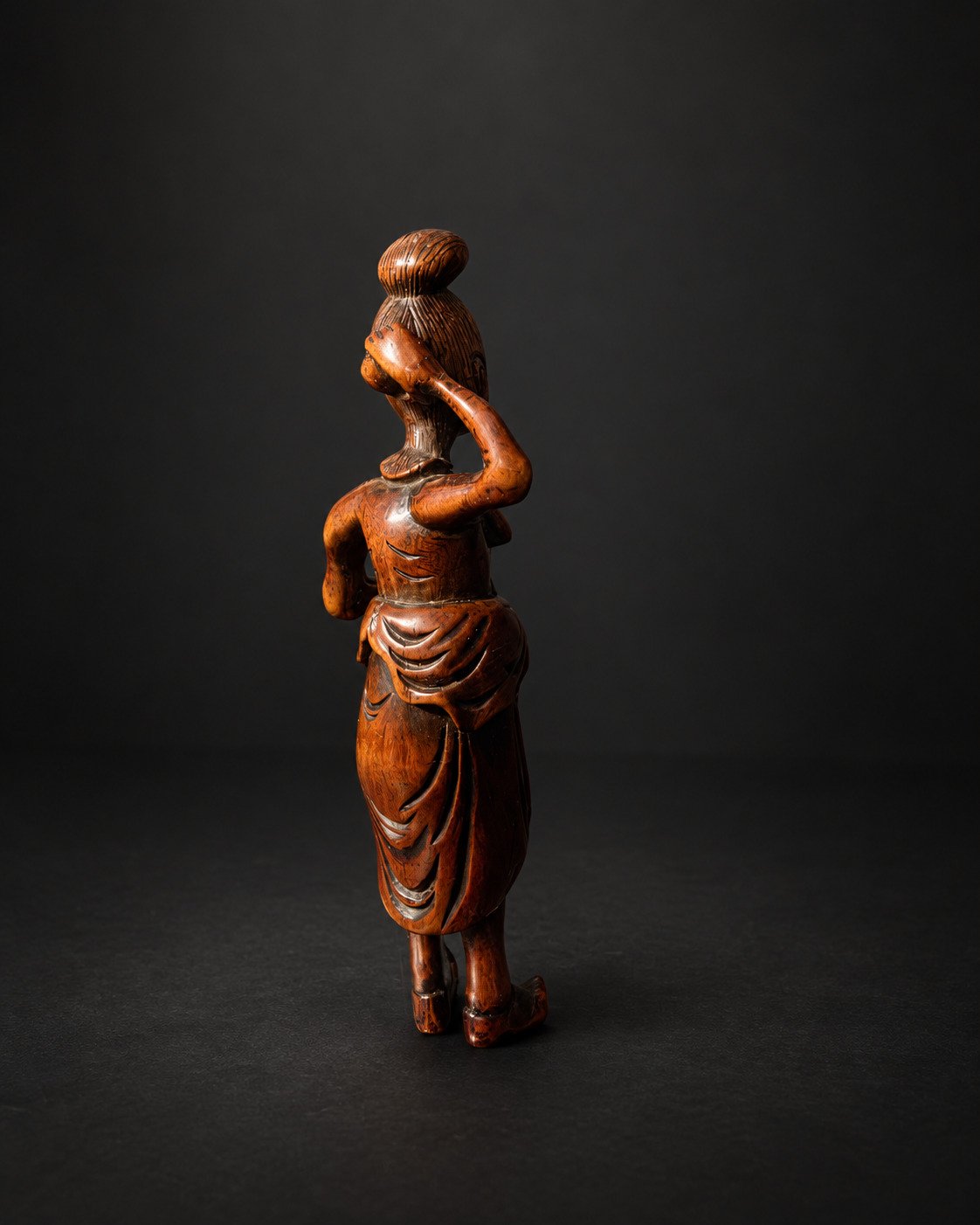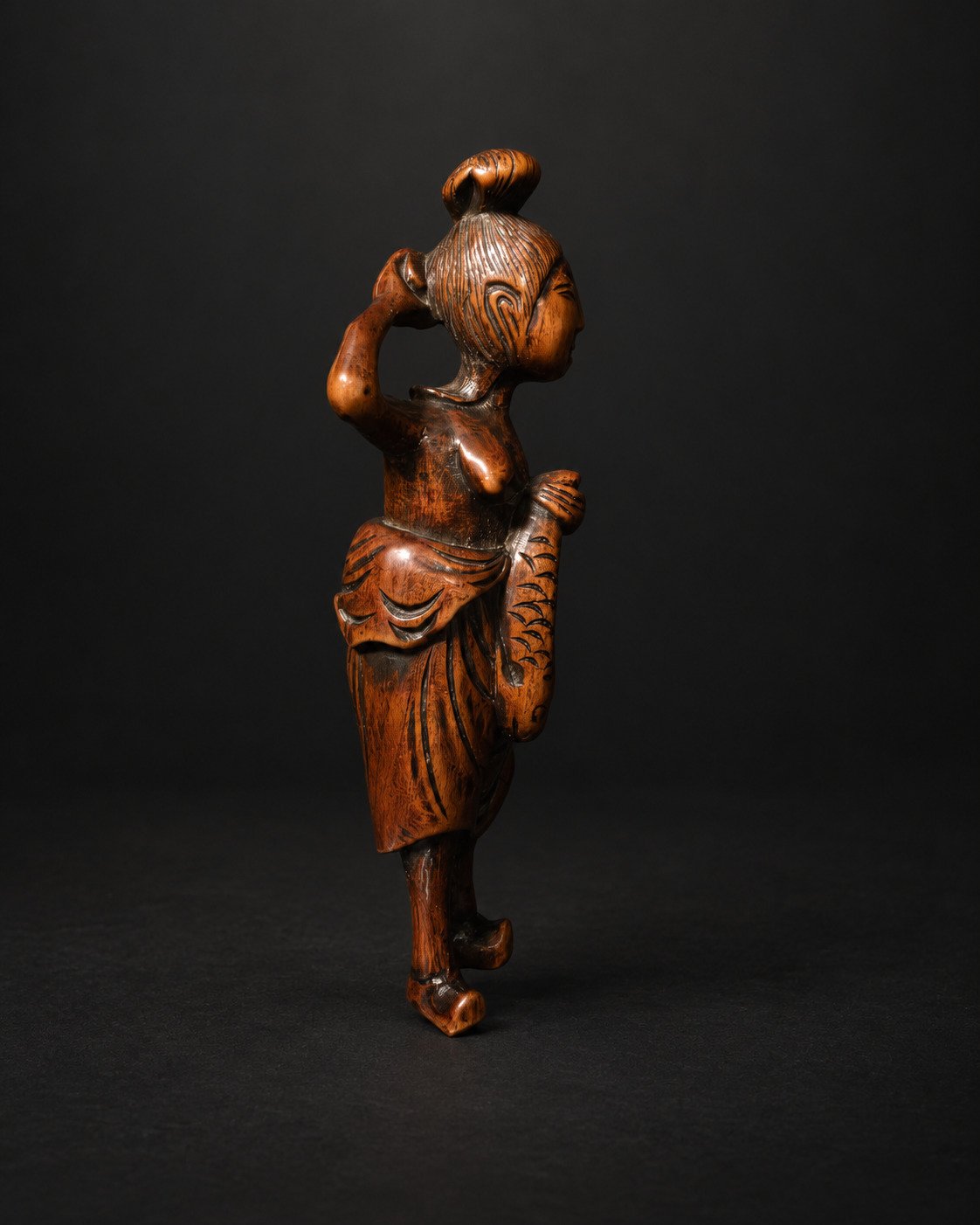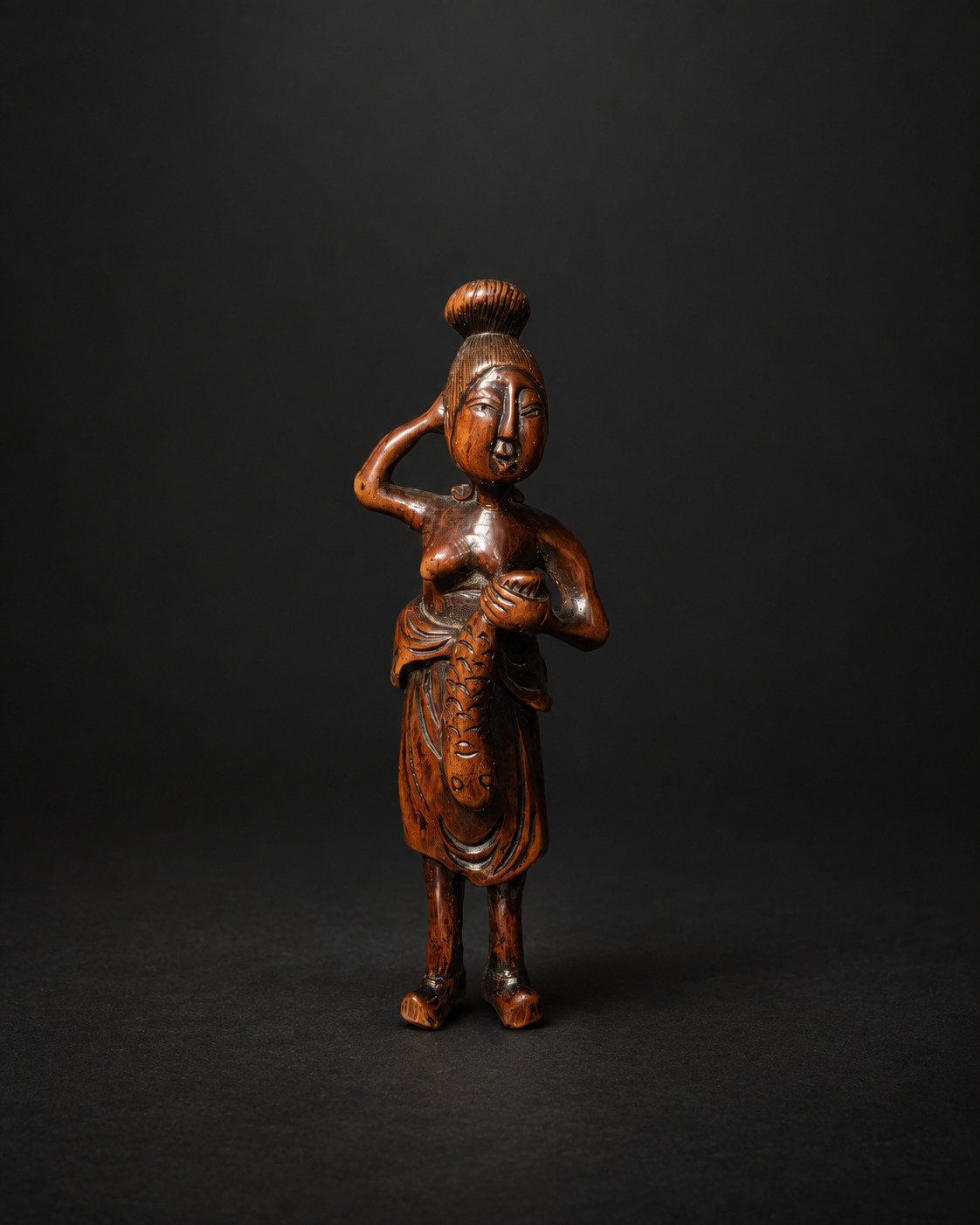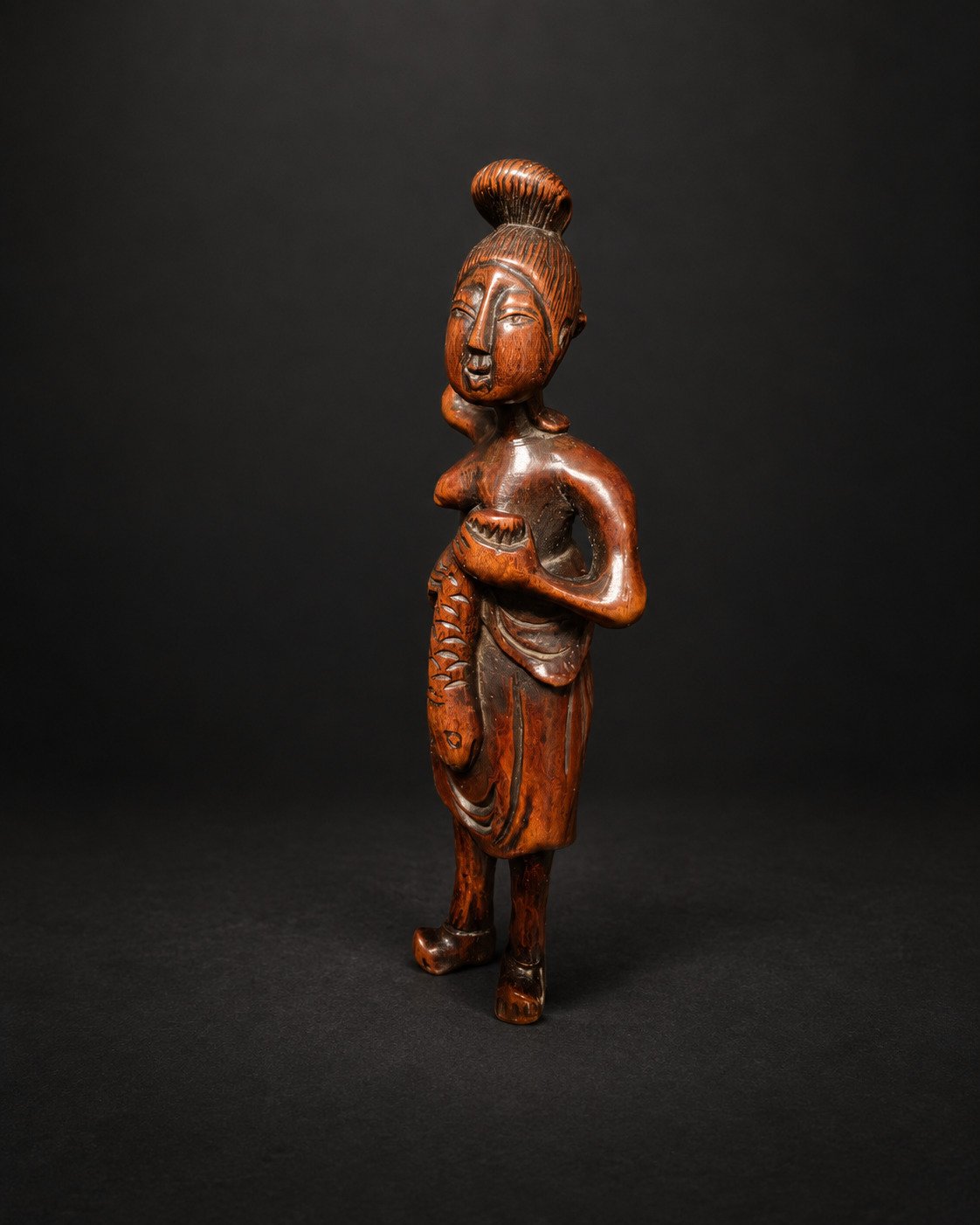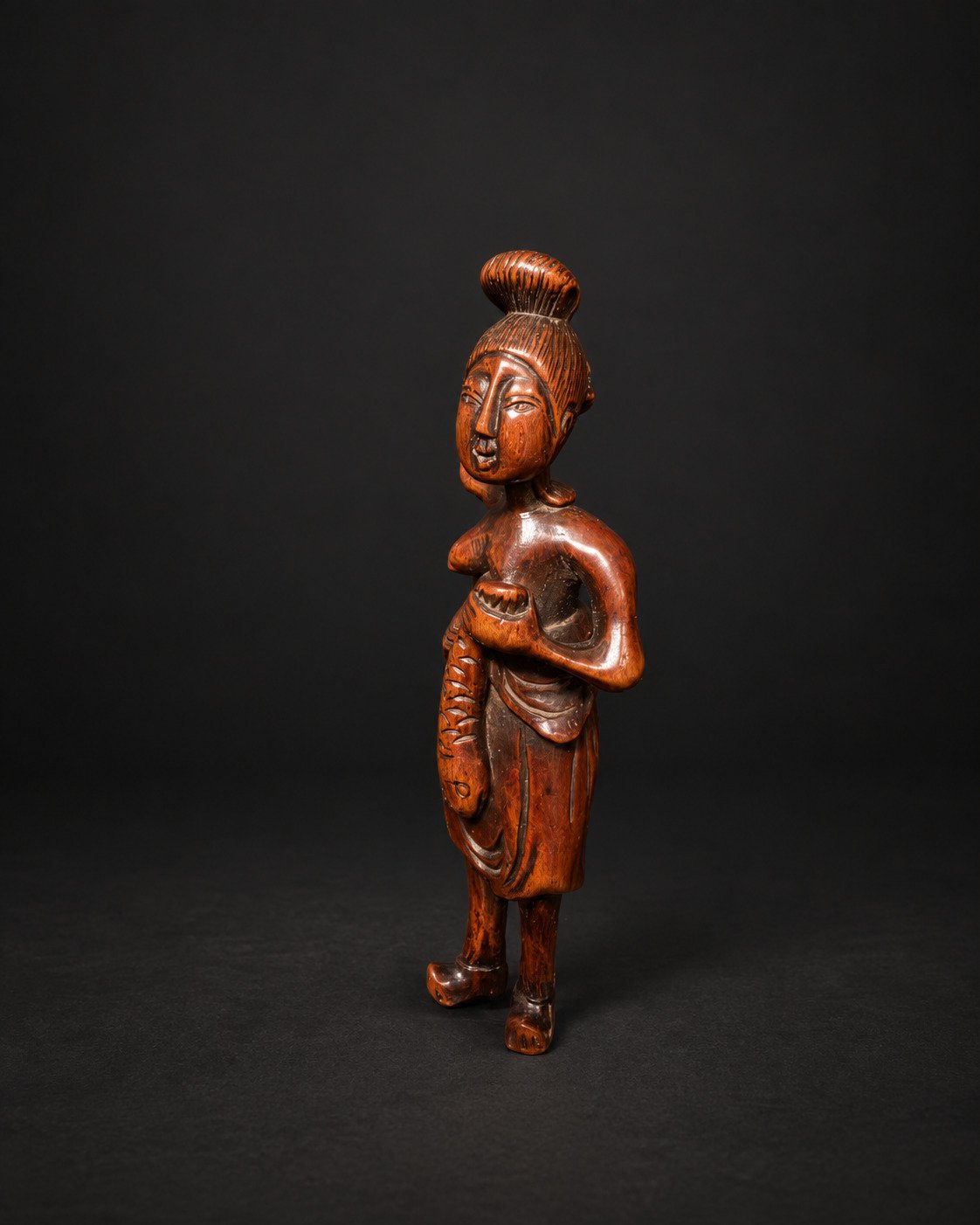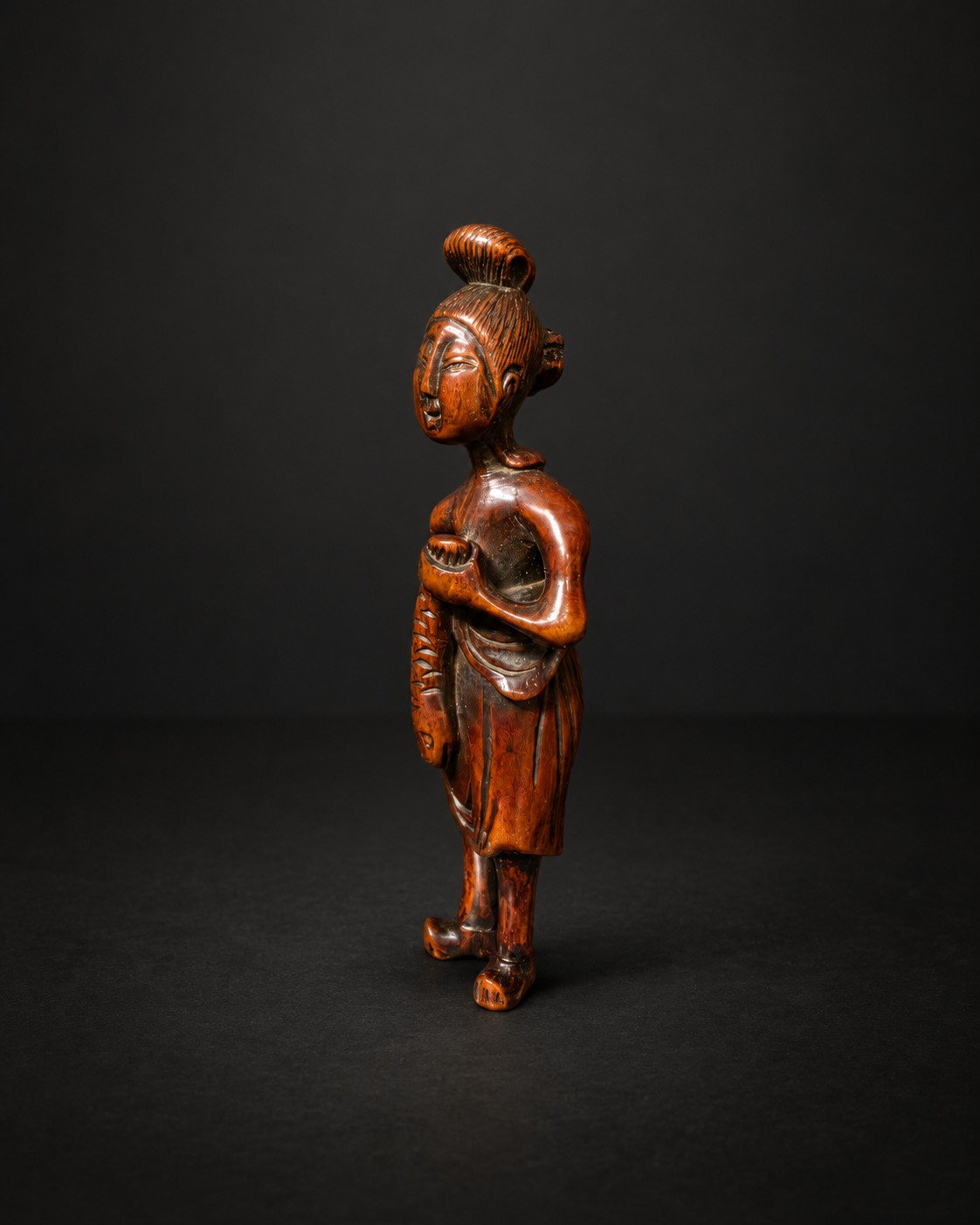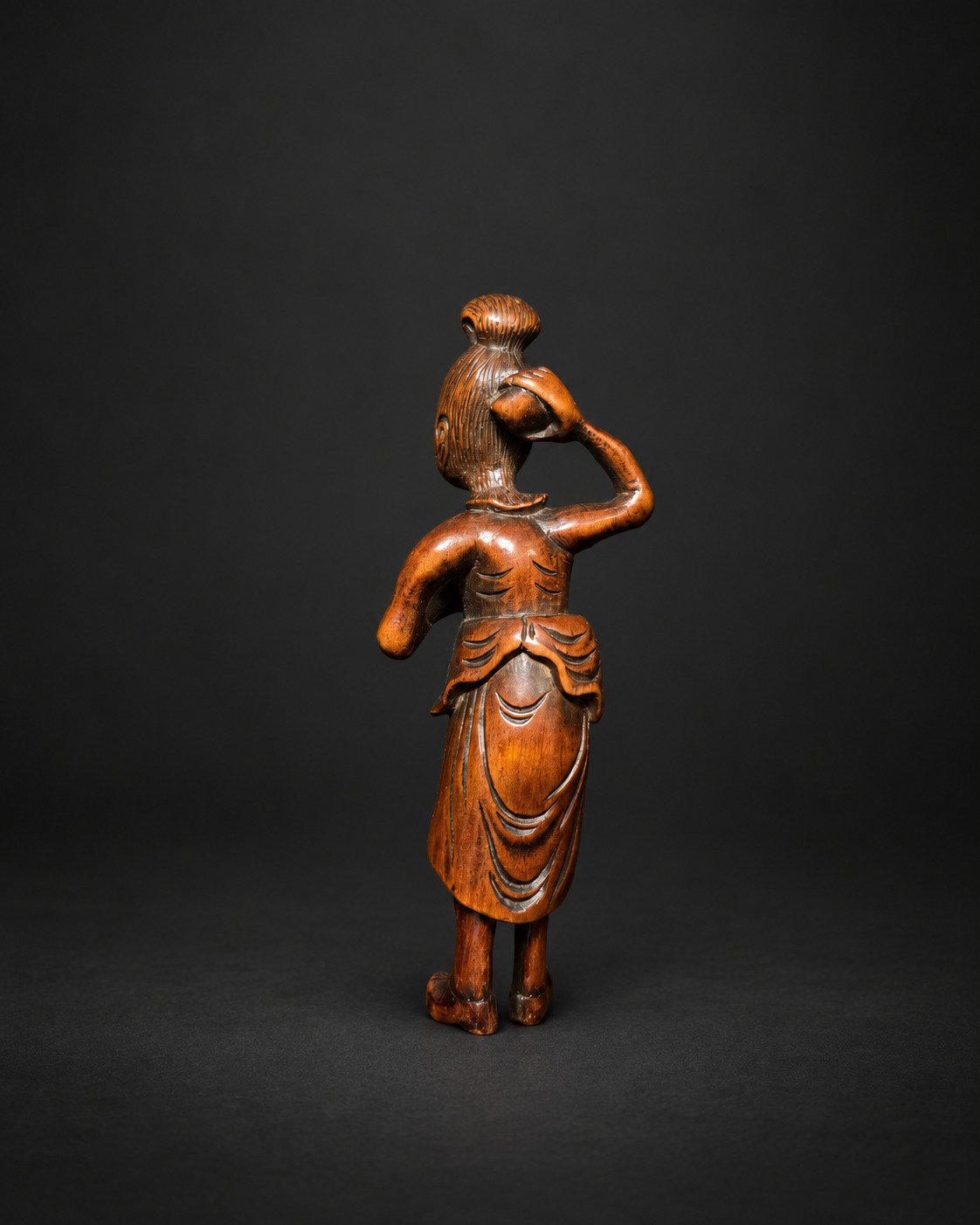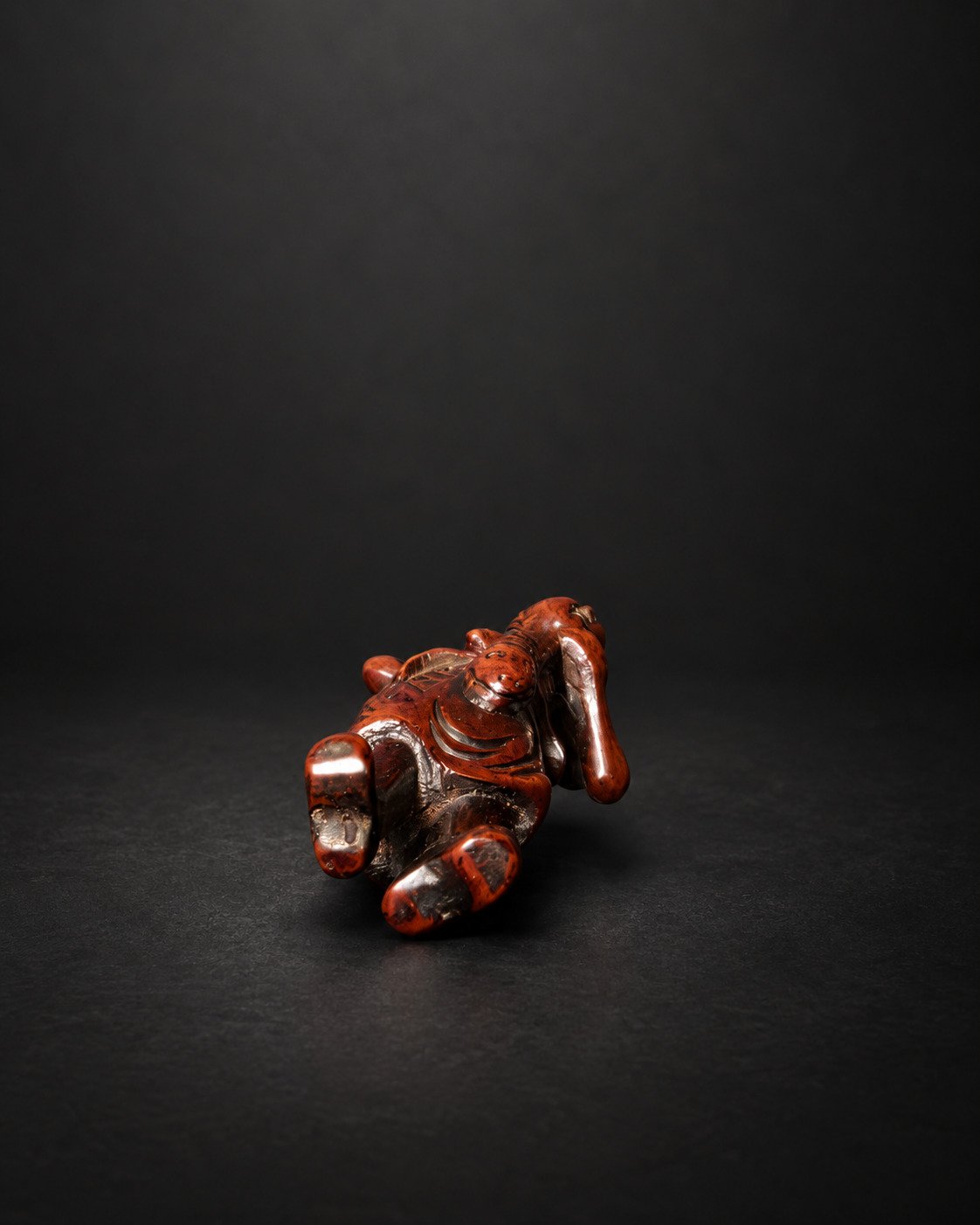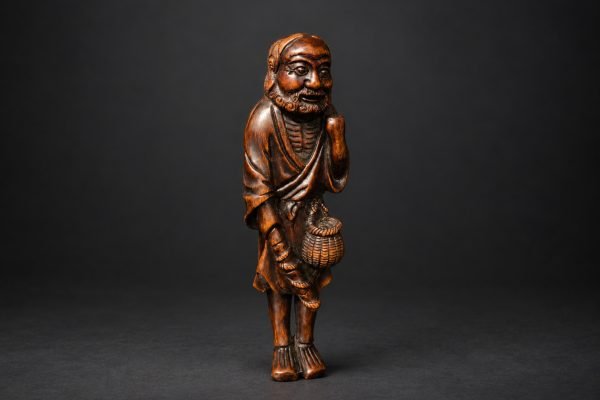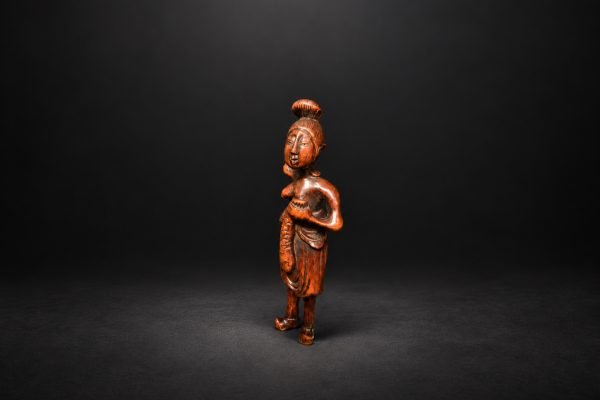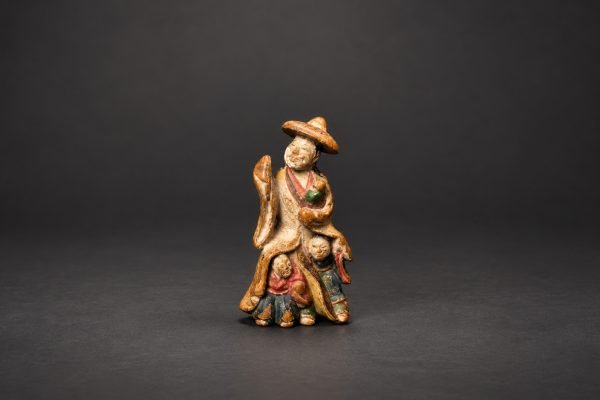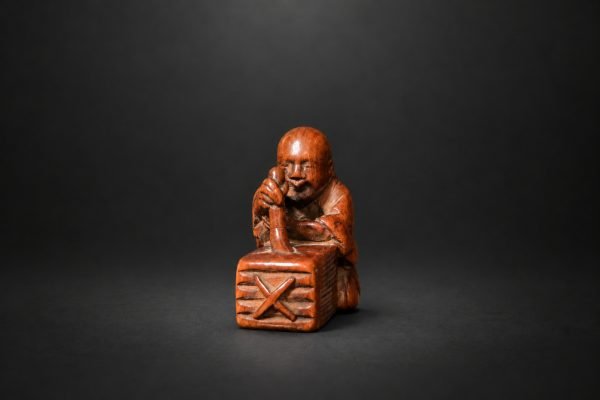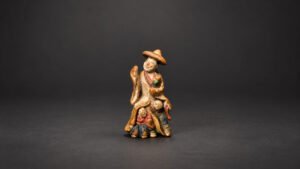
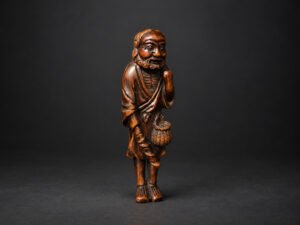
An expressive antique Japanese sashi netsuke carved in wood and depicting an ama, one of the traditional women divers of Japan’s coastal communities. The slender figure stands upright with one hand raised toward her hair in a gesture traditionally associated with the subject, while the other arm secures a fish against her hip, representing the day’s catch from the sea.
The elongated form is characteristic of the sashi type, designed to be worn vertically behind the obi rather than suspended in the more compact manner associated with many conventional netsuke.
The figure is carved with a tall, elegant silhouette, finely incised hair arranged into a high topknot, a wrapped skirt secured with a short overlapping sash, and small sandals beneath the hem.
Her face is calm and archaic in character, defined by long almond-shaped eyes and a small restrained mouth.
The carving retains a rich, warm patina, particularly glossy across the shoulders and arms where repeated handling has polished the wood over time.
The subject represents an ama, one of the women divers historically associated with Japan’s coastal regions.
Ama were known for diving without modern breathing equipment to gather marine resources such as abalone, shellfish and seaweed.
Their distinctive occupation and close association with the sea made them a recurring subject in Japanese visual culture.
During the Edo period, ama appeared in a wide variety of artistic media, including prints, paintings and netsuke.
Their representation could emphasize physical endurance, coastal life, beauty, labor and the intimate relationship between human activity and the sea.
In this carving, the subject is identified immediately by the fish held against the body and by the traditional gesture of one hand raised toward the hair.
The fish held against the figure’s hip is one of the principal narrative elements of the composition.
It hangs vertically alongside the body and is carved with a clearly defined head, elongated form and repeated incised details suggesting scales or surface texture.
Rather than being treated as a separate object, the fish is incorporated into the silhouette of the standing figure.
This creates a strong visual relationship between the diver and her catch.
The fish also reinforces the occupational identity of the ama without requiring additional attributes or scenery.
Its long form complements the elongated proportions of the sashi netsuke itself.
One arm rises toward the side of the head in a gesture traditionally associated with representations of ama.
The raised arm creates an elegant curve that breaks the otherwise strongly vertical structure of the carving.
It also introduces an informal human quality to the figure.
The gesture suggests a moment of pause following physical activity, while simultaneously drawing attention toward the elaborate topknot and finely incised hair.
The opposite arm curves across the torso to secure the fish at the hip.
Together, the two arms create an effective rhythm around the upper body and prevent the elongated composition from appearing rigid.
The hair is one of the most carefully articulated areas of the carving.
It is gathered into a high rounded topknot, giving the figure additional vertical emphasis.
Fine incised lines define individual strands across the head and continue into the raised knot.
The repeated linear cutting creates texture and contrast against the smoother surfaces of the face, shoulders and torso.
The hair is not treated as a simple solid mass.
Instead, the strand-by-strand incision gives it a strong decorative character and demonstrates careful attention to surface detail.
The large topknot also balances the lower volume created by the fish and wrapped skirt.
The face is rendered in a restrained and somewhat archaic manner.
Long almond-shaped eyes dominate the narrow facial structure.
The nose is strongly defined, while the mouth is small and compact.
Rather than presenting a highly individualized portrait, the carver has chosen a stylized expression appropriate to the overall character of the figure.
The resulting face appears calm and composed.
Its simplicity contrasts effectively with the more deeply incised hair and flowing garment.
The restrained expression also gives the figure a timeless quality that complements the warm aged surface of the wood.
The figure wears a wrapped skirt with a short overlapping sash across the waist.
The garment falls vertically around the legs and is defined by long carved folds.
These folds are cut with confident, deep strokes rather than delicate shallow engraving.
The result gives the fabric weight and structural clarity.
The drapery also helps integrate the fish into the overall composition.
Its edge follows the vertical movement of the catch and creates a continuous descending rhythm from the torso to the feet.
The overlapping sash introduces an additional horizontal element that breaks the long vertical line of the body.
At the base of the carving, the feet are shown wearing small sandals.
Although modest in scale, they provide a clear visual termination to the elongated figure.
Their compact form contrasts with the long legs and vertical drapery.
The sandals are integrated into the carving without excessive detail, maintaining the overall simplicity of the lower portion of the piece.
This restrained treatment keeps the visual emphasis on the figure’s gesture, face, hair and catch.
This carving belongs to the sashi netsuke type.
Unlike many compact netsuke intended to rest against the outside of the obi, sashi netsuke are characteristically elongated.
They were worn thrust vertically behind the obi.
The long proportions of this figure are therefore functional as well as aesthetic.
The standing form, high topknot, vertical fish and long garment all reinforce the natural suitability of the composition for the sashi format.
Rather than compressing the subject into a rounded or compact mass, the carver takes advantage of the vertical structure to create a slender full-length figure.
The cord passes through natural himotoshi created by the open spaces within the carving.
Rather than drilling two isolated holes into a flat section of the piece, the sculptor has incorporated the cord passage into the composition itself.
The open space between the arm and the body provides a natural route for the cord.
This approach allows the functional element of the netsuke to become part of the sculptural design.
The negative space also lightens the silhouette and adds depth around the torso.
The use of natural himotoshi is particularly well suited to a tall figural sashi netsuke such as this example.
The carving is characterized by confident, decisive cutting.
The drapery is defined by long, deep strokes that create strong shadows and clearly separate the layers of clothing.
The hair is articulated through repeated fine incisions.
The face, fish, arms and feet are more smoothly modeled, creating a controlled contrast between detailed and polished surfaces.
The figure is slender but structurally coherent.
Each element contributes to the elongated overall silhouette without making the composition appear fragile or excessively complicated.
The result is direct and sculptural rather than overly ornamental.
One of the most attractive characteristics of the piece is its warm, deep patina.
The wood has developed rich brown and reddish-brown tones that vary across the surface.
Particularly noticeable is the glossy quality of the shoulders and arms.
According to the supplied description, these areas were polished through repeated handling over time.
This naturally developed sheen contrasts with the deeper incisions of the hair, garment and fish.
The patina strengthens the sculptural modeling by catching the light on raised surfaces while leaving recessed areas darker.
It also contributes significantly to the historical character of the object.
The visible polish on the shoulders and arms is consistent with a piece that has been handled repeatedly.
On netsuke, such wear can become an important part of the object’s visual history.
High points and frequently touched surfaces may become smoother and glossier, while recessed carving retains more texture.
In this example, the difference between polished areas and deeply cut details enhances the three-dimensional quality of the carving.
The supplied description does not mention major losses, repairs, restoration or replacement elements.
Any detailed condition assessment should therefore be based on close examination of the object and all available photographs.
Ama were popular subjects in Edo-period Japanese art.
Their work as divers placed them within a distinctive coastal world that was both familiar and visually compelling.
Artists could depict them at work, carrying their catch or in moments associated with their daily routine.
In netsuke, the small scale allowed these subjects to be transformed into intimate sculptural scenes intended to be held and handled.
This example reduces the narrative to its essential elements: the woman, her gesture and the fish she has taken from the sea.
The simplicity of the composition makes the subject immediately readable while preserving the elegance expected of a functional netsuke.
At 10 cm in height, the carving has the elongated proportions characteristic of a sashi netsuke.
Its width and depth remain comparatively narrow, reinforcing the slender standing silhouette.
The proportions allow the full figure, fish, raised arm and topknot to be represented without excessive compression.
The piece is described as an antique Edo-period wood sashi netsuke.
The wood displays a warm, deep patina with particularly glossy surfaces on the shoulders and arms, consistent with repeated handling.
The carved details of the hair, garment and fish remain clearly legible.
The supplied description does not mention a signature, restoration, structural repair, missing elements or additional documentation.
The exact century range in the supplied source is written as “VIII–XIX Century”; the Edo-period attribution is retained here without further narrowing that dating.
Prospective buyers should review all available photographs carefully when assessing condition and surface wear.
This sashi netsuke combines a classic Edo-period subject with a format particularly well suited to full-length figural carving.
The ama is immediately recognizable through the fish held at her side, the raised hand and the direct simplicity of the composition.
The elongated form makes effective use of the sashi format, while the natural himotoshi demonstrate how function has been integrated into the sculpture rather than added separately.
The carving is especially appealing for the contrast between finely incised details and broad polished surfaces.
The strand-by-strand hair, deeply cut drapery and textured fish stand against the smooth, richly patinated shoulders and arms.
The resulting surface has considerable visual depth and a tactile quality closely associated with netsuke as objects intended to be handled.
For collectors of Edo-period netsuke, maritime subjects, representations of Japanese women or elongated sashi forms, this piece offers a strong combination of recognizable subject matter, functional design, confident carving and mature patina.
An antique Japanese wood sashi netsuke depicting an ama, one of Japan’s traditional women divers, standing with one hand raised toward her finely incised high topknot while holding a fish against her hip. The slender figure wears a wrapped skirt with a short overlapping sash and small sandals, and her calm stylized face is defined by long almond-shaped eyes and a small mouth. Natural himotoshi are formed by the open space between the arm and body. Deep confident carving, long flowing drapery cuts and a rich warm patina — particularly glossy on the shoulders and arms from handling — give the piece a strong sculptural and historical presence.
| Época | Edo |
|---|

Order above 1.000,00 € gets free shipping.

Secure and hassle-free payment process.

Certificate of authenticity included.

Have questions? Contact us via WhatsApp.
Contact