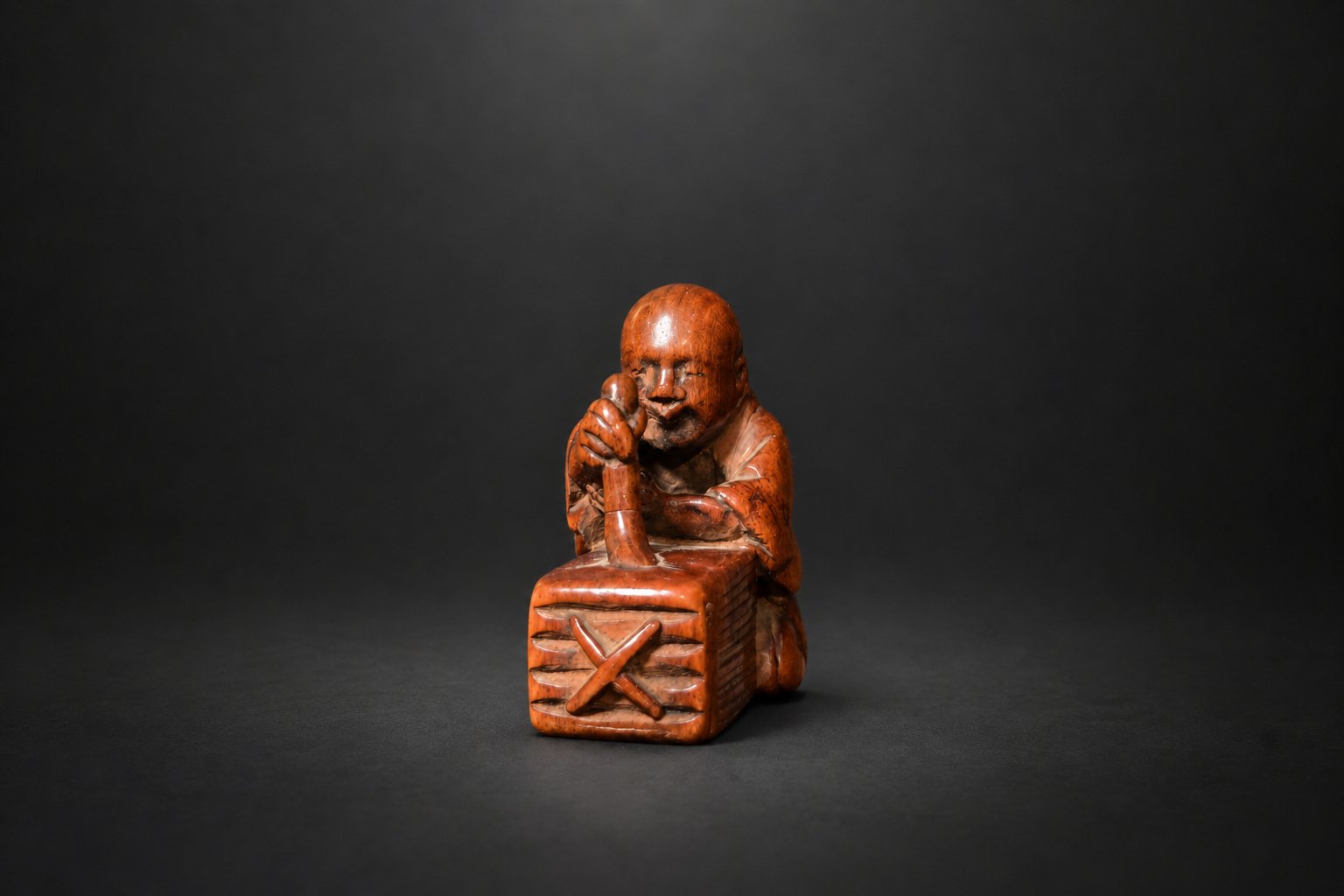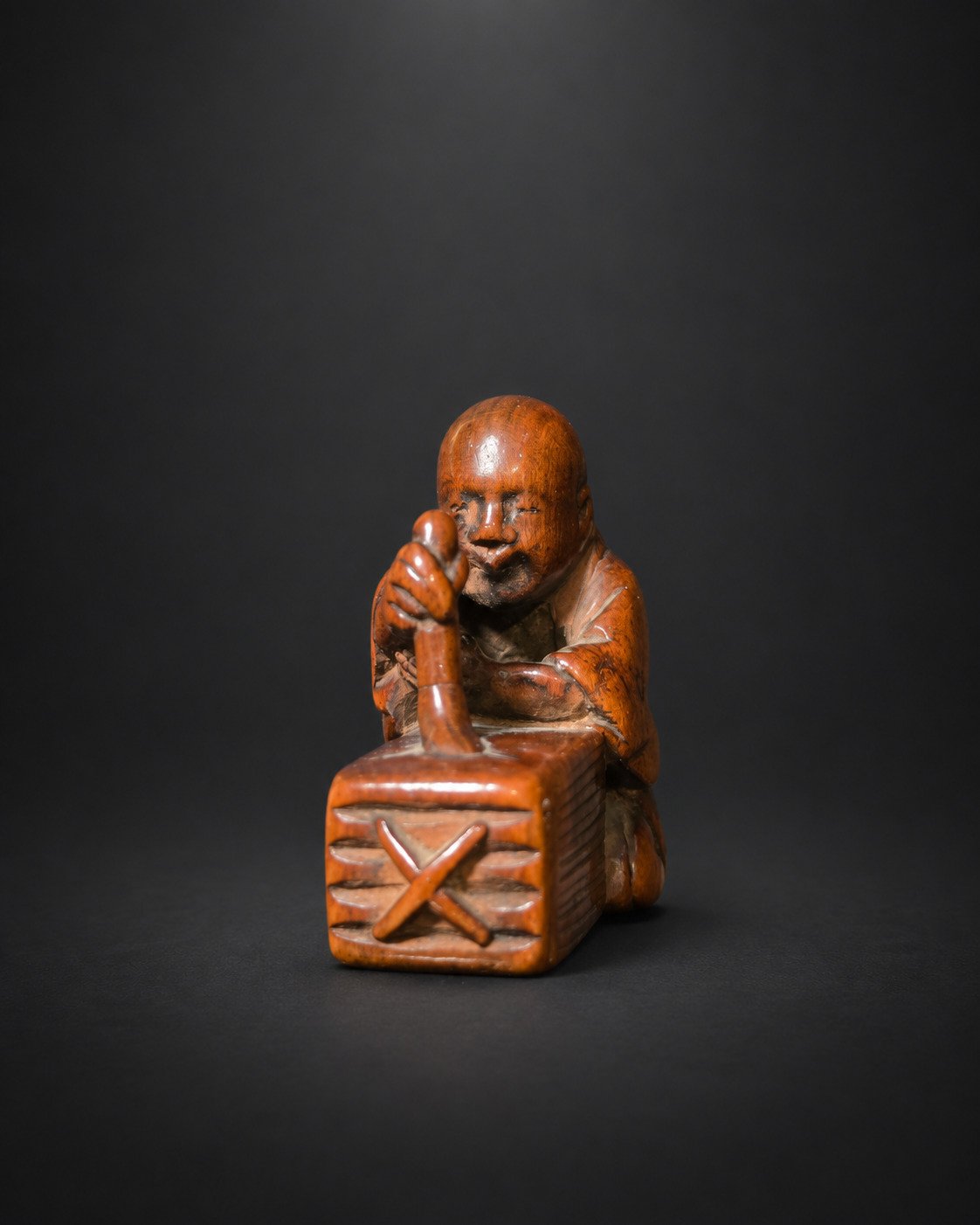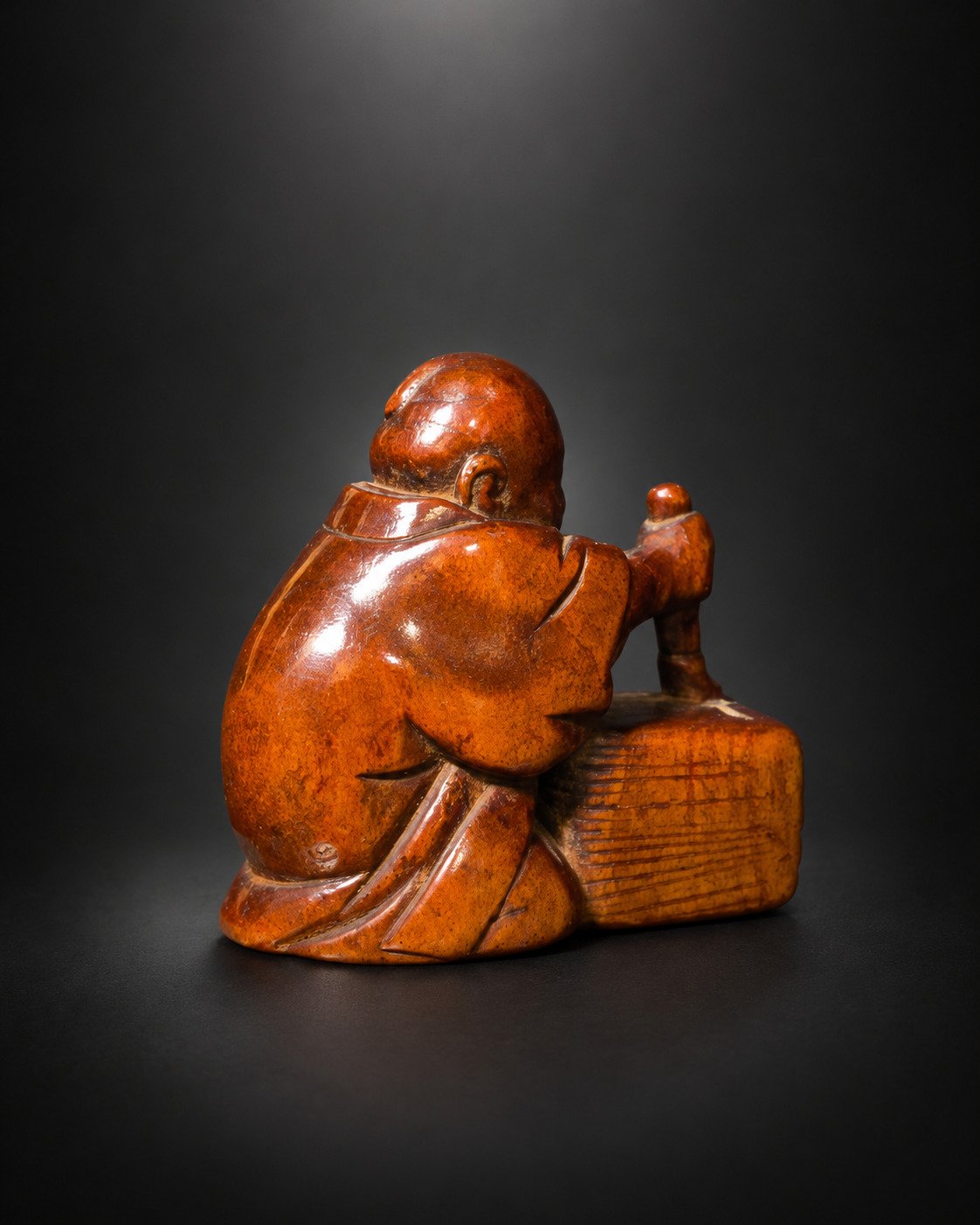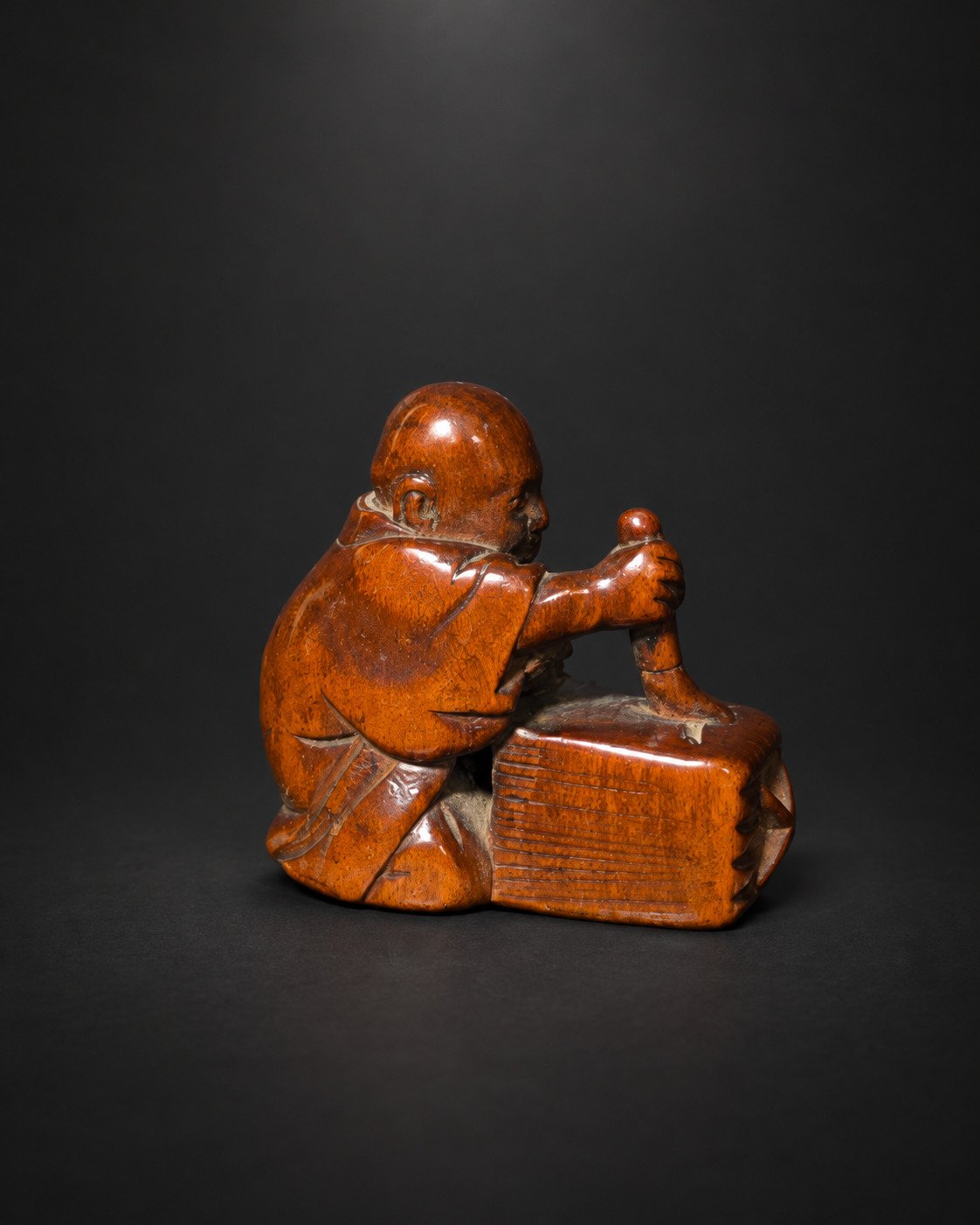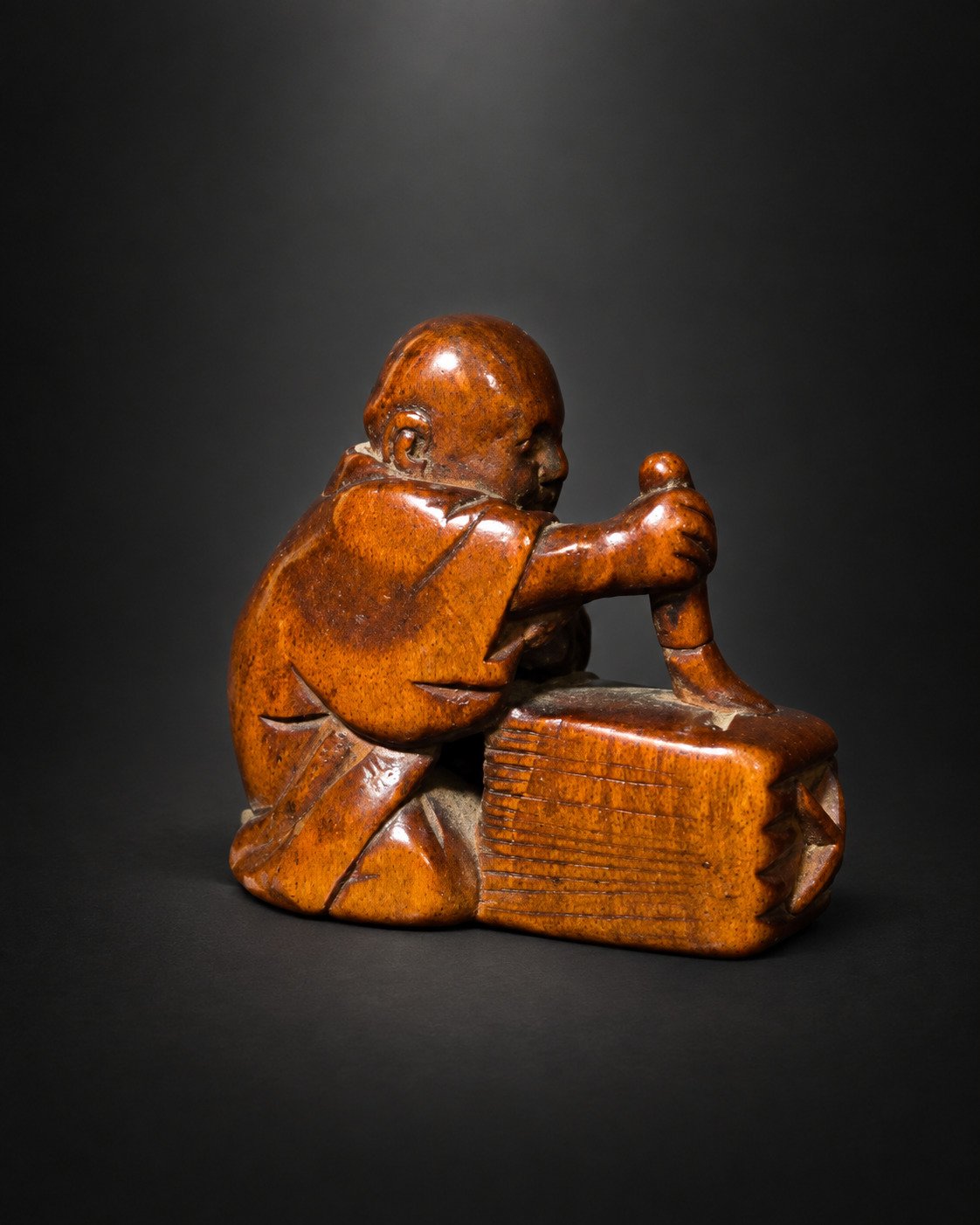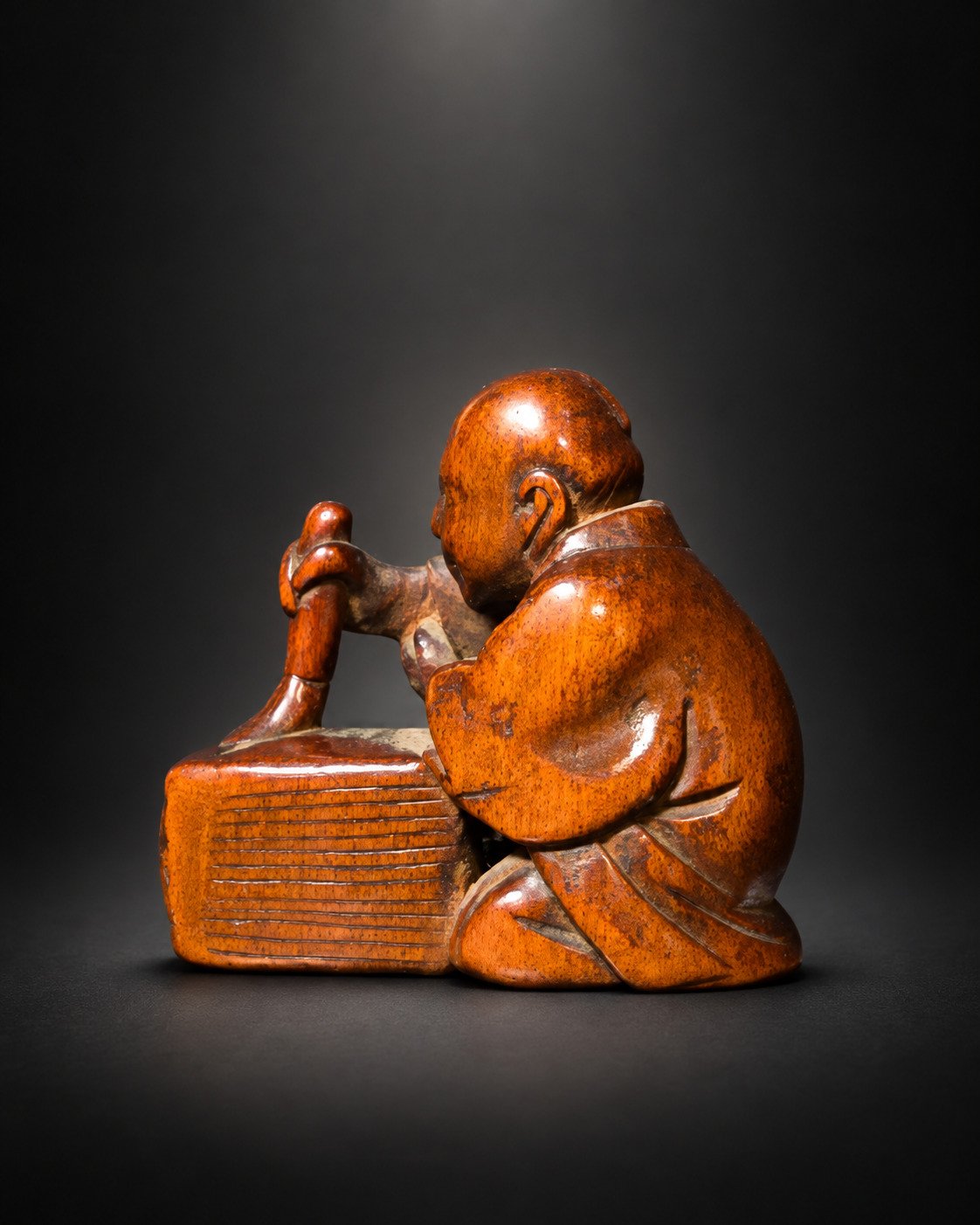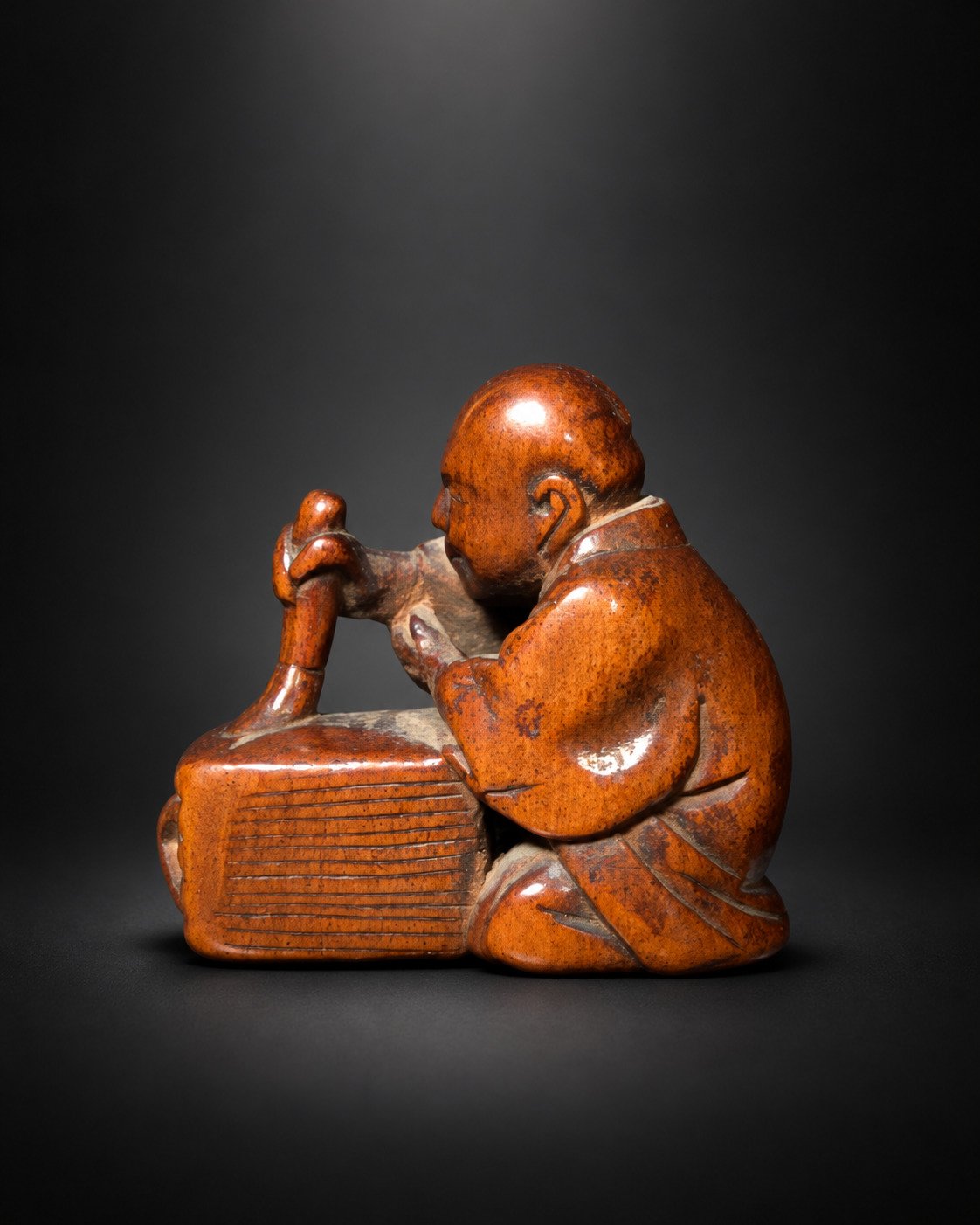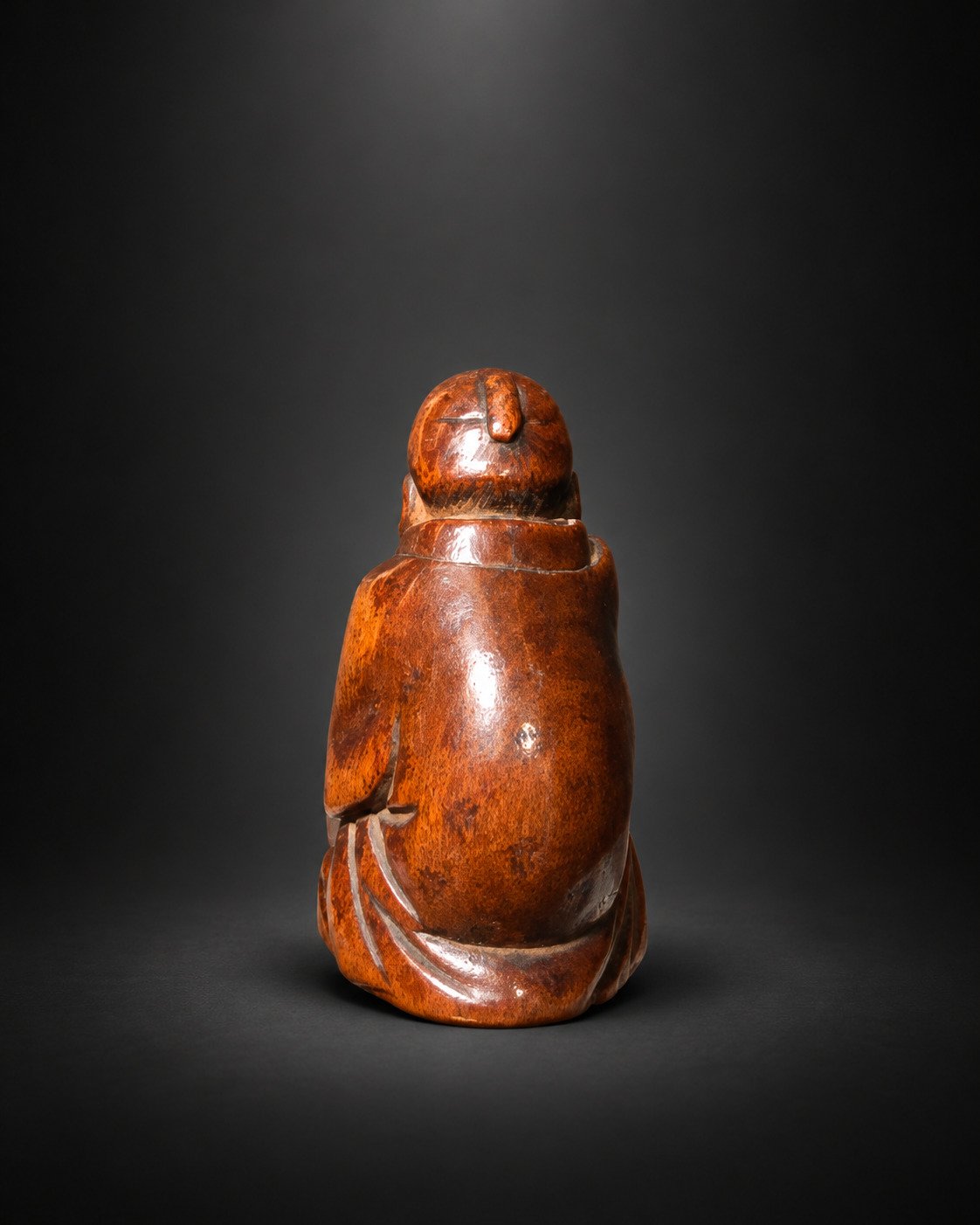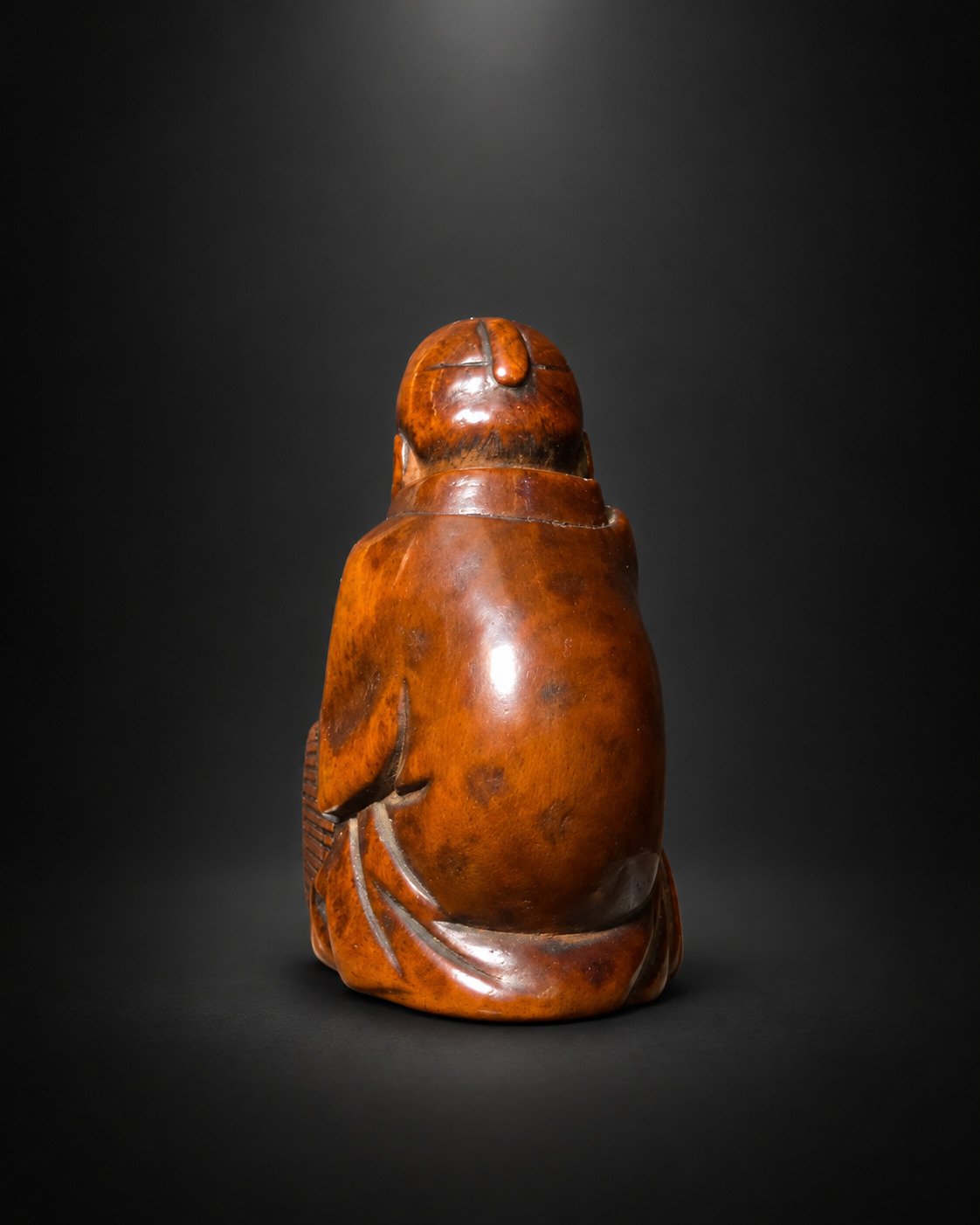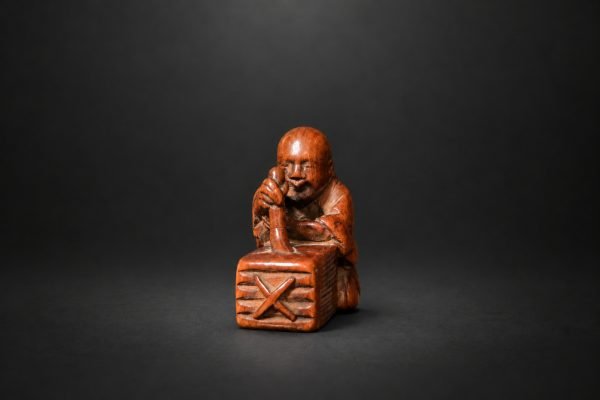
A charming and highly expressive boxwood netsuke depicting a kneeling calligrapher, carved during the Edo period. The figure bends intently over a large writing surface, gripping an oversized brush in both hands as he concentrates completely on his work.
Despite its compact dimensions, the carving creates a remarkably animated scene. The calligrapher’s hunched posture, carefully positioned hands and oversized brush immediately communicate the act of writing, while the warm surface and lustrous patina of the boxwood give the netsuke the tactile character associated with pieces that have been handled and appreciated over time.
The subject may allude to Kōbō Daishi (Kūkai), the celebrated Buddhist monk, scholar and calligrapher whose legendary skill with the brush became deeply embedded in Japanese popular culture.
The composition is built around a bald male figure kneeling low to the ground. His body folds forward over a rectangular block as he holds a large writing brush upright between both hands.
His head is lowered so closely toward the brush that his face almost meets his hands, creating an unusually convincing impression of concentration. Rather than presenting the figure formally, the carver captures a fleeting human moment: a calligrapher entirely absorbed in the task before him.
The brush forms the visual center of the composition. Held vertically between both hands, it rises through the compact arrangement of the figure and terminates against the writing surface below.
Its exaggerated scale makes the activity immediately legible even at the small dimensions required of a netsuke. It also gives the carving a slightly humorous quality characteristic of many Edo-period netsuke, where recognizable human behavior could be condensed into a lively miniature scene.
Beneath the figure is a substantial rectangular block. Its sides are carefully worked with a series of parallel grooves, giving the impression of layered sheets, a bound stack of paper or another prepared writing surface.
One end bears a raised cross-shaped element. Together with the grooved sides, these details transform what could have been a simple structural base into an integral part of the narrative.
The imagery recalls the celebrated reputation of Kōbō Daishi, or Kūkai (774–835), founder of the Shingon school of Japanese Buddhism and one of the most famous calligraphers in Japanese cultural history.
Numerous legends developed around Kūkai’s extraordinary mastery of writing. One of the best known concerns a calligraphic inscription traditionally associated with the Ōtenmon gate of the imperial palace in Kyoto. According to the story, after discovering that a stroke had been omitted, Kūkai completed the character by throwing or directing his brush toward the inscription rather than simply rewriting it.
The legend became associated with the famous expression Kōbō mo fude no ayamari — essentially, “even Kōbō makes mistakes with the brush” — a reminder that even a master can make an error.
Although the calligraphic subject and prominent brush make an association with Kōbō Daishi plausible, without an identifying inscription or documentary provenance the figure is best described as a calligrapher, possibly representing or inspired by Kōbō Daishi.
The netsuke is conceived as a compact three-dimensional sculpture, with the figure, brush and writing block brought together into a tightly unified composition.
The hands are particularly effective. They are clearly differentiated despite their minute scale and positioned naturally around the brush. The robes are treated more softly, their folds following the crouched posture without overwhelming the central action.
The result is a balanced example of katabori netsuke, where narrative, character and practical form are combined within only a few centimeters.
Much of the appeal of the carving lies in its understated humor. The figure is not simply shown holding a brush: his entire body participates in the act of writing.
His hunched shoulders, lowered head and tightly gathered hands make his concentration almost exaggerated. Viewed from different angles, the relationship between the man’s face, hands, brush and writing surface becomes increasingly apparent.
This type of visual storytelling is one of the qualities that makes figural netsuke particularly engaging as miniature sculpture.
The netsuke is carved from boxwood, a dense, fine-grained material particularly well suited to detailed miniature carving.
Its surface has developed a warm orange-brown tone with a smooth, lustrous patina. Variations in color across the raised and recessed areas emphasize the modeling of the figure and contribute considerably to the visual depth of the carving.
The resulting surface has the mellow appearance expected of an antique object that has aged and been handled over time.
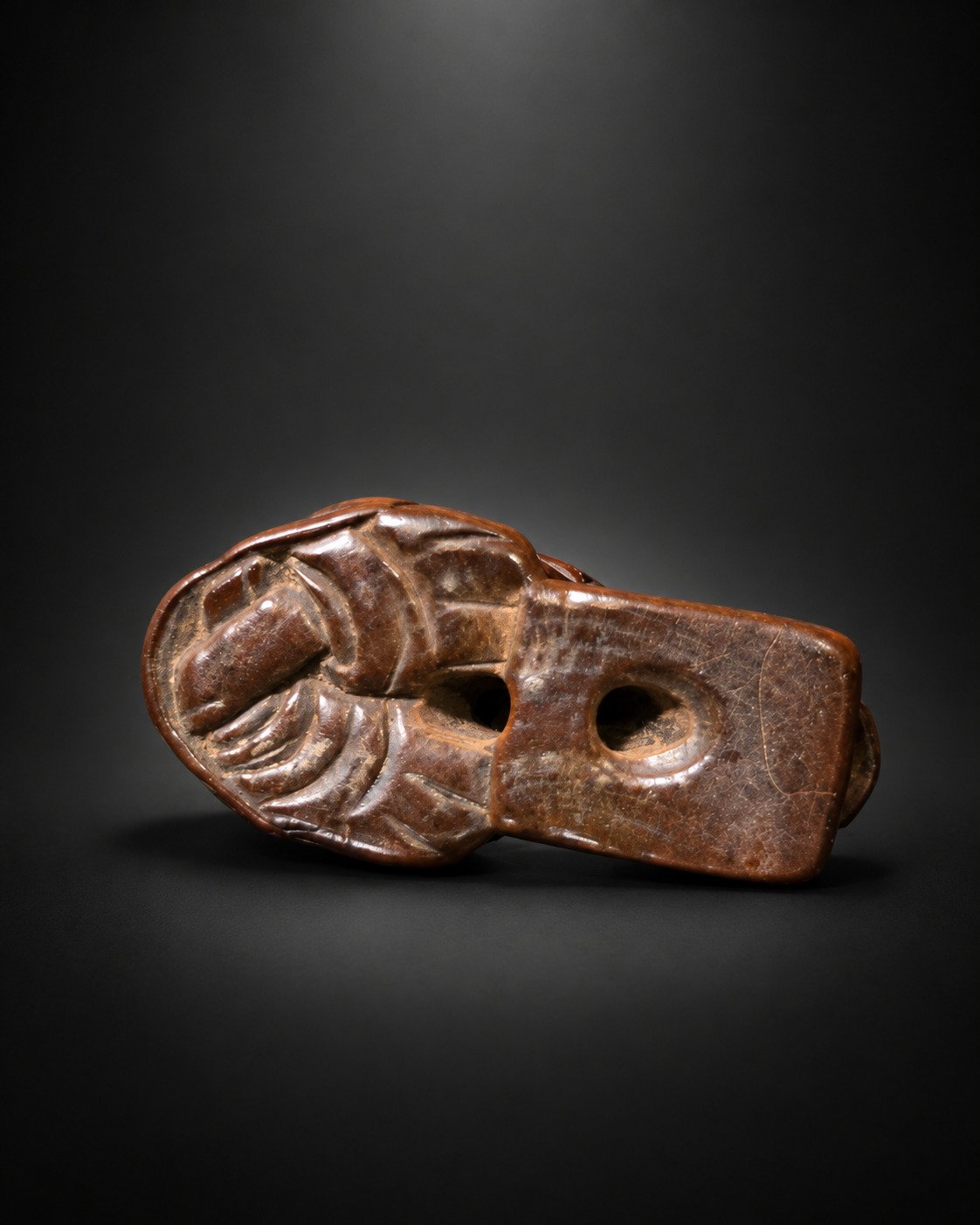
The underside incorporates two himotoshi, the cord holes through which a netsuke was traditionally attached to the cord of an inrō, tobacco pouch or other sagemono.
Their placement within the base allows the carving to retain its compact sculptural form while remaining consistent with the netsuke’s original practical function.
Netsuke developed as functional toggles used with traditional Japanese clothing, which lacked sewn pockets. Small personal containers were suspended from the obi by cords, with the netsuke securing the ensemble above the sash.
By the Edo period, however, netsuke had evolved far beyond purely utilitarian objects. Carvers transformed animals, people, folklore, occupations, religious subjects and scenes from everyday life into sophisticated miniature sculptures.
A calligrapher offered an especially appropriate subject: instantly recognizable, culturally resonant and capable of being arranged into the compact posture necessary for a functional netsuke.
This example combines several qualities sought in figural netsuke: a clearly readable narrative, compact composition, expressive posture, finely articulated hands, functional himotoshi and an attractive aged boxwood surface.
The possible connection with the traditions surrounding Kōbō Daishi adds another layer of cultural interest, while the oversized brush and intense posture give the carving an immediately engaging personality even without relying on a specific identification of the figure.
A charming Edo-period boxwood netsuke depicting a kneeling calligrapher completely absorbed in his work, both hands wrapped around an unusually prominent writing brush. Its compact composition, expressive posture, finely articulated hands and warm orange-brown patina give the piece considerable character despite its diminutive 3.5 cm scale. The imagery may evoke the celebrated calligraphic traditions surrounding Kōbō Daishi (Kūkai), while the two himotoshi on the underside preserve the object’s original function as a netsuke. An engaging example of the humor, observation and narrative detail found in Japanese miniature carving.
| Época | Edo |
|---|

Order above 1.000,00 € gets free shipping.

Secure and hassle-free payment process.

Certificate of authenticity included.

Have questions? Contact us via WhatsApp.
Contact