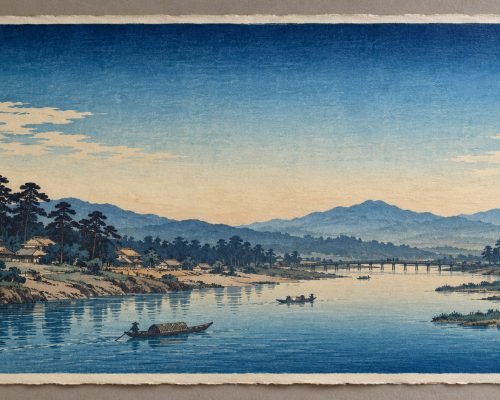
Surimono bring poetry and imagery together in prints made for private circulation. Captured collection records from the Cleveland Museum of Art describe commissions celebrating an event, elaborate images distributed among friends or poetry-club members, and a composition carrying poems from a poetry salon. These examples offer a concrete way to explore the relationship between pictures, words and their intended recipients. They do not establish one purpose for every surimono: each object needs to be read through its own documented context.
Surimono are privately commissioned prints. The Cleveland Museum of Art describes one example as a print used to announce or commemorate a special event. Its record for A Low Tide Pentaptych gives the literal meaning of the term as “printed things.” Rather than treating the word as an explanation of every work, it is useful to ask what the record of a particular print says about its occasion, subject and circulation. Those details help connect the image to the audience for whom it was made.
Basket of Peonies provides a specific example. The museum dates the color woodblock print to 1810 or 1814 and identifies it as a surimono celebrating an event in the life of the actor Ichikawa Danjuro VII. The peony was his emblem; the description also associates the flower with summer in Japanese tradition. Here the pictured subject is connected to a named person and a commemorative occasion. The record does not identify that occasion more precisely, so the print should not be used to invent a particular celebration or a wider account of the actor’s life.
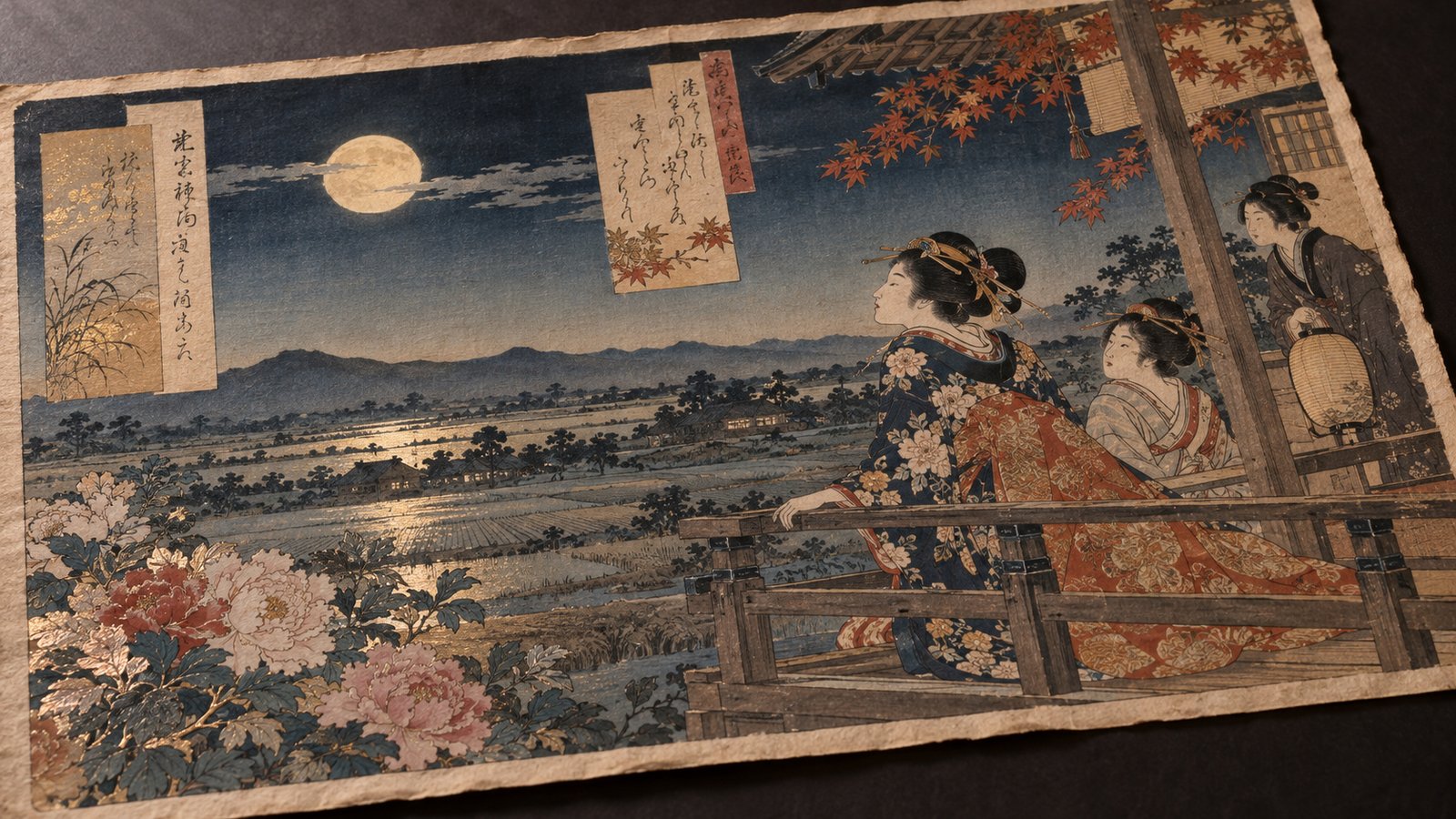
Text can be part of the image rather than a separate explanation below it. A Cleveland record for a surimono of courtesans watching an autumn moon from a balcony in the Yoshiwara describes the robes, the evening scene and the poetic atmosphere. It also identifies an accompanying poem. The picture and the words are therefore both relevant to reading this documented object. This is an observation about the specific print, rather than proof that every poem in every surimono works in the same way.
In that scene, the courtesans and their attendants look towards the full moon above the surrounding rice fields. The museum supplies an English rendering of the poem that also refers to the moon and the people gathered in the room. That shared subject gives a documented connection between the visual setting and the text. A reader can follow the connection without inventing a translation, assuming an unrecorded recipient, or treating the poem as evidence for details that the collection record does not give.
A different record, Woman by a Plum Tree Matched with the Wisteria Maiden, describes surimono as elaborately printed images intended for private distribution among friends or members of a poetry club. This supplies evidence for the audience, even though it does not give a full account of the verses or all the people who received this particular print.
The relationship between a poetry circle and a printed composition is especially clear in A Low Tide Pentaptych, dated around 1830. The museum identifies five privately commissioned surimono that together show women collecting sea life at low tide. It also records ten poems written by members of a poetry salon, placed across the upper part of the composition. These details connect a visual subject, written contributions and an identified kind of group.
According to the museum description, nine of the poems contain the words “low tide”; the remaining poem describes abalone as a sought-after jewel. The recurrence of the subject links the text to the activity pictured below it. The five-part format matters here because the poems occupy a shared composition. This example is not being used as a guide to checking the completeness, condition or value of multi-sheet prints, which are different questions.
The record supports a specific conclusion: poetry by members of a salon was incorporated into this printed image. It does not tell us everything about the commissioning process or how each recipient responded. Keeping that distinction makes the example useful without turning a brief collection description into an unsupported social history.
Taken together, the records show several ways in which poems, pictures and private circulation can belong together. Basket of Peonies links its image to a commemorative occasion and an actor’s emblem. The Wisteria Maiden record describes distribution among friends or poetry-club members. A Low Tide Pentaptych connects a depicted activity with poems contributed by members of a poetry salon. The autumn-moon print provides another documented relationship between a scene and accompanying words.
The answer to the reader’s question is therefore grounded in these objects: the print could carry a subject chosen for an occasion or group, while its text added another element to the composition. Reading the description of the audience alongside the image and poem helps explain that connection. It is more precise to identify these documented functions than to assume that all surimono were tokens of friendship, that every recipient shared the same knowledge, or that every poem had the same role.
CEO of SupeinNihonto, dealer and collector of ancient Japanese art and weapons from Canillo, Andorra.
Contact