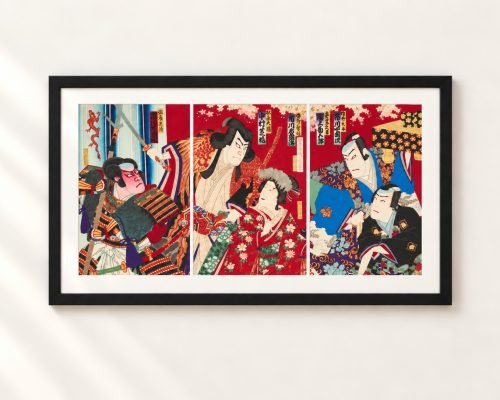
October 17, 2026
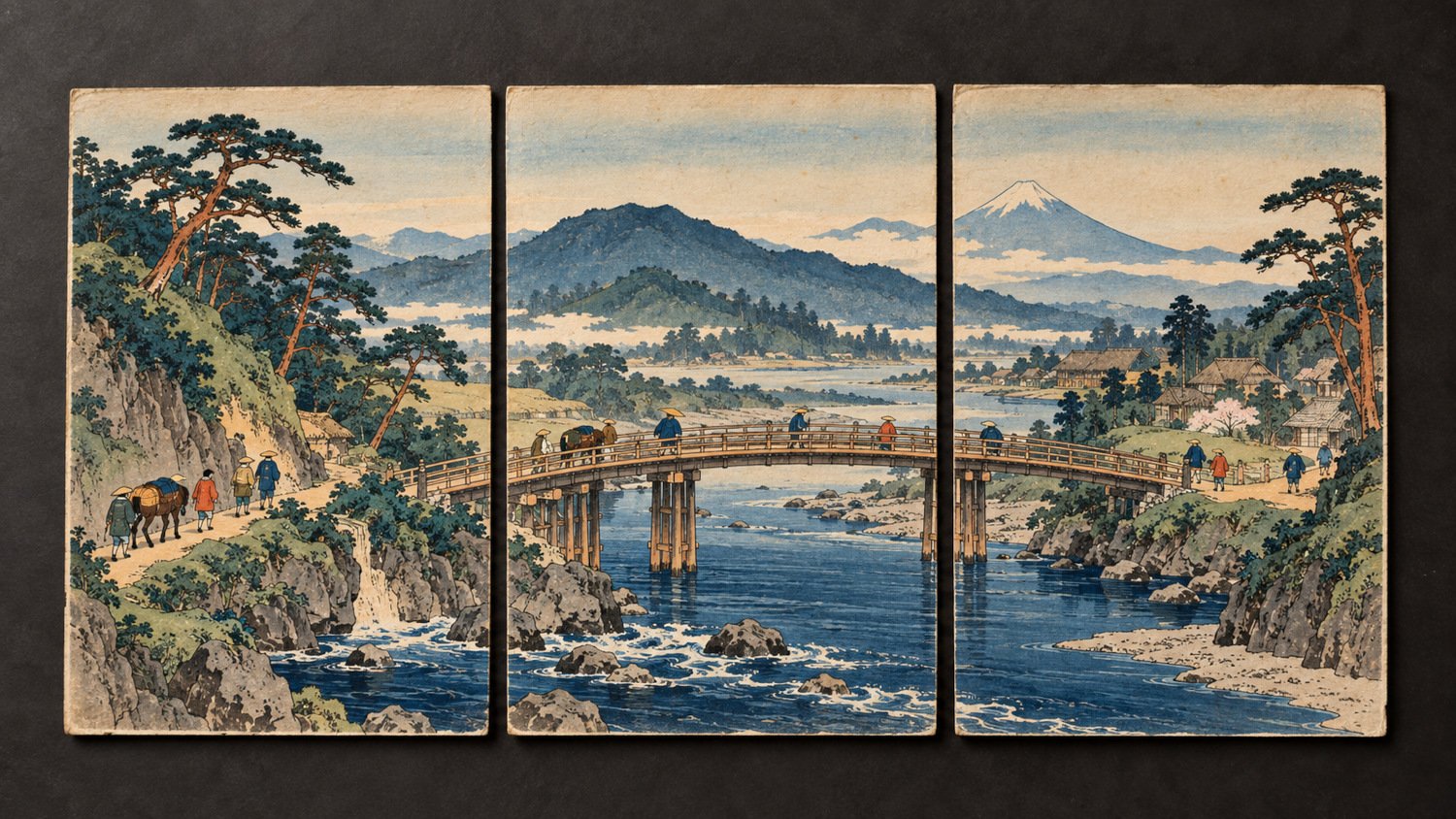
A sweeping landscape, a crowded procession or a dramatic confrontation can extend beyond the boundaries of a single Japanese print. In a triptych, three sheets work together to create a larger composition, allowing the eye to move between figures, architecture and scenery.
For collectors, this format raises questions that do not arise in quite the same way with a single-sheet print. Are all three panels present? Are they arranged correctly? Why does one look lighter than the others? Have the edges been trimmed or the sheets joined?
Assessing Japanese woodblock print triptychs means examining both the complete image and each individual sheet. A convincing overall composition is important, but it does not replace a careful comparison of the three impressions.
For an introduction to the wider tradition, see our guide to ukiyo-e history, artists and Japanese woodblock prints.
A triptych is a composition arranged across three panels. In Japanese woodblock prints, it commonly takes the form of three printed sheets placed side by side.
The Japanese term sanmai-tsuzuki refers to this connected three-sheet format. It gave artists space to develop an image beyond the dimensions of an individual sheet, accommodating broad landscapes and elaborate scenes.
However, three prints by the same artist do not automatically make a triptych. They may belong to a series while remaining independent designs.
The distinction is compositional: were these three images designed to be understood together as one work?
Some triptychs depend on unmistakable continuity. A building, shoreline or figure crosses from one sheet into the next. Others connect more subtly through the setting and the relationship between figures.
Utagawa Kuniyoshi’s Women Near a River, dated around 1850 in the Metropolitan Museum of Art’s collection, illustrates the second approach. Each sheet contains a separate woman, while the landscape and foreground unite the three figures.
When looking at a possible triptych, follow several elements rather than searching for one perfect join:
These connections help explain both the arrangement and the artistic purpose of the format.
Before comparing colours or condition, establish which sheets belong to the work.
A museum record or a reliable illustrated catalogue can show whether the composition consists of three sheets, identify their order and reveal missing portions. This is especially useful when a single panel looks convincing as an independent image.
Compare the actual design rather than relying only on the artist’s name or a broadly similar subject. Two prints of a procession, for example, may share costumes and scenery without belonging to the same composition.
Record the title, artist and any documented publisher or date information. If a reference identifies an individual panel as the “left sheet of a triptych,” preserve that distinction when describing it.
A single sheet can be an interesting collectible without being a complete work in this format.
Two questions should be considered separately:
| Question | What you are establishing |
|---|---|
| Are the correct three sheets present? | Completeness of the design |
| How closely do the impressions correspond? | Consistency of printing and appearance |
A triptych may contain all the correct panels while showing noticeable differences between them.
RISD Museum notes that sheets could historically be purchased separately and that surviving sets do not necessarily consist of impressions from a matched edition. Later collectors often preferred a more uniform appearance across the complete image.
Consequently, visual differences do not automatically mean that one panel is false or belongs to another design. Equally, harmonious colour does not establish that the sheets have always remained together.
Descriptions should distinguish what is visible from what is documented. “Complete three-sheet composition” is a different claim from “a set with documented continuous provenance.”
Colour is often the first difference a viewer notices. One sheet may have stronger reds, a paler sky or a warmer paper tone than its neighbours.
Begin with repeated or continuous passages. If a river extends across the composition, compare its appearance on either side of the joins. Examine similar areas of clothing and background under the same lighting.
However, do not assume that every discrepancy results from fading. The Rijksmuseum identifies several possible explanations for colour differences in Japanese prints, including changes over time, different editions and later colouring or overpainting. Distinguishing these possibilities can require specialist investigation.
Photographs introduce another limitation. Separate images may have different exposure or white balance settings. Before drawing conclusions from an online listing, request a photograph showing all three sheets together under consistent light.
A useful question is therefore: does the difference remain visible when the panels are photographed or examined under comparable conditions?
Record the dimensions of each sheet individually, not just the overall width of the framed work.
Small differences in size are not, by themselves, evidence of a problem. The Metropolitan Museum of Art records slightly different dimensions for each sheet of Kuniyoshi’s Women Near a River.
What matters is how the edges relate to the surviving image.
Compare them with a documented example and ask:
An absent white border alone is not enough to establish how much, if any, trimming has occurred. The comparison needs to concern the same design and its known format.
Never trim an antique sheet to make the three panels line up more neatly. The remaining edges are part of the object and may preserve useful evidence.
A vivid panel is not necessarily the most finely printed one.
Compare small details across the set: hair, textile patterns, foliage and fine architectural lines. Look at the clarity of the outlines and how the coloured areas relate to them.
Conservation documentation for the Metropolitan Museum of Art’s Japanese print collection distinguishes colour quality, paper condition and printing quality as separate aspects of examination. A sheet can perform differently in each category.
For your own notes, avoid reducing everything to “good condition.” Instead, describe what you can see:
| Aspect | Useful observation |
|---|---|
| Colour | One panel appears lighter than its neighbours |
| Printing | Fine lines remain clear or appear less distinct |
| Paper | A particular sheet has a crease, tear or loss |
| Completeness | All three required panels are present |
This produces a more informative record and makes comparisons between sets easier.
A triptych deserves three individual condition assessments as well as an overall view.
A crease on one panel may be hard to notice in a wide photograph. A repair near a join can disappear visually when the complete work is framed. Request detailed images of the edges and, where safely accessible, the reverse.
Keep observations specific to their location. For example: “crease across the lower area of the centre sheet” is more helpful than “some wear.”
Backing, patches, adhesive residue and trimming are among the features recorded in professional Japanese print condition surveys. Their presence should be described rather than concealed beneath a general statement about age.
If the reverse is hidden by mounting, acknowledge that limitation. Do not assume it is undamaged simply because the front presents well.
You may encounter triptychs whose panels have been attached or mounted onto a shared backing.
Their current presentation does not, on its own, establish when or why they were joined. RISD Museum discusses how later collectors sometimes fastened sheets together to create an uninterrupted image.
Before considering any intervention, establish what can be seen and what remains concealed. Ask whether the sheets overlap, whether the joins are visible from the reverse and whether there is a conservation report.
Do not attempt to pull joined sheets apart or remove backing to inspect them. Professional conservation literature specifically recognises that the risks of backing removal must be weighed against the condition and vulnerability of the paper.
A documented assessment is more useful than assuming that every mounted triptych should be separated.
A focused enquiry can resolve much of the uncertainty before a purchase:
These questions support a more informed assessment without treating an online photograph as a substitute for examining the object.
A triptych offers a particular pleasure: the relationship between its parts becomes visible as the eye moves across the work.
An individual panel may be beautiful, yet the neighbouring sheets can explain a gesture, complete a landscape or reveal the scale of a scene. Studying the whole and the details together is what makes this format rewarding.
When exploring Japanese woodblock prints at Supein Nihonto, check whether a work is described as a single-sheet design, an individual panel from a larger composition or a complete multi-sheet set. That distinction helps you understand exactly what the object represents and how it was intended to be viewed.
A ukiyo-e triptych is a composition designed across three panels, commonly three printed sheets arranged side by side. The sheets work together through the scene, figures or setting.
Not necessarily. A series can contain independent images. A triptych is a connected three-part composition, which should be confirmed through the design and reliable references.
Yes. Differences may reflect printing variations, preservation history or other factors. They should be examined in context rather than treated as automatic evidence that a panel is incorrect.
No. Surviving sheets can differ slightly in size. Compare the dimensions alongside the edges, image continuity and a documented example of the same work.
It can be collected for its own artistic and historical interest. However, it should be clearly identified as one panel from a larger composition rather than described as a complete triptych.
Not without a specialist assessment. The suitability of separation depends on the paper, adhesives, backing and condition. Removing a mount can expose fragile areas or cause damage.
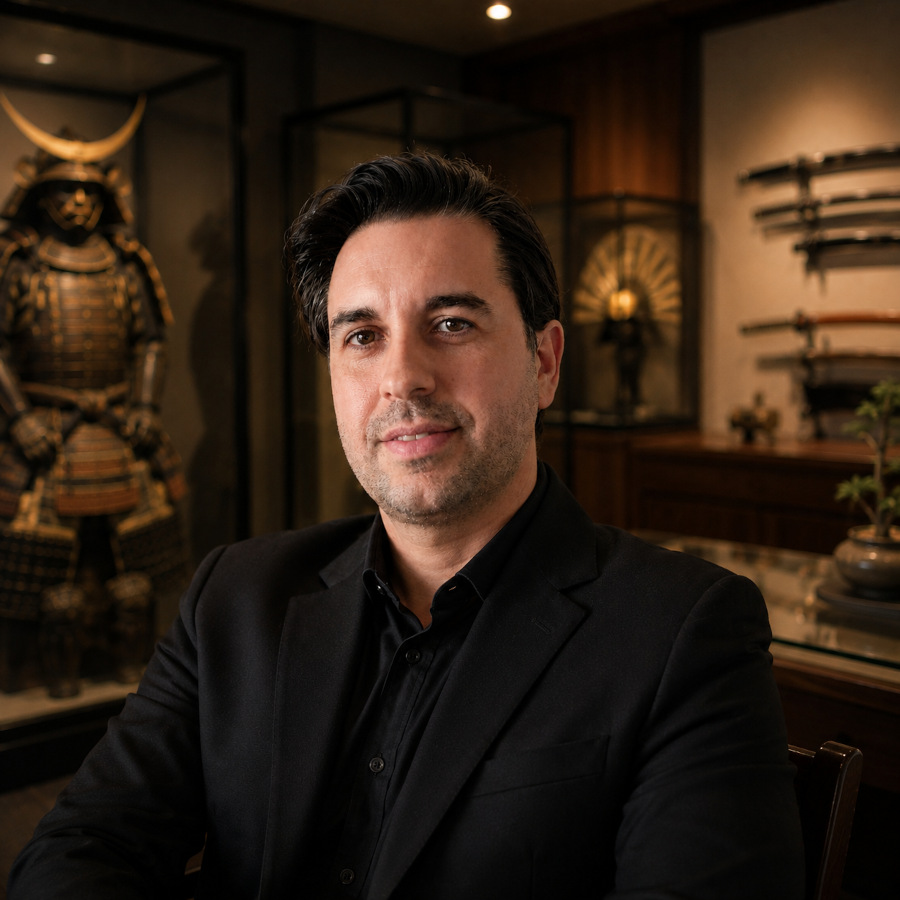
CEO of SupeinNihonto, dealer and collector of ancient Japanese art and weapons from Canillo, Andorra.
Contact