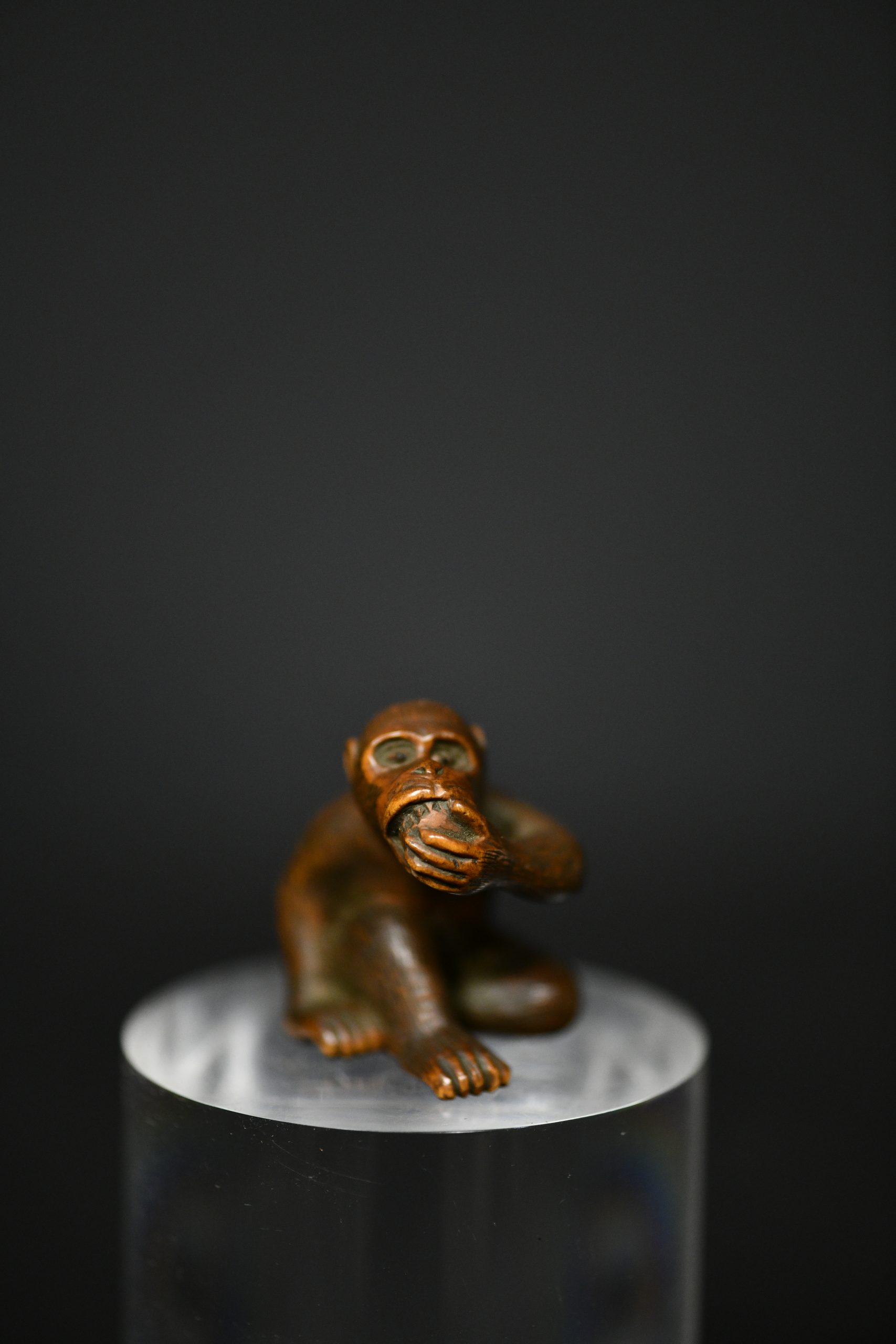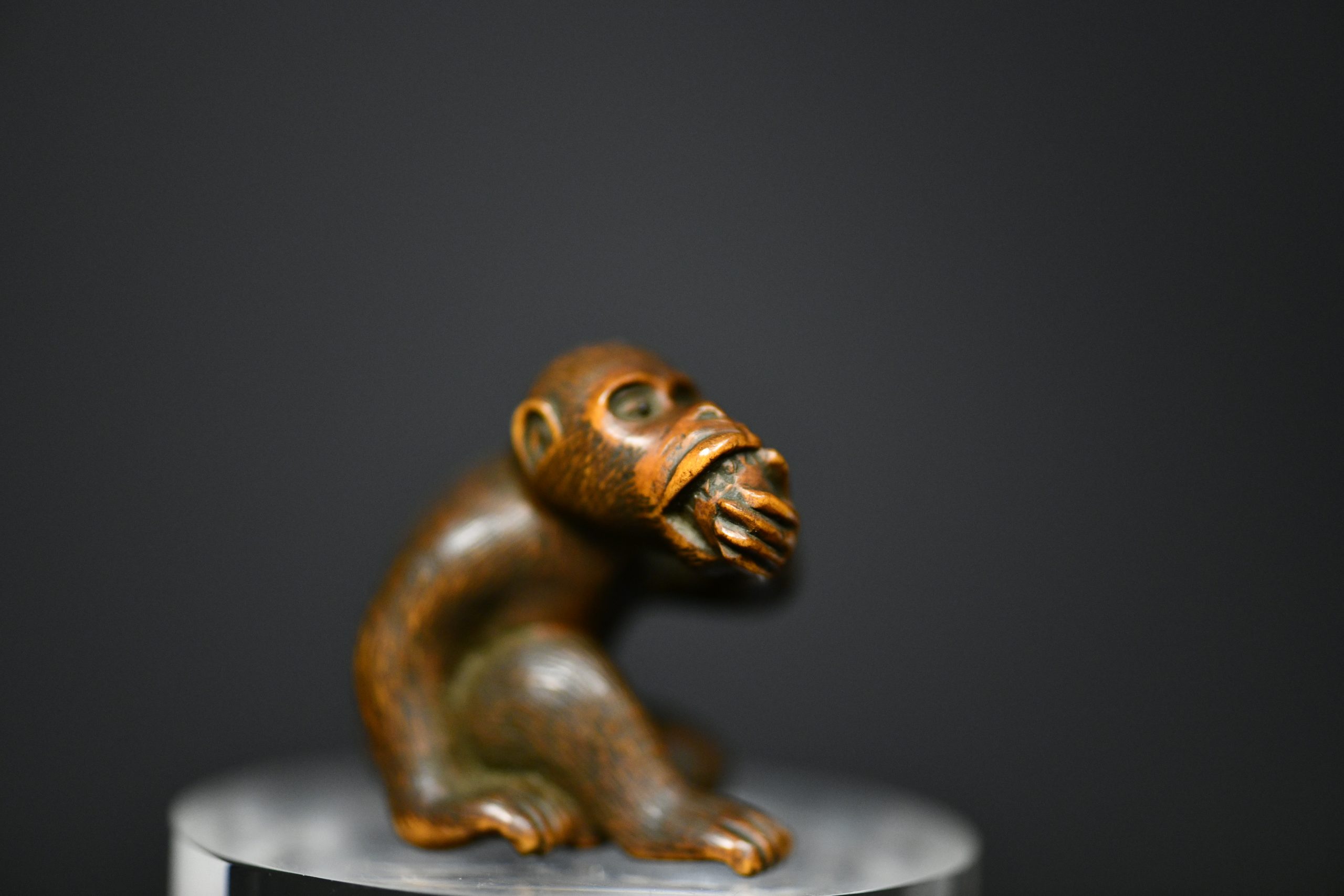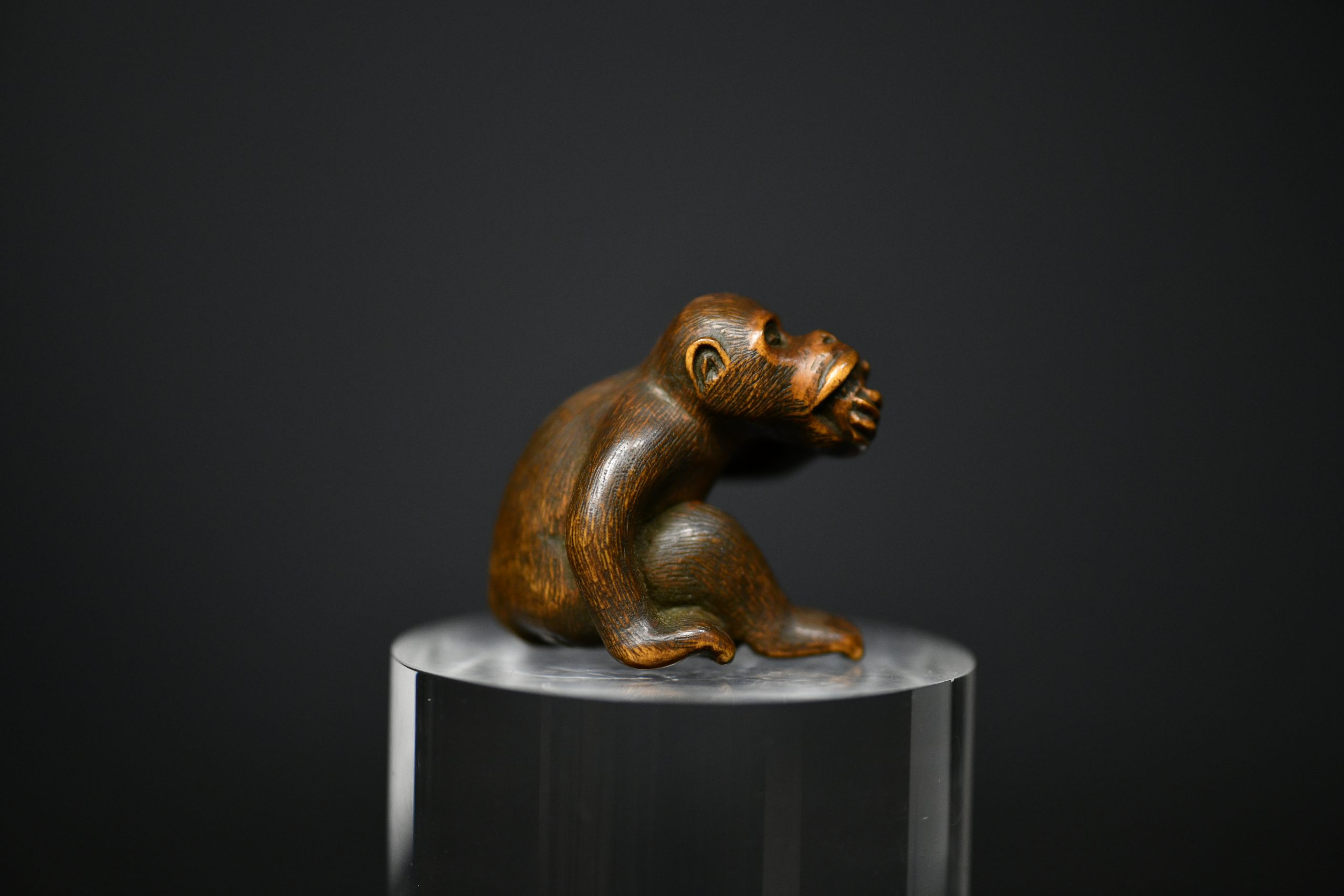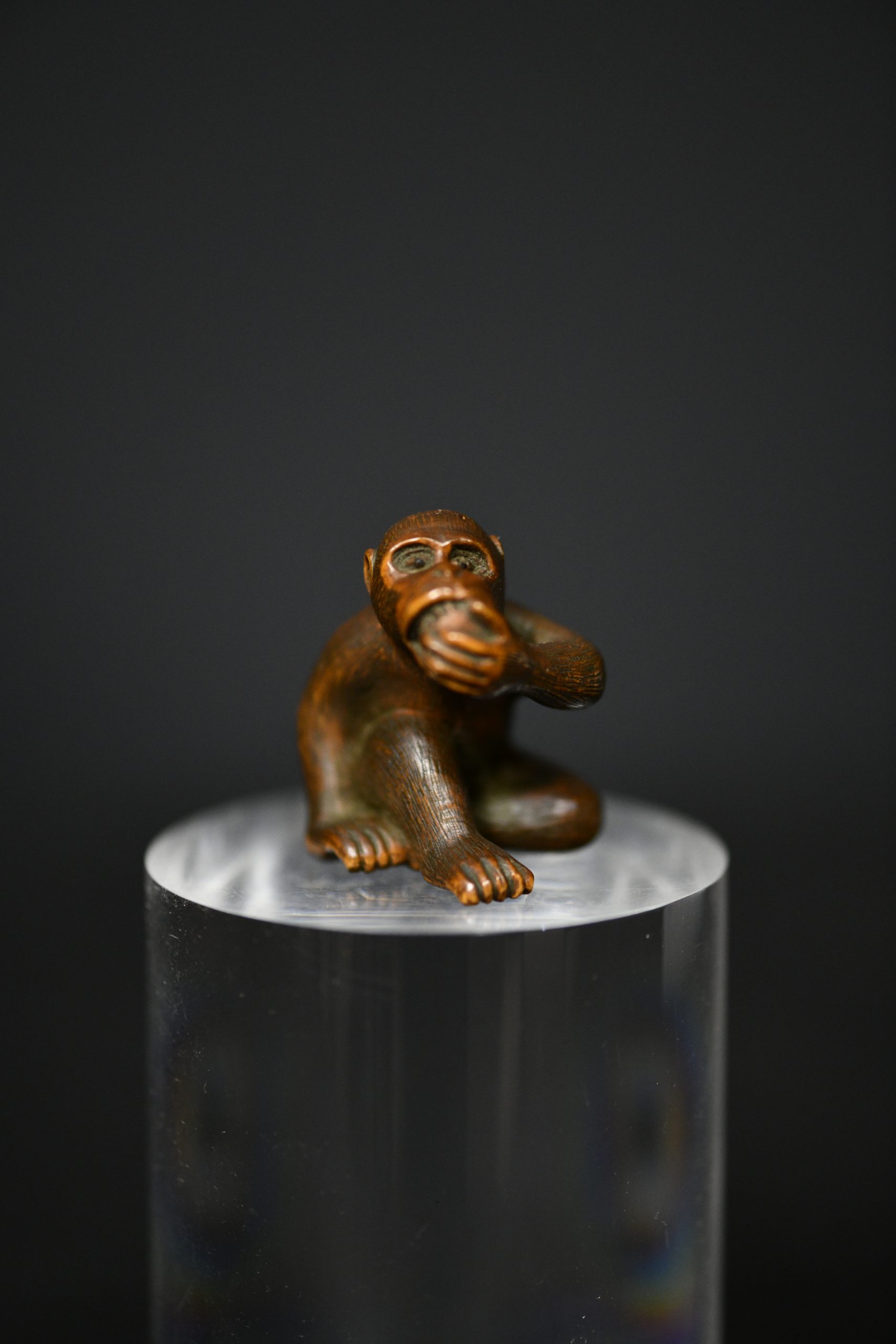

A charming Japanese wood netsuke depicting a monkey eating a persimmon, signed Masami. Compact, expressive and strongly tactile, the carving combines the lively character of the monkey with the rounded form of the fruit in a carefully unified composition.
The wood has developed an attractive mature patina and rich natural coloration, enhancing the modelling and giving the piece a particularly pleasing surface. The carving is described as being in the style of Masanao, reflecting a compact and expressive approach to animal sculpture rather than implying a direct attribution to that master.
The netsuke is preserved in very good overall condition and measures 4 × 4 × 3.2 cm.
The monkey is one of the most engaging animal subjects in Japanese netsuke carving.
Its human-like gestures, expressive face and naturally flexible body gave carvers considerable freedom to create compositions that could be humorous, lively or highly observational.
In the present example, the animal is shown actively eating a persimmon, creating an immediate sense of movement and personality.
Rather than presenting the monkey as a static animal study, the carver has captured a specific moment of behavior, giving the netsuke a strong narrative quality.
The monkey holds and eats a persimmon, a familiar fruit in Japanese culture and an especially effective subject for miniature carving because of its compact rounded form.
The fruit provides a strong visual counterpoint to the monkey’s body and helps organize the carving into a balanced sculptural mass.
Its inclusion also transforms the subject from a simple animal figure into a small scene of everyday natural behavior.
The interaction between monkey and fruit gives the netsuke an affectionate and slightly humorous character.
Monkeys appear frequently in Japanese painting, decorative art and miniature sculpture.
Artists were particularly attracted to their expressive anatomy and gestures, which often resemble human behavior and lend themselves naturally to humorous or anecdotal scenes.
Fruit-eating monkeys form part of this broader tradition of observing animals in recognizable activities.
The combination of the monkey’s animated posture and the persimmon creates a subject that is immediately legible while still allowing the carver considerable freedom in the arrangement of the body and limbs.
Measuring only 4 × 4 × 3.2 cm, the netsuke condenses the monkey and fruit into a compact three-dimensional form.
The nearly equal length and width create a balanced volume, while the body and persimmon are arranged closely together to minimize fragile projecting elements.
This type of compact construction is particularly effective in netsuke carving because the object remains visually interesting from multiple viewpoints while retaining a comfortable, tactile form.
The monkey and fruit are conceived as parts of a single sculptural unit rather than as separate elements.
The carving is characterized by rounded modelling and carefully controlled transitions between the body of the monkey and the persimmon.
The figure retains a lively sense of movement despite the compact proportions, while the face and hands become natural focal points within the composition.
The treatment balances broad sculptural surfaces with smaller descriptive details, giving the piece visual richness without making the composition unnecessarily complex.
This controlled relationship between expressive modelling and compact form is an important part of the netsuke’s appeal.
The carving has been described as being in the style of Masanao.
This stylistic comparison refers to the compact treatment of the animal subject, the emphasis on expressive modelling and the way the figure is organized as a strongly unified sculptural volume.
The description should be understood as a stylistic reference rather than as an attribution to Masanao himself.
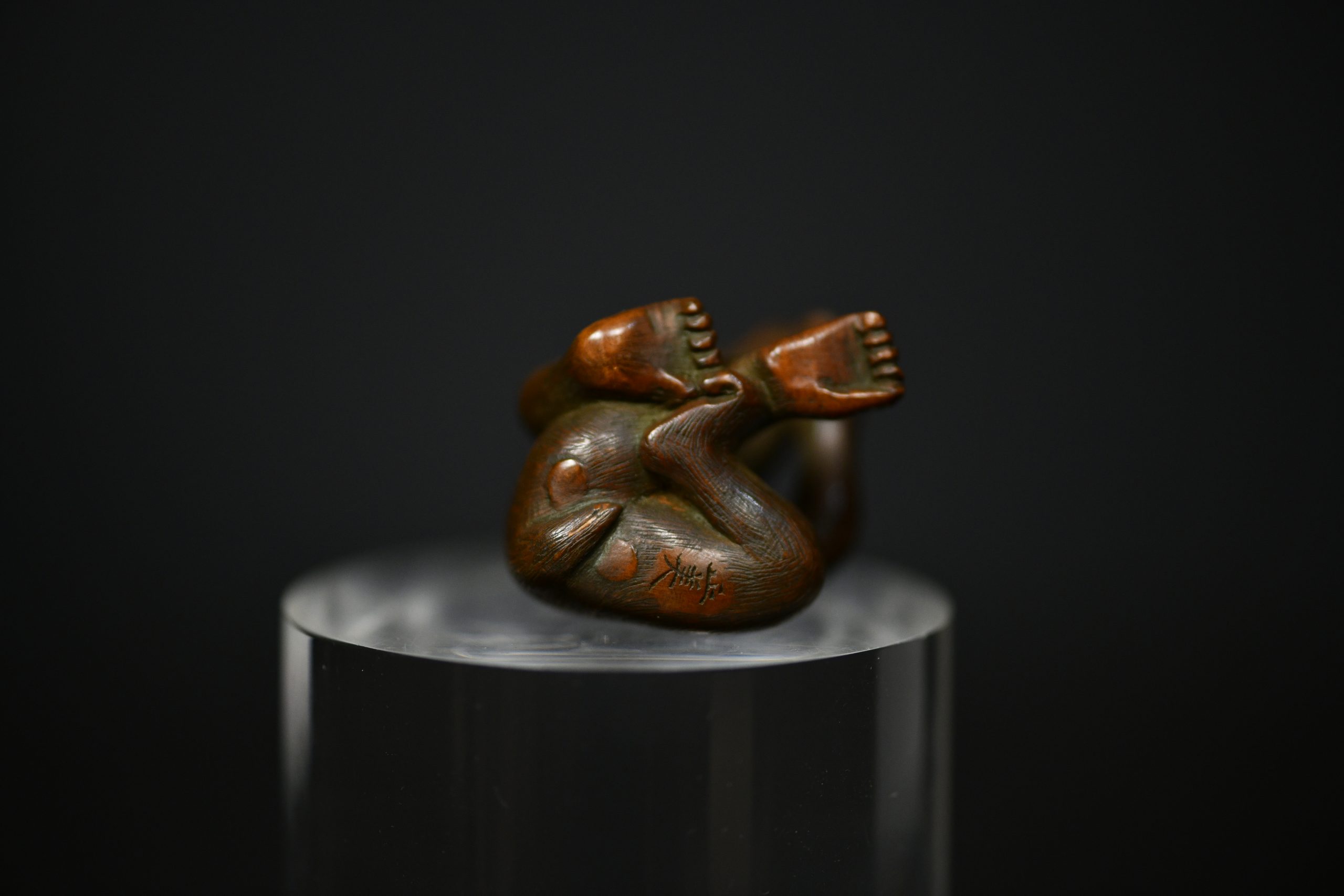
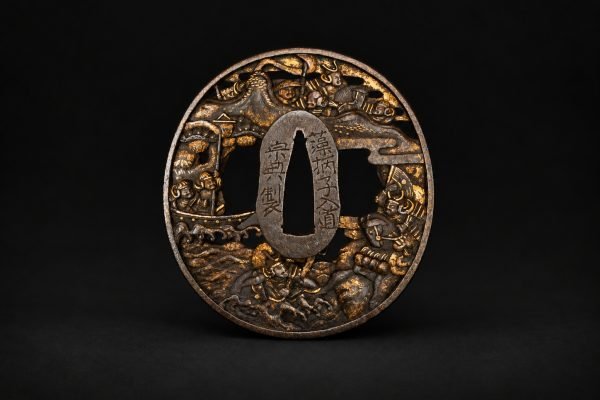
The netsuke bears its own signature, Masami, which should be treated independently from the stylistic comparison.
The netsuke is signed Masami.
The signature forms an important part of the identification and study of the piece and distinguishes it from unsigned animal carvings of similar subject.
Without additional documentation, the safest catalogue description is to state that the netsuke bears the signature Masami rather than making a broader biographical or workshop attribution.
The signature, together with the distinctive subject and compact modelling, adds further interest for collectors of signed Japanese netsuke.
The netsuke is carved from wood with a warm natural coloration.
The precise wood species has not been identified and should therefore remain unspecified without material analysis.
The surface has developed an attractive mature patina, giving the carving additional depth and visual warmth.
Patina is particularly important in antique wooden netsuke because repeated handling can gradually soften and polish exposed surfaces while leaving deeper areas darker.
These subtle tonal differences contribute greatly to the tactile and historical character of the piece.
Traditional netsuke were created as functional objects intended to be worn and handled.
Their small scale encouraged carvers to produce rounded, compact forms that could be comfortably held while still offering a complete sculptural composition.
The present monkey and persimmon is especially successful in this respect.
The rounded fruit, folded body and compact overall proportions create a self-contained volume that can be appreciated both visually and through touch.
One of the strongest qualities of the netsuke is its personality.
The act of eating gives the monkey an immediate sense of animation and makes the sculpture more than a simple zoological study.
The subject feels familiar, humorous and intimate, qualities that were particularly well suited to the personal nature of netsuke.
The expressive treatment of the animal combined with the simple fruit motif gives the piece a memorable character despite its small dimensions.
The netsuke is preserved in very good overall condition.
The wood displays an attractive mature patina and natural tonal variation consistent with an older carved object.
Any minor surface variation or traces of historical handling visible in the photographs should be considered in the context of the object’s age and traditional use.
Please examine the detailed photographs carefully, as they form an important part of the description and provide the best record of the carving, signature, patina and overall condition.
This netsuke combines several qualities that make it particularly appealing to collectors of Japanese animal carving.
The monkey is an expressive and engaging subject, while the persimmon introduces a simple narrative element and helps create a compact, balanced composition.
The mature wood patina gives the sculpture considerable tactile appeal, while the signature Masami adds an important point of identification and study.
The stylistic relationship to the animal carving associated with Masanao provides an additional area of interest while remaining clearly separate from the actual signature of the piece.
Its compact proportions, animated subject and rich surface make it an attractive example of the playful and highly personal character of Japanese netsuke carving.
A charming signed Japanese wood netsuke depicting a monkey eating a persimmon. Signed Masami and carved in the style of Masanao, the piece combines expressive animal modelling, a compact sculptural composition and a rich mature wood patina. Preserved in very good overall condition and measuring 4 × 4 × 3.2 cm, it offers an engaging example of the humor, observation and tactile refinement associated with traditional Japanese netsuke carving.

Order above 1.000,00 € gets free shipping.

Secure and hassle-free payment process.

Certificate of authenticity included.

Have questions? Contact us via WhatsApp.
Contact