1 in stock
1 in stock
Add to Compare
Add to Wishlist
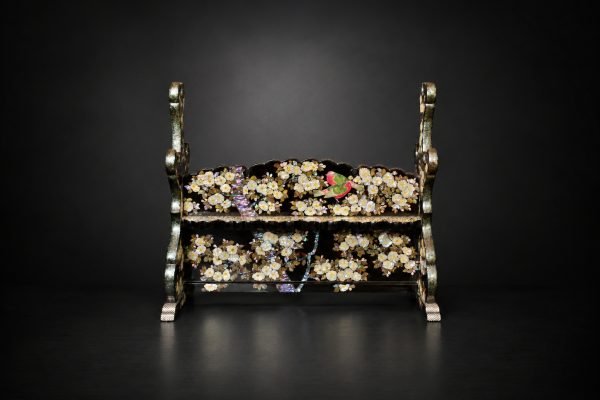
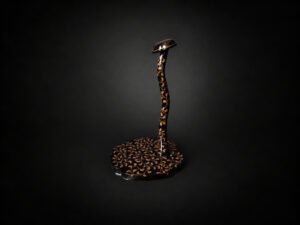
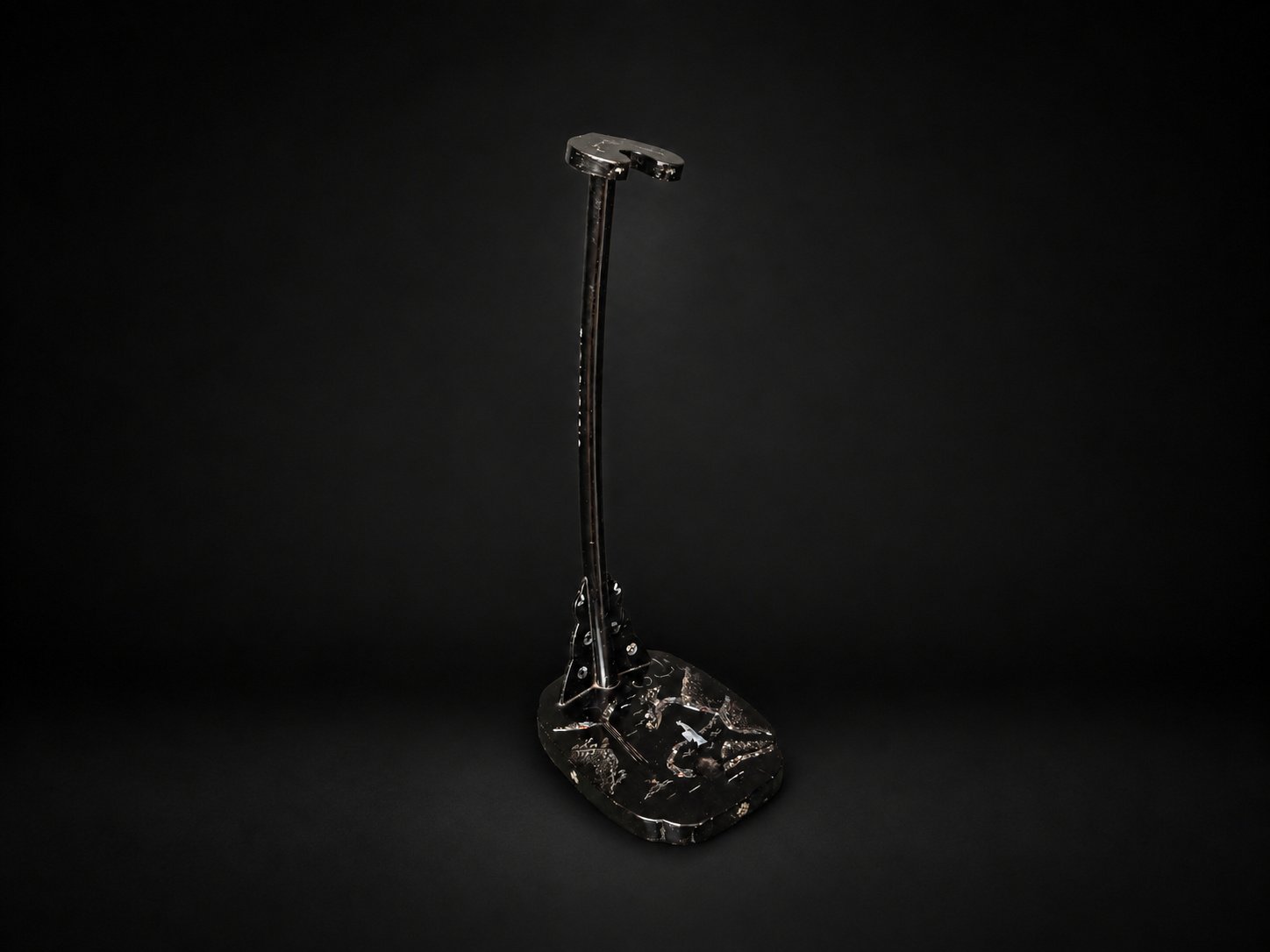
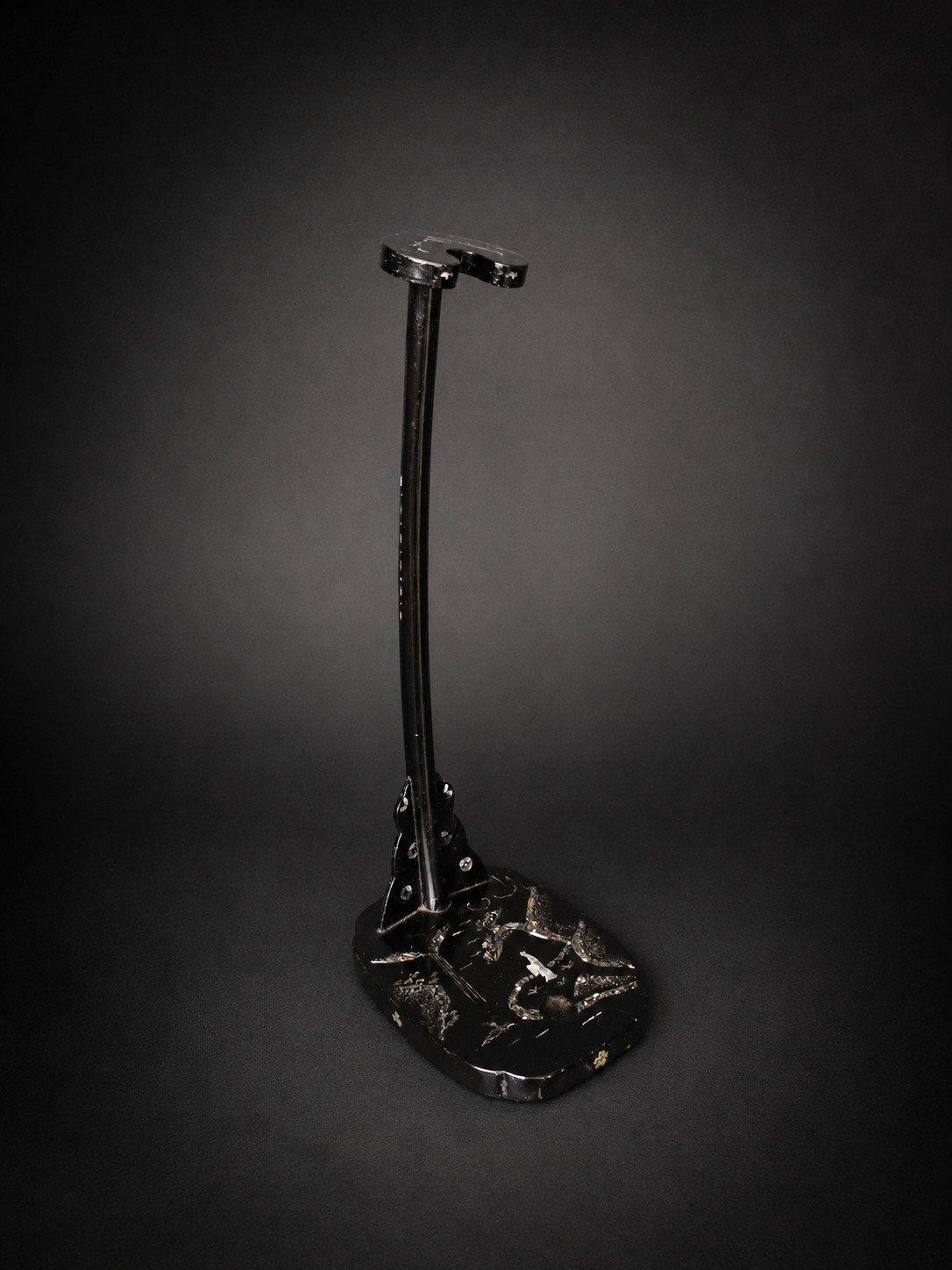
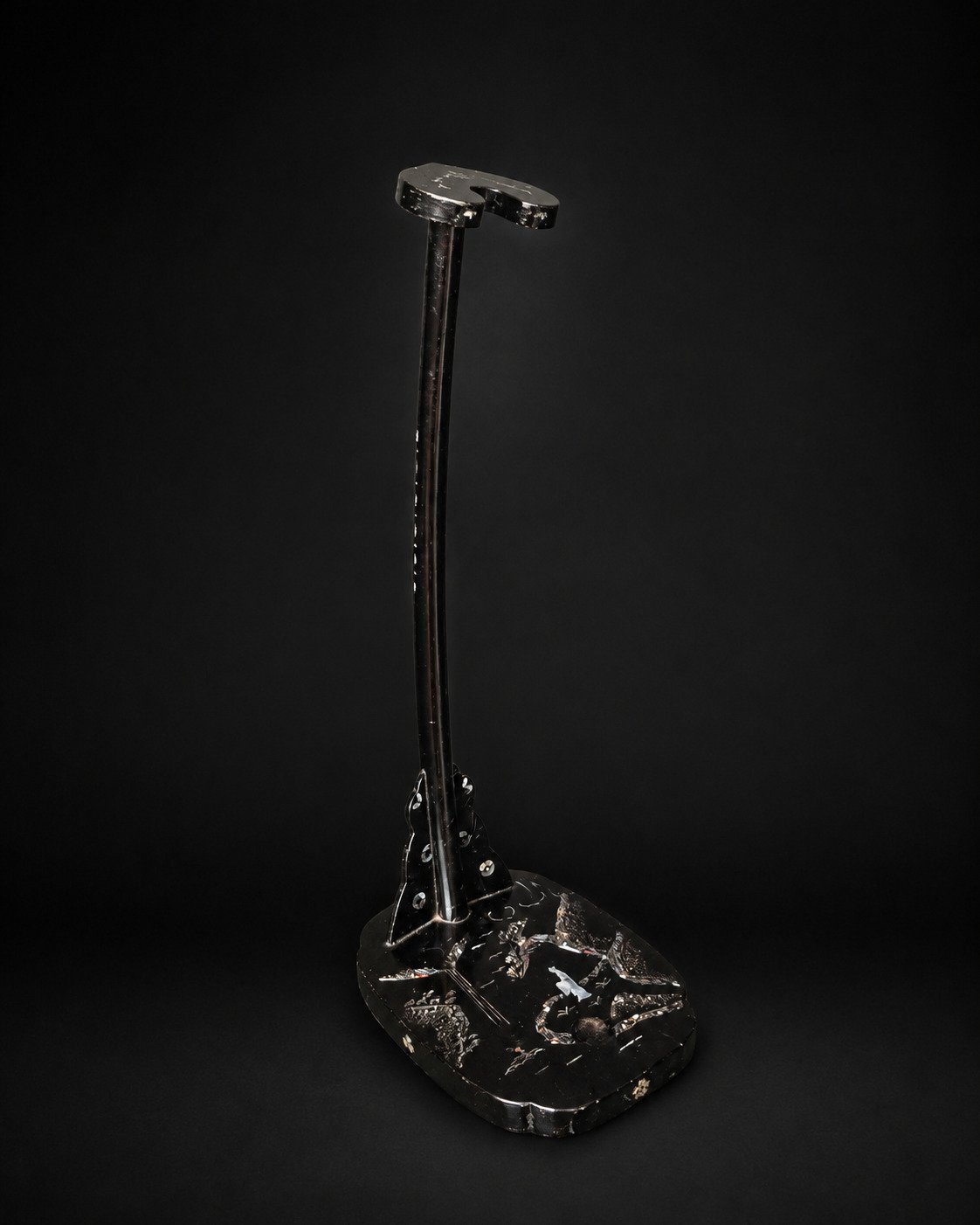
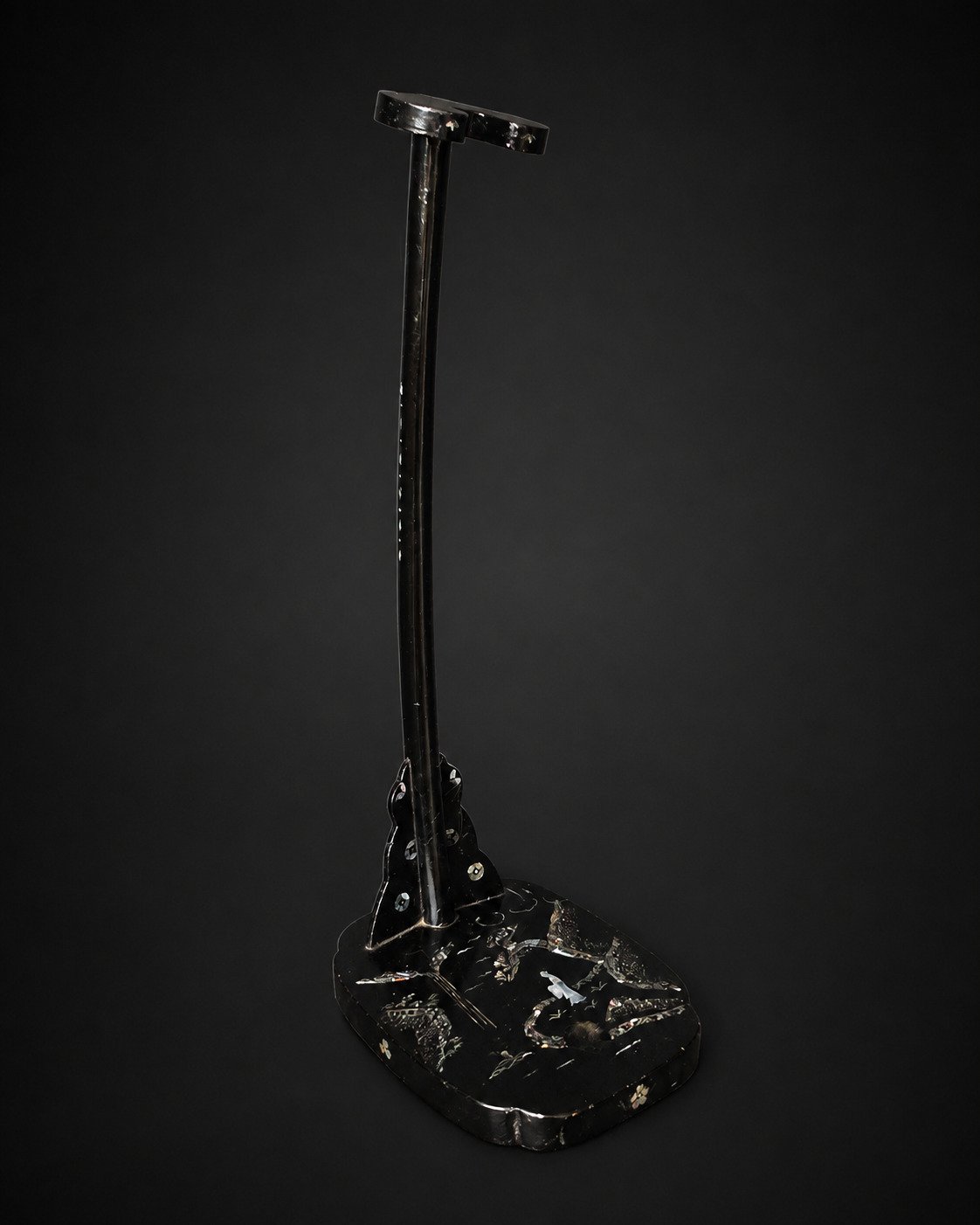
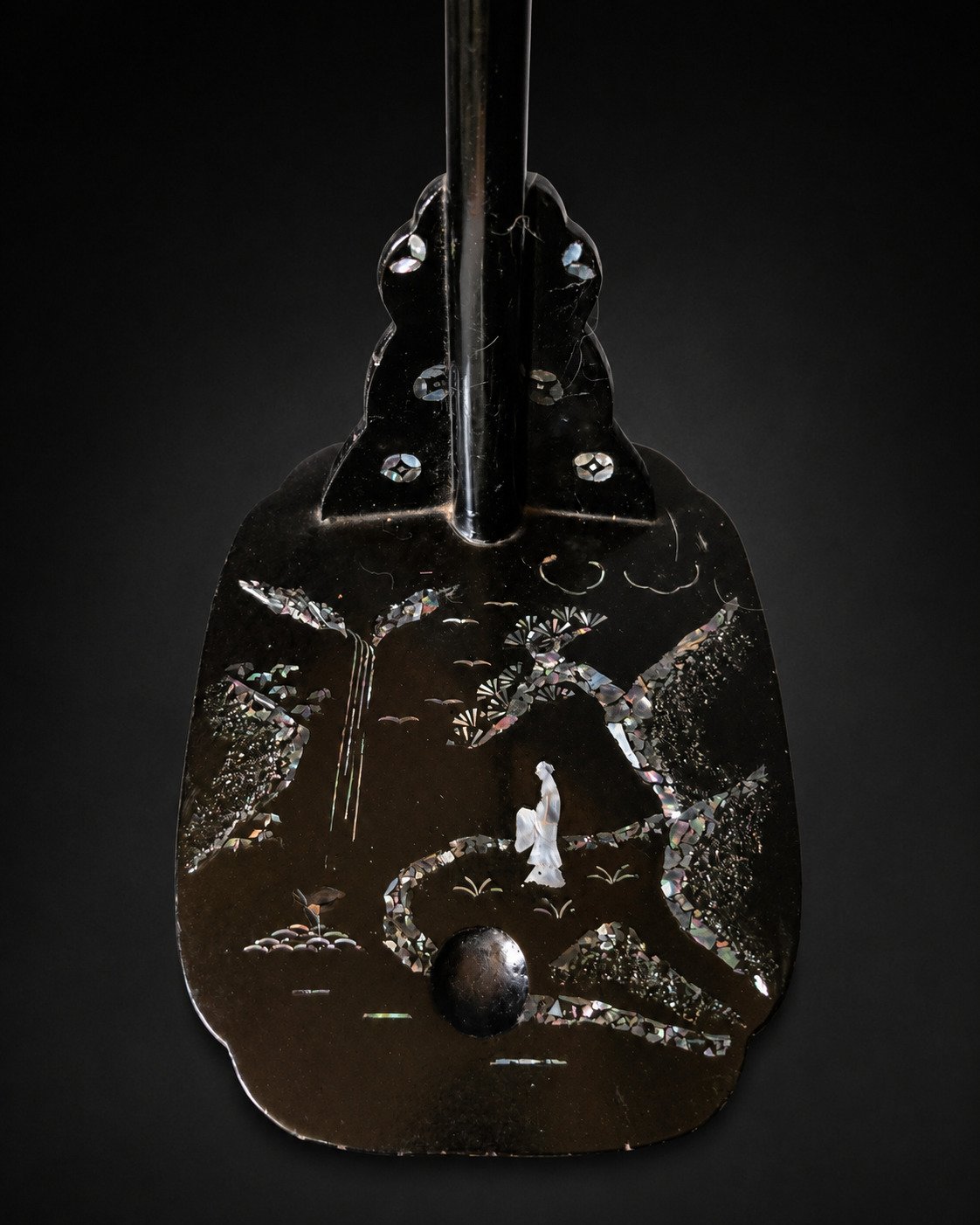
An elegant Japanese katana-kake dating to the late 19th century, distinguished by its refined vertical form and richly pictorial aogai raden decoration executed in finely cut iridescent mother-of-pearl against a polished black lacquer ground.
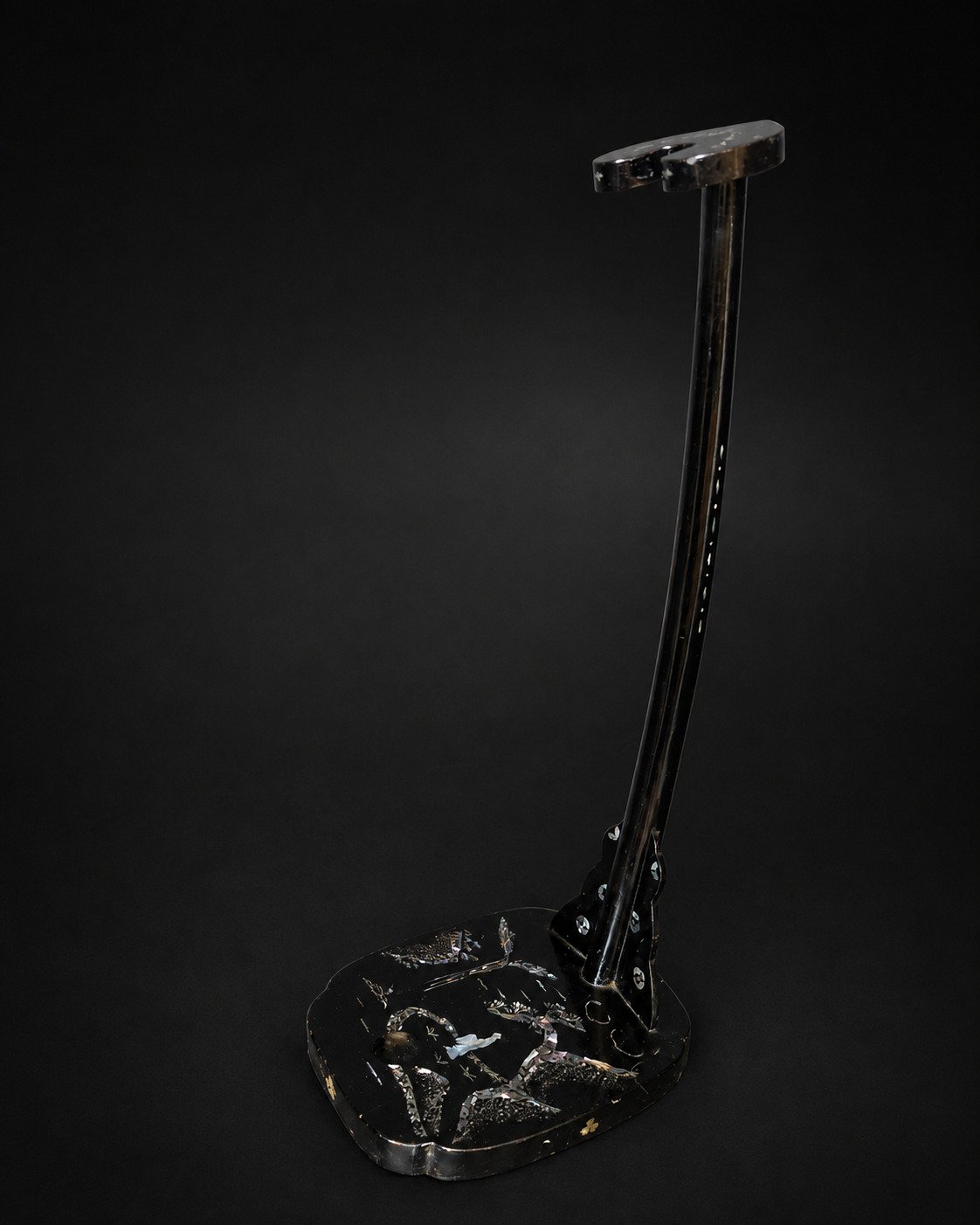
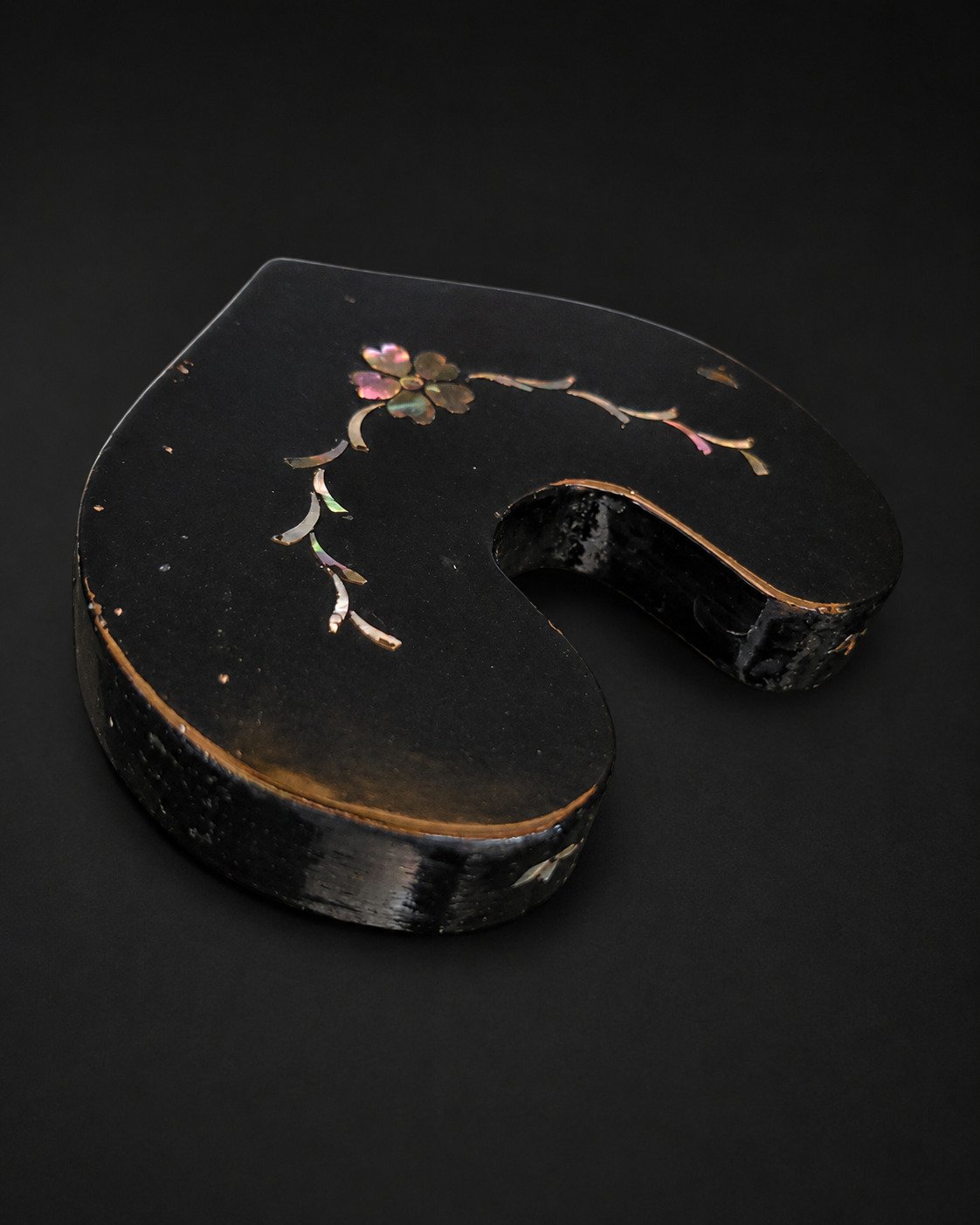
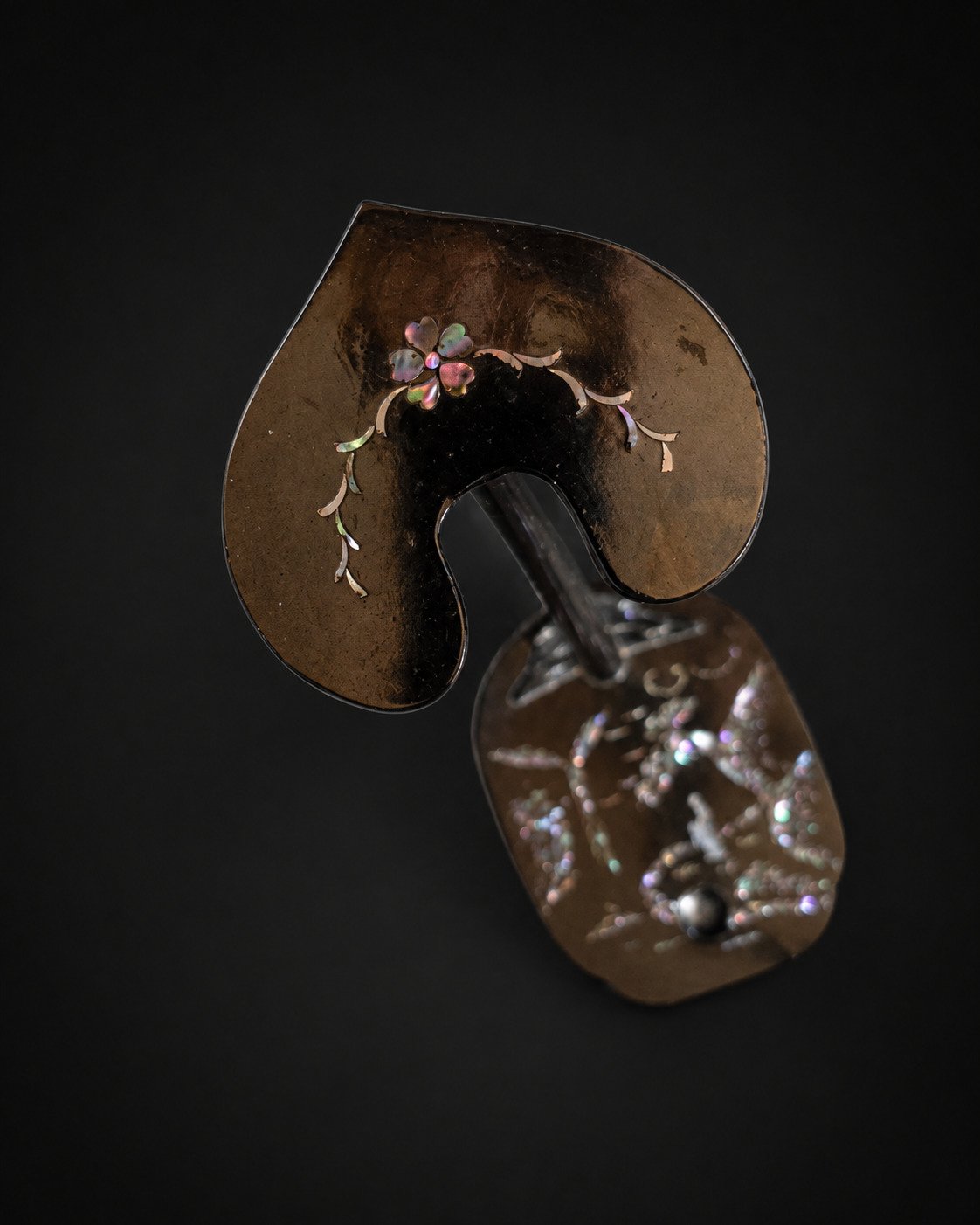
The stand comprises a broad rectangular base, a slender gently curved neck and a forked upper support designed to cradle a Japanese sword. At the foot of the upright is a separate shaped lacquer saddle, decorated with delicate mother-of-pearl ornament and positioned to support and steady the tsuka.
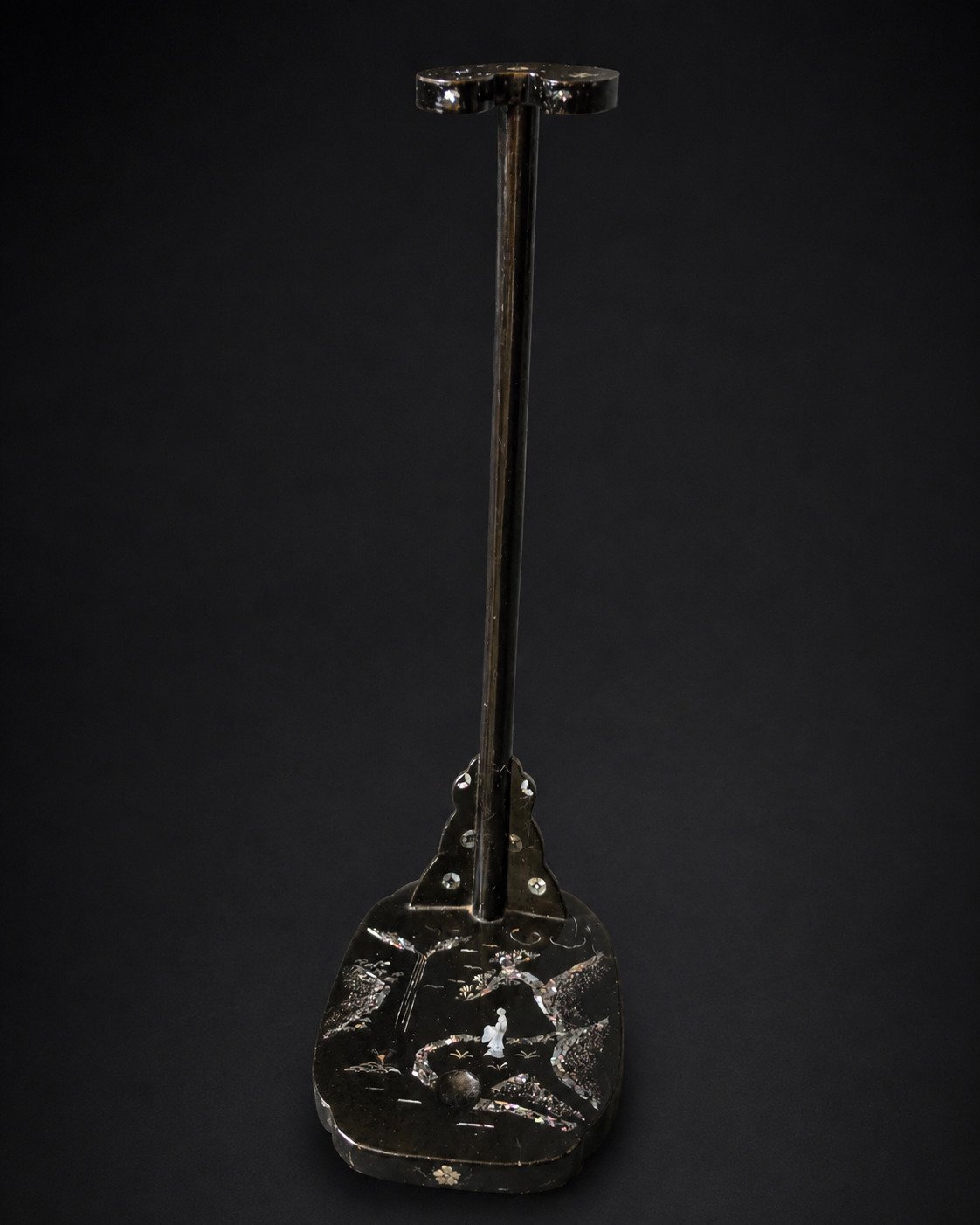
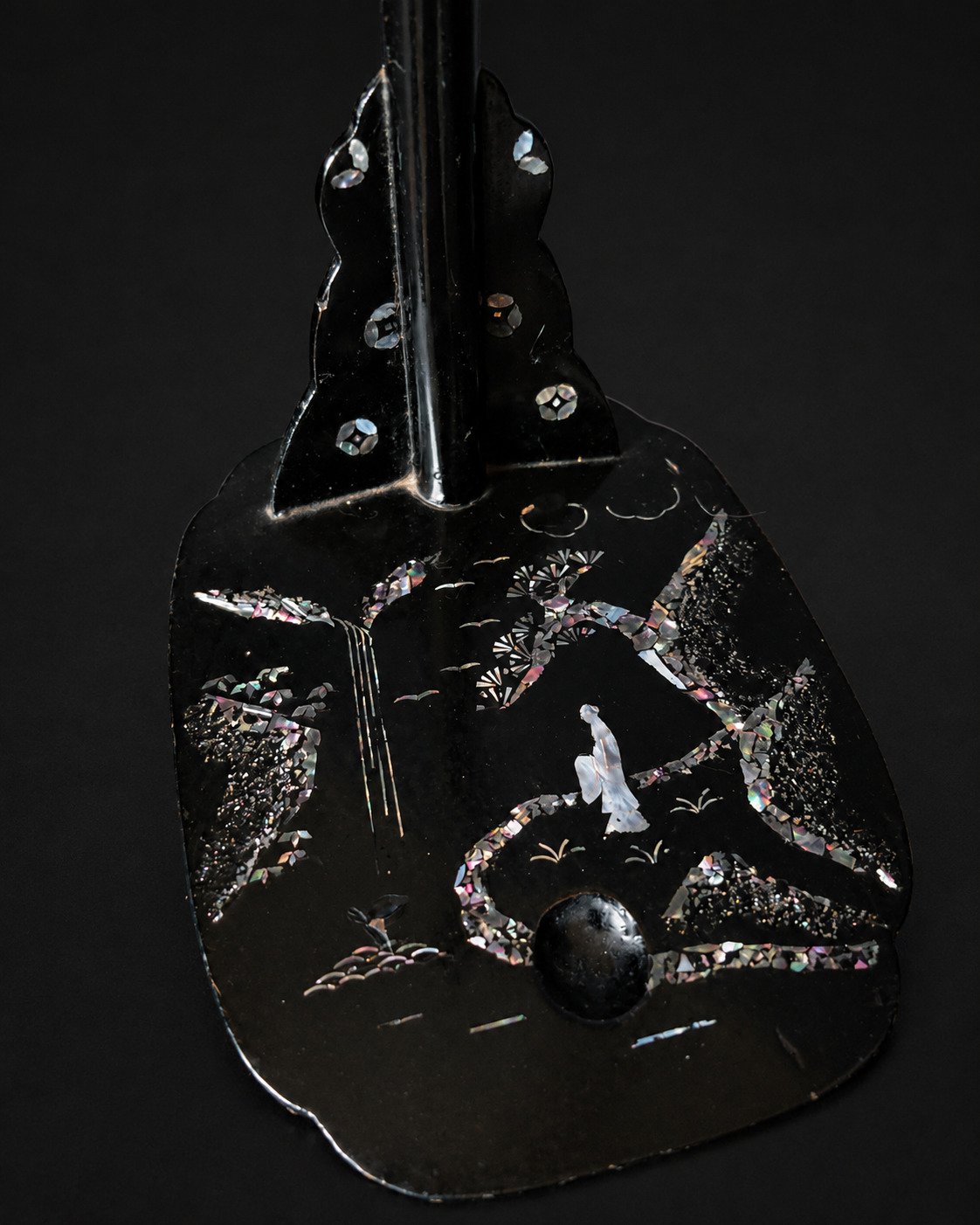
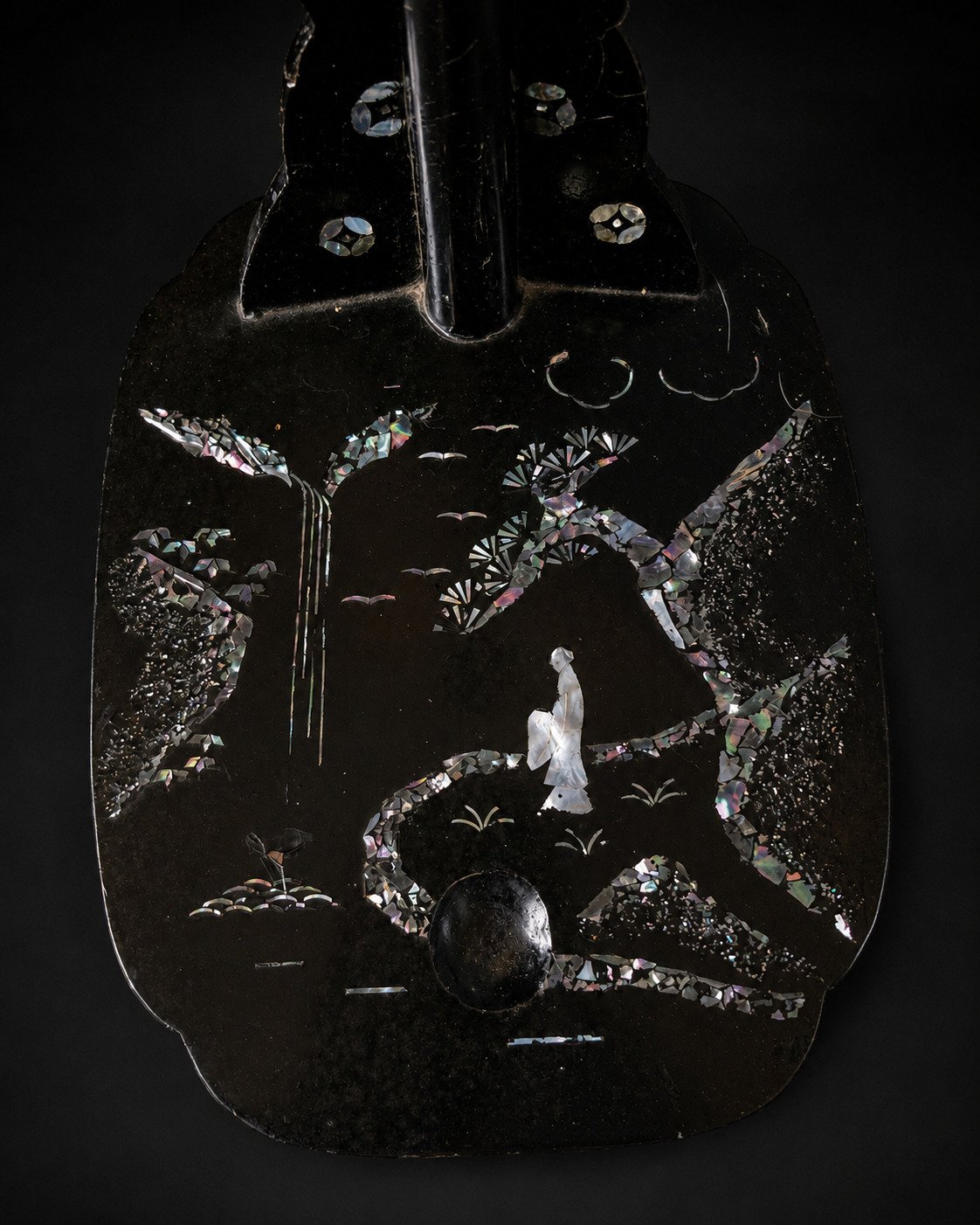
The principal decorative field is the base itself, where carefully shaped fragments of iridescent shell create an elaborate landscape populated by a robed traveller, a cascading waterfall, windswept pine trees, birds and a crane at the water’s edge. Fine gold details complement the shell inlay and enrich the atmospheric character of the scene.
The katana-kake follows a specialized vertical configuration designed for the presentation of a single Japanese sword.
A substantial rectangular platform provides the foundation for a tall, narrow neck that rises in a gentle curve before terminating in a forked upper cradle.
The elongated proportions create a particularly elegant silhouette, with the slender upright visually balancing the broader and much more extensively decorated base.
At approximately 64 cm high, the stand possesses considerable vertical presence while retaining a refined and restrained profile.
The structure is finished predominantly in deep black lacquer, providing a highly effective background for the iridescent shell decoration.
The polished surface creates strong visual contrast with the pale and multicoloured reflections of the mother-of-pearl, allowing even very small inlaid elements to remain clearly visible.
Depending on the angle of illumination, the shell shifts through silver, blue, green, violet and warmer tones, introducing colour into an otherwise restrained black lacquer composition.
The reflective character of the lacquer itself further enhances this effect, particularly across the broad upper surface of the base.
The principal decorative technique is aogai raden, using thin sections of iridescent shell cut into carefully controlled shapes and set into the lacquer surface.
Rather than restricting the shell to simple geometric borders or isolated accents, the decoration employs it pictorially to construct figures, birds, trees, rocks and elements of the surrounding landscape.
This approach requires individual shell fragments to function almost like brushstrokes, with their shapes and natural variations in colour contributing directly to the representation of the scene.
The result is a complex pictorial surface whose appearance changes noticeably as light moves across the iridescent material.
The broad base serves as the principal pictorial field and is decorated with an extensive Japanese landscape composition.
A winding path moves through an idealized natural setting of rocks, vegetation, water and trees, creating depth across the otherwise flat lacquer surface.
The composition is not arranged as a simple symmetrical ornament. Instead, its figures and natural elements are distributed across the platform to create the impression of a continuous landscape.
This asymmetrical treatment gives the decoration a distinctly painterly character and encourages close examination from different angles.
Among the most distinctive elements of the composition is a robed human figure represented within the landscape.
Finely shaped pieces of shell articulate the figure and garments, allowing the folds and movement of the clothing to remain legible despite the relatively small scale.
The figure appears integrated into the surrounding landscape rather than isolated as a heraldic or purely symbolic motif.
Its inclusion introduces a narrative dimension to the scene and transforms the base into a miniature genre landscape rather than a purely ornamental surface.
The composition incorporates a cascading waterfall and waterside elements, providing one of the principal structural features of the landscape.
Contrasting shell fragments and fine linear details suggest the movement of water through the rocky terrain.
The waterfall introduces a vertical counterpoint within the horizontal decorative field of the base and helps organize the surrounding trees, birds and figure into a coherent pictorial setting.
The use of reflective mother-of-pearl is particularly effective for representing water, as changing light naturally produces shifting highlights across the surface.
A crane standing near the water forms one of the most recognizable animal motifs within the composition.
The bird is constructed from finely shaped shell elements, allowing its body, neck and plumage to be distinguished against the black lacquer.
In Japanese visual culture, cranes have long been associated with longevity and auspicious meaning, while also appearing frequently in naturalistic landscape imagery.
Here, the crane functions both as an elegant decorative motif and as a natural component of the waterside scene.
The landscape is framed and animated by pine trees whose irregular branches and foliage extend across the black lacquer ground.
Numerous small shell fragments are used to suggest the structure and texture of the trees, while finer details articulate branches and vegetation.
Their windswept forms introduce movement into the composition and complement the flowing water and flying birds.
Pine imagery also carries longstanding associations with endurance and longevity within Japanese art, making it particularly appropriate within a refined decorative landscape.
Small birds in flight appear throughout the landscape and contribute to the sense of space and movement.
Their silhouettes are rendered with remarkably economical pieces of shell, demonstrating how relatively small fragments could be used to create recognizable pictorial forms.
Placed against the open black lacquer ground, the birds also function as visual links between the more densely decorated areas of the composition.
Their iridescent surfaces catch the light independently, causing individual elements of the landscape to emerge and recede as the viewing angle changes.
Fine gold-toned details complement the mother-of-pearl decoration throughout the base.
These delicate additions are used to suggest grasses, atmospheric elements and other fine features that would be difficult to express through shell alone.
The warmer metallic tone provides an effective contrast with the cooler iridescence of the aogai and prevents the composition from becoming visually monochromatic.
The interaction between black lacquer, reflective shell and restrained gold detailing is central to the sophistication of the decorative scheme.
At the foot of the upright is a separate shaped lacquer element associated with the support of the tsuka.
Its rounded lobed outline recalls the Japanese mokko-gata form and provides a softer sculptural transition between the vertical neck and the broad platform.
The saddle is decorated with delicate mother-of-pearl ornament, including a floral spray that further connects this functional component with the decorative vocabulary of the main stand.
Its position allows the sword hilt to be steadied against the platform while the upper fork supports the sword above.
The aogai decoration is not confined exclusively to the base.
Small circular, floral and geometric shell accents appear along the neck and around the structural junction between the upright and platform.
These restrained details create a visual connection between the elaborate pictorial base and the otherwise comparatively sober vertical support.
Their limited use also prevents the narrow neck from becoming overly decorative, preserving the elegant vertical emphasis of the design.
The upper end of the neck terminates in a forked horizontal support designed to receive and stabilize the sword.
The central opening creates a natural resting point while the projecting sides help maintain the position of the mounted sword.
Its compact form provides a functional counterpoint to the elaborate base below and completes the distinctive silhouette of the katana-kake.
Subtle shell decoration continues onto the upper element, maintaining visual continuity throughout the object.
One of the most notable aspects of the piece is the precision with which the shell has been cut and assembled.
The aogai fragments are not merely decorative inserts but are shaped to represent specific pictorial details, including garments, birds, pine foliage, rocks and elements of the landscape.
Producing such imagery requires considerably more control than repetitive geometric raden decoration, particularly when very small pieces must combine to create recognizable forms.
The result demonstrates the ability of lacquer craftsmen to use shell as a genuinely pictorial medium rather than simply as a reflective decorative material.
The visual character of the katana-kake changes substantially according to lighting and viewing angle.
Against the deep black lacquer, the aogai can appear relatively restrained under diffuse illumination but becomes dramatically iridescent when struck by direct light.
Individual fragments shift between pale silver and stronger blue, green, violet and pink reflections.
This changing appearance gives movement to the pictorial decoration and makes close physical viewing particularly rewarding.
The structure was conceived specifically for the presentation of a Japanese sword when not being worn.
The forked upper support provides one point of contact, while the shaped saddle near the base helps position and stabilize the tsuka.
This allows the sword and katana-kake to function together as a unified display rather than treating the stand as a purely utilitarian accessory.
The elaborate decoration of the platform demonstrates how objects associated with the storage and presentation of swords could themselves become significant works of decorative art.
The form, materials and extensive pictorial use of aogai raden are consistent with Japanese lacquer production of the late 19th century.
During this period, Japanese lacquer craftsmen continued established decorative traditions while producing increasingly elaborate objects that exploited the strong visual contrast between polished black lacquer, metallic decoration and iridescent shell.
The combination seen here — a functional sword stand transformed through detailed pictorial inlay — demonstrates the continued sophistication of lacquer craftsmanship during this period.
The quality and density of the decoration are consistent with an object intended for a well-appointed domestic interior rather than a purely utilitarian sword support.
The katana-kake survives in antique condition with age-related wear consistent with a late 19th-century Japanese lacquer object.
The principal pictorial decoration remains clearly visible and the mother-of-pearl continues to display strong iridescence under appropriate lighting.
Surface wear, small losses, irregularities and historical changes to the lacquer or inlay should be understood within the context of the age and use of an antique object of this type.
Please examine the accompanying high-resolution photographs carefully, as they form an essential part of the description and provide the most accurate record of the object’s present condition.
This katana-kake is particularly attractive for collectors interested in the intersection of Japanese lacquer art, raden craftsmanship and samurai sword culture.
Its tall sculptural profile already distinguishes it from conventional horizontal sword racks, while the extensive pictorial aogai decoration gives the object an additional artistic dimension.
The combination of human figure, waterfall, crane, birds, pine trees and landscape elements creates a miniature narrative composition that can be appreciated independently of the stand’s original practical function.
The fine shell cutting is especially noteworthy, demonstrating a degree of pictorial sophistication beyond simpler geometric or sparsely decorated examples.
Measuring 64 × 28 cm, the piece represents an elegant example of how the practical presentation of the Japanese sword could be combined with sophisticated lacquer craftsmanship and highly detailed pictorial decoration.
An elegant late 19th-century Japanese katana-kake distinguished by its polished black lacquer surface and exceptionally pictorial aogai raden decoration. The broad base is transformed into a miniature landscape through finely cut iridescent mother-of-pearl depicting a robed traveller, cascading waterfall, windswept pine trees, flying birds and a crane at the water’s edge, complemented by delicate gold-toned details. A slender curved neck rises to a forked sword cradle, while a separate mokko-gata-style saddle at its base helps support the tsuka and carries additional mother-of-pearl decoration. Measuring 64 × 28 cm, this refined single-sword stand combines the practical architecture of Japanese sword display with the sophisticated pictorial possibilities of late 19th-century lacquer and aogai raden craftsmanship.

Order above 1.000,00 € gets free shipping.

Secure and hassle-free payment process.

Certificate of authenticity included.

Have questions? Contact us via WhatsApp.
Contact