FREE EXPRESS INTERNATIONAL DELIVERY
1 in stock
1 in stock
Add to Compare
Add to Wishlist
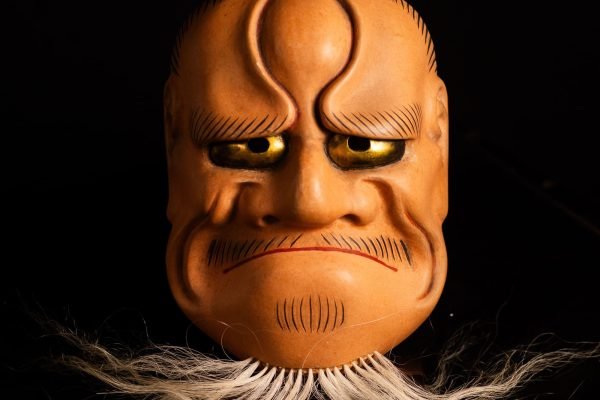
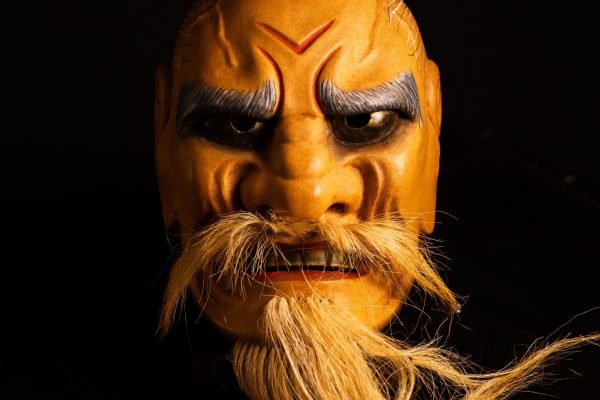
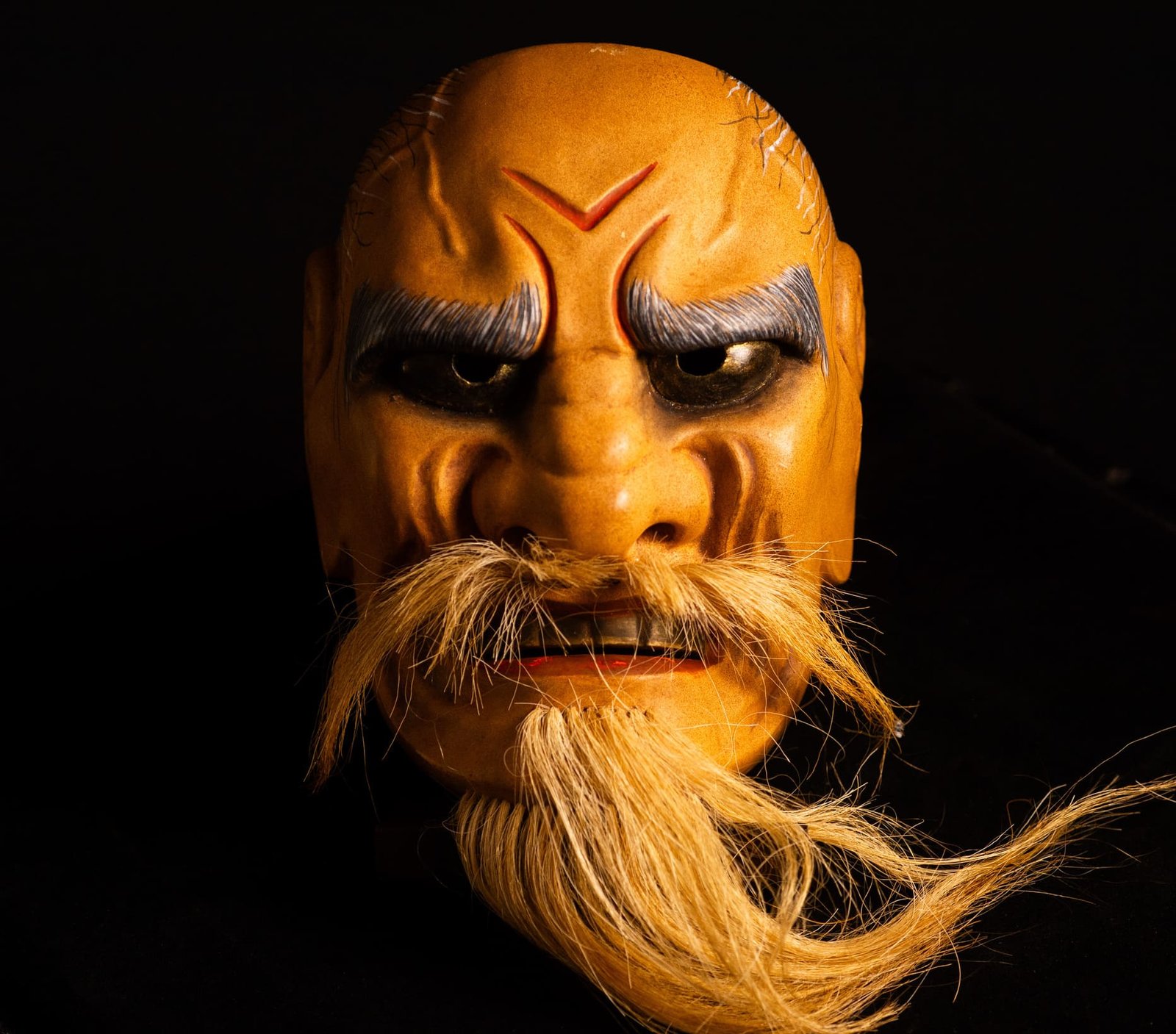
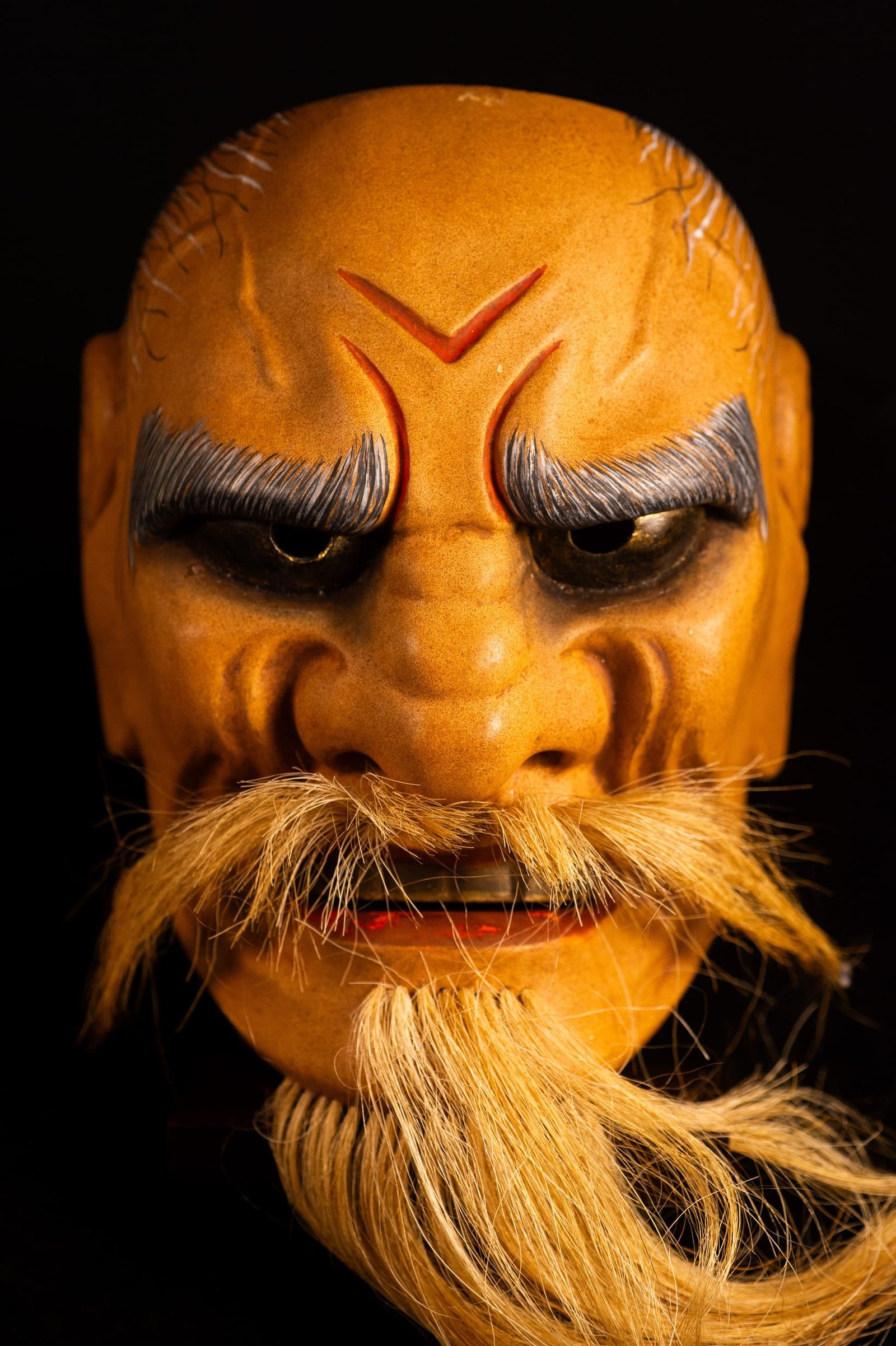
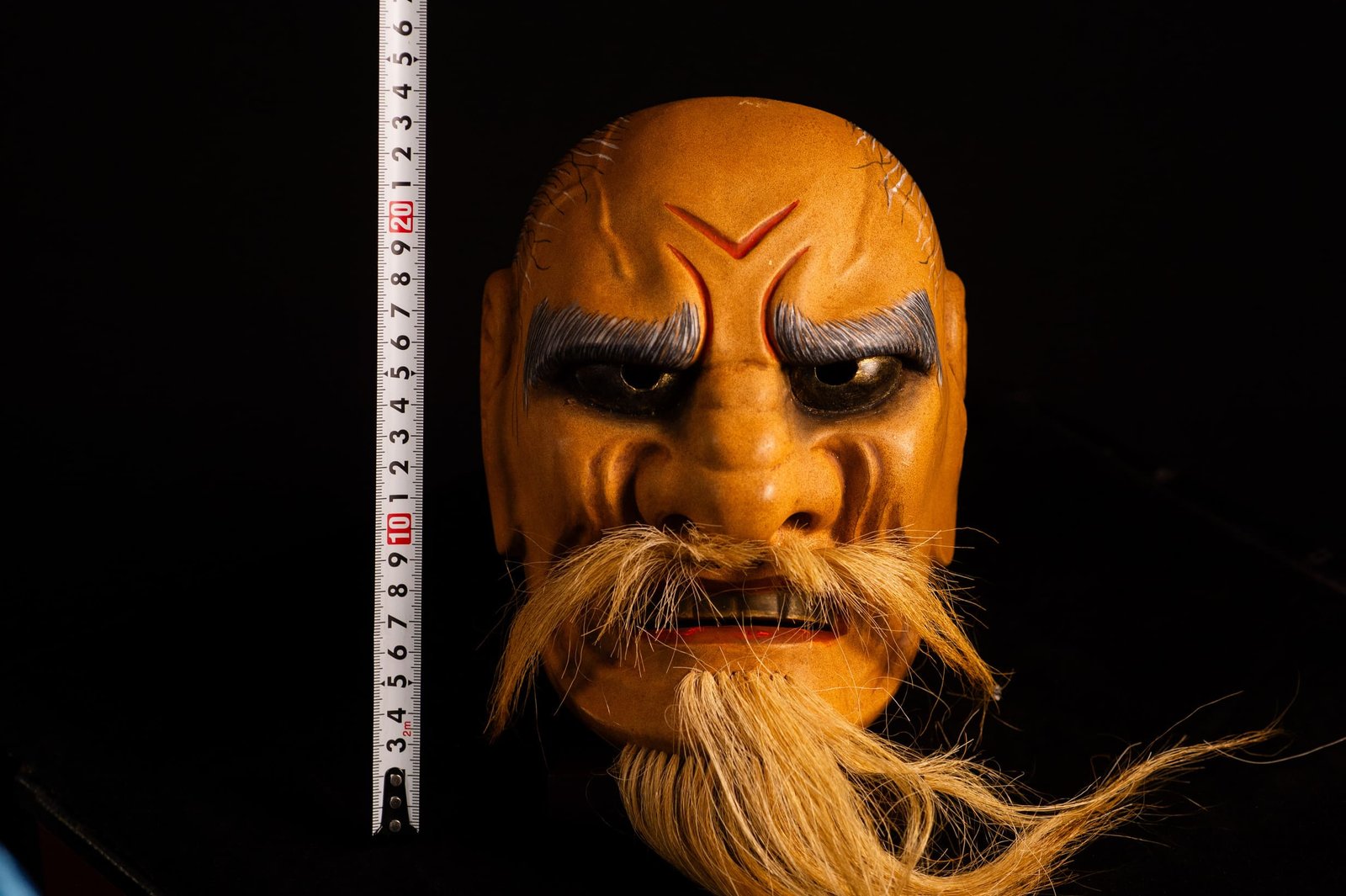
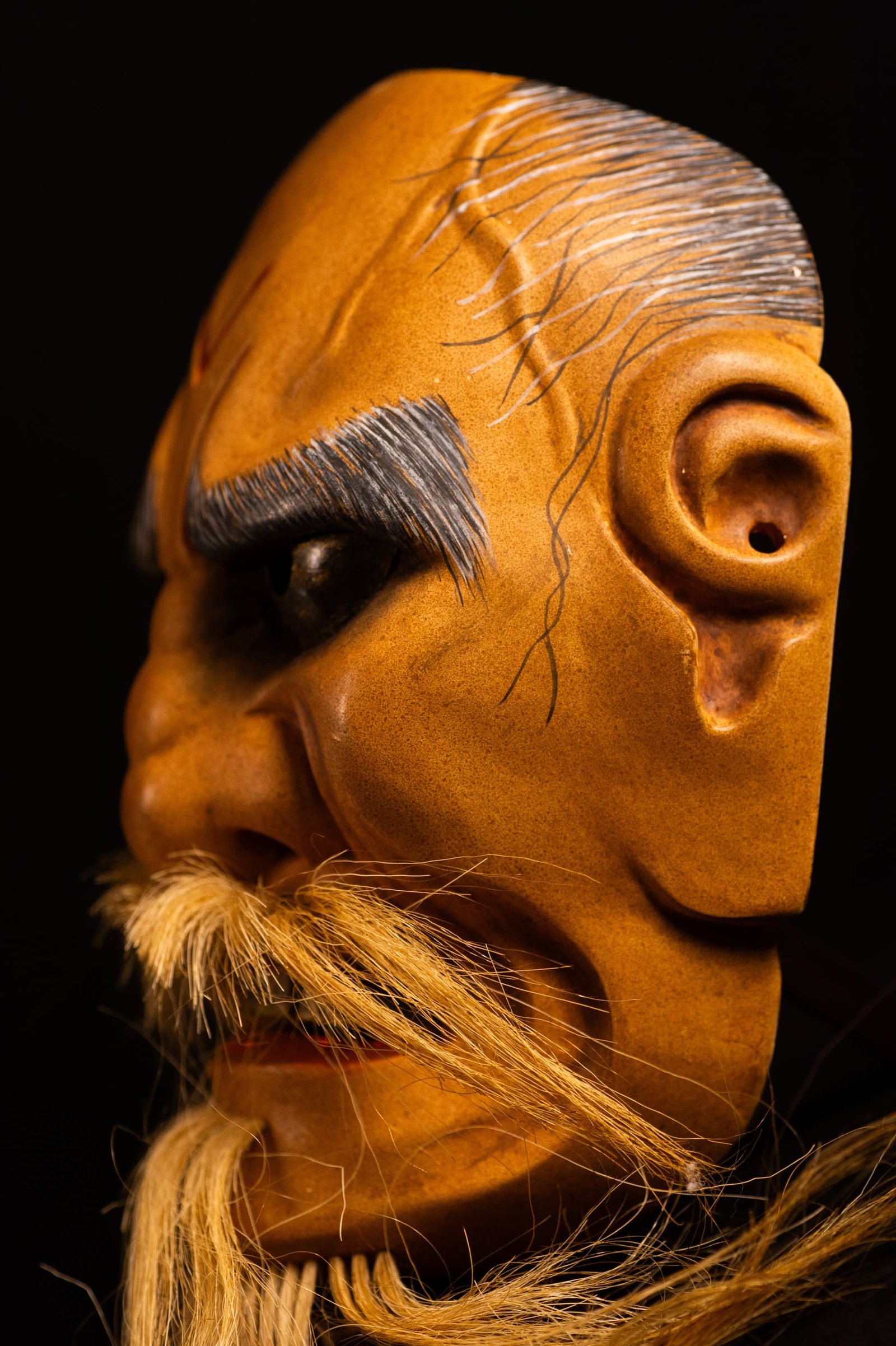
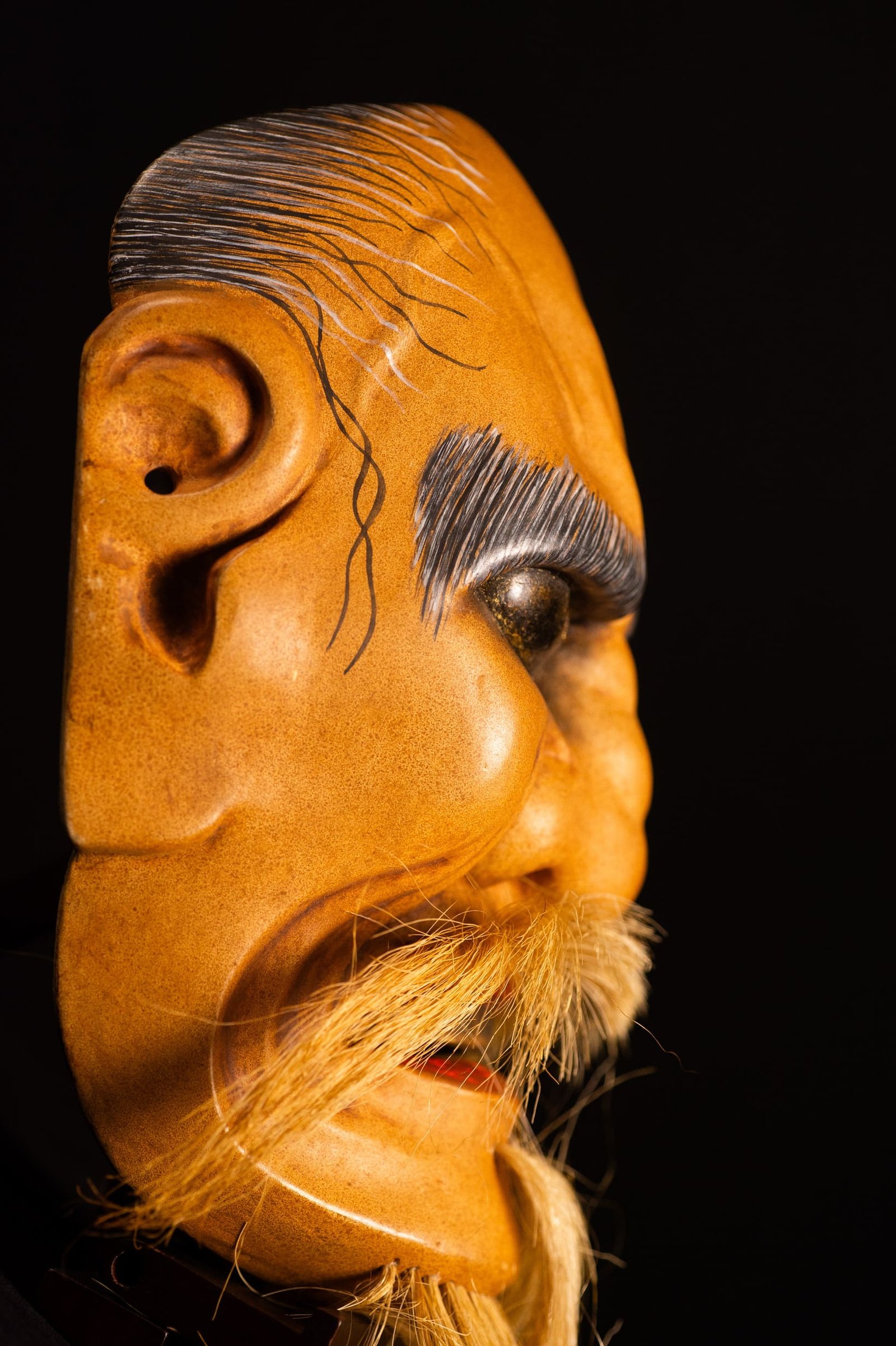
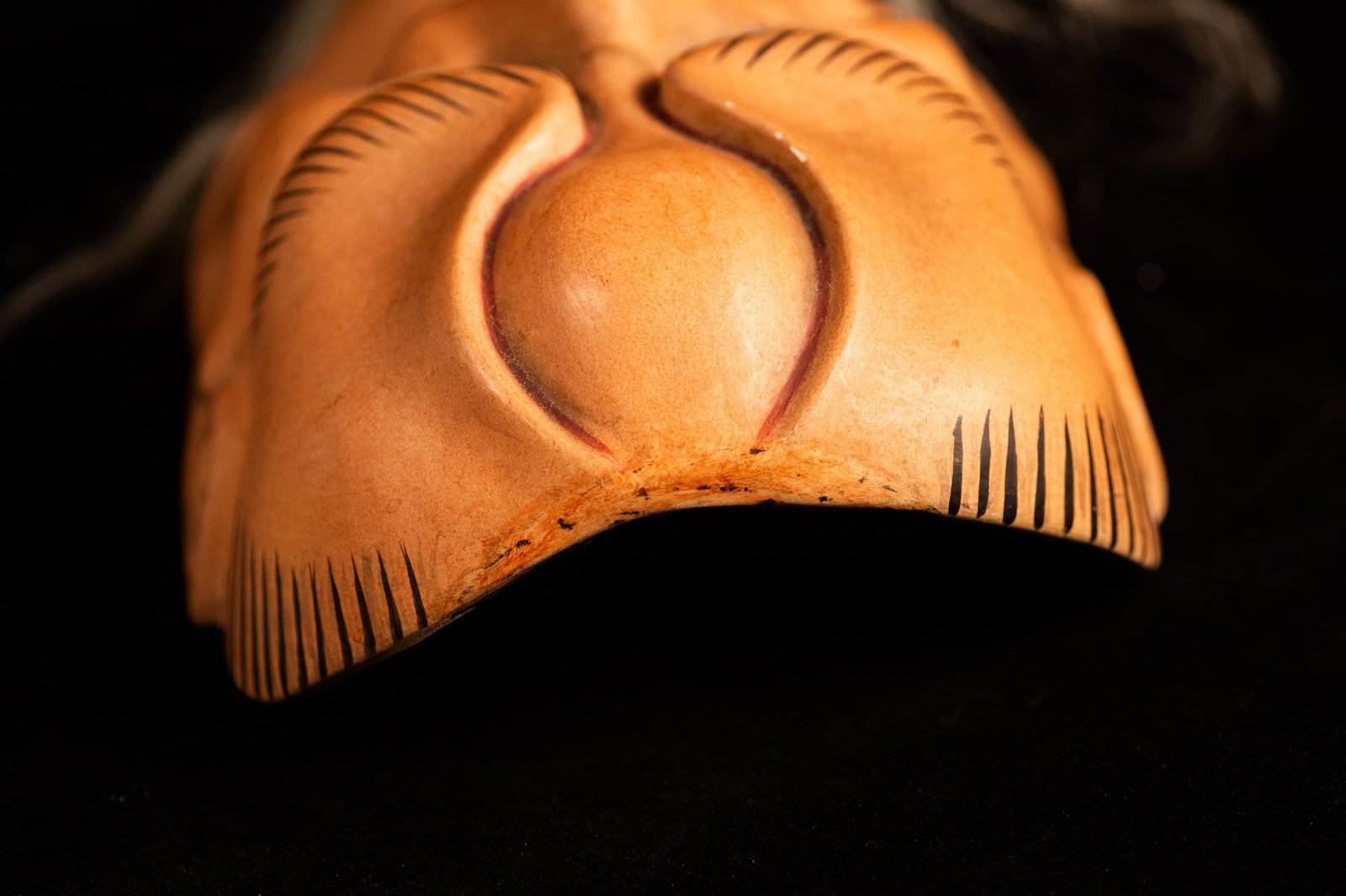
An imposing antique Japanese wooden mask representing a Sennin, the legendary mountain hermit or immortal ascetic whose imagery derives from Daoist traditions and was later absorbed into Japanese religious, artistic and theatrical culture. Carved at approximately life size, the mask combines the weathered authority of an elderly human face with unmistakably supernatural details.
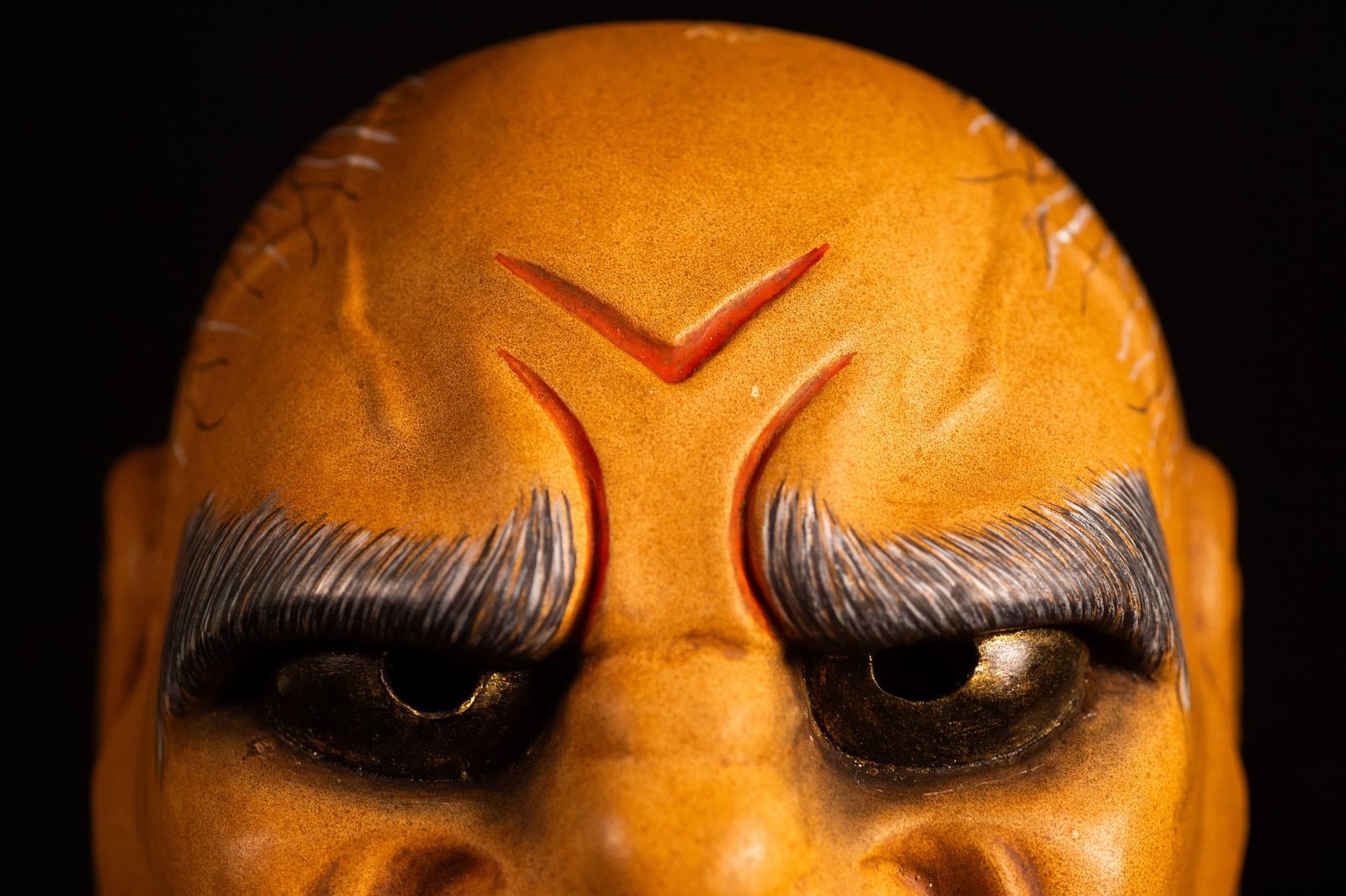
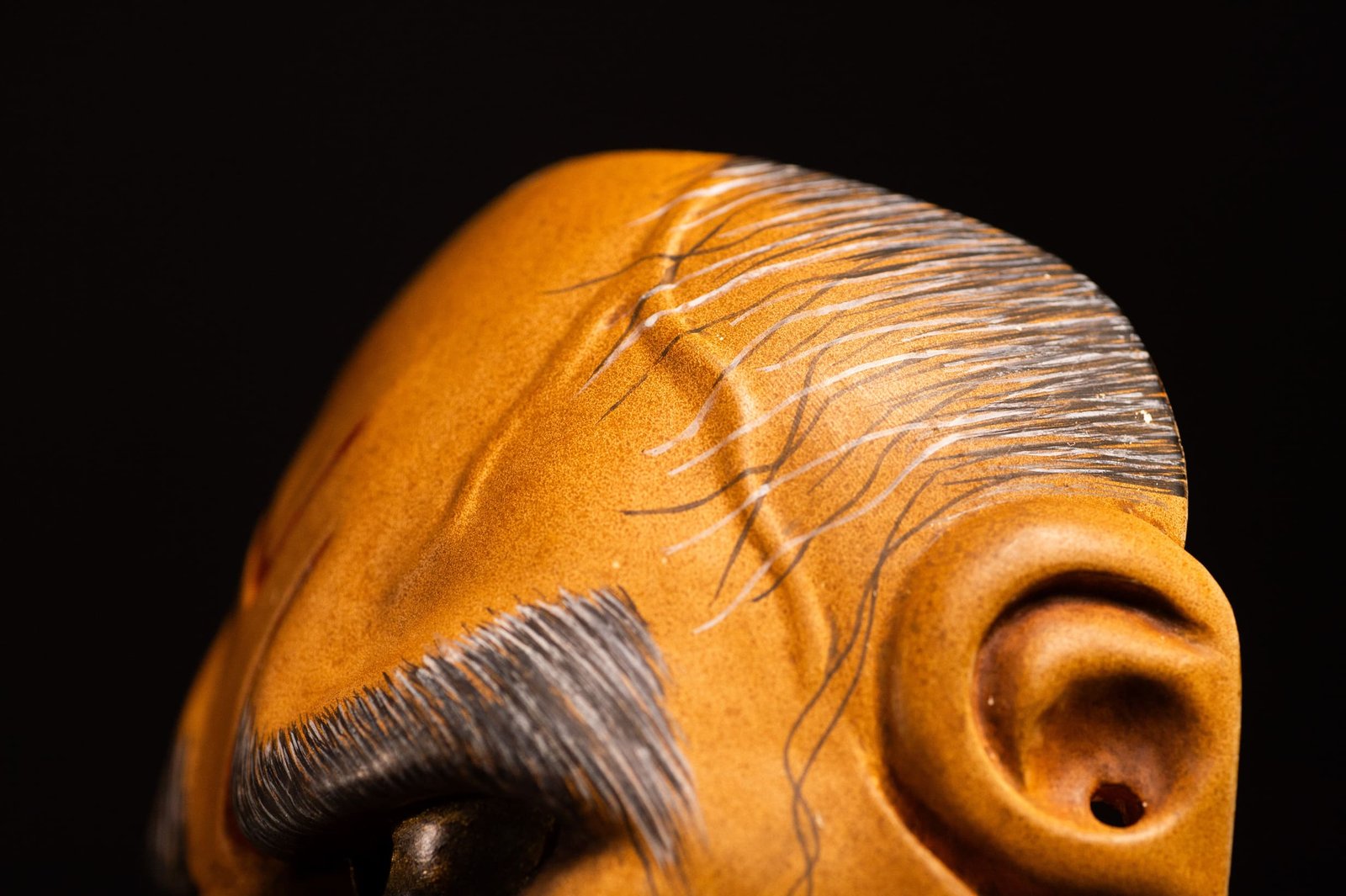
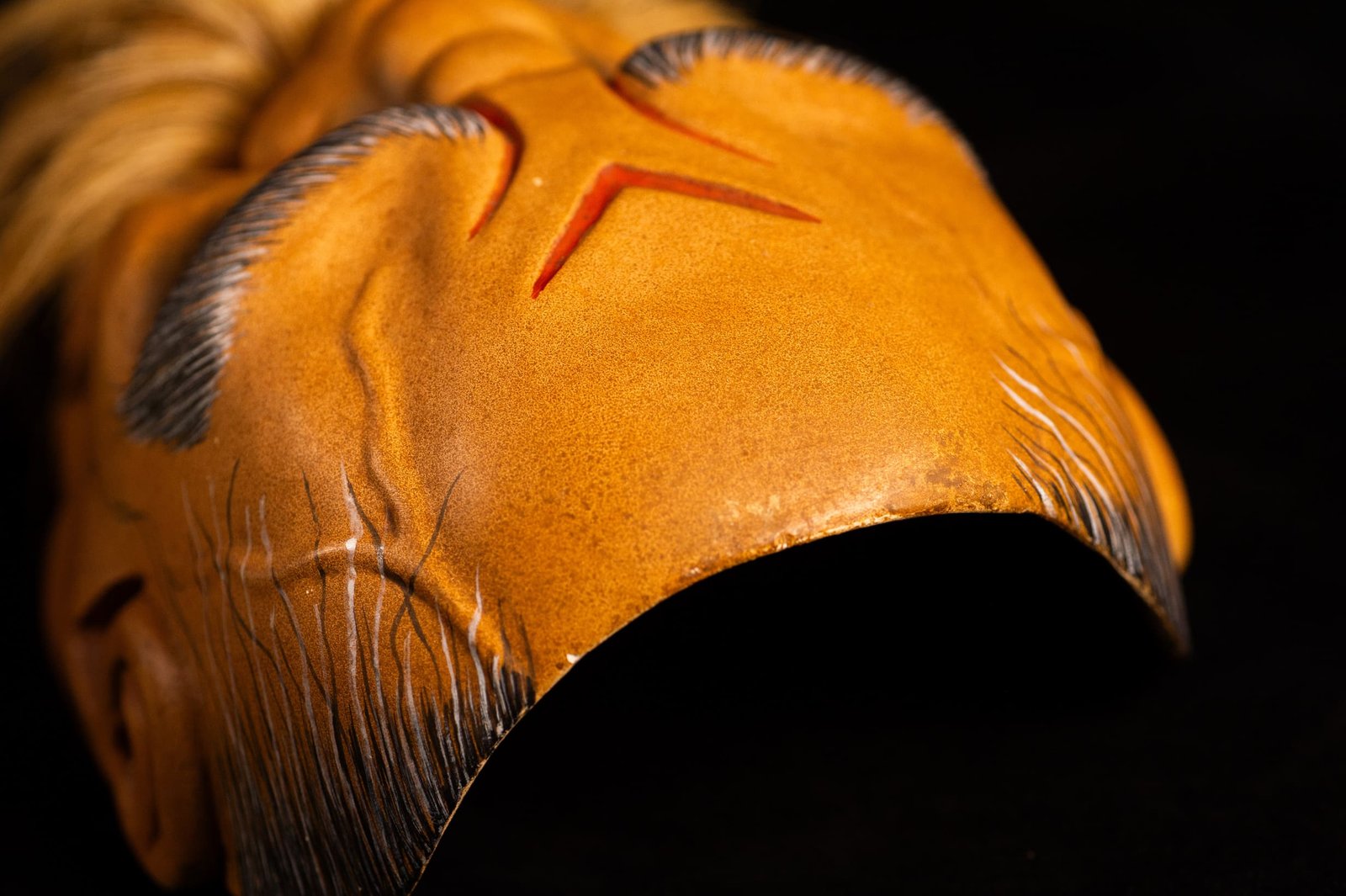
The shaved crown is marked at the centre of the forehead by a distinctive red winged emblem, signalling that the represented figure belongs to a world beyond ordinary humanity.
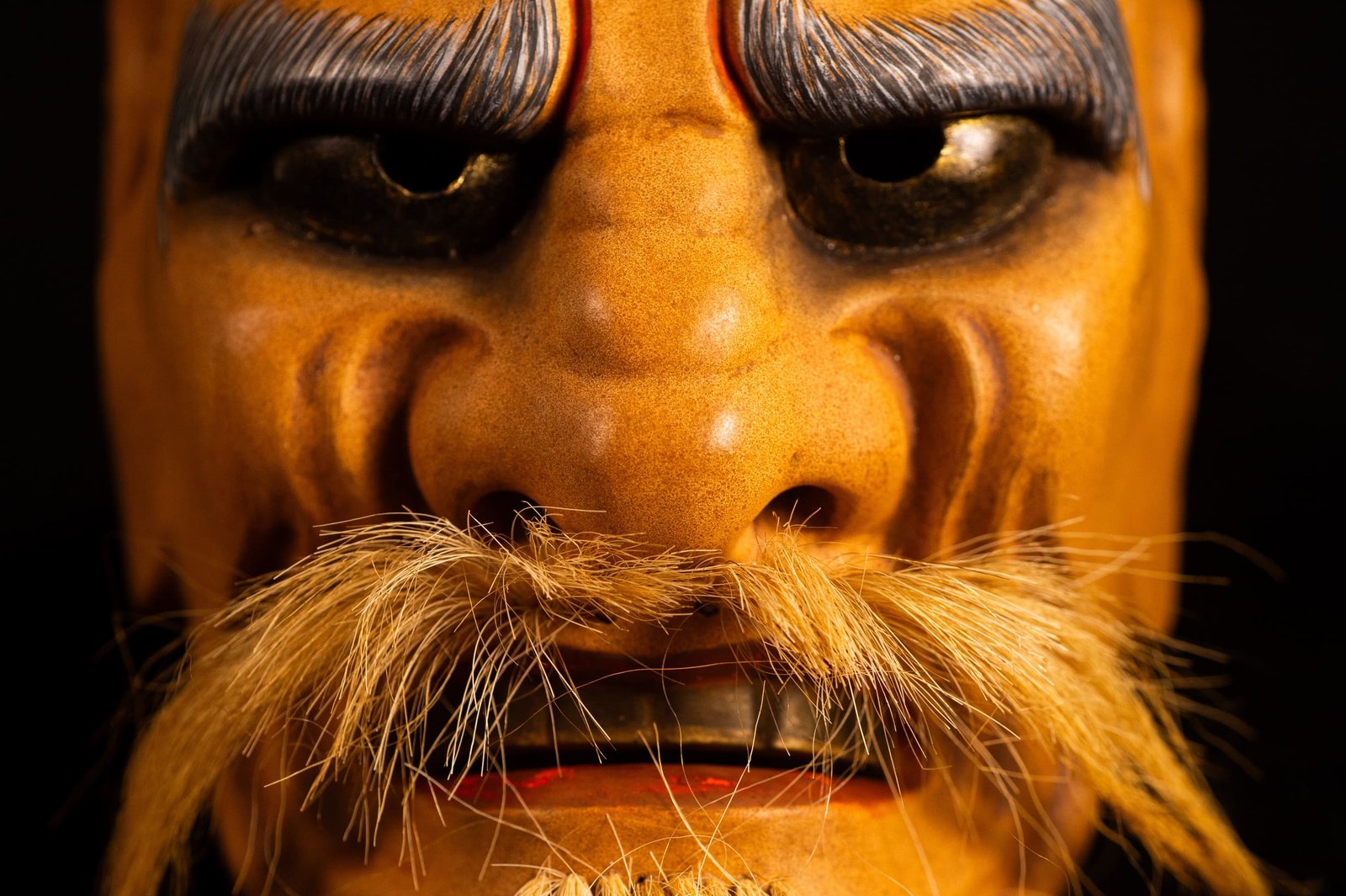
Heavy grey painted eyebrows frame the inserted gilt-metal eyes, while an exceptionally long moustache and beard of natural fibre descend well below the chin.
The elongated facial hair gives the mask a dramatic vertical presence and reinforces the impression of immense age, spiritual discipline and existence beyond the normal human lifespan.
Rather than portraying a conventional elderly man, the mask presents an immortal or spiritually transformed being whose physical austerity is inseparable from wisdom and supernatural power.
A Sennin is traditionally understood as a mountain hermit, immortal ascetic or transcendent being associated with legends of Daoist origin.
Such figures are often imagined as having withdrawn from ordinary society to inhabit remote mountains, caves or wild landscapes.
Through meditation, spiritual discipline, knowledge of nature or supernatural practice, the Sennin is believed to have exceeded the normal limitations of human life.
In visual culture, Sennin may appear aged, eccentric or physically austere.
Their extreme age does not necessarily imply weakness.
Instead, long eyebrows, pronounced facial structures and flowing beards may communicate wisdom, endurance, spiritual authority and freedom from ordinary time.
The present mask reflects this imagery through its shaved crown, metallic eyes, supernatural forehead marking and exceptionally long natural-fibre beard.
The concept of the immortal mountain ascetic developed from traditions associated with Daoist thought and legend.
Accounts of immortals frequently describe figures who retreat from the human world, cultivate spiritual or physical disciplines and acquire extraordinary longevity or supernatural abilities.
When introduced into Japanese culture, these figures became part of a wider visual and narrative vocabulary that included painting, sculpture, literature, religious imagery and theatre.
The Japanese Sennin should not be understood merely as an elderly hermit.
The figure occupies a boundary between humanity and the supernatural.
He may retain a recognisable human form while displaying attributes that identify him as spiritually transformed or immortal.
The present mask expresses this dual identity.
Its aged face and natural-fibre beard remain recognisably human, while the metallic eyes and red forehead symbol separate the character from ordinary mortal existence.
The mask’s expression communicates age, intensity and spiritual distance.
The face is not constructed around an open grimace, smile or overt display of emotion.
Its power comes instead from the relationship between the concentrated eyes, pronounced brows, elongated facial structure and flowing beard.
The Sennin appears to observe the world from a position beyond ordinary human concerns.
The long facial hair suggests the passage of extraordinary time, while the supernatural mark on the forehead indicates a transformed spiritual condition.
This combination creates an expression that may appear wise, severe, mysterious or otherworldly depending on the angle of presentation and the direction of the light.
The mask is carved from wood as a complete three-dimensional theatrical form.
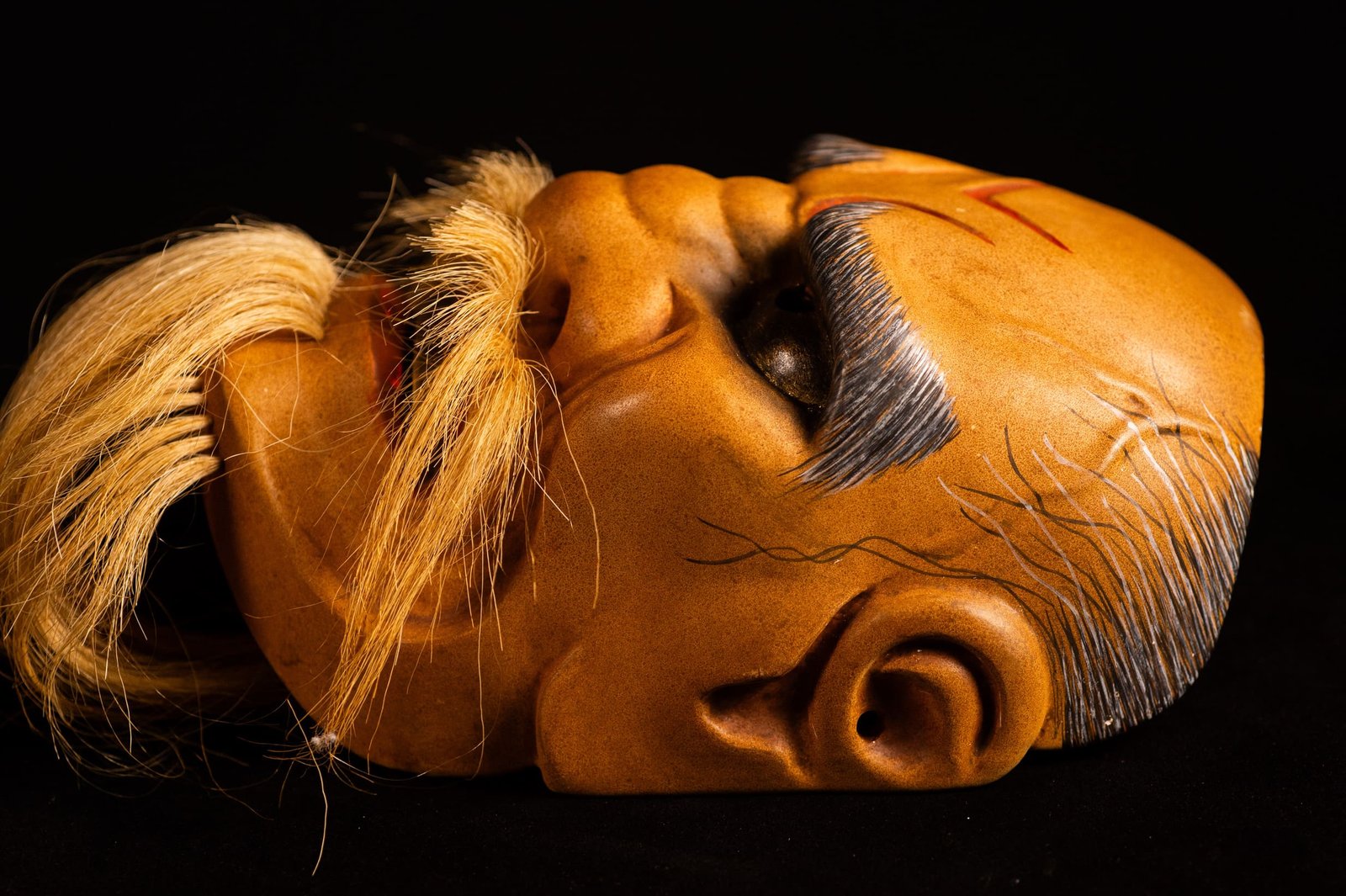
The facial structure is designed to remain expressive when viewed from the front, from a three-quarter angle and in profile.
The forehead, eyes, nose, cheeks, mouth and chin are carefully integrated into a coherent sculptural composition.
Although the natural-fibre moustache and beard extend beyond the carved face, they function as part of the overall design rather than as secondary decoration.
The wooden structure establishes the fixed expression, while the attached fibres introduce movement and texture.
During performance, even slight movements of the actor could cause the long beard and moustache to shift.
This would have animated the otherwise immobile face and strengthened the impression of a living supernatural presence.
The figure is represented with a shaved crown.
This feature emphasizes the ascetic identity of the Sennin and separates the upper head from the long facial hair below.
The absence of conventional hair directs attention toward the forehead, eyes and supernatural marking.
It also creates a clear contrast between the restrained upper portion of the head and the exceptionally abundant moustache and beard.
The shaved crown may suggest withdrawal from ordinary worldly life, spiritual discipline or the unusual physical appearance of an immortal hermit.
Within the theatrical image, it contributes to the figure’s austerity and immediately distinguishes him from courtly, warrior or ordinary elderly male characters.
At the centre of the forehead is a red painted mark with a winged form.
According to the supplied identification, this emblem signals the supernatural status of the figure.
Its central position makes it one of the mask’s most symbolically important details.
The mark interrupts the otherwise restrained surface of the shaved forehead and introduces a vivid chromatic accent above the eyes.
Its wing-like form may visually suggest spiritual elevation, transformation or an identity that transcends ordinary human existence.
However, no specific name, ritual interpretation or individual deity has been supplied for the symbol.
It should therefore be described as a supernatural status mark rather than attributed to a particular religious figure or esoteric system without further documentation.
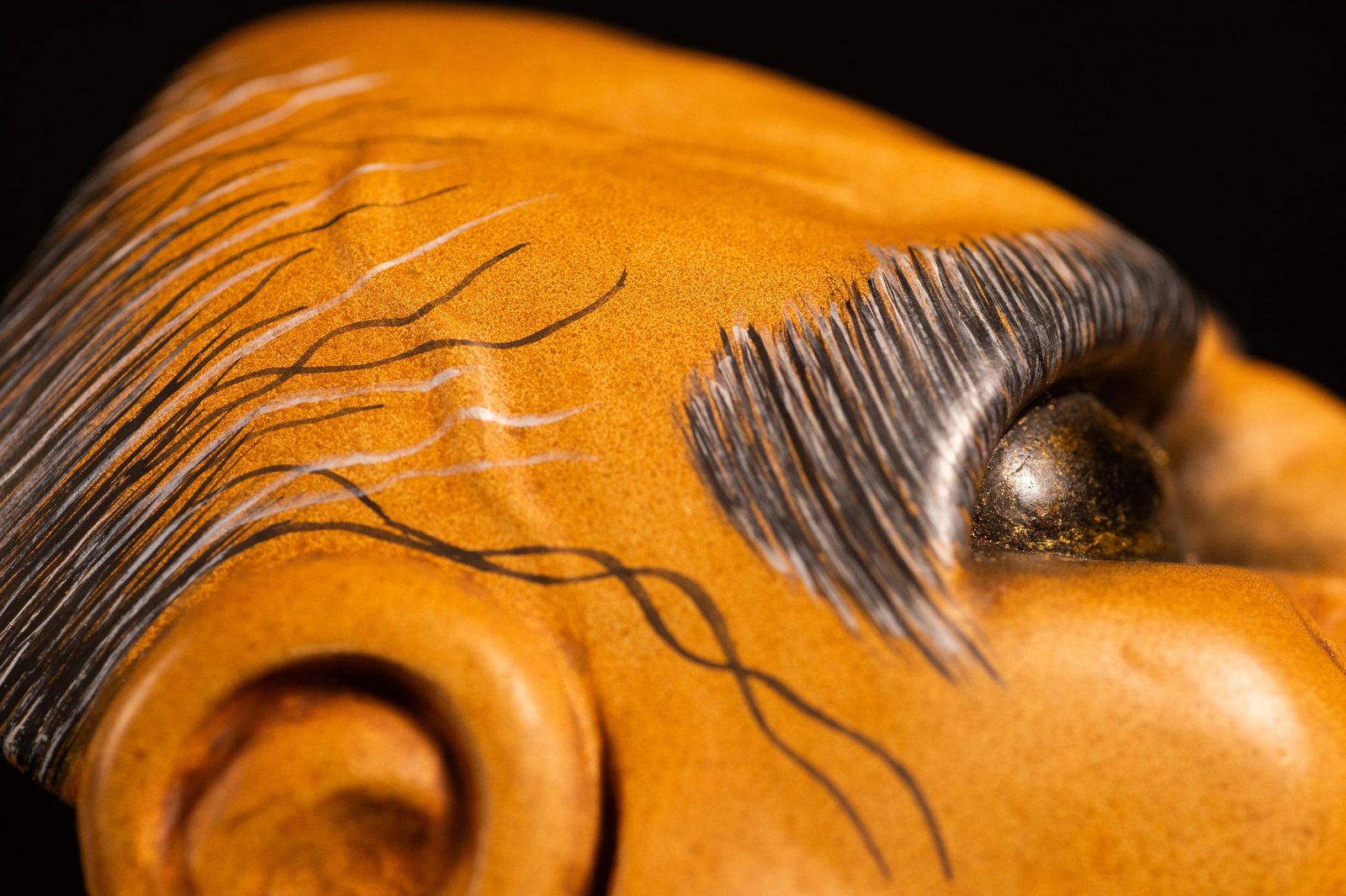
Heavy grey eyebrows are painted prominently above the eyes.
Their thickness emphasizes the great age of the character and reinforces the intensity of the gaze.
The grey colouring corresponds visually with the white-grey natural fibres of the moustache and beard, creating continuity between the upper and lower parts of the face.
The brows also provide a strong graphic frame for the gilt-metal eyes.
Their broad form gives the upper face weight and authority, while their curved placement directs attention inward toward the centre of the expression.
Under directional lighting, the contrast between the painted eyebrows, metallic eyes and carved forehead would have made the gaze clearly legible from the audience.
The mask is fitted with gilt-metal eyes.
These reflective elements distinguish the gaze from that of an ordinary human figure and contribute directly to the mask’s supernatural character.
Unlike eyes rendered entirely through carved and painted wood, metallic eyes react strongly to changing light.
As the actor moved, the gilt surfaces could catch and reflect illumination, creating momentary flashes of brightness.
This effect would have made the gaze appear animated even though the facial expression itself remained fixed.
The metallic finish also introduces a visual contrast with the aged wooden face, grey eyebrows and pale natural fibres.
The eyes appear as concentrated points of spiritual awareness within the otherwise restrained expression.
Their brilliance reinforces the interpretation of the figure as an immortal or transcendent being.
The gaze is one of the most important expressive elements of the mask.
The gilt-metal eyes produce an intense and distant presence that may be read as wisdom, spiritual concentration or supernatural perception.
Unlike comic masks with exaggerated eye direction or fierce masks with openly aggressive expressions, the Sennin’s gaze is more controlled.
Its force derives from stillness.
The mask suggests a being who has observed the human world over an extraordinary span of time and whose awareness extends beyond ordinary experience.
Small changes in the angle of the mask would nevertheless transform the perceived emotion.
Raised slightly, the face could appear enlightened, elevated or visionary.
Lowered into shadow, the same expression could appear more severe, mysterious or spectral.
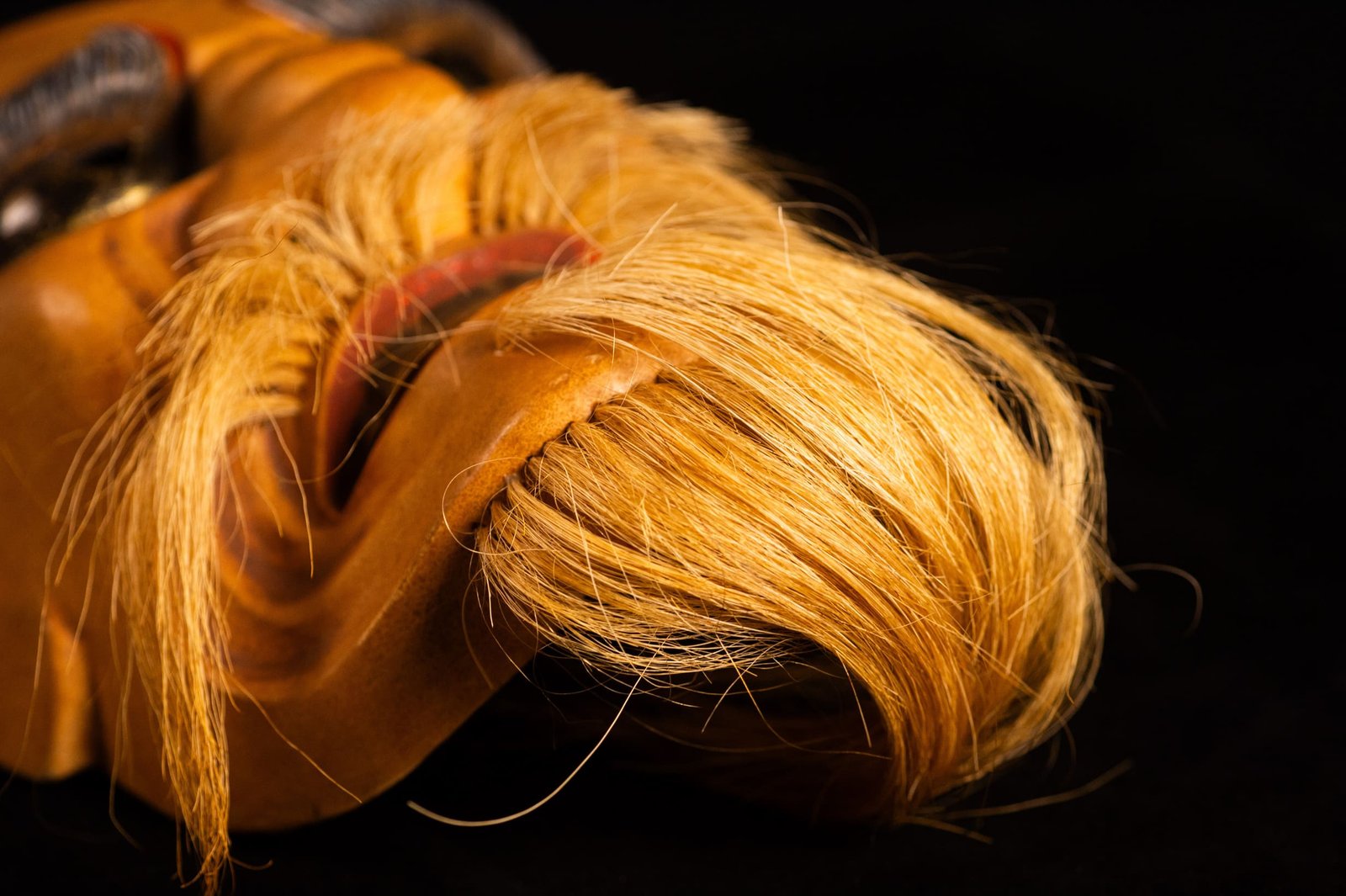
An exceptionally long moustache of natural fibre extends from above the mouth.
The fibres flow outward and downward, merging visually with the beard below.
The moustache is not merely an indicator of age.
Its extreme length contributes to the supernatural identity of the character and suggests a lifespan extending far beyond normal human limits.
Because it is made from natural fibre rather than painted onto the surface, the moustache introduces real movement into the mask.
During performance, the fibres could respond to the actor’s gestures, breathing and changes in direction.
This movement would have softened the fixed carved expression and produced the impression of a living, breathing ascetic.
The pale colouring also creates a strong contrast with the darker facial details and gilt-metal eyes.
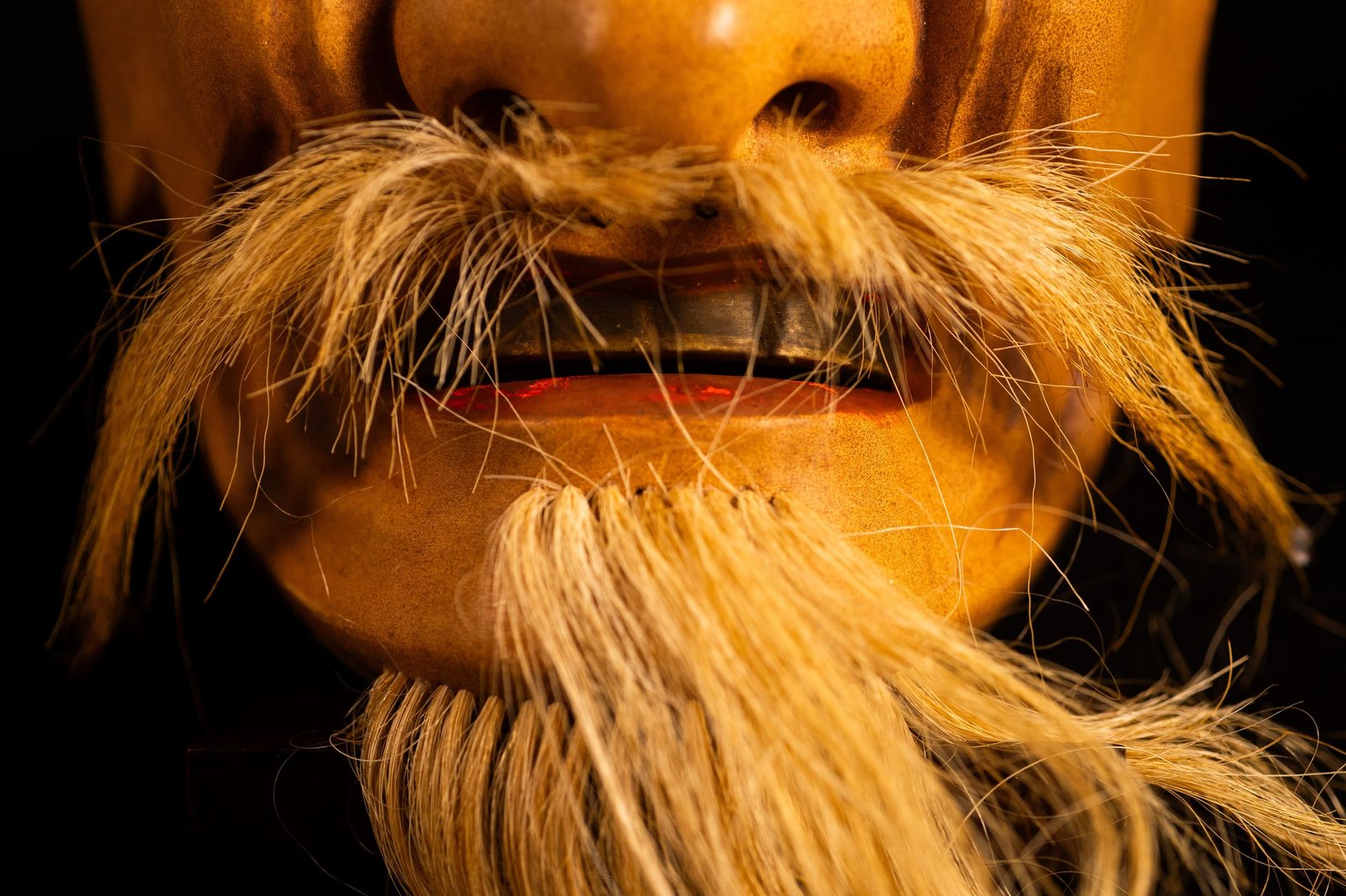
The beard is among the mask’s most visually commanding features.
Formed from white-grey natural fibre, it flows well below the chin and extends the figure far beyond the boundaries of the carved wooden face.
Its extraordinary length communicates extreme age, spiritual endurance and immortal existence.
The beard gives the mask a strong vertical composition.
The viewer’s attention moves from the red forehead mark and metallic eyes, down through the nose and mouth, and finally into the long cascading fibres.
This vertical progression reinforces the dignity and contemplative presence of the figure.
The irregular texture of the natural fibres adds visual richness and prevents the beard from appearing rigid or ornamental.
As an organic material, it may also display age-related variation, tangling, thinning or irregularity consistent with the antique character of the object.
The use of natural fibre is essential to the theatrical function of the mask.
The carved wooden face remains fixed, but the beard and moustache can respond to movement.
When the performer turns, bows or raises the head, the fibres may shift independently from the rigid wooden structure.
This introduces a temporal element into the expression.
The face appears ancient and unmoving, while the beard remains responsive and alive.
The contrast is particularly appropriate for the representation of an immortal ascetic.
The figure appears rooted in extreme age yet still animated by spiritual energy.
When displayed outside performance, the fibres continue to provide texture and a sense of movement, especially under soft directional light.
The visual identity of the mask depends on the tension between human age and supernatural transformation.
The face possesses recognizable signs of an elderly man: grey eyebrows, a long moustache and an abundant beard.
Yet these features are intensified beyond naturalistic proportions.
The beard is exceptionally long, the eyes are metallic and the forehead carries a supernatural emblem.
The result is not simply an old hermit, but an ascetic who has crossed the boundary between mortality and immortality.
His appearance conveys withdrawal from ordinary society, prolonged spiritual practice and the accumulation of knowledge over an extraordinary existence.
The mask therefore presents age as a form of power rather than decline.
The supplied identification describes the mask as representing a Sennin.
No particular Noh play, named immortal, historical character or individual performance has been specified.
The mask should therefore be presented as a Sennin character type rather than attributed to a specific role without additional documentation.
Within a theatrical context, the mask could communicate the presence of a mountain hermit, immortal ascetic or supernatural elder.
The long beard, metallic eyes and forehead mark allow the audience to recognize immediately that the figure exists outside ordinary human society.
The precise dramatic meaning would have depended on the costume, movement, chant, narrative and relationship with the other performers.
Masks have occupied an essential role in Japanese theatre, religious ritual and festival culture for centuries.
Within Noh, the mask does more than conceal the performer’s individual face.
It allows the actor to embody a different identity, whether human, historical, spiritual, divine or supernatural.
The actor’s own appearance recedes and the represented figure becomes dominant.
This transformation is achieved through the interaction of mask, costume, movement, music, chant and lighting.
Because the expression is fixed, the performer uses subtle changes of posture and head angle to create emotional variation.
A slight upward tilt may illuminate the metallic eyes and make the figure appear elevated or visionary.
A downward tilt may deepen the shadows beneath the brows and make the face appear more severe, distant or mysterious.
The Sennin mask’s reflective eyes, pronounced brows and long moving beard are particularly suited to this theatrical process.
Japanese masking traditions developed through a long interaction between performance, ritual, local festivals and indigenous religious beliefs.
Spiritual and divine presences in Japan are frequently referred to as kami.
In certain ritual and theatrical contexts, wearing a mask could symbolize transformation, embodiment or possession.
The performer temporarily ceased to appear as an ordinary individual and became the visible manifestation of the represented being.
This broader cultural context helps explain the powerful transformative role of Japanese masks.
However, the Sennin belongs specifically to a legendary tradition of the immortal mountain ascetic derived from Daoist sources.
The supplied information does not identify this particular mask as the representation of a named kami or individual deity.
It should therefore be described as a supernatural Sennin figure rather than assigned to a specific divine identity without documentary evidence.
The Sennin figure reflects the historical exchange of religious concepts, legends and visual traditions across East Asia.
Ideas associated with immortal hermits and transcendent ascetics entered Japanese culture and developed distinctive local forms.
Within Japanese art, such figures could represent spiritual discipline, detachment from worldly concerns, extraordinary longevity and knowledge of hidden natural or supernatural forces.
The theatrical mask condenses these ideas into a single face.
The shaved head evokes asceticism.
The red forehead emblem signals supernatural identity.
The gilt-metal eyes suggest heightened spiritual awareness.
The long white-grey beard communicates immense age and existence beyond ordinary human time.
Together, these features create a powerful image of an immortal who remains recognisably human while belonging to a different spiritual order.
The mask is carved at a 1:1 or life-size scale, corresponding to the proportions of a functional theatrical mask.
Its long natural-fibre beard significantly extends its visual dimensions below the carved face.
For display, sufficient vertical space should be allowed so that the fibres can fall naturally without being compressed or folded.
A frontal presentation emphasizes the symmetry of the eyebrows, metallic eyes and central forehead mark.
A slightly angled presentation reveals the depth of the carved face while preserving the full visual effect of the flowing beard.
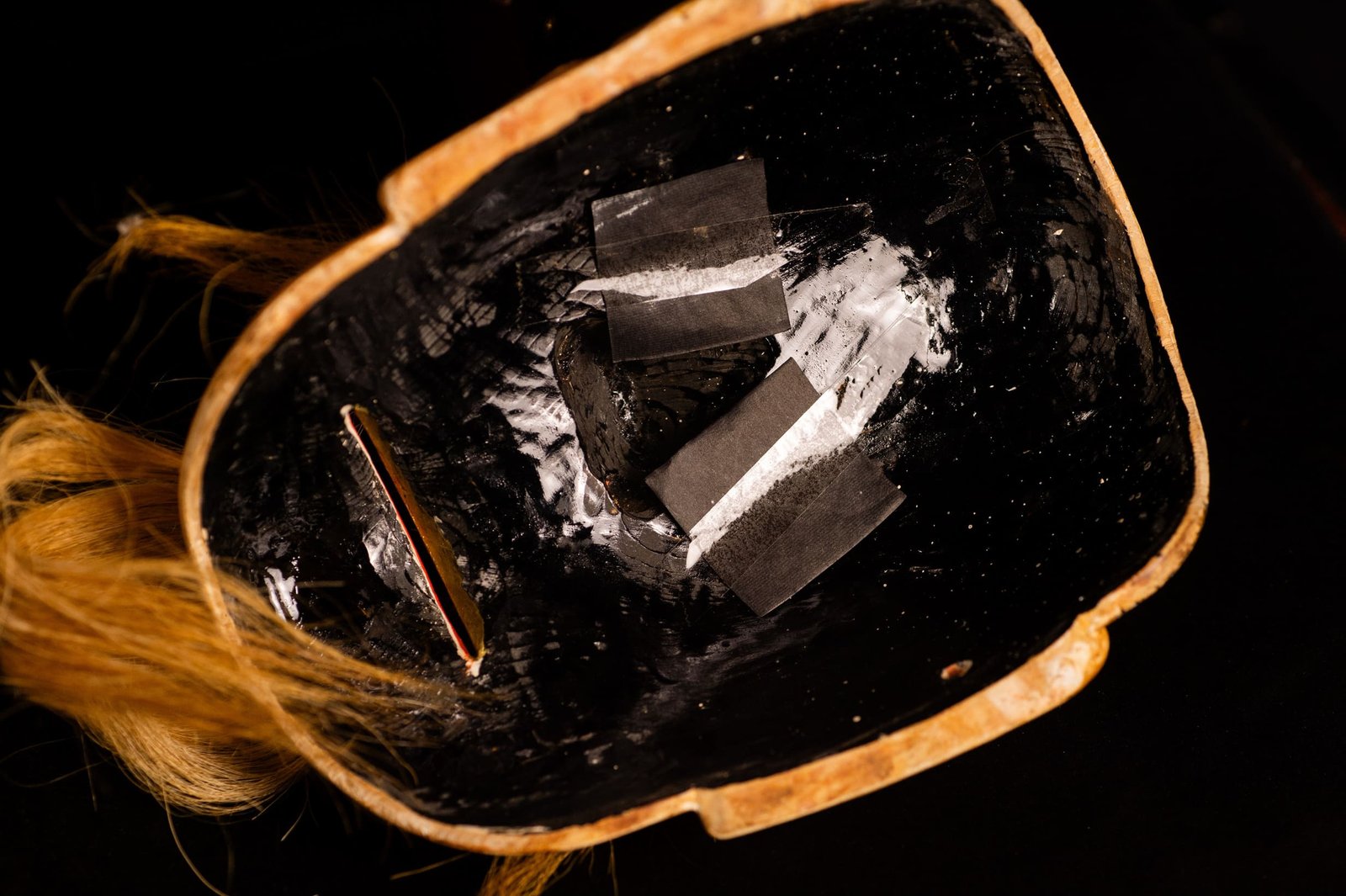
The mask should be supported without placing pressure on the edges, eyes, nose, moustache, beard or any original fastening points.
Direct sunlight, excessive humidity, very dry conditions and sudden environmental changes should be avoided.
The natural fibres should not be brushed aggressively, washed or treated with unsuitable cleaning products.
The gilt-metal eyes should also be protected from abrasion and unnecessary handling.
The mask is described as antique.
No detailed conservation, restoration or condition report has been supplied.
As an antique theatrical object combining carved wood, painted decoration, metal elements and natural fibres, it may display age-related variations, wear and irregularities across these different materials.
The exceptionally long moustache and beard should be handled with particular care, as natural fibres can become fragile, tangled or uneven over time.
No exact date, individual mask carver, workshop attribution, inscription, documented performance history or provenance has been provided.
The description is based on the supplied identification as a Sennin mask and on the stated physical characteristics of the object.
Prospective buyers should examine all available photographs carefully when assessing its condition.
This antique Sennin mask is distinguished by the exceptional length of its natural-fibre moustache and beard and by the combination of human age with supernatural symbolism.
The shaved crown and central red winged mark immediately establish an unusual visual identity.
The mark provides a concentrated point of colour and signals that the represented elder is not an ordinary human figure.
The gilt-metal eyes introduce a reflective, spiritually charged gaze, while the heavy grey eyebrows reinforce the impression of age and authority.
The flowing natural fibres are especially important.
They extend the mask beyond the carved wooden face, introduce genuine movement and create an imposing vertical silhouette.
Their extreme length strengthens the association with immortality, spiritual discipline and existence outside conventional human time.
For collectors of Noh theatre, Japanese masks, religious imagery, Daoist-derived iconography or carved wooden sculpture, the piece offers a compelling combination of theatrical function, spiritual meaning and dramatic visual presence.
An imposing antique Japanese Noh mask representing a Sennin, the legendary mountain hermit or immortal ascetic derived from Daoist tradition. Carved from wood at life size, the mask features a shaved crown marked at the centre of the forehead by a distinctive red winged supernatural emblem, heavy grey painted eyebrows and reflective gilt-metal eyes. An exceptionally long moustache and flowing beard of white-grey natural fibre extend well below the chin, creating a powerful image of extreme age, spiritual discipline and immortal existence. With its combination of carved wood, metallic detail, painted symbolism and moving organic fibre, the mask is a striking example of Japanese theatrical sculpture and an exceptional object for a collection of Noh masks, Asian religious art or ritual material culture.
| Época | Edo |
|---|

Order above 1.000,00 € gets free shipping.

Secure and hassle-free payment process.

Certificate of authenticity included.

Have questions? Contact us via WhatsApp.
Contact