1 in stock
1 in stock
Add to Compare
Add to Wishlist
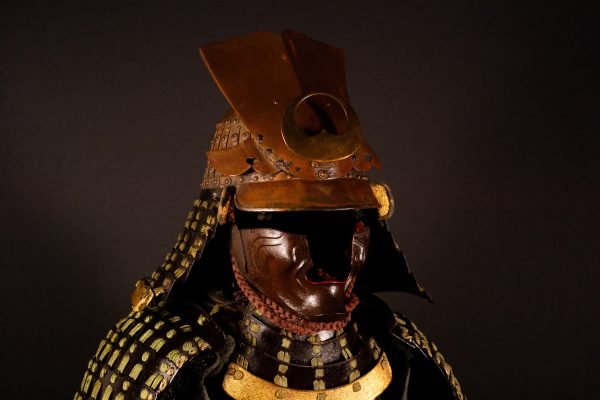
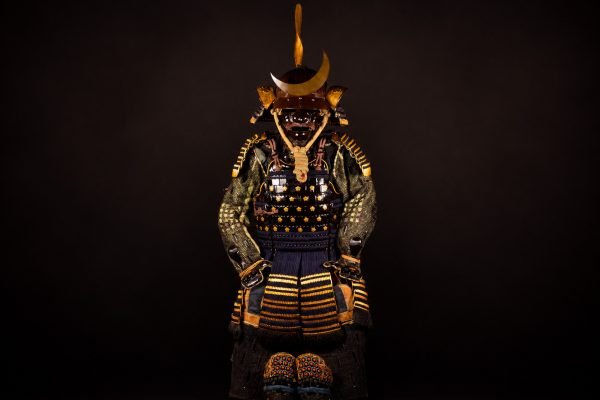
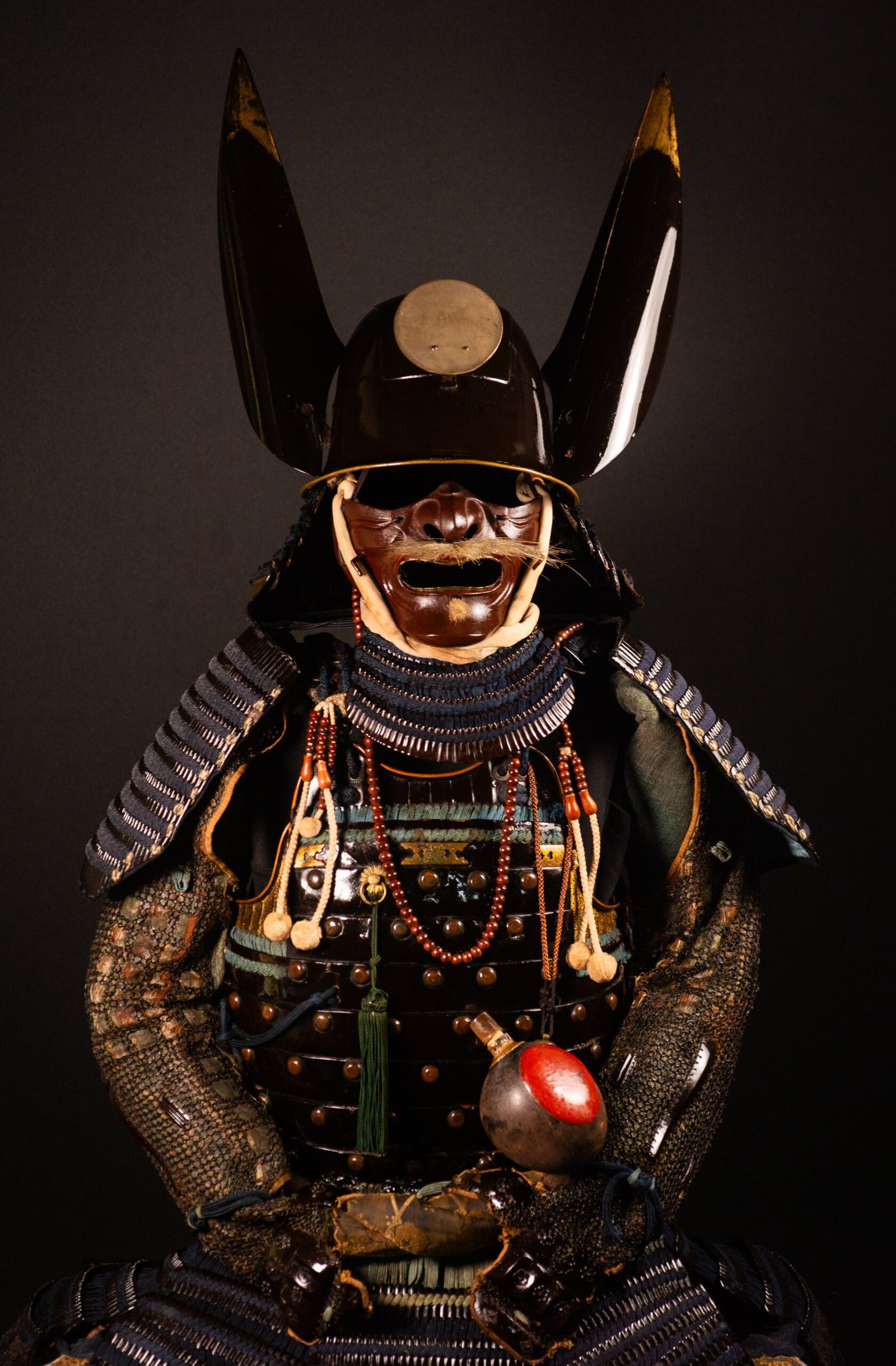
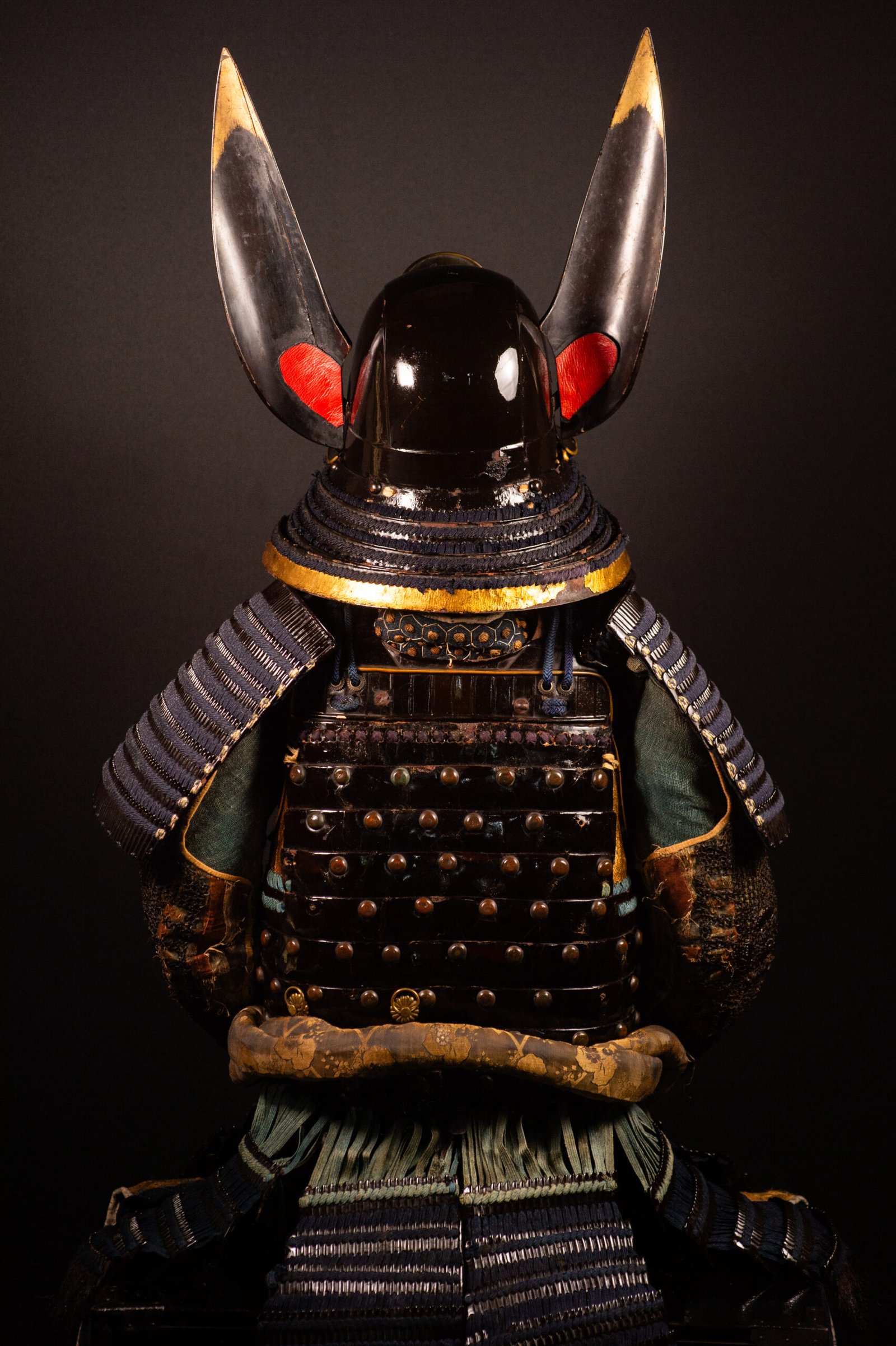
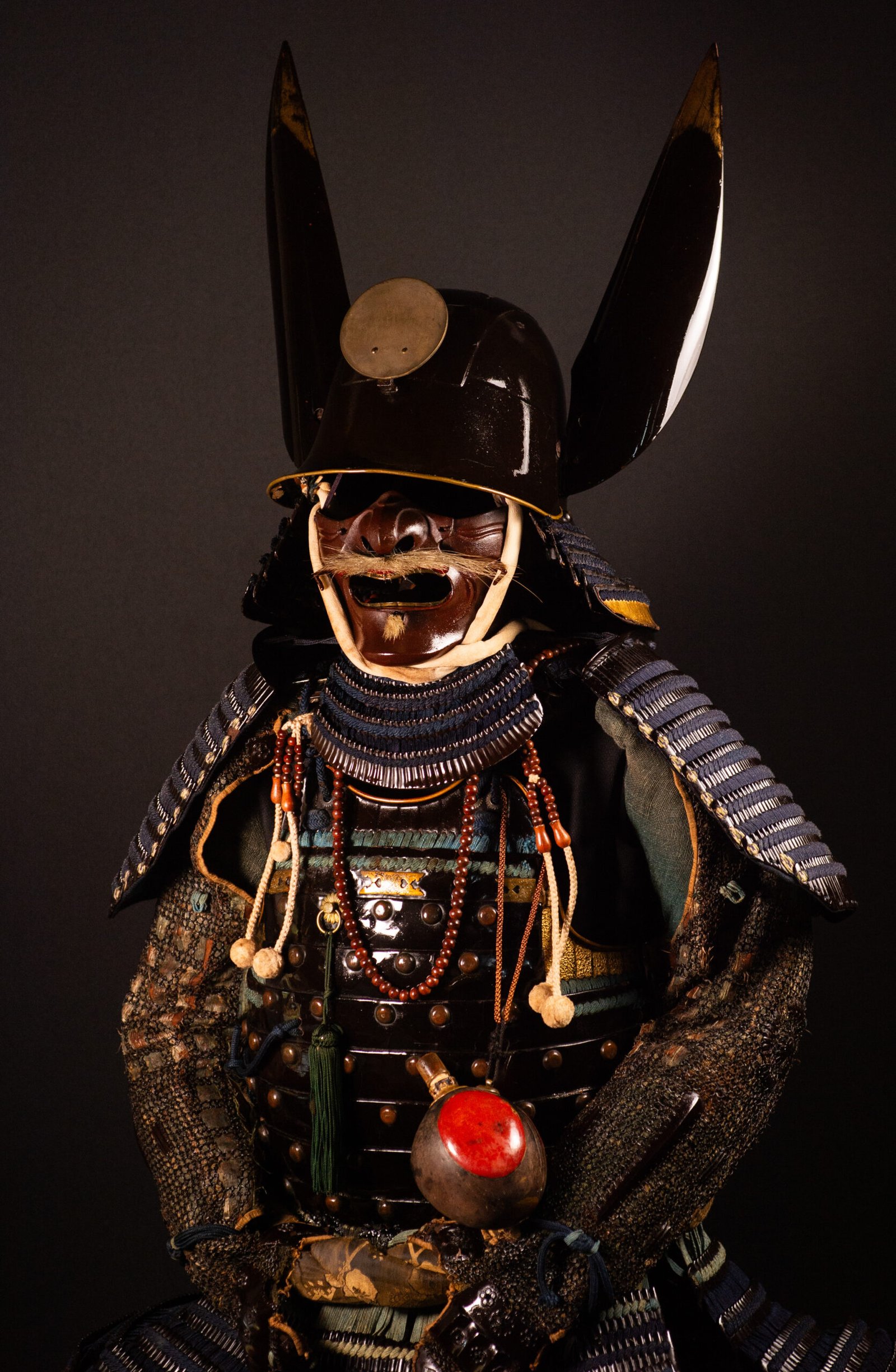
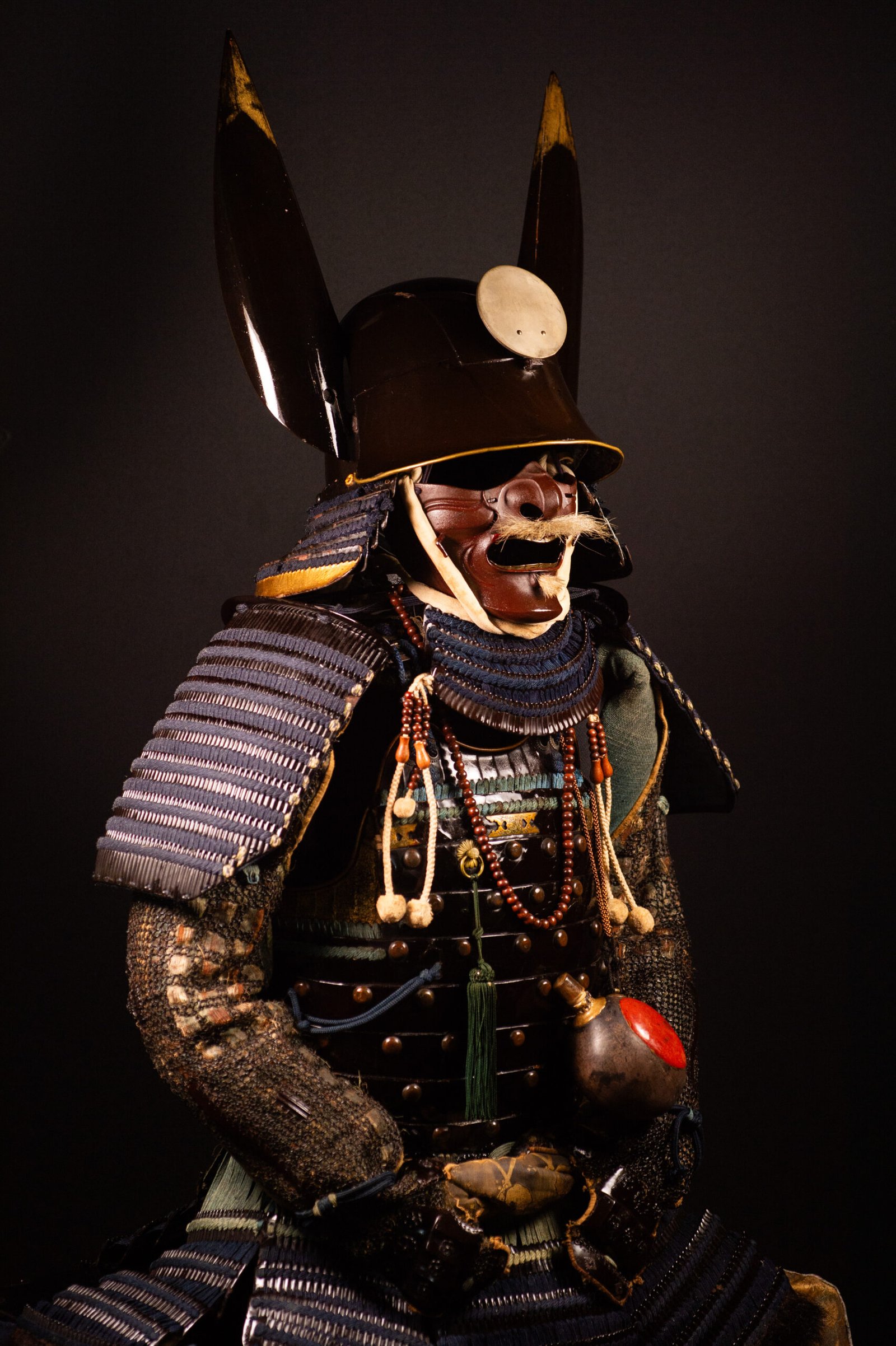
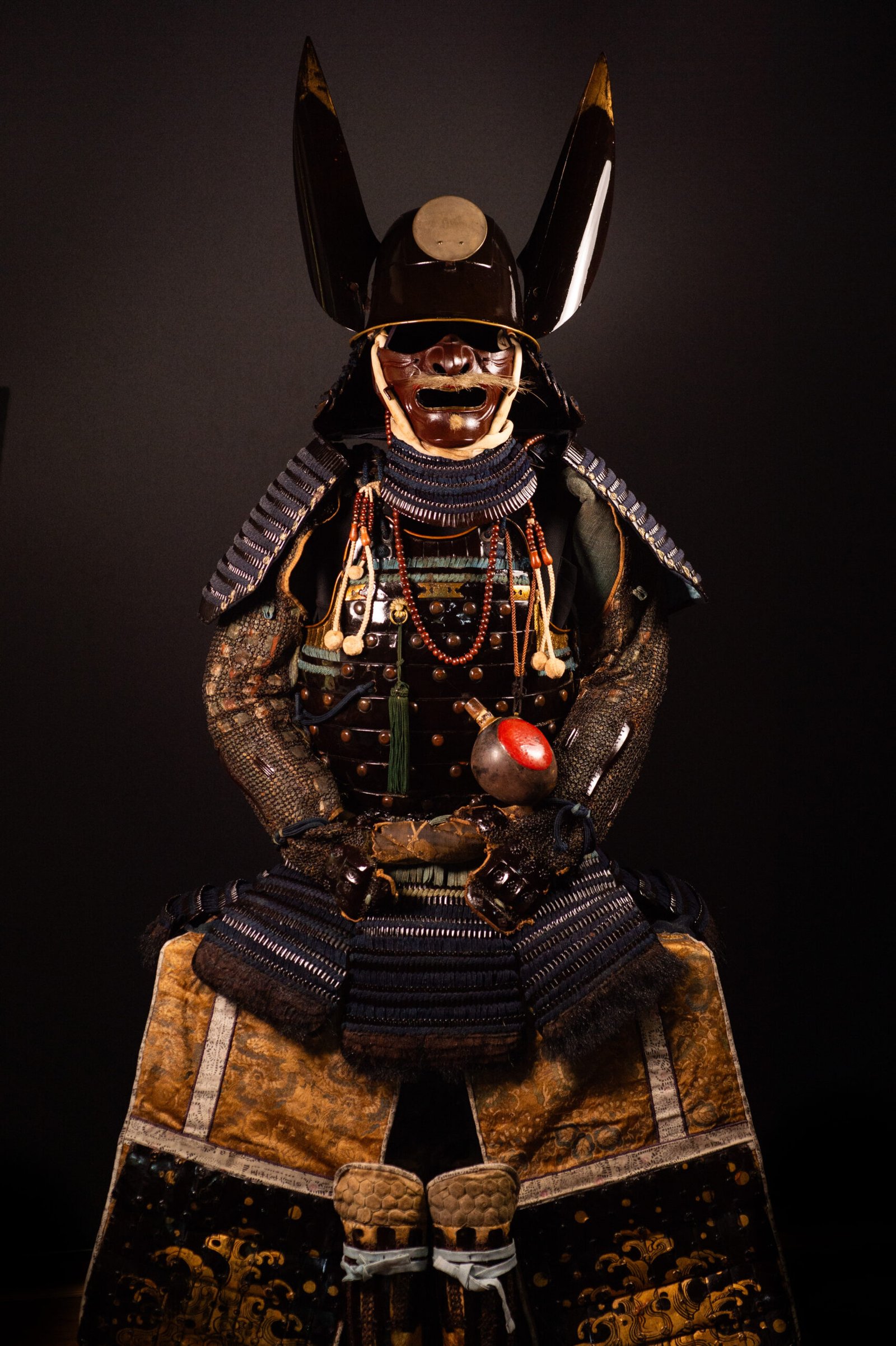
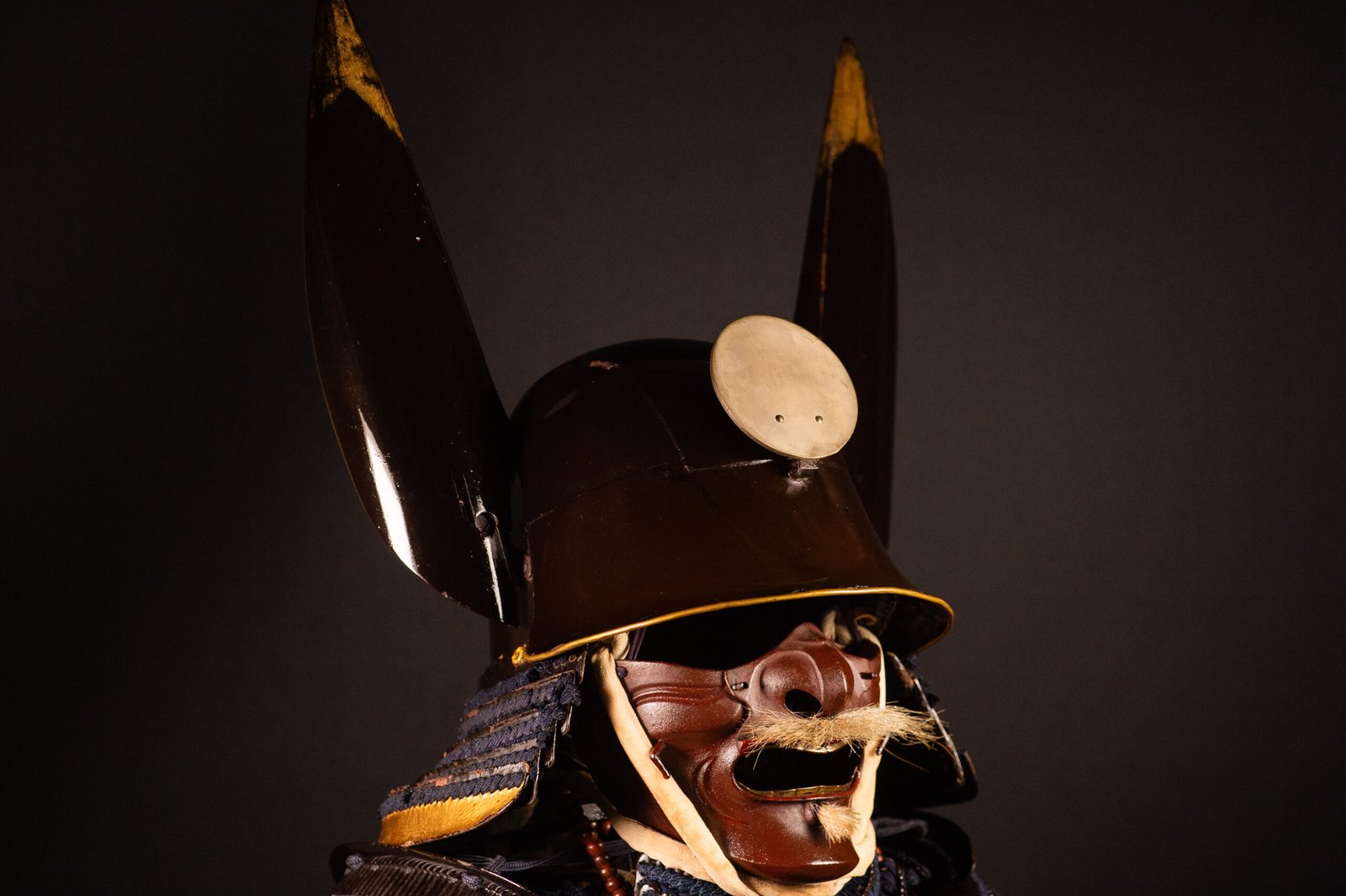
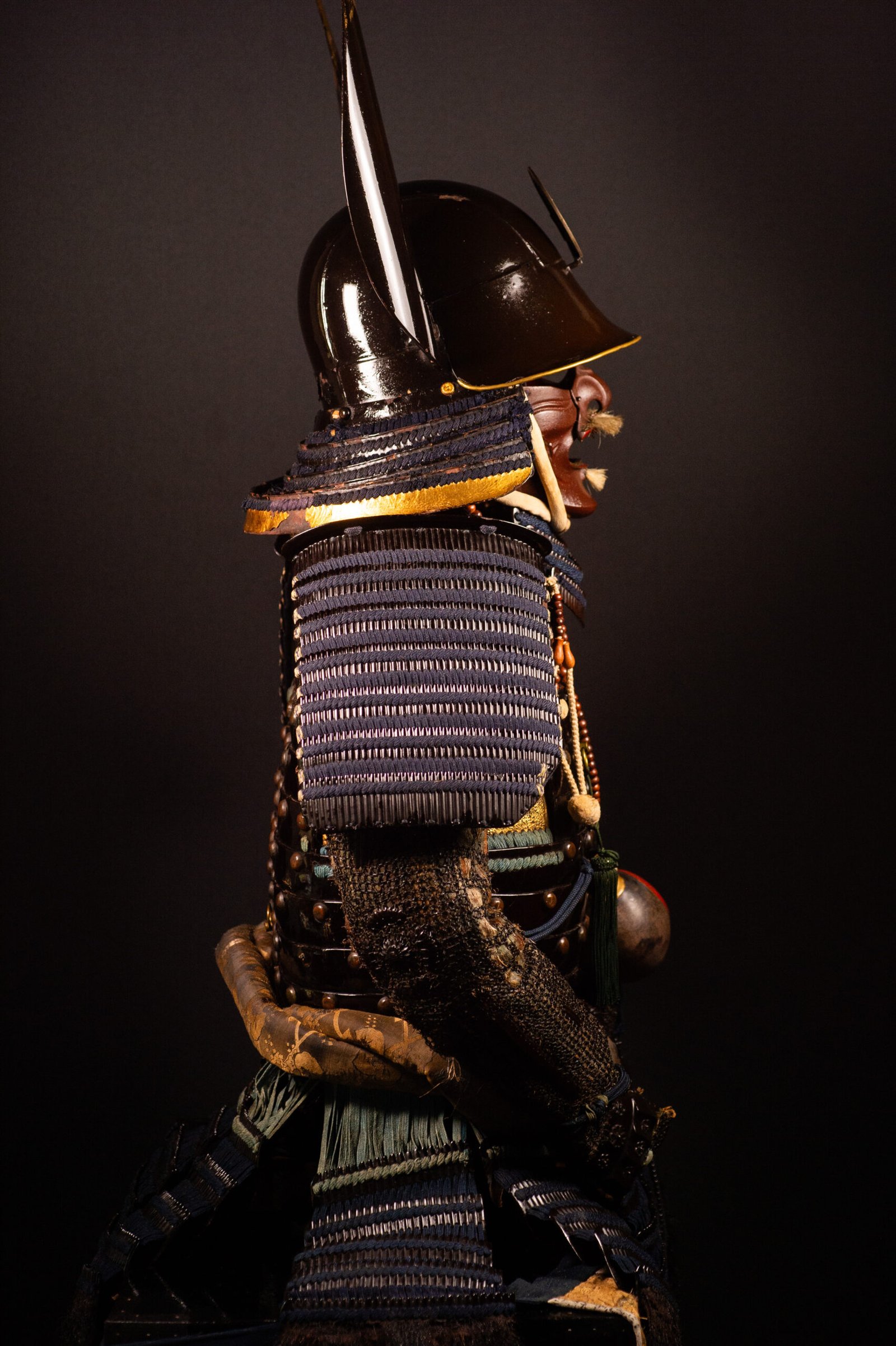
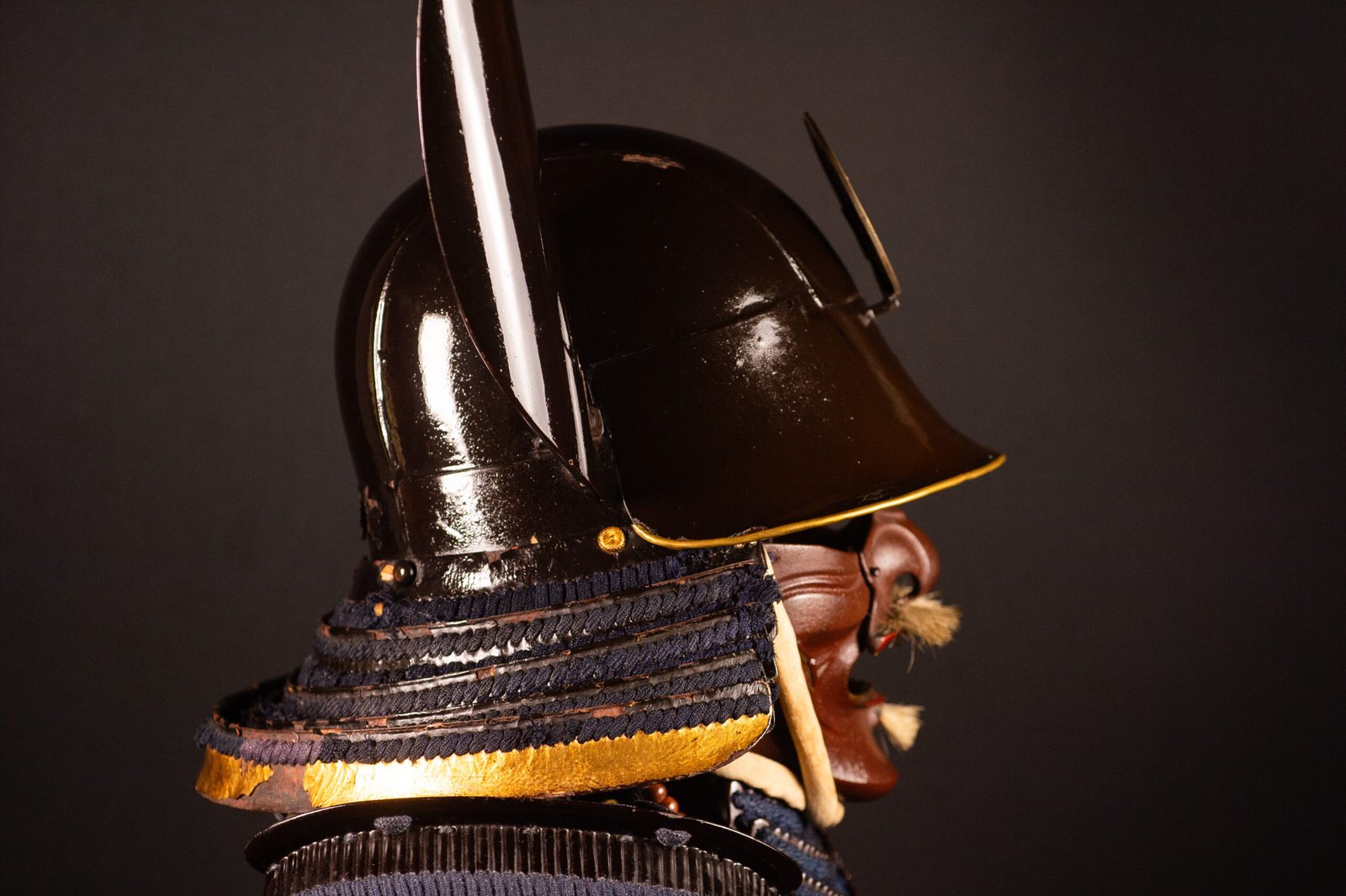
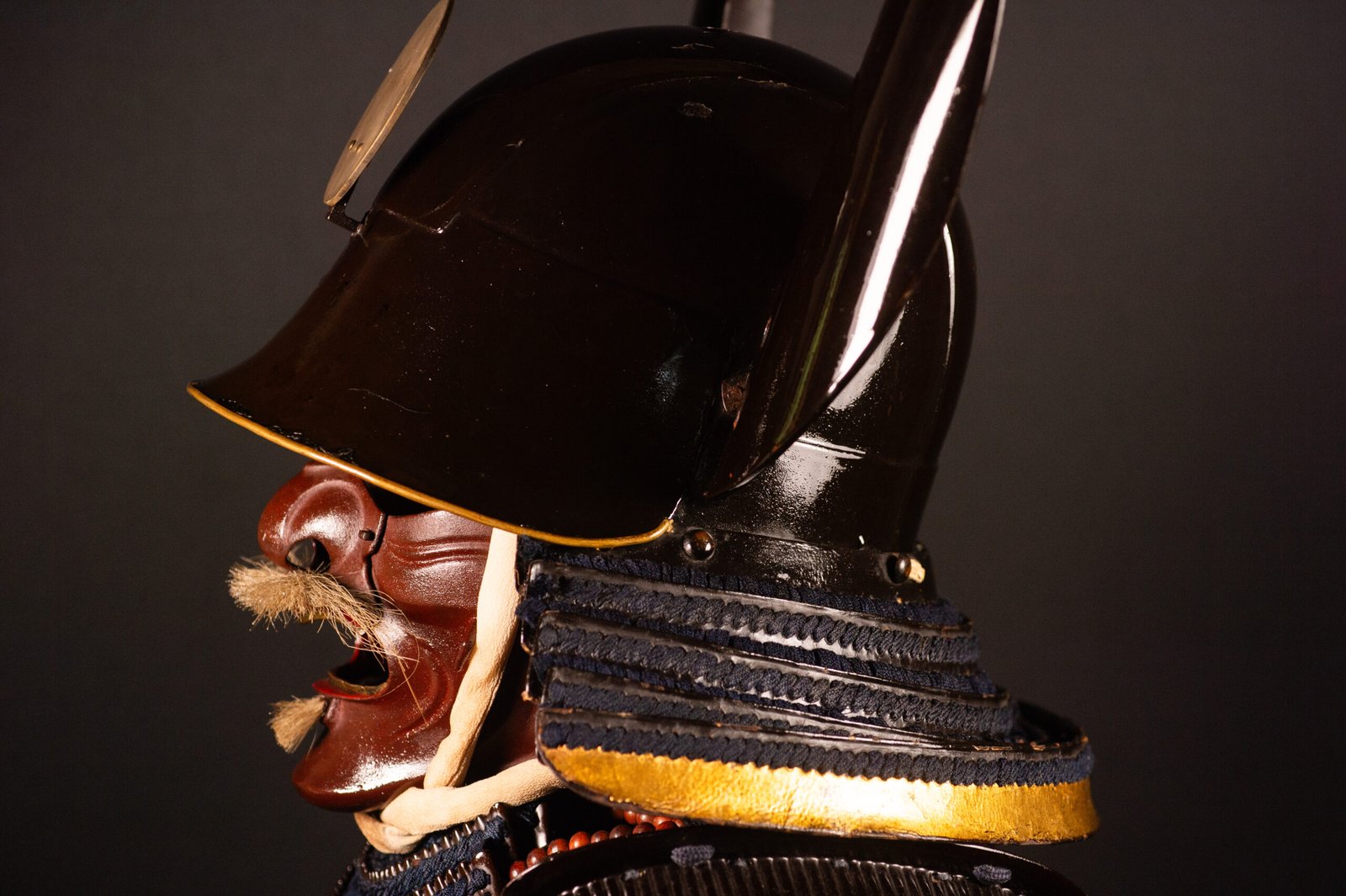
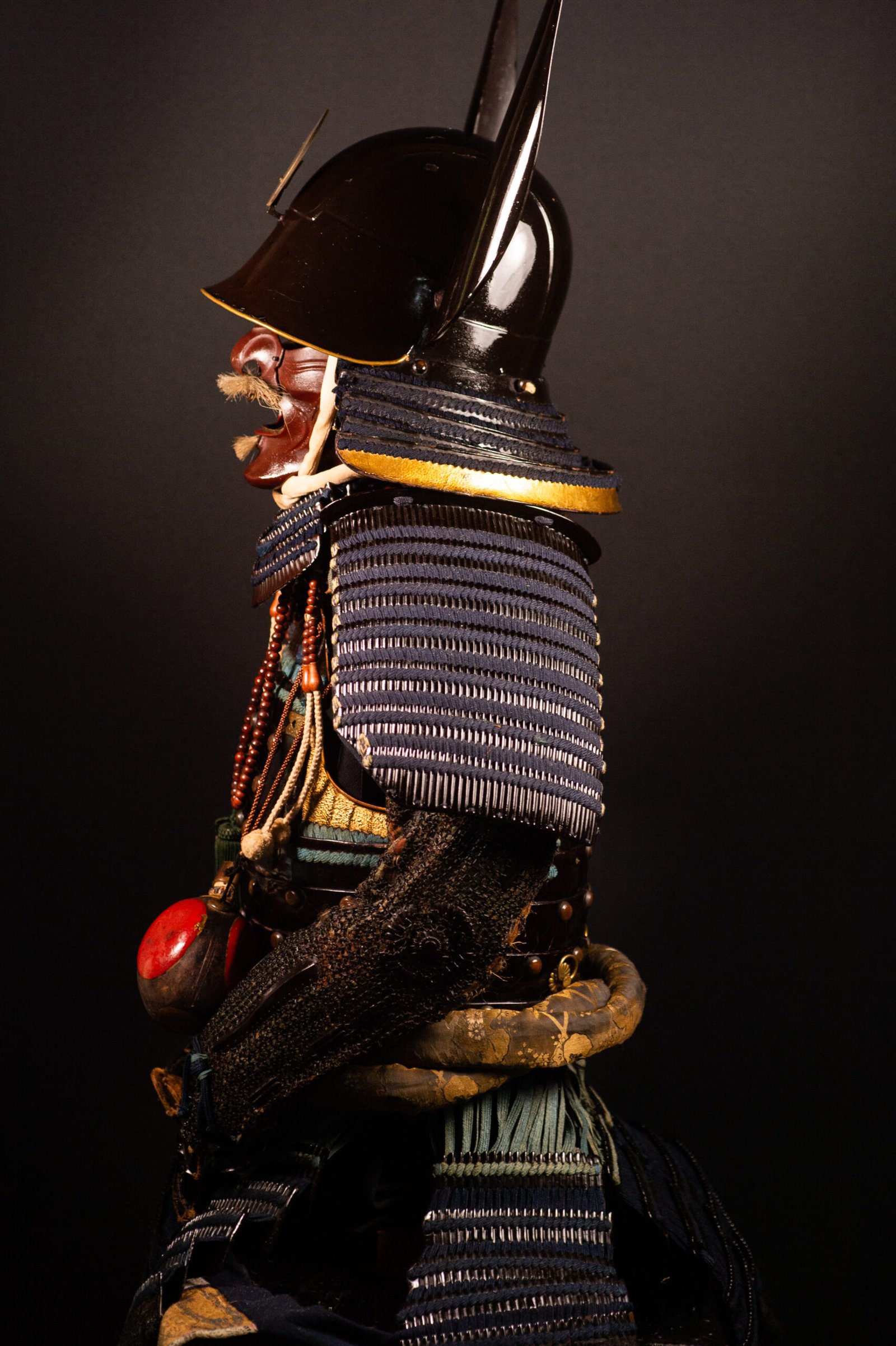
A visually imposing complete Japanese samurai armor, or gusoku, constructed in black lacquer and unified throughout by deep navy-blue kon-ito lacing. Stylistically attributed to the middle Edo period, the ensemble combines a distinctive helmet fitted with tall horn- or wing-shaped side ornaments, an expressive reddish-brown facial mask with natural-hair moustache, a riveted plate cuirass, articulated skirt guards decorated with gold waves, brocade-covered shoulder protection and chainmail sleeves.
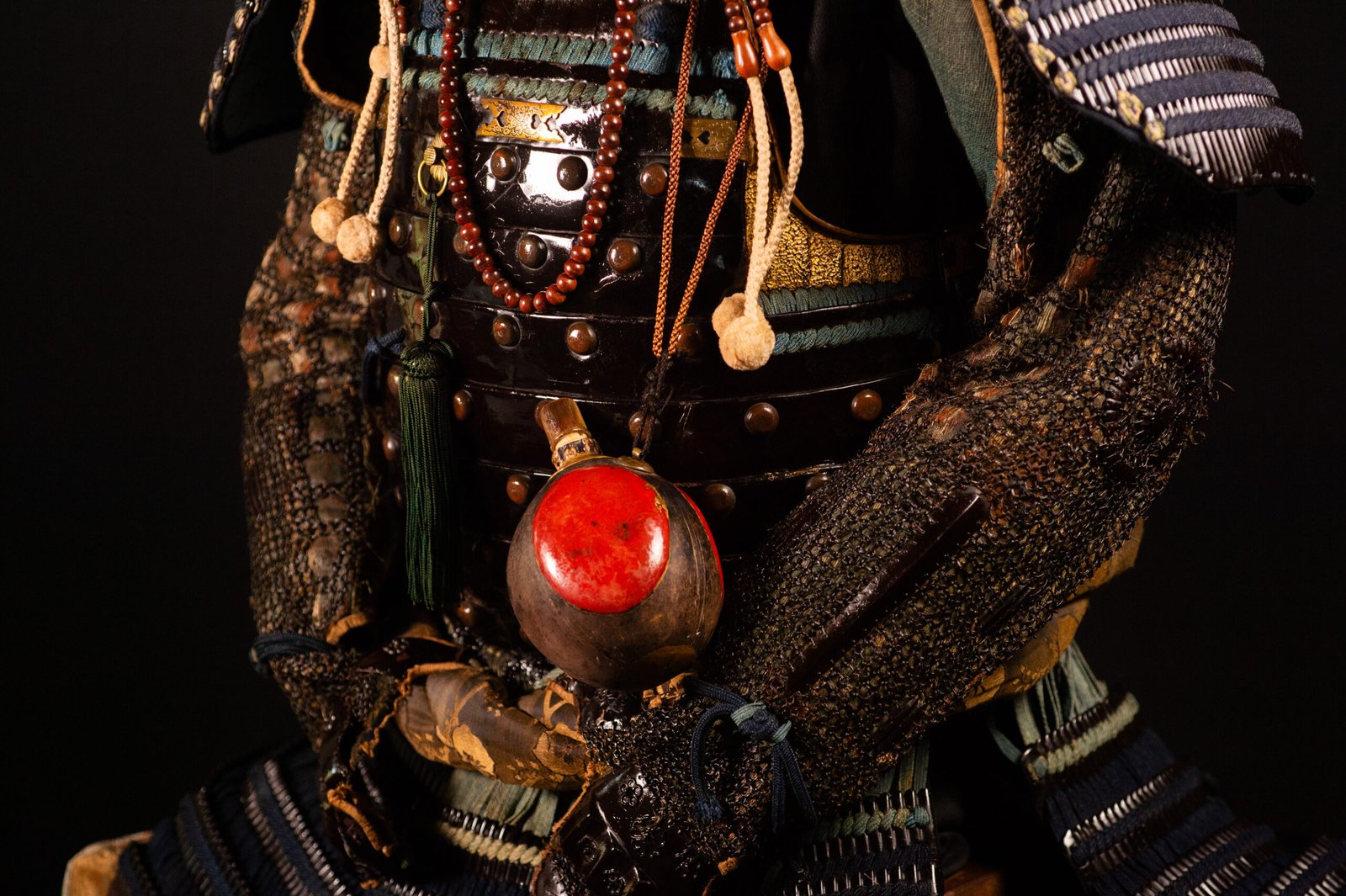
The armor is further enriched by accessories associated with the spiritual and practical world of the samurai: a dark wooden Buddhist prayer-bead strand suspended from the front of the cuirass and a lacquered gourd-shaped flask secured at the waist.
No authentication certificate accompanies this piece. The proposed dating to the mid-Edo period is therefore presented as a stylistic assessment based on the construction, materials, decorative treatment and visual examination of the armor rather than as a formally certified attribution.
The armor is stylistically assessed as dating from the middle Edo period.
During the Edo period, the long peace established under Tokugawa rule transformed the role of samurai armor. Although practical protection remained essential, complete suits increasingly expressed rank, identity, ceremonial presence and the personal taste of their owners.
The present armor reflects this balance between functional construction and dramatic presentation.
Its black lacquer, navy-blue lacing, bold helmet ornaments, expressive facial armor and decorative textiles create a coherent visual identity characteristic of Edo-period armor intended to communicate both military authority and social status.
As the piece is not accompanied by an authentication or appraisal certificate, no specific armor-making school, workshop, armorer or original owner should be assigned without further specialist examination.
The ensemble is presented as a complete traditional gusoku, comprising the principal defensive components required to protect the head, face, throat, torso, shoulders and arms.
The armor follows a restrained but commanding palette built around black and dark brown lacquer, navy-blue silk cord, gold textile, gilt metal and limited red-lacquered accents.
This controlled use of color gives the armor a powerful presence without overwhelming the construction.
The navy-blue lacing serves as the principal visual link between the different elements, appearing across the helmet, throat guard, cuirass and articulated skirt.
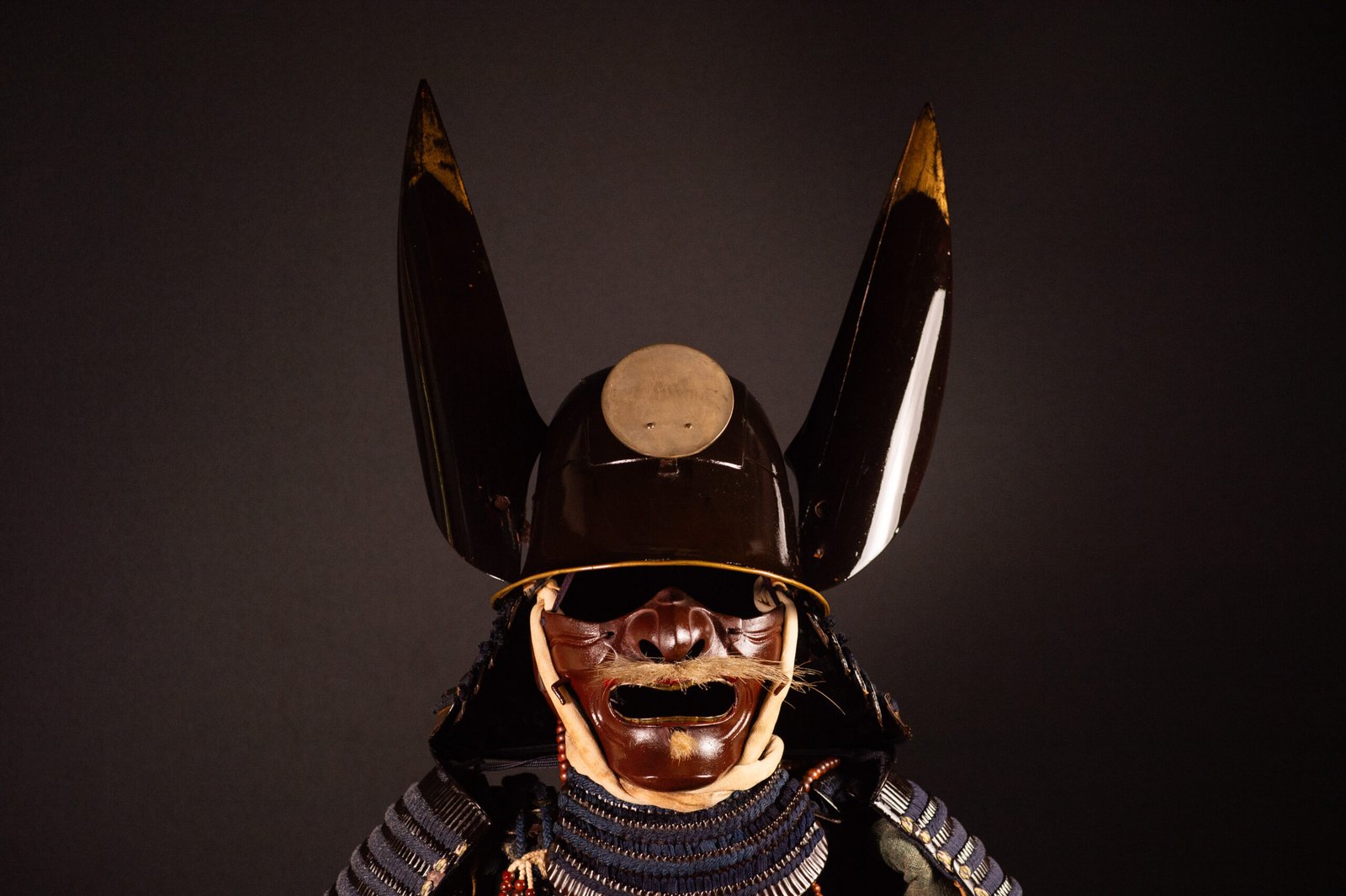
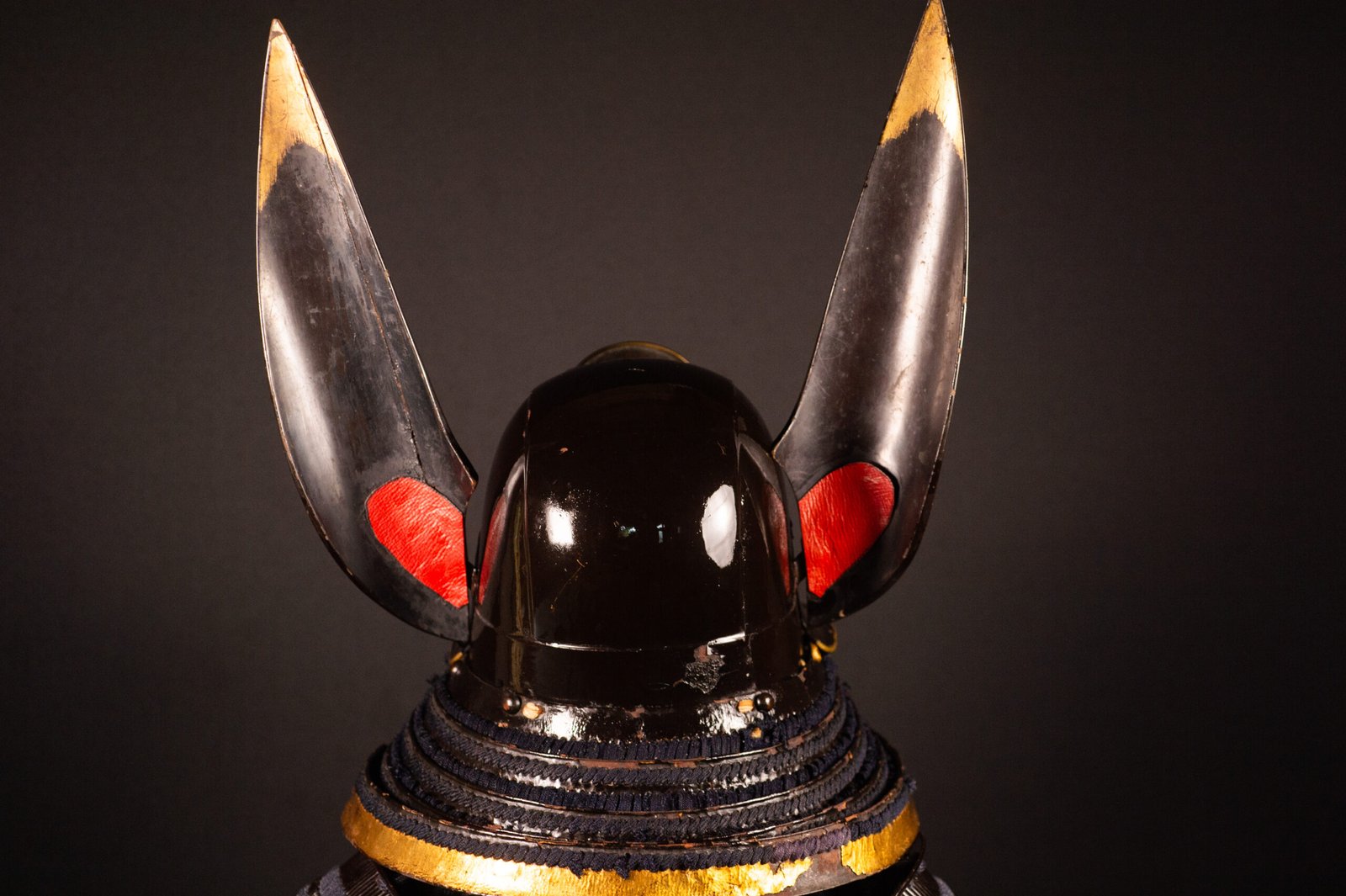
The kabuto is formed from a smooth black-lacquered bowl with a clean, rounded profile.
At the front of the helmet is a small oval silver-toned disc, providing a restrained metallic accent against the deep black lacquer.
The defining feature of the helmet is the tall pair of curved black-lacquered side ornaments, or wakidate.
These ornaments rise prominently from either side of the bowl and create a dramatic horn- or wing-shaped silhouette.
Their outer surfaces are finished in black lacquer, while their interiors are highlighted in red lacquer, creating a vivid contrast visible from different viewing angles.
Several rows of navy-blue cord visually connect and secure the associated helmet elements, reinforcing the chromatic continuity of the full armor.
The bold profile of the wakidate transforms the helmet into the focal point of the ensemble and would have given the wearer an immediately recognizable appearance.
Tall horn-, antler- and wing-shaped ornaments were used on Japanese helmets to create a distinctive battlefield and ceremonial identity.
Such forms enlarged the apparent silhouette of the warrior and allowed him to be recognized among other armored retainers.
Although the precise intended symbolism of the present ornaments cannot be established without supporting documentation, their upward-curving form communicates strength, elevation and authority.
The red lacquer applied to the inner surfaces adds visual depth and provides a striking counterpoint to the otherwise dark helmet.
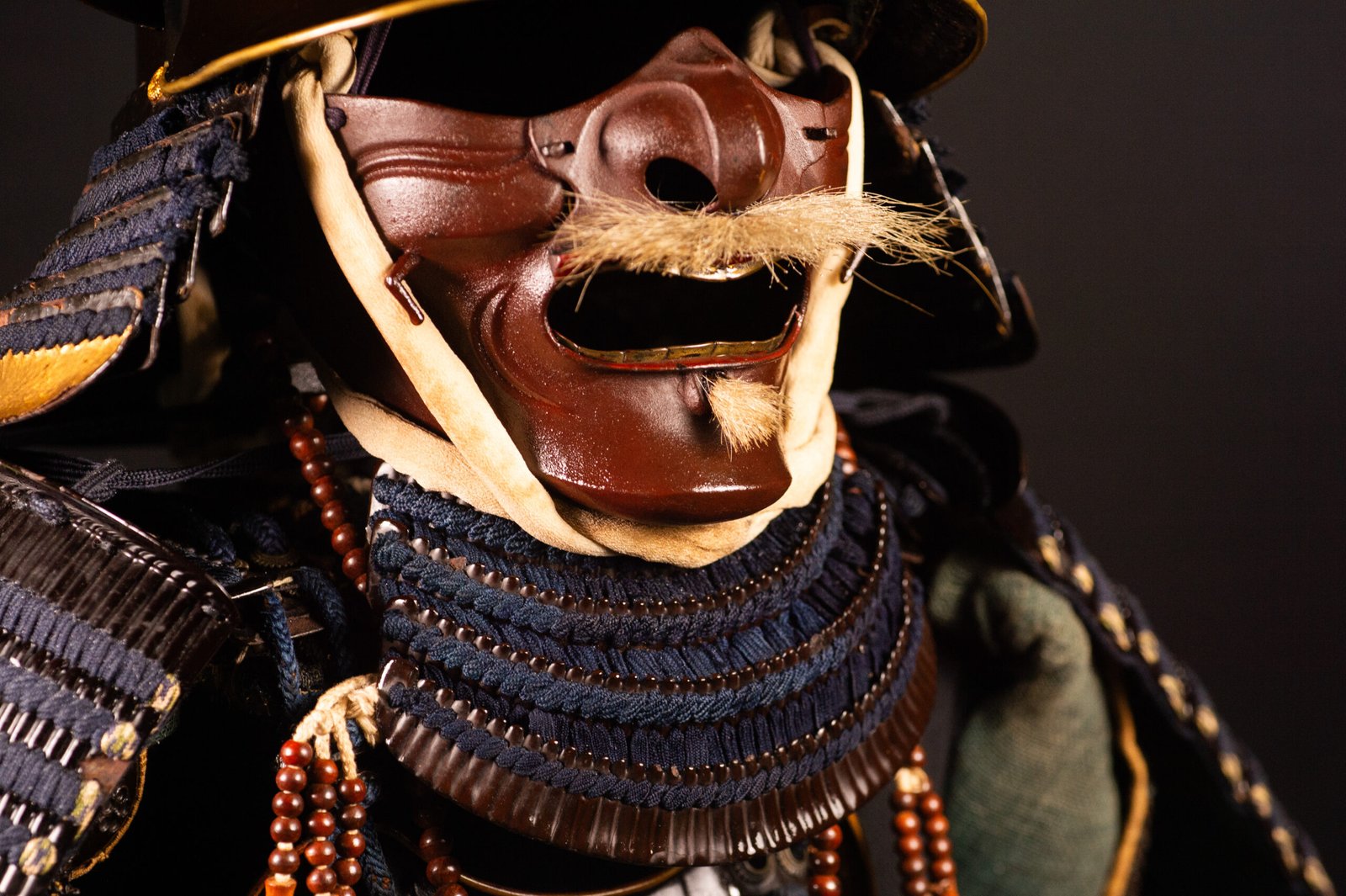
The facial armor is finished in a deep mahogany or reddish-brown lacquer that contrasts strongly with the black helmet and cuirass.
The surface is modelled with expressive carved features, including pronounced wrinkles and an open mouth.
These details give the mask a fierce and theatrical expression, consistent with the intimidating visual language traditionally associated with samurai facial protection.
A natural blond-hair moustache is attached above the mouth, adding further realism and personality to the mask.
Cream-colored leather straps secure the menpō, introducing another subtle tonal contrast within the ensemble.
The combination of reddish-brown lacquer, deeply modelled facial lines and pale natural hair makes this one of the most visually distinctive elements of the armor.
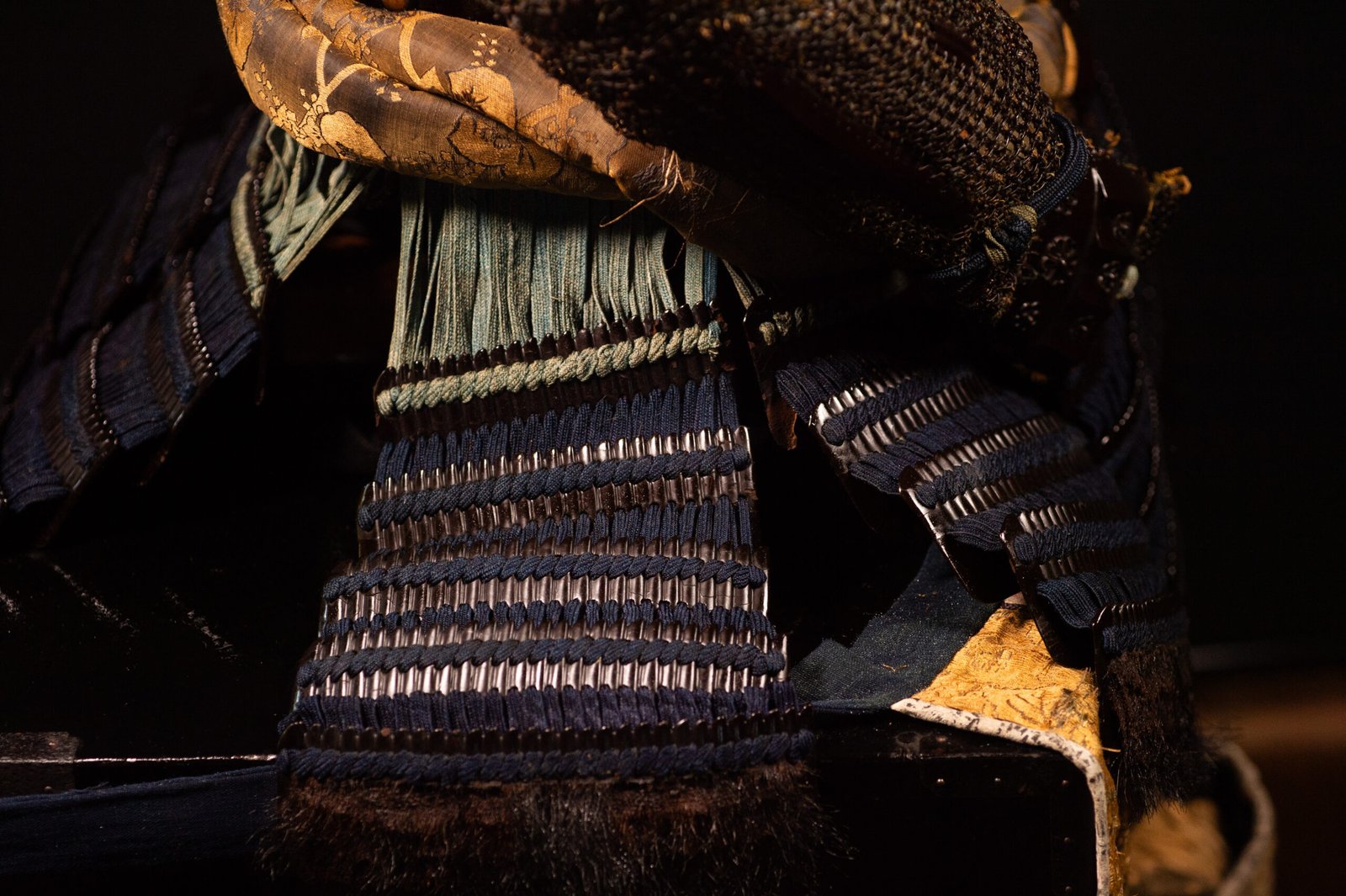
The facial armor is completed by a lacquered yodare-kake, the articulated throat guard suspended below the mask.
It is formed from several overlapping tiers joined with navy-blue cord.
This construction provided protection to the throat and upper chest while preserving sufficient flexibility for movement of the head and neck.
The use of the same deep blue lacing found elsewhere on the armor helps integrate the mask and throat guard with the complete ensemble.
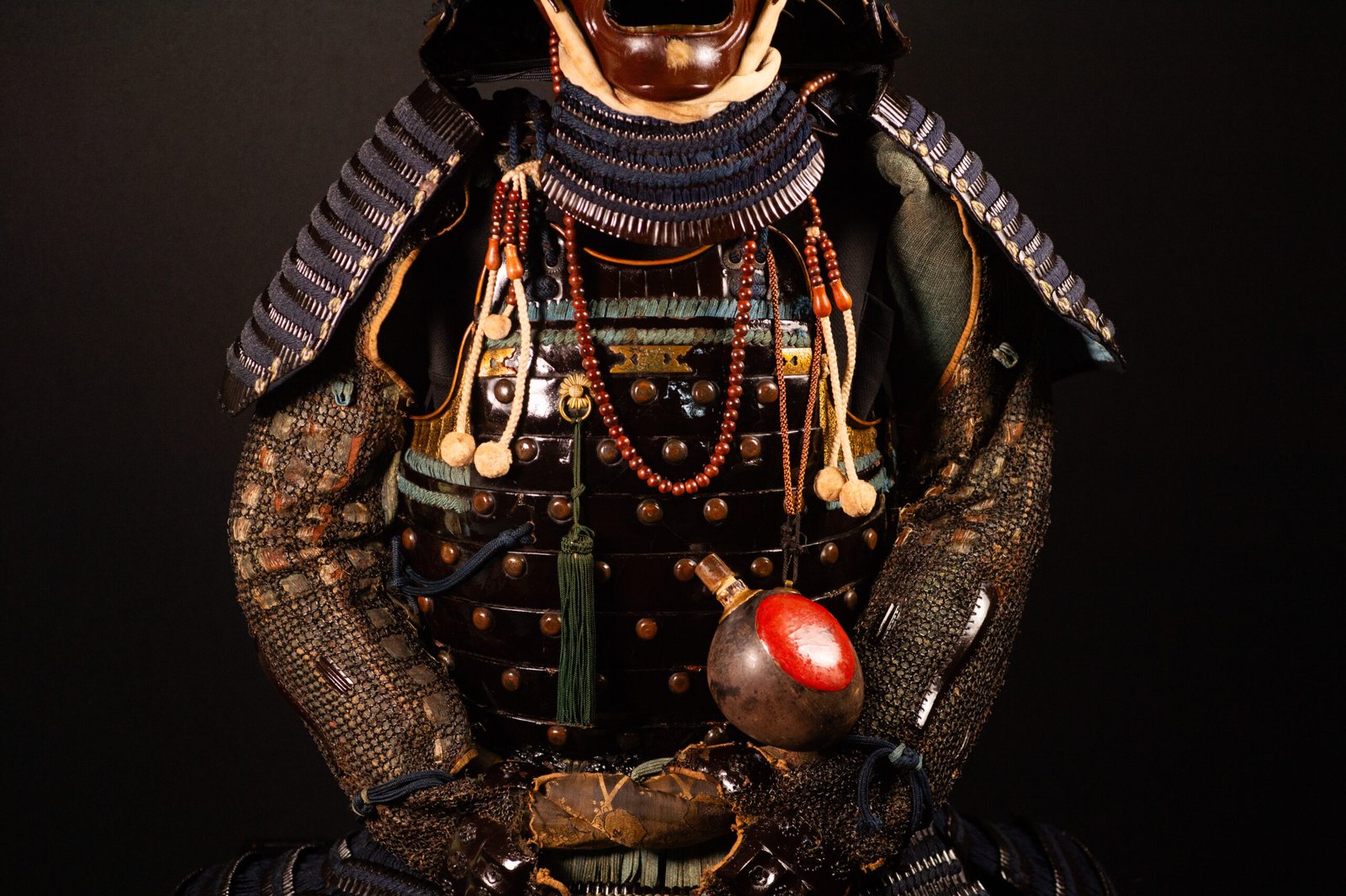
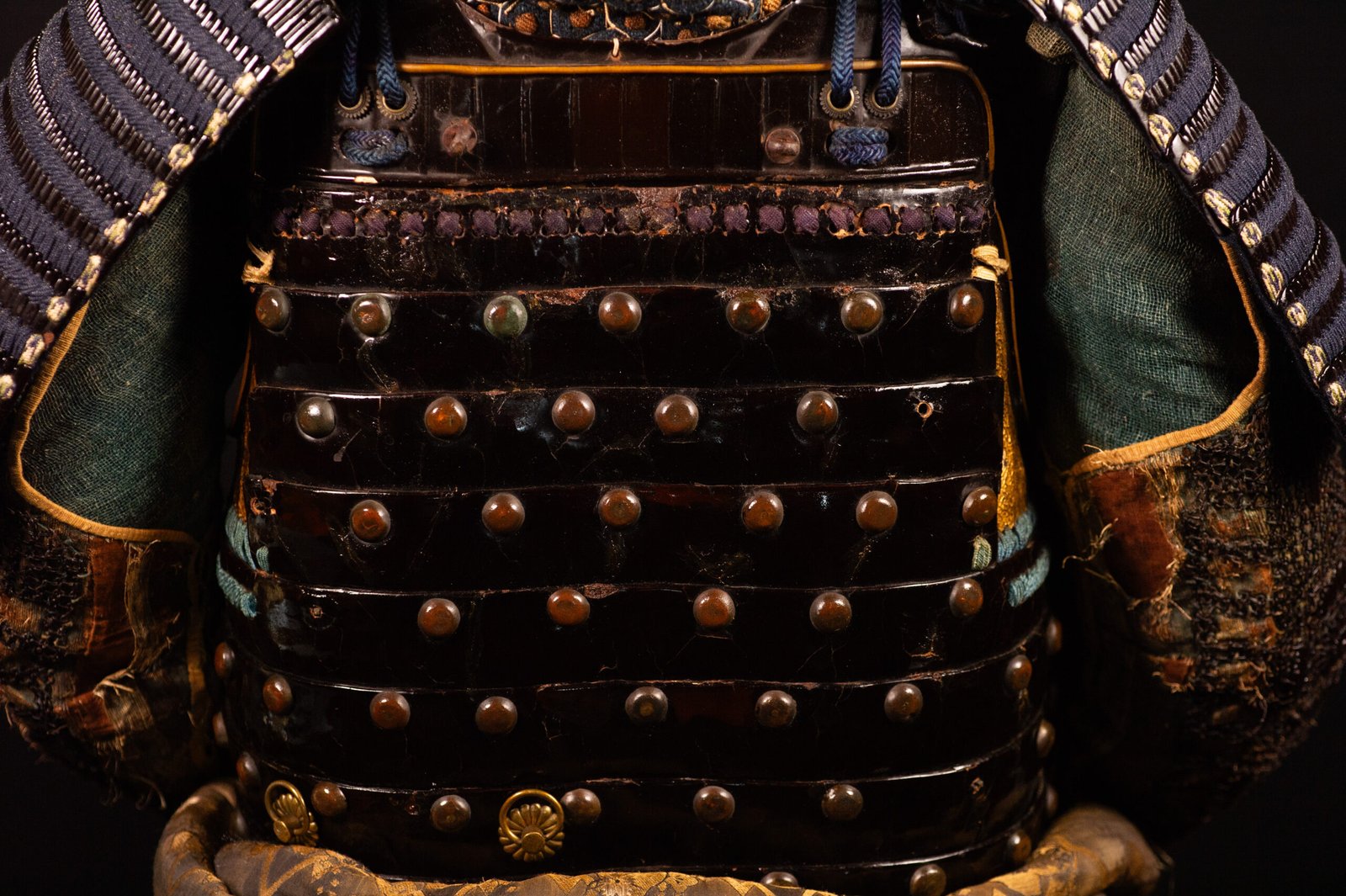
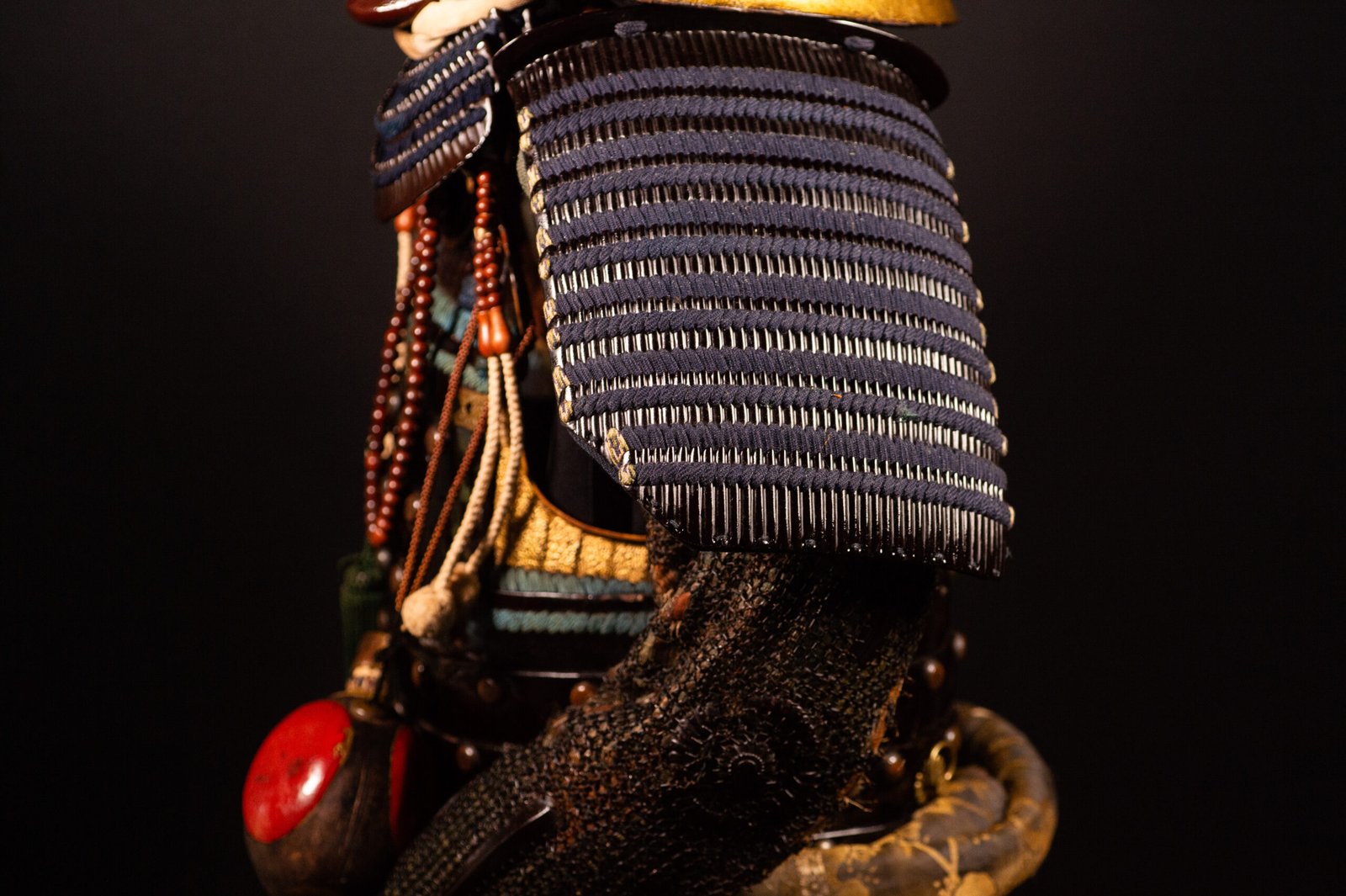
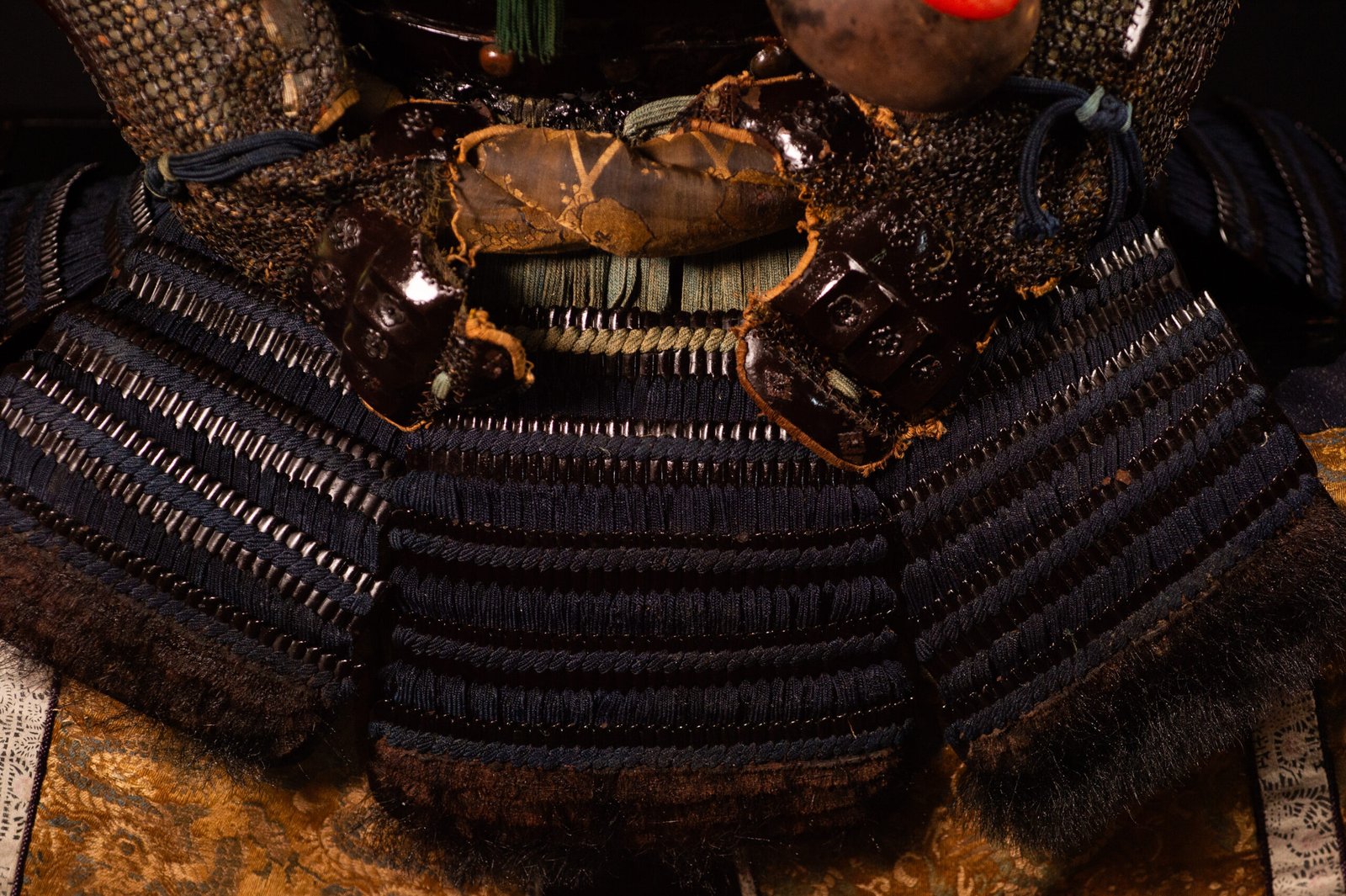
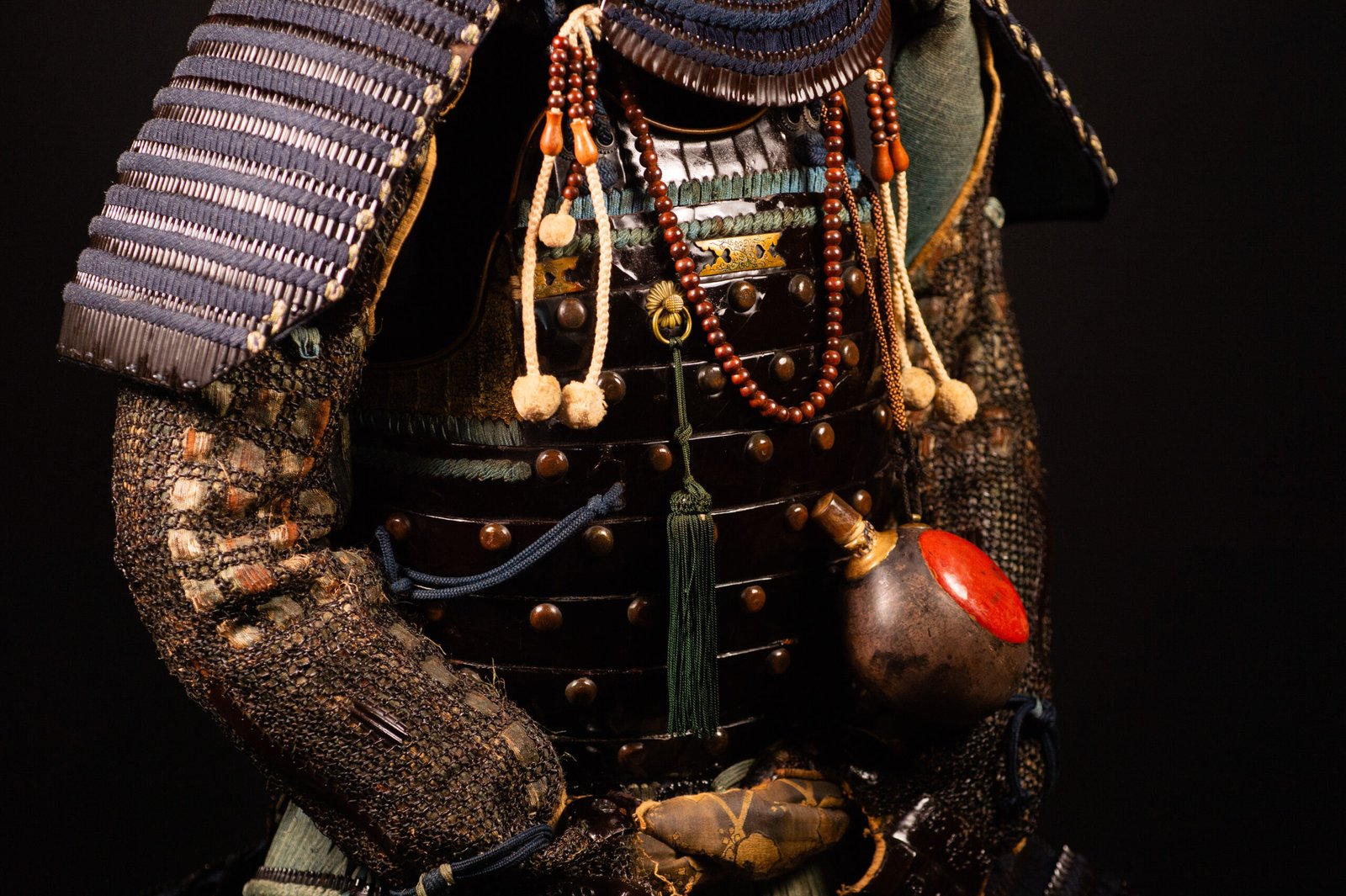
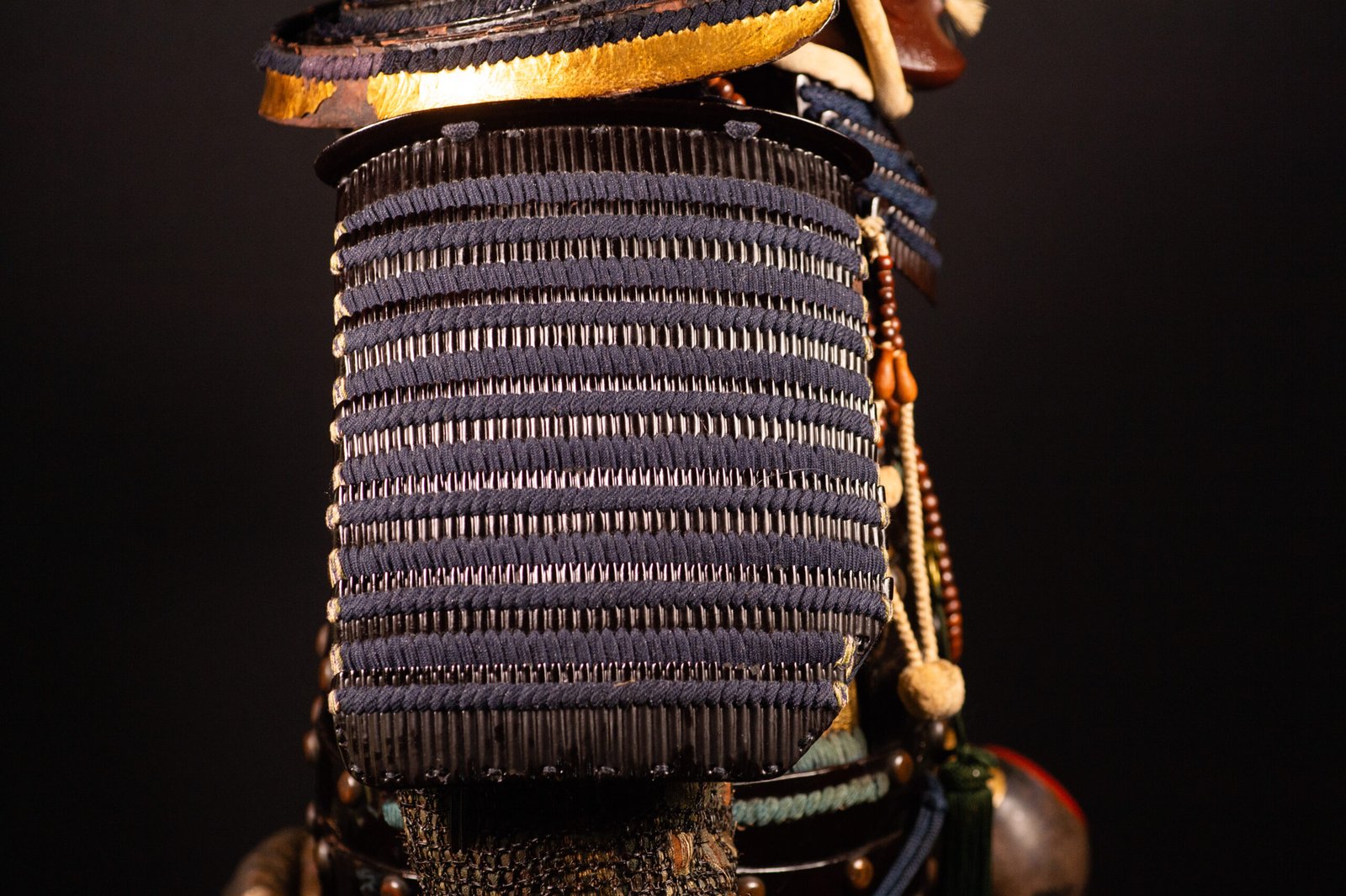
The dō is constructed from numerous small riveted plates arranged in horizontal rows.
The plates are finished in black to dark-brown lacquer, producing a rich surface whose tone changes subtly according to the light.
This layered construction combines structural strength with the flexibility required for movement.
Navy-blue cord runs along the upper edge of the cuirass, visually connecting it with the helmet and lower defenses.
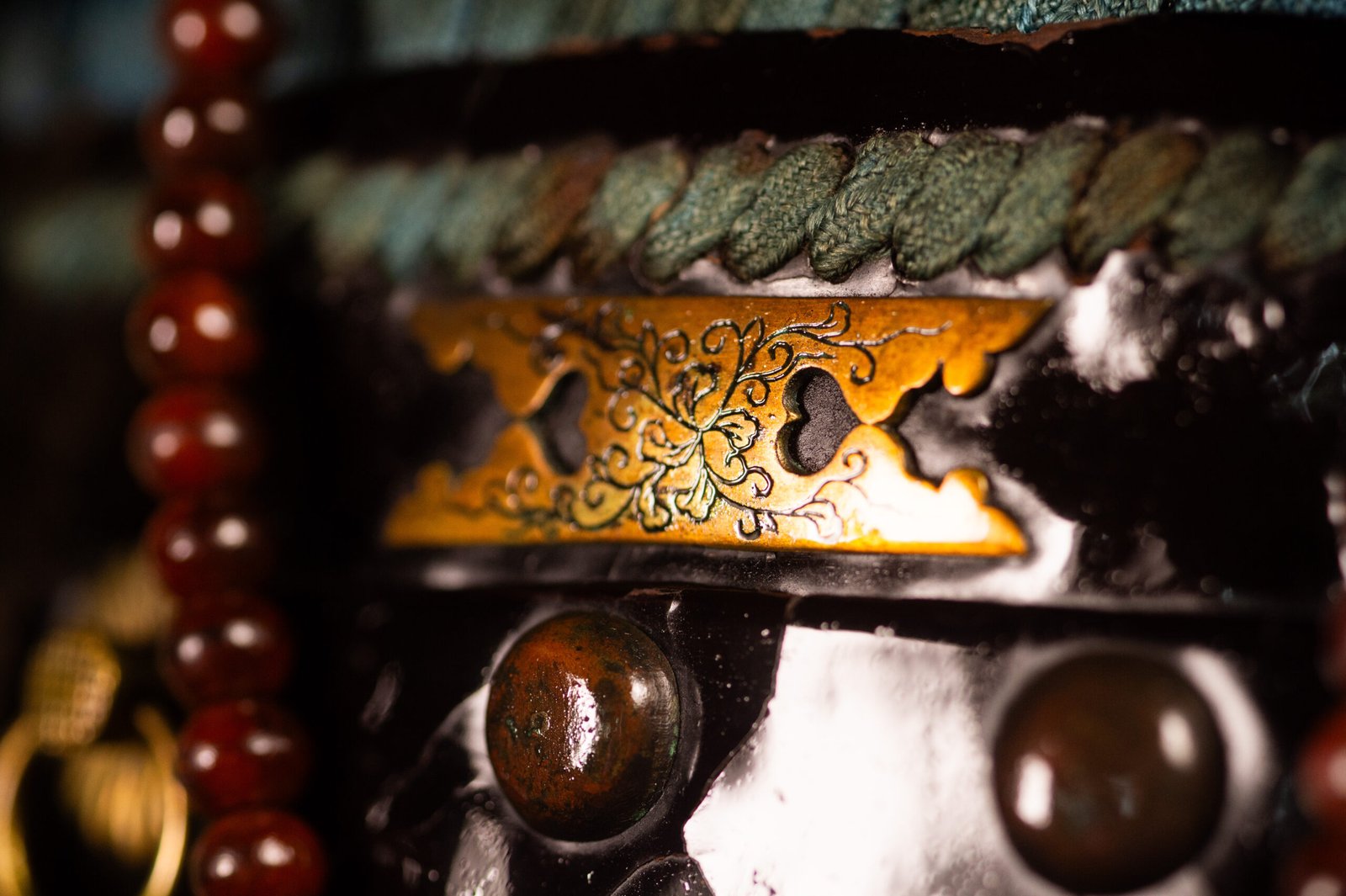
Mounted prominently on the chest is a gilt metal fitting engraved with a floral motif.
This decorative element introduces a point of refinement to the otherwise dark and martial surface of the cuirass.
The contrast between black lacquer, blue lacing and gilt metal gives the torso a balanced and formal appearance.
Old lacquer repairs are visible around the junction between the lower edge of the dō and the uppermost lames of the kusazuri.
These interventions are consistent with the historical maintenance of armor that experienced use and long-term handling.
Traditional Japanese lacquer armor was periodically repaired to stabilize surfaces, protect underlying materials and prolong the functional life of the object.
The visible repairs are relatively minor and do not affect the structural integrity of the armor.
Rather than being treated simply as modern defects, they should be understood as part of the material history of the piece and evidence of its continued preservation over time.
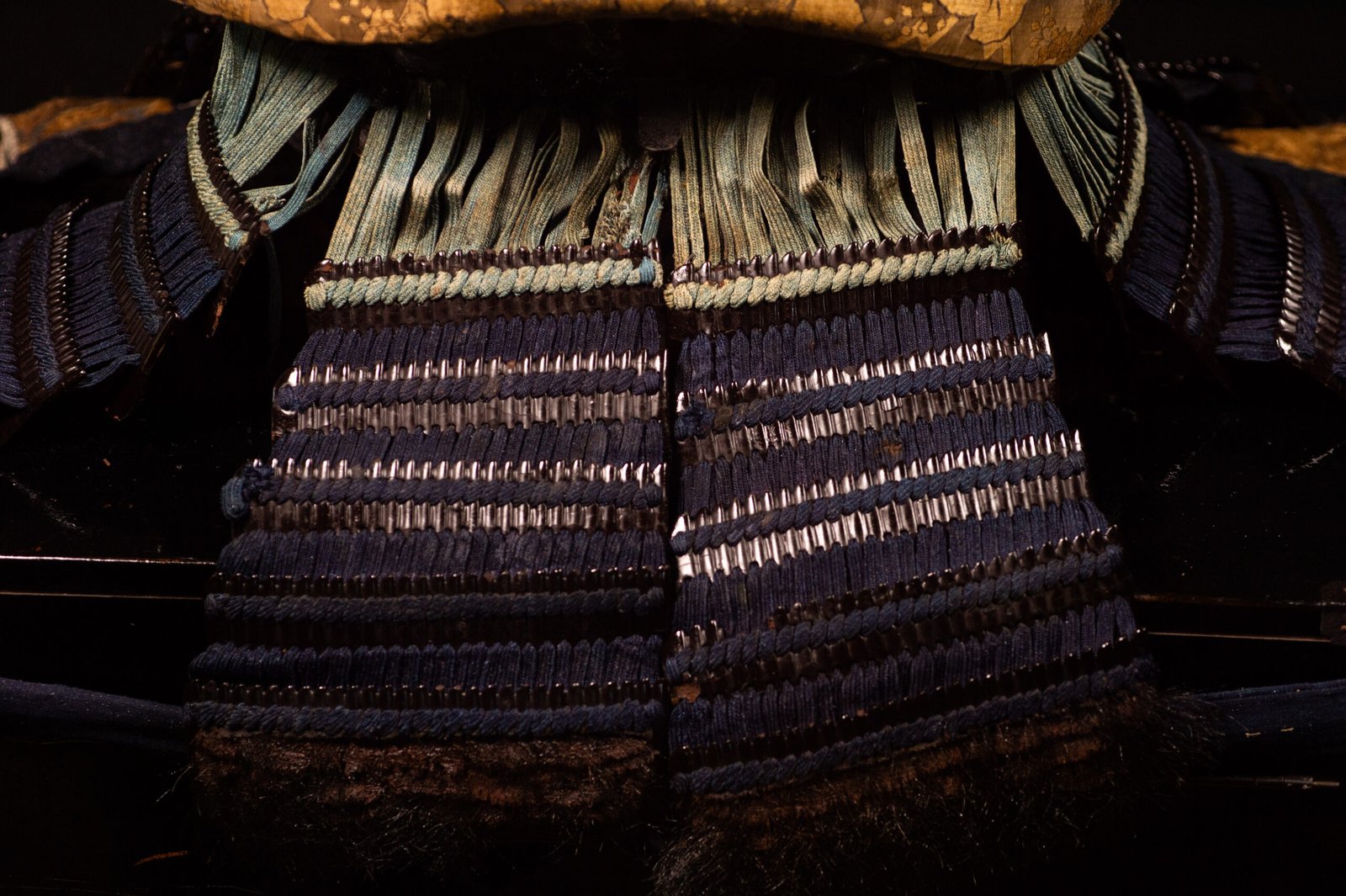
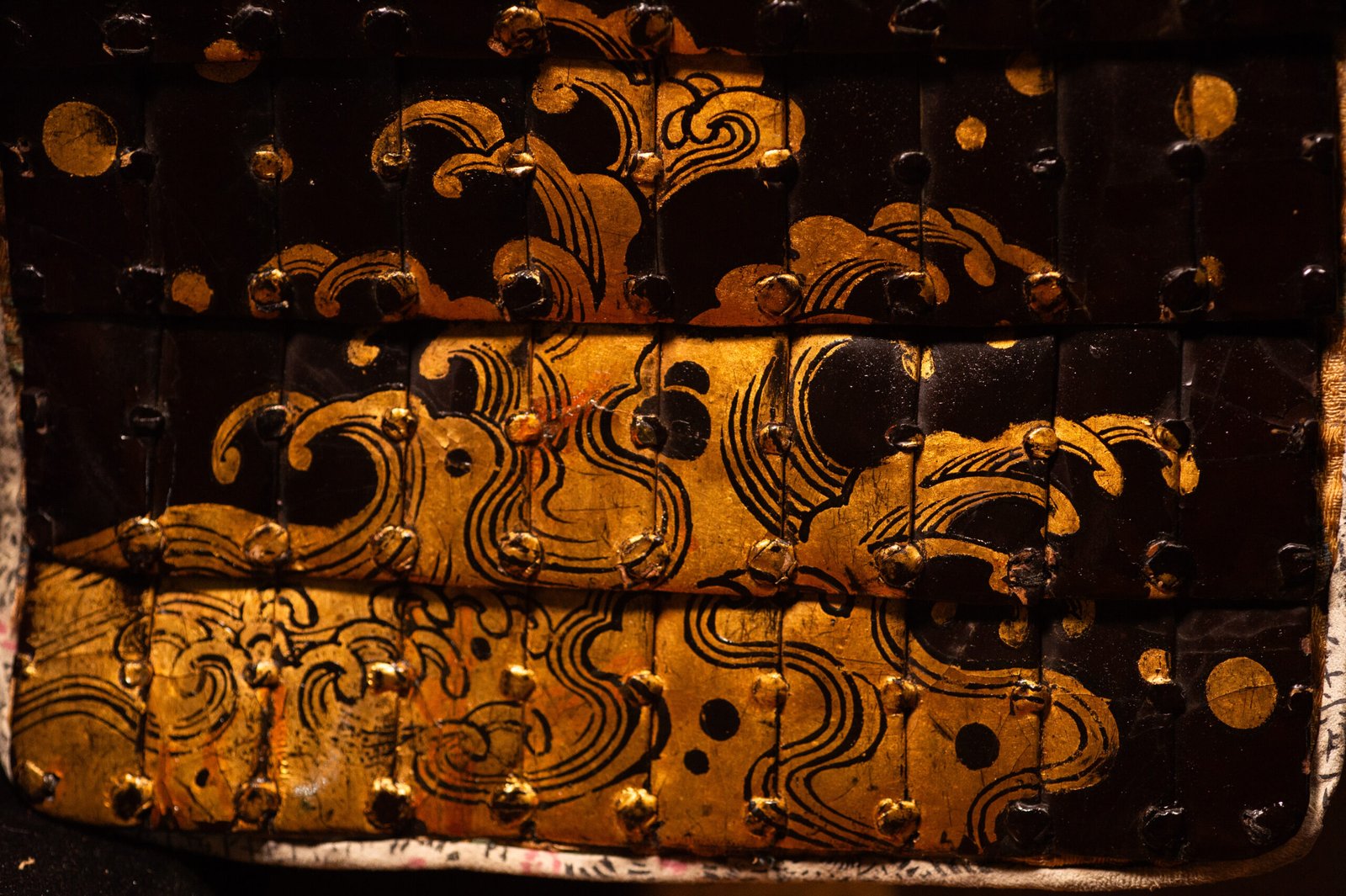
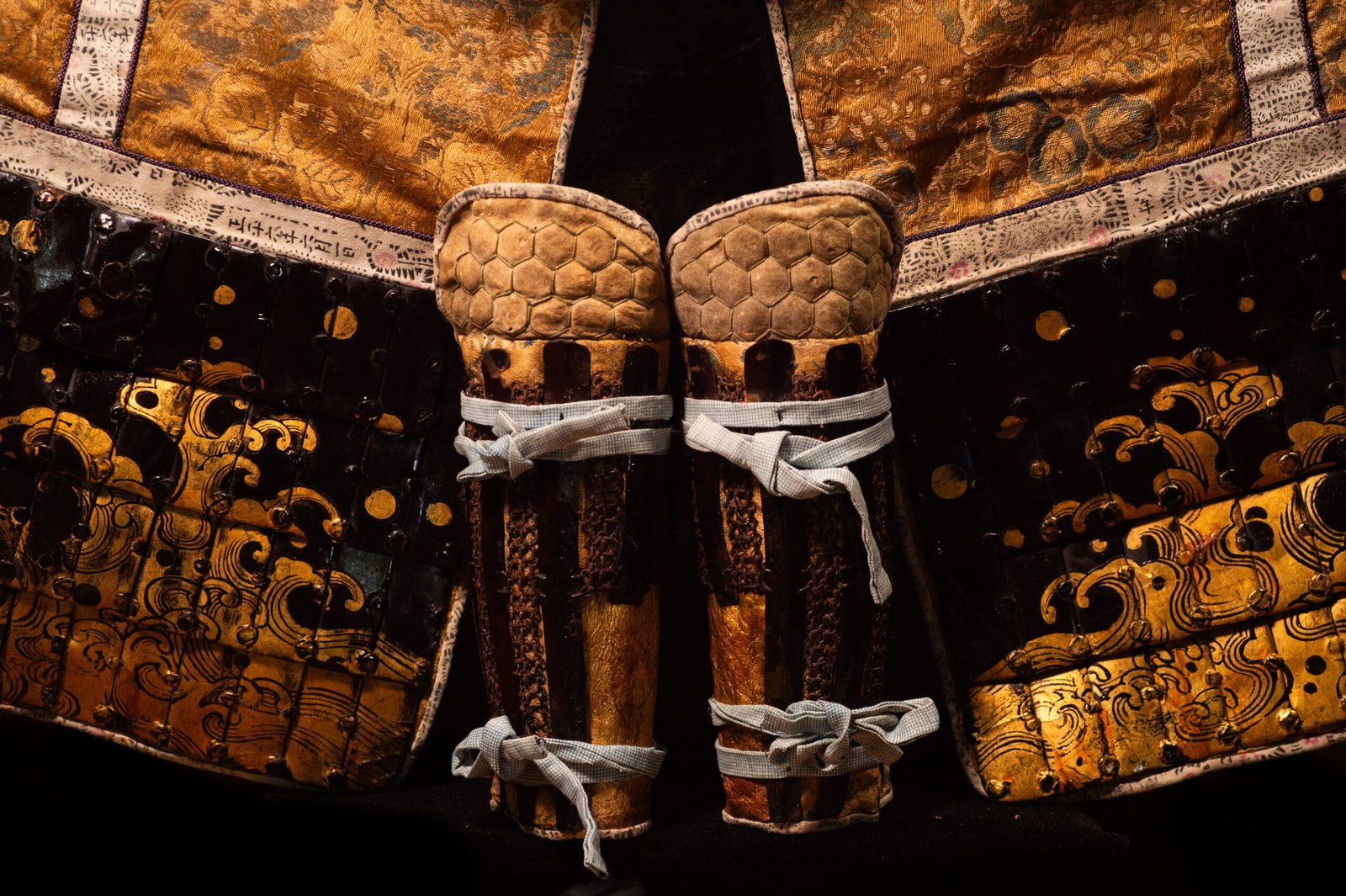
The lower cuirass is fitted with articulated kusazuri, designed to protect the hips and upper legs without excessively restricting movement.
The individual plates are joined with navy-blue lacing, continuing the principal color of the ensemble.
Against the black lacquered ground appears a decorative gold-lacquer wave motif, or nami.
The flowing wave design introduces movement across the lower section of the armor and provides an elegant visual counterpoint to the rigid horizontal construction of the plates.
The lower edge is finished with an olive-green fringe.
This unusual tonal detail softens the transition between the lacquered defenses and the textile elements worn beneath them.
Waves are among the most enduring motifs in Japanese art.
They can evoke movement, endurance, transformation and the continuous force of nature.
When applied to samurai equipment, wave imagery also creates an effective visual relationship between the disciplined structure of armor and the fluid movement required in combat.
On the present kusazuri, the gold waves stand out clearly against the black lacquer while remaining consistent with the gilt chest fitting and gold brocade used elsewhere.
The sode are covered in gold brocaded silk decorated with a floral pattern.
This textile surface gives the shoulder guards a markedly ceremonial and aristocratic appearance.
The warm gold ground provides a rich contrast with the black lacquer of the helmet and cuirass, while the floral ornament adds refinement to the otherwise strongly martial silhouette.
Textile-covered components such as these allowed armor makers to introduce complex patterns and luxurious materials without compromising the visual unity of the suit.
The use of gold brocade also connects the sode with the fabric used beneath the chainmail sleeves.
The kote combine flexible chainmail, or kusari, with gold brocaded fabric.
The chainmail provides articulated protection along the arms while preserving the flexibility required for handling weapons and moving freely.
The underlying brocade displays a floral pattern that visually corresponds with the textile treatment of the shoulder guards.
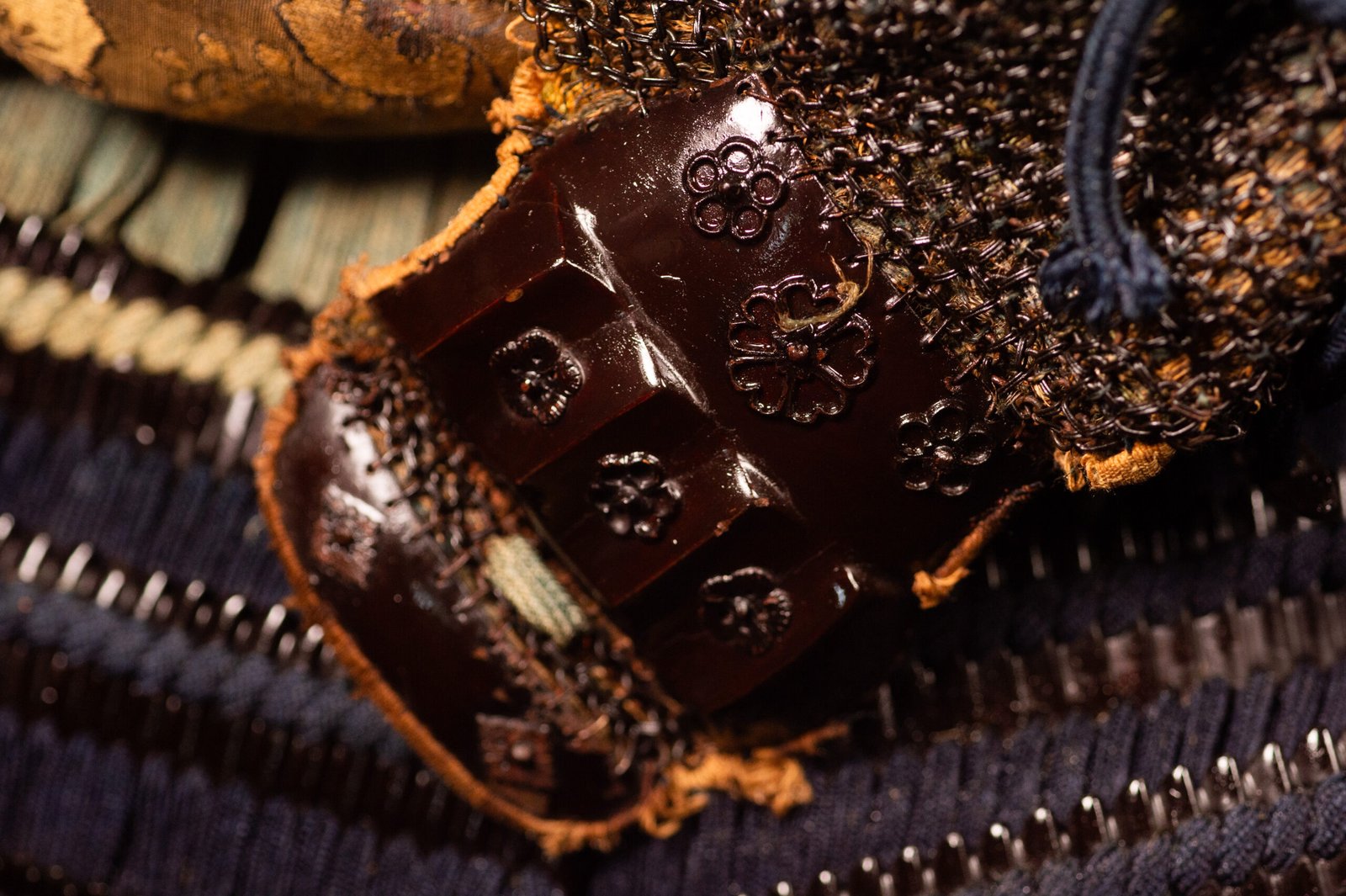
Dark-lacquered hand and fist covers, or tekko, protect the backs of the hands.
Small floral metal fittings further decorate the sleeves and repeat the botanical ornament found on the chest fitting and brocade.
This combination of chainmail, textile, lacquered plates and decorative metalwork illustrates the sophisticated integration of flexible and rigid materials characteristic of Japanese armor construction.
Suspended from the front of the cuirass is a strand of dark wooden Buddhist prayer beads, or juzu.
Prayer beads were used within Buddhist devotional practice for recitation, meditation and the counting of prayers or invocations.
Their presence alongside samurai equipment evokes the important relationship between martial life, religious observance and reflection on mortality.
Individual warriors could direct their devotion toward different Buddhist figures or traditions, including protective deities and bodhisattvas such as Fudō Myōō or Kannon.
Without documentary evidence, the beads should not be assigned to a particular sect or devotional practice, but they remain a significant object within the broader spiritual culture of the samurai.
As displayed here, the juzu introduces a human and contemplative dimension to the armor, suggesting not only combat and status but also faith, discipline and awareness of death.
Attached at the waist is a lacquered gourd-shaped flask, or hyōtan.
The vessel is fitted with a gilt stopper and a red-lacquered cap, creating a small but visually striking accessory against the dark armor.
Gourd-shaped containers could serve a practical purpose, including carrying water or sake while travelling or on campaign.
The gourd also possessed strong auspicious associations in Japanese culture and was frequently connected with protection, prosperity and good fortune.
One of the best-known historical uses of the motif was Toyotomi Hideyoshi’s Sennari-byōtan, or thousand-gourd battle standard, to which additional gourds were traditionally associated with successive victories.
The presence of the flask therefore combines a practical aspect of life on campaign with a decorative form rich in cultural meaning.
Together with the prayer beads, it provides valuable insight into the personal objects that could accompany a warrior beyond the purely defensive components of his armor.
The armor is unified by a carefully balanced combination of materials:
black and dark-brown lacquer establish the principal defensive surfaces;
navy-blue kon-ito creates continuity across the articulated components;
gold brocade introduces ceremonial richness;
gilt metal provides controlled decorative highlights;
red lacquer adds dramatic contrast to the helmet and flask;
and natural hair and leather contribute texture and realism to the facial armor.
The decorative vocabulary combines floral motifs, waves and bold sculptural forms.
Although these elements are varied, they remain visually coherent because they are repeated through a restrained and consistent palette.
The armor is preserved as a historical Japanese ensemble with visible signs of age, use and maintenance.
Old lacquer repairs are present at the join between the cuirass and the upper section of the kusazuri.
These repairs are minor, structurally stable and compatible with the long working and preservation history of an antique suit of armor.
Natural wear may also be present across the lacquer, lacing, textile, chainmail, leather and metal fittings.
Such characteristics should be assessed in relation to the age and historical nature of the object rather than according to the standards applied to newly manufactured decorative pieces.
The surviving black lacquer, deep blue lacing, gold brocade, wave decoration, natural-hair moustache and accessories allow the complete visual character of the armor to remain clearly appreciable.
The principal attraction of this armor lies in its striking visual identity and the variety of surviving decorative and personal elements incorporated into the complete ensemble.
The helmet is especially memorable.
Its tall, curved black-lacquered wakidate, with contrasting red interiors, create a commanding silhouette that distinguishes the suit immediately from more restrained forms of Edo-period armor.
The expressive reddish-brown menpō, with pronounced wrinkles, open mouth and natural blond-hair moustache, adds a strong sculptural and theatrical dimension.
The lower armor is equally noteworthy.
Gold-lacquer waves across the black kusazuri, olive-green fringe, gold floral brocade and dark blue lacing create a rich but balanced decorative programme.
The prayer beads and gourd-shaped flask give the ensemble an additional layer of interest not always retained with antique armor.
These accessories connect the armor with the lived experience of the samurai: devotion, travel, practical preparation, personal protection and the acceptance of mortality.
The old lacquer repairs should also be understood within the historical life of the object.
They demonstrate that the armor was maintained and preserved rather than remaining an untouched decorative construction.
For collectors, such details can contribute to the authenticity and individuality of an antique ensemble.
As no authentication certificate accompanies the armor, its value should not be based on an unsupported attribution to a particular armorer, school or historical owner.
Instead, its appeal rests on the completeness of its presentation, the strength of its decorative character, the survival of its distinctive accessories and its coherent stylistic relationship to Edo-period samurai armor.
A visually commanding complete Japanese gusoku, stylistically attributed to the mid-Edo period and unified by black lacquer, deep navy-blue lacing and richly contrasting textile and metal details. Its dramatic wing-shaped helmet ornaments, expressive mahogany-lacquered menpō, gold-wave kusazuri, floral brocade, Buddhist prayer beads and lacquered hyōtan flask create an unusually characterful ensemble that combines martial presence, ceremonial refinement and intimate details of samurai life. Offered without an authentication certificate, the armor is presented with a careful stylistic assessment and a transparent description of its surviving condition and historical repairs.
| Época | Edo |
|---|

Order above 1.000,00 € gets free shipping.

Secure and hassle-free payment process.

Certificate of authenticity included.

Have questions? Contact us via WhatsApp.
Contact