
November 13, 2026
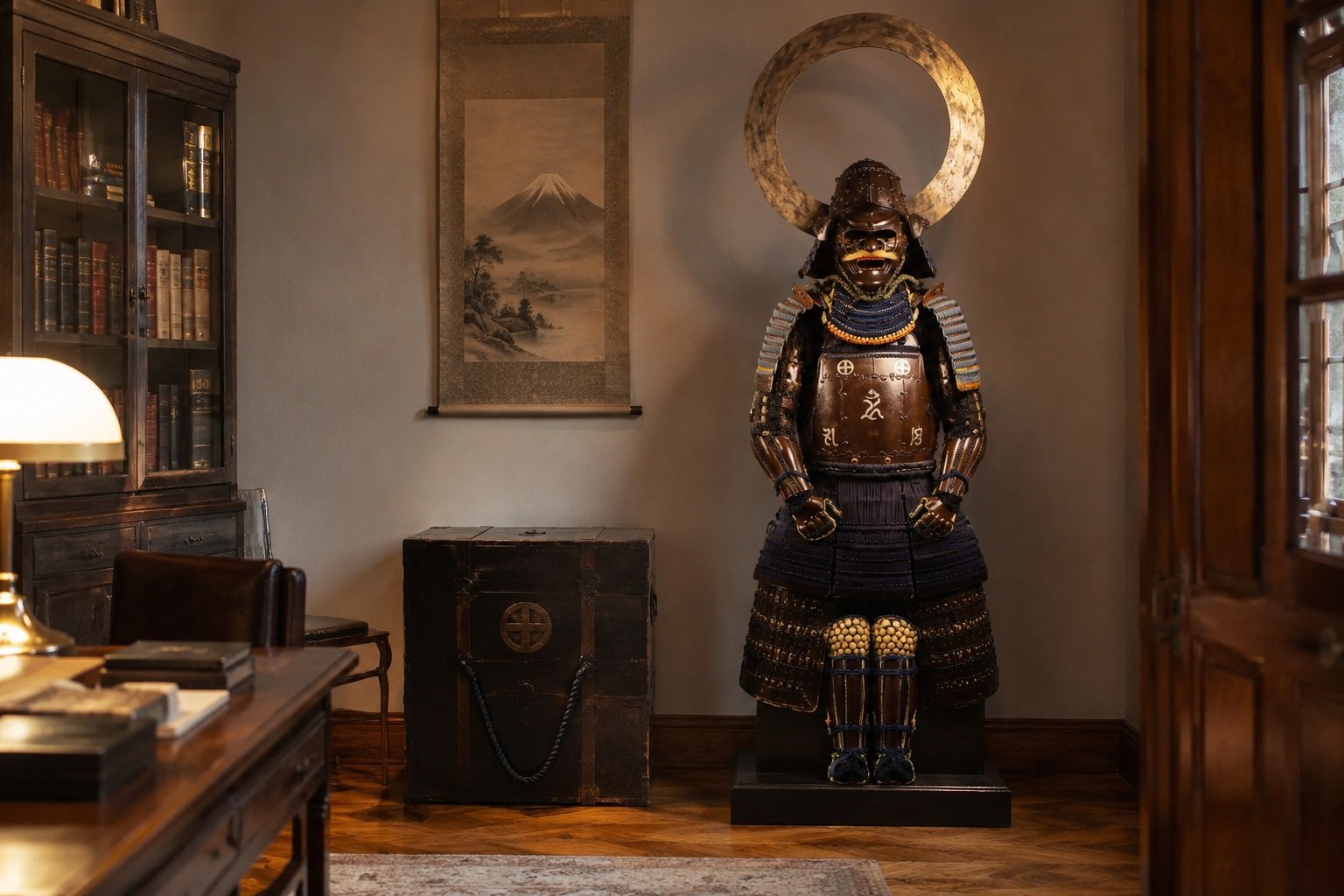
Some objects are fascinating even before we know their history. For me, Japanese samurai armor is one of them.
A Japanese sword impresses us with the elegance of its blade. A tsuba can surprise us with the delicacy of its decoration. A netsuke invites us to discover tiny details that might otherwise go unnoticed.
But a complete suit of samurai armor has something different about it.
When we look at a properly assembled gusoku, we are not simply observing a collection of antique components. We are standing before a figure that seems to preserve something of the presence of the warrior who might once have worn it.
The helmet, the face mask, the overlapping shoulder plates, the intricate lacing that runs throughout the structure… Everything contributes to creating a silhouette that we recognize immediately.
What I find particularly remarkable is that nobody needs to be inside it to create that impression.
A samurai armor can remain motionless for centuries and still have a story to tell.
Perhaps that is why I find the subject of displaying these pieces so interesting.
An antique Japanese armor is not necessarily acquired simply to be stored away. Part of the pleasure of collecting is being able to contemplate it, study its details and live alongside a small fragment of Japanese history.
And the way we display it can completely change how we experience it.
I have always found it interesting to consider how Japanese armor evolved throughout its history.
During periods of warfare, its primary purpose was obvious: to protect warriors in battle.
However, with the arrival of the Edo period (1603–1868) and the relative stability established under the Tokugawa shogunate, armor continued to play an important ceremonial and representative role.
Craftsmen continued producing extraordinary helmets, cuirasses and protective elements, incorporating elaborate lacquerwork, intricate textiles and richly decorated ornaments.
In some cases, the visual appearance of an armor became just as important as its construction.
We only need to look at certain Edo-period kabuto to understand this.
Some feature enormous gilded crests. Others incorporate shapes inspired by animals, religious symbols or family emblems. Their designs can be surprisingly expressive.
And this brings me to something I particularly appreciate about Japanese armor.
When a complete suit is displayed, all those individual elements stop being separate objects and begin to interact with one another.
The kabuto defines the upper silhouette. The menpō gives expression to the face. The cuirass establishes the central structure. The sode, arm guards and lower protective elements complete the figure.
The result is almost sculptural.
It is easy to understand why an antique samurai armor can become one of the most significant pieces in a private collection of Japanese art.
If I had to choose where to display an antique samurai armor, I would begin with a very simple question: from where will it be viewed?
It might seem like a minor consideration, but I believe it makes an enormous difference.
A complete armor contains many elements worth appreciating. The curves of the helmet, the overlapping protective plates, the colors of the lacing and the reflections of the lacquer all contribute to a complex composition.
Surround it with too many objects, and much of that richness can disappear.
Personally, I find the idea of giving an armor enough space to be appreciated as an individual work of art far more appealing.
There is something especially attractive about imagining a Japanese armor inside a library or private study.
The combination of wood, books and antique materials can create a particularly appropriate atmosphere for a historical piece.
An armor with dark lacquer and restrained metal decoration can convey extraordinary elegance.
On the other hand, an Edo-period gusoku with brightly colored lacing or a large golden helmet ornament can become the visual centerpiece of an entire room.
I do not think one approach is necessarily better than the other.
It depends on the character of the armor and, above all, on what we want to emphasize.
I also like the idea of displaying samurai armor in a modern interior.
We sometimes imagine that Japanese antiques must be surrounded by oriental furniture, folding screens or traditional Japanese decoration.
That is not necessarily the case.
A complete armor can look spectacular against a simple wall, surrounded by contemporary materials and discreet lighting.
In fact, this contrast can make its age, craftsmanship and distinctive forms even more apparent.
However, there is one thing I consider essential:
The armor should remain the focal point without allowing the interior design to compromise its safety.
I would avoid placing it in a busy passageway, beside a sunny window or too close to a source of heat.
Before being a decorative element, it remains a historical object that deserves protection.
When we look at a complete samurai armor, our attention usually turns immediately to the helmet or face mask.
However, there is another element that I find particularly interesting: the gusoku-bitsu.
This is the traditional chest used to store and transport the components of Japanese armor.
These wooden boxes, often reinforced with metal fittings and sometimes decorated with lacquer or family crests, formed part of the equipment associated with complete armor sets.
I like to think about the role they once played.
Today, we see a perfectly assembled armor, with every component arranged for display.
But for much of its history, those same pieces could have been carefully dismantled and stored inside their chest.
The gusoku-bitsu reminds us of that reality.
It also helps explain one of the most recognizable traditional methods of displaying Japanese armor: the complete ensemble mounted on a supporting structure, often positioned above its storage chest.
Visually, this arrangement can be particularly attractive.
The chest elevates the armor and contributes to the presentation of the complete figure.
However, it is important to remember that not every antique chest can safely support the weight of an assembled armor.
A suitable internal stand is essential to distribute the weight without placing pressure on fragile components.
And when an armor retains its original storage chest, I believe it deserves to be appreciated as part of its history, rather than simply as a box for keeping accessories.
This is one of the most important considerations for any collector.
An authentic Japanese armor may be two hundred, three hundred or even more years old.
And although certain metal components may appear remarkably well preserved, other materials can be considerably more delicate.
Lacing, textiles, leather components and lacquered surfaces have undergone centuries of aging.
For this reason, mounting antique armor requires much greater care than assembling a modern reproduction.
Attention must be paid to how the helmet rests on its support, how the shoulder guards are suspended and which parts of the structure actually carry the weight.
For example, it would make little sense to force old lacing merely to make both shoulders appear perfectly symmetrical.
Similarly, a face mask should never be held in position by tension that might damage its original components.
I believe this is one of the fundamental differences between displaying an antique and simply decorating a room.
The display must adapt to the condition of the armor, never the other way around.
If a piece requires a special support or contains fragile elements, consulting a professional conservator is the most responsible approach.
A historical armor does not need to look newly manufactured to be extraordinary.
Its small irregularities, subtle variations in lacquer color and the natural aging of certain materials are also part of its history.
One of the things that fascinates me about Japanese art is how dramatically our perception of an object can change depending on the light.
This is particularly evident with lacquered armor.
A black cuirass may initially appear to have an almost uniform surface under unsuitable lighting.
But introduce soft, carefully directed light, and reflections, textures and subtle differences in the finish begin to emerge.
The same applies to helmets.
The curves of a kabuto, the relief of its decorative elements and the forms of its maedate can acquire a completely different presence depending on how they are illuminated.
Personally, I prefer lighting that allows us to discover these details gradually.
I do not think it is necessary to turn an armor into the centerpiece of an elaborate lighting display.
Its craftsmanship is already interesting enough.
There is, however, an important precaution.
Antique Japanese armor can contain silk, cotton, leather and lacquer, all of which may be sensitive to light and environmental conditions.
Direct sunlight, nearby sources of heat and excessively intense lighting should therefore be avoided.
Carefully controlled LED lighting suitable for historical objects can be a good option, always taking the condition of the individual armor into account.
In some cases, limiting the duration of display may also be advisable.
After all, the objective is to enjoy the armor for many years without accelerating its deterioration.
One of the things I appreciate most about Japanese armor is that every complete ensemble can convey a different impression.
When we examine several Edo-period armors, it is remarkable to discover how much their proportions, colors and decorative elements can vary.
And it is precisely this diversity that I would like to illustrate through three pieces from the Supein Nihonto collection.
The first example is a complete Edo-period samurai armor with moegi green lacing.
This is one of those pieces in which color plays a fundamental role.
The contrast between the dark lacquered iron, vermilion details, gilded decoration and green moegi-odoshi lacing creates an extraordinarily rich composition.
But what particularly attracts my attention is the relationship between those colors and the upper part of the armor.
Its tall helmet, accompanied by a large golden disc-shaped ornament, gives the ensemble a highly distinctive silhouette.
It is easy to imagine this armor in a room with neutral tones, where all attention would naturally be directed toward its forms.
I find it a wonderful example of something we sometimes forget: Japanese armor was not always intended to convey a dark or intimidating appearance.
It could also express refinement, richness of color and considerable artistic sensitivity.
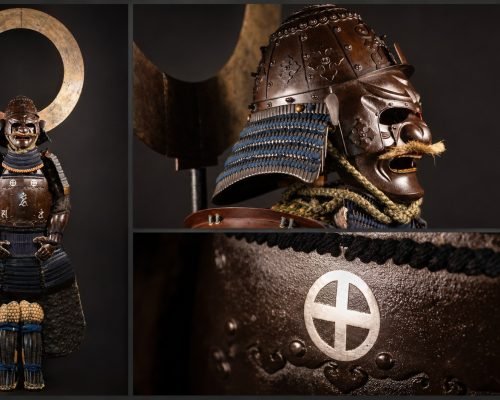
The second piece, the Mōri Clan Samurai Armor from the mid-Edo period, conveys a very different impression.
Here we find reddish lacquer tones, dark blue lacing and patterned textiles that create a much more restrained composition.
It does not depend on a spectacular oversized ornament to attract attention.
Its appeal lies in its balance.
The rounded helmet, horizontally plated cuirass and harmonious relationship between the different components form a visually coherent ensemble.
This is the kind of armor I can easily imagine in a private library or a dedicated collection room.
Not so much because of its immediate visual impact, but because it encourages us to stop and appreciate the smaller details.
It seems like the sort of piece that could reveal something new every time we looked at it.
Its product description also indicates that it comes with a display stand and storage box, two elements that are particularly relevant for anyone wishing to display a complete historical armor.
The third example is a complete Edo-period samurai armor with indigo lacing.
Here, my attention immediately turns to the helmet.
Its large golden crescent-moon ornament completely transforms the silhouette of the ensemble.
The deep indigo-blue lacing and elaborate decorative elements create a composition with a particularly strong personality.
I find it fascinating how a relatively specific component, the maedate, can change our perception of an entire armor.
In this case, we are not simply talking about the shape of the helmet.
The rising curve of the crescent moon visually extends the figure upward, creating a highly recognizable profile.
For this reason, if I were considering how to display this piece, I would pay particular attention to the available vertical space.
It would be a shame to place an armor like this somewhere that restricted the visual impact of its ornament.
This is an excellent example of how different armors can require different display arrangements.
What works for a gusoku with a relatively discreet helmet may not be appropriate for another with a large and elaborate crest.
And that individuality is precisely part of their appeal.
If I were considering acquiring an antique Japanese armor for display, I would not begin simply by asking where it would look best.
I would first try to understand the piece itself.
Is the armor complete? Does it retain all its original components? Are there restorations or replaced elements? What is the condition of the lacing and lacquered surfaces?
I would also want to know whether it includes a suitable display stand and its traditional storage chest.
Not because every armor must necessarily retain these accessories, but because they can influence both its historical interest and the practical possibilities for displaying it.
Only then would I start thinking about the space.
An armor with a large maedate may require considerable height. Another, with particularly broad shoulder guards, may need more lateral space than we initially imagine.
And finally, I would consider its character.
Some armors impress us immediately. Others are more restrained and require patient observation before revealing all their details.
Personally, I do not believe one should be considered superior to another simply because of its visual impact.
Each offers a different way of approaching Japanese art and history.
What matters is finding a piece that genuinely captures our interest and ensuring that we can preserve it properly.
It is tempting to think that once an armor has been assembled, the ideal solution is to leave it permanently on display.
But that is not always the best decision.
Some armors can remain on display for extended periods if they are in good condition and kept in an appropriately controlled environment.
Others, particularly those containing fragile textiles or unstable surfaces, may require periods of careful storage.
Museums face similar considerations.
At the Asian Art Museum in San Francisco, for example, specialized conservation and mounting work on Japanese armor has been documented in preparation for exhibitions.
These processes demonstrate how an object that appears structurally robust can contain extremely delicate components.
I think it is important to remember that iron and textiles do not age in the same way.
An armor may preserve its general shape while containing weakened lacing, sensitive leather or lacquered surfaces that require special attention.
For this reason, the best display is not always the most spectacular one.
Sometimes, the most responsible decision is to protect a piece for a period of time and display it again when conditions are appropriate.
If you are interested in understanding these materials in greater detail, you can read our article about the use of urushi lacquer in Japanese samurai armor.
There is something I particularly appreciate about antique Japanese armor.
When we look at one of these pieces, it is easy to be impressed by its appearance. The helmet, golden ornaments, expressive masks and colors immediately capture our attention.
But beyond that first impression lies something much more interesting.
Someone had to shape the iron plates.
Another craftsman prepared and applied the different layers of lacquer.
Someone created the intricate lacing and textiles that connect the components.
And behind the armor’s final appearance were technical decisions, family traditions, artistic preferences and knowledge passed down through generations.
That is why, when I look at Japanese armor as a work of art, I do not think exclusively about the samurai who may once have worn it.
I also think about all the people who contributed to its creation.
And I believe that is one of the great reasons these objects deserve to be preserved.
Japanese armor represents more than the military history of Japan.
It also represents the history of its craftsmen.
Perhaps that is why it does not need elaborate decoration surrounding it.
An appropriate support, respectful lighting and enough space to appreciate its form are often sufficient.
Everything else is already present in the armor itself.
Every historical Japanese armor has its own personality.
Some stand out for their spectacular helmets. Others reveal their beauty through the combination of lacquer colors, the elegance of their lacing or the details preserved in their construction.
But all of them allow us to approach an artistic tradition that extends far beyond the familiar image of the samurai warrior.
At Supein Nihonto, our collection brings together original Japanese armors representing different periods, traditions and styles, intended for collectors who appreciate both their history and their craftsmanship.
Because acquiring an antique armor is not simply about adding another object to a collection.
It also means accepting the responsibility of preserving a small part of Japanese history.
We invite you to explore our collection of authentic Japanese samurai armor — Gusoku and Yoroi and discover the different personalities preserved within these extraordinary historical objects.
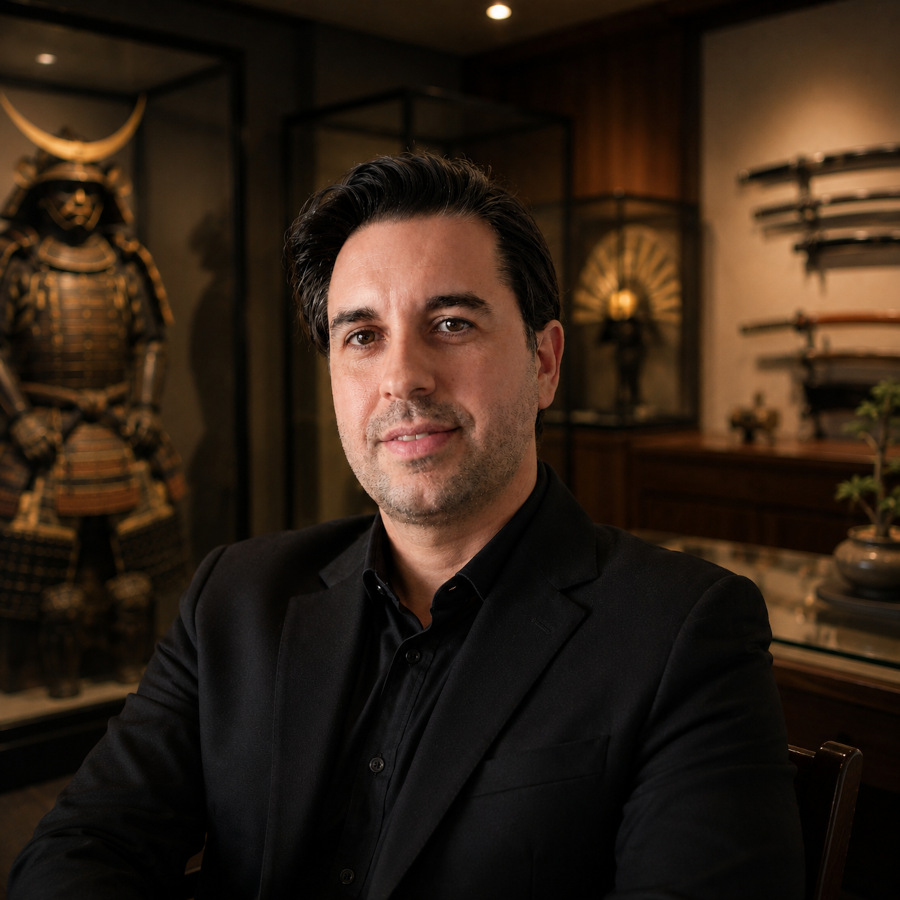
CEO of SupeinNihonto, dealer and collector of ancient Japanese art and weapons from Canillo, Andorra.
Contact