Mōri Clan Samurai Armor (Gusoku) with Reddish Lacquer – Mid-Edo Period
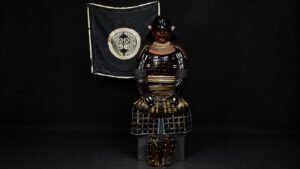
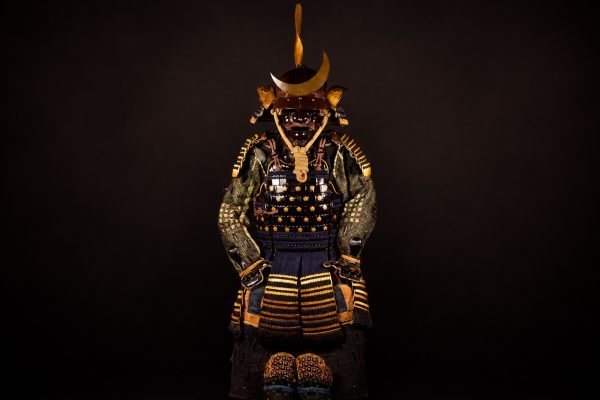
A distinctive Japanese samurai armor (gusoku) from the mid-Edo period, with a confirmed association with the Mōri clan. Its appearance is defined by warm reddish lacquer, dark blue lacing, patterned textiles, and restrained gilt ornament.
The relationship between the rounded helmet, horizontal-plate cuirass, and accompanying defenses gives the ensemble a balanced silhouette. An old textile tag references the Mōri house in Chikuzen Province, in present-day Fukuoka Prefecture. The armor is accompanied by a display stand, a storage box, and a certificate issued by Supein Nihonto.
The Helmet
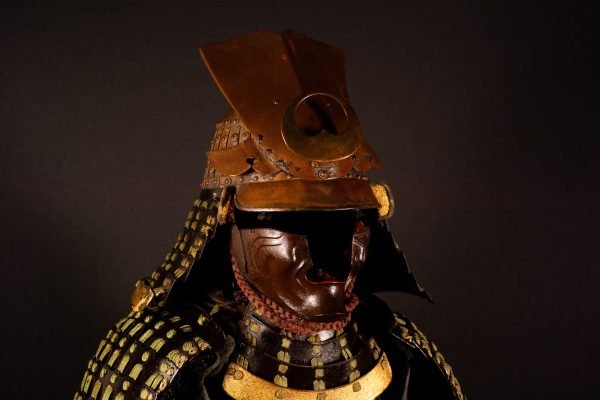
The zunari-bachi kabuto has a clean, rounded profile finished in deep reddish lacquer. Its relatively restrained outline allows the color and proportions of the helmet to take prominence.
A modest maedate and an ornamental gold-colored cord provide contrasting details at the front. These elements complement the lacquer without overwhelming the shape of the helmet bowl.
The shikoro is finished in black lacquer and joined with dark blue odoshi. The contrast between the reddish helmet bowl, dark neck guard, and blue lacing introduces the principal colors repeated throughout the armor.
The Cuirass
The dō is of okegawa-dō construction, with horizontal plates forming the torso protection. Its reddish lacquer surface is one of the defining features of the ensemble.
The horizontal arrangement gives the cuirass a clearly structured appearance, while the lacquer creates a broad field of warm color. Dark blue lacing and the surrounding textile elements provide contrast without interrupting the visual balance.
The Shoulder and Arm Defenses
The sode continue the ensemble’s coordinated appearance through their lacquered surfaces and dark blue lacing. Their position on either side of the cuirass helps define the width and outline of the assembled armor.
The kote combine metal protective elements with patterned textile. Traditional geometric designs introduce finer detail alongside the broader lacquered surfaces of the helmet and torso.
The Thigh and Leg Defenses
The haidate and suneate complete the lower section of the ensemble. Their protective elements, textile components, and dark blue fastening details continue the visual language established above.
Across the armor, the combination of lacquered metal, patterned fabric, and lacing creates a consistent relationship between color and texture. This visual coherence is particularly apparent when the ensemble is displayed on its stand.
The Mōri Clan Association
This armor has a confirmed association with the Mōri clan. An old textile tag accompanying the ensemble references the Mōri house in Chikuzen Province, corresponding to part of present-day Fukuoka Prefecture.
The tag is an important detail in the armor’s historical identification and should be considered alongside the ensemble and its accompanying documentation. The clan association is retained here without assigning the armor to a particular named wearer or attributing a specific military role to it.
Period
Mid-Edo period.
The armor combines traditional protective forms with a coordinated decorative treatment. Its reddish lacquer, dark blue lacing, and geometric textiles give it a distinctive appearance within the broader tradition of Edo-period Japanese armor.
Condition
The ensemble retains a visually cohesive presentation, with reddish lacquer, dark blue lacing, and patterned textiles contributing to its overall character. Age-related wear and deterioration are present, including wear to textile components.
The photographs form an important part of the description and should be examined closely to assess the condition of individual elements. Additional photographs of the lacquer, lacing, fabrics, and fittings can be requested before purchase.
As with other historical armors incorporating delicate textiles and laced components, care is required during handling, assembly, and disassembly.
Documentation and Accessories
The armor comes with a certificate issued by Supein Nihonto. The old textile tag referencing the Mōri house in Chikuzen is also part of the accompanying historical material.
A display stand and storage box are included for presentation and storage.
Key Features
- Type: Japanese samurai armor (gusoku)
- Period: Mid-Edo period
- Clan association: Confirmed association with the Mōri clan
- Historical detail: Old textile tag referencing the Mōri house in Chikuzen Province, present-day Fukuoka Prefecture
- Kabuto: Zunari-bachi helmet with deep reddish lacquer
- Helmet ornament: Restrained maedate and ornamental gold-colored cord
- Shikoro: Black lacquer with dark blue odoshi
- Dō: Horizontal-plate okegawa-dō with reddish lacquer
- Sode: Shoulder defenses continuing the ensemble’s coordinated colors and lacing
- Kote: Metal protective elements combined with patterned textile
- Lower defenses: Haidate and suneate
- Lacing: Dark blue
- Textiles: Traditional geometric patterns
- Condition: Age-related wear and deterioration; see photographs for individual details
- Documentation: Certificate issued by Supein Nihonto
- Included accessories: Display stand and storage box
About Supein Nihonto
Our photographs are taken without digital retouching so that you can examine the appearance and condition of each object. Through our work with collectors, galleries, and museums in Japan, we seek out pieces that reflect the variety and craftsmanship of Japanese art.
Samurai art is our passion, and sharing its details is an important part of what we do. If you would like additional photographs or information about this armor, please contact us.
A mid-Edo gusoku associated with the Mōri clan, distinguished by its reddish lacquer, dark blue lacing, and balanced silhouette. The zunari helmet, horizontal-plate cuirass, and patterned textiles give the ensemble a character that rewards both an overall view and closer examination.