Some netsuke immediately catch the eye because of their complexity.
Others work in a quieter way.
This small Edo-period carving belongs to the second group.
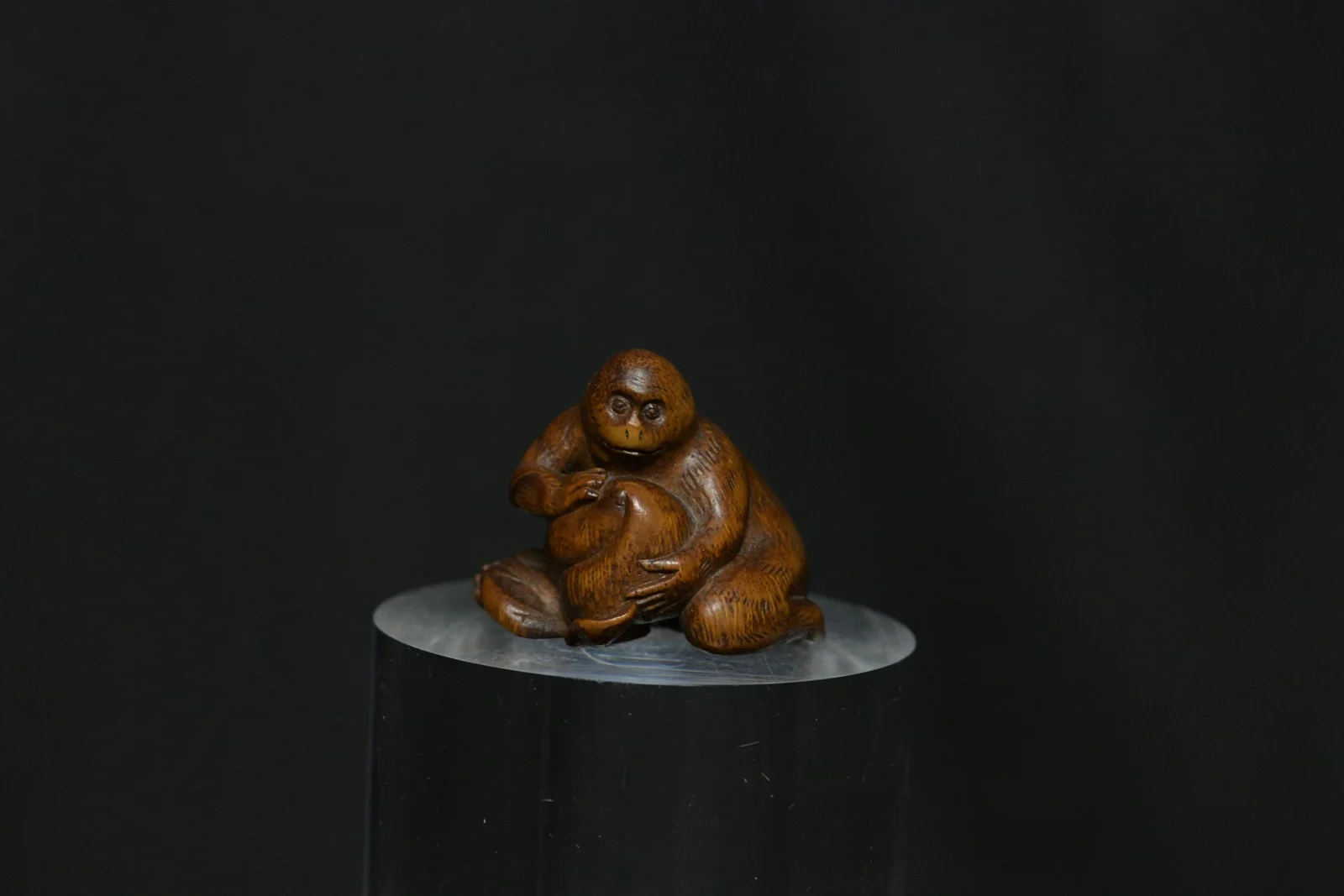
The subject is simple: a seated monkey with a large persimmon.
But the closer you look, the more interesting the relationship between the two forms becomes.
The fruit is not simply placed beside the animal. It occupies much of the centre of the composition, while the monkey’s arms, hands and body curve around it.
The result is a very compact little sculpture.
The persimmon is almost as important to the composition as the monkey itself.
Its broad, rounded surface sits at the centre of the carving and gives the netsuke much of its volume.
The monkey is arranged around it rather than simply next to it.
One arm crosses the upper part of the fruit, while the other comes around its side. The legs remain gathered close to the body, helping the entire carving maintain a rounded silhouette.
This compact construction is particularly important in a netsuke.
At only 4 × 3.3 × 3.3 cm, there is very little room for unnecessary extension.
Everything has to fit together.
The monkey is represented seated and leaning toward the fruit.
What I find especially appealing is the way the body remains easy to understand despite the small scale.
The head sits clearly above the composition.
The shoulders and arms move toward the persimmon.
The legs fold inward.
And the hands rest naturally against the fruit.
There is a clear contrast between the animal’s body and the smoother central form of the persimmon.
The carved details of the fur help separate the monkey visually from the fruit without breaking the compact shape of the netsuke.
The face is one of the most direct parts of the carving.
The eyes, nose and mouth are all clearly defined within a relatively small rounded head.
The expression is restrained rather than exaggerated.
That simplicity works well here because the composition does not depend on a dramatic facial expression.
Instead, the interest comes from the posture of the animal and the way it interacts physically with the fruit.
The persimmon is deliberately large in relation to the monkey.
Its rounded form creates a strong visual centre.
Compared with the more articulated surface of the animal, the fruit is smoother and more continuous.
This contrast makes the composition easier to read.
We see the monkey.
We see the fruit.
And then we begin to notice how the two have been fitted together.
The monkey’s hands, arms and torso visually lock into the shape of the persimmon.
That is what gives the carving its compactness.
This netsuke is carved from wood.
The precise wood species is not recorded, so I would not try to identify it from appearance alone.
What we can see clearly is its warm brown colour and the tonal variation across the surface.
The recessed areas are darker.
The raised surfaces catch more light.
That difference helps define the carving.
It is especially noticeable around the fur, the hands, the face and the smaller folds between the monkey and the fruit.
The existing patina is an important part of how the netsuke appears today.
On a small wood carving like this, surface colour can completely change the way details are perceived.
The darker tones in the recessed areas increase the visual depth of the carving, while the smoother exposed surfaces retain warmer highlights.
This gives the netsuke a softer and more natural appearance than a uniformly coloured surface would have.
It also makes the object particularly interesting to examine under changing light.
One detail worth explaining is the natural himotoshi.
In a netsuke, the himotoshi are the openings through which the cord would pass.
In some pieces, these are clearly drilled holes.
In others, like this example, the cord passage is created through existing openings in the sculptural form.
That is what is meant here by natural himotoshi.
Instead of interrupting the composition with separate holes, the cord passage is integrated into the structure of the carving itself.
It is a small technical detail, but an important one when examining how a netsuke was conceived as a functional object rather than simply as a miniature sculpture.
For readers who would like a broader introduction, our guide What Is a Netsuke? explains their original function and the importance of features such as the himotoshi.
This is also a piece that makes more sense when imagined in the hand.
From the front, the monkey and persimmon form one clear group.
But a netsuke is three-dimensional.
Turning it reveals the curvature of the fruit, the way the limbs wrap around the composition and the openings that form the natural himotoshi.
That changing relationship between the forms is part of what makes Japanese netsuke so enjoyable to study.
They are small objects, but they are rarely designed to be understood from a single viewpoint.
The piece is dated to the Edo period.
Beyond that, there is no narrower dating, maker attribution or school recorded with the object.
And in this case, I think that is enough.
The carving already gives us plenty to look at:
a seated monkey,
a large persimmon,
a compact sculptural structure,
warm wood tones,
visible patina,
and natural himotoshi integrated into the form.
What I like most about this piece is its economy.
There are only two main elements.
The monkey and the fruit.
Nothing feels unnecessary.
The persimmon gives the composition its volume.
The monkey wraps around it.
The arms connect both forms.
The folded legs keep the silhouette compact.
And the natural himotoshi remain integrated into the sculpture.
At 4 × 3.3 × 3.3 cm, the object is small enough to fit comfortably in the hand, yet the composition still feels complete.
It is a good example of how a netsuke can take a very simple subject and turn it into something that rewards slow observation.
The closer you look, the more clearly you see how carefully the two forms have been made to belong together.
CEO of SupeinNihonto, dealer and collector of ancient Japanese art and weapons from Canillo, Andorra.
Contact