October 14, 2026

A scientific study compared three historical tsuba from the British Museum with experimental copper-alloy samples to investigate shakudō patina. Its results connect alloy composition with differences in surface color and texture. The findings concern the objects and experimental conditions studied, offering a focused explanation of the roles of gold, silver, and tin.
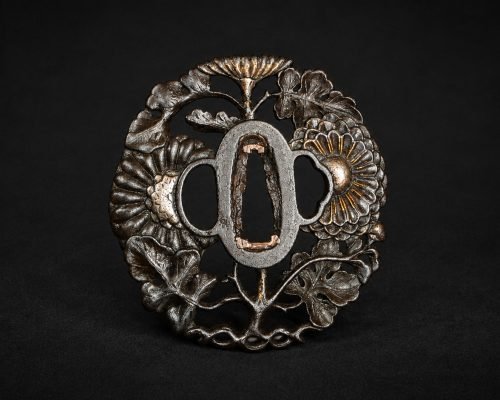
Shakudō marugata tsuba with Japanese folklore decoration from the Supein Nihonto collection. Collection example; not one of the three British Museum tsuba examined in the study.
Explore Japanese sword guards in our Tsuba collection.
Agnese Benzonelli, Ian C. Freestone, and Marcos Martinón-Torres published the study in PLOS ONE in 2023. They investigated how alloying elements affected traditionally patinated copper-alloy samples, then compared their observations with three historical sword guards. This combination let them test material behavior under experimental conditions and check whether the measured colors followed similar trends on museum objects.
The British Museum examples were selected for their shakudō base or inlays: BM-TS244, BM1952,0211.31, and BM1958,0730.56.d. The researchers examined the historical objects with colorimetry, optical microscopy, and portable X-ray fluorescence. More extensive techniques, including electron microscopy and diffraction, were used on experimental samples. These were different levels of examination, not identical tests on every object.
In the experimental comparisons, adding gold moved the patina color farther toward blue than adding silver alone. The authors also found that gold made the patina more homogeneous, uniform, and black. They relate these effects to a slower reaction and the development of a thinner, more compact surface layer.
The comparison with historical objects supported the measured color trend. Patinas on alloys containing mainly gold were bluer than those on alloys containing mainly silver; the latter were in turn bluer than patinas on alloys without precious metals. This describes the reported measurements, rather than a visual test for identifying an unknown fitting.
The analyzed historical shakudō contained both gold and silver, with silver present in lower proportions than gold. The authors contrast this with some recipes in the literature. Their observations show why a simplified description of an alloy does not necessarily capture every element found in a historical example.
Silver influenced patina color in the experiments, but its effect differed from that of gold. The study compares gold-rich and silver-rich alloys through measured color coordinates. Its evidence is therefore more specific than saying that precious-metal content simply makes every surface darker or improves every finish.
Under the experimental conditions, tin promoted more rapid corrosion and larger cuprite crystals. The resulting surfaces were coarser, more matte, and powdery, with poorer adherence. A dark color alone therefore did not mean that a sample had the same surface qualities as the thin, smooth patina the researchers were investigating.
The authors conclude that the absence of tin and the presence of gold limited oxide-layer growth compared with the other tested compositions. They connect that limited growth with a smooth appearance and the desired blue-black effect. These are findings about the tested alloys and treatment conditions, not instructions for treating an antique.
Optical observation of the museum objects showed smooth surfaces without observable crystals or scratches. The researchers considered this consistent with fine polishing before patination, but explicitly called for electron-microscope examination to confirm the surface features. It would go beyond their results to claim that the microscopic structure of the museum patinas had already been established by those methods.
The study also left the presence or absence of noble-metal nanoparticles unresolved. Its methods could not observe them, and further investigation was needed. For readers of historical tsuba, the value of this research is its comparison of measured color and experimental material behavior, together with its stated limits. It does not certify another object’s composition, authenticity, age, or value.
CEO of SupeinNihonto, dealer and collector of ancient Japanese art and weapons from Canillo, Andorra.
Contact