
1 in stock
1 in stock
Add to Compare
Add to Wishlist
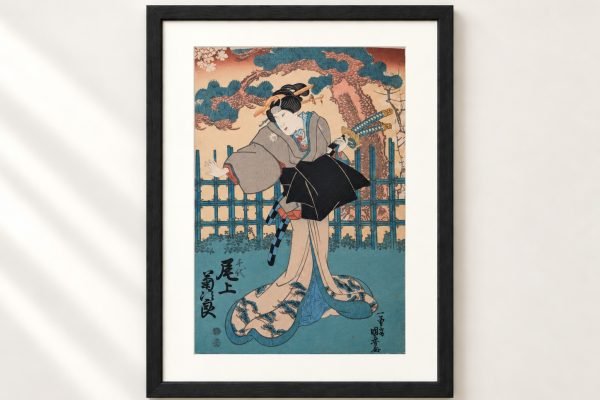
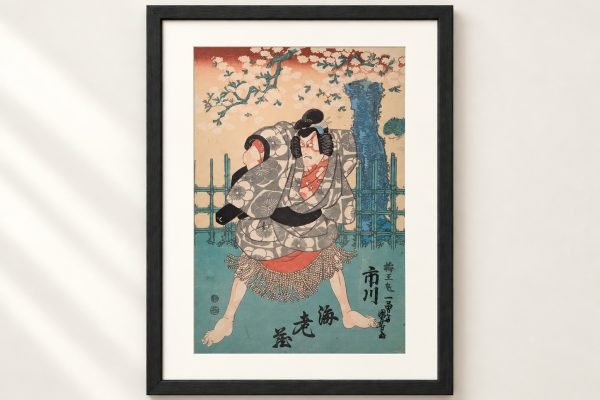
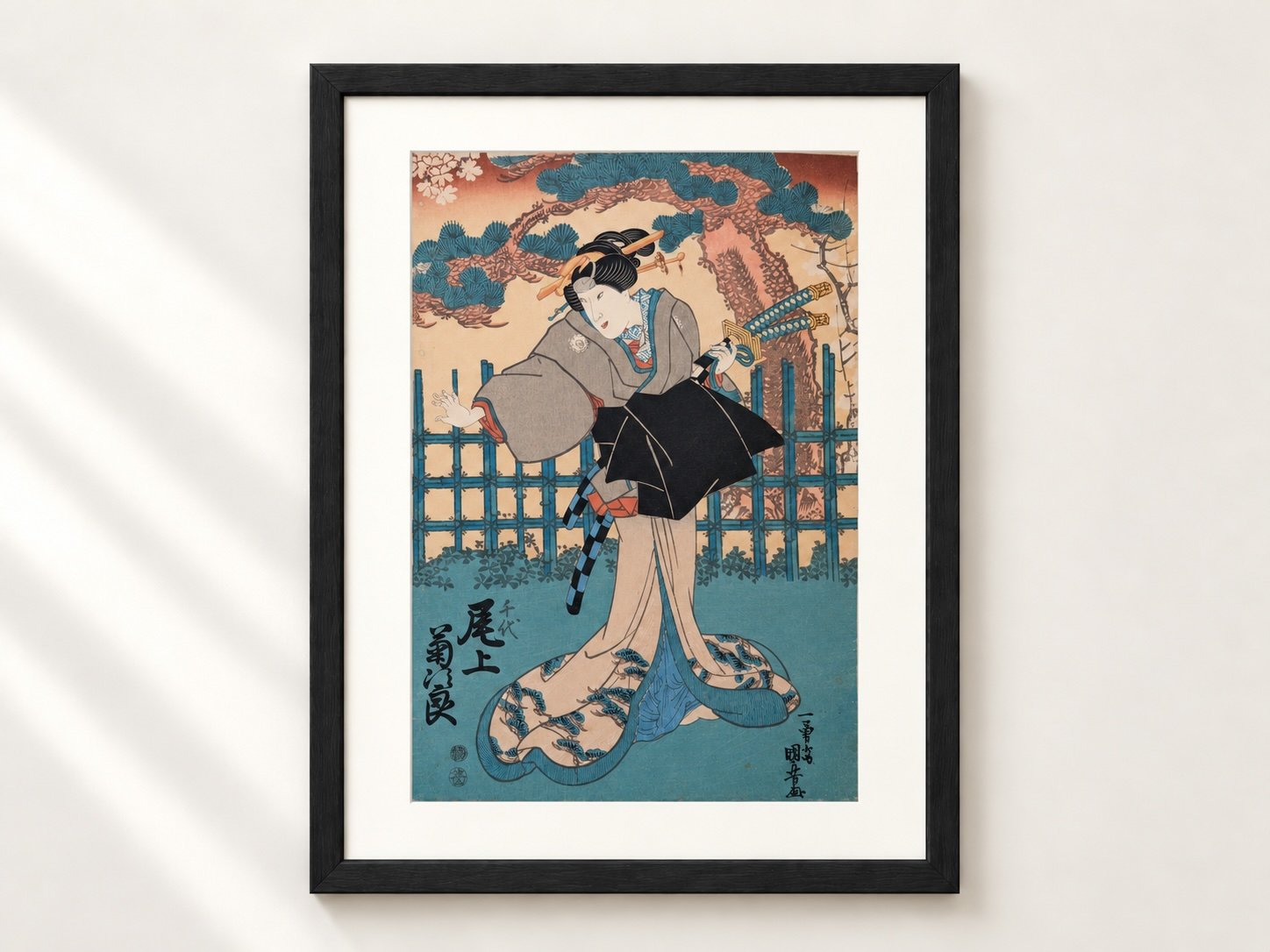
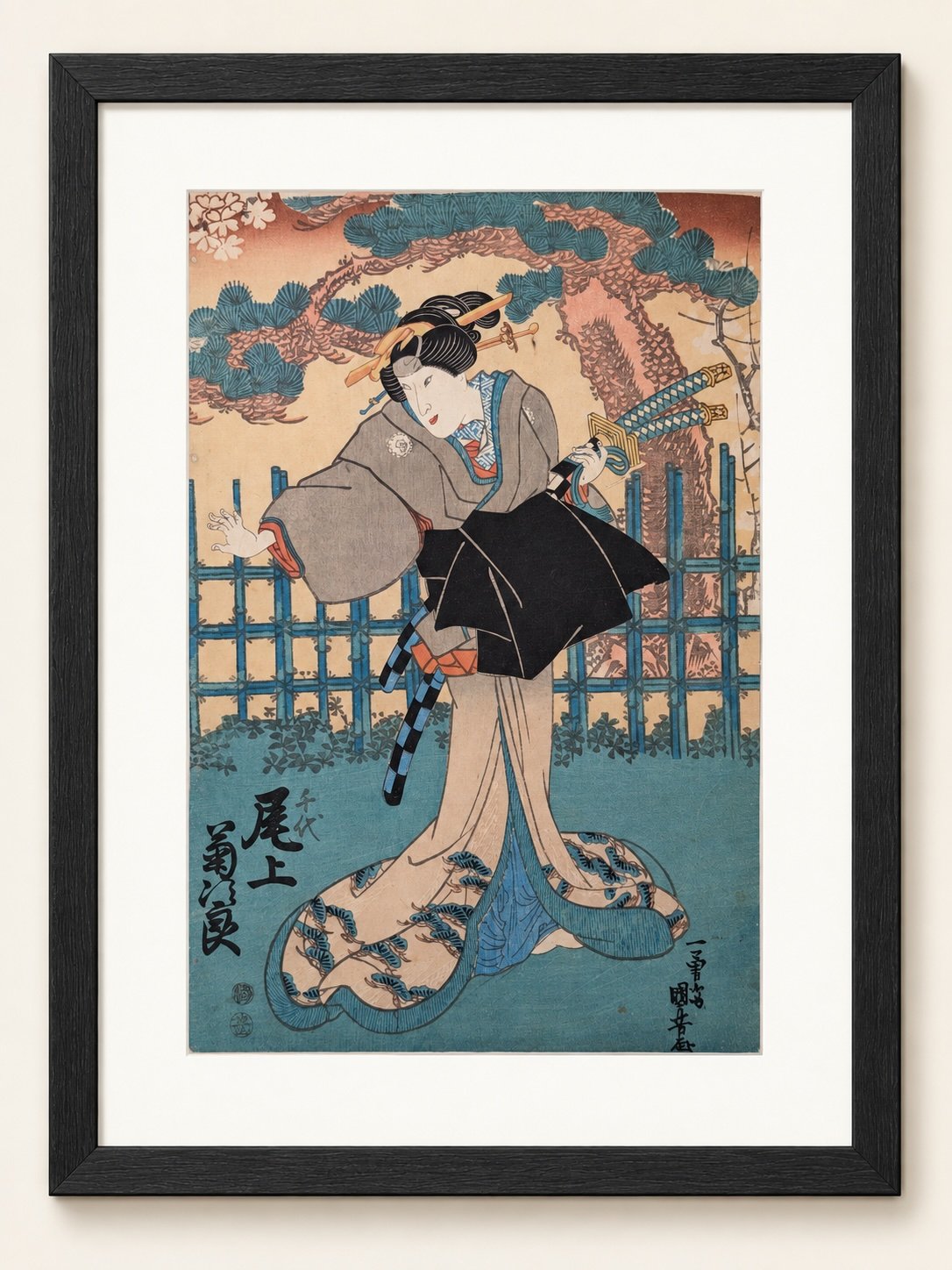
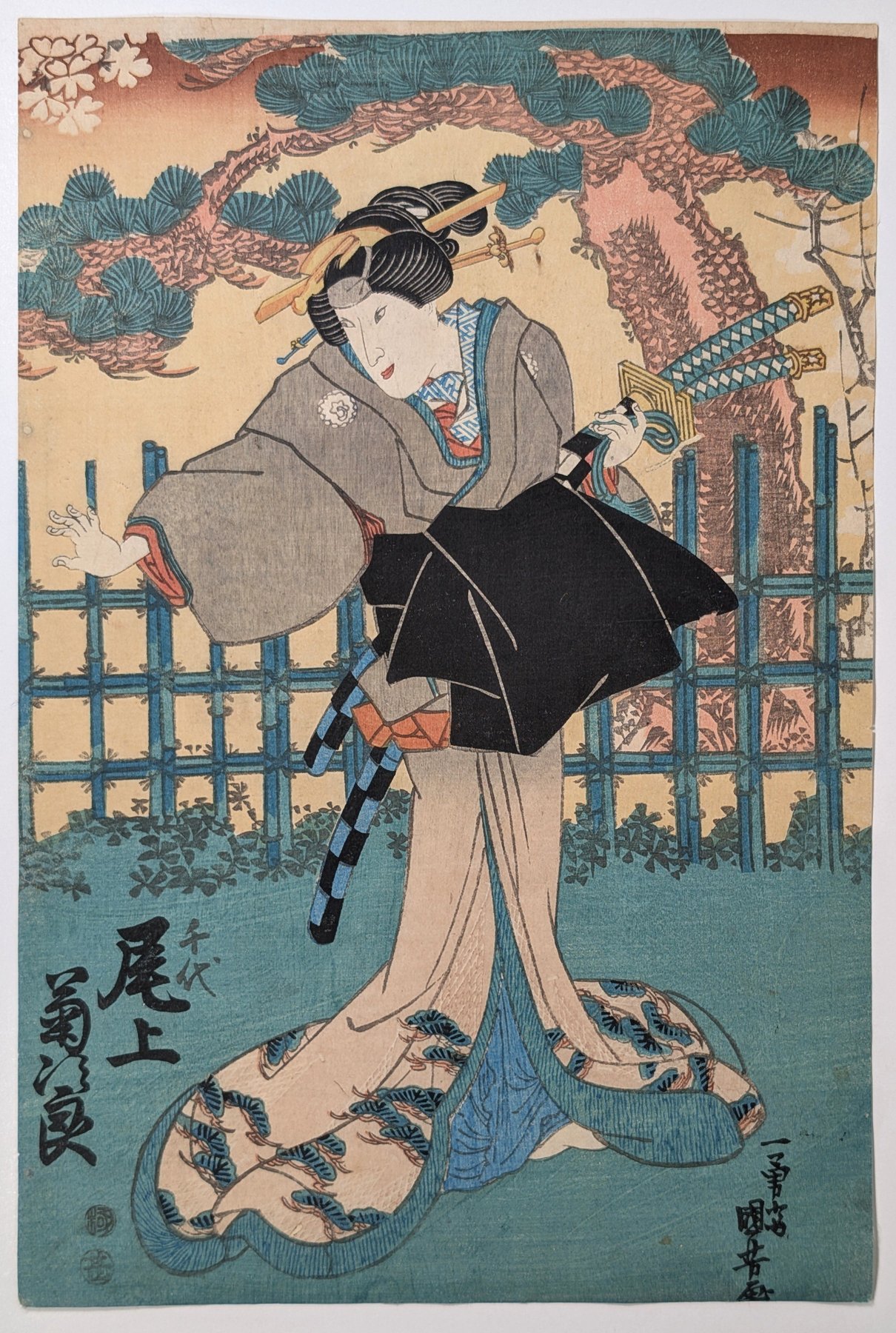
An original antique Japanese ukiyo-e woodblock print by Utagawa Kuniyoshi (1797–1861), depicting the onnagata kabuki actor Onoe Kikujirō in the role of Chiyo (千代), wife of Matsuōmaru, from Sugawara Denju Tenarai Kagami (菅原伝授手習鑑, “Sugawara and the Secrets of Calligraphy”). Dating from approximately 1847–1852, the print is signed Ichiyūsai Kuniyoshi ga (一勇斎国芳画) and belongs to a multi-sheet composition illustrating the celebrated Ga no iwai (賀の祝, “Celebration of Longevity”) scene. Chiyo stands beneath a pine tree beside the blue bamboo fence that continues across the series, her hand positioned at the small dagger worn at her sash.
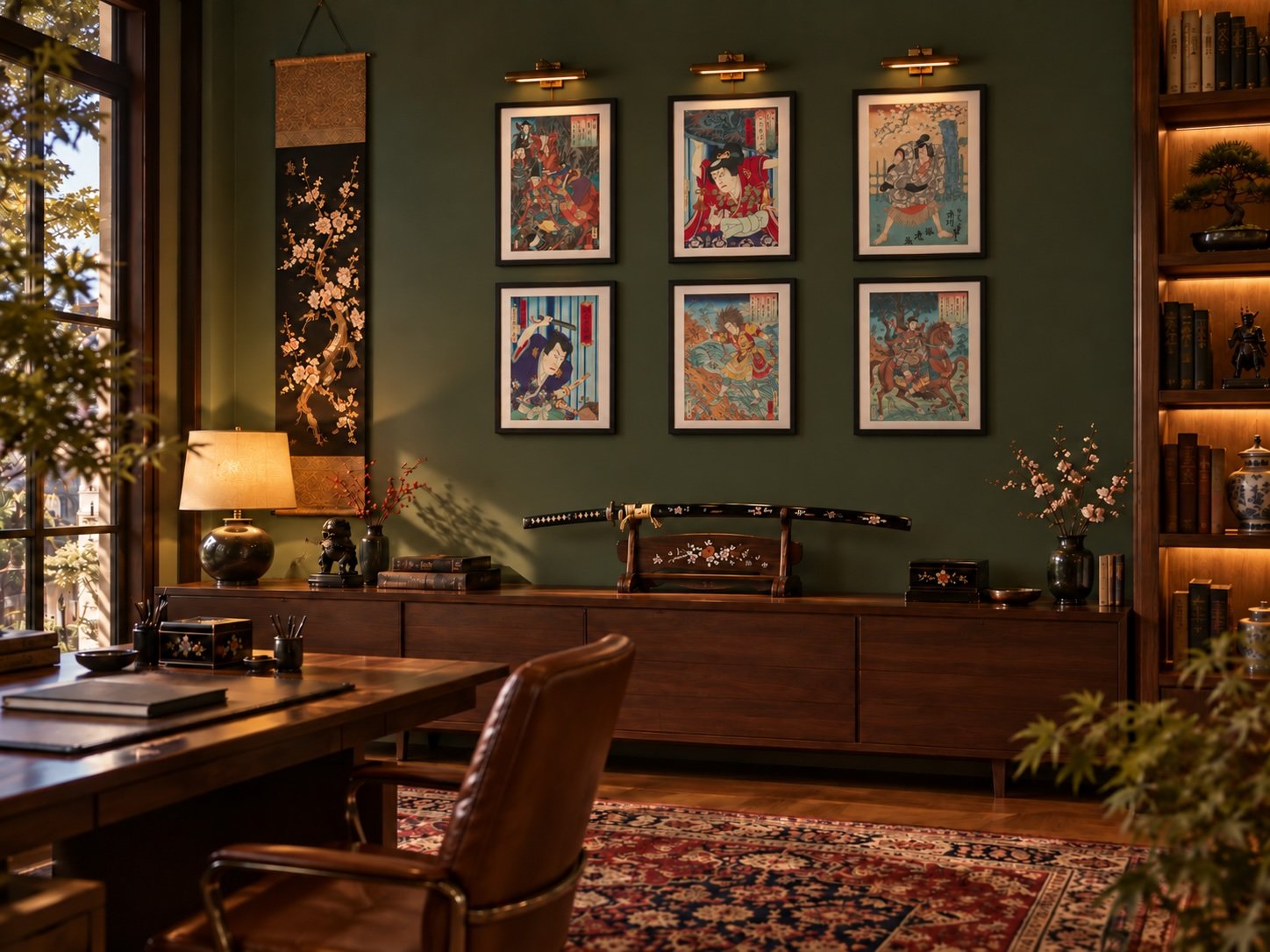
The ukiyo-e comes framed and ready to hang.
Onoe Kikujirō appears as Chiyo in an elegant full-length composition framed by the garden landscape.
Her layered costume combines restrained grey, black, pale beige and blue tones against the stronger blue-green ground and warm sky.
A large pine tree extends across the upper part of the image, while the blue bamboo fence establishes the same continuous garden setting used throughout Kuniyoshi’s multi-sheet series.
Chiyo’s hand rests close to the small blade at her sash — a quiet detail that gains greater emotional significance when seen in relation to the later events of the drama.
The print presents the onnagata actor Onoe Kikujirō in the role of Chiyo, wife of Matsuōmaru.
Rather than portraying Chiyo in an overtly theatrical or violent moment, Kuniyoshi gives the figure a controlled, graceful presence.
Her body turns gently within the vertical composition.
One arm extends outward while the other hand remains close to the small dagger at her sash.
The long robes fall toward the ground in sweeping folds, giving the figure an elegant vertical rhythm.
Her pale face, carefully arranged hair and restrained expression contrast with the tension implied by the blade.
The result is an image of apparent calm carrying the suggestion of future tragedy.
Chiyo is the wife of Matsuōmaru, one of the three brothers at the emotional center of Sugawara Denju Tenarai Kagami.
Her role in the Ga no iwai scene is comparatively quiet.
She appears within the family gathering at Shiratayū’s home, before the full consequences of the political conflict have unfolded.
Later in the drama, however, Chiyo becomes essential to one of the work’s most famous and devastating episodes.
Together with Matsuōmaru, she is drawn into a sacrifice undertaken to protect the young son of Sugawara no Michizane.
That later event transforms apparently minor details in the present scene into powerful signs of what is still to come.
Sugawara Denju Tenarai Kagami (菅原伝授手習鑑, “Sugawara and the Secrets of Calligraphy”) is one of the three great historical dramas of the bunraku and kabuki traditions.
The play is loosely based on the downfall of the Heian-period scholar and statesman Sugawara no Michizane (845–903).
Michizane is falsely accused through political intrigue engineered by his rival Fujiwara no Shihei and is exiled to Dazaifu.
After his death, he becomes revered as Tenjin, the deity of scholarship and learning.
The historical conflict forms the background to a deeply emotional family story involving three brothers whose loyalties place them on opposing sides.
The most celebrated subplot follows three triplet brothers — Umeōmaru, Matsuōmaru and Sakuramaru — sons of the retired ox-cart driver Shiratayū.
As the political crisis develops, the brothers find themselves serving opposing masters.
Matsuōmaru occupies the most uncomfortable position, outwardly serving the camp responsible for Michizane’s persecution.
Umeōmaru remains loyal to the disgraced Michizane.
Sakuramaru becomes caught between the political and personal consequences of the conflict.
Their loyalties gradually tear apart a family that, in the Ga no iwai scene, is still momentarily gathered together.
The present sheet belongs to Kuniyoshi’s multi-sheet representation of Ga no iwai (賀の祝), the “Celebration of Longevity.”
The scene takes place at Shiratayū’s house in Sata village.
The occasion is his seventieth birthday.
Members of the divided family return to the house, creating what initially appears to be a domestic reunion.
It is one of the final moments of relative calm before the brothers’ divided loyalties produce irreversible consequences.
Kuniyoshi’s decision to portray the participants on individual sheets gives each character a distinct psychological and visual presence while still allowing the complete group to function as one continuous theatrical scene.
Although Chiyo plays a relatively subdued role in this part of the drama, she later becomes central to one of its most emotionally devastating turns.
Matsuōmaru outwardly serves the enemy camp.
His deeper loyalties, however, prove more complicated.
When the life of Michizane’s young son must be protected in secret, Matsuōmaru and Chiyo are called upon to make an extraordinary sacrifice.
The emotional force of that later episode depends in part on the contrast between ordinary family life and the impossible demands created by political loyalty.
Seen with knowledge of what follows, Kuniyoshi’s quiet portrait of Chiyo acquires considerable dramatic weight.
One of the most suggestive details in the composition is the small blade at Chiyo’s sash.
Her hand appears to be drawing or sheathing the dagger.
Within the immediate scene, the gesture remains restrained.
It does not dominate the composition.
Yet the blade introduces a subtle note of tension into an otherwise elegant portrait.
Given Chiyo’s later role in the drama, the detail can be read as a quiet visual foreshadowing.
Kuniyoshi does not need to depict the later tragedy directly.
A small object, handled almost casually, is enough to introduce the possibility of violence, sacrifice and the darker events that lie ahead.
Kuniyoshi designed the Ga no iwai scene as a multi-sheet set rather than concentrating the entire family gathering into one crowded composition.
Each actor received an individual sheet.
When the prints were assembled, however, the settings connected visually.
The same bamboo fence extended across the individual images.
The graded sky continued from sheet to sheet.
Trees associated with the principal figures appeared throughout the set.
This allowed each performer to remain the central subject of an individual portrait while the complete series could still be read as one continuous garden scene.
The present Chiyo print therefore works both independently and as part of a larger theatrical composition.
A large pine tree dominates the upper portion of the composition.
Its twisting trunk and spreading branches form a strong organic framework around Chiyo.
Dense blue-green pine needles contrast with the warmer tones of the trunk and sky.
The tree also participates in the broader botanical symbolism of the series.
Matsuōmaru’s name contains matsu, meaning pine.
Alongside the plum associated with Umeōmaru and the cherry associated with Sakuramaru, the three trees visually reinforce the identities of the brothers across the multi-sheet composition.
The landscape is therefore not merely decorative.
It becomes part of the symbolic structure of the drama.
Behind Chiyo, the blue bamboo fence forms a regular network of vertical and horizontal lines.
This architectural rhythm contrasts with the flowing curves of the figure’s robes and the twisting branches of the pine tree above.
The fence is also an important device for connecting the separate sheets in Kuniyoshi’s series.
When displayed together, its repeated structure helps establish the impression of one shared garden extending across multiple compositions.
The cool blue of the bamboo works particularly well against the pale beige of Chiyo’s lower robes and the warm sky above.
Chiyo’s costume is comparatively restrained but highly sophisticated.
The outer robe is predominantly grey, with blue and red accents visible around the collar and sleeves.
A broad black section creates strong visual weight across the center of the figure.
The long pale lower robes descend toward the ground and are decorated near the hem with repeated blue motifs.
These subdued tones allow the costume to harmonize with the blue-green garden while remaining clearly distinct from it.
Kuniyoshi balances the greys, blacks, blues and pale beige against touches of warmer red and orange.
The result is elegant rather than overwhelmingly decorative.
Chiyo is portrayed by an onnagata, a male kabuki actor specialising in female roles.
Onnagata performance developed its own highly codified vocabulary of gesture, posture, movement and costume.
The goal was not simply imitation, but the creation of a stylized theatrical ideal of femininity.
Kuniyoshi’s actor portraits translate that stage language into print.
Here, Onoe Kikujirō’s pose, the positioning of the hands, the arrangement of the robes and the carefully composed hairstyle all contribute to Chiyo’s visual identity.
At the same time, the presence of the dagger introduces an underlying strength and seriousness appropriate to the character’s later dramatic importance.
Utagawa Kuniyoshi (1797–1861) was born Yoshisaburō in Edo, the son of a silk dyer.
Around 1811, he entered the Utagawa school as a pupil of Utagawa Toyokuni I.
Kuniyoshi achieved major fame with his 1827 series depicting the 108 heroes of the Chinese novel Suikoden.
The series established him as one of the foremost designers of musha-e, or warrior prints.
His artistic range, however, extended far beyond heroic warriors.
He was equally accomplished in theatre, actor portraiture and other major areas of ukiyo-e.
Alongside Hiroshige and Kunisada, Kuniyoshi is considered one of the last great masters of the ukiyo-e tradition.
Kabuki provided Kuniyoshi with subjects ideally suited to his strengths as a designer.
Actor prints allowed him to combine expressive posture, elaborate costume, dramatic narrative and recognizable performers.
In the present work, he uses relatively restrained movement to suggest Chiyo’s personality.
The extended hand creates a graceful line toward the left.
The hand at the sash directs attention toward the dagger.
The long vertical robes anchor the figure.
The pine branches above and bamboo fence behind create a carefully structured environment around her.
The composition demonstrates how effectively Kuniyoshi could communicate theatrical narrative without relying on extreme action.
The work is executed as a nishiki-e, or full-color Japanese woodblock print.
This technique required the coordinated use of multiple carved woodblocks.
A principal key block established the black outlines.
Additional blocks printed separate areas of color.
In the present sheet, the process creates the blue bamboo fence, pale green-blue ground, warm graded sky, grey robe, black clothing, blue textile details, flesh tones and the varied colors of the pine tree.
The surviving impression remains strong and clean.
The key block is sharp, allowing the details of the costume, face, fence and landscape to remain clearly defined.
The print is executed in vertical ōban tate-e format and measures approximately 36 × 24.5 cm.
The format was particularly effective for full-length actor portraits.
It allowed Kuniyoshi to present Chiyo almost from head to foot while still giving considerable space to the garden environment.
The figure occupies the center of the sheet.
The pine tree spreads across the upper area.
The bamboo fence extends horizontally through the middle.
The long robes anchor the lower portion.
These elements create a balanced composition in which figure and landscape are closely integrated.
The print is signed Ichiyūsai Kuniyoshi ga (一勇斎国芳画).
The signature identifies the work as a design by Utagawa Kuniyoshi.
It dates from Kōka 4 to Kaei 5 (1847–1852).
This places the work within Kuniyoshi’s mature period.
By this point, his command of actor portraiture, textile pattern, figure design and complex multi-sheet compositions was fully developed.
The balance between the figure of Chiyo and the surrounding garden demonstrates that maturity particularly clearly.
This is an original antique Japanese woodblock print, not a modern reproduction or later decorative reprint.
Its age is an essential part of its historical character and authenticity.
Original ukiyo-e from this period have survived through generations of ownership, handling, storage and display.
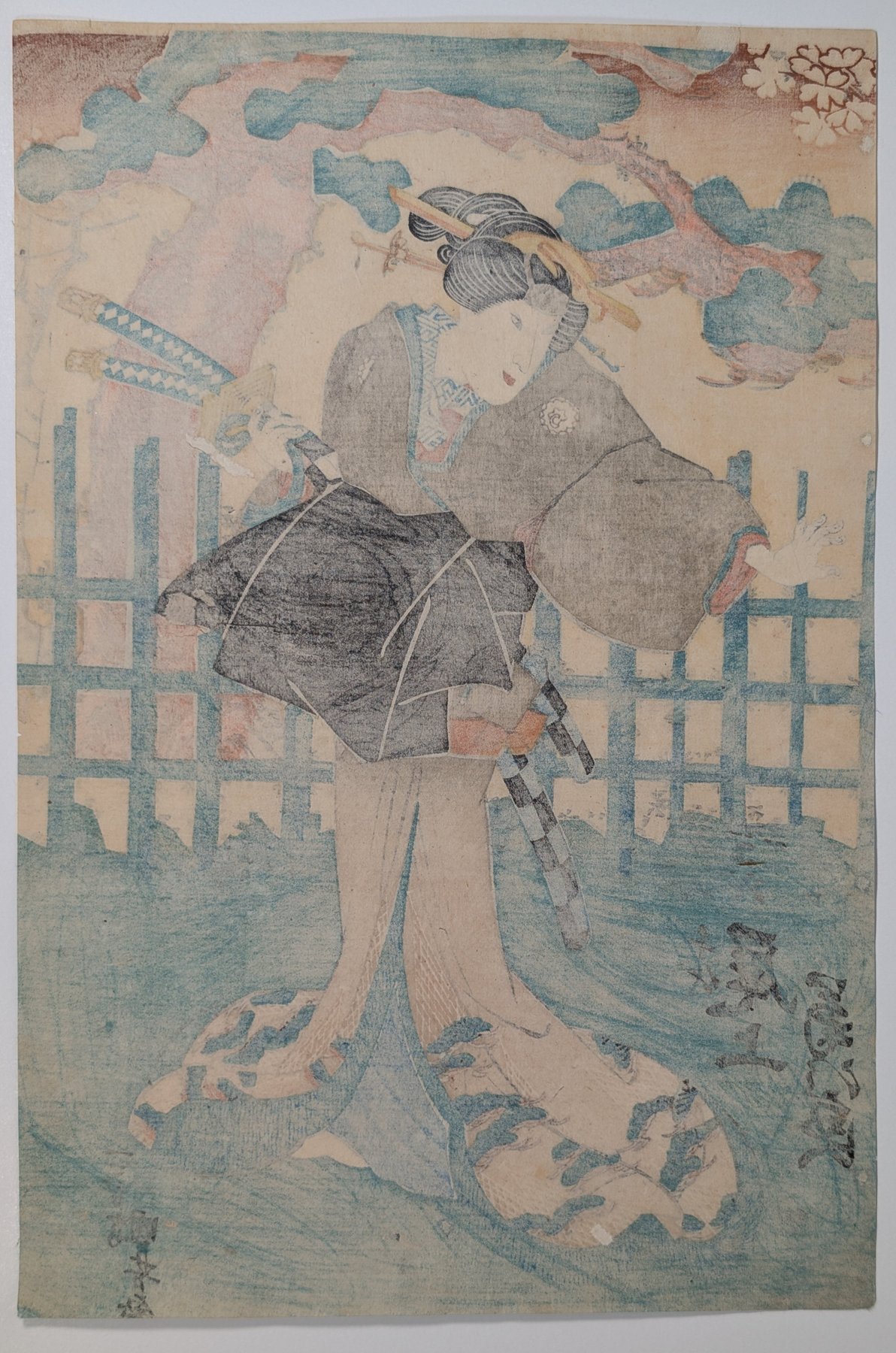
With works on paper that have survived for more than a century and a half, gentle toning, occasional small spots, minor creasing or faint handling marks are normal and expected.
These characteristics are consistent with genuine period prints.
They should be understood within the context of an original historical object rather than compared with the appearance of a newly manufactured reproduction.
The print is in excellent condition throughout.
The color is unusually well preserved for a Kuniyoshi actor sheet of this date.
The blue of the bamboo fence remains fresh and even.
The pale green-blue ground retains its clarity.
The graded red band across the upper sky remains particularly attractive.
The impression is strong and clean, with the key block sharply defined.
These qualities make the state of preservation especially noteworthy for an original Japanese woodblock print dating from the mid-nineteenth century.
As with any antique work on paper, minor age-related traces may naturally be present and should be understood as part of the history of the original object.
The ukiyo-e is individually framed and sold complete with its frame.
It arrives ready to hang.
The dark frame and light mount create a clean presentation that allows the original composition to remain the visual focus.
The neutral framing works especially well with the blue-green garden, warm sky, grey and black clothing and pale tones of Chiyo’s lower robes.
The work can therefore be displayed immediately while preserving the visual character of the original antique print.
This print combines several qualities that make Utagawa Kuniyoshi one of the defining masters of nineteenth-century ukiyo-e.
It presents an important character from one of kabuki’s great historical dramas, performed by an onnagata actor and placed within an ambitious multi-sheet theatrical composition.
The image is visually elegant but narratively charged.
The pine tree, blue bamboo fence and carefully graded garden setting connect the sheet with the rest of the Ga no iwai series.
Chiyo’s restrained pose contrasts with the small dagger at her sash, a detail that quietly anticipates the much darker role she and Matsuōmaru will later be forced to play.
The excellent preservation of the color adds further interest.
The blue fence, pale green-blue ground and red gradation of the sky retain much of their original visual strength, while the sharp key block preserves the clarity of Kuniyoshi’s drawing.
As an original mid-nineteenth-century kabuki print, the work brings together theatrical history, onnagata performance, narrative symbolism, sophisticated woodblock craftsmanship and strong decorative presence.
An original antique Japanese ukiyo-e by Utagawa Kuniyoshi depicting the onnagata actor Onoe Kikujirō as Chiyo (千代), wife of Matsuōmaru, in the Ga no iwai scene from Sugawara Denju Tenarai Kagami (菅原伝授手習鑑). Dating from Kōka 4–Kaei 5 (1847–1852) and signed Ichiyūsai Kuniyoshi ga (一勇斎国芳画), the print shows Chiyo standing beneath a pine tree beside the blue bamboo fence that continues across Kuniyoshi’s multi-sheet composition. Her hand is positioned at the small dagger worn at her sash, a quiet detail that foreshadows the devastating sacrifice she and Matsuōmaru will later make to protect Michizane’s young son. Executed as an ōban tate-e nishiki-e measuring approximately 36 × 24.5 cm, the print survives in excellent condition, with unusually fresh blue, pale green and graded red color and a strong, clean impression. Original antique Japanese woodblock print, not a modern reproduction. Individually framed and supplied ready to hang.

Order above 1.000,00 € gets free shipping.

Secure and hassle-free payment process.

Certificate of authenticity included.

Have questions? Contact us via WhatsApp.
Contact