
1 in stock
1 in stock
Add to Compare
Add to Wishlist
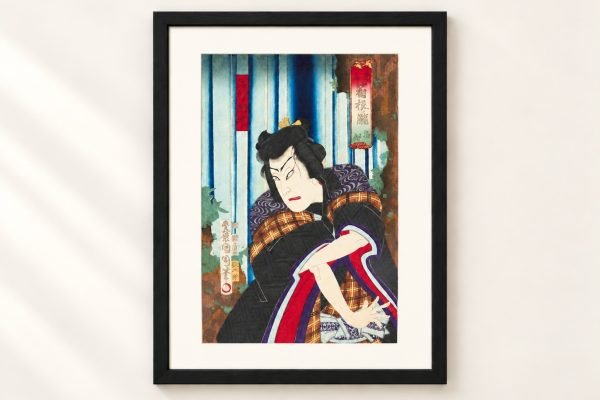
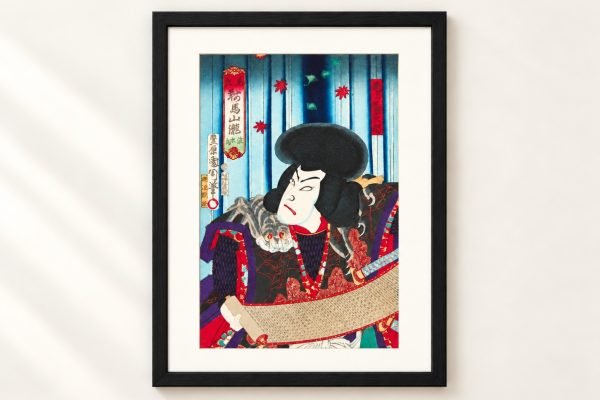
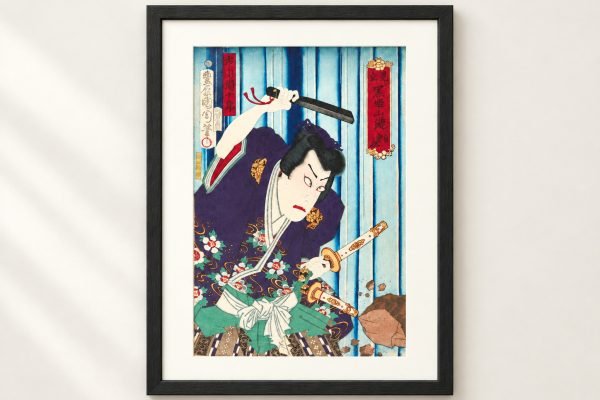
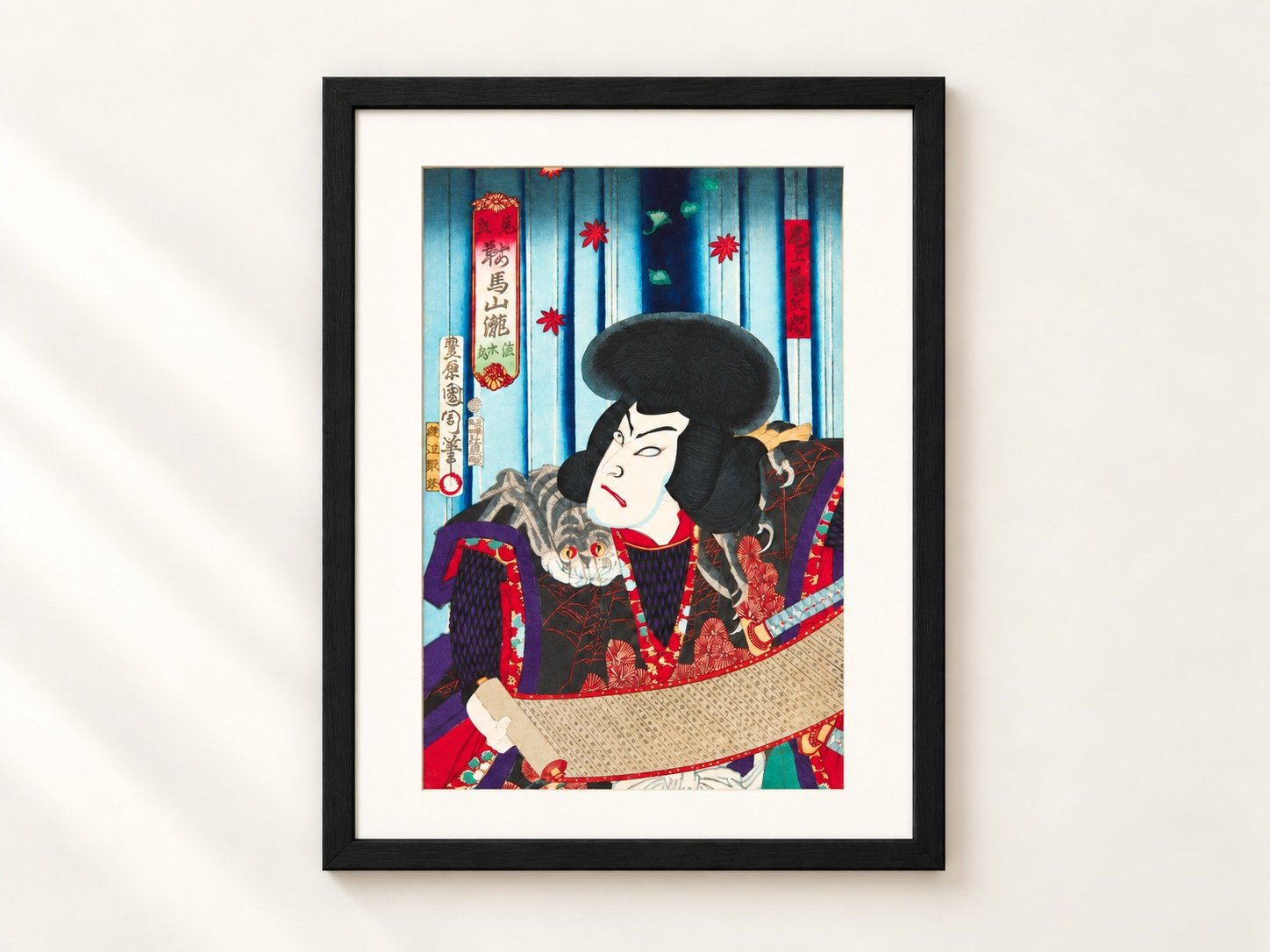
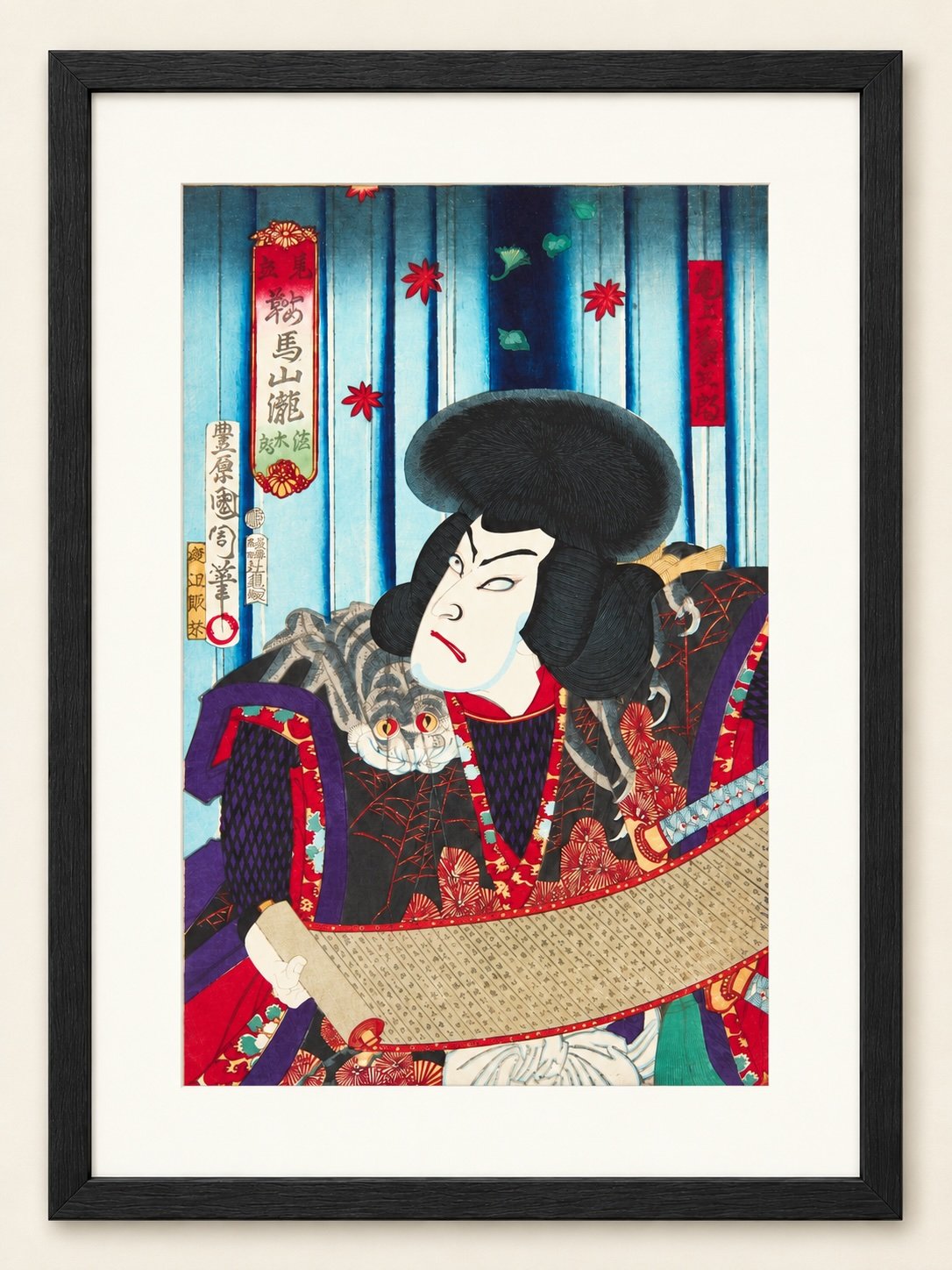
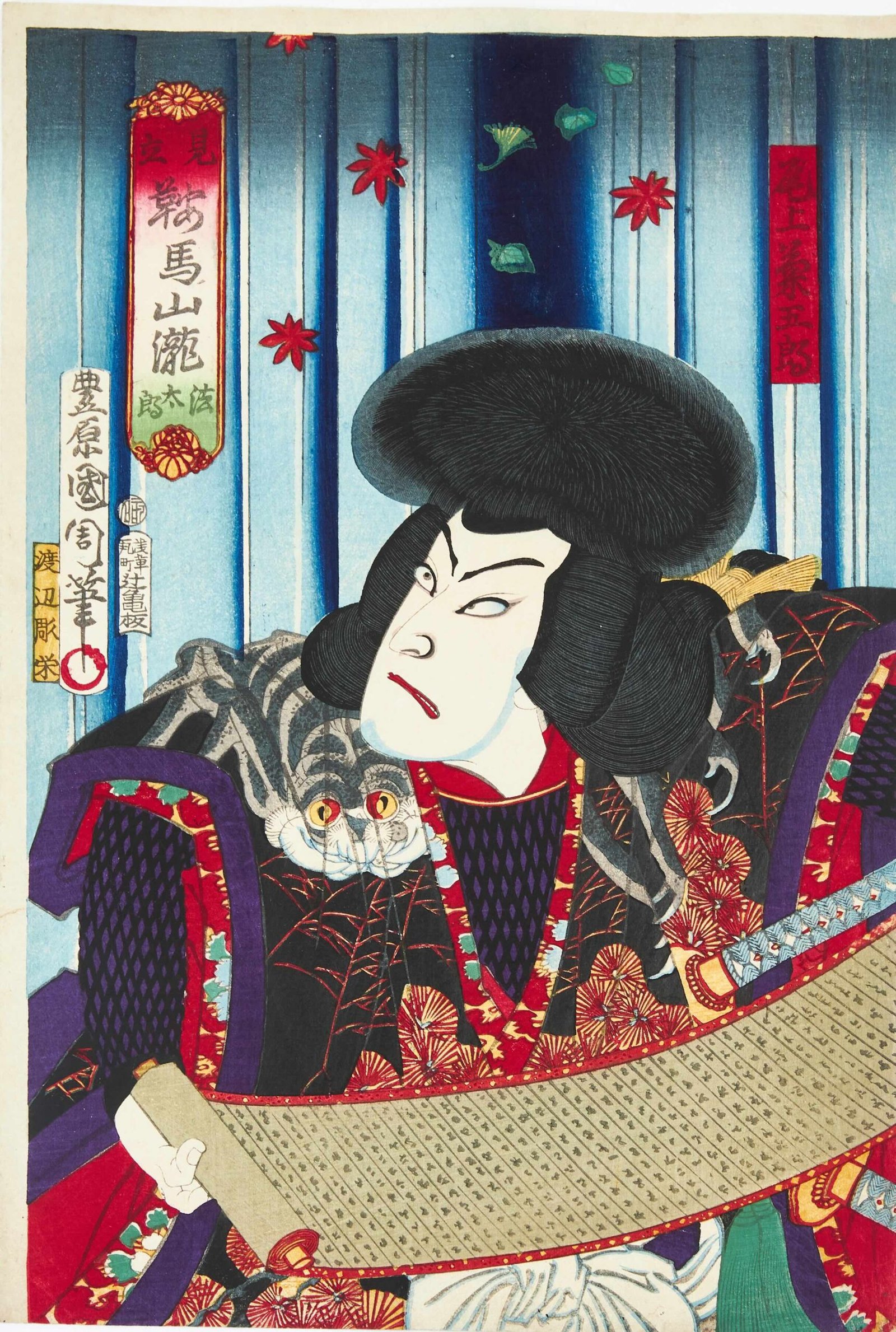
An original antique Japanese ukiyo-e woodblock print by Toyohara Kunichika (1835–1900), depicting the kabuki actor Onoe Kikugorō in the role of Tsuchigumo, the legendary giant earth-spider, in Mitate Kurama-yama Takitarō (見立 鞍馬山滝太郎). Executed as an ōban tate-e nishiki-e, the print belongs to Kunichika’s mitate-e waterfall series and presents the actor in rich theatrical costume beneath a massive black wig, with red spider-web patterns covering the dark robe and a monstrous cat-like mask peering over his shoulder.
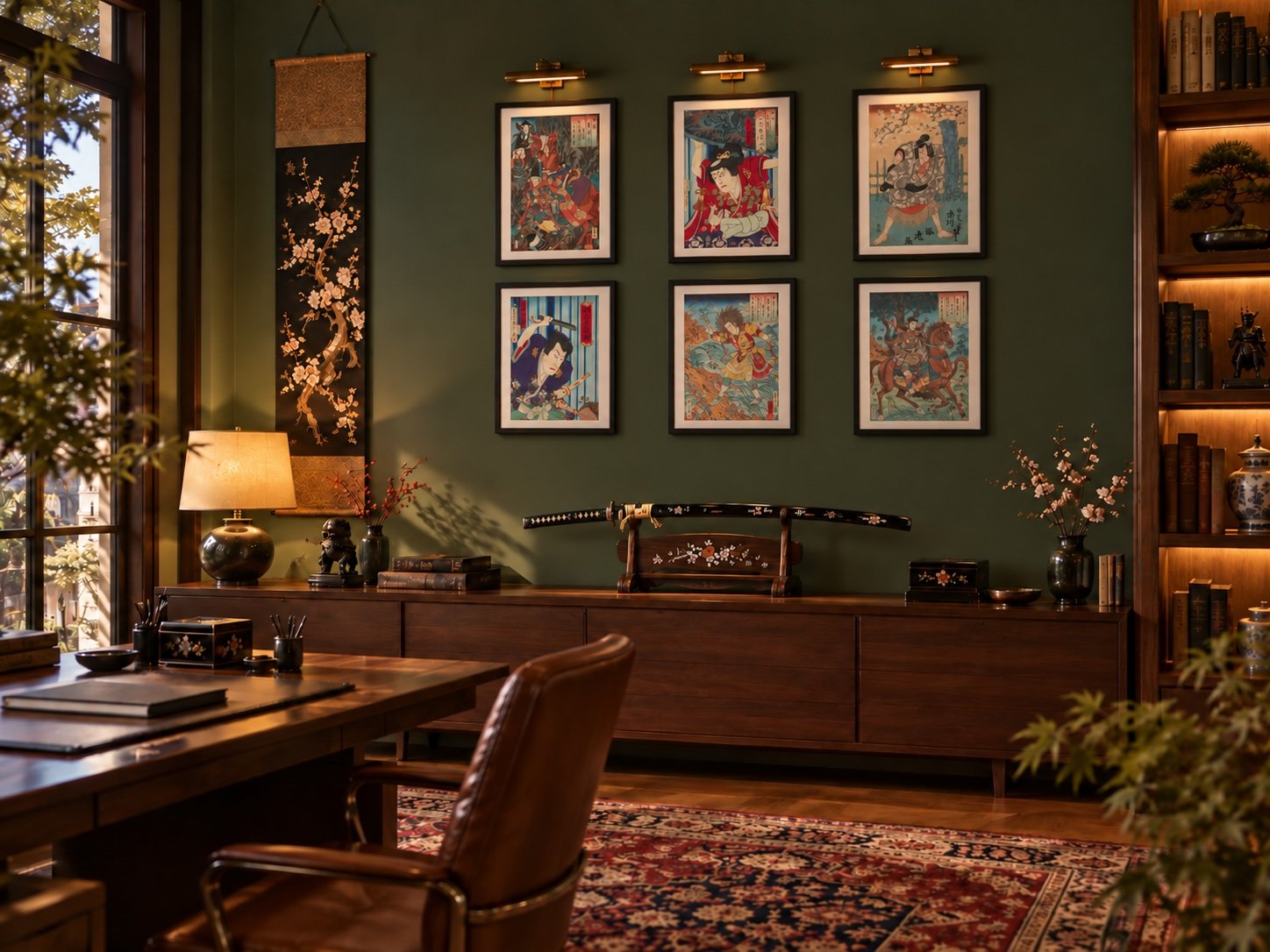
The ukiyo-e comes framed and ready to hang.
Onoe Kikugorō appears in one of the most immediately recognizable supernatural roles of the kabuki stage.
The dark costume is crossed by a dense network of red spider-web lines, visually identifying the character with the legendary Tsuchigumo.
A strange animal-like mask emerges over the actor’s shoulder, reinforcing the eerie supernatural character of the scene.
Across the lower part of the composition, the actor holds a large unfurled scroll covered in lines of text.
Behind him, vertical bands of blue evoke the waterfall setting that links the image to Kunichika’s broader mitate series.
The print portrays Onoe Kikugorō in the role of Tsuchigumo, one of the most famous supernatural creatures in Japanese theatrical and legendary tradition.
Kunichika gives the actor a commanding presence.
His face occupies the visual center of the composition, framed by an enormous black wig whose exaggerated form immediately signals the theatrical nature of the character.
The expression is controlled and severe rather than wildly animated.
This stillness contrasts with the highly decorative costume surrounding the face.
The dark robe is covered with red lines forming a dense spider-web pattern, transforming the entire costume into a visual reference to the creature’s supernatural identity.
Tsuchigumo is associated with the famous legend of the warrior Minamoto no Yorimitsu, also known as Raikō.
According to the story, Yorimitsu becomes gravely ill.
During the night, a mysterious figure disguised as a priest approaches him.
The visitor is in fact a supernatural spirit.
It attacks Yorimitsu and attempts to trap him in sticky spider silk.
Although weakened by illness, the warrior resists the attack and wounds the apparition.
His retainers later follow the creature and discover its true form.
The supernatural attacker is revealed as a giant spider dwelling beneath an old mound.
The creature is eventually hunted down and destroyed.
This combination of disguise, supernatural transformation and heroic combat made the story especially suited to dramatic representation on the kabuki stage.
The Tsuchigumo legend offered kabuki artists and performers an ideal opportunity to combine theatrical transformation, extraordinary costume and supernatural symbolism.
The character could appear initially in human form before revealing its monstrous identity.
Spider silk, oversized wigs, elaborate robes and dramatic stage effects could all be incorporated into the performance.
Kunichika condenses this theatrical language into a single printed image.
Rather than depicting an actual giant spider, he uses costume and associated imagery to communicate the role.
The red web pattern, dark robe, enormous wig and strange mask together make the supernatural identity immediately legible to an audience familiar with the legend.
The dark robe is one of the most distinctive elements of the print.
Across its surface, fine red lines create an extensive cobweb pattern.
The design spreads across the black fabric like an actual web, making the costume itself an extension of Tsuchigumo’s supernatural nature.
Bright red, purple and patterned borders frame different sections of the garment.
Decorative floral motifs introduce additional areas of red and pale blue.
The strong contrast between the dark fabric and vivid red web lines gives the costume exceptional visual impact.
Kunichika frequently used elaborate textile design as a major compositional element, and here the robe becomes almost as important as the actor’s face.
A strange cat-like or monstrous face appears over the actor’s shoulder.
Its pale features and wide eyes stand out sharply against the dark costume.
This unsettling secondary face adds another supernatural element to the composition.
Rather than appearing as an independent central figure, it emerges from behind the actor, creating ambiguity between costume, creature and theatrical prop.
Its presence reinforces the atmosphere of transformation and otherworldly danger associated with Tsuchigumo.
The mask also creates a strong visual detail near the center of the image, positioned between the actor’s face and the richly patterned robes.
Across the lower foreground, Onoe Kikugorō holds a large unfurled scroll.
Its pale surface is densely covered with written characters arranged in regular vertical lines.
The scroll creates a broad diagonal band across the composition.
This pale horizontal element contrasts strongly with the intensely colored textiles and dark costume behind it.
It also provides a visual counterweight to the massive black wig above.
Within the design, the scroll contributes another layer of theatrical detail without distracting from the actor’s face and supernatural costume.
The title references Kurama-yama, Mount Kurama, north of Kyoto.
Kurama occupies an important place in Japanese religious, legendary and literary culture.
In the present print, its name supplies the waterfall reference that anchors the work within Kunichika’s mitate-e waterfall series.
The background is constructed from strong vertical bands of blue, turquoise and pale tones.
These vertical forms evoke the visual rhythm of falling water.
They provide a cool background against which the actor’s black, red and purple costume appears especially intense.
The waterfall therefore functions both as a series motif and as a powerful visual device.
The print belongs to a series based on the concept of mitate, in which actors, characters and famous locations are brought together through visual or conceptual association.
Rather than presenting straightforward landscape views, Kunichika combines theatrical characters with named waterfalls and water-related settings.
Each print can therefore be understood on multiple levels.
It is an actor portrait.
It represents a famous theatrical or legendary role.
At the same time, it links that role to a particular waterfall or landscape reference.
Here, Tsuchigumo is associated with Kurama-yama, creating a composition in which supernatural theatre and evocative landscape are fused.
Toyohara Kunichika (1835–1900) was born Ōshima Yasohachi in Edo.
He trained within the artistic tradition of the Utagawa school before becoming a pupil of Utagawa Kunisada, also known as Toyokuni III.
Kunichika became one of the artists most closely associated with the kabuki theatres of Edo and later Tokyo.
He spent much of his artistic life around the theatre world and sketched leading actors directly from life.
Among the major performers he portrayed were Ichikawa Danjūrō IX, Onoe Kikugorō V and Bandō Hikosaburō V.
This direct familiarity with performers, costumes and stage gesture became fundamental to his artistic identity.
Onoe Kikugorō V was among the leading kabuki actors portrayed by Kunichika.
Kunichika’s close relationship with the theatrical world allowed him to observe the distinctive physical presence, expressions and stage identities of performers such as Kikugorō.
In supernatural roles, the actor could be transformed through costume, makeup, wigs and props into characters far removed from ordinary human appearance.
The present image demonstrates this transformation clearly.
The recognizable human face remains at the center, yet everything surrounding it — the oversized wig, spider-web robe, mask and dramatic color — transforms the performer into the legendary Tsuchigumo.
Kunichika is widely regarded as the last major master of yakusha-e, the ukiyo-e tradition of kabuki actor portraiture.
His career developed during a period when Japanese visual culture was undergoing rapid change.
Photography increasingly offered new ways to record actors and public figures.
Kunichika continued to exploit qualities unique to woodblock printing.
Bold color, exaggerated costume patterns, stylized gesture and carefully structured compositions allowed his images to convey the heightened visual language of the kabuki stage.
The present print is an especially striking example because the supernatural subject gave Kunichika an opportunity to push costume and pattern toward an almost fantastic intensity.
Kunichika was among the early ukiyo-e artists to exploit synthetic aniline dyes newly available in Japan during the Meiji era.
These pigments enabled particularly intense reds, purples and blues.
In this print, deep black and vivid red dominate the spider-web costume.
Purple borders, bright decorative details and strong blue vertical bands add further chromatic contrast.
The pale face and scroll stand out sharply against these saturated colors.
The result is a composition with the dramatic color intensity associated with Kunichika’s mature theatrical work.
The work is executed as a nishiki-e, or full-color Japanese woodblock print.
This technique required the coordinated use of multiple carved woodblocks.
A principal key block established the main black outlines.
Additional blocks were then used to apply the individual areas of color.
In this print, separate impressions create the blue waterfall background, deep black costume, red spider-web lines, purple fabric, decorative floral patterns, pale flesh tones and the warm beige surface of the scroll.
The finished image demonstrates the complexity and precision achievable through traditional Japanese polychrome woodblock printing.
The print is presented in the vertical ōban tate-e format.
This format was particularly effective for kabuki actor portraits because it allowed a single performer to dominate the composition.
Kunichika uses the vertical proportions to give the actor considerable monumentality.
The enormous black wig occupies much of the upper central area.
The robes spread outward across the middle of the image.
The unfurled scroll establishes a broad diagonal across the lower foreground.
Behind all of this, the vertical waterfall bands reinforce the height of the composition.
The result is a carefully balanced arrangement of vertical, diagonal and rounded forms.
This is an original antique Japanese woodblock print, not a modern reproduction or later decorative reprint.
Its age is an essential part of its historical character and authenticity.
Original ukiyo-e of this period have survived through generations of ownership, handling, storage and display.
With works on paper that have survived for well over a century, gentle toning, occasional small marks, light creasing or faint handling traces are normal and expected.
These characteristics are consistent with authentic period works.
They should be understood within the context of an original historical print rather than compared with the appearance of a newly manufactured reproduction.
The print comes from the collection of Dr. Eugen Milch (1889–1958), an Austrian physician and artist whose life was marked by extensive international travel.
Milch served as a medical officer during the First World War.
During the early 1920s, he travelled throughout Europe on a combined study and painting journey.
In 1924 he married the artist Emma Bormann.
The couple visited Sweden that same year and, together with the artist Oskar Bergman, exhibited several paintings at Liljevalchs in Stockholm.
In 1937, Eugen Milch travelled to China with other Austrian physicians following an invitation from the Chinese government.
Emma joined him two years later.
Although the original posting did not materialise as planned, Milch became superintendent of a hospital in Beihai in 1938.
His years in East Asia combined his medical career with his continuing interest in art and travel.
In 1941, Japanese forces occupied parts of the southern Chinese coast, including Beihai.
The Milch family managed to relocate to Shanghai.
During their time in China, Eugen and Emma eventually decided to separate.
Eugen later assisted British forces in China, service for which he was granted British citizenship.
His life and career therefore placed him directly within some of the major historical transformations affecting East Asia during the first half of the twentieth century.
Continuing his travels, Eugen Milch later went to Japan to study the aftermath of the war.
According to the provenance associated with the collection, it is likely that he acquired the present group of Japanese woodblock prints during this period.
He died in Hong Kong in 1958.
The collection subsequently passed by descent within the family.
This provenance adds another historical dimension to the print, connecting a nineteenth-century Japanese theatrical image with the international life of a twentieth-century physician, artist, traveller and collector.
The print shows some signs of wear consistent with age, together with light handling creases.
It remains in good general condition.
As with original Japanese works on paper of this age, gentle toning, occasional small marks, minor creasing and faint traces of handling are normal and expected.
These characteristics are consistent with a genuine antique print that has survived for well over a century.
They should not be interpreted as evidence that the work is in poor condition.
The condition information is provided for transparency and to allow collectors to understand the preserved state of the original print.
The ukiyo-e is individually framed and sold complete with its frame.
It arrives ready to hang.
The dark frame and light mount create a clean presentation that places full emphasis on Kunichika’s highly detailed composition.
The neutral framing works especially well with the deep black wig and costume, vivid red web pattern, saturated blue background and warm tones of the scroll.
The work can therefore be displayed immediately while preserving the visual presence of the original antique print.
This print combines several qualities for which Toyohara Kunichika is particularly admired: a major kabuki actor, a famous supernatural subject, elaborate costume design, intense Meiji-era color and the conceptual structure of the mitate-e waterfall series.
The Tsuchigumo subject gives the work exceptional dramatic and iconographic interest.
The red web pattern spreading across the dark robe immediately identifies the supernatural theme.
The monumental black wig and strange mask heighten the atmosphere of transformation and menace.
The large scroll introduces another richly detailed element, while the vertical blue waterfall background provides a striking visual counterpoint to the dark figure.
The work also represents Kunichika’s close relationship with leading kabuki performers such as Onoe Kikugorō V and his importance within the final major phase of the yakusha-e tradition.
Its documented provenance from the collection of Dr. Eugen Milch adds a further layer of collecting history.
An original antique Japanese ukiyo-e by Toyohara Kunichika depicting Onoe Kikugorō as Tsuchigumo in Mitate Kurama-yama Takitarō (見立 鞍馬山滝太郎). The actor appears beneath an enormous black wig, wearing a dark kimono covered in a vivid red spider-web pattern, with a monstrous cat-like mask peering over his shoulder and a large unfurled scroll across the foreground. The imagery identifies the character with Tsuchigumo, the legendary giant earth-spider that attacks the warrior Minamoto no Yorimitsu before being hunted down in its monstrous form. Kurama-yama provides the waterfall reference linking the work to Kunichika’s mitate-e series. Executed as an ōban tate-e nishiki-e, the print combines bold Meiji-era color with the theatrical intensity characteristic of Kunichika’s celebrated yakusha-e. From the collection of Dr. Eugen Milch (1889–1958), subsequently by descent within the family. In good general condition with age-appropriate wear and light handling creases. Original antique Japanese woodblock print, not a modern reproduction. Individually framed and supplied ready to hang.

Order above 1.000,00 € gets free shipping.

Secure and hassle-free payment process.

Certificate of authenticity included.

Have questions? Contact us via WhatsApp.
Contact