
1 in stock
1 in stock
Add to Compare
Add to Wishlist
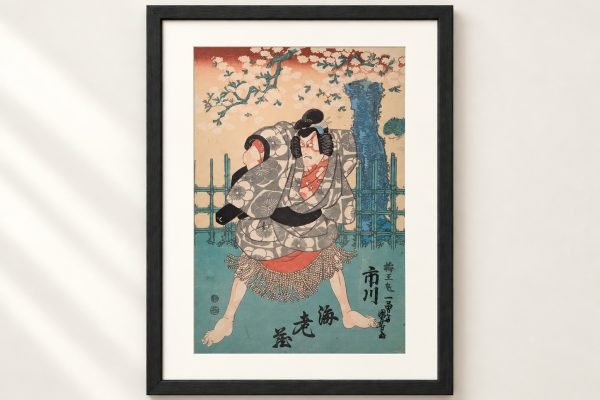
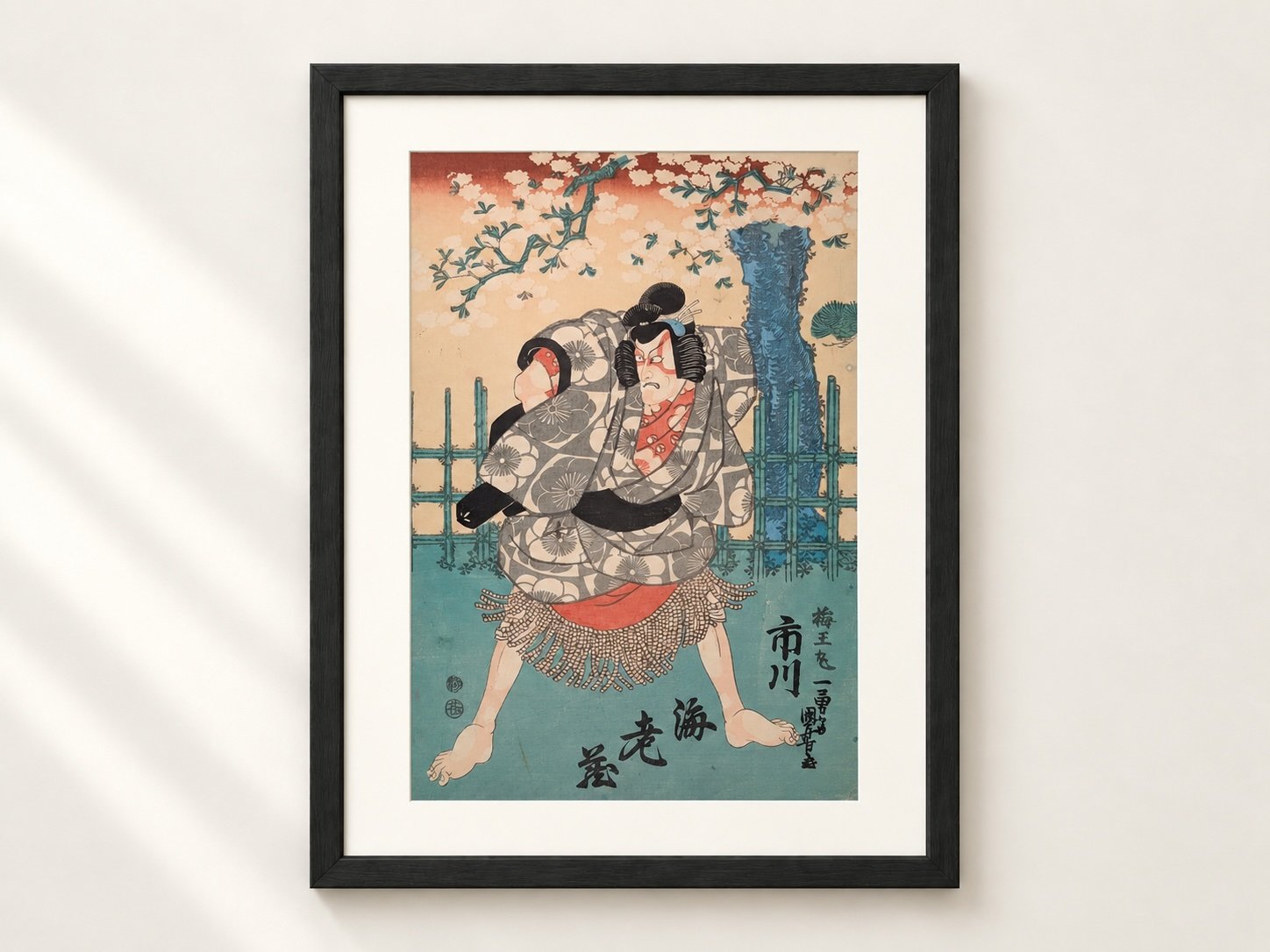
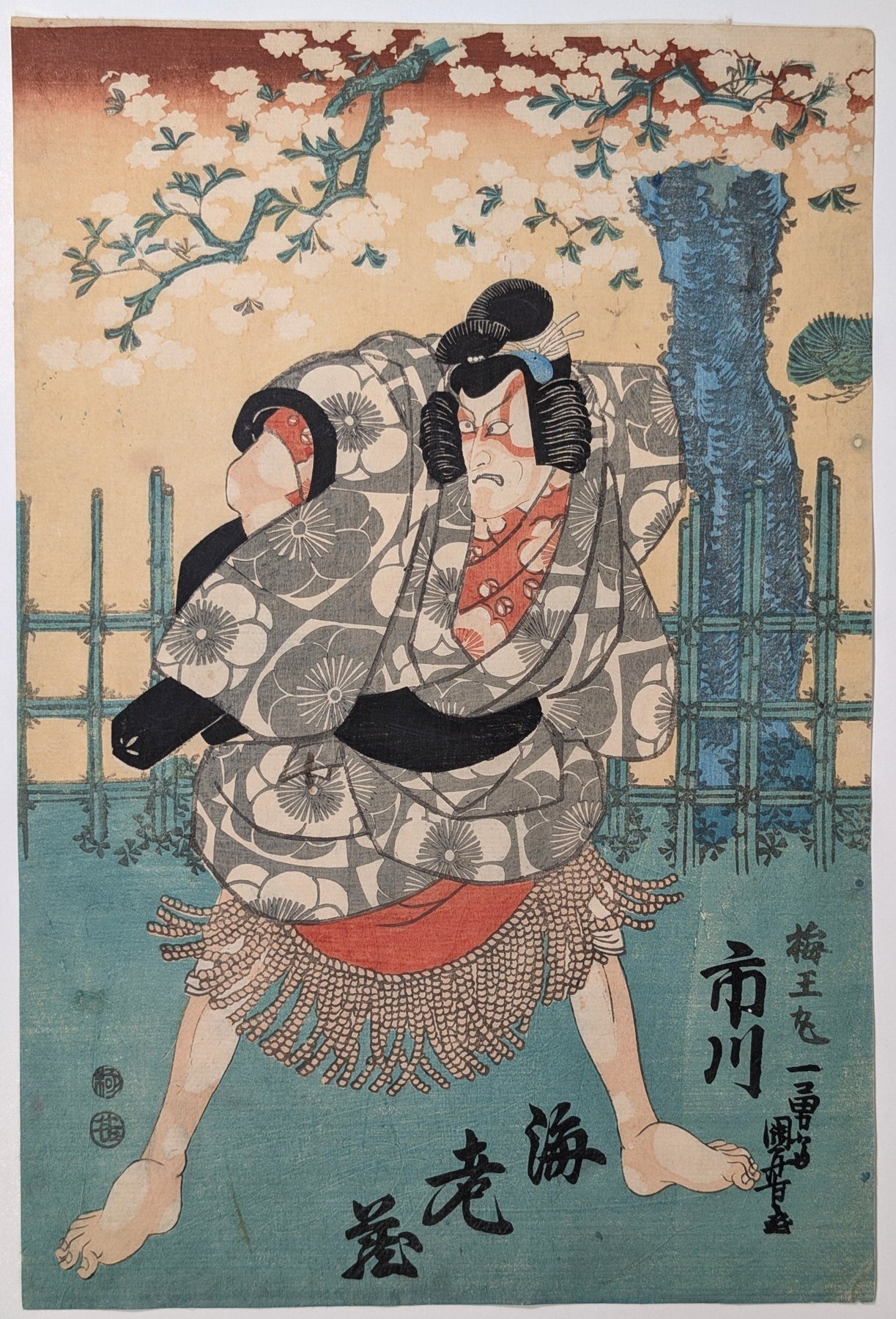
An original antique Japanese ukiyo-e woodblock print by Utagawa Kuniyoshi (1797–1861), depicting the kabuki actor Ichikawa Ebizō in the role of Umeōmaru (梅王丸) from Sugawara Denju Tenarai Kagami (菅原伝授手習鑑, “Sugawara and the Secrets of Calligraphy”). Dating from approximately 1847–1852, the print is signed Ichiyūsai Kuniyoshi ga (一勇斎国芳画) and belongs to a multi-sheet set illustrating the celebrated Ga no iwai (賀の祝, “Celebration of Longevity”) scene.
The ukiyo-e comes framed and ready to hang.
Ichikawa Ebizō is shown as Umeōmaru, barefoot and firmly braced in a combative stance.
He wears a striking grey kimono covered with large floral motifs, offset by black and red details that intensify the force of the figure.
Behind him, a blue bamboo garden fence creates a strong architectural rhythm, while flowering cherry branches spread across the upper part of the composition.
The pale green ground, soft warm sky and deep black of the actor’s wig create a carefully balanced palette, characteristic of Kuniyoshi’s sophisticated actor prints.
The print portrays Ichikawa Ebizō in the role of Umeōmaru, one of the central characters in Sugawara Denju Tenarai Kagami.
Umeōmaru is presented with his body tensed and legs spread firmly apart, creating a powerful sense of physical readiness.
His expression is equally forceful.
The sharply defined kabuki makeup, intense gaze and strong stance establish the character immediately as a figure of loyalty, conflict and controlled aggression.
Kuniyoshi gives the actor almost the entire height of the composition, allowing costume, expression and gesture to dominate the scene.
The result is both a recognizable actor portrait and a concentrated depiction of Umeōmaru’s dramatic character.
Sugawara Denju Tenarai Kagami (菅原伝授手習鑑, “Sugawara and the Secrets of Calligraphy”) is one of the three great historical plays of the bunraku and kabuki traditions.
The drama is loosely based on the downfall of the Heian-period scholar and statesman Sugawara no Michizane (845–903).
Michizane is falsely accused through the political intrigues of his rival Fujiwara no Shihei and is exiled to Dazaifu.
After his death, he becomes revered as Tenjin, the deity associated with scholarship and learning.
Within this broader political tragedy, the play develops an equally powerful family story centered on three brothers whose loyalties place them on opposing sides of the conflict.
One of the most celebrated subplots of the drama follows a set of triplet brothers, sons of the retired ox-cart driver Shiratayū.
Each brother serves a different master as the political crisis unfolds.
Umeōmaru serves the disgraced Sugawara no Michizane.
Matsuōmaru serves Michizane’s persecutor.
Their third brother, Sakuramaru, becomes trapped between the opposing loyalties that divide the family.
Their names form one of the play’s most important symbolic structures.
Ume means plum.
Matsu means pine.
Sakura means cherry.
These “three trees” recur throughout the drama as visual and poetic motifs, linking the brothers even as political loyalty forces them apart.
This print comes from a multi-sheet composition illustrating Ga no iwai (賀の祝), the “Celebration of Longevity” scene.
The episode takes place at Shiratayū’s home in Sata village during the celebration of his seventieth birthday.
For a brief moment, the three brothers are reunited within the family home.
It is one of the last moments of apparent domestic calm before their conflicting loyalties bring tragedy into the household.
The scene becomes a crucial emotional turning point in the drama.
Sakuramaru’s guilt ultimately drives him to commit seppuku within the same act.
Matsuōmaru’s own story develops toward another profound act of sacrifice later in the play.
Against this background, Umeōmaru’s powerful stance acquires an additional sense of tension.
The figure is not merely a theatrical warrior portrait.
He belongs to a family already beginning to fracture under the pressure of political allegiance.
Rather than presenting the entire family reunion in a single crowded composition, Kuniyoshi gave each actor an individual sheet.
When the complete group was assembled, the separate prints formed a continuous scene.
A shared garden setting connected the individual compositions.
The bamboo fence continued across the sheets.
The graded sky provided another visual link.
The plum, pine and cherry motifs associated with the three brothers appeared across the complete design.
This approach allowed each actor to command his own composition while preserving the unity of the larger theatrical scene.
The present print was therefore designed both as an independent actor portrait and as part of a broader visual narrative.
The garden plays an important structural role in the composition.
Behind Umeōmaru, a blue bamboo fence creates a sequence of repeated vertical and horizontal lines.
These geometric elements contrast strongly with the large rounded floral forms of the actor’s kimono.
Above him, branches heavy with pale cherry blossoms spread across the warm sky.
The blossoms soften the composition visually while also recalling the botanical symbolism that runs throughout the play.
The pale green lower ground, blue bamboo and warm graded sky establish distinct bands of color behind the actor.
Kuniyoshi uses this controlled setting to keep attention firmly on Umeōmaru while still suggesting the larger garden shared by the other sheets in the series.
Utagawa Kuniyoshi (1797–1861) was born Yoshisaburō in Edo, the son of a silk dyer.
Around 1811 he entered the Utagawa school as a pupil of Utagawa Toyokuni I.
Kuniyoshi achieved major success with his 1827 series depicting the 108 heroes of the Chinese novel Suikoden.
The series established his reputation as one of the foremost designers of musha-e, or warrior prints.
His artistic range, however, extended far beyond warrior subjects.
Kuniyoshi produced actor prints, theatrical scenes and many other forms of ukiyo-e with equal imagination and technical skill.
Alongside Hiroshige and Kunisada, he is regarded as one of the last great masters of the ukiyo-e tradition.
Although Kuniyoshi is especially famous for his warrior prints, the theatrical world provided another important field for his work.
Kabuki actor portraits allowed him to combine several of his greatest strengths.
Powerful bodies, exaggerated gesture, elaborate costume patterns and intense expressions could all be concentrated into a single figure.
In this portrait of Umeōmaru, those qualities are immediately visible.
The actor’s broad silhouette fills the image.
The large flower patterns of the kimono create powerful areas of repeated form.
The black belt and wig provide strong visual anchors, while red accents focus attention around the face and lower costume.
The theatrical energy of the image is therefore achieved through both characterization and design.
The work is executed as a nishiki-e, or full-color Japanese woodblock print.
This method depended on the coordinated use of multiple carved woodblocks.
A key block established the primary outlines of the design.
Additional blocks were then used to print the different areas of color.
In the present work, the technique creates the greys of the patterned kimono, the pale green ground, the blue bamboo, the red costume details, the warm tones of the sky and the delicate blossoms above the figure.
The surviving impression retains a particularly strong balance between color and line.
The print is in vertical ōban tate-e format and measures approximately 36 × 24.5 cm.
The tall format was particularly effective for kabuki actor portraits.
It allowed a single performer to occupy almost the complete image while still leaving room for costume, setting and inscriptions.
Here, Umeōmaru’s legs stretch widely across the lower part of the composition while his broad upper body fills the center.
The flowering branches occupy the upper area of the print, balancing the physical weight of the actor below.
The result is a tightly controlled composition in which the figure feels both monumental and dynamic.
The print bears the signature Ichiyūsai Kuniyoshi ga (一勇斎国芳画).
The signature identifies the work as a design by Utagawa Kuniyoshi.
The print dates to the period from Kōka 4 to Kaei 5 (1847–1852), placing it within Kuniyoshi’s mature career.
By this point, his command of figure design, theatrical expression and complex pattern was fully developed.
The strong combination of actor, costume and architectural garden elements visible here reflects that maturity.
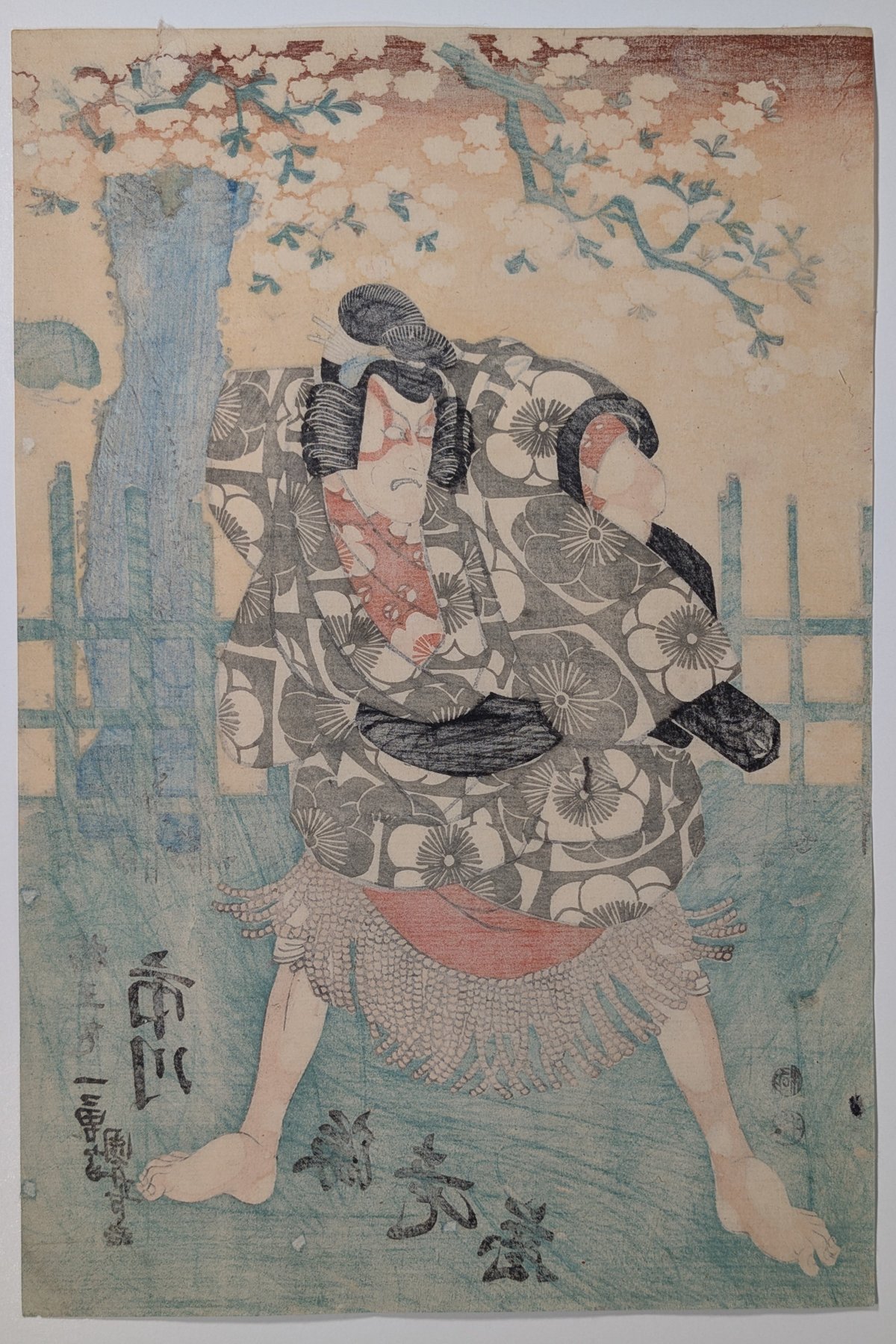
This is an original antique Japanese woodblock print, not a modern reproduction or later decorative reprint.
Its age forms an essential part of its historical character.
Original ukiyo-e of this period have survived through generations of ownership, handling, storage and display.
With works on paper more than a century and a half old, modest toning, small marks, occasional creasing or traces of handling may naturally occur.
Such characteristics are normal for authentic period prints.
They should be understood within the context of an original historical object rather than compared with the appearance of a newly manufactured reproduction.
The print is in excellent condition throughout.
The color is unusually well preserved for a Kuniyoshi actor print of this date.
The blue of the bamboo fence remains fresh and even.
The pale green ground retains its clarity.
The graded red band across the sky remains strong.
The black of the actor’s wig retains considerable depth.
The impression itself is clean and strong, with the key block remaining sharp.
These qualities make the preserved state of the print particularly noteworthy for an original work dating from the middle of the nineteenth century.
The ukiyo-e is individually framed and sold complete with its frame.
It arrives ready to hang.
The dark frame and light mount provide a clean presentation that places full emphasis on Kuniyoshi’s original composition.
The neutral framing works particularly well with the muted grey costume, pale green ground, blue bamboo fence and warm tones of the upper background.
The print can therefore be displayed immediately while retaining the visual character of the original antique work.
This print brings together several qualities that make Utagawa Kuniyoshi one of the defining figures of nineteenth-century ukiyo-e.
It combines a major kabuki subject, a powerful actor portrait, sophisticated textile pattern, strong figure design and a composition connected to one of the canonical historical plays of the Japanese stage.
The subject of Umeōmaru also gives the work significant narrative depth.
His loyalty to Sugawara no Michizane places him at the heart of the political and family conflict that drives Sugawara Denju Tenarai Kagami.
The multi-sheet character of the original design adds another level of interest.
Although the present sheet functions independently, its garden setting was designed to connect visually with the other actors in the Ga no iwai scene.
Its condition is particularly notable.
The strong blue bamboo, pale green ground, graded sky, deep black wig and sharp key block preserve much of the visual impact that Kuniyoshi intended.
As an original mid-nineteenth-century actor print by one of the great masters of ukiyo-e, it combines theatrical history, woodblock craftsmanship and strong decorative presence in a single work.
An original antique Japanese ukiyo-e by Utagawa Kuniyoshi depicting Ichikawa Ebizō as Umeōmaru (梅王丸) in the celebrated Ga no iwai scene from Sugawara Denju Tenarai Kagami (菅原伝授手習鑑). Dating from Kōka 4–Kaei 5 (1847–1852) and signed Ichiyūsai Kuniyoshi ga (一勇斎国芳画), the print shows Umeōmaru barefoot and braced in a powerful combative stance before a blue bamboo garden fence, with flowering branches above. Executed as an ōban tate-e nishiki-e measuring approximately 36 × 24.5 cm, it formed part of a multi-sheet theatrical composition. The print survives in excellent condition, with unusually strong color, a deep black wig, fresh blue and green tones and a sharp, clean impression. Original antique Japanese woodblock print, not a modern reproduction. Individually framed and supplied ready to hang.

Order above 1.000,00 € gets free shipping.

Secure and hassle-free payment process.

Certificate of authenticity included.

Have questions? Contact us via WhatsApp.
Contact