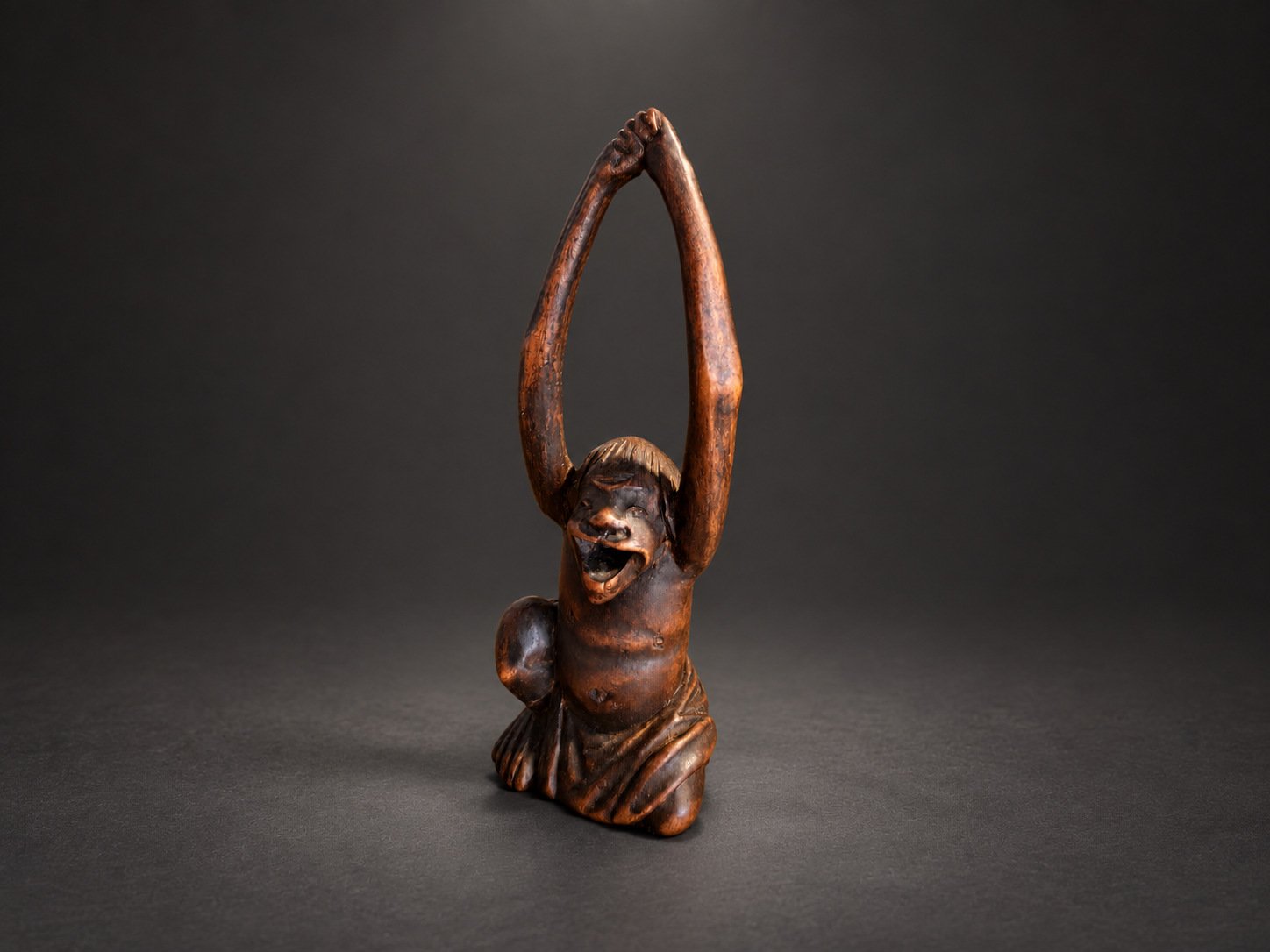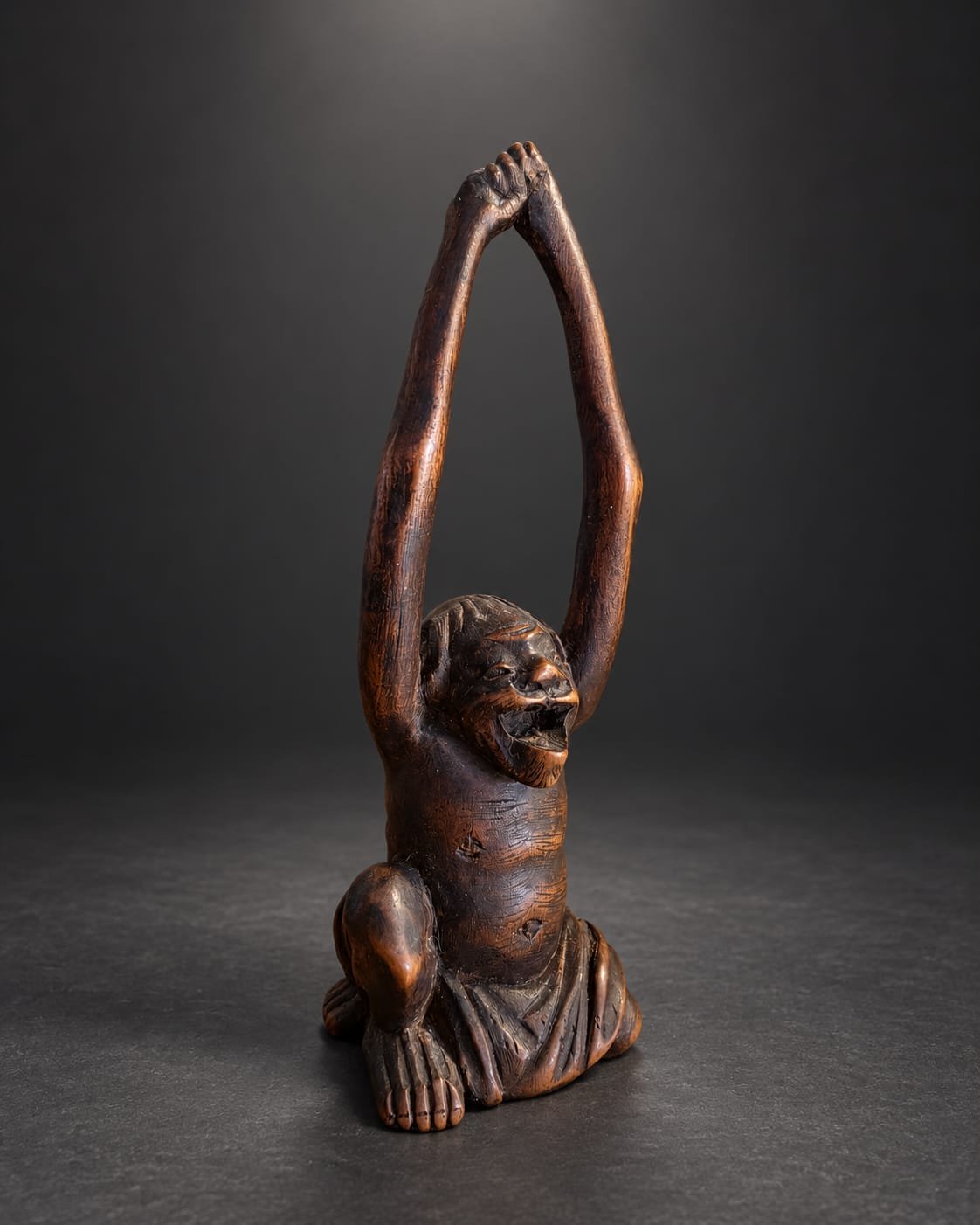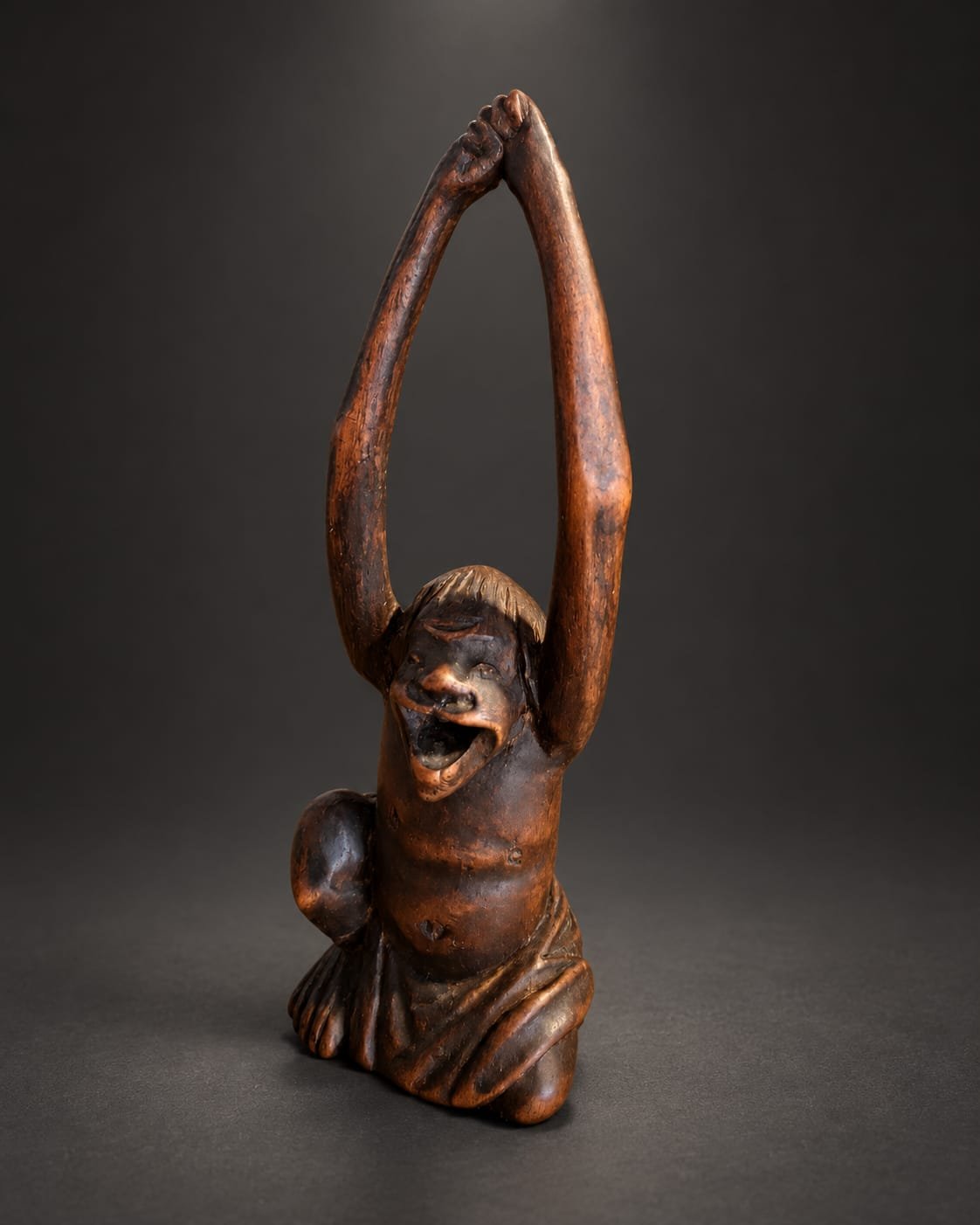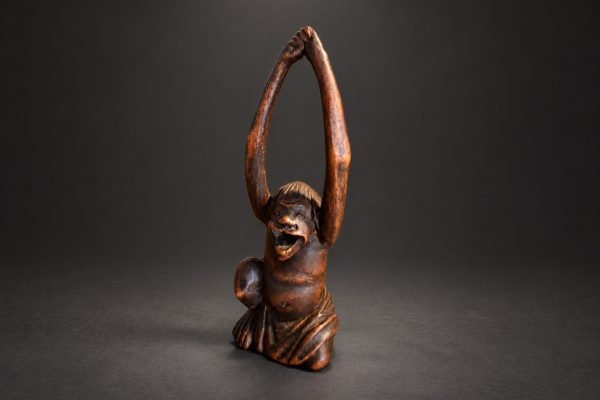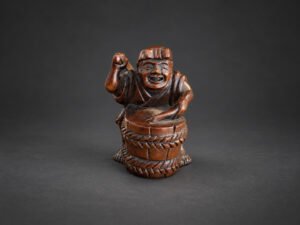
An unusually expressive Japanese wood netsuke of Tenaga, the legendary long-armed man of Chinese and Japanese folklore, dating to the late Edo period, 19th century. Kneeling with his extraordinary arms stretched vertically above his head and his hands clasped together, the figure arches his entire body into an exaggerated stretch.
His head tilts backward and his mouth opens dramatically in what may be read as an enormous yawn, shout, or exhalation. Teeth and tongue are visible beneath a broad, fleshy nose, while a ragged fringe of hair falls over the forehead and deeply modeled cheeks reinforce the physical effort of the pose.
The composition is immediately recognizable: Tenaga’s impossibly elongated arms form a tall open arch above the compact body, making his legendary anatomy the dominant feature of the sculpture.
Tenaga, literally the “long-armed man,” belongs to the fantastic beings of East Asian folklore that became familiar subjects in Japanese visual culture.
For netsuke carvers, such characters offered an ideal opportunity to exaggerate anatomy while maintaining a compact sculptural form. In this example, Tenaga’s defining feature is taken to an extreme: the arms extend dramatically upward and account for most of the height of the object.
Rather than presenting him in a narrative scene, the carver concentrates on a single physical action — stretching — allowing the strange proportions of the body to become the subject in themselves.
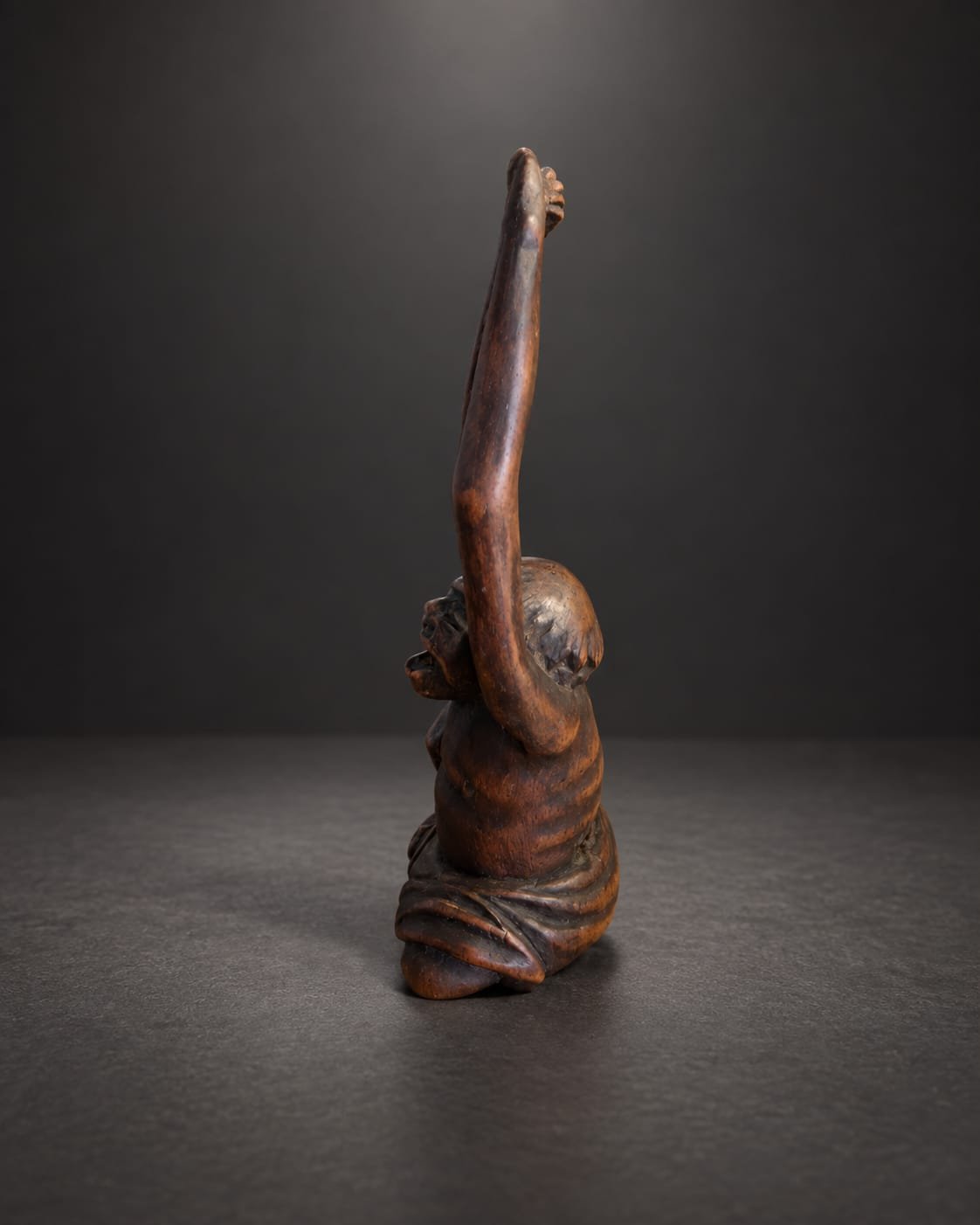
The pose gives the netsuke remarkable verticality.
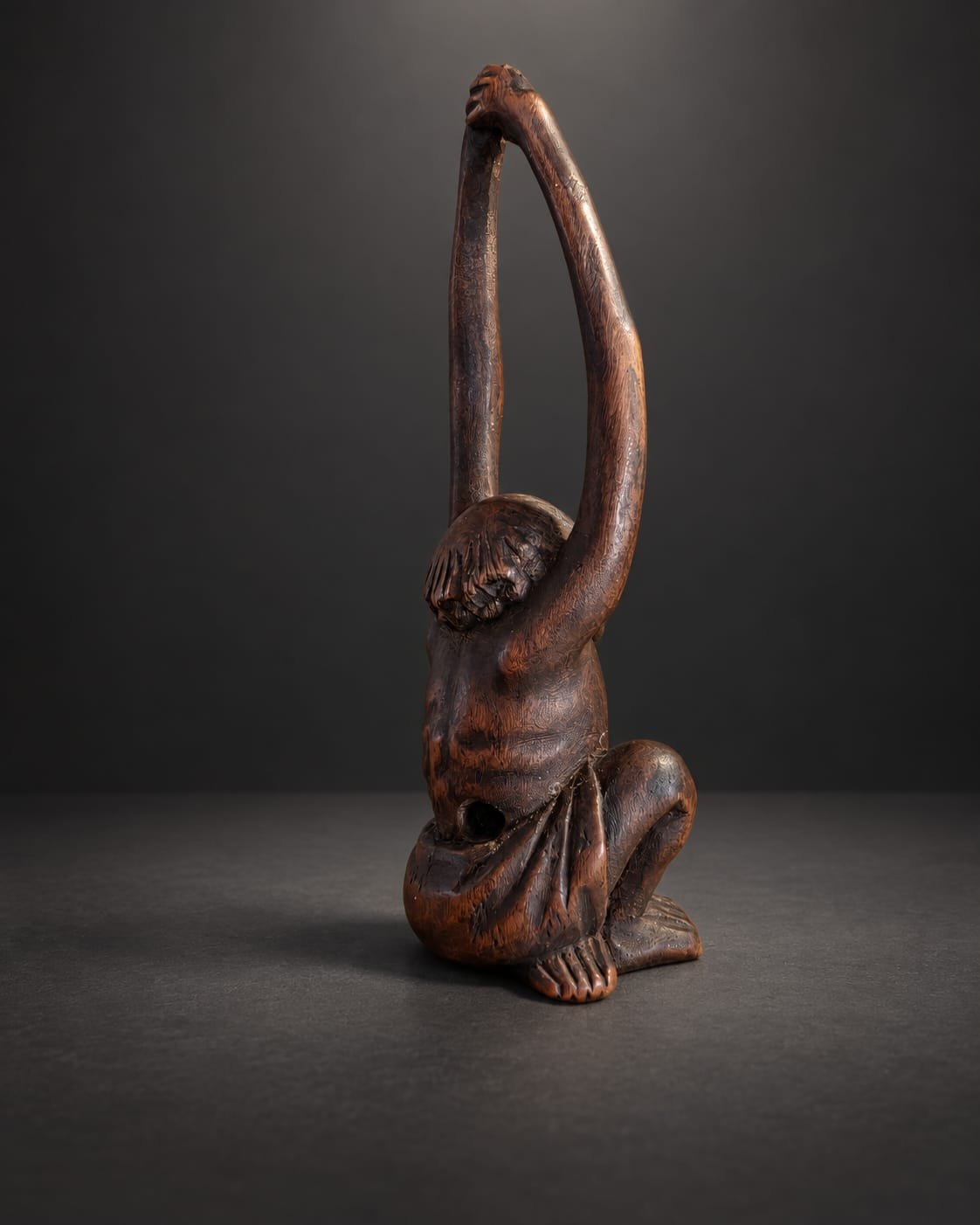
Tenaga kneels with his hands clasped high above his head, the arms rising almost straight upward before meeting at the fingertips. The torso arches beneath them, creating a continuous line from the knees through the spine and shoulders to the joined hands.
This elongated silhouette is particularly striking for a netsuke, whose forms are normally compact and rounded. Despite its unusual height, the figure remains visually controlled and cohesive.
The face is carved with considerable personality.
Tenaga throws his head backward, his mouth opening widely to reveal the teeth and tongue. The broad nose projects strongly from the face, while the cheeks crease around the mouth and eyes.
A roughly cut fringe of hair falls across the forehead, contrasting with the smoother modeling of the face and giving the figure an untamed, almost comic appearance.
The expression captures the bodily sensation of the stretch with unusual immediacy, making the small carving feel animated rather than static.
The arms are the defining sculptural feature of the netsuke.
Exceptionally long and slender, they rise from the shoulders in two sweeping curves before meeting above the head. Their exaggerated length creates the open arch that dominates the composition.
The surfaces retain subtle anatomical modeling rather than being treated simply as smooth elongated forms. Slight changes in thickness and contour suggest the elbows, muscles, and natural tension created by the upward stretch.
In contrast to the extraordinary arms, the torso is compact and lean.
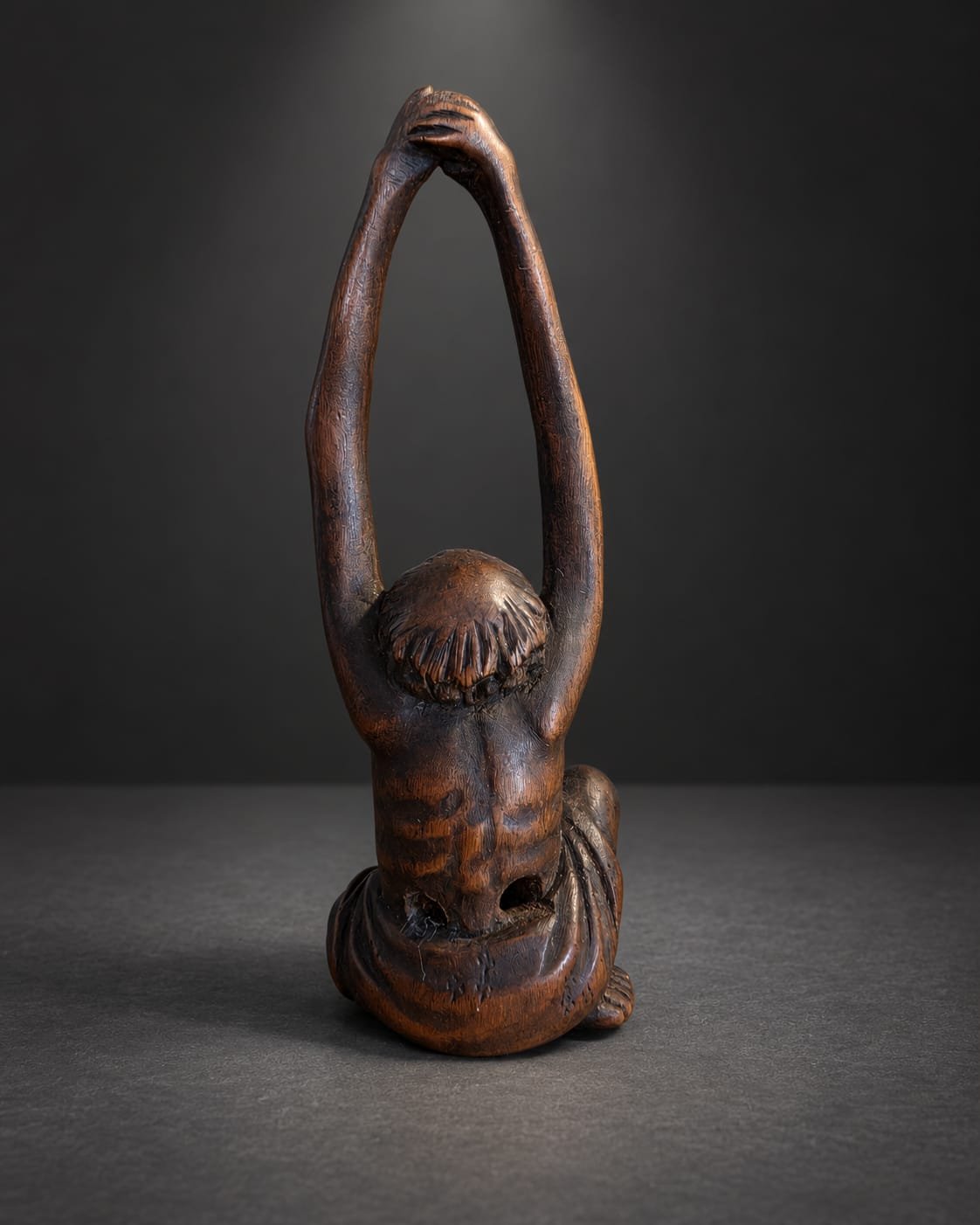
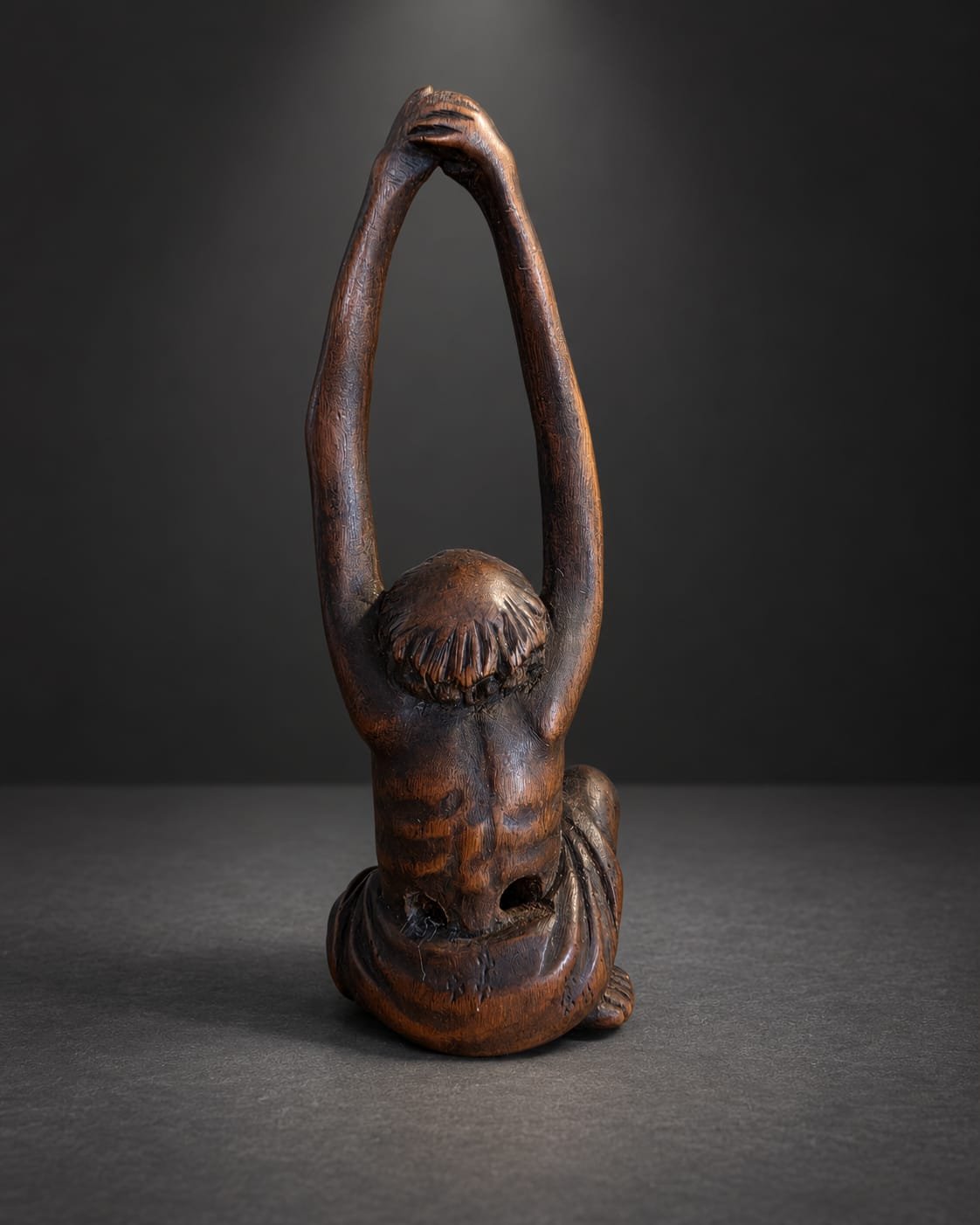
The body is modeled with a distinctly sinewy character. On the reverse, the ribs and line of the spine are clearly articulated, emphasizing the physical strain of the pose.
The restrained treatment of the torso keeps attention focused on the elongated limbs while adding anatomical depth when the sculpture is turned in the hand.
A simple loincloth wraps around Tenaga’s hips in broad, soft folds.
The cloth provides a visual transition between the lean torso and the folded legs below, while its rounded folds contrast with the long taut lines of the arms.
Seen from the rear and underside, the fabric also plays an important structural role in integrating the legs, torso, and himotoshi into a compact base.
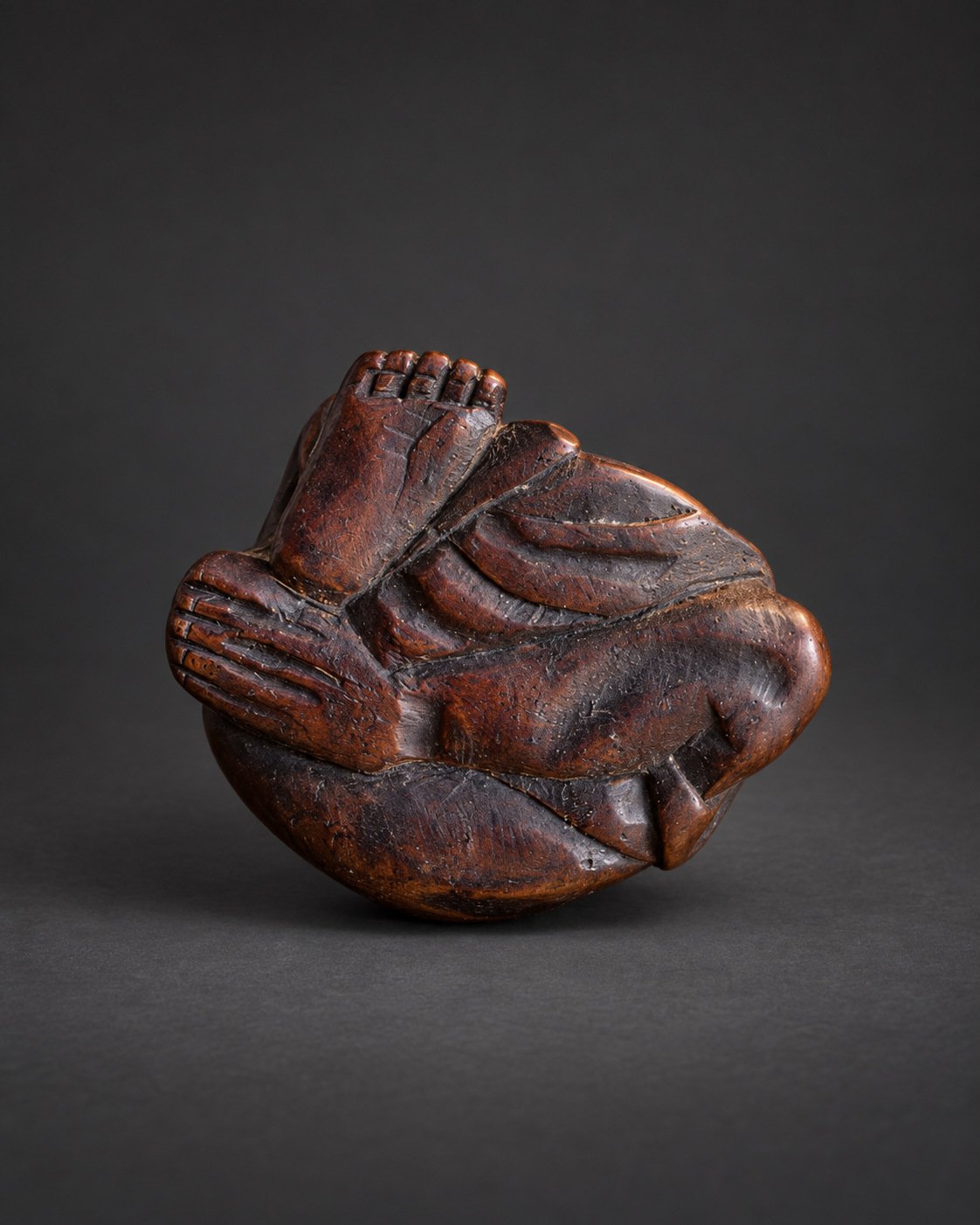
The underside reveals the same attention to detail found on the visible surfaces.
The legs are folded beneath the body, with the two bare soles carved against the folds of the loincloth. Each toe is individually separated and clearly defined.
This careful treatment of the underside reflects the traditional nature of netsuke as tactile objects intended to be handled, rotated, and examined from every direction rather than viewed only from the front.
At the small of the back are two naturally integrated himotoshi, positioned between the modeled spine and the folds of the loincloth.
Rather than interrupting the body with conspicuous drilled openings, the cord passage is incorporated into the existing sculptural structure of the figure.
These himotoshi preserve the original practical function of the piece as a wearable netsuke used to secure an inrō, tobacco pouch, or other sagemono suspended from the obi.
The carving is particularly effective from multiple viewpoints.
From the front, the elongated arms and open mouth dominate the composition. From the side, the exaggerated curvature of the body and projection of the nose become more apparent. From behind, the spine, ribs, folded cloth, and integrated himotoshi reveal an entirely different sculptural reading.
Even the underside has been fully considered, with folded legs, soles, and individually articulated toes completing the composition.
The wood has developed a deep and attractive chestnut-brown patina through age and prolonged handling.
A soft, even polish is especially visible along the arms and other projecting surfaces, where generations of contact have gradually softened and enriched the wood.
Darker tones remain in recessed areas around the face, torso, and drapery, naturally emphasizing the carving and giving the figure greater depth.
The netsuke dates to the late Edo period, 19th century, when Japanese netsuke carving had developed into a highly sophisticated form of miniature sculpture.
Folkloric figures were particularly suited to the medium because their unusual anatomy, expressions, and narratives allowed carvers to create immediately recognizable subjects within extremely small dimensions.
This Tenaga is a particularly bold example, reducing the subject to his most distinctive physical characteristic and turning the elongated arms themselves into the principal architecture of the sculpture.
The netsuke survives in excellent condition for its age.
The wood retains a rich chestnut patina with a soft, even polish developed through historical handling. A small number of natural irregularities in the wood are visible on the chest and abdomen and are consistent with the character of the material.
Only minor wear appropriate to its age is present. The facial details, fingers, toes, hair, loincloth folds, torso modeling, and elongated arms remain clearly defined.
This netsuke combines a highly recognizable folkloric subject with an unusually dramatic silhouette.
The elongated arms create a sculptural form unlike more compact human netsuke, while the expressive open mouth, carefully modeled anatomy, fully worked underside, natural himotoshi, and mature wood patina reward close examination.
Unsigned but confidently carved, it is a distinctive late Edo-period interpretation of Tenaga and an engaging example of the imaginative range of Japanese netsuke carving.
A striking late Edo-period wood netsuke of Tenaga, the legendary long-armed man, captured in an extraordinary full-body stretch. Kneeling with his hands clasped high above his head, the figure forms a dramatic open arch with his impossibly elongated arms, while his head falls backward and his mouth opens in an exaggerated yawn or shout. The lean torso, modeled spine and ribs, simple loincloth, carefully articulated feet, natural himotoshi, and rich chestnut patina demonstrate the carver’s attention to the sculpture from every angle. Measuring approximately 7.8 cm high, this unusually vertical composition is a particularly expressive interpretation of one of the most distinctive figures in Japanese folklore.
| Época | Edo |
|---|

Order above 1.000,00 € gets free shipping.

Secure and hassle-free payment process.

Certificate of authenticity included.

Have questions? Contact us via WhatsApp.
Contact