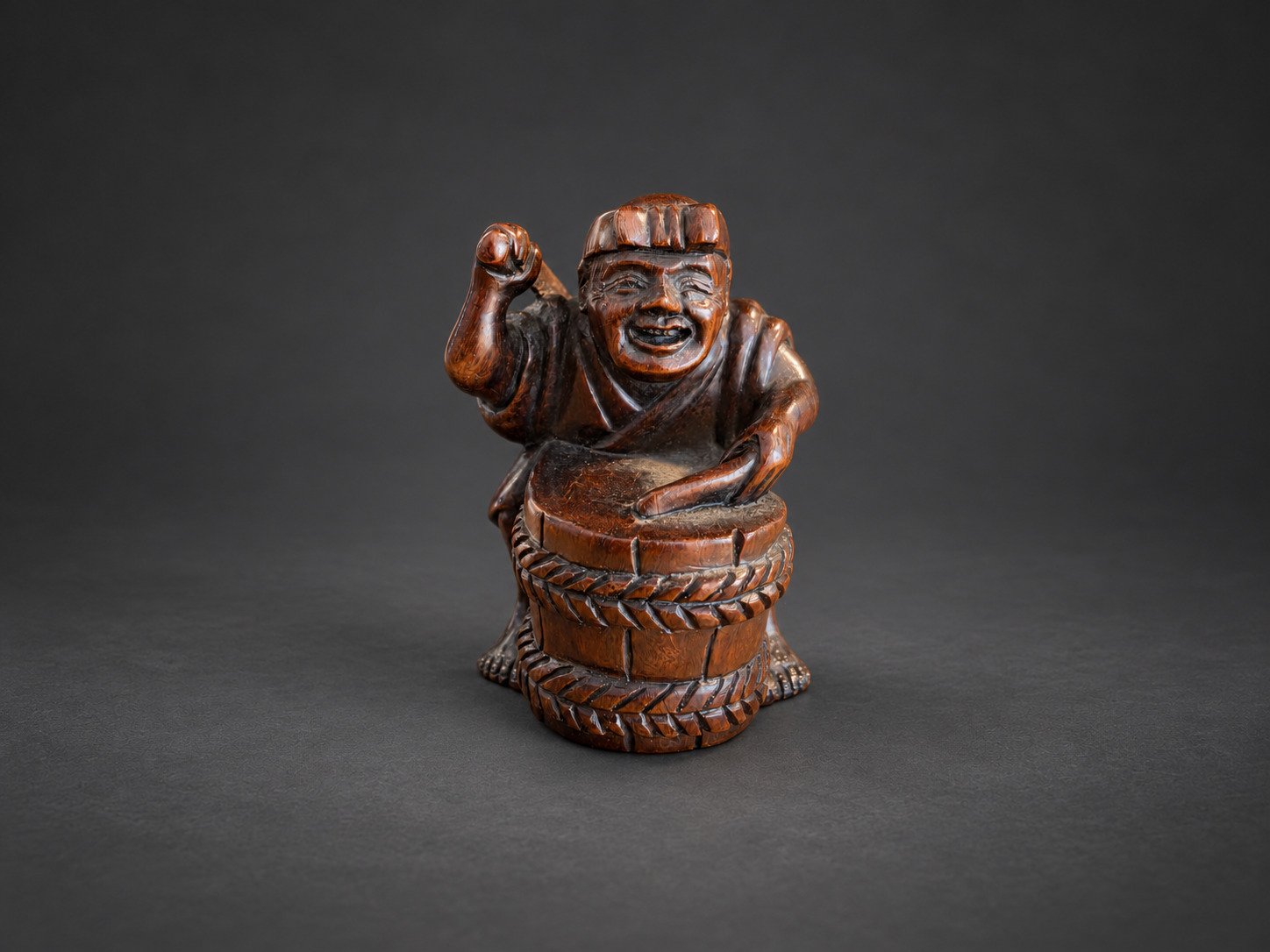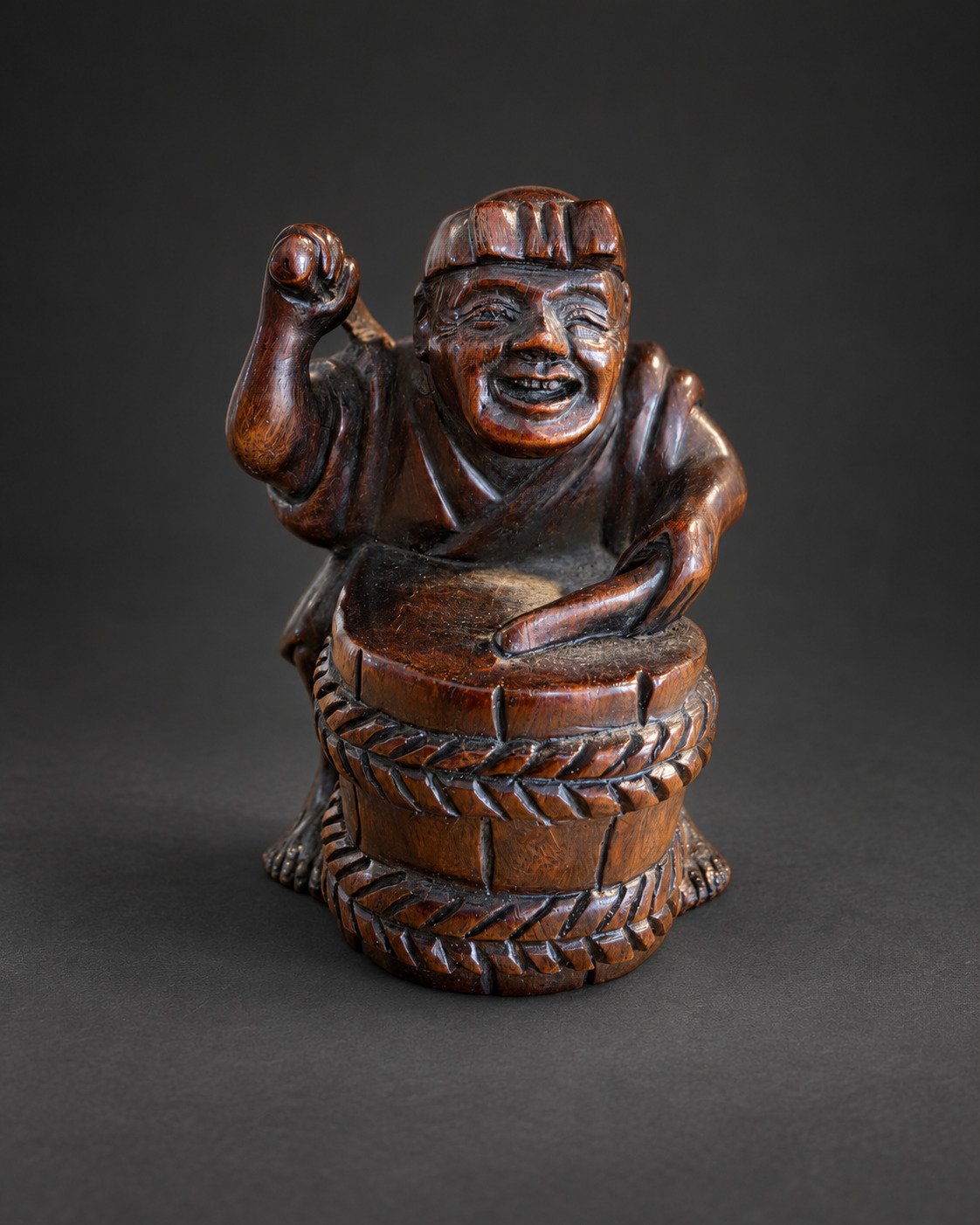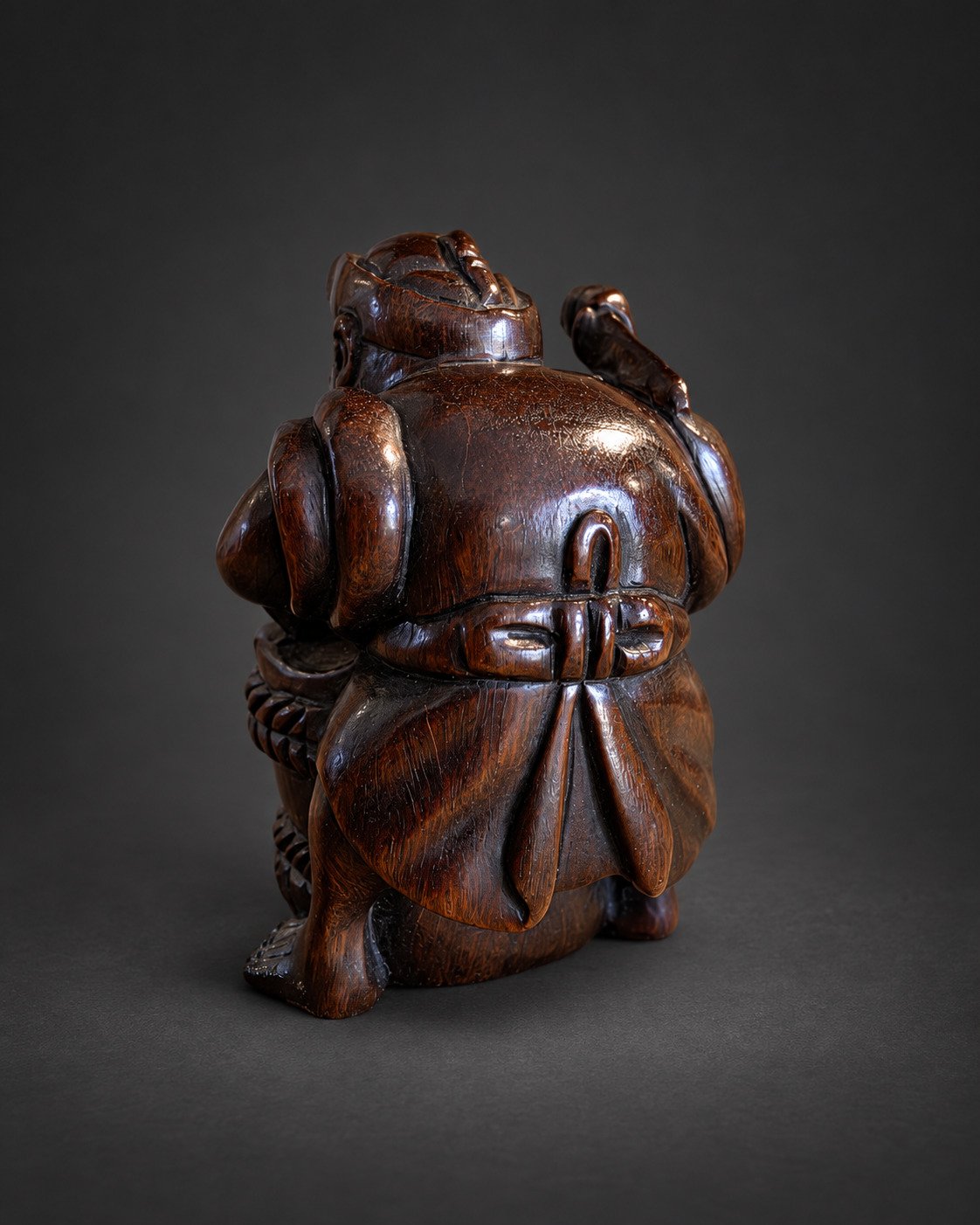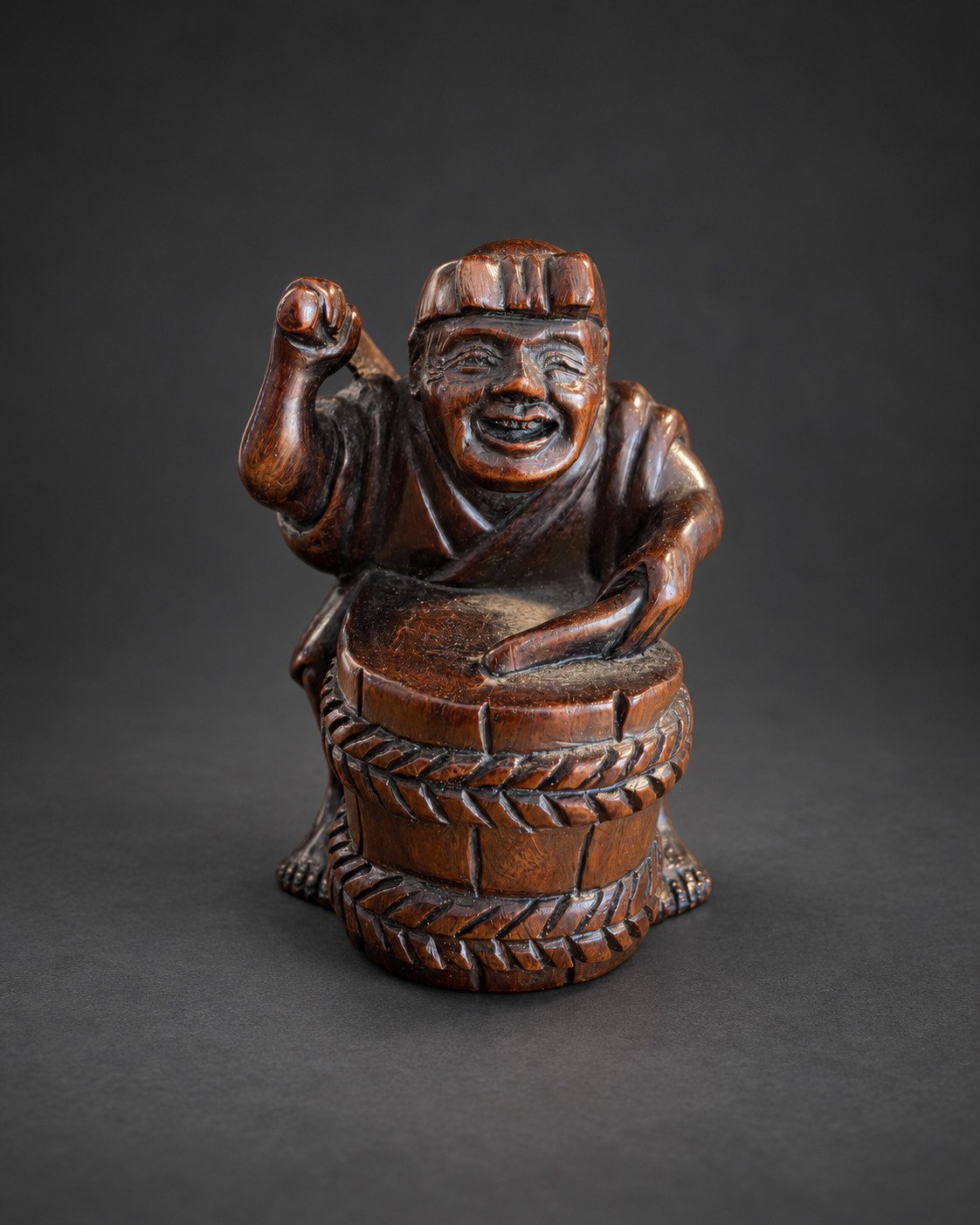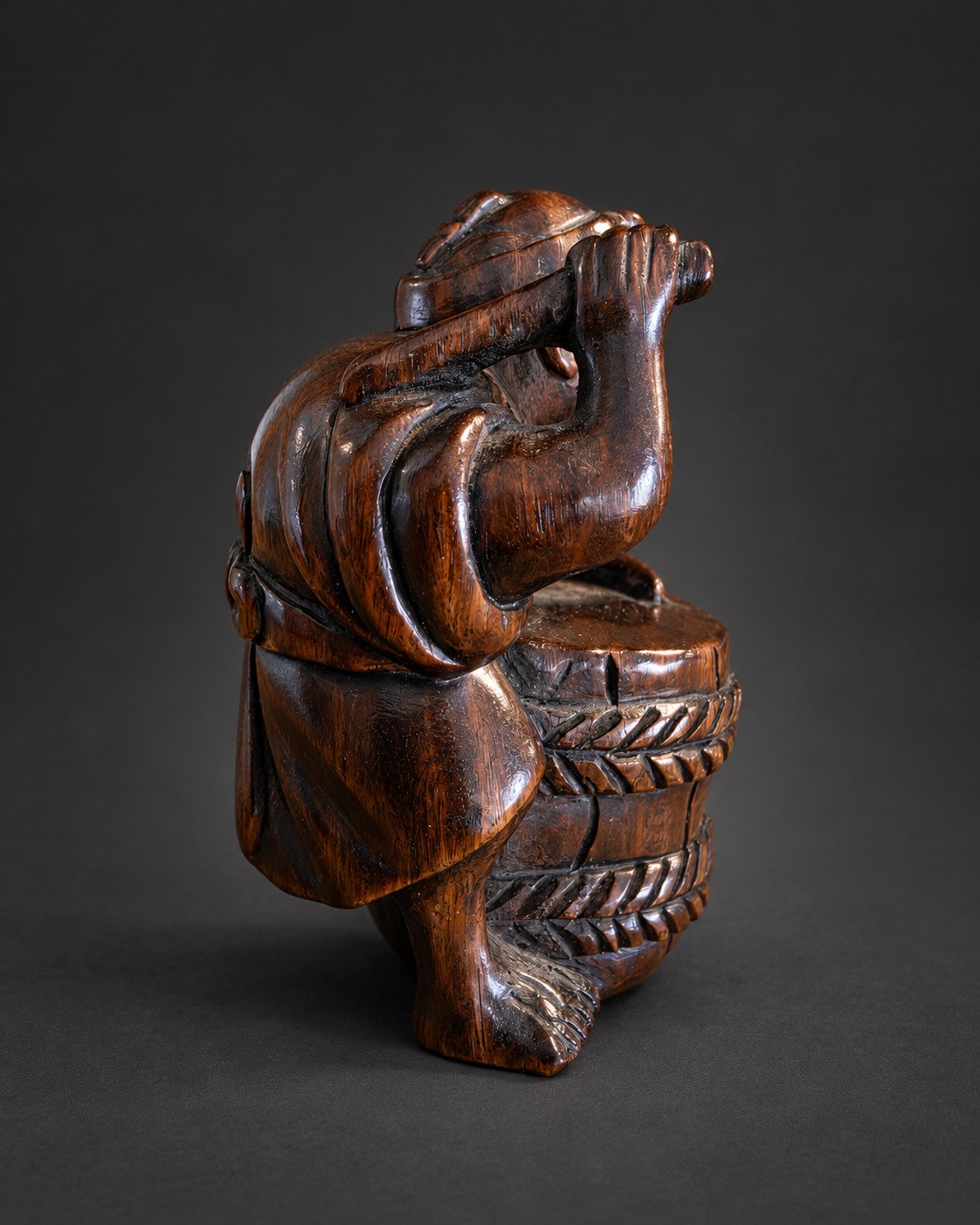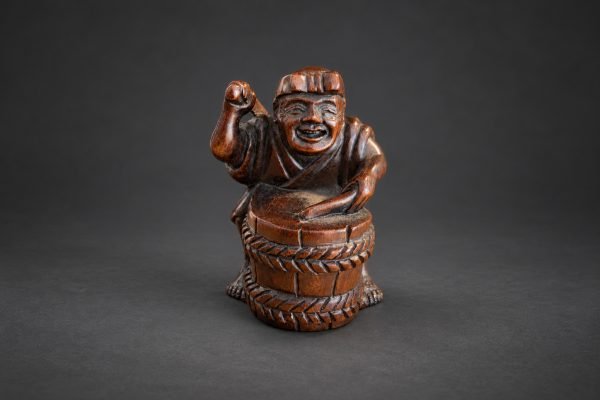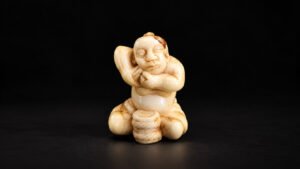
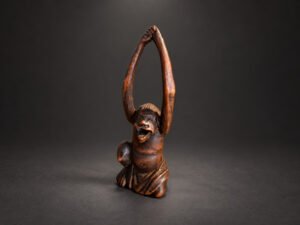
An animated Japanese wood netsuke of a drummer, dating to the Meiji period, late 19th century, and signed 友正 Tomomasa. The figure leans enthusiastically over a large barrel-shaped drum, one bachi resting against the drumhead while the other is raised high behind his shoulder, ready to deliver the next beat.
The scene is full of movement and humor. A knotted cloth is wrapped around the drummer’s head, his mouth opens in a broad laugh, and finely carved lines around the eyes reinforce the impression of a performer completely absorbed in the rhythm. The deeply patinated wood and soft polish created through generations of handling give the carving a particularly warm and tactile character.
The subject captures a musician in the middle of an energetic performance rather than in a static pose.
His left hand holds a short drumstick (bachi) against the drumhead, while the right arm sweeps upward behind the shoulder with the second stick raised for the next strike.
This asymmetrical gesture creates the impression of continuous movement. The viewer can almost anticipate the next beat as the raised arm prepares to descend.
The compact arrangement of body, drum, and sticks is particularly effective for a netsuke, transforming a moment of performance into a small sculpture that remains visually coherent from every angle.
The drummer’s expression is one of the most engaging features of the carving.
His face breaks into a broad, open-mouthed laugh, with the teeth clearly visible. Fine incised lines around the eyes suggest both age and expression, while the raised cheeks reinforce the sense of genuine amusement.
A cloth tied around his head further suggests the lively atmosphere of a popular performance or festival setting.
Rather than presenting an idealized musician, the carver has created a recognizable human character: joyful, animated, and completely engaged with his music.
The two bachi, or drumsticks, are essential to the movement of the composition.
One remains close to the drumhead while the other rises dramatically over the drummer’s shoulder. This difference in position captures two consecutive moments within a single sculpture — one strike completed and another about to begin.
The raised stick also creates a strong diagonal that prevents the compact figure from appearing static despite its small dimensions.
The drum itself is carved as a substantial, squat barrel-shaped form that acts as both the narrative focus and the structural base of the netsuke.
Its body is divided into clearly defined vertical panels, while the drumhead is enclosed by a raised rim.
Two thick braided cords encircle the body. These are carved in deep chevron relief, producing a strong repeating pattern that contrasts with the smoother surfaces of the drum and the rounded forms of the performer.
The careful rendering of these cords gives the drum considerable visual weight despite the small scale of the object.
The drummer wears a loose robe modeled in broad, rounded folds.
Rather than covering the body in fine surface detail, the carver uses substantial volumes to describe the garment, allowing the folds to complement the compact mass of the figure.
At the back, the robe is gathered by a sash whose knot and hanging ends are carved in full relief, adding another layer of three-dimensional detail when the netsuke is viewed from behind.
The drummer’s bare feet emerge at the base on either side of the drum.
Each toe is individually defined, a small but characteristic example of the attention paid to areas that might easily have been simplified.
The feet also help stabilize the composition visually, anchoring the animated upper body around the solid form of the drum.
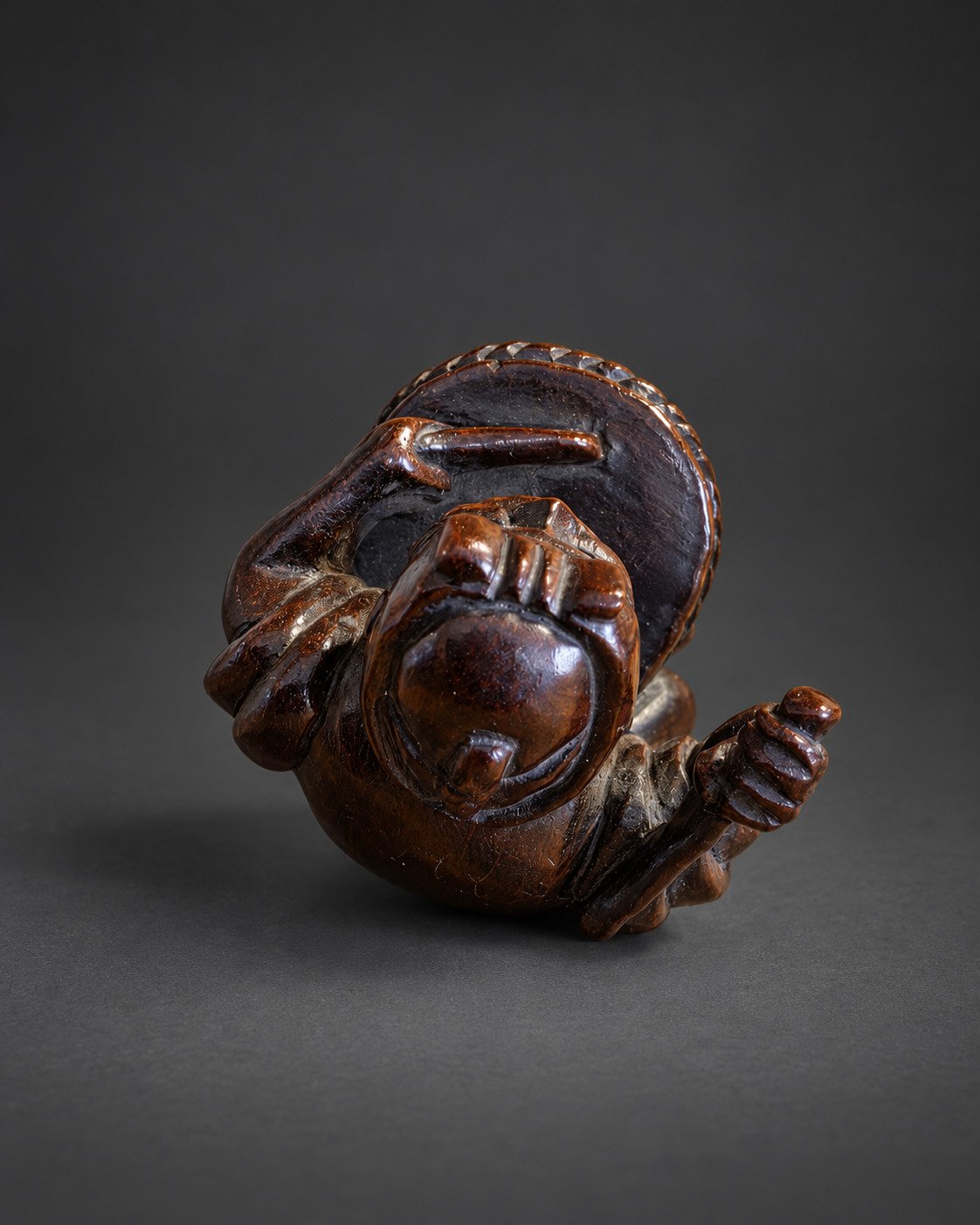
Like a well-conceived netsuke, the carving is not intended to be understood from only one viewpoint.
Seen from the front, the face, raised arm, and drum create the main narrative. From the sides and rear, the robe, sash, headcloth, drum cords, and body posture reveal additional details.
Viewed from above, the drummer’s raised arm, the drumstick, and the wrapped head create a circular movement around the rim of the drum.
This tightly controlled composition keeps all projecting elements within a compact overall form suitable for an object traditionally worn and handled.
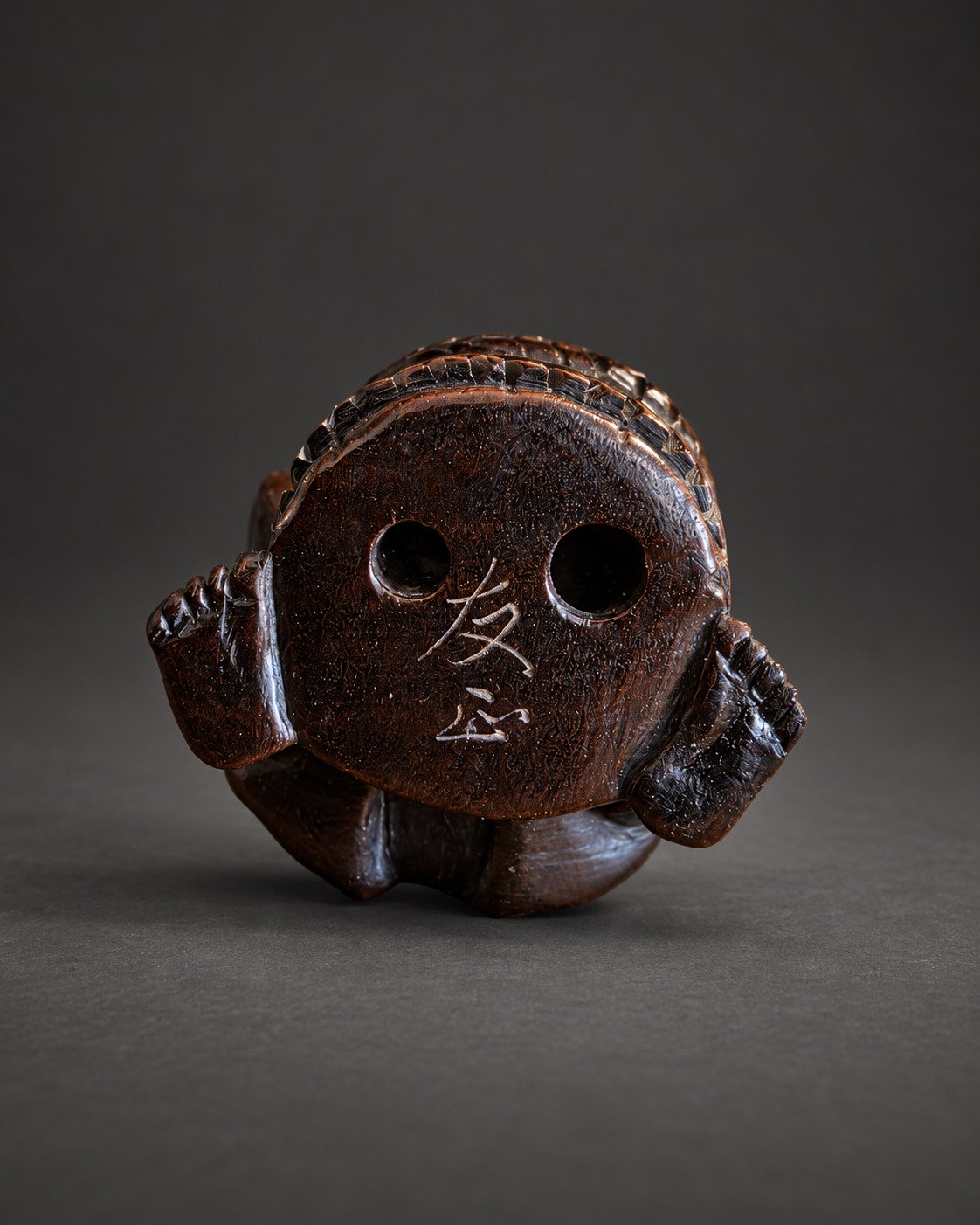
The underside of the drum bears the incised signature 友正 – Tomomasa.
The characters are cut into the flat underside and highlighted with white pigment, making the signature clearly legible against the dark wood.
The signature forms an important part of the object and is recorded here as observed. Without additional specialist documentation, no further attribution to a particular recorded carver or workshop is proposed.
The flat underside of the drum is pierced with two large himotoshi, the cord openings required for the traditional use of the netsuke.
These openings would have allowed the piece to function as a counterweight securing an inrō, tobacco pouch, or another form of sagemono suspended from the obi.
Their position in the underside of the drum allows them to perform their practical function without interrupting the sculptural composition.
The wood has developed a rich deep chestnut-brown patina through age and handling.
Raised surfaces display a soft natural polish, particularly on the face, arms, drum, and projecting folds, while recessed areas remain darker and help emphasize the carved details.
This contrast gives the netsuke a depth and warmth that develops naturally through long-term handling and cannot easily be reproduced artificially.
The netsuke dates to the Meiji period, late 19th century, when netsuke carving continued to combine traditional wearable function with increasingly sophisticated miniature sculpture.
Subjects drawn from popular life, trades, entertainers, festivals, and humorous everyday situations remained especially effective because they allowed carvers to explore movement, expression, costume, and personality within a remarkably small format.
This drummer belongs naturally to that tradition, transforming a fleeting instant of music and laughter into a compact sculptural narrative.
The netsuke survives in excellent condition for its age.
The wood retains a deep and attractive chestnut patina with soft polishing to the high points from historical handling. Only minor wear consistent with age and antiquity is present.
The principal carved details remain clearly defined, including the facial expression, teeth, headcloth, drumsticks, braided cords, robe folds, sash, feet, himotoshi, and signature.
This netsuke brings together several qualities valued in Japanese miniature carving: a lively human subject, an expressive face, a strongly animated pose, compact three-dimensional composition, functional himotoshi, and an attractive old wood patina.
The Tomomasa signature adds further documentary interest, while the energetic drummer and carefully rendered drum give the piece immediate visual appeal even at its small scale.
It is a particularly engaging example of the humor, observation, and sculptural inventiveness that characterize Japanese netsuke of the late 19th century.
A lively late 19th-century Meiji-period wood netsuke of a drummer, signed 友正 Tomomasa and carved with exceptional character. Leaning over his barrel-shaped drum with one bachi resting on the drumhead and the other raised high for the next beat, the laughing performer captures a fleeting moment of music, movement, and festival humor. Deeply carved braided cords, rounded robe folds, articulated bare feet, functional himotoshi, and a richly developed chestnut patina reward examination from every angle. Measuring approximately 4 × 3 × 2.8 cm, this compact and expressive netsuke is a particularly appealing example of Japanese miniature carving from the Meiji period.
| Época | Edo |
|---|

Order above 1.000,00 € gets free shipping.

Secure and hassle-free payment process.

Certificate of authenticity included.

Have questions? Contact us via WhatsApp.
Contact