October 18, 2026
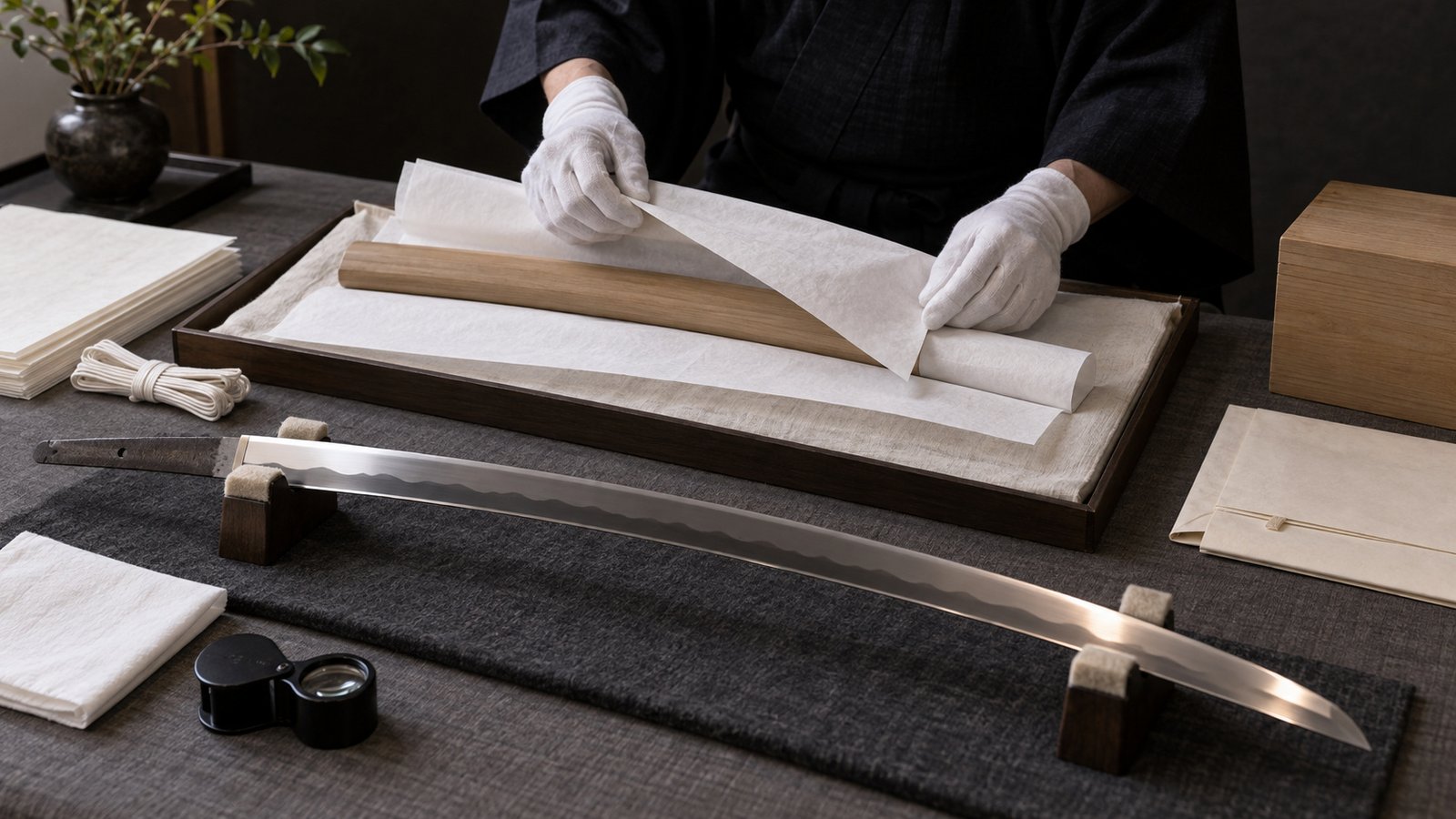
Submitting a Japanese sword for shinsa (expert examination) rewards calm preparation rather than last-minute fussing. The aim is straightforward: present the blade safely, cleanly and respectfully, with clear paperwork and minimal handling, so that the judges can observe what they need to observe. This guide focuses on conservative, reversible steps—etiquette, packaging, and the typical kantei (observational appraisal) points—without implying any particular outcome.
For international collectors, “shinsa” can sound like a single, uniform process. In practice, it is best understood as a structured examination carried out by a recognised organisation, using that organisation’s criteria and methods at that time. Preparation is less about trying to “help” the blade, and more about avoiding anything that obscures or harms it.
Shinsa is an expert examination intended to arrive at an organisational judgement about a sword, typically expressed in the organisation’s own documentation. It is not a retail valuation, and it is not a guarantee of future market performance. A considered submission therefore prioritises:
From a collector’s perspective, certification-literacy matters: learn what the organisation is trying to determine, and present the sword in a way that allows careful observation without interference from excess oil, poor packaging, or avoidable handling damage.
Collectors commonly encounter shinsa in the context of the NBTHK (Nihon Bijutsu Tōken Hozon Kyōkai) and the NTHK (Nihon Tōken Hozon Kai), sometimes including shinsa events held outside Japan. Without promising specific procedures (which can vary by venue and organiser), it is sensible to assume that both contexts will expect:
In other words, “NBTHK submission” and “NTHK shinsa” share the same practical preparation fundamentals even when the administrative steps differ.
However experienced the judges may be, shinsa results speak to the organisation’s criteria, evidence, and consensus at the time of examination. They do not rewrite the blade’s physical reality; they summarise an informed view of it. Results can also be affected by what can be seen: a tired polish, heavy oiling, or distracting surface grime may complicate observation. Treat the process as a careful examination rather than an ultimate verdict, and avoid interpreting any outcome as a definitive market appraisal.
A calm timeline reduces risk. Many avoidable problems—missing forms, rushed packing, ill-fitting parts—come from compressing the preparation into the final days. Plan as though you will have to re-check everything twice.
Work backwards from the announced shinsa date (or the appointment window) and build in slack for delays. A conservative planning approach might include:
If shipping internationally, add additional time for carrier constraints, customs processes, and any regulatory steps. Even within one country, do not assume a courier will handle a sword package gently or keep it away from heat.
In shinsa preparation, clear information is part of good etiquette: it reduces confusion and keeps the desk moving. While exact form fields differ, it is common to assemble neutral data such as:
Measure carefully, write legibly, and keep your units consistent. If you are unsure how to take a particular measurement, it is better to leave it blank than to guess.
For photographs, aim for images that are useful rather than dramatic:
Do not try to “prove” an idea with photos. The point is to provide clear reference material for identification and handling, and to support accurate paperwork.
Keep your documentation organised in a way that still makes sense if parcels are separated. A conservative system is:
Do not place loose papers in direct contact with the blade or inside the inner wrap where they could abrade the lacquer or wick moisture. If an organiser requests documents to be included with the package, keep them in a separate sleeve outside the inner sword wrapping.
Handling is where good intentions can do harm. The goal is preservation: clean enough for observation, stable enough for transport, and untouched where touching would remove historical evidence. Avoid any amateur restoration, polishing, rust removal, or “improvements”.
Judges need to see the steel. A heavy oil film can mask jigane (surface steel) and hamon (tempering line), while aggressive wiping can create fine scratches. A conservative approach is:
If you are travelling to a venue, remember that temperature changes can cause oil to migrate. What looks “lightly oiled” at home may look heavy after a warm journey. Err on the side of minimal.
The nakago (tang) should not be cleaned, scrubbed, oiled, re-patinated, or otherwise altered. Its condition and patina are part of the blade’s record, and any intervention can remove evidence that cannot be replaced. In practical terms:
If you must handle the nakago during disassembly, do so briefly and carefully, and keep everything stable and supported.
A great deal of transport damage comes not from impacts, but from small movements within the saya (scabbard) or within koshirae (mounts). Before submission, check the practical basics:
If you are uncertain about the stability of the mounts, it can be safer to submit the blade in shirasaya (plain wooden storage mounting) if you have it, rather than in a complex koshirae that may flex, loosen, or trap grit.
While each organisation has its own documentation style, the underlying observation categories are familiar to students of kantei. The collector’s task is not to lead the judges to a conclusion, but to ensure the blade can be viewed clearly and safely. Think of the judges’ work as moving from the general to the specific.
Sugata refers to overall form and silhouette. At a baseline level, observers may consider:
This is one reason over-oiling is unhelpful: it can turn the surface into a mirror and obscure geometry. Likewise, a blade that is loose in its saya can be difficult to present calmly, which is a practical and etiquette issue as much as an observational one.
Jigane is the visible surface steel, and hada is the grain pattern seen in that steel. Seeing these features depends heavily on:
As a submission practice, do not attempt to “refresh” the appearance with powders, abrasives, or improvised cleaning agents. If the surface condition is such that hada cannot be seen well, that is a conservation question for qualified professionals—not a problem to solve the week before shinsa.
The hamon (tempering line) and boshi (tempered pattern in the point) are central to how a blade is read. Observers may also look for hataraki—visible activities and internal features within the hardened and unhardened areas—depending on what the blade presents. From a preparation standpoint:
It can be tempting to practise “showing the hamon” by repeated drawing and re-sheathing. Avoid that. Every cycle risks contact at the koiguchi (mouth of the scabbard), micro-scratches, or accidental knocks. Practise once or twice with care if you must, then stop.
Condition of the nakago, including the patina, file marks (yasurime), and any inscriptions (mei), is observed as part of the overall picture. The correct collector stance is restraint:
If you include a note about an inscription, keep it descriptive and cautious (for example, “inscription present” rather than an asserted attribution). Let the examination do its work.
Shipping is where many blades suffer preventable harm: crushed boxes, shifting contents, condensation, and careless handling. Your packaging should assume the parcel may be dropped, inverted, or left in a hot vehicle. Build immobilisation first; cushioning second; rigidity third.
For transport, shirasaya is generally preferred because it is designed for storage and tends to hold the blade securely and simply. Whether in shirasaya or a saya within koshirae, check:
If the blade is being transported with mounts, confirm that nothing inside the saya is loose, and that there is no obvious grit at the koiguchi that could be dragged along the polish.
Even a good-fitting saya can allow slight movement over a long journey. A conservative approach to immobilisation is to add reversible, non-abrasive support at the habaki area:
Do not wedge material into the saya in a way that forces the blade or presses against the edge. Immobilisation should prevent movement, not create pressure points.
Use a double-box strategy. The inner layer should hold the sword firmly; the outer layer should protect against crushing and punctures.
Be cautious with over-sealing: an airtight package can trap moisture if the sword is packed in a humid environment. The best practice is dry, clean packing conditions, with moderate buffering rather than aggressive “vacuuming” of the parcel.
Follow the organiser’s instructions for labelling and forms. As a general risk-control measure:
Compliance is part of preservation. A parcel delayed or opened due to unclear declarations can be exposed to heat, handling, and moisture for far longer than planned.
Good etiquette at the venue is not theatrical; it is practical. It keeps the desk safe, protects everyone’s time, and helps the judges work without distraction. Assume you will be in a queue with other collectors and limited space.
If you are travelling with more than one item, keep each submission clearly separated and labelled to avoid mixing parts or paperwork under pressure.
When you reach the desk or table, follow instructions precisely. Typical good practice includes:
Even if you are knowledgeable, resist the impulse to “guide” the examination. The judges will look where they need to look, in the order that makes sense to them.
If asked questions, respond with neutral facts:
Avoid offering attributions, school claims, or period assertions. Overstated claims rarely help, and they can create confusion. Let the documentation produced by the examination speak in its own terms.
Many problems seen around shinsa are not rare disasters; they are small, common mistakes repeated across many submissions. Avoiding them is one of the simplest forms of respect you can show to the blade and to the process.
Two extremes cause needless trouble:
Use minimal oil and gentle, clean materials. If you find yourself “working” at a mark, stop. Shinsa preparation is not a polishing session.
A loose habaki can allow movement that scuffs at the machi area, and repeated minor contact can become visible damage. If you suspect poor fit:
On the day, a stable, safe presentation matters more than a last-minute attempt to “tighten things up”.
It is understandable to feel hopeful about a blade, especially if you have studied it carefully. Nonetheless, forms are not the place to argue a case. Common errors include asserting a maker, school, or era as fact, or presenting an unverified signature reading. Keep descriptions neutral and factual. If you include notes, make them modest and clearly distinguished from certainty.
How you respond after shinsa matters as much as how you prepare. Treat the outcome as information to be integrated thoughtfully, not as a personal judgement. Avoid turning a single result into an absolute narrative.
Outcomes can vary: recognition may be granted, a decision may be deferred, or the sword may receive no recognition under that organisation’s criteria at that time. None of these outcomes should be treated as a market appraisal. They reflect an examination under particular conditions, and they can be revisited later if circumstances change (for example, improved documentation, further research, or appropriate conservation).
If a blade’s surface condition makes observation difficult—whether due to tired polish, active rust, staining, or other issues—conservation may be worth discussing with qualified professionals. The key point is that conservation is not a do-it-yourself project. Anything abrasive, irreversible, or speculative can permanently remove evidence and reduce the blade’s ability to be judged fairly in future.
If you are considering professional work, gather clear photographs and describe your goals conservatively (stabilisation, visibility, preservation), rather than chasing a particular shinsa result.
If you receive papers or written findings, read them closely and literally. Note what is stated, what is not stated, and the terminology used. Keep careful records: scan or photograph the documents, store them safely, and keep the sword’s paperwork organised so that future handling and insurance decisions are informed by accurate information. If you are unsure what a term means, seek education first rather than filling gaps with assumptions.
Japanese swords move through a complex landscape of laws, carrier rules, and practical risks. Good shinsa preparation includes taking responsibility for compliance and for the safety of others. If you are uncertain, pause and seek advice before shipping or travelling.
Insure shipments where possible and declare contents in accordance with carrier rules. Under-declaring or disguising contents can backfire if a claim is needed, and it may create legal exposure. Keep a clear record of:
These are practical protections, not an implication of value; they simply support responsible custody.
Before any cross-border movement, check the applicable regulations in the sending country, transit points (if relevant), and destination country. Requirements may apply to bladed items generally, and additional requirements may apply depending on classification, age, or documentation. This guide cannot substitute for legal advice; treat compliance as essential to preservation and to your own peace of mind.
Where uncertainty exists—whether about conservation, documentation, packing, or lawful shipment—consult appropriate professionals. In practice, that might mean an experienced organiser, a qualified polisher for condition questions, or a specialist shipper familiar with regulated goods. The right advice often prevents the kind of improvised decision that causes irreversible harm.
No. Do not clean or alter the tang; its patina and condition are part of the historical record.
Apply a minimal, even film. Excess oil can obscure jigane and hamon and may be wiped off at the desk.
It is generally preferred for safe transport. If unavailable, ensure the mount is secure and the blade is immobilised.
Provide neutral facts only. Avoid asserting maker, school or era; let examiners form their judgments.
Consider conservation, research, or resubmission later. Results reflect criteria at that time and are not market appraisals.
Continue your preparation with our observation guide and learn to read organisational papers responsibly; see our Authenticity Guarantee for how we handle documentation.

CEO of SupeinNihonto, dealer and collector of ancient Japanese art and weapons from Canillo, Andorra.
Contact