October 18, 2026

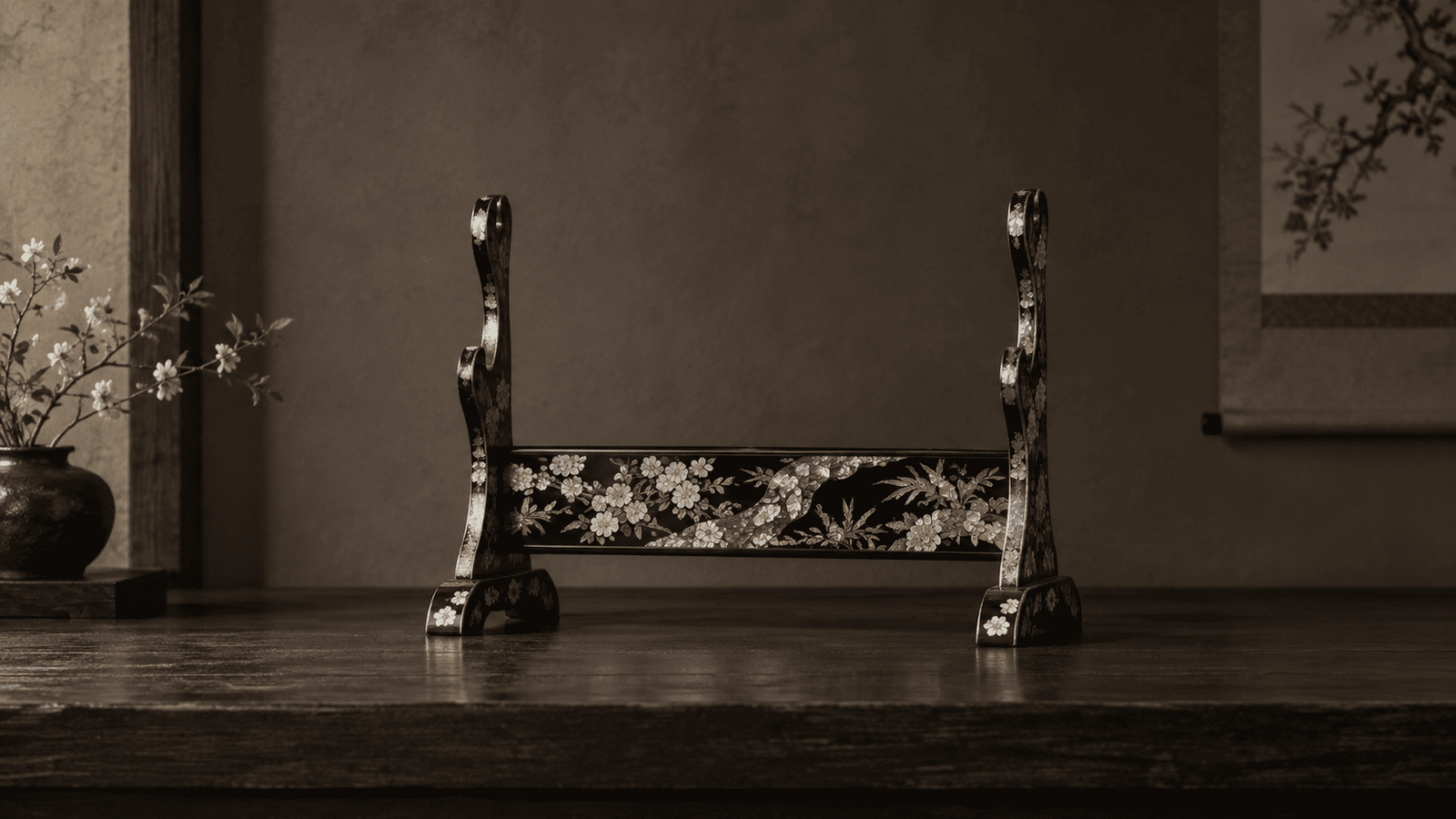
A Japanese sword can be appreciated on many different levels.
There is the blade itself: its shape, forging, jihada, hamon and history. There are also the koshirae, the tsuba, the lacquered saya and the many fittings that surround it.
But there is another element of Japanese sword culture that is sometimes overlooked: the object on which the sword is displayed.
The katana-kake, or Japanese sword stand, may appear at first to be a purely functional piece of equipment. Its purpose is straightforward: to support one or more swords when they are not being worn.
Yet some antique katana-kake were anything but ordinary.
The finest examples combine woodworking, lacquer, shell inlay, metal fittings and pictorial decoration to such a degree that the stand becomes an independent work of decorative art.
In these cases, the sword is not simply placed on a support.
It becomes part of a complete visual composition.
A katana-kake is a stand designed to hold Japanese swords horizontally.
Forms vary considerably. Some are simple and restrained, while others are constructed to accommodate multiple swords and can become surprisingly architectural in appearance.
A stand may be designed for a single sword, a pair of swords or, in more ambitious examples, several blades displayed together.
The form therefore performs two functions at once:
This second function is particularly important when considering highly decorated antique examples.
A plain stand can disappear visually beneath the sword.
An elaborate katana-kake does the opposite: it participates actively in the display.
It is easy to think of sword stands as accessories.
That description makes sense for simple modern examples, but it becomes inadequate when looking at sophisticated antique Japanese pieces.
A finely decorated katana-kake can incorporate many of the same techniques found in Japanese lacquerware, boxes, cabinets, inrō and other luxury objects.
The stand itself may include:
Once this level of craftsmanship is involved, functionality is only part of the story.
The katana-kake becomes an object worthy of study even when no sword is resting on it.
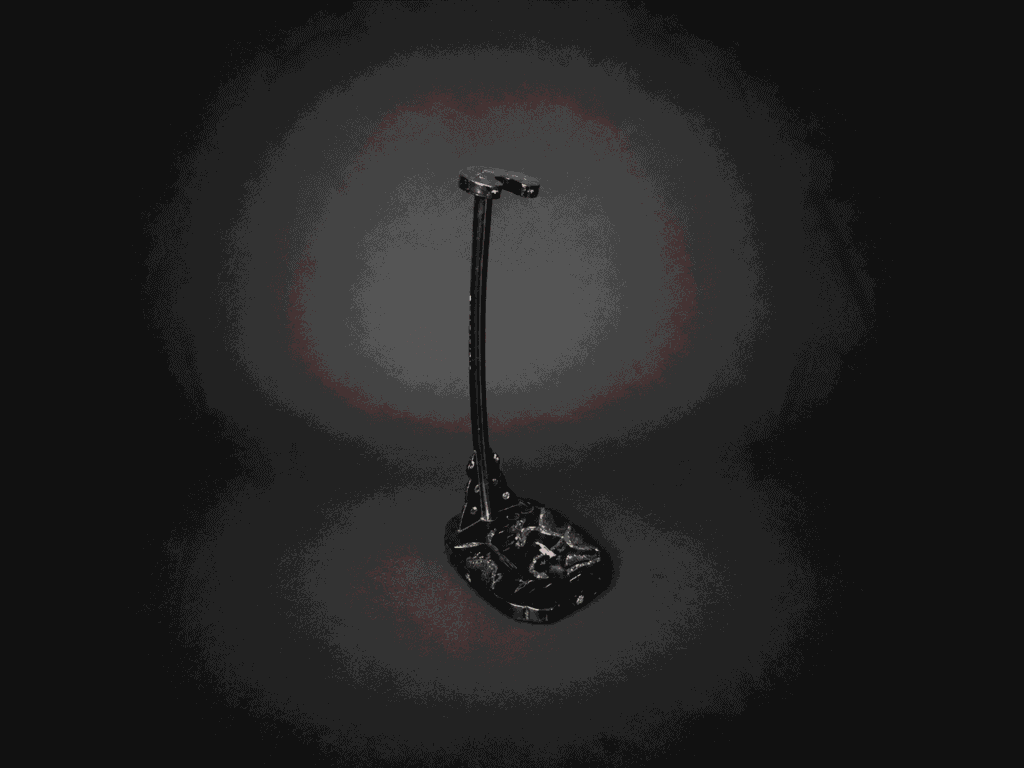
One of the most visually powerful materials used on Japanese sword stands is lacquer.
Deep black lacquer can provide a dramatic ground for more complex decoration. Its reflective surface creates depth while allowing gold, shell and coloured details to stand out sharply.
On an elaborate stand, the lacquer is not merely a protective coating.
It defines the entire visual character of the object.
A glossy black surface can transform the sword stand into a dark architectural framework in which every decorative detail becomes more intense.
This effect becomes especially striking when combined with iridescent shell.
Among the most spectacular decorative techniques found on Japanese lacquer objects is raden.
Raden uses pieces of mother-of-pearl, abalone or similar shell inserted into or applied to a surface to create decorative patterns and pictorial scenes.
Under changing light, these materials can produce flashes of blue, green, violet, turquoise, pink and gold.
The effect is difficult to understand from a single static photograph because the appearance changes as either the object or the viewer moves.
On a katana-kake, raden can be used to create:
The stand therefore acquires a living surface that reacts continuously to illumination.
This is one reason why a highly decorated antique katana-kake can have such a strong presence in person.
Closely related shell decoration can also produce a more fragmented, shimmering appearance sometimes described in relation to aogai.
Instead of using shell only for clearly defined pictorial elements, smaller pieces can create dense mosaic-like surfaces across supports and architectural components.
The visual effect differs from the more narrative panels of raden.
One area may show clearly identifiable flowers or birds, while another becomes almost abstract: a field of changing iridescent colour.
Combining these treatments allows a single sword stand to move between representation and pure surface decoration.
A particularly revealing example is a 19th-century Japanese three-sword katana-kake decorated in glossy black lacquer with extensive raden and aogai-style shell inlay.
The piece is constructed in three levels, allowing three swords to be displayed together rather than the more common one- or two-sword arrangement.
Its structure alone gives it considerable sculptural presence.
But the decoration transforms it completely.
One principal face presents sweeping branches of autumn maple, or momiji, with red and gold leaves and a bird among the foliage. The reverse presents a different composition dominated by abundant white blossoms and a pair of colourful birds.
This is important.
The decoration was not conceived only for a single frontal viewpoint.
Both sides were treated as meaningful visual surfaces.
That tells us that the object was intended to be looked at and appreciated in the round.
It is furniture, sculpture and pictorial lacquer art at the same time.
The use of flowers, birds and changing foliage is deeply connected to Japanese visual culture.
Seasonality appears throughout Japanese painting, textiles, lacquer, metalwork and other decorative arts.
On a katana-kake, these motifs can introduce an additional poetic dimension to an object that is ultimately associated with weapons.
Autumn maple leaves suggest one atmosphere.
Flowering branches create another.
Birds bring movement and life into the composition.
The contrast can be especially sophisticated when different sides of the same stand represent different seasonal settings.
The sword display then becomes part of a much wider artistic language.
A katana displayed on a plain support and the same katana displayed on an elaborate antique lacquer stand do not create the same experience.
The sword itself has not changed.
Its context has.
An elaborate katana-kake frames the blade in the same way that an important frame changes the presentation of a painting.
Lacquer can echo the finish of a saya.
Gold decoration can interact visually with koshirae fittings.
Mother-of-pearl can contrast with polished metal.
A multi-tier stand can turn several swords into a coordinated ensemble rather than a group of unrelated objects.
In a sophisticated display, the relationship between sword and stand becomes part of the composition.
The most elaborate stands also belong to the broader history of Japanese interior decoration.
A highly decorated sword stand has a physical presence comparable to other luxury lacquer objects.
Its silhouette, proportions and materials remain visually interesting even when the stand is empty.
This distinction matters for collectors.
One does not necessarily need to view an important katana-kake only through the lens of sword collecting.
It can equally appeal to collectors of:
The boundaries between these fields are often more fluid than modern categories suggest.
Another fascinating element is the architecture of more ambitious katana-kake.
Side supports rise vertically.
Sword cradles project outward.
Horizontal rails connect the structure.
Scalloped edges or shaped panels can break up otherwise rigid geometry.
The result can resemble a miniature architectural construction.
In the 19th-century three-tier example described above, the tall lateral supports, curved sword rests and scalloped horizontal elements create a strong silhouette even before the decoration is considered.
The decorative program then follows that architecture rather than simply covering it.
Branches travel across panels.
Shell decoration climbs the uprights.
Gold scrollwork separates visual registers.
Structure and ornament reinforce one another.
A three-sword katana-kake is inherently more ambitious than a simple single-level stand.
It has to solve a practical problem: supporting several swords securely.
But it must also avoid becoming visually cumbersome.
When successful, the vertical arrangement creates rhythm and hierarchy.
One sword occupies the highest position.
Others form lower levels.
Together they become a unified display.
When this architectural structure is combined with elaborate lacquer and shell work, the stand can dominate a display cabinet even before swords are added.
With mounted blades installed, the visual effect becomes considerably more complex.
Collectors of Japanese swords naturally spend enormous amounts of time studying blades.
That attention is justified.
But the wider world surrounding the nihontō contains craftsmanship of extraordinary quality.
A katana-kake can bring together the work of specialists in:
An elaborate example could require hundreds of individually shaped decorative elements.
Flowers, leaves, branches and birds may each be assembled from separate pieces.
Large surfaces need careful preparation before the decorative layers can even begin.
The result reminds us that historical Japanese sword culture extended far beyond the forge.
There is an important distinction between a stand designed simply to display a sword and an antique katana-kake created as a decorative object.
Modern stands are often intentionally understated.
That can be ideal when the goal is to focus all attention on the blade.
Antique examples can work differently.
Their materials, age, craftsmanship and iconography may make them collectible in their own right.
Neither approach is inherently better.
They serve different purposes.
For the collector interested in the broader material culture of the samurai and Japanese decorative arts, however, an antique katana-kake can add an entirely different dimension to a sword collection.
When examining an antique Japanese sword stand, it is useful to look beyond the first impression.
Study the overall construction.
Look at the lacquer.
Examine how decoration interacts with the shape of the object.
If shell inlay is present, observe it from several angles because iridescence can change dramatically with light.
Compare both faces.
Some of the most interesting examples were intended to be viewed from multiple directions.
Condition is also important.
Antique lacquer naturally develops wear, small surface changes and signs of age. These should be evaluated in relation to the age and complexity of the object rather than judged by the standards applied to a new stand.
Documentation, provenance and period attribution can also become increasingly important as the quality and value of the piece rise.
The katana is often treated as an isolated object.
Historically and artistically, it rarely existed in isolation.
The blade belonged to a wider visual environment that included mounts, fittings, storage, clothing, armour and the spaces in which these objects were displayed.
The katana-kake belongs to that environment.
At its simplest, it holds a sword.
At its most sophisticated, it can become a work of art capable of standing beside the sword rather than beneath it.
A great Japanese sword stand does not merely support the blade.
It completes the presentation.
For collectors interested in sword culture beyond the blade itself, antique katana-kake open an especially interesting field.
They can unite samurai history with lacquerwork, shell inlay, seasonal imagery and sculptural design within a single object.
Some remain deliberately restrained.
Others are spectacular.
The finest examples demonstrate that there was no necessary separation between functionality and beauty in Japanese decorative art.
A sword stand could perform its practical purpose while simultaneously serving as an object of prestige, craftsmanship and aesthetic appreciation.
Explore our selection of antique Japanese katana-kake and sword stands →
For a collector, that is perhaps the most interesting way to look at them:
not simply as places to put a sword, but as part of the artwork surrounding the sword itself.
A katana-kake is a Japanese sword stand designed to support and display one or more swords horizontally. Antique examples range from simple functional forms to highly decorated lacquer objects.
Yes. Antique katana-kake can be collected independently of swords, particularly when they feature high-quality lacquer, raden, aogai, unusual construction or elaborate pictorial decoration.
Raden is a Japanese decorative technique using pieces of mother-of-pearl, abalone or other iridescent shell to create patterns and pictorial designs on lacquered and other surfaces.
Highly elaborate examples certainly can be appreciated as independent decorative artworks. Some combine woodworking, lacquer, shell inlay, gold decoration and complex seasonal imagery in addition to their practical role as sword stands.
The capacity depends on its construction. Katana-kake exist for one or more swords, while more elaborate examples may use multiple tiers to create coordinated displays of several blades.
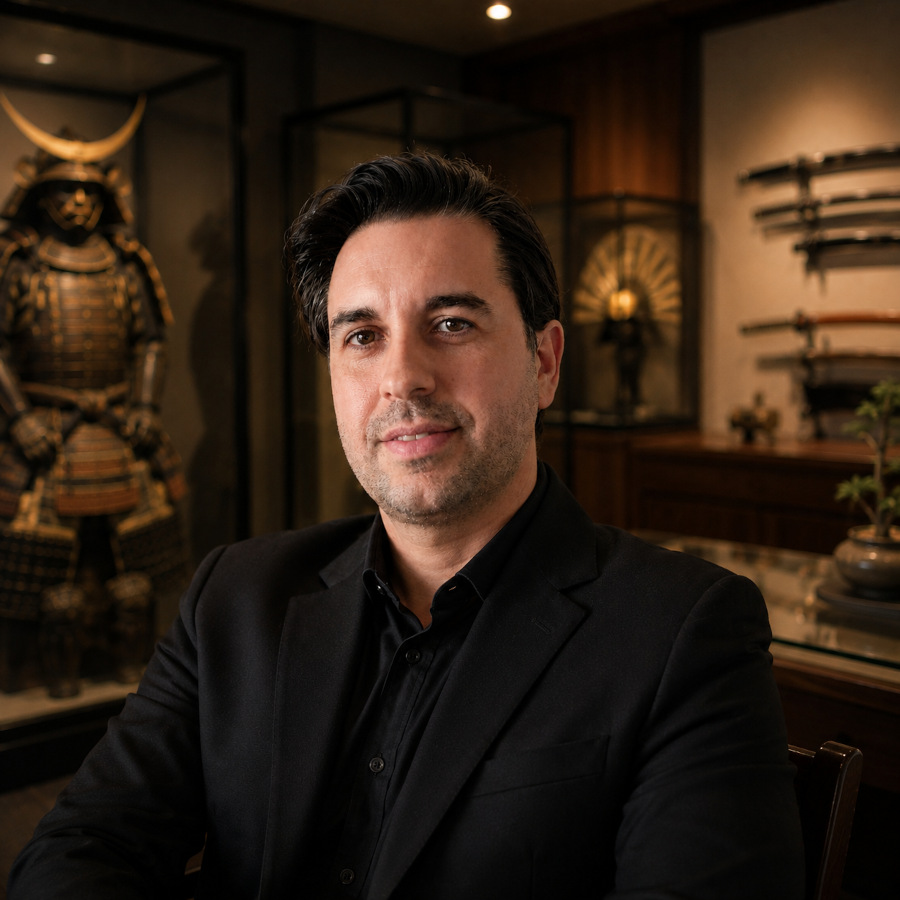
CEO of SupeinNihonto, dealer and collector of ancient Japanese art and weapons from Canillo, Andorra.