Japanese Samurai Armor (Yoroi) with Orange Lacing and Gilt Kuwagata – Early 20th Century, Meiji–Taishō
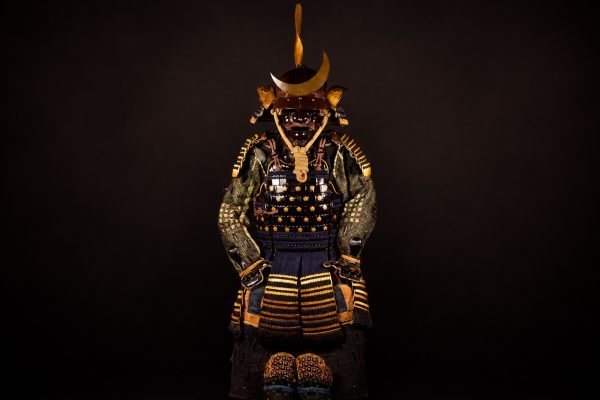
A richly decorated Japanese suit of armor (yoroi) dating to the early 20th century, late Meiji–Taishō period. Its appearance is defined by warm orange lacing, glossy black lacquer, and numerous gilt decorative fittings. Broad shoulder guards and a prominent helmet ornament give the ensemble a distinctive silhouette.
The repeated orange lacing creates a visual connection between the helmet, torso, shoulder guards, and lower defenses. Against the dark lacquer, the gilded details and patterned textiles introduce contrasting colors and textures. The armor is accompanied by a display stand, a black lacquer storage box, and a certificate issued by Supein Nihonto.
The Helmet
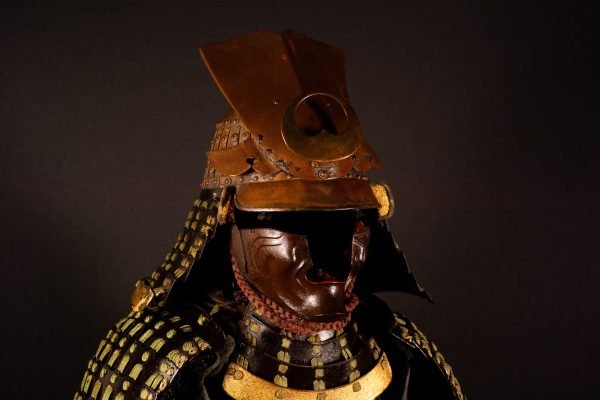
The kabuto has a plate-built bowl with pronounced vertical features and visible rivets, creating a strongly articulated profile. Its dark finish contrasts with the tall gilt kuwagata and central relief ornament mounted at the front.
The frontal decoration is one of the most prominent features of the ensemble. The upward-reaching kuwagata frame the central ornament and extend the outline of the helmet, emphasizing its height and symmetry.
The large fukigaeshi are covered with a light-toned material bearing a repeating pattern and finished with gilt metal fittings. Behind them, the broad shikoro continues the orange color scheme through successive rows of plates and lacing.
The Mask
The menpō is finished in glossy black lacquer and modeled with a severe expression. A natural-hair mustache adds texture to the face, while the vivid red cord introduces a further contrast against the black lacquer and surrounding gold-colored ornament.
Seen together, the mask and helmet create a particularly expressive focal point. The dark face, red cord, patterned fukigaeshi, and tall kuwagata each contribute to the character of the upper section.
The Cuirass and Skirt
The dō presents rows of protective elements joined by abundant orange lacing (odoshi), with gilt fittings arranged across the surface. The close spacing of the lacing and the contrast between the dark components and bright ornament give the torso a detailed, layered appearance.
The kusazuri continue below the cuirass in successive rows of plates and matching lacing. Their arrangement extends the orange and black color scheme into the lower part of the armor and contributes to the balanced appearance of the assembled suit.
The Shoulder Guards
The large, broad sode are a defining part of the silhouette. Their multiple tiers repeat the orange lacing, dark surfaces, and gilt details found elsewhere in the ensemble.
Their width gives the armor a substantial outline, while the regular rows of lacing provide a visual rhythm that connects them to the cuirass and skirt.
The Arm Defenses
The kote combine patterned textile with metal protective sections. The decorative fabric provides a softer contrast to the lacquered and gilded surfaces, adding another layer of detail to the arms.
The gilt tekkō, protecting the backs of the hands, display floral and vegetal relief decoration. These ornamental surfaces complement the fittings on the helmet and torso.
The Thigh and Leg Defenses
The haidate and lower-leg defenses continue the decorative character of the ensemble through protective elements, dark lacquered surfaces, orange lacing, and gilt details.
Viewed as a whole, the lower section maintains the same relationship between color, texture, and ornament seen in the upper armor. The repeated materials and colors help unify the presentation when the suit is assembled on its stand.
Period and Dating
Early 20th century, late Meiji–Taishō period.
The armor is presented with this updated dating rather than the previous attribution to the late Edo period and the 19th century. Its decorative appearance draws on the forms and visual traditions of Japanese samurai armor.
Storage Box and Display Stand
The armor is accompanied by a black lacquer storage box bearing a large gold-painted character on the front. The box is a later accompanying item and is not presented as original to the manufacture of the armor.
A display stand is included for assembling and presenting the suit.
Documentation
The armor comes with a certificate issued by Supein Nihonto.
Condition
The armor shows signs of age and wear, including deterioration and tears in some textile areas. The photographs form an important part of the description and should be examined closely to assess the condition of the lacing, fabric, lacquer, and decorative fittings.
Because the ensemble includes delicate textile and laced components, care is required when handling, assembling, and disassembling it. Additional condition photographs can be requested before purchase.
Key Features
- Type: Japanese suit of armor (yoroi / gusoku)
- Date: Early 20th century
- Period: Late Meiji–Taishō
- Color scheme: Orange lacing, black lacquer, and gilt ornament
- Kabuto: Plate-built helmet with pronounced vertical features and visible rivets
- Frontal ornament: Tall gilt kuwagata with a central relief ornament
- Fukigaeshi: Light-toned patterned covering with gilt metal fittings
- Shikoro: Broad neck guard with matching orange lacing
- Menpō: Glossy black lacquer, natural-hair mustache, and vivid red cord
- Dō: Rows of protective elements with abundant orange odoshi and gilt fittings
- Sode: Large, broad, multi-tiered shoulder guards
- Kusazuri: Tiered skirt defenses with matching orange lacing
- Kote: Patterned textile with metal protective sections
- Tekkō: Gilt hand defenses with floral and vegetal relief decoration
- Lower defenses: Thigh and leg protection continuing the ensemble’s decorative scheme
- Materials described: Metal protective elements, lacquer, textile, lacing, and gilt fittings
- Condition: Age-related wear, including deterioration and tears in textile areas
- Included accessories: Display stand and later black lacquer storage box with a gold-painted character
- Documentation: Certificate issued by Supein Nihonto
About Supein Nihonto
Our photographs are taken without digital retouching so that you can examine the appearance and condition of each object. Through our work with collectors, galleries, and museums in Japan, we seek out pieces that reflect the variety and craftsmanship of Japanese art.
Samurai art is our passion, and sharing its details is an important part of what we do. If you would like additional photographs or information about this armor, please contact us.
A visually distinctive early 20th-century Japanese armor, combining orange lacing, dark lacquer, patterned textiles, and gilt decoration. The tall kuwagata, broad shoulder guards, and coordinated colors give the assembled ensemble a particularly striking presence.