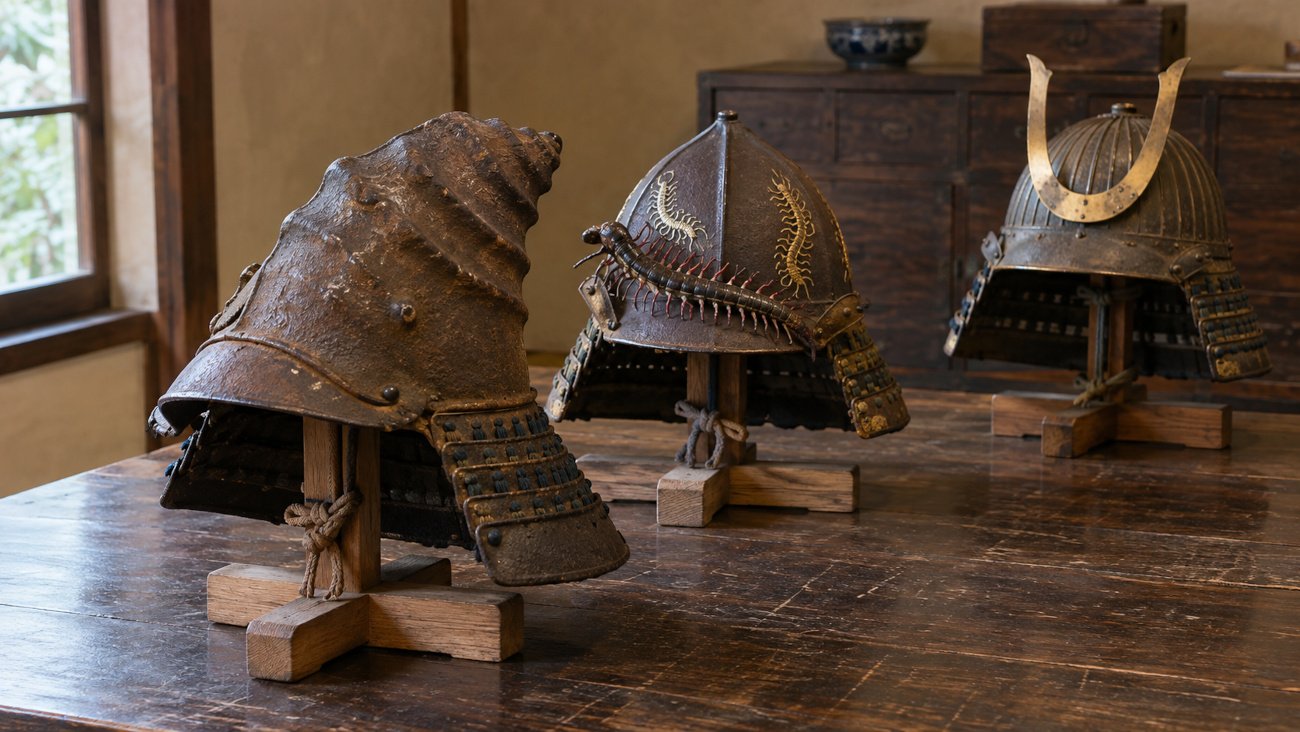
Japanese samurai helmets can range from relatively restrained iron bowls to extraordinary sculptural creations representing Japanese samurai helmets range from restrained iron bowls made for practical use to extraordinary sculptural creations representing shells, waves, animals, court caps and supernatural beings. Exceptional examples can command remarkable prices when rarity, workmanship, condition, provenance and historical importance come together.
However, comparing auction results requires care. A kabuto sold independently is not directly comparable with a complete suit of samurai armor that happens to include an important helmet. Auction estimates, hammer prices and final prices including the buyer’s premium must also be distinguished.
This article therefore concentrates first on individually sold Japanese kabuto with publicly documented auction results. Complete armors incorporating important helmets are discussed separately.
Among the publicly accessible auction records reviewed for this article, the highest documented result for a kabuto sold as an individual object is $377,000.
The helmet was an eighteenth-century iron kawari kabuto constructed in the form of a conch shell. It was sold at Bonhams’ Arts of the Samurai auction in New York on 8 October 2013.
The result was particularly remarkable because the helmet had a presale estimate of $40,000–50,000. Intense competition pushed the final price to more than seven times the upper estimate.
Unlike other frequently cited high-value results, this was not a complete suit of armor. The $377,000 price applied to the kabuto itself.
The following results are shown in the currencies used by the auction houses at the time of sale. Sotheby’s states that the results from its 2021 London auction include its buyer’s premium but exclude applicable taxes and additional costs.
No present-day currency conversion has been applied. Exchange rates change over time, and converting historical results using a modern rate could create a misleading comparison.
Private transactions are also normally confidential. “Most expensive” in this article therefore refers to publicly documented auction results that can be verified, not every important kabuto that may have been sold privately.
| Auction result | Kabuto | Period | Auction |
|---|---|---|---|
| $377,000 | Iron kawari kabuto in the form of a conch shell | Edo period, 18th century | Bonhams, New York, 2013 |
| £52,920 | Suji-bachi signed Saotome Iyetada | Edo period, 17th century | Sotheby’s, London, 2021 |
| £52,920 | Hoshi-bachi with raised rivets and preservation certificate | Edo period, 17th century | Sotheby’s, London, 2021 |
| £50,400 | Momonari kabuto with shell-shaped wakidate | Edo period, 17th century | Sotheby’s, London, 2021 |
| £47,880 | Kawari kabuto in the form of a turbo shell | Edo period, 17th–18th century | Sotheby’s, London, 2021 |
The table should not be interpreted as a precise currency-adjusted global ranking. It is a selection of significant, verifiable results for kabuto sold independently.
The most exceptional result located during this research is the eighteenth-century iron kawari kabuto shaped as a conch shell, sold by Bonhams in New York for $377,000.
Kawari kabuto—literally “unusual helmets”—allowed Japanese armorers to transform protective equipment into highly individual works of sculpture. Shells were especially suitable subjects because their spiral forms could create a dramatic silhouette while retaining symbolic and military associations.
The conch, or horagai, was used in Japanese religious and military contexts. Conch trumpets were associated with yamabushi mountain ascetics and were also used to communicate signals during military campaigns.
This particular helmet was not merely an ornamental shell placed over an ordinary bowl. Its complex form was constructed in iron, demonstrating an exceptional level of technical skill. The interior was finished in gold lacquer, further indicating the quality and importance of the object.
Its final price reflected a rare combination of factors:
The result rose dramatically above its $40,000–50,000 estimate and remains an extraordinary benchmark for an individual antique Japanese kabuto.
View the documented Bonhams auction lot
A seventeenth-century suji-bachi signed by Saotome Iyetada was sold by Sotheby’s in London in May 2021 for £52,920. Its original estimate was only £8,000–10,000.
The helmet bowl was assembled from sixty-two iron plates with clearly raised ridges. These ridges give the suji-bachi its characteristic appearance and demonstrate the precision required to shape and join numerous individual plates into a coherent bowl.
The kabuto also featured:
The Saotome school is one of the best-known traditions of Japanese armor production. Nevertheless, a signature alone does not determine value. The workmanship, construction, originality and consistency of the signature with the helmet must all be assessed.
This example exceeded its upper estimate by more than five times, showing how strongly collectors may compete for a well-presented, signed helmet associated with a respected armor-making school.
View the Saotome Iyetada suji-bachi at Sotheby’s
One of the most surprising results in the same Sotheby’s auction was achieved by a seventeenth-century hoshi-bachi. Estimated at just £4,000–6,000, it sold for £52,920.
A hoshi-bachi is characterised by the prominent rivets visible on the surface of the helmet bowl. In this example, the bowl was constructed from sixty-two iron plates and retained its raised rivets as an important part of the design.
Its principal features included:
The helmet was accompanied by a Tokubetsu Kicho Shiryo certificate issued in 2016 by the Nihon Katchu Bugu Kenkyu Hozon Kai, the Japanese Armor Preservation Society.
A certificate should never replace a direct examination of the object, but documented assessment by a recognised specialist organisation can strengthen collector confidence.
The final result was almost nine times the upper estimate. It is an excellent example of why auction estimates should not be treated as fixed valuations.
View the certified hoshi-bachi at Sotheby’s
A seventeenth-century momonari kabuto sold for £50,400 against an estimate of £20,000–30,000.
Momonari means “peach-shaped” and describes the distinctive curved profile of the helmet bowl. The form is frequently connected with the influence of European helmets introduced into Japan during the sixteenth century, particularly designs with smooth plates and a pronounced central ridge.
The Sotheby’s example was made from iron and decorated in black lacquer. Its rim had later gold and silver nashiji decoration, while the peak was embellished with gold hiramaki-e scrollwork.
The most immediately recognisable features were the lateral ornaments, or wakidate, shaped as clam shells and made from wood decorated in gold, red and black lacquer.
The helmet had also been exhibited at the Palazzo Reale in Milan in 2009 and was published in the accompanying exhibition catalogue. A documented exhibition and publication history can add authority to an object’s provenance and increase its appeal to serious collectors.
View the momonari kabuto at Sotheby’s
Another shell-shaped helmet appeared in the Sotheby’s London sale of May 2021. This seventeenth- to eighteenth-century kawari kabuto achieved £47,880 against an estimate of £20,000–30,000.
The iron bowl was formed as a realistically rendered turbo shell. The helmet also incorporated:
Although both this helmet and the $377,000 Bonhams example were inspired by seashells, they are different objects and should not be confused.
Their results also demonstrate that a similar subject does not guarantee a similar price. Construction method, quality, condition, provenance, rarity, date and the bidders participating in a particular sale can produce dramatically different outcomes.
View the turbo-shell kawari kabuto at Sotheby’s
Some very high auction prices associated with kabuto actually belong to complete suits of armor.
For example, an eighteenth-century haramaki armor incorporating an elaborate kabuto by Masanobu sold at Bonhams for $341,000. The helmet was undoubtedly one of the most important elements, but the lot also included the cuirass, mask, sleeves, shoulder guards and leg defenses.
Another armor with a monumental silver-leaf eboshi-shaped kawari kabuto sold for $40,000. Again, this was the price for the complete ensemble rather than the helmet alone.
| Auction result | Object | Classification |
|---|---|---|
| $341,000 | Haramaki armor with a kabuto by Masanobu | Complete armor |
| $40,000 | Armor with a monumental silver-leaf eboshi kawari kabuto | Complete armor |
These results are relevant when studying important samurai armor, but they should not be inserted into a ranking of individual kabuto. Doing so would suggest that the complete price belonged exclusively to the helmet.
There is no universal price list for antique Japanese helmets. Value is created by several interconnected factors.
Kabuto associated with respected armor-making traditions such as the Myōchin, Saotome and Haruta schools may attract strong collector interest.
However, a signature must be evaluated carefully. Its form, placement, age and relationship to the helmet’s construction all matter. A prestigious name is not valuable if the signature is unreliable or was added later.
Kabuto from the Muromachi, Sengoku and Momoyama periods are generally scarcer than later examples. Nevertheless, age alone does not make a helmet important.
A later Edo-period helmet of exceptional quality, rarity and preservation may be more desirable than an earlier but heavily altered or incomplete object.
Collectors examine whether the helmet bowl, neck guard, visor, turnbacks, lacquer, lacing, fittings and ornaments belong together.
Japanese armor was frequently repaired, adapted or reassembled during its working life. Historically appropriate modifications can form part of an object’s story, but substantial reconstruction must be identified honestly.
Unusual kawari kabuto can command high prices because some designs are unique or survive in extremely small numbers.
Shells, waves, animals, plants, horns, court caps and religious symbols can make a helmet visually striking, but originality of form must be supported by convincing period construction.
A dramatic silhouette alone is not sufficient. Collectors look at the forging of the bowl, the joining of the plates, the quality of the rivets, the lacquer work and the integration of decorative elements.
Technically ambitious helmets made from iron are especially impressive because the armorer had to create a sculptural form without compromising the structure of the object.
Documented ownership, inclusion in an important collection, museum exhibition or publication in a recognised catalogue can increase confidence and desirability.
Provenance does not automatically prove authenticity, but a credible and continuous history reduces uncertainty and places the helmet within a wider collecting context.
Original lacquer, stable iron, preserved lacing, complete fittings and an appropriate shikoro all affect value.
Some restoration is normal in centuries-old armor. The crucial questions are how extensive it is, when it was carried out and whether it preserves or obscures the historical integrity of the helmet.
Documentation from a specialist Japanese armor organisation can support an attribution or assessment. Certification is particularly valuable when it clearly identifies the object and can be verified.
Nevertheless, the helmet itself must always remain the primary evidence. Important purchases should be assessed through the combined study of construction, materials, condition, signature, provenance and documentation.
Several different figures may appear in an auction catalogue or sales report:
These figures are not interchangeable.
The 2021 Sotheby’s auction offers two particularly clear examples. The Saotome Iyetada suji-bachi was estimated at £8,000–10,000 and sold for £52,920. The certified hoshi-bachi was estimated at £4,000–6,000 and achieved the same final result.
The market price of a rare object is ultimately determined by the competition present when it is offered.
The enormous distance between the $377,000 record and the other documented results shows how selective the high-end kabuto market can be.
Most authentic helmets—even good and collectible examples—will not approach the record price. Exceptional results occur when several desirable characteristics converge in a single object and at least two determined buyers compete for it.
The Sotheby’s results also demonstrate that visually restrained helmets can perform as strongly as dramatic kawari kabuto. The certified hoshi-bachi and the signed Saotome suji-bachi each sold for £52,920, exceeding the results of more sculptural examples in the same auction.
For serious collectors, spectacle is only one part of value. Historical construction, respected workmanship, originality, documentation and preservation can be equally important.
An authentic antique kabuto is both protective equipment and a work of Japanese metalwork, lacquer art and symbolic design.
Before purchasing an important helmet, collectors should examine:
No single feature proves authenticity or value. A reliable assessment comes from studying the complete object.
You can learn more about the construction and history of these helmets in our guide to what a kabuto is.
At Supein Nihonto, we specialise in authentic Japanese swords, samurai armor and historical objects sourced for collectors. Explore our selection of authentic antique kabuto for sale or contact us if you require further information about a particular piece.
Essential information about documented auction records, high-value samurai helmets and the factors that determine the value of an authentic antique kabuto.
Among the publicly accessible auction records reviewed for this article, the highest documented result for an individual kabuto is $377,000. The eighteenth-century iron kawari kabuto was shaped as a conch shell and sold by Bonhams in New York in 2013.
No. The conch-shell kawari kabuto was sold as an individual helmet rather than as part of a complete suit of armor. This makes the result especially important when comparing public auction prices for antique Japanese kabuto.
In May 2021, Sotheby’s sold a signed Saotome Iyetada suji-bachi and a certified hoshi-bachi for £52,920 each. A momonari kabuto sold for £50,400, while a turbo-shell kawari kabuto achieved £47,880.
A complete eighteenth-century haramaki armor incorporating an elaborate kabuto by Masanobu sold for $341,000. However, the amount applied to the entire suit of armor, including the cuirass, mask, sleeves and leg defenses, not to the kabuto alone.
Its value reflected its rare sculptural form, technically ambitious iron construction, gold-lacquered interior, condition and provenance. Strong competition between bidders also pushed the final result far above its original auction estimate.
No. Their unusual sculptural forms often attract collectors, but signed, certified or historically important helmets with more restrained designs can achieve equally strong results. Period, maker, originality, condition, provenance and quality of construction must all be considered.
No. A certificate from a recognised specialist organisation can support confidence in a helmet, but it does not establish its market value by itself. Construction, authenticity, condition, rarity, originality and provenance must still be examined.
An auction estimate is only a presale opinion and not a fixed valuation. When several collectors compete for the same rare helmet, bidding can push the final result far beyond the estimated range.
Not always. An auction result reflects bidding on a particular date and normally includes the buyer’s premium. A dealer’s asking price may also account for research, authentication, guarantees, commercial costs and the possibility of purchasing without auction competition.
Usually not. Private-sale prices are commonly confidential. Rankings of the most expensive kabuto can therefore document verified public auction results, but they cannot account for every private transaction between collectors, dealers and institutions.
Authentication requires examination of the iron bowl, construction method, rivets, lacquer, shikoro, fittings, signature, restoration and provenance. Important purchases should be supported by detailed documentation and, whenever possible, direct examination by a specialist in Japanese armor.
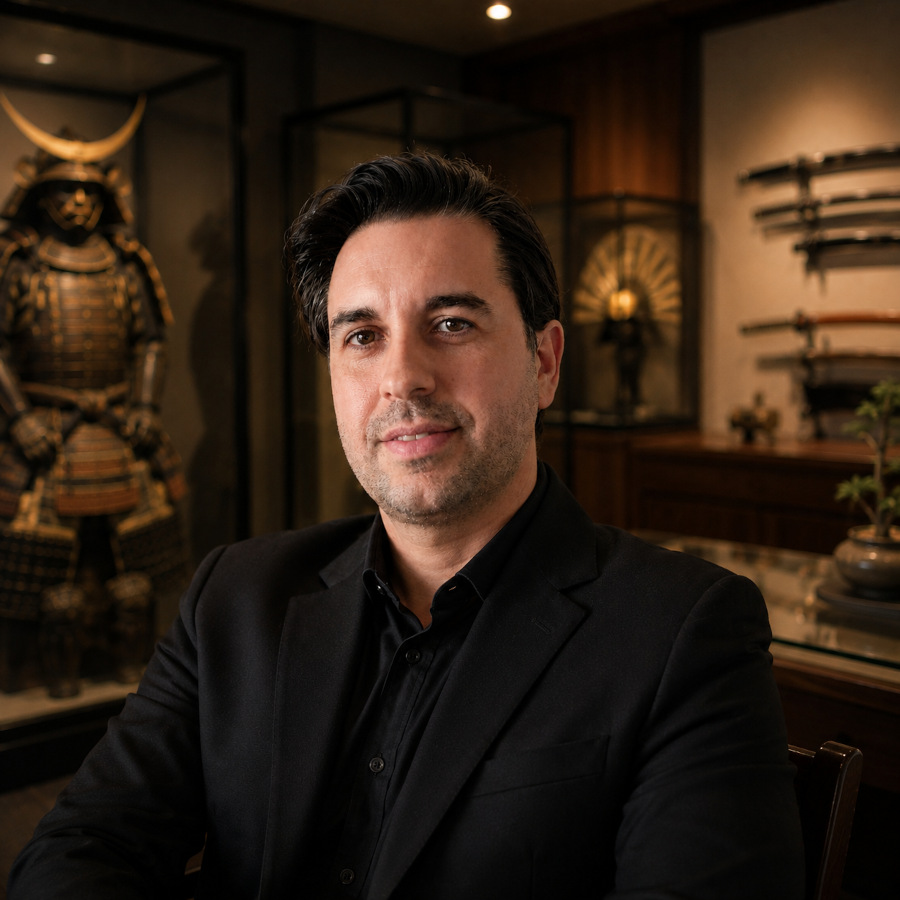
CEO of SupeinNihonto, dealer and collector of ancient Japanese art and weapons from Canillo, Andorra.
Contact