November 21, 2026

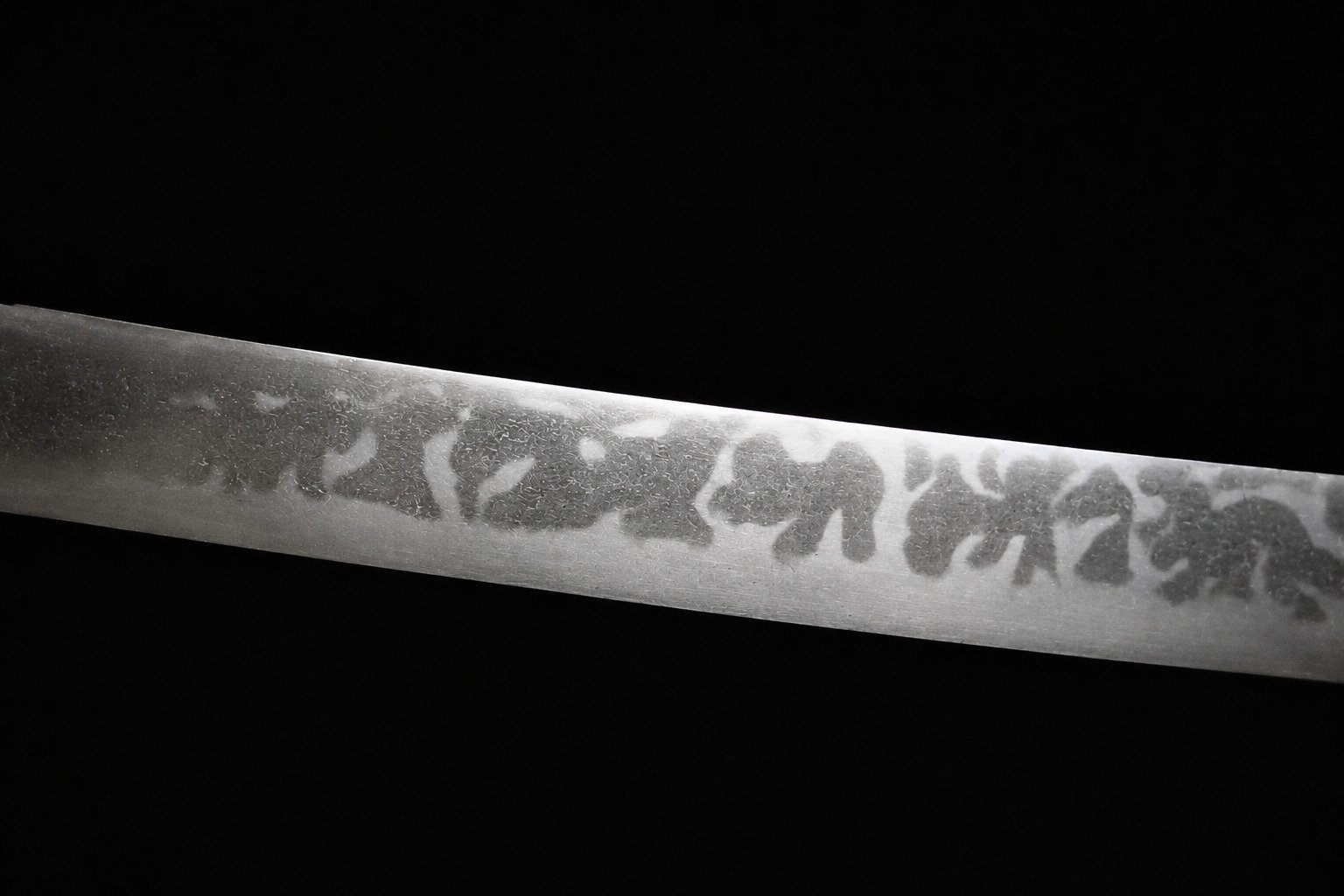
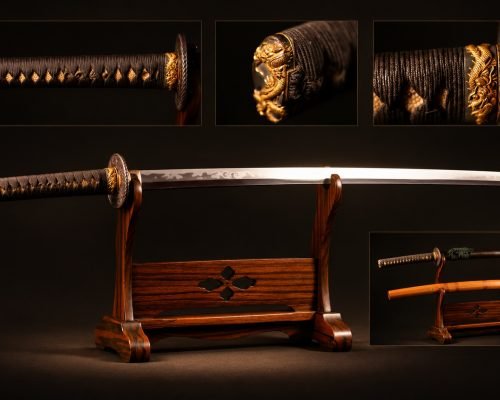
What interests me most about an antique Japanese sword is that the work of its maker is still there to see. A flowing grain, a particularly fine area of steel, or the pattern running beside the cutting edge preserves decisions made centuries ago. Knowing something of that history helps us look at these details with greater appreciation.
To understand katana steel, it helps to begin with the questions its makers faced: how to obtain suitable material, how to work it, and how to create a blade that could hold an edge without becoming too brittle.
Japan had been using swords for centuries when, during the Heian period (794–1185), the curved blades associated with the Japanese sword tradition developed. This transformation accompanied the rise of the warrior class. The tachi, which preceded the katana, belonged to that medieval world in which Japanese swords were acquiring their distinctive identity.
Important lineages of swordsmiths emerged around Kyoto. During the Kamakura period (1185–1333), schools such as Awataguchi and Rai earned considerable recognition. Their surviving work reminds us that the appreciation of a finely made blade was already well established long before the peace of the Edo period. Technical skill and an eye for beauty had been developing together for generations.
An essential part of this story begins with two simple materials: iron-rich sand and charcoal. The traditional smelting process known as tatara brings them together to produce a metallic mass called a kera. This contains materials with different properties, which must be separated and selected. Particularly suitable steel is known as tamahagane.
The material leaving the furnace still required considerable work. The mass had to be broken apart and its fragments sorted. Carbon content and the appearance of the fractured surfaces helped determine their suitability. The craft therefore began well before anything resembling a sword emerged.
Steel is essentially an alloy of iron and carbon. In a blade, carbon influences how the material responds to hardening. Its concentration can also change during forging, so the composition of the original fragments and that of the worked steel are not necessarily the same.
This is one reason the name of the raw material tells only part of the story. What the swordsmith did with it mattered enormously.
The swordsmith gathered selected fragments, forge-welded them together, and worked the resulting block through repeated heating, hammering, and folding. This helped refine the material, reduce impurities, and adjust its carbon content. The number of folds depended on the steel and the intended result; a higher count alone tells us little about a sword’s quality.
Folds and layers are also different things. Each fold doubles the existing layers, allowing thousands to form without thousands of folding operations. This work contributes to the jihada, the grain revealed on the finished blade through polishing.
Swordsmiths also developed constructions combining harder outer steel with a softer core. Together with heat treatment, this helped balance toughness and the ability to retain a cutting edge. Methods of assembling these materials varied between periods, schools, and individual makers.
A blade could already have its recognizable shape while still awaiting a decisive operation: yaki-ire, or quench hardening. The smith applied a clay mixture in different thicknesses, heated the blade, and rapidly cooled it. The edge and the body cooled at different rates, producing different structures and degrees of hardness.
The hamon is the visible expression of this differential hardening. It may follow a restrained line or develop into a lively, complex pattern. I find this one of the most beautiful aspects of Japanese swords: a decision affecting the blade’s physical properties also gives its surface a distinctive character.
We can approach this history through the Bizen Osafune Harumitsu tantō in the Supein Nihonto collection. Dating to the sixteenth century, it belongs to the Sue-Bizen tradition. Its steel displays a tight combination of itame and mokume grain, while the edge carries an irregular midare hamon.
Within a single blade, we can therefore distinguish two different aspects of its manufacture: the texture associated with forging and the pattern created by hardening. You do not need to master every Japanese term to begin appreciating that difference.
Another example is the wakizashi attributed to den Bushū Shimobara Chikashige, dated by its appraisal to the Tenbun era, approximately 1532–1555.
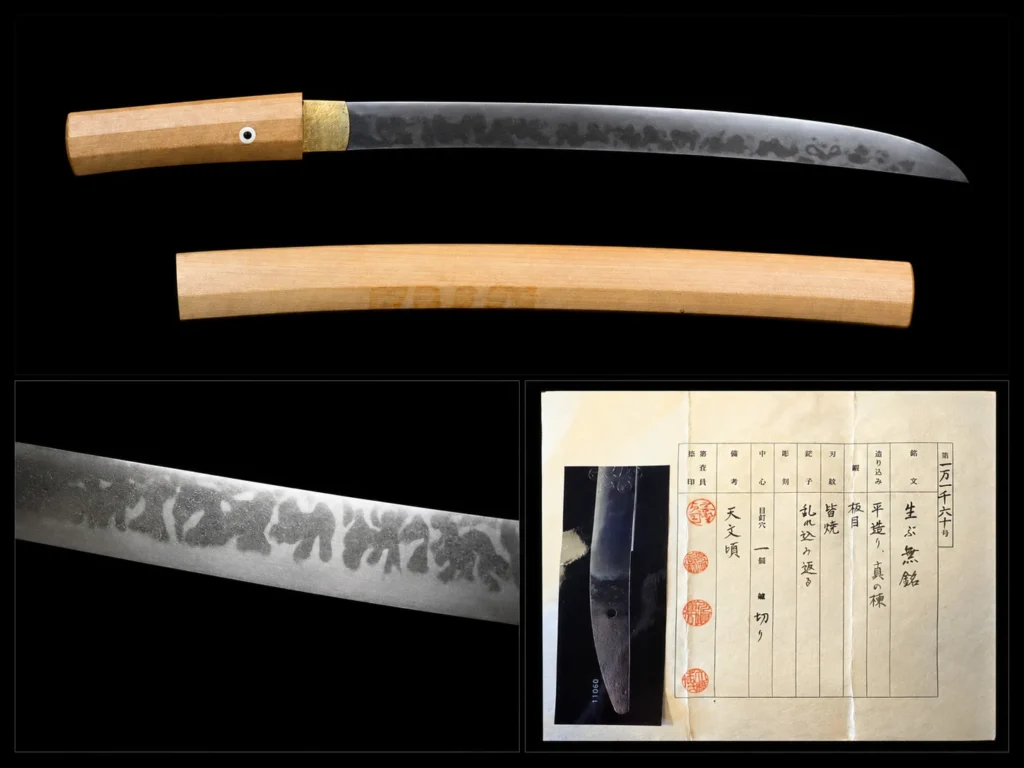
Its hitatsura hardening includes isolated hardened areas called tobiyaki, which appear in the body of the blade beyond the main edge pattern. These scattered forms invite a slower look, following their relationship with the surrounding steel.
Both blades bring the discussion back to something tangible: the surviving work of sixteenth-century craftsmen.
During the prolonged peace of the Edo period (1603–1868), swords retained an important role as symbols of samurai status. Swordsmiths continued working in centers such as Osaka and Edo, making blades that combined the demands of a weapon with those of a prestigious work of art.
The history of their materials also involved contact with the wider world. In the early seventeenth century, Echizen Yasutsugu worked with imported steel known as nanban-tetsu. It is a detail I like to remember because it shows craftsmen testing and adapting materials within a tradition that continued to develop.
The second-generation Hizen Masahiro katana, dating to the Kanbun era, brings us to another workshop in seventeenth-century Japan. Its steel presents an exceptionally fine, compact ko-itame grain alongside an active gunome-midare hamon. Here, the pleasure lies in the relationship between the delicate texture of the steel and the movement of the hardening pattern.
These three pieces allow us to compare work from different periods and traditions. Each offers a concrete way of returning to the same questions: what material did the maker have, and how did he choose to transform it?
Japan’s modernization profoundly changed the place of the sword. The 1876 prohibition on wearing swords threatened the livelihoods of their makers, although recognition of the craft’s artistic importance helped support its preservation.
Traditional steel production also required renewed support. Following interruptions during the twentieth century, the NBTHK restored the Nittōho Tatara at Okuizumo, which was officially relit in 1977. Preserving Japanese swords meant safeguarding the knowledge needed to produce their material as well.
That is why I find it rewarding to spend time looking at the blade, even when its mounting is spectacular. A subtle grain or a small variation in the hardening pattern can bring us closer to someone who worked hundreds of years ago.
The next time you look at an antique Japanese sword, give those details a moment of your attention. Much of the history of its making is still there.
Common questions about tamahagane, folding, hardening, and the steel used in traditional Japanese swords.
Traditional Japanese swords are made from iron-carbon steel. Tamahagane is a well-known starting material, but historical materials and construction methods varied. A blade’s properties depend on its composition, forging, and heat treatment.
Tamahagane is steel selected from the metallic mass produced by traditional tatara smelting, using iron sand and charcoal. The swordsmith sorts and works this material before shaping it into a blade.
Folding and forge-welding help consolidate and refine the material, reduce impurities, and adjust the distribution and content of carbon. This work also contributes to the visible grain. More folds alone do not mean a better sword.
Jihada is the grain associated with forging, revealed through polishing. Hamon is the visible pattern associated with differential hardening. They reflect different stages of the blade’s manufacture and can be appreciated separately.
During differential hardening, the cutting edge cools more rapidly than the body, producing different steel structures and hardness levels. This helps combine an edge that retains its sharpness with a tougher body.
Yes. In the early seventeenth century, Echizen Yasutsugu worked with imported steel known as nanban-tetsu. This is one example of swordsmiths experimenting with materials within the Japanese swordmaking tradition.
No. Good photographs can help show the blade’s grain, hamon, and surface condition, but they cannot establish an exact chemical composition. Identifying precise carbon percentages requires appropriate analysis.
CEO of SupeinNihonto, dealer and collector of ancient Japanese art and weapons from Canillo, Andorra.