FREE EXPRESS INTERNATIONAL DELIVERY
1 in stock
1 in stock
Add to Compare
Add to Wishlist
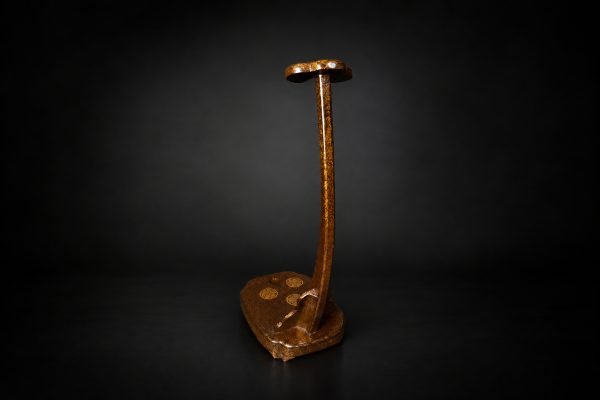
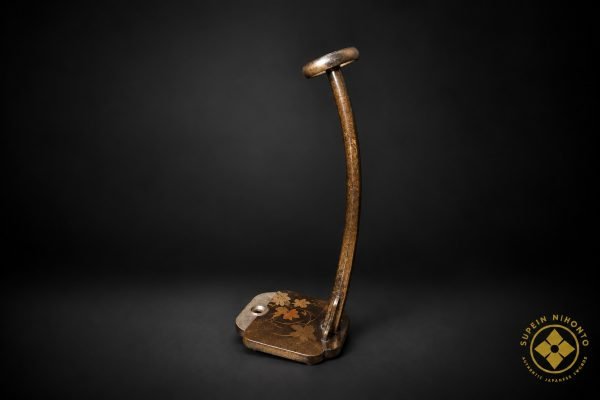
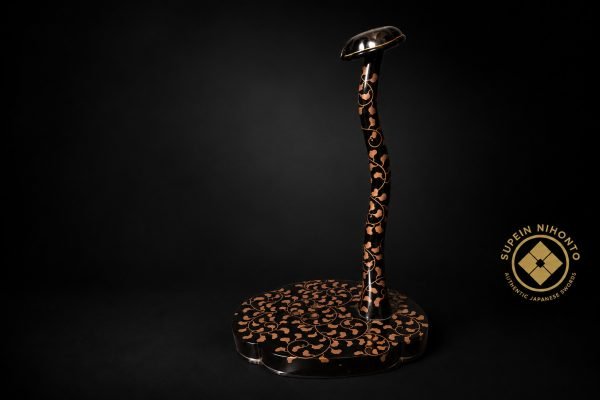
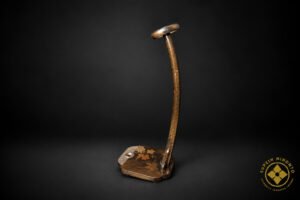
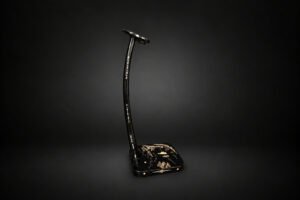
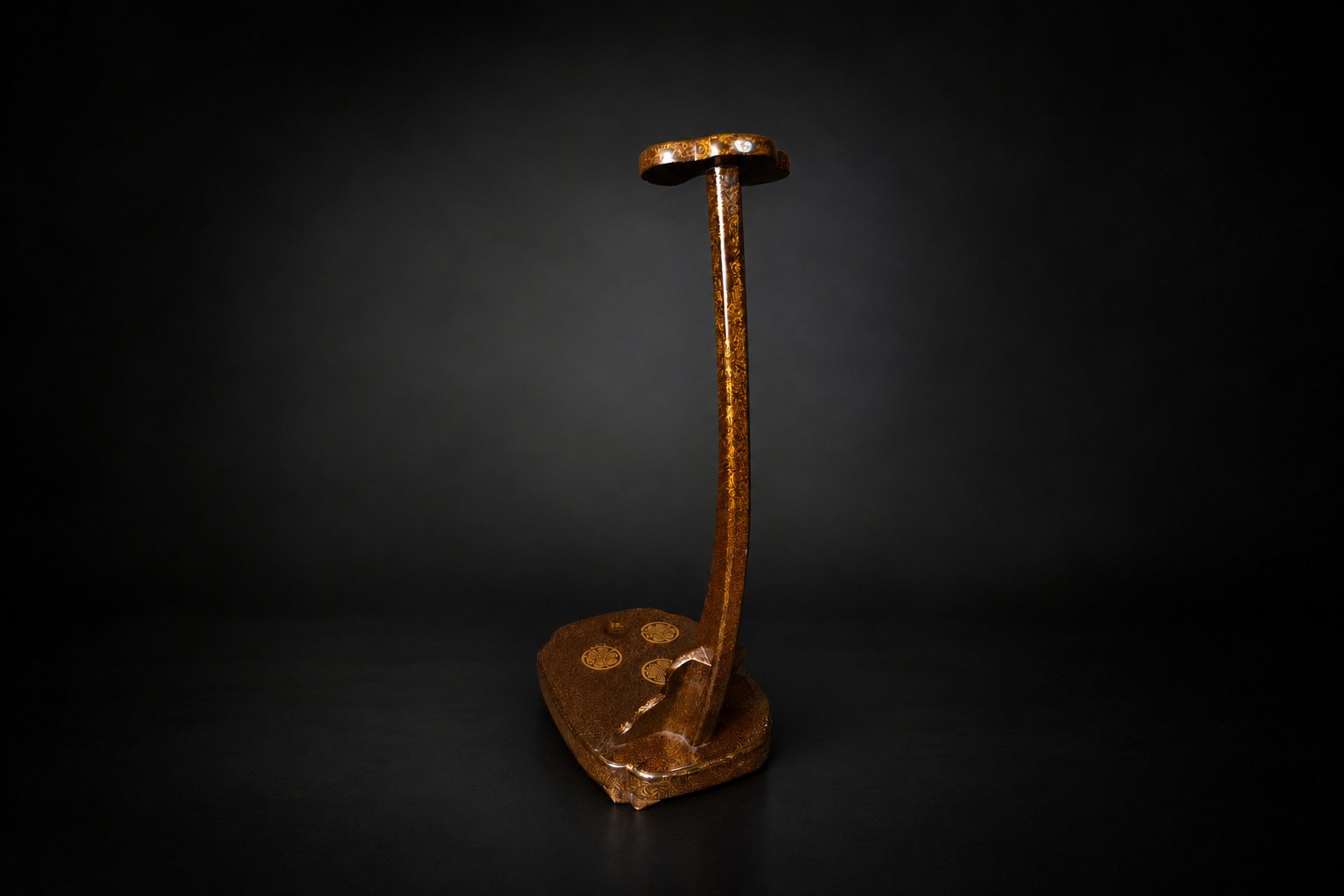
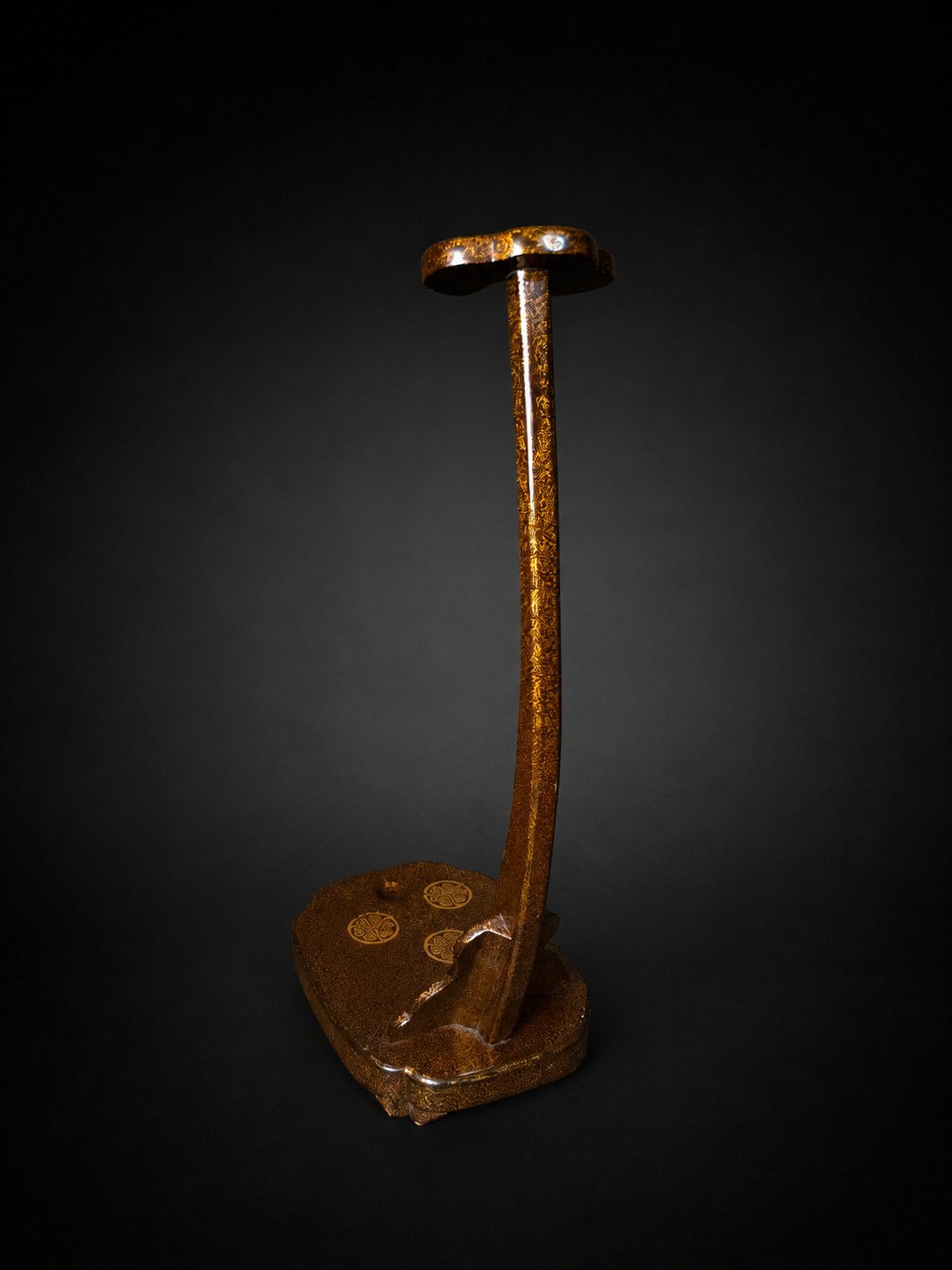
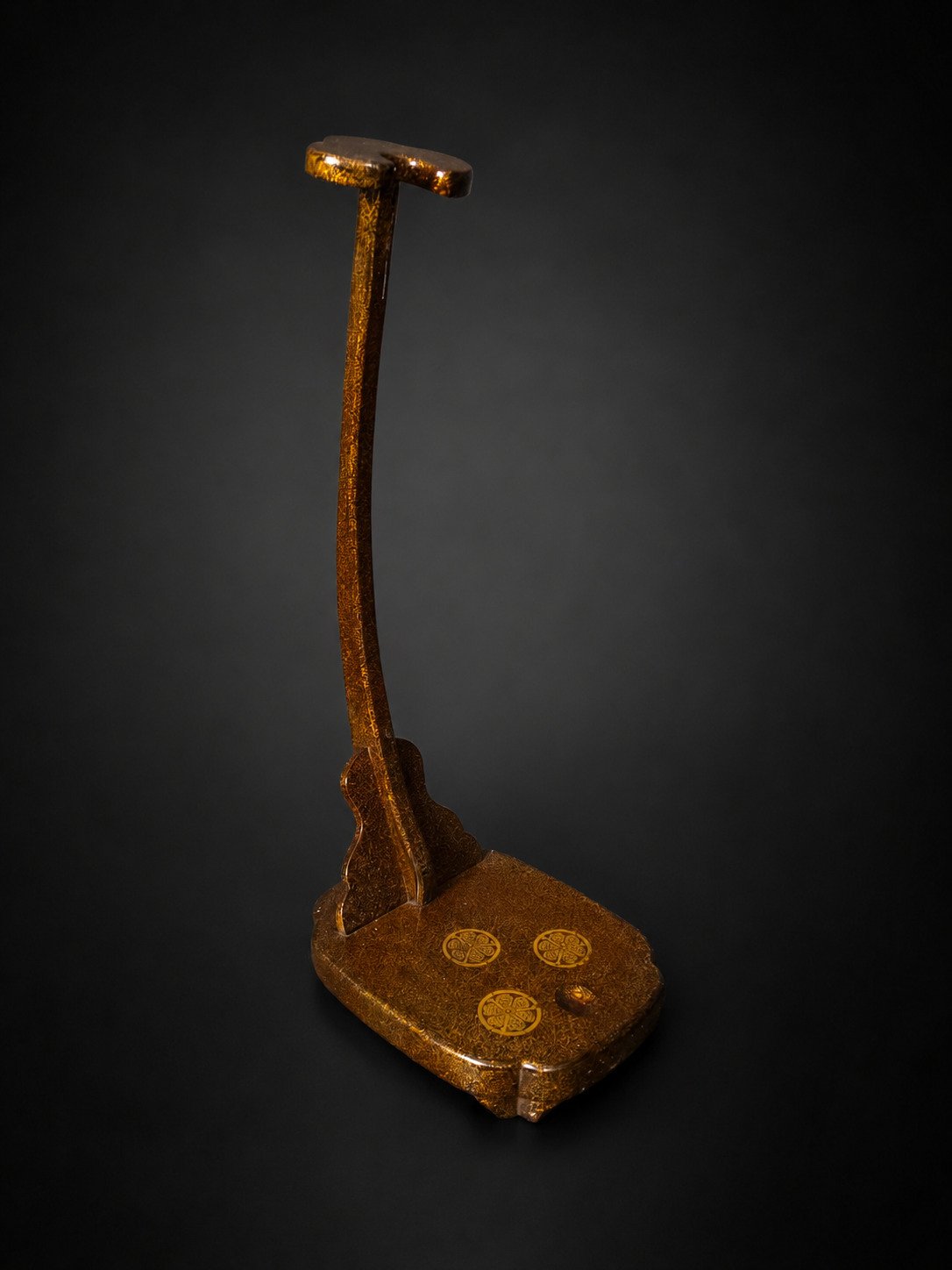
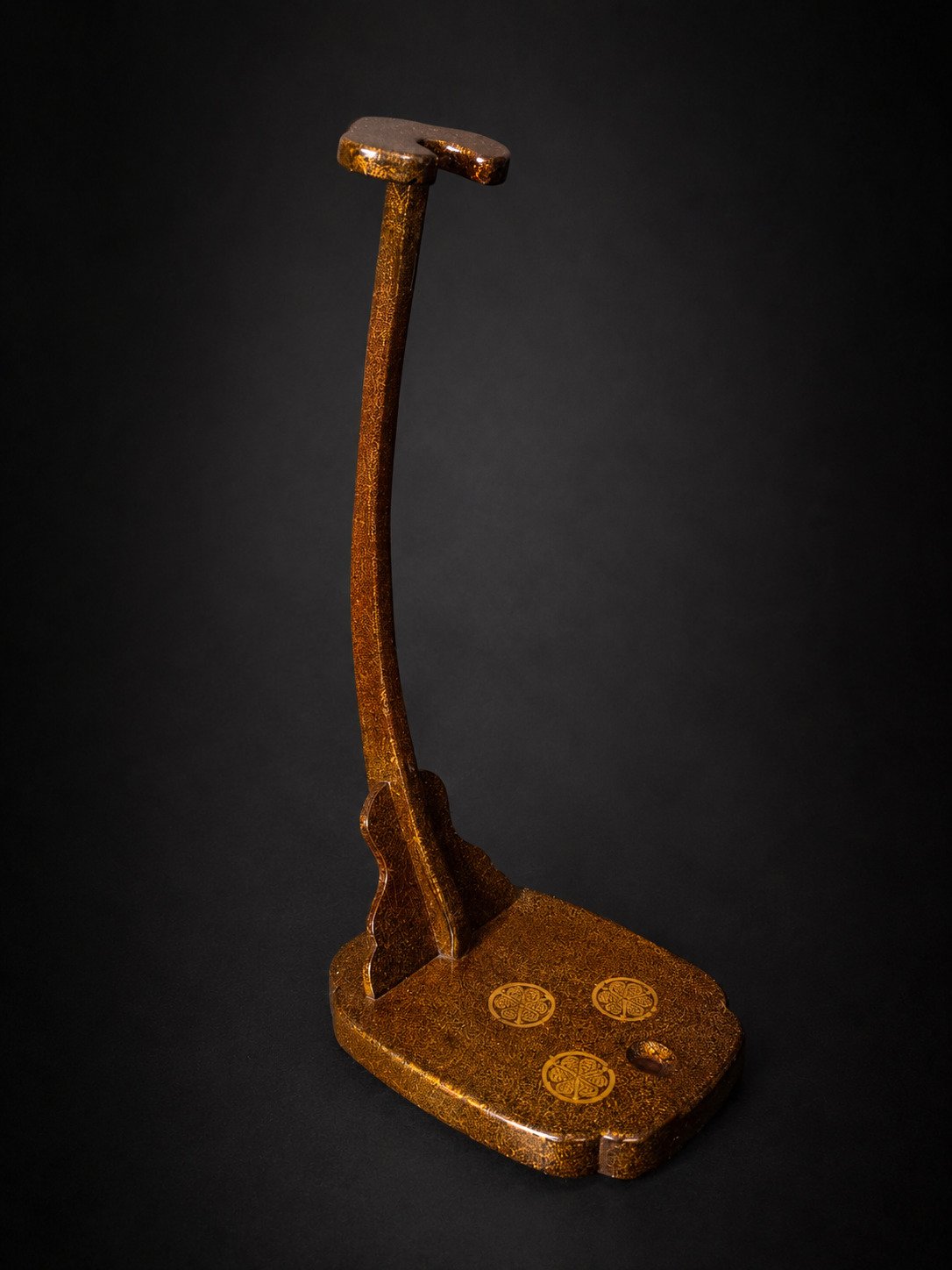
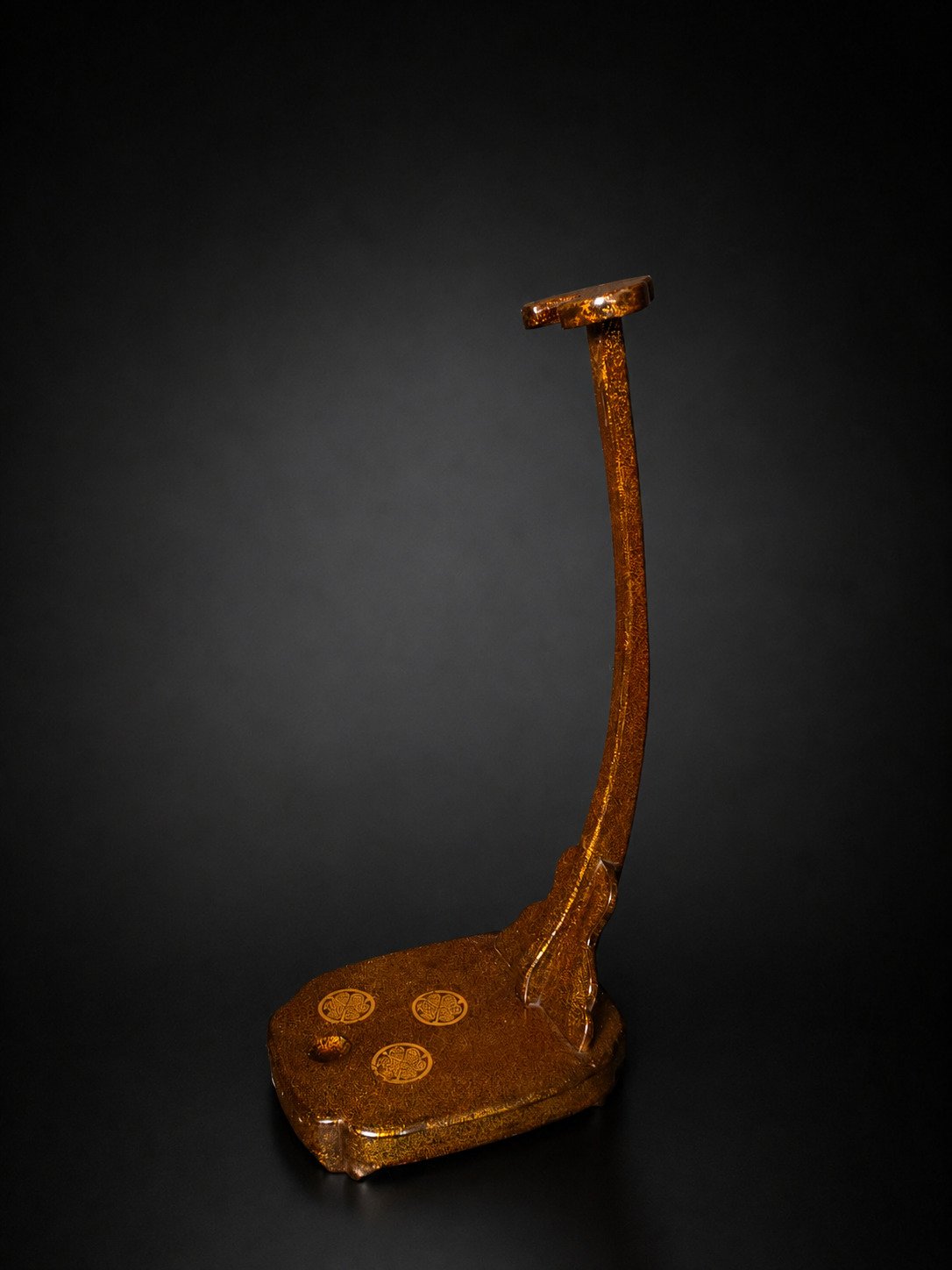
An exceptionally refined Japanese katana-kake from the 19th century, distinguished by its tall, elegant silhouette and an extraordinarily dense gold lacquer decoration extending across virtually the entire surface.
Designed to support and display a single Japanese sword, the stand combines a broad shaped base, a gracefully curved vertical neck and an upper cradle, all unified by an intricate gold karakusa ground.
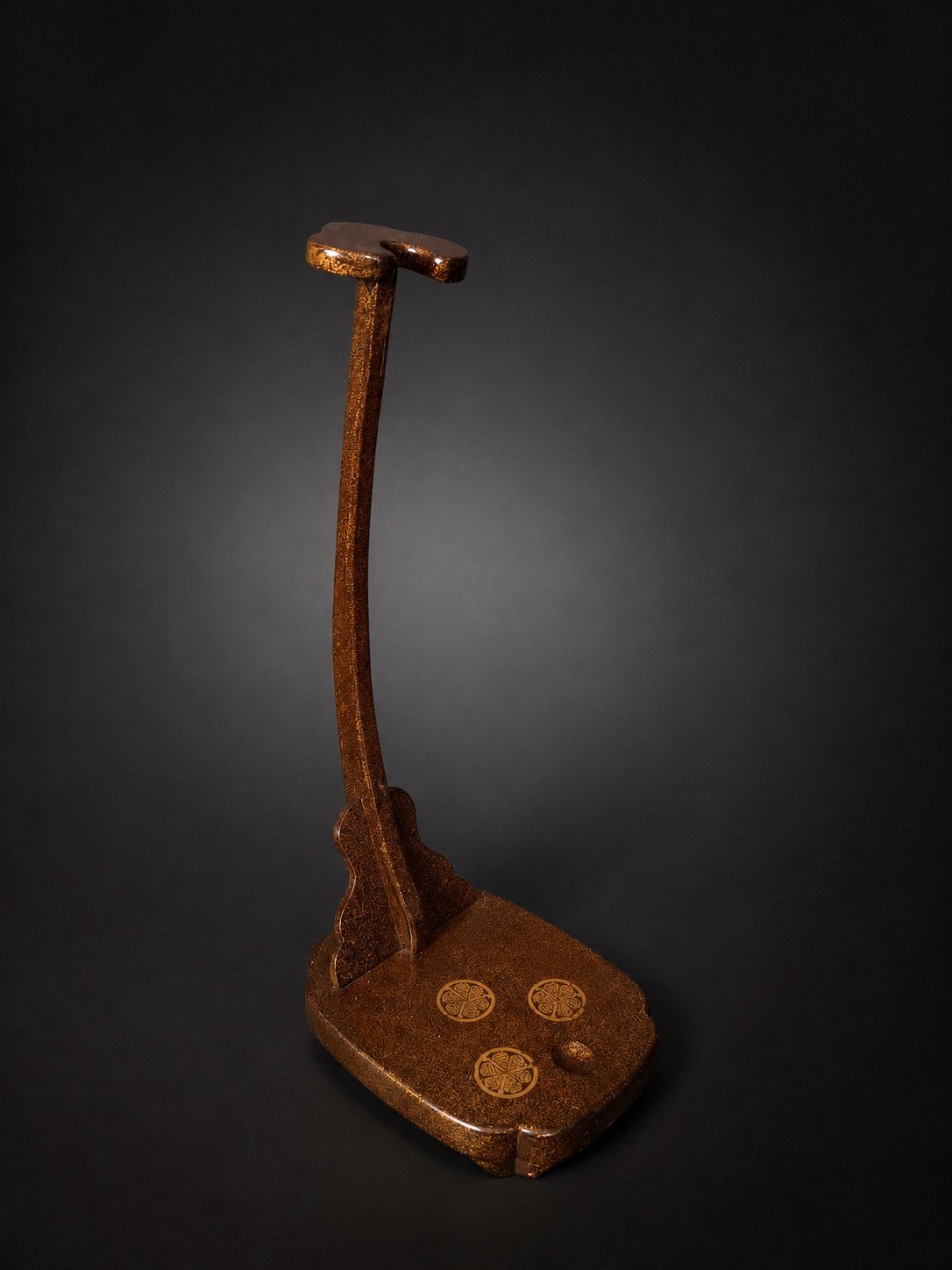
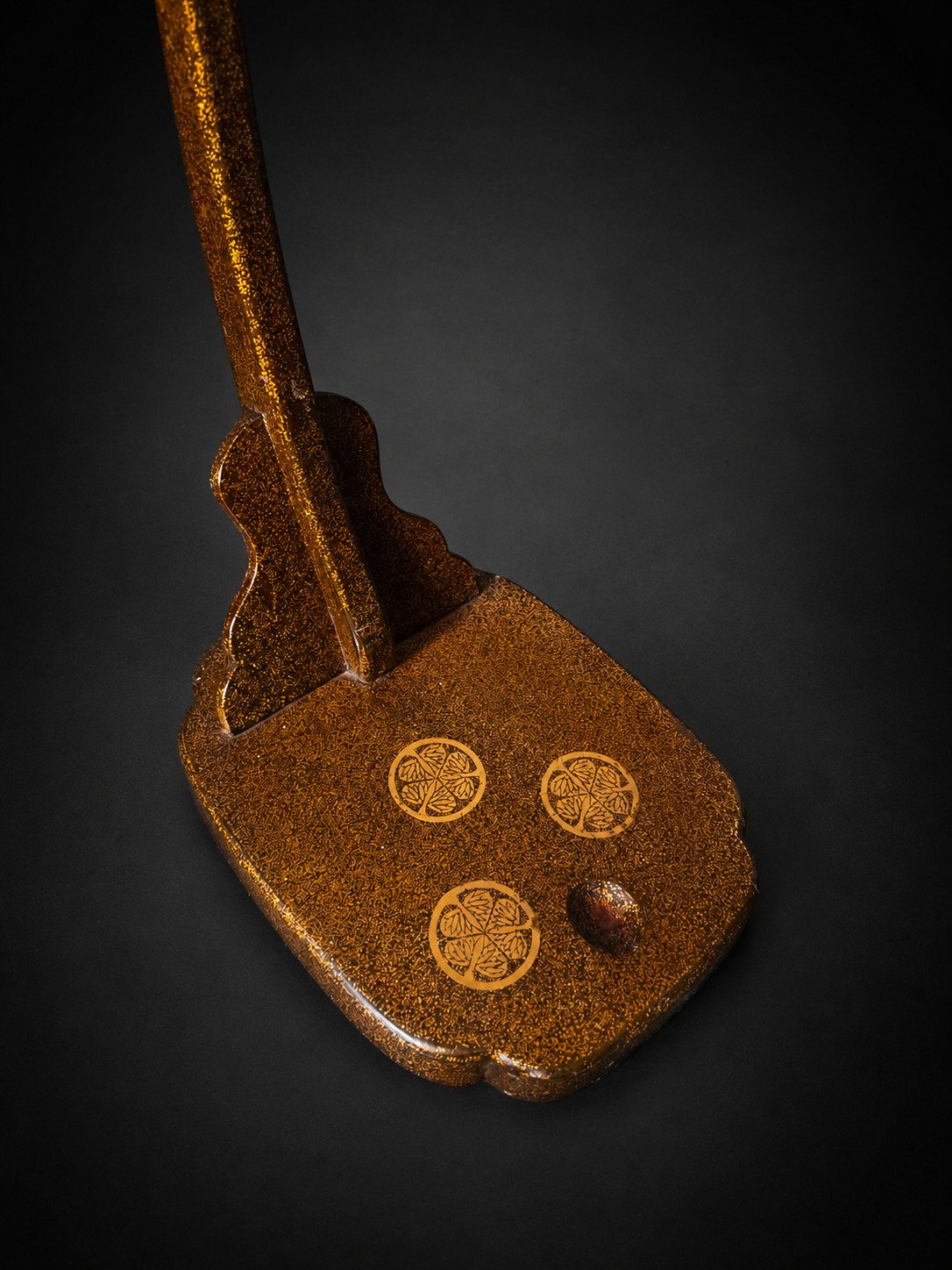
Of particular significance are the three prominent mitsuba-aoi crests decorating the base — the celebrated triple-hollyhock mon historically associated with the Tokugawa shogunal house. Their presence gives the piece a particularly powerful historical and heraldic character.
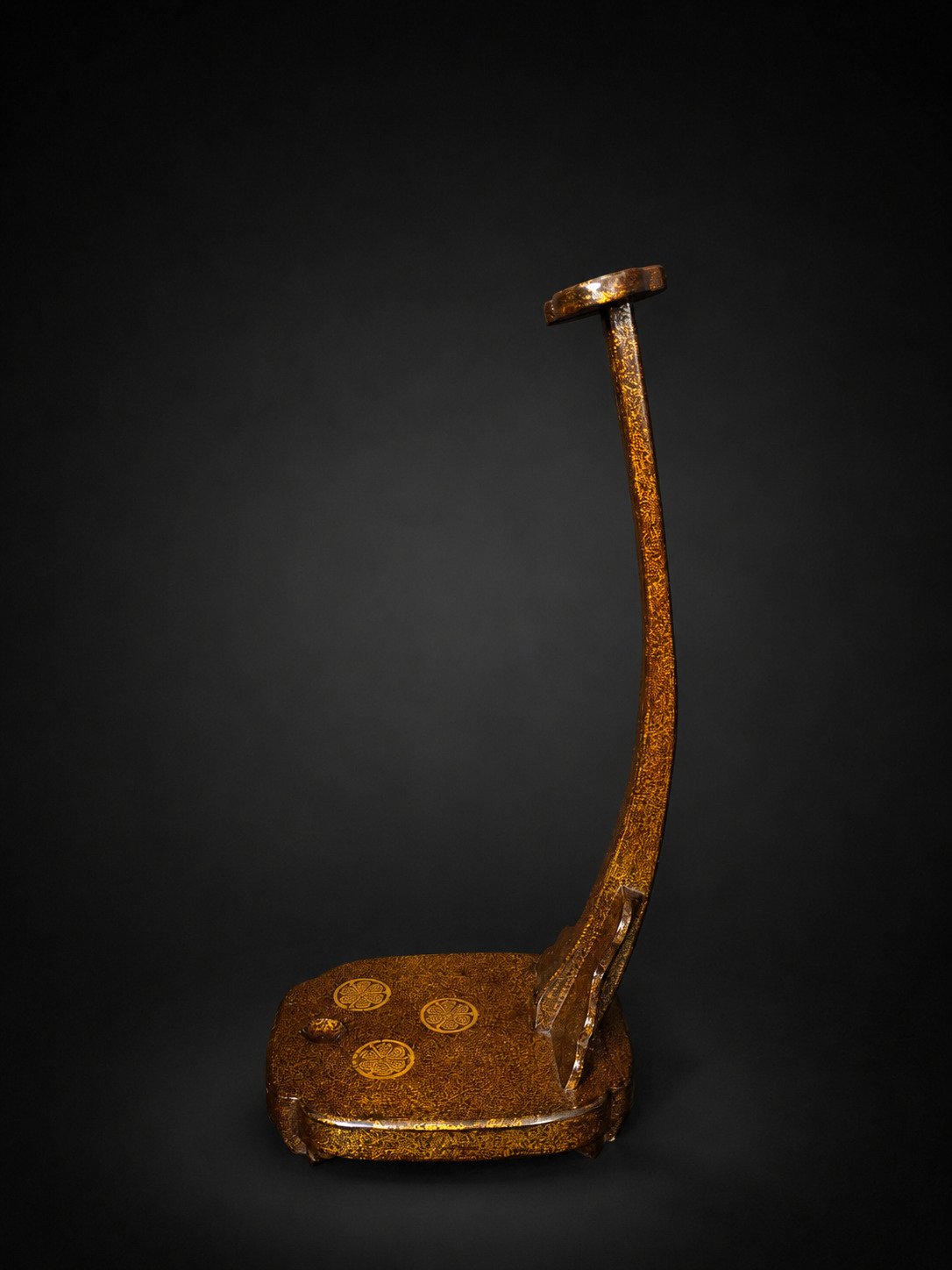
The katana-kake is constructed around a tall, gently curving vertical support rising from a substantial shaped base.
At the summit is a horizontally oriented cradle with a central recess designed to receive and support a sword securely while on display.
The pronounced curvature of the neck gives the stand a graceful, almost calligraphic profile, balancing the visual weight of the broad base below.
Unlike conventional horizontal racks intended to accommodate several swords, this vertical format presents a single blade as an individual object of importance.
Virtually the entire visible surface of the stand is covered in a remarkably dense gold lacquer decoration.
The base, vertical neck, supporting brackets, feet and upper cradle all share the same richly worked surface, giving the object a remarkably unified appearance.
Under direct or raking light, the numerous minute gold elements create a highly reflective surface that shifts between deep brown, amber and brilliant gold.
This continuous treatment transforms the structural components of the stand into a single decorative composition rather than separating functional and ornamental areas.
The principal decorative ground consists of densely arranged karakusa, the traditional Japanese scrolling-vine motif derived from continuously growing and intertwining plant forms.
The pattern extends uninterrupted across almost every part of the object, creating an extraordinarily fine network of golden scrolls against the darker lacquer beneath.
Karakusa ornament has a long history within Japanese decorative arts and was particularly well suited to lacquer because its continuous rhythm could be adapted to complex surfaces and architectural forms.
Here, its extremely dense execution gives the stand a textile-like richness when viewed from a distance, while close examination reveals the intricacy of the individual scrolling elements.
The fine gold decoration is consistent with the visual character of hiramaki-e, a traditional Japanese lacquer technique in which metallic powders are applied to create designs that remain comparatively close to the surface.
The exceptionally fine execution of the karakusa pattern allows the decoration to cover broad areas without overwhelming the elegant form of the object.
Instead, the thousands of minute golden details create texture, depth and changing reflections as the stand is viewed from different angles.
The extensive use of this type of decoration across both broad and narrow structural elements would have required considerable control and specialized lacquer craftsmanship.
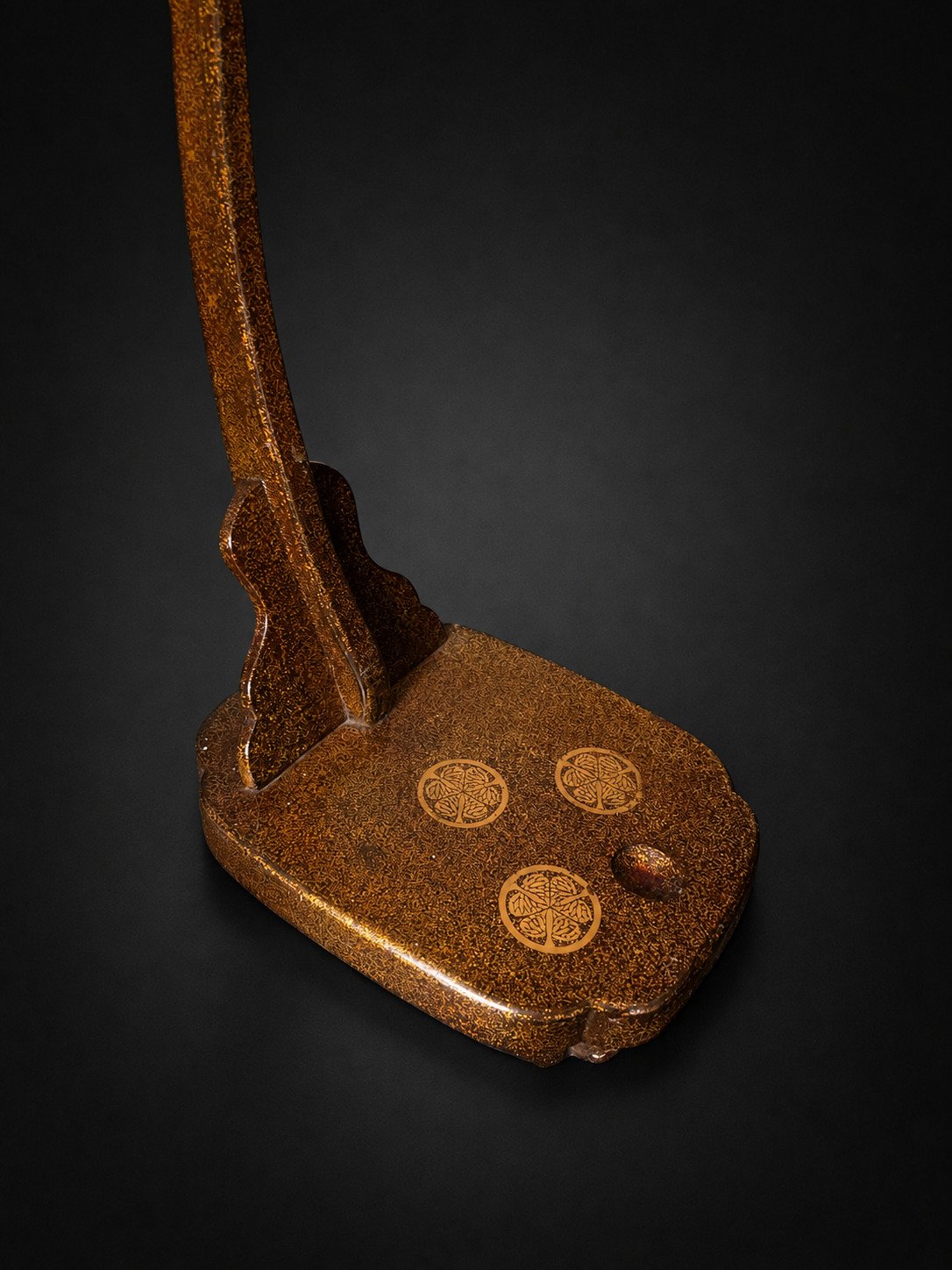
The upper surface of the base is prominently decorated with three circular examples of the mitsuba-aoi crest.
The design consists of three stylized hollyhock leaves arranged symmetrically within a circular composition and is one of the most immediately recognizable heraldic motifs in Japanese history.
The mitsuba-aoi is particularly associated with the Tokugawa family, whose shoguns governed Japan throughout the Edo period from 1603 until 1868.
The three crests stand out clearly against the extraordinarily dense karakusa ground, creating strong visual focal points on the otherwise continuously patterned base.
During the Edo period, forms of the triple-hollyhock crest were closely associated with the Tokugawa shogunal family and its principal branches, making the motif a potent symbol of political authority and elite status.
Its appearance on a richly lacquered object associated with the display of a Japanese sword therefore carries considerable historical and symbolic significance.
Without documented provenance, however, the presence of the crest alone should not be considered proof that the stand was personally owned or commissioned by the Tokugawa shogunal family.
The piece may have been produced for a Tokugawa-affiliated household, for an individual entitled to use an associated crest, or as a later commemorative or prestigious work deliberately referencing Tokugawa heraldry.
Regardless of the precise original context, the combination of the mitsuba-aoi motif with such extensive gold lacquer decoration clearly gives the object an unusually prestigious character.
The three mon are arranged across the broad upper surface of the base, each enclosed within a circular border and rendered in gold against the intricate karakusa decoration.
Their comparatively restrained geometry contrasts effectively with the dense, flowing vegetal ornament surrounding them.
This juxtaposition allows the crests to remain immediately legible despite the extraordinary richness of the underlying decoration.
The repeated use of the mon also reinforces its importance as one of the principal visual themes of the object rather than as a minor ornamental detail.
Alongside the three crests is a small raised lacquered knob, integrated into the upper surface of the base.
Its rounded form interrupts the otherwise predominantly flat decorated surface and adds a subtle sculptural element to the composition.
Like the surrounding structure, it is finished to harmonize with the rich gold and brown lacquer palette of the stand.
The tall vertical neck rises from an elaborate shaped bracket that provides both structural reinforcement and decorative transition between the base and upright.
The bracket has a pronounced scalloped profile, giving the lower section of the stand an architectural and sculptural quality.
It is decorated with the same dense gold karakusa pattern as the remainder of the piece, maintaining complete visual continuity.
The neck itself curves subtly as it rises, preventing the tall form from appearing rigid and contributing significantly to the elegant overall silhouette.
At the top of the long neck is a compact horizontal platform shaped specifically to support a sword.
A central recess provides a natural resting point for the blade or mounted sword, while the projecting sides help maintain its position.
Even this relatively small functional component is completely decorated with the same gold lacquer treatment found throughout the rest of the stand.
The result is a design in which no major visible structural element has been treated as merely utilitarian.
The broad base has a softly shaped rectangular form with rounded corners and subtle projecting contours.
It is raised slightly above the display surface on short integrated feet, giving the object additional visual lightness despite the substantial size of the base.
The sides and feet continue the same intricate lacquer decoration found on the upper surface, demonstrating the comprehensive nature of the decorative programme.
This attention to areas that would normally receive less visual emphasis is indicative of the care invested in the overall execution of the piece.
Standing approximately 68 cm high, the katana-kake possesses a commanding vertical presence.
Its unusual proportions draw the eye upward from the broad heraldic base along the slender curved neck toward the sword cradle.
When used with a mounted Japanese sword, the stand would have transformed the blade into a prominent vertical display, while the gold lacquer and Tokugawa-associated mon provided an appropriately prestigious visual setting.
Even without a sword, its distinctive silhouette, extensive lacquer work and heraldic decoration allow it to function as an important decorative object in its own right.
The most remarkable characteristic of the stand is the extraordinary consistency of its decoration.
Rather than concentrating expensive lacquer work only on the most visible sections, the artisan extended the fine gold karakusa treatment across the base, sides, feet, supporting bracket, long neck and upper cradle.
Such extensive decoration would have required considerable time and specialized craftsmanship, particularly given the complexity of applying a continuous fine pattern to narrow and curved surfaces.
The combination of sophisticated lacquer work, heraldic imagery and a specialized sword-display function indicates that this was conceived as an object of considerable decorative prestige.
The katana-kake survives in antique condition with age-related wear consistent with a 19th-century lacquer object.
The gold decoration remains highly visible throughout the structure and continues to produce a rich reflective effect under direct lighting.
Minor surface wear, irregularities and historical changes to the lacquer should be regarded as part of the natural history of an antique object of this type.
Please examine the accompanying high-resolution photographs carefully, as they form an essential part of the description and provide the most accurate record of the object’s present condition.
This katana-kake combines several characteristics of particular interest to collectors of Japanese lacquer, samurai culture and sword-related objects.
Its unusual vertical format, extensive gold karakusa decoration and prominent use of the mitsuba-aoi crest create a strong connection between Japanese lacquer craftsmanship, sword culture and elite heraldic symbolism.
The Tokugawa-associated mon is particularly noteworthy, while the absence of documented provenance makes it appropriate to distinguish carefully between the historical significance of the crest and any specific claim of Tokugawa ownership.
As an object, it remains an exceptionally decorative example of the manner in which the presentation of the Japanese sword could itself become an important expression of craftsmanship, status and visual refinement.
An exceptional 19th-century Japanese katana-kake distinguished by its elegant vertical form and extraordinarily extensive gold lacquer decoration. The shaped base, curved neck, supporting bracket, feet and upper sword cradle are covered in dense karakusa scrollwork, creating a richly textured golden surface that changes dramatically under the light. Three prominent mitsuba-aoi crests — the celebrated triple-hollyhock mon historically associated with the Tokugawa family — decorate the base and give the piece a particularly powerful heraldic character. Measuring 68 × 34 cm, this refined single-sword stand combines sophisticated Japanese lacquer craftsmanship, samurai sword culture and elite heraldic symbolism in a highly distinctive display object.

Order above 1.000,00 € gets free shipping.

Secure and hassle-free payment process.

Certificate of authenticity included.

Have questions? Contact us via WhatsApp.
Contact