FREE EXPRESS INTERNATIONAL DELIVERY
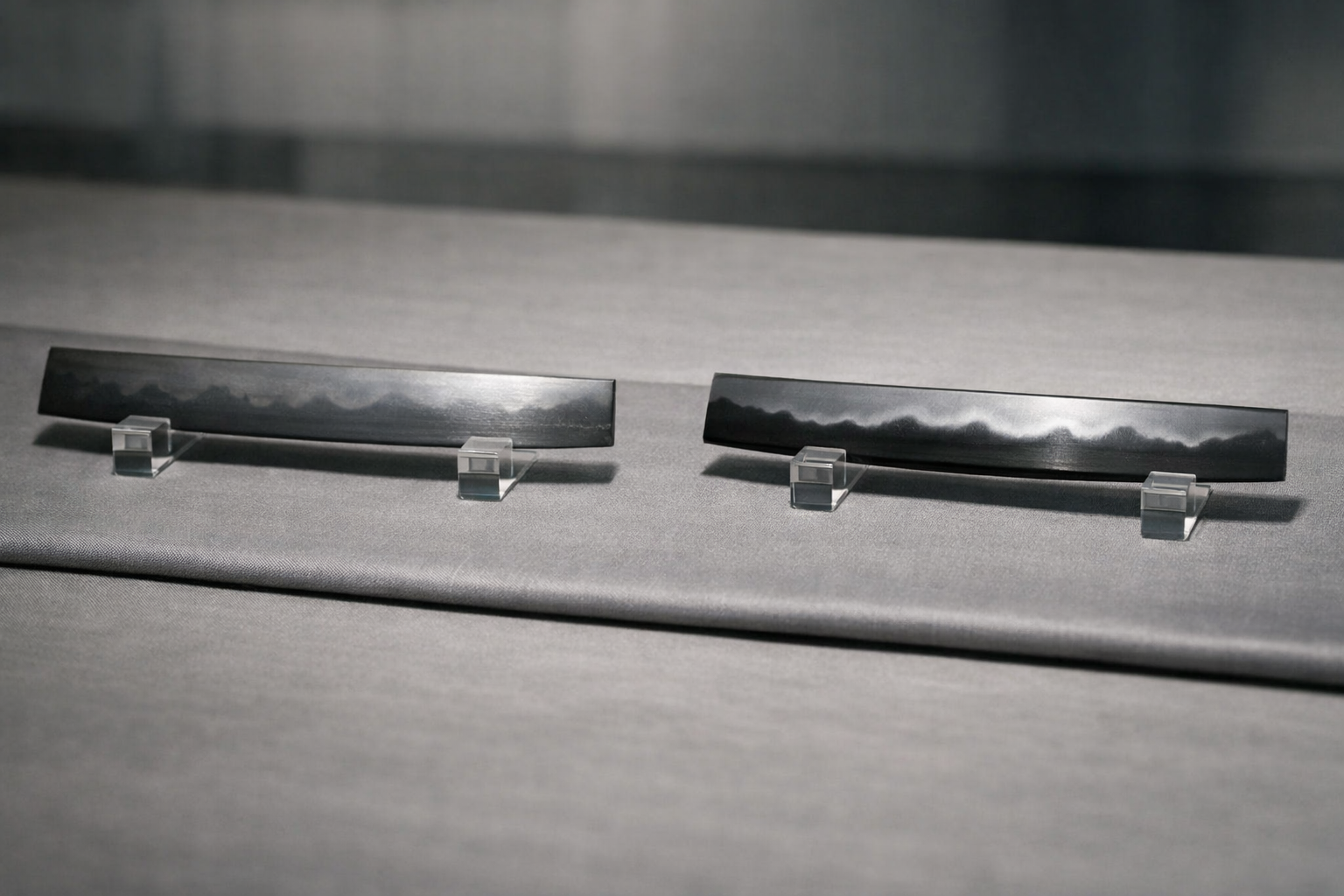
In Japanese sword study, polish is not a decorative afterthought; it is the lens through which the steel becomes readable. The same blade can appear markedly different depending on whether it is finished in sashikomi or hadori, and those differences can nudge the observer—sometimes subtly, sometimes decisively—towards particular impressions about the hamon, the jihada, and the activities within them. The key is to separate what the finish reliably does to the surface (observable effect) from what we might be tempted to conclude (interpretation). This guide sets out that distinction, offers practical viewing habits, and keeps the discussion strictly within responsible observation rather than attribution.
A Japanese blade is a complex surface: hardened and unhardened zones, fine topography, and minute reflective structures. Polish makes these elements legible by refining the surface so it interacts with light in controlled ways. Because polish changes how light behaves, it can also change what your eye prioritises. Learning to recognise polish-driven emphasis is therefore part of learning to “read” a sword.
Polishing is a specialist craft that refines a blade’s surface to reveal structures and patterns already present in the steel. In other words, it can present information more clearly, but it does not create the underlying metallurgy. A polish can:
Polishing is not a tool for establishing maker, school, period, authenticity, or any kind of certification status. Visual clarity can support study, but clarity is not the same thing as proof. Moreover, outcomes vary by the individual blade and the practitioner; what a given finish reveals strongly on one sword may be more muted on another.
Collectors and students tend to return to a small set of visual domains. These are the areas most obviously influenced by finish, and therefore the areas in which polish bias most often appears:
The practical implication is simple: if a finish emphasises the hamon, you may under-read the jihada; if a finish preserves subtler texture, you may under-read the overall hamon outline at a glance.
It is tempting to treat what looks “bolder” as what is “more real”. That is precisely where polish bias enters. A finish can make the hamon appear wider, cleaner, or more continuous without altering the actual hardened zone. Conversely, a more subdued presentation can make a blade appear quieter than it truly is, especially under indifferent lighting.
Keep two statements in mind as you compare swords (or photographs):
With that distinction in place, we can look at each finish on its own terms.
Sashikomi polish is widely discussed among collectors because it often reads as comparatively “natural” and understated. In observational terms, it tends to favour subtlety: the hamon can appear integrated with the steel rather than outlined as a separate graphic element. That can be a practical advantage for close study, provided the viewer uses appropriate light and takes time.
Established: In sashikomi, the hamon is commonly seen with less overt “drawing” around it. The transition between the hardened and unhardened areas may appear more gradual, and the surface can reward slow tilting under light. Jihada texture is often easier to keep “in view” because it is not visually overpowered by a bright, frosted band along the hamon.
Interpretation (use with caution): Observers sometimes conclude that the hamon is narrower or less emphatic. That may be true for the particular blade, but it may also be a presentation effect: reduced edge emphasis can make the same hardened zone read as slimmer, especially in photographs or flat lighting.
A useful mental check is to ask: “Am I seeing the hamon’s structure, or am I simply missing its boundary because the contrast is low?” The answer often depends more on light than on the blade.
Established: Many viewers find that sashikomi allows the steel’s micro-contrast to remain legible: the sparkle of nie and the mist-like quality of nioi can appear less “covered” by a bright overlay. When the lighting is controlled, this can support careful study of internal texture rather than only the outline.
Interpretation (use with caution): Because subtle features may be easier to resolve in a well-executed sashikomi finish, an observer may assume the blade has “more activity” than a comparable blade in a different finish. In reality, you are often comparing visibility rather than metallurgy. A quieter-looking hadori-finished hamon can still contain rich internal detail; it may simply demand different lighting and slower viewing to bring it out.
For study, it helps to note what you can actually see: “nie appears in clusters along the yakiba under point light” is a more reliable observation than “the blade has abundant nie”. The first is grounded in a repeatable viewing condition; the second is easily influenced by presentation.
The risk with sashikomi is not exaggeration but understatement. If contrast is low, boundaries soften, and the eye may lose the hamon’s continuity—particularly where the pattern becomes fine, where the ji is dark, or where the lighting is diffuse and weak.
Common pitfalls include:
In practice, sashikomi invites patience. If you rush, you may conclude the blade is quieter than it is.
Hadori polish is often recognised immediately because it tends to outline the hamon with a lighter, frosted band. For many viewers—especially newcomers—this increases legibility at a glance. The trade-off is that the outlining effect can sometimes become the dominant visual fact, encouraging the observer to treat the drawn band as if it were the hamon itself.
Established: Hadori typically presents a hazy, light-toned path that follows the hamon. This can make the hamon’s overall shape easier to track, especially in casual viewing conditions or across a room.
Interpretation (use with caution): The hadori band can appear to standardise or broaden the hamon visually. That appearance is not the same as a change in the hardened zone. It is a presentation layer that affects how the boundary reads to the eye. In photographs, the effect can be magnified: the camera often “locks onto” the brightest feature and sacrifices subtle gradations elsewhere.
A careful observer therefore distinguishes between the visible outline created by hadori and the underlying yakiba characteristics that may sit within and beneath that outline.
Hadori’s strength is immediate recognition. The macro-outline of the hamon can be quickly followed, and broad features become easy to describe consistently. This can be helpful when teaching the basic vocabulary of hamon shapes and when presenting a blade to audiences who will not spend long with it.
At the same time, enhanced brightness along the hamon can make fine internal activity less distinct, particularly if the viewer relies on a single lighting condition. Subtle hataraki may still be present and can still be seen, but you may need to:
The practical caution is straightforward: do not let the hadori band substitute for observation. Use it as a guide to where the hamon runs, then study within it.
Hadori’s principal risk is overconfidence. Because the hamon reads clearly and crisply, the observer can assume the border is intrinsically sharp, clean, and uniform. Yet the drawn, frosted path can make transitions appear cleaner than the steel’s native gradations under different light.
Typical misreadings include:
None of these points condemn hadori. They simply describe the kind of bias it can introduce if you forget that polish is a presentation, not a verdict.
Rather than treating sashikomi and hadori as competing ideologies, it is more useful to understand them as different ways of making the same steel legible. Below are practical, observation-led comparisons—again separating established surface effects from what must remain interpretive.
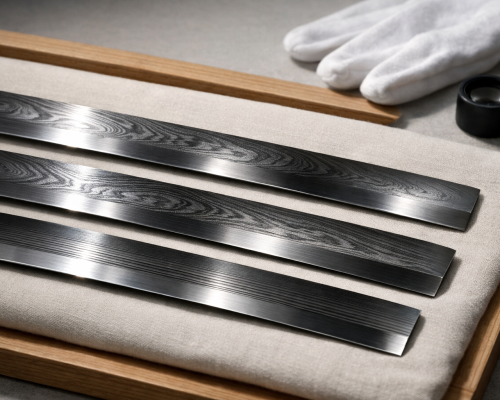
Established contrast difference: Hadori tends to emphasise the hamon’s macro-outline, increasing immediate contrast between hamon and ji. Sashikomi tends to favour micro-texture and internal modulation, often asking the viewer to work a little harder for the outline.
Continuity as an interpretive trap: In hadori, the hamon can appear more continuous because the bright band connects the path visually. In sashikomi, the same area may appear to “breathe” more, with soft transitions that can be mistaken for interruptions if the lighting is poor. The safest approach is to test continuity under multiple angles and lights before concluding that a line breaks, thins, or fades.
A repeatable habit: track the hamon slowly from machi to kissaki, then return and do the same under a different light. If a perceived gap disappears, it was probably a viewing artefact.
The boshi is notably sensitive to finish and light because the kissaki’s geometry changes the angle of reflection. As a result, it is an ideal place to practise careful observation without jumping to conclusions.
Established: Hadori may make the overall boshi path easier to follow—useful for basic comprehension and for ensuring you have not lost the line as the blade curves into the tip. Sashikomi may, under careful light, show finer texture and subtle activity within the boshi and around the turn-back, because you are not primarily reading a frosted outline.
Interpretation (handle cautiously): It is easy to infer that one finish “has a better boshi” than the other. What you can reliably say is narrower: one finish may make the boshi easier to see quickly; the other may reward close, slow viewing with fine detail. Neither observation should be converted into a claim about maker, era, or quality.
Established tendency: Many observers find that sashikomi preserves the prominence of jihada texture relative to the hamon, because it does not add an emphatic bright band that dominates the visual field. In hadori, the hamon can become the centre of attention, and the jihada may appear quieter by comparison.
On utsuri (where present): Utsuri, when visible, can be subtle and is highly dependent on surface condition and lighting. A finish that encourages you to study the ji carefully may make it easier to notice faint, pale activity—yet it is essential not to assume utsuri is absent simply because it does not present itself immediately in a particular lighting setup or in photographs.
The conservative practice is to describe what you see in explicit viewing conditions: “a pale, shadow-like band appears intermittently in the ji under diffuse light” is a disciplined note; “utsuri is present/absent” is often too categorical unless you have observed the blade extensively.
If polish is a lens, then your viewing method is the discipline that stops the lens becoming a distortion. The protocol below is intentionally simple and repeatable. It is designed to help you observe consistently across different finishes and to reduce the risk of over-reading what a polish emphasises.
Good observation depends less on expensive equipment than on controlled conditions and patience.
As a discipline, try to avoid forming conclusions while the blade is stationary. Instead, let the blade “talk” as you vary the angle: the persistence of a feature across angles is often more informative than a single dramatic flash.
One lighting setup can flatter a hadori outline and flatten internal texture; another can make sashikomi subtleties bloom. To avoid being misled by your own environment:
A feature that appears only under one extreme condition is not necessarily “false”, but it should be recorded as conditional rather than treated as a stable characteristic.
A checklist helps prevent polish bias by forcing you to look beyond what is most obvious. Here is a compact routine you can reuse on any blade, in any finish:
This routine does not replace knowledge; it supports it by making your observations more consistent and less driven by whatever the polish makes most conspicuous.
Clear terms are a form of intellectual honesty. They allow you to describe what you see without quietly implying attribution, age, or quality. The definitions below are deliberately practical and limited to what is needed for this discussion.
In practice, nie and nioi are frequently what you are trying to separate from polish effects. If a finish makes everything look uniformly white or uniformly dark, you may lose the ability to distinguish sparkle from mist. That is a cue to change light rather than to change conclusions.
Because these terms can be loaded in other contexts, it is best to keep their use descriptive: “jihada is clearly visible under diffuse light” is better than “jihada is excellent”, and “a pale shadow-like area may be visible” is better than a categorical claim made from one quick glance.
Collectors sometimes encounter a blade in one finish and wonder whether it would be “better” in the other. That question touches conservation, study goals, and risk. This section does not offer instructions for polishing; it frames the decision ethically and practically, and stresses the role of qualified professionals.
Repolishing removes steel. That is not a moral judgement; it is a physical fact. Over time, repeated or aggressive polishing can alter geometry and reduce the crispness of details. Even where a blade appears healthy, the decision to remove more material should be treated as consequential rather than cosmetic.
The collector’s responsibility is therefore conservative: preserve information where possible. A polish that makes a feature more visible today is not automatically worth the long-term cost if the blade is already legible and stable.
Restraint is often a sound scholarly choice. If the blade’s key features are already readable—hamon, jihada, boshi, and the overall surface condition—then changing the finish may offer only a shift in emphasis rather than genuinely new information.
Situations where restraint is commonly prudent include:
None of this says “never repolish”; it says “treat repolish as irreversible”.
Only trained specialists should polish. If you are considering a change of finish—whether from hadori to sashikomi or the reverse—the proper next step is consultation with a qualified togishi. The discussion should focus on:
A good consultation helps replace abstract arguments about “which is best” with a blade-specific, condition-specific plan—or an equally valuable decision not to intervene.
Collectors are often pulled between two legitimate desires: to study a blade deeply, and to present it attractively for others (or for personal enjoyment). The important discipline is to keep those goals explicit. When you name the goal, you reduce the risk of using presentation as a proxy for scholarship.
For study, you are usually trying to maximise the legibility of micro-features: internal texture within the hamon, the character of nie and nioi under controlled light, and the surface information carried by the jihada. A finish that supports this can be helpful, but it is not a guarantee. Your method still matters more than the label of the polish style.
Two practical reminders keep study oriented toward observation:
In other words, treat polish as a viewing condition, not as evidence.
For exhibition or casual viewing, the audience’s time is limited and the environment is rarely ideal. A finish that offers immediate readability can support appreciation, helping viewers locate the hamon and understand the blade’s visual structure quickly. In that context, clarity is not superficial—it is communicative.
However, the same boundary applies: exhibition clarity should not be used to imply conclusions about who made the blade or when. It is a tool of presentation, not a certificate.
Collectors inevitably encounter commercial language around polish: “more dramatic”, “more visible”, “better”. Those terms may describe an aesthetic preference, but they can also smuggle in claims about significance. Keep the separation firm:
This separation protects both newcomers and experienced collectors from the same error: turning a surface effect into a conclusion.
It can appear wider because a light-toned band outlines the hamon. This is a presentation effect; the actual hardened zone does not change.
Often, sashikomi preserves subtle micro-contrast that helps study, but results vary by blade and lighting. Observation should remain cautious.
Possibly, but any repolish removes steel and must only be done by a qualified togishi after careful consultation about goals and condition.
Polish influences what features you notice. However, polish alone cannot establish maker, period, school, or authenticity.
Match the finish to goals: study vs display. Seek professional advice, weigh conservation, and avoid assuming one style increases value.
Continue your study with our in-depth guides on hamon and observation. Start with hamon basics, follow a repeatable viewing routine, and explore context on nihonto vs modern swords using the internal links above.
CEO of SupeinNihonto, dealer and collector of ancient Japanese art and weapons from Canillo, Andorra.
Contact