FREE EXPRESS INTERNATIONAL DELIVERY
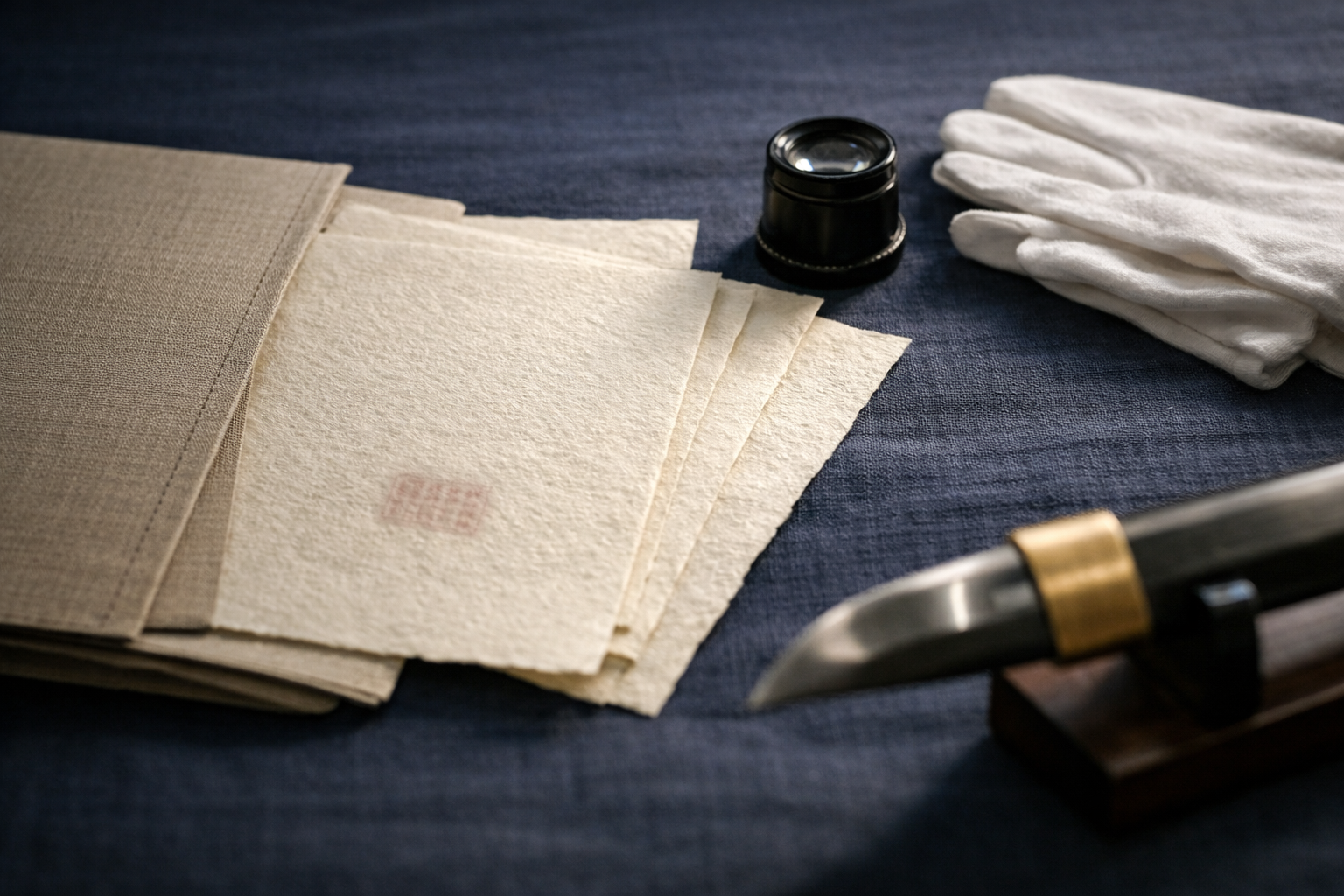
For many collectors, Japanese sword papers are the first piece of documentation they encounter when evaluating a blade, koshirae, or fittings. These certificates can be genuinely helpful: they record an organisation’s opinion, provide a formal level or category, and give a date and reference number that can be preserved alongside the object. Yet papers are often misunderstood—treated as a guarantee, a substitute for close study, or a simple proxy for quality.
This guide aims to build certification literacy. It outlines what NBTHK and NTHK papers are designed to do, how shinsa (appraisal) is typically framed, how to read an origami (certificate) carefully, and how to interpret paper levels without overreliance on them. Throughout, it separates what papers formally state from what the market may infer, and keeps the focus on the object itself.
In common collector usage, “papers” means a sword-related certificate issued after appraisal by a recognised organisation—most often the NBTHK or an NTHK body—stating an opinion and recording details for reference. Papers are not the sword, not a permanent truth, and not a complete report on condition or history.
What papers can usually be treated as established, documentable facts (because they are written on the certificate):
What papers are frequently used to suggest, but do not strictly guarantee:
A certificate is best understood as a dated, structured opinion recorded by an issuing body. It can support study and confidence, but it does not replace close examination, appropriate references, and careful handling of uncertainty.
A few terms recur in listings and discussions. Used carefully, they help clarify what you are actually looking at:
The NBTHK is one of the better-known organisations in the Japanese sword world. In collector practice, “NBTHK papers” normally means an NBTHK certificate issued after shinsa, stating an opinion and a level or category.
At their core, NBTHK papers record the NBTHK’s opinion at the time of shinsa, expressed through a certificate format and a named category (level). That is a meaningful form of documentation, but it remains an opinion anchored to a date and to the condition and presentation of the item at that time.
Two practical implications follow:
Collectors commonly encounter a progression of NBTHK categories. Without turning this into a rigid ladder (and without implying automatic market consequences), it is helpful to recognise the names that appear in descriptions:
In general collector language, these are often treated as levels of recognition. The crucial discipline is to read what is actually written on the paper—especially the scope and the attribution—rather than relying on the category name alone.
Most newcomers meet NBTHK papers through NBTHK Hozon and Tokubetsu Hozon. These categories are widely cited in listings, sometimes with a shorthand implication that “more is better”. The reality is more nuanced: the certificate tells you what the NBTHK was prepared to state about that object, in that form, on that date.
Hozon is commonly understood as a form of NBTHK recognition that records the organisation’s opinion and confirms that the item was judged suitable to receive that certificate. For collectors, the practical value of Hozon papers often lies in clarity:
Common misunderstandings are worth stating plainly:
Tokubetsu Hozon is generally presented as a higher category than Hozon. In market practice, many listings highlight Tokubetsu Hozon as a signal that an item has received a stronger form of recognition within the NBTHK framework.
For collectors, there are two balanced ways to approach Tokubetsu Hozon:
It is wise to resist a simplistic reading in which Tokubetsu Hozon is treated as a substitute for looking at the sword. Two blades may hold the same category while differing markedly in condition, quality of polish, completeness, and suitability for your own collecting focus.
When you are shown an NBTHK certificate (or any certificate presented as NBTHK), focus on three practical checkpoints before you think about level:
Equally important: treat the paper as part of a documentation set—alongside photographs, measurements, polish history where known, and any relevant export or collection notes—rather than as a standalone verdict.
At higher levels of NBTHK recognition, collectors often encounter the terms Juyo and Tokubetsu Juyo. These categories are frequently discussed with intensity, sometimes with the assumption that they settle all questions. A more careful approach is to treat them as formal recognitions within an NBTHK framework, with the same basic discipline: read the certificate, understand the scope, and remember that condition and context still matter.
Within NBTHK’s framework, Juyo is commonly understood as a high level of recognition. In practice, it often appears in serious collections and institutional contexts because it provides a clear statement of what the NBTHK panel was willing to record at that level.
Even so, the certificate does not eliminate the need for connoisseurship. A responsible collector still asks:
Tokubetsu Juyo is generally positioned as a higher form of recognition than Juyo. It may be discussed as particularly selective, but it is best to avoid converting that general reputation into claims about certainty, price, or permanence.
For the collector, Tokubetsu Juyo papers can be approached in a grounded manner:
One caution is worth repeating: higher-level papers do not make an object immune to later questions of condition, matching components, or the natural evolution of scholarship. They remain a record of an opinion at a moment in time.
NTHK papers are also widely encountered internationally, particularly because NTHK shinsa has been presented in various countries over time. Collectors should be aware that there can be variation in how NTHK paperwork looks and how information is presented, so careful reading and cross-checking are essential.
NTHK Kanteisho refers to an NTHK certificate of appraisal. As with other papers, its central purpose is to record the organisation’s opinion after shinsa. Typical elements collectors look for include:
The important mindset is the same: treat the Kanteisho as a dated record of an NTHK opinion, rather than an unchanging guarantee.
Collectors may encounter NTHK papers with varying degrees of detail and in differing layouts. Some documents may be more approachable to non-Japanese readers than others, but do not equate readability with reliability. Instead, focus on verifying the same fundamentals you would for any origami:
Where you see grading notes or structured categories, treat them as part of that organisation’s presentation of its opinion. Avoid assuming that similarly named levels between NBTHK and NTHK are directly equivalent; they are separate bodies with their own systems and document formats.
Collectors often want to know what “counts” at shinsa. While the detailed internal procedures of any panel are not something to speculate about, it is reasonable to describe, at a high level, what an appraisal must consider in order to reach an attribution and issue a certificate. Shinsa can be thought of as an exercise in connoisseurship under constraints: the panel examines what is presented, in its current condition, and records what it can responsibly support.
For blades, appraisal necessarily turns on features that relate to workmanship and tradition. Collectors typically focus on:
This list is intentionally general. The key point for collectors is that shinsa is grounded in what is actually visible, and visibility is affected by polish quality and condition.
Koshirae and fittings are often collected in their own right and may be evaluated separately from the blade. A frequent source of confusion in listings is the assumption that “papered” means “everything in the set is papered”. In practice:
The safest habit is to read the paper’s subject line and description carefully, then confirm that the object you are buying is the same object the paper describes.
Shinsa results become most useful when they are supported by good documentation practices. For collectors, “continuity” means being able to show that the paper belongs to the item you have in hand. Helpful habits include:
These steps do not replace expertise, but they reduce avoidable confusion—especially for items that change hands internationally.
Whether NBTHK or NTHK, an origami can look daunting at first. The goal is not to translate every character immediately, but to extract the information that is most important for identification and scope. The following step-by-step method is intentionally conservative and avoids reading more into the paper than is clearly stated.
Start by finding the issuing organisation’s name and the paper level or type. These are usually among the most prominent parts of the document, often accompanied by seals or stamps.
If you are using a translation, treat it as a guide and still verify these headline fields against the original paper. Misread issuer names and paper types are among the simplest—but most consequential—errors.
Next, establish what the paper applies to. This is where many misunderstandings begin, particularly when a seller photographs a paper alongside a complete mounted sword.
Then compare the described object to the physical object:
This is not about proving an attribution yourself; it is about ensuring the certificate is not being inadvertently or deliberately paired with the wrong item.
Finally, extract the date and reference number, and make them part of your permanent record. Practical steps include:
If a paper appears unusually worn, altered, or inconsistent in format, the correct response is not to jump to conclusions but to slow down: verify scope, compare to the object, and seek informed help where appropriate.
A healthy way to treat papers is as useful information that complements, but does not replace, direct engagement with the sword. Papers can make communication clearer—especially across languages—and they can reduce uncertainty in a market where many objects circulate far from their origin. But they remain one part of a larger judgement.
In a documentation sense, papers can establish:
This is already valuable: it gives you a stable reference point for discussion, insurance documentation, collection catalogues, and future study.
Equally, papers cannot guarantee several things that collectors sometimes wish they could:
These points encourage you to keep your evaluation anchored in the object: study the workmanship, inspect condition, and keep documentation organised.
In the marketplace, paper levels are often used as shorthand. Collectors may weigh NBTHK and NTHK papers differently depending on collecting goals, personal experience, and the specific sword in question. Common patterns of interpretation include:
These are tendencies, not rules. No certificate level should be used to override obvious issues of condition, mismatched components, or unclear scope.
Most problems with papers are not caused by the papers themselves but by how they are read, presented, or assumed. A few recurring pitfalls account for a large proportion of misunderstandings in online listings and private sales.
It is tempting to treat a certificate as a final conclusion. The safer approach is to treat it as a high-quality snapshot of opinion. If you later decide to re-submit, the outcome may confirm, refine, or alter what was previously stated. This can reflect:
The practical antidote is modesty: keep your language aligned with what the paper states, and remain open to further study.
One of the most serious pitfalls is a paper that does not correspond to the exact object being sold. Sometimes this is accidental (papers separated from items during estate handling); sometimes it is careless listing practice; occasionally it may be deliberate.
Protect yourself with simple checks:
If a seller cannot provide clear photographs of the nakago and the paper together, or cannot explain what the paper covers, assume you need more information before proceeding.
Translations are helpful, but they can introduce errors—especially when they are partial, overly interpretive, or created by someone unfamiliar with sword terminology. Common problems include:
A practical approach is to use translations as a guide, but always verify the core fields—issuer, level, date, scope, and reference number—against the original document. Where a detail materially affects your decision, seek a second informed reading rather than relying on a single informal translation.
Whether you are buying a sword with existing papers or considering submission, a disciplined checklist helps you avoid avoidable mistakes. The aim is not to turn every collector into a shinsa panel, but to ensure your decisions are grounded and your records coherent.
If your goal is submission, focus on practical readiness rather than trying to influence an outcome:
Submission decisions should be aligned with your goals: clarifying an attribution, creating documentation for a collection, or learning more through the process.
Good record-keeping is one of the most effective collecting habits. It protects you, helps future custodians, and supports responsible scholarship.
No. Papers record the organisation’s opinion at that time. Attributions can change with new submissions or research.
Kanteisho is an NTHK certificate issued after shinsa. NBTHK and NTHK are separate organisations with their own formats and criteria.
Not necessarily. Certificates may pertain to the blade, koshirae, or individual fittings. Always read the scope stated on the paper.
Use translations as a guide, but verify key fields (issuer, level, date, scope, numbers) against the original document.
It depends on your goals. Re-submission may confirm, refine, or alter opinions. Consider condition, costs, and potential outcomes.
If you’re comparing documentation on a potential acquisition, review our Authenticity Guarantee for how we handle papers, and consult an example listing noting Tokubetsu Hozon for context.
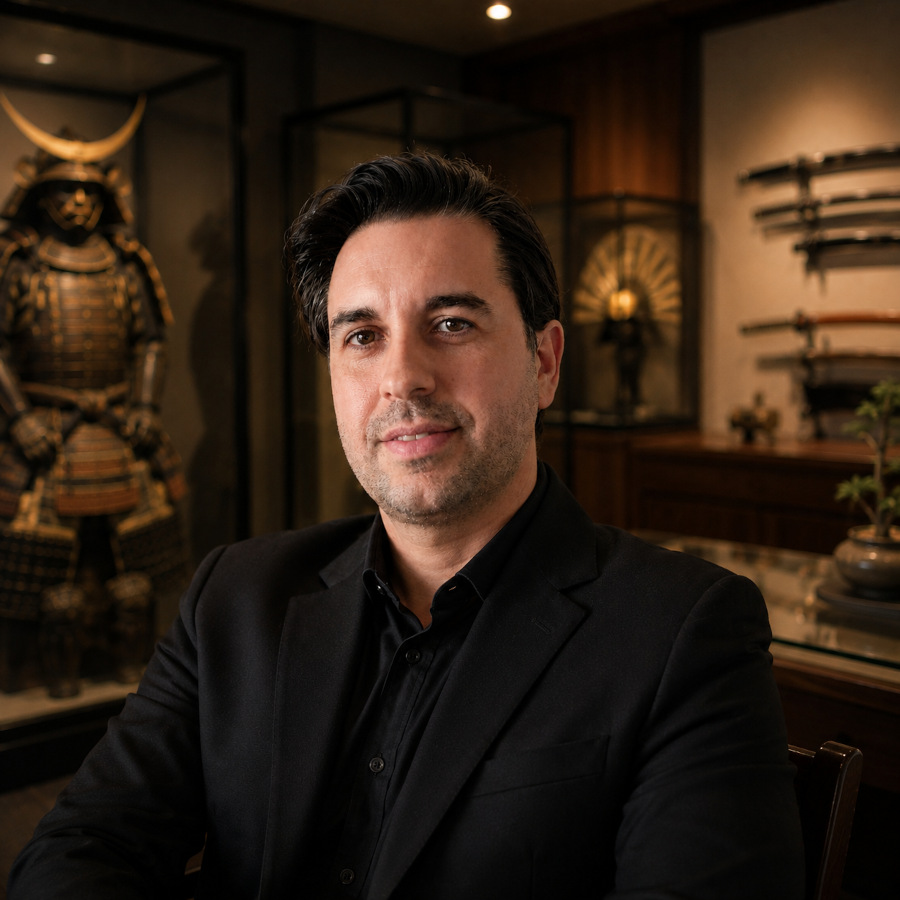
CEO of SupeinNihonto, dealer and collector of ancient Japanese art and weapons from Canillo, Andorra.
Contact