October 14, 2026
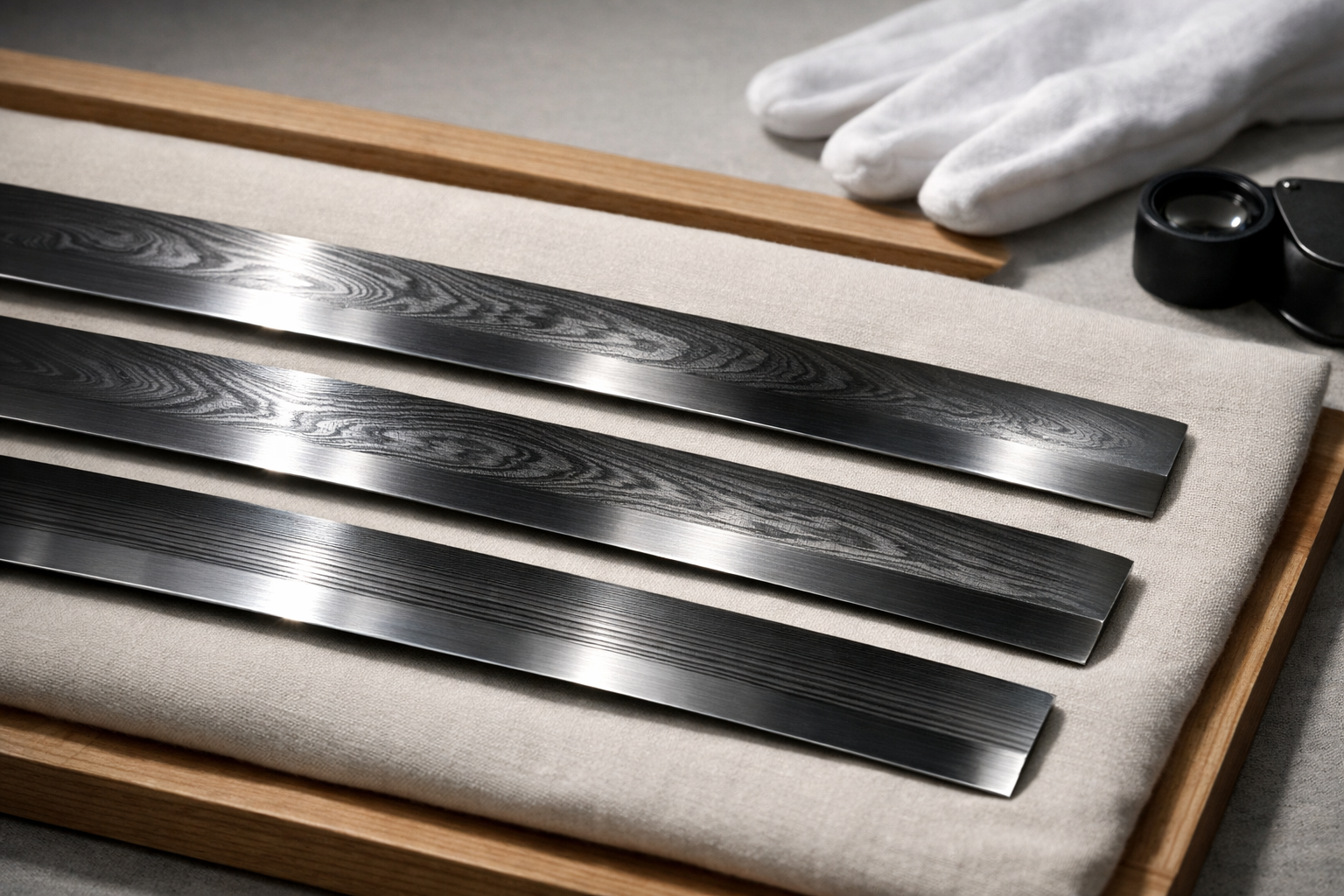
Many collectors learn to recognise a hamon long before they can describe the steel surface that carries it. Yet jihada (often shortened to hada) is not a decorative afterthought: it is a readable consequence of forging and finishing, and it repays careful, disciplined looking. This guide is deliberately practical. It focuses on what can be observed in-hand (and what cannot), how to set up viewing conditions that make jihada identification more consistent, and how to describe itame jihada, mokume jihada, and masame jihada without drifting into unsupported attributions.
Jihada is the visible steel grain on the blade’s surface. It is not “painted on” by the polisher; rather, it becomes legible through a combination of forging history and the way the surface has been refined. When you see hada clearly, you are reading texture: lines, flows, and figures that appear to sit within the steel rather than on top of it.
Two cautions belong at the start. First, jihada is not always equally visible. A blade may have a real and coherent grain that remains difficult to see because of polish condition, lighting, or surface health. Second, the language used for jihada is descriptive: terms such as itame, mokume, and masame are labels for patterns, not guarantees of origin.
Confusing hada vs hamon is one of the most common early missteps. Hada refers to the steel’s surface texture—grain and pattern within the body of the blade. Hamon is the hardened edge pattern produced by heat treatment, typically running along the cutting edge and interacting with the blade’s geometry.
In practice, they can distract from one another. A vivid hamon can dominate the eye, while very fine jihada requires quieter, more patient looking. Treat them as separate layers of information. You can note how they relate visually, but you should not assume that a striking hamon implies a particular jihada, or vice versa.
When experienced readers discuss jihada, they tend to begin with neutral observation points before naming a pattern. A judge-like approach typically includes:
Notice that none of these points requires you to name a maker, school, period, or “type”. They are a way to record what you can actually see, with enough clarity that another person could re-check your description.
The ability to see jihada depends heavily on the state of the surface. A well-maintained polish can make fine grain legible; a tired, scratched, or corroded surface can blur it into a general haze. Even where the underlying grain is present, active rust, stable pitting, or heavy oxidation can interrupt the continuous “read” that helps you decide whether you are looking at itame jihada, mokume jihada, or masame jihada.
It is also worth separating two different problems:
In both cases, the correct response is not experimentation. Do not attempt to “bring it out” with abrasives, polishing compounds, etches, acids, or improvised cleaning. Those interventions can create new textures that imitate hada while damaging the blade.
Because jihada is subtle, it benefits from controlled lighting. Diffuse overhead light can flatten the surface and hide fine grain. A more angled light source often reveals the grain’s relief and boundaries more clearly, but the exact best angle varies by blade, polish, and environment. The practical point is to avoid a single fixed setup: change the angle and distance slowly, and watch how the pattern “switches on” and “switches off” as reflections move.
Use a matte, non-distracting background so that you are not fighting reflections or bright colour casts. If the background is glossy or patterned, it can create false boundaries on the blade surface and make jihada identification less reliable.
Finally, try to keep your conditions consistent when comparing sections of a blade. If you change lighting and angle between observations, you may be comparing the room rather than the steel.
“Judge-like” observation begins with safe, minimal handling. Fingerprints are not merely cosmetic: skin oils can mark the surface and encourage later corrosion. If you are inspecting a bare blade, handle it with appropriate care and avoid touching the polished surfaces. Keep movements slow and deliberate, and ensure the blade is supported and controlled at all times.
Equally important: do not improvise tools. No metal picks for “checking”, no household cloths that can scratch, and no chemicals intended for other metals. If the blade needs restoration or assessment, consult qualified professionals rather than attempting to correct issues yourself.
Itame jihada is often described as a wood-grain flow. In purely visual terms, look for curving, layered lines that appear to drift and fold, with a sense of movement rather than strict repetition. The grain may show alternating bands that feel “stacked” or “stratified”, but with gentle, irregular turns rather than perfect circles.
When you are learning, it can help to record what you see before applying the label. For instance:
If, after scanning multiple areas under consistent light, those descriptions remain true, itame becomes a reasonable pattern name to use.
One of the practical challenges with itame jihada is that it can tighten or loosen and still remain recognisably itame. In some areas it may appear fine and almost “misty”; elsewhere it can open up and become more legible. It may also blend with other tendencies. Your task is not to force the whole blade into a single word, but to note where the flow is most convincing and where it becomes ambiguous.
Think in terms of mapping: “predominantly itame, with sections that appear tighter/looser” is more honest than insisting on a single, absolute label. This is especially important when you are looking at a blade with mixed surface condition, where clarity may vary from one section to another.
Itame is frequently over-called because many surface artefacts can look like “flow” at a glance. Common misreads include:
A simple control is to change the light angle slowly. True grain tends to remain structurally coherent as reflections move, whereas wipe lines and glare often “jump” or disappear in a way that feels external to the steel.
Mokume jihada is associated with rounded, whorled figures—often described as burl-like or rosette-like. Visually, you are looking for clustered circular or oval forms that repeat in a way that suggests growth rings or knots in wood. Under careful, angled viewing, these figures can appear to interlock or overlap rather than sit as isolated “spots”.
Because mokume relies on recognisable figures, it can be tempting to decide too quickly. Resist the urge to label after a single convincing patch. Instead, confirm that similar rounded structures appear in more than one section and that they remain plausible as you change angle and distance.
When describing mokume, note the density and distribution rather than forcing a binary “present/absent” decision. Useful neutral observations include:
This kind of description is not only more accurate; it also travels better. Another viewer can take your notes and know where to look, rather than arguing over a single word.
False mokume readings are common in blades with surface issues. Two pitfalls deserve particular caution:
If what you are seeing depends on one exact position and collapses the moment you change the viewing angle, treat it as tentative. A defensible jihada identification should survive patient re-checking.
Masame jihada is the linear member of the trio: straight, parallel grain that reads as a set of lines with a steady cadence. The essential test is rhythm and coherence. Random scratches can also be straight, but they rarely form an organised pattern that feels structurally “built in”.
When you suspect masame, look for:
Keep your language careful. “Linear tendency” may be a better first note than declaring “masame” immediately, particularly if the polish is tired or the lighting is uneven.
Collectors sometimes report that linear grain can appear more clearly in certain zones than others, but this is not a rule you can safely apply without checking the blade in front of you. The practical approach is comparative: examine multiple zones—such as different surfaces and sections along the length—under the same light and angle, and note where the linear pattern is most consistent.
If masame seems to strengthen or weaken by area, record that as an observation rather than turning it into a conclusion about origin. Mixed appearance may reflect genuine variation, changes in surface condition, or simply the way reflections behave on different geometries.
Masame is especially vulnerable to confusion with later marks and maintenance traces. Watch for:
A reliable check is consistency across lighting angles. True jihada should remain readable as a pattern, even if its contrast rises and falls with the light. Superficial marks often behave like a mirror trick: they appear very strong at one angle and then disappear entirely.
Many blades do not present a single, uniform pattern from end to end and surface to surface. Even where a general tendency is clear, hada can appear different across zones simply because the geometry and reflections are different. A disciplined observer expects some change and documents it rather than fighting it.
Practically, this means you should be ready to say: “predominantly flowing grain, with areas of more linear tendency,” or “whorled figures appear in patches within an otherwise flowing texture.” This is not hedging for its own sake; it reflects the reality that steel texture can be complex, and visibility can vary.
To read mixed jihada sensibly, focus on continuity. Ask:
Make notes in plain language, then add the Japanese term only if it remains the best description after repeated checks. This order—observe, then name—reduces the risk of seeing what you expect to see.
Mixed jihada is where many collectors begin to overreach. It is easy to treat one convincing patch as a decisive clue. Resist that. A single area—especially if it is small, unusually reflective, or partially compromised—cannot responsibly carry conclusions about maker, school, period, authenticity, signature, provenance, or certification.
Keep your interpretation proportional to your evidence. “There appears to be a whorled tendency in this section” is a defensible statement. “Therefore it must be X” is not.
Consistency is what makes observation usable. A simple method is to divide the blade into repeatable segments and scan each segment in the same way. For example:
This is deliberately unromantic. It is, however, how you build a description that another person could test.
Before you write “itame”, “mokume”, or “masame”, write what you see in neutral terms. Good descriptive pairs include:
Only then decide whether a pattern label fits. This habit is a cornerstone of reliable jihada identification, because it stops the term from becoming a substitute for observation.
While you should keep hada vs hamon distinct, it is still useful to cross-check your observations against the blade’s overall geometry and the visual behaviour of the hamon. Not to draw historical conclusions, but to ensure you are not being misled by reflections or by a single dominant feature.
For instance, if the hamon is highly reflective in a particular zone, it may throw glare onto adjacent surfaces and mask fine grain. Likewise, a change in geometry can change how the same grain reads. Use the broader view to sanity-check your lighting and to confirm that your jihada notes are not merely notes about reflection.
Photographs can be helpful, but they are an imperfect substitute for in-hand viewing. Two issues regularly interfere with jihada:
This does not mean photos are useless; it means you should treat them as suggestive rather than decisive, especially for very fine or mixed patterns.
From good photographs—well lit, high resolution, with controlled reflections—you can sometimes note broad tendencies: a generally flowing texture, hints of whorled figures, or a more linear look in a particular zone. The key word is “hint”. If the image quality is not strong enough to survive zooming without artefacts, or if the surface is dominated by glare, reserve judgement.
A careful photographic note might read: “In these images, the surface suggests a flowing grain, but reflections and resolution prevent a confident call.” That sort of statement is honest, and it keeps educational description separate from claims.
If jihada matters to your decision-making—whether for study, collecting goals, or assessing whether a blade merits further professional attention—seek in-hand viewing where possible. Photographs are at their weakest when the question is subtle: tight grain, mixed texture, or a surface that is slightly compromised. In those situations, hands-on viewing, or assessment by a qualified professional, is the responsible next step.
Hada is structural texture visible on the surface of the blade body. Hamon is the hardened edge pattern created by heat treatment. They can be studied together, but they describe different phenomena and should not be conflated.
As your eye improves, you will likely want more terms for fineness, mixture, and surface condition. Build that vocabulary slowly, and always anchor words to observations you can demonstrate under consistent light. A small number of well-used terms, applied carefully, is more valuable than a long list used loosely.
Nothing in jihada identification is worth damaging a blade. Avoid any abrasive action, chemical treatments, or attempts to “improve” visibility at home. If the surface is compromised, the correct priority is preservation, not experimentation.
If a blade appears to need restoration, or if you are uncertain about its surface condition, consult qualified professionals. Polishing and restoration are specialist disciplines; amateur intervention can permanently alter the very features you are trying to study, including jihada and hamon.
The fastest improvement comes from repeated, consistent looking at multiple blades. Try to view examples in person under similar lighting, take neutral notes, and revisit them later. Over time you will learn not only the names—itame, mokume, masame—but also the range of how each can present, how mixed jihada behaves, and how surface condition changes what is legible.
Jihada (hada) is the steel’s visible grain from forging; hamon is the hardened edge pattern from heat treatment. One is structural texture, the other is a hardening line.
No. Jihada is one observation point among many. Maker, school or period cannot be responsibly assigned from grain alone.
Visibility depends on polish, lighting, and surface condition. Corrosion, scratches or unsuitable light can obscure the grain.
Masame is linear, but its clarity and location can vary by area. Verify across sections and lighting angles before labelling.
Often not. Glare and compression can mislead. Photos may suggest tendencies, but in-hand viewing is preferred for judgment.
Ready to train your eye further? Start with the detailed observation procedure and keep the Nihonto glossary at hand as you study blades in person.

CEO of SupeinNihonto, dealer and collector of ancient Japanese art and weapons from Canillo, Andorra.
Contact