Out of stock
Out of stock
Add to Compare
Add to Wishlist
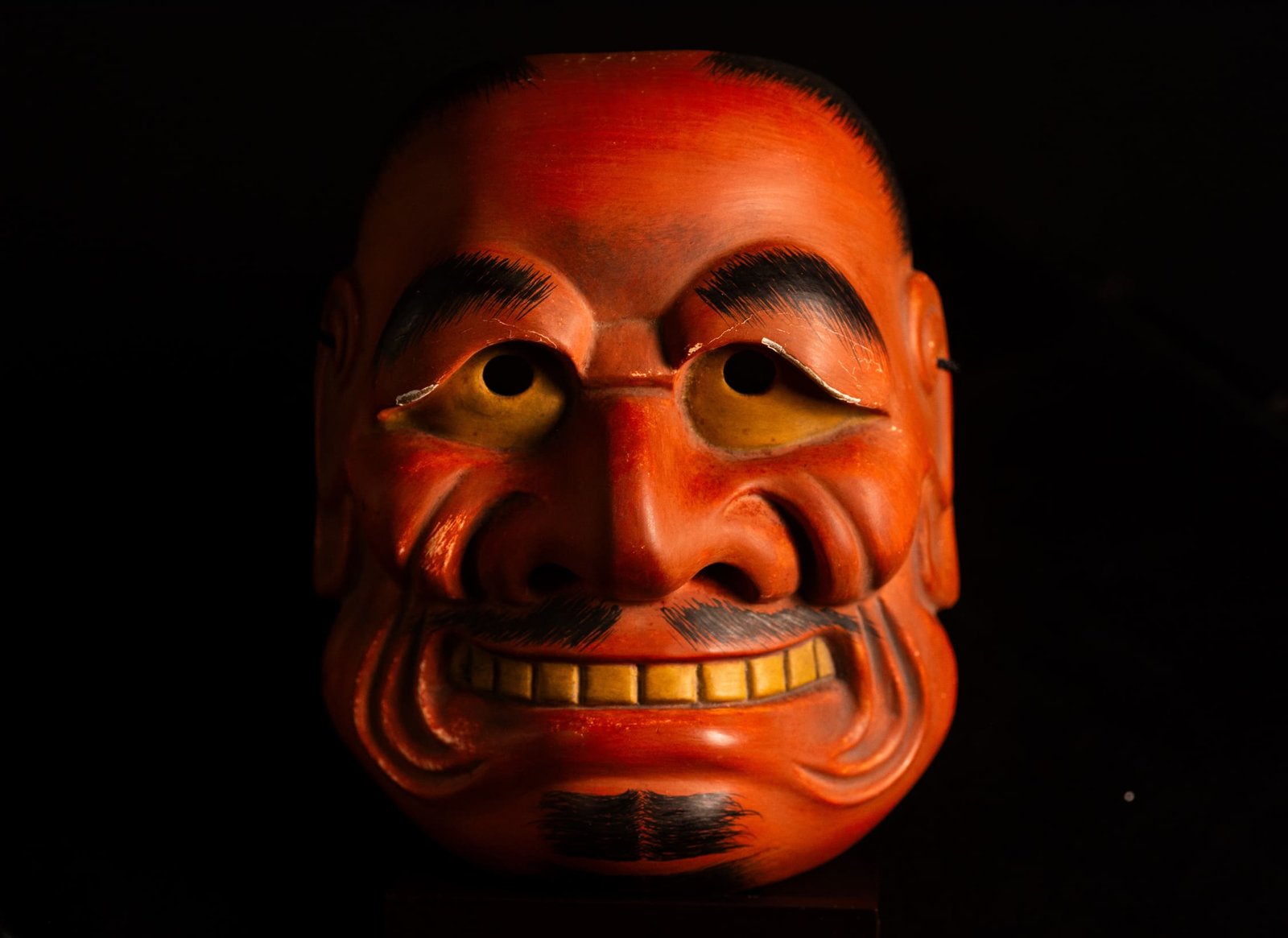
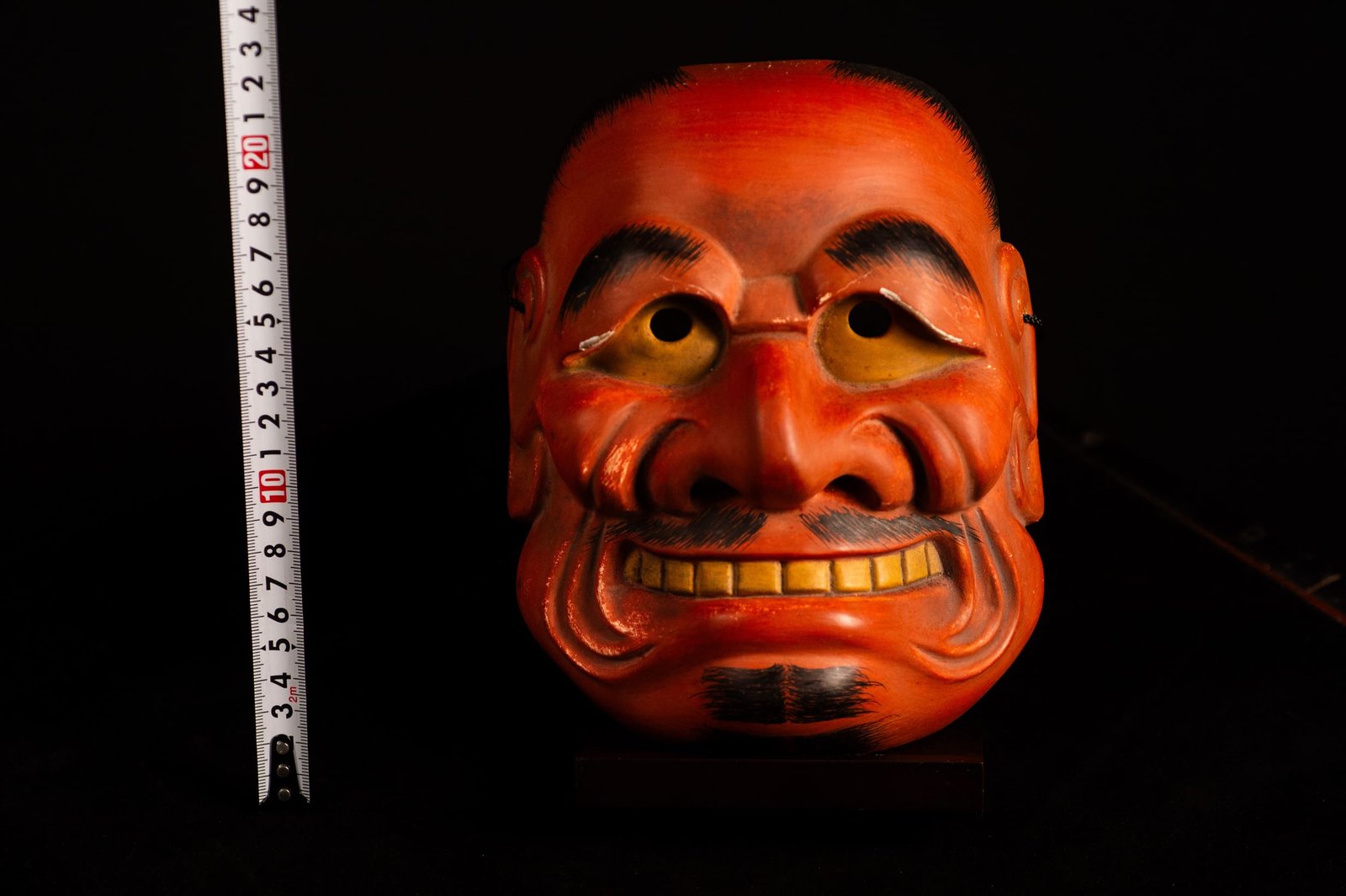
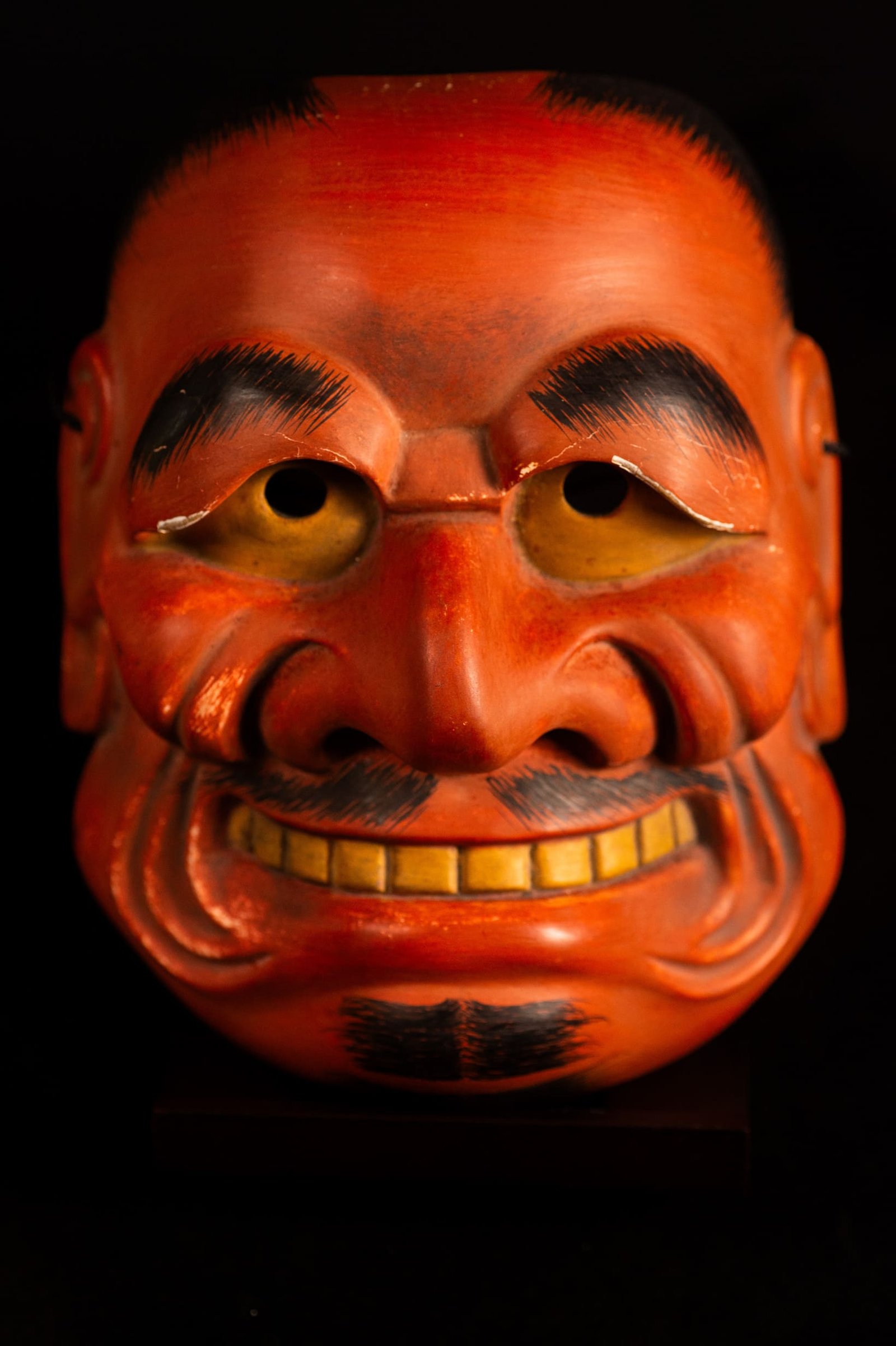
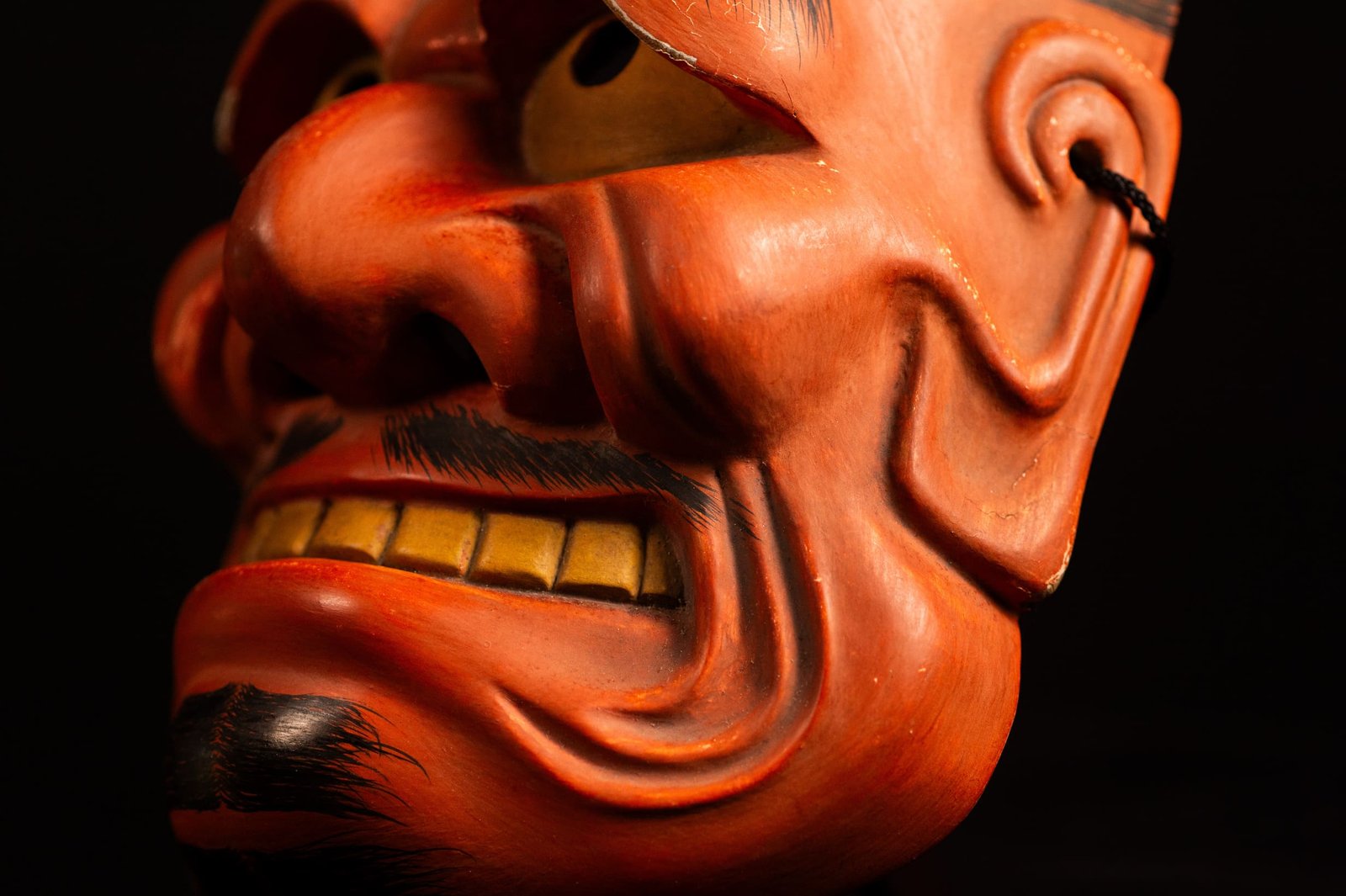
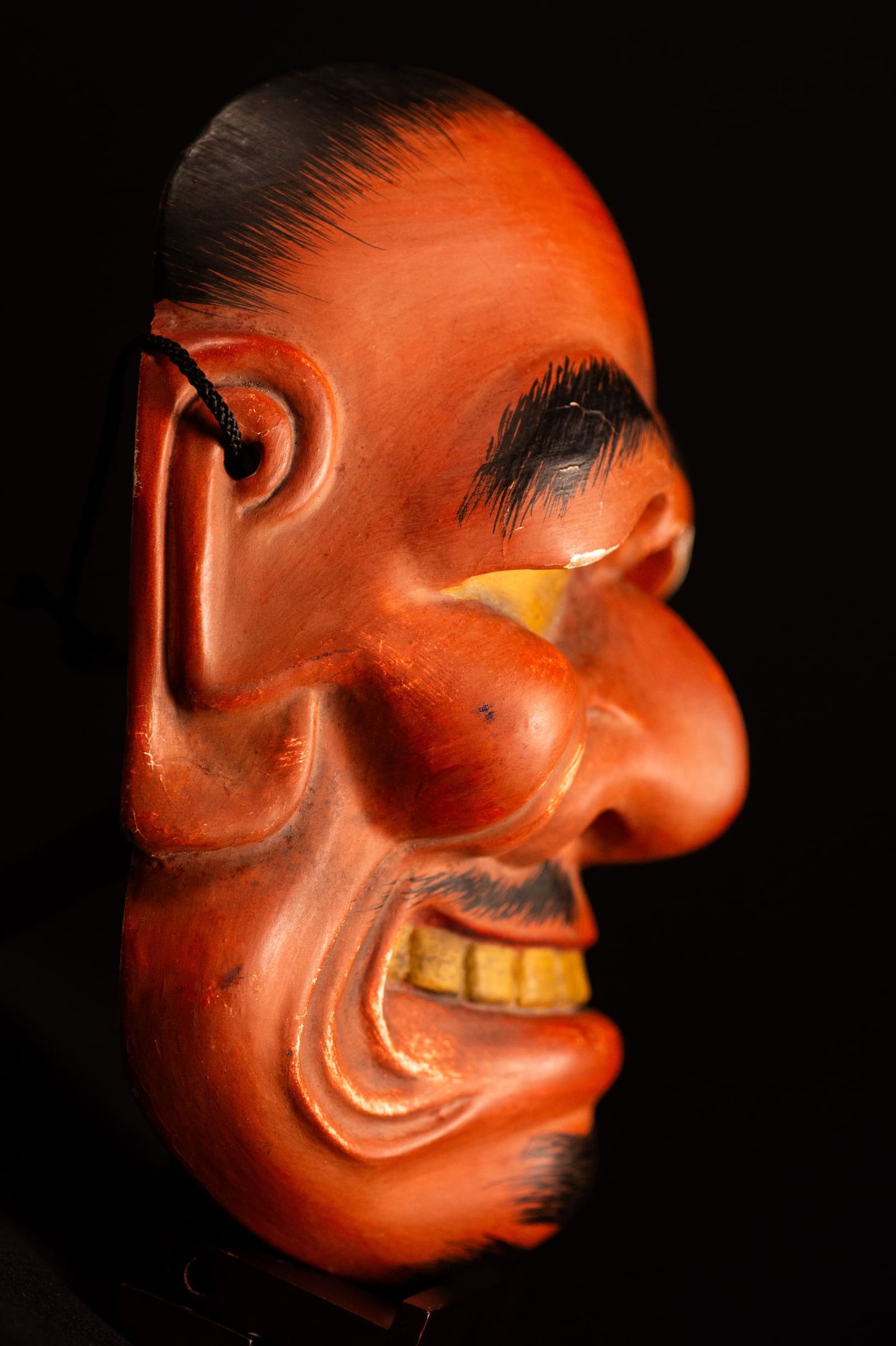
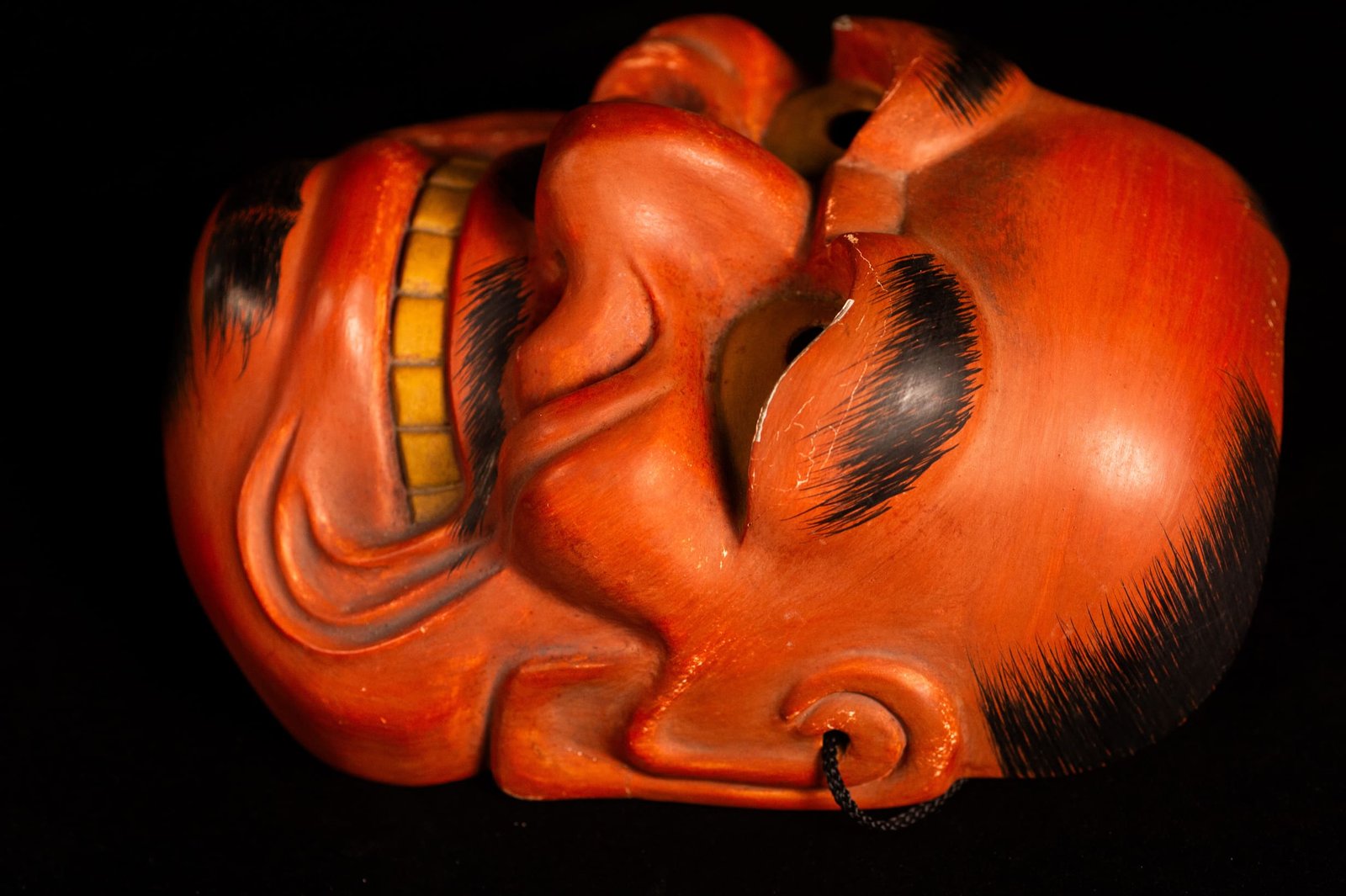
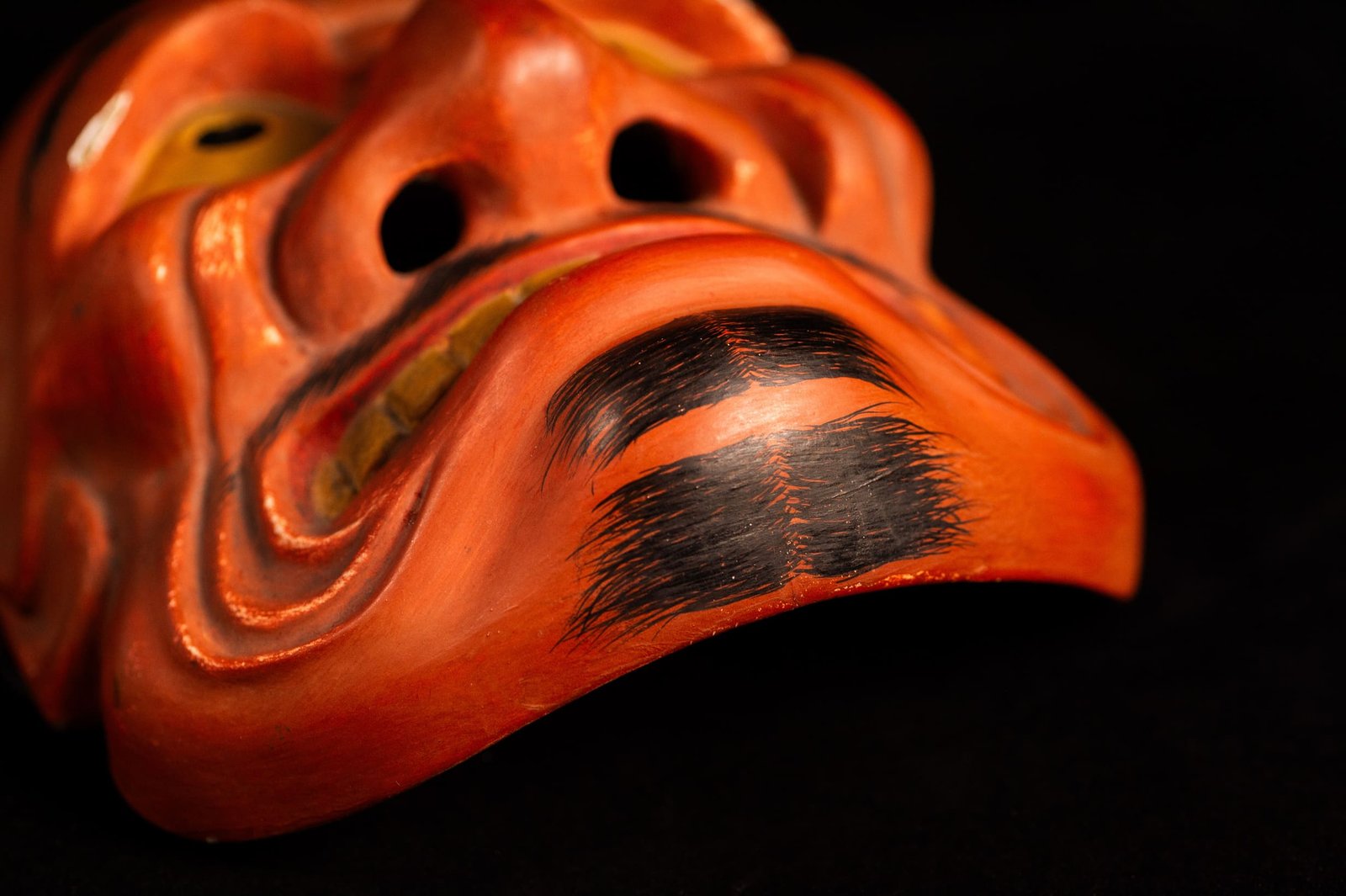
A striking antique Japanese wooden mask representing Tobide, an energetic bulging-eyed deity type used within the dramatic and spiritual world of Noh theatre. Carved at approximately life size and fully lacquered in vivid vermilion red, the mask combines a broad smiling mouth, reflective gilt eyes, a complete row of gilt teeth and sharply animated facial modelling.
The expression is powerful without being malevolent.
Tobide represents the swift, spirited presence of a forceful yet benevolent divine being. The expanded eyes, raised eyebrows, flared nostrils and broad grin communicate supernatural energy, while the rounded cheeks and smiling mouth prevent the figure from appearing purely threatening.
Flame-like carved forms extend from the temples and reinforce the impression of movement. Together with the brilliant red lacquer and reflective gold details, they create a face that seems charged with divine vitality.
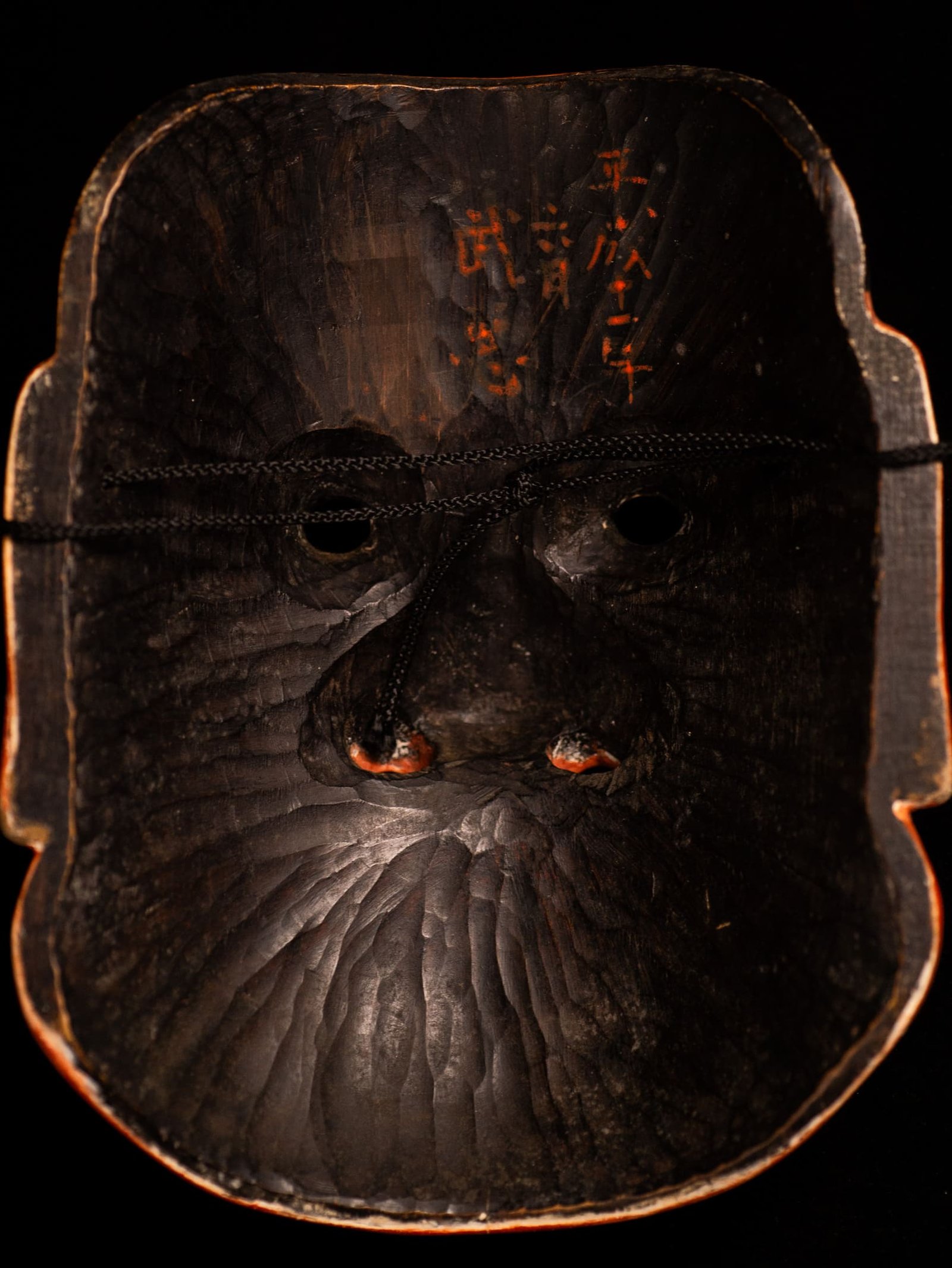
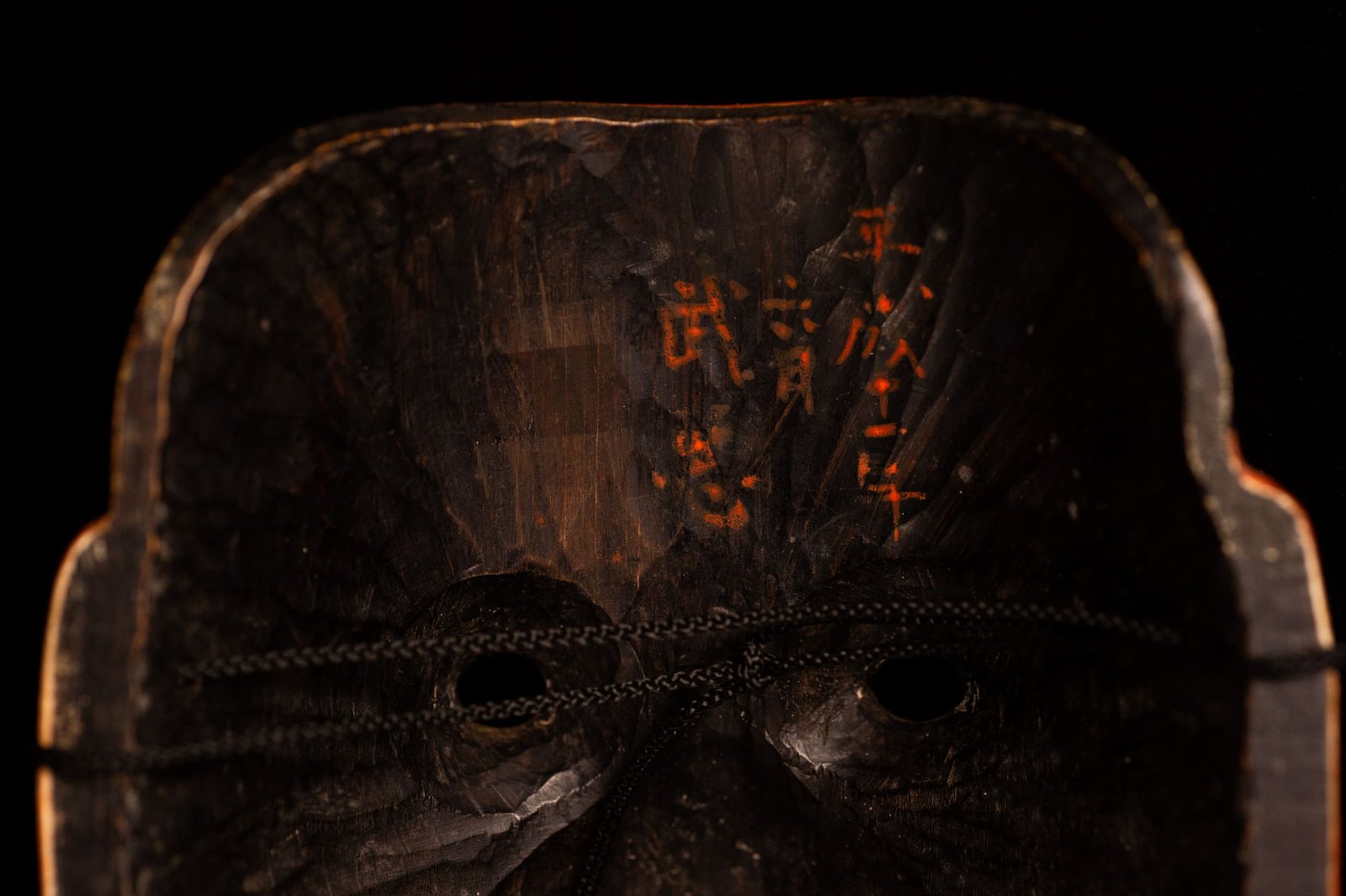
A red-ink inscription is visible on the reverse. No transcription, translation or attribution has been supplied, and the inscription should therefore not be used to assign the mask to a particular carver, workshop or historical owner without further specialist examination.
Tobide belongs to a family of highly animated masks characterised by prominent eyes and intense supernatural expression.
The name is associated with the impression of the eyes projecting or “leaping” outward. This effect is central to the character of the mask.
Unlike serene deity masks or restrained human portraits, Tobide presents divine energy through exaggerated movement and heightened facial structure.
The eyes are large and round, the eyebrows rise dramatically above them, the nose projects strongly and the mouth opens into a wide grin.
These features communicate a being that is alert, immediate and spiritually powerful.
Despite its intensity, the face is not simply demonic or hostile. Tobide may represent a forceful but benevolent deity whose power is active, protective and capable of inspiring both awe and confidence.
The visual identity of the mask depends on the impression of rapid movement.
The eyes appear to rise upward, the eyebrows sweep across the brow, the nostrils flare and the smiling mouth stretches broadly across the lower face.
The carved forms at the temples resemble flames, locks of hair or bursts of spiritual energy.
These elements direct the eye outward from the centre of the face and give the mask a sense of expansion.
Rather than appearing static, the expression seems ready to change with the actor’s movements.
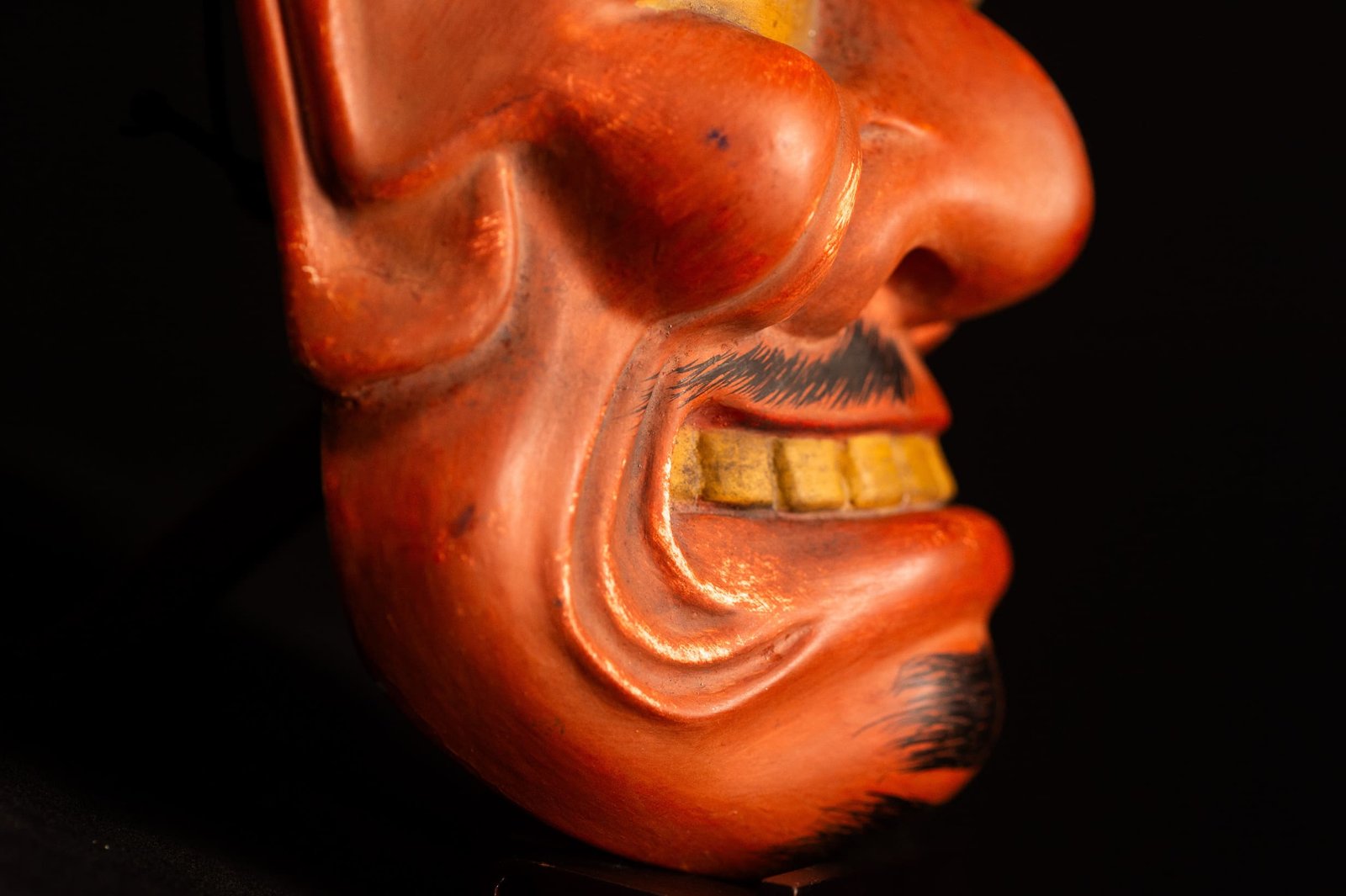
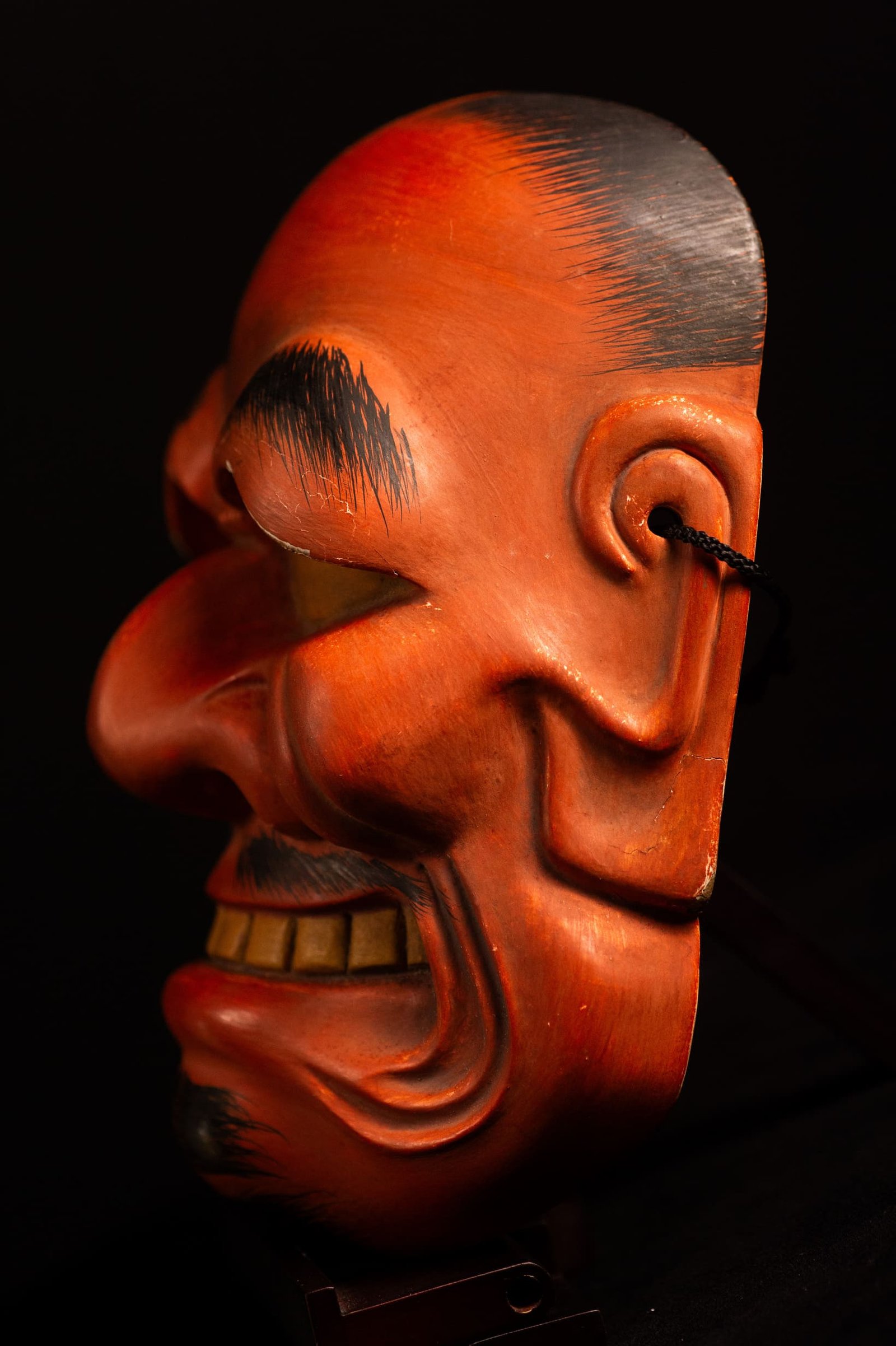
When viewed frontally, the mask appears cheerful, commanding and intensely alert. From an oblique angle, the projecting nose, deep cheek contours and flared temple forms create a more dramatic and otherworldly presence.
This ability to change under movement and light is fundamental to the expressive power of Japanese theatrical masks.
The mask is carved from wood as a complete sculptural form.
Its expression is established through pronounced depth and carefully controlled transitions between the forehead, eyes, nose, cheeks, mouth and chin.
The forehead is broad and rounded, giving way to strongly modelled eyelids and deeply set metallic eyes.
The nose is prominent, with large flaring nostrils that contribute to the animated expression.
The cheeks project outward before curving into deeply carved lines around the corners of the mouth.
The lower face is broad and rounded, creating a stable base beneath the energetic upper features.
Although the mask is fully covered by lacquer and painted decoration, the carved structure remains essential to its visual effect.
The three-dimensional modelling allows light to move across the surface and continually alter the apparent mood.
The entire face is finished in a vivid vermilion-red lacquer.
Red has a long history in Japanese ritual, theatrical and religious art.
It can suggest vitality, protection, spiritual force, celebration and supernatural presence.
On this mask, the red surface is especially effective because it unifies the exaggerated features into a single powerful image.
The colour varies subtly across the face.
Brighter orange-red tones appear on projecting areas such as the forehead, cheeks, nose and chin, while darker red and brown shadows gather around the eyes, nostrils, mouth and carved recesses.
These tonal differences strengthen the sculptural depth.
The lacquer also provides a controlled reflective surface that would have responded strongly to theatrical lighting.
As the actor moved, light could pass across the forehead, nose, cheeks and mouth, making the face appear increasingly animated.
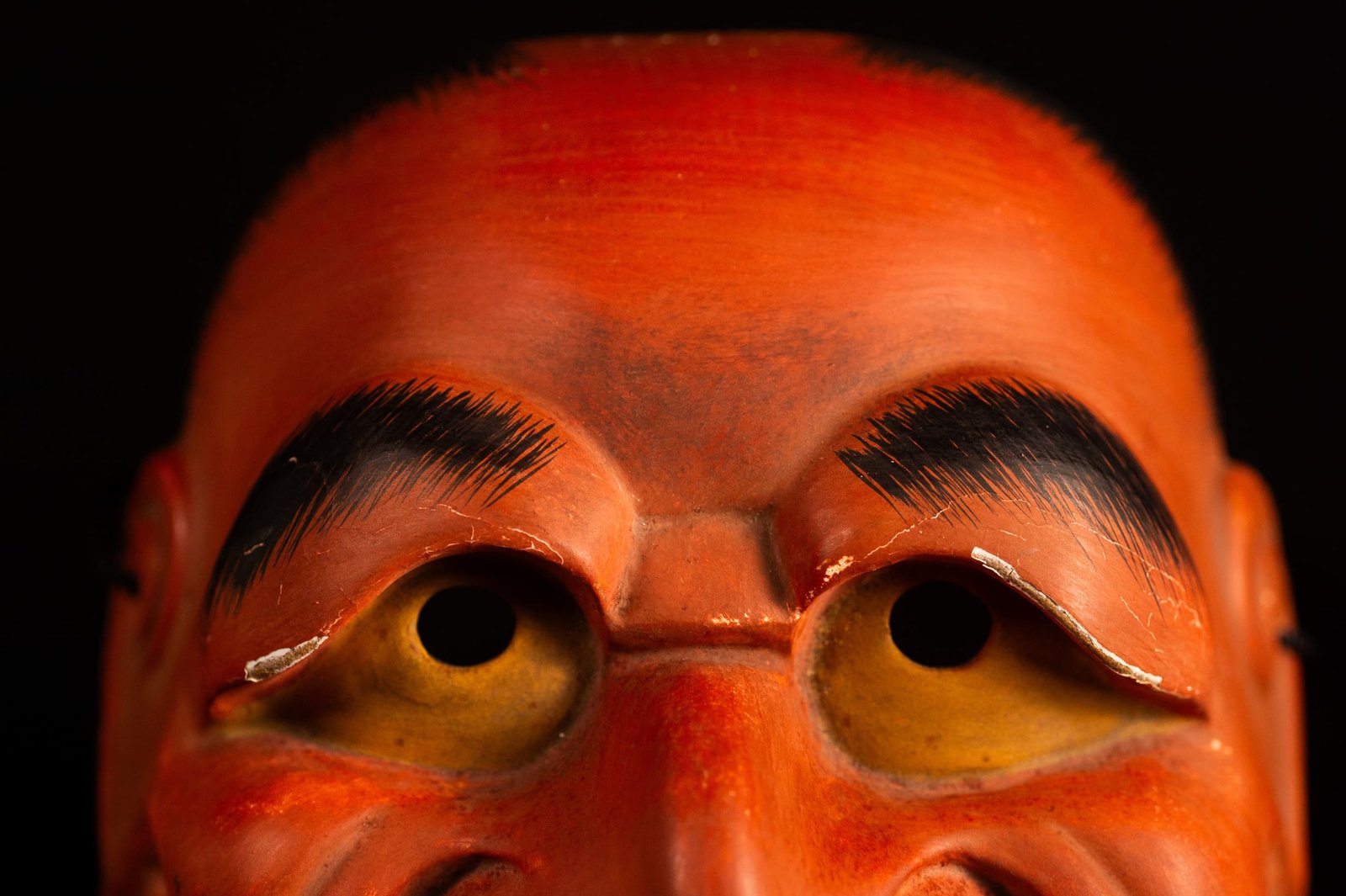
The most immediately recognisable features are the large round gilt eyes.
They sit within sharply shaped openings beneath strongly arched black eyebrows.
Their metallic gold surfaces reflect light and create a brilliant contrast with the surrounding red lacquer.
The pupils are formed as dark openings, allowing the performer to see through the mask.
Their upward orientation gives the face an alert and animated gaze.
The figure appears to look upward, as though reacting to a divine vision, sudden event or spiritual presence beyond the immediate scene.
Under changing light, the gilt surfaces would have flashed or brightened, intensifying the impression of supernatural awareness.
The eyes are therefore both functional and highly theatrical.
They allow vision while simultaneously becoming one of the mask’s main symbolic and expressive elements.
The upward direction of the pupils is fundamental to the mask’s personality.
Rather than looking calmly forward, the eyes appear lifted and expanded.
This creates an expression that can be interpreted as joyful, surprised, ecstatic or intensely vigilant.
When the actor lowers the mask slightly, the upward gaze becomes especially pronounced.
When the mask is raised, the eyes can appear broader and more openly benevolent.
Small changes in angle would therefore have allowed the performer to shift the emotional character of the face without altering the fixed carving.
The gaze contributes to the impression of swift and spirited divine energy for which Tobide is known.
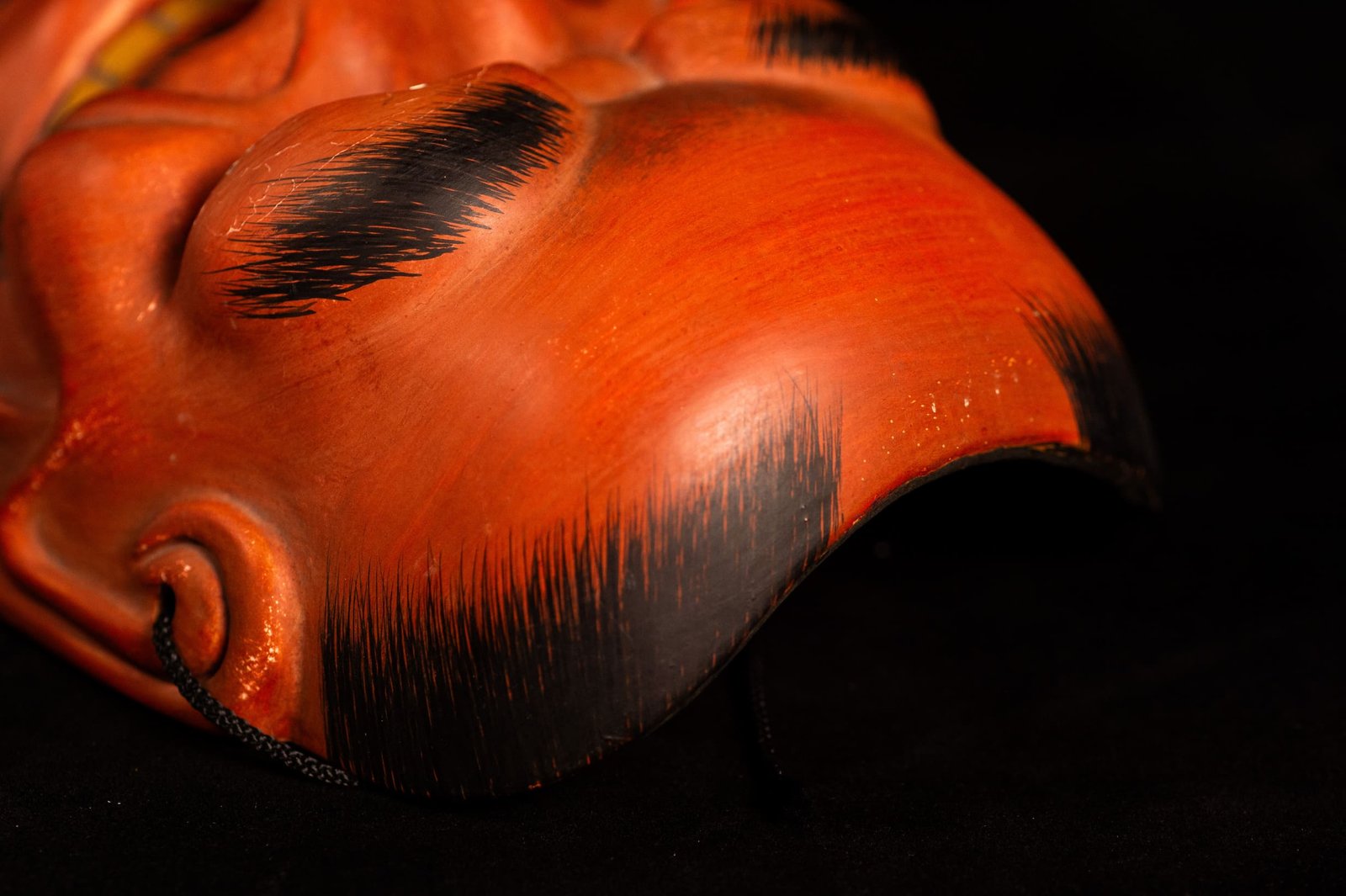
Broad black eyebrows rise dramatically above the eyes.
They are painted with individual brush-like strokes that imitate coarse hair and follow the curved shape of the brow.
The high arch opens the upper part of the face and increases the apparent size of the eyes.
It also gives the expression a sense of surprise, alertness and comic liveliness.
The strong contrast between black pigment, red lacquer and gold eyes creates a graphic clarity appropriate for theatrical use.
Even from a distance, the eyebrows help define the direction and intensity of the gaze.
They also balance the black painted moustache and goatee on the lower face, creating a coherent distribution of dark details across the red surface.
The nose is broad, rounded and strongly projecting.
Its volume dominates the central portion of the mask and reinforces the powerful physical presence of the deity.
Large nostrils open beneath the nose, while deeply carved curves extend outward toward the cheeks.
These expanded forms suggest forceful breathing and heightened energy.
The nose does not aim for naturalistic proportion.
Instead, its scale and curvature are deliberately exaggerated to strengthen the theatrical expression.
From the side, the projection of the nose becomes especially prominent and demonstrates the depth of the carving.
The surrounding channels cast strong shadows that separate the nose from the cheeks and intensify the animated modelling of the face.
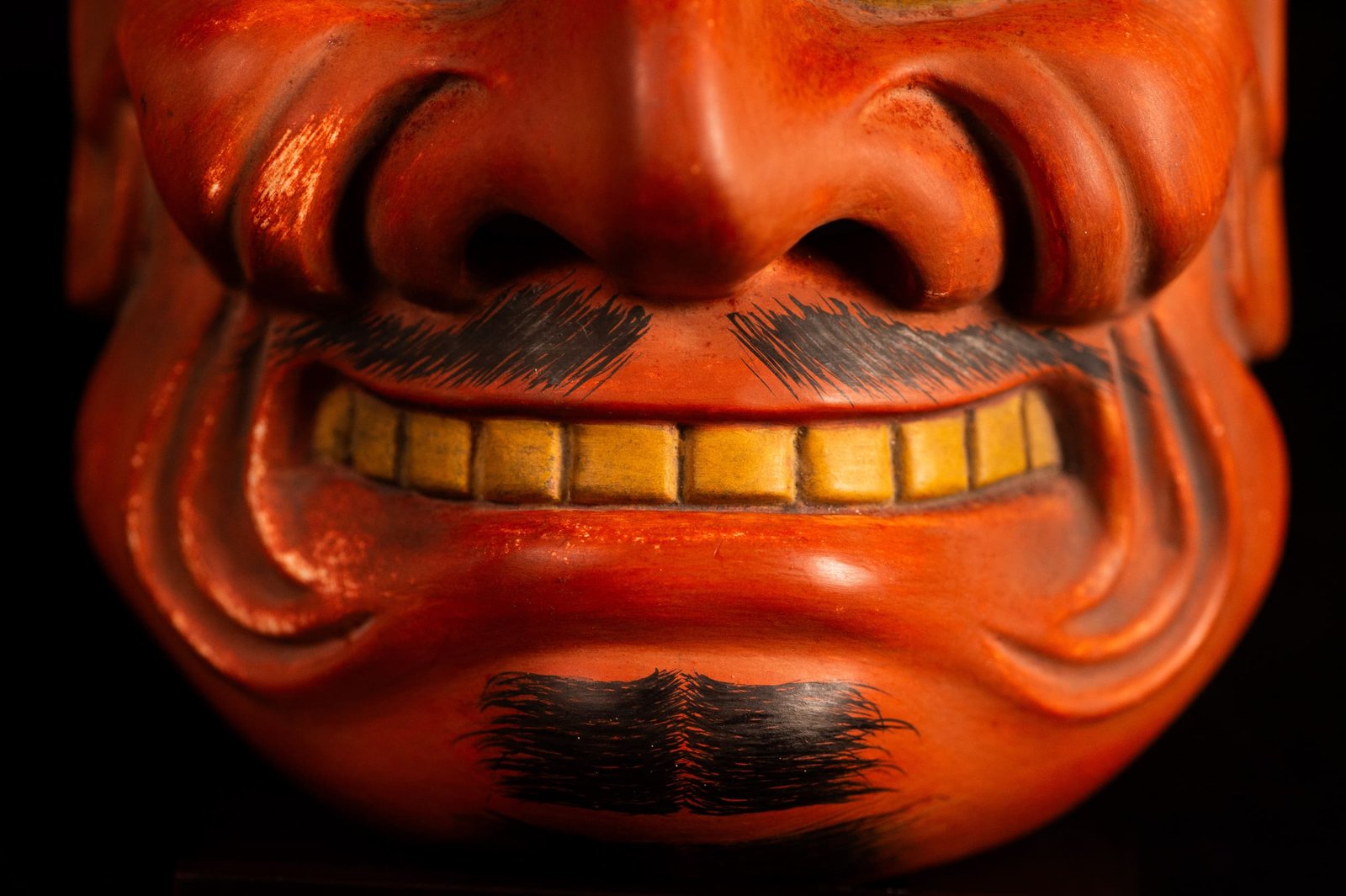
A fine black moustache is painted above the upper lip.
Its brush-like strokes extend outward and slightly downward from the centre of the face.
Although relatively delicate compared with the large eyes and mouth, the moustache adds individual character and helps identify the figure as an adult male deity.
The pointed shape complements the upward movement of the eyebrows and the outward motion of the temple extensions.
It also frames the upper edge of the grin and creates a visual transition between the projecting nose and the gilt teeth.
Additional black painted hair appears on the chin, forming a compact goatee that balances the moustache.
The mouth is opened into a broad, strongly defined grin.
Unlike a fearful grimace or an expression of aggression, the smile appears energetic, direct and almost celebratory.
The corners of the mouth rise into deeply carved curves that continue toward the cheeks.
These carved channels amplify the breadth of the grin and create pronounced shadows around the lower face.
The upper lip is relatively narrow and is visually reinforced by the painted moustache.
The lower lip is fuller and projects outward, giving the mouth additional volume.
The overall expression combines humour, confidence and supernatural vitality.
It presents the deity as powerful but approachable rather than cruel or destructive.
A complete row of rectangular gilt teeth is visible within the open mouth.
The reflective gold surface forms one of the strongest visual contrasts in the mask.
Against the vermilion-red face and dark interior shadows, the teeth appear brilliant and immediately noticeable.
Their regular arrangement gives structure to the broad grin, while their metallic finish strengthens the deity’s extraordinary character.
Gold details in Japanese theatrical and religious art can suggest brilliance, sacred presence, status and supernatural power.
On the present mask, the gilt teeth work in direct relationship with the gilt eyes.
Both features catch the light and create two luminous points within the red face.
This repetition visually connects the gaze and the smile, reinforcing the mask’s lively and benevolent energy.
Distinctive carved extensions flare outward from the temple area on both sides of the face.
Their angular, flowing contours resemble flames, stylised locks of hair or bursts of supernatural energy.
These forms are essential to the silhouette of the mask.
They widen the upper sides of the face and create an impression of movement extending beyond the principal facial structure.
From a frontal view, they frame the cheeks and eyes.
From the side, their depth and curved edges become more evident, demonstrating the sculptor’s attention to the mask’s profile.
The flame-like temple forms complement the red lacquer and contribute directly to the interpretation of Tobide as a swift and spirited divine presence.
The ears are carved in relief along the sides of the mask.
Openings positioned in or near the ear area retain dark fastening cords.
These cords correspond to the original function of the object as a wearable theatrical mask.
During performance, the cords would secure the mask to the actor’s head while allowing sufficient stability for controlled movement.
The ears are elongated and stylised, integrating into the angular side contours of the face.
Their simplified form does not compete with the eyes or mouth but contributes to the strong lateral silhouette.
The surviving cords also provide useful evidence of the mask’s intended practical function rather than merely decorative production.
A red-ink inscription is visible on the reverse of the mask.
Inscriptions on the interior of Japanese theatrical masks may relate to a maker, workshop, owner, performer, collection, inventory or later documentation.
However, an inscription cannot be interpreted reliably without examination of the original characters, writing style and historical context.
No transcription or translation has been supplied for the present inscription.
It is therefore described only as a red-ink inscription visible on the reverse.
No claim regarding authorship, school, workshop or provenance should be based on the inscription without further specialist study.
A detailed photograph and examination by a scholar of Japanese theatrical masks may provide additional information.
Masks have been integral to Japanese theatre, religious ritual and festival traditions for centuries.
Within Noh, a mask does not simply conceal the performer’s face.
It allows the actor to embody a particular person, spirit, deity or supernatural presence.
The individual identity of the performer recedes, while the character represented by the mask becomes dominant.
This transformation is achieved through the combined effect of costume, movement, music, chant, lighting and the carefully carved planes of the mask.
In religious and ritual contexts, wearing a mask could symbolise a form of embodiment or possession.
The wearer temporarily became the visible manifestation of a spiritual being or its human incarnation.
Tobide’s exaggerated eyes, brilliant gold details and red lacquer make this process of transformation especially immediate.
The mask does not present an ordinary human face. It creates the image of a divine presence charged with movement, power and benevolent force.
The spiritual beings associated with Japan’s indigenous religious traditions are commonly referred to as kami.
Kami may be connected with natural forces, places, ancestors, protective powers, extraordinary beings or divine presences.
They are not always represented as calm or gentle.
A benevolent deity may possess a fierce, dramatic or overwhelming appearance because its power exceeds ordinary human experience.
The forceful expression of Tobide should be understood within this cultural framework.
The bulging eyes, flared nostrils, red face and broad grin communicate supernatural intensity rather than moral evil.
The mask evokes a divine being whose energy is swift, spirited and capable of protection or beneficial intervention.
The supplied identification does not connect this specific mask with a named deity or documented individual performance.
It should therefore be presented as a Tobide deity type rather than attributed to a particular kami.
The mask is carved at a 1:1 or life-size scale, corresponding to the proportions of a functional theatrical mask.
Its broad face, projecting nose, metallic eyes and flame-like temple extensions give it a commanding physical presence when displayed.
The expression is particularly effective under controlled directional lighting.
Light striking the gilt eyes and teeth can reproduce some of the visual animation for which the mask was designed.
When displayed, the mask should be supported without placing pressure on the edges, cords, temple extensions or projecting facial features.
Direct sunlight should be avoided because prolonged exposure may affect the lacquer, pigments and gilded surfaces.
Excessive humidity, very dry conditions and sudden environmental changes should also be avoided to help preserve the carved wood and decorative finish.
The gilt elements should not be polished with abrasive or chemical cleaning products.
The mask is preserved in antique condition with visible evidence of age and use.
The photographs show variations in the vermilion-red surface, minor abrasions, localised losses and areas of wear around projecting edges and facial features.
Small cracks and signs of age are visible in certain areas, including parts of the side contours and eye surrounds.
The painted eyebrows, moustache, chin hair, gilt eyes and gilt teeth remain clearly legible and continue to define the character strongly.
The dark fastening cords are present at the sides.
These characteristics are consistent with an antique theatrical object and contribute to its historical appearance.
They should not be assessed according to the standards applied to newly produced decorative masks.
No detailed conservation or restoration report has been supplied. Prospective buyers should examine the complete photographic documentation carefully.
This antique Tobide mask is distinguished by its brilliant colour, metallic details and unusually animated expression.
The large gilt eyes and complete row of gilt teeth immediately establish its supernatural character.
Their reflective surfaces would have responded strongly to stage lighting and remain highly effective when the mask is displayed today.
The vermilion-red lacquer gives the face visual unity and reinforces its association with vitality, protective power and divine energy.
The black eyebrows, pointed moustache and goatee introduce precise graphic details, while the strongly projecting nose and deeply carved cheeks add sculptural depth.
The flame-like extensions at the temples are especially important.
They expand the silhouette and give the face a sense of movement that distinguishes it from more restrained Noh mask types.
The red-ink inscription on the reverse provides an additional subject for future specialist investigation, although no attribution should be made without a reliable reading and comparative study.
For collectors of Noh theatre, Japanese religious art, antique masks and carved wooden sculpture, the piece offers a compelling combination of spiritual meaning, theatrical design and vivid visual presence.
A vivid antique Japanese Noh mask representing Tobide, the bulging-eyed deity type associated with forceful yet benevolent divine power. Carved from wood at life size and fully lacquered in vermilion red, the mask is defined by its round gilt eyes, upward gaze, dramatically arched black eyebrows, broad projecting nose, fine pointed moustache, wide grin and complete row of gilt teeth. Flame-like carved extensions at the temples intensify the sense of swift spiritual movement, while the red-ink inscription on the reverse adds further historical interest. With its brilliant colour, reflective gold details and animated expression, the mask is a powerful example of Japanese theatrical sculpture and an imposing object for a collection of Noh masks, Asian art or ritual material culture.
| Época | Edo |
|---|

Order above 1.000,00 € gets free shipping.

Secure and hassle-free payment process.

Certificate of authenticity included.

Have questions? Contact us via WhatsApp.
Contact