1 in stock
1 in stock
Add to Compare
Add to Wishlist
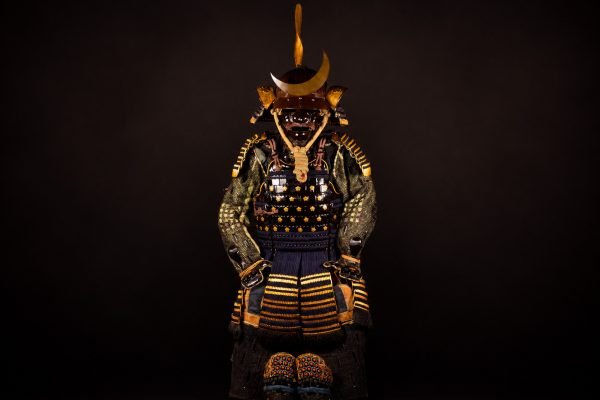
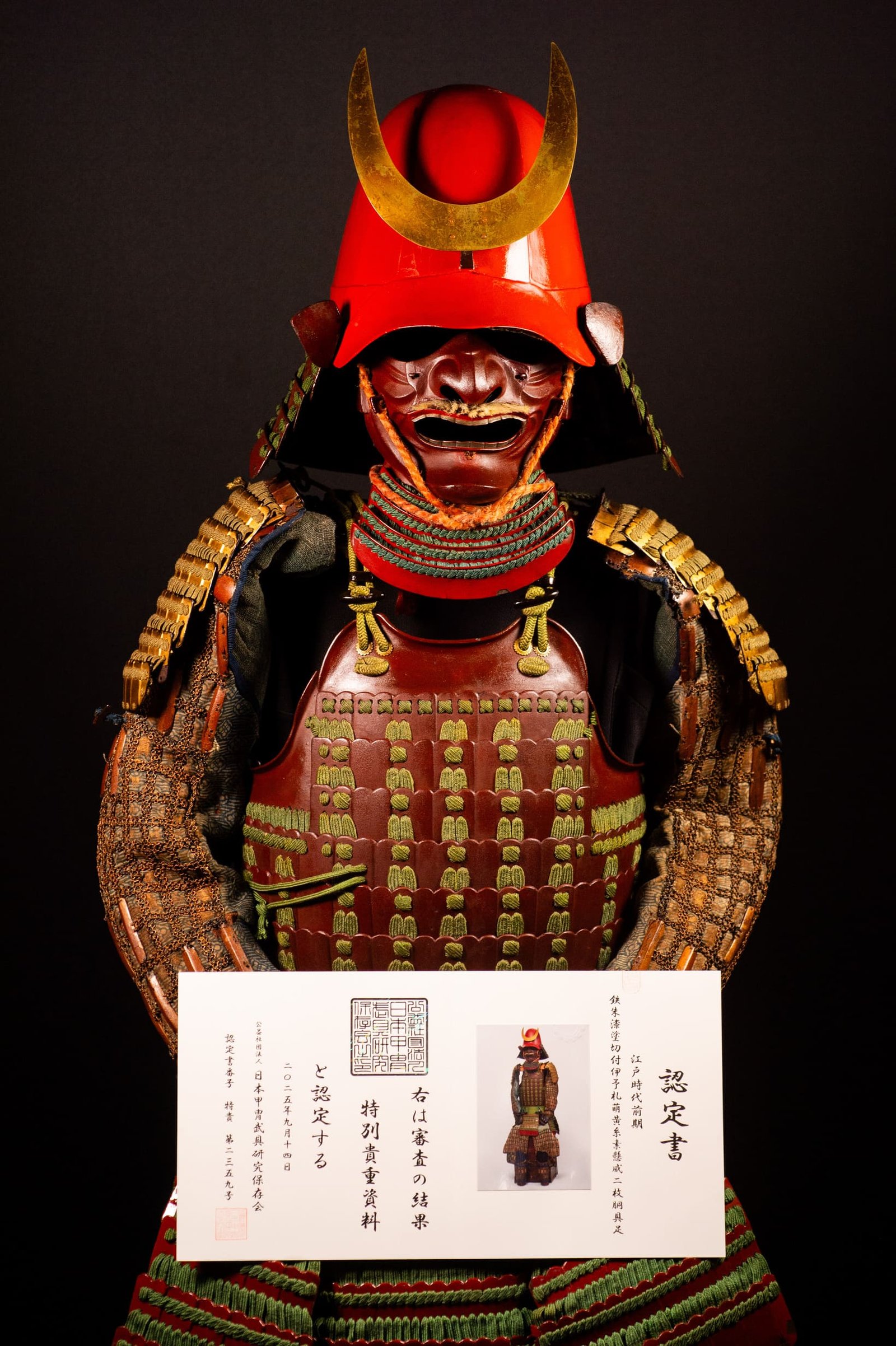
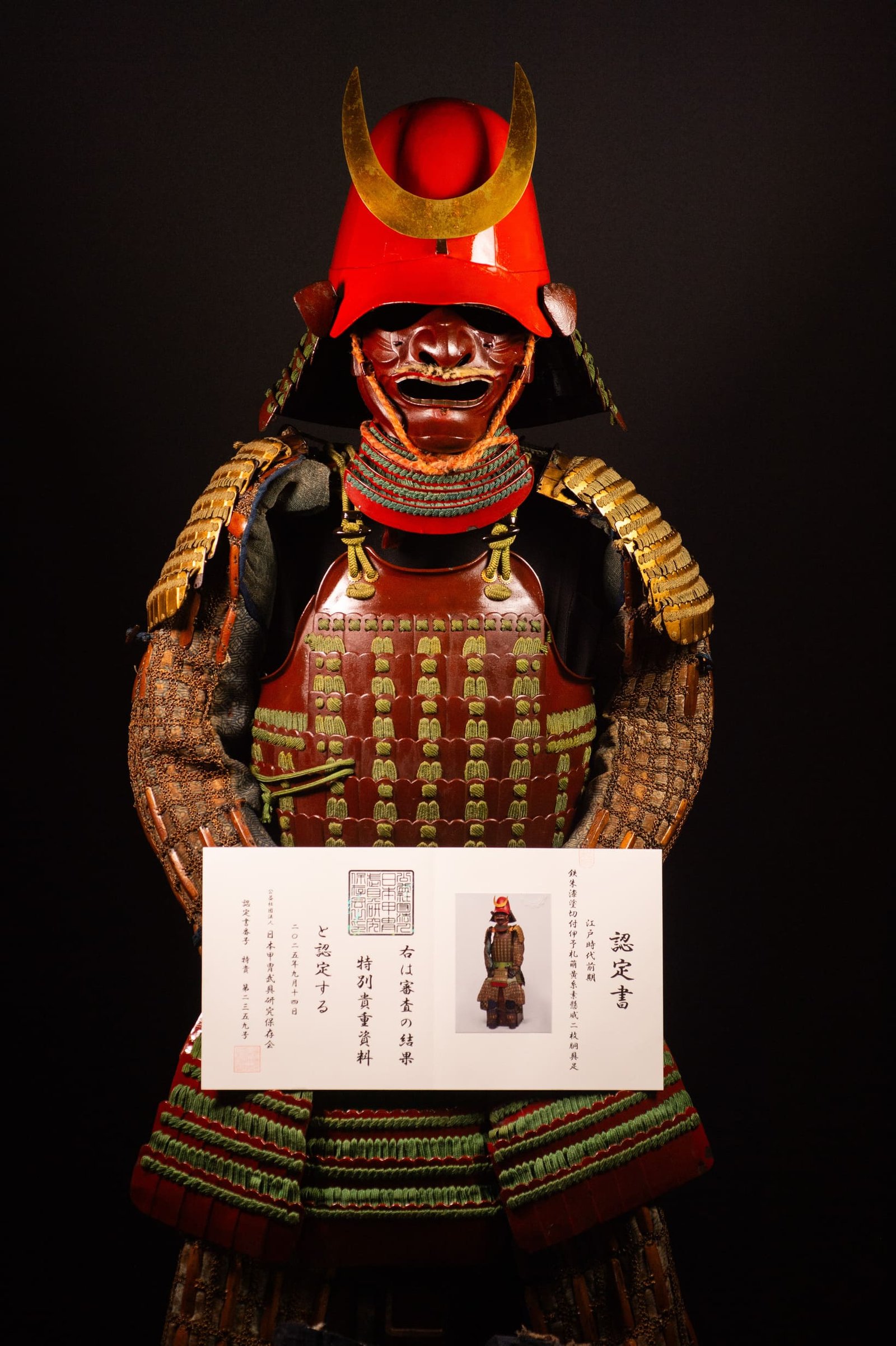
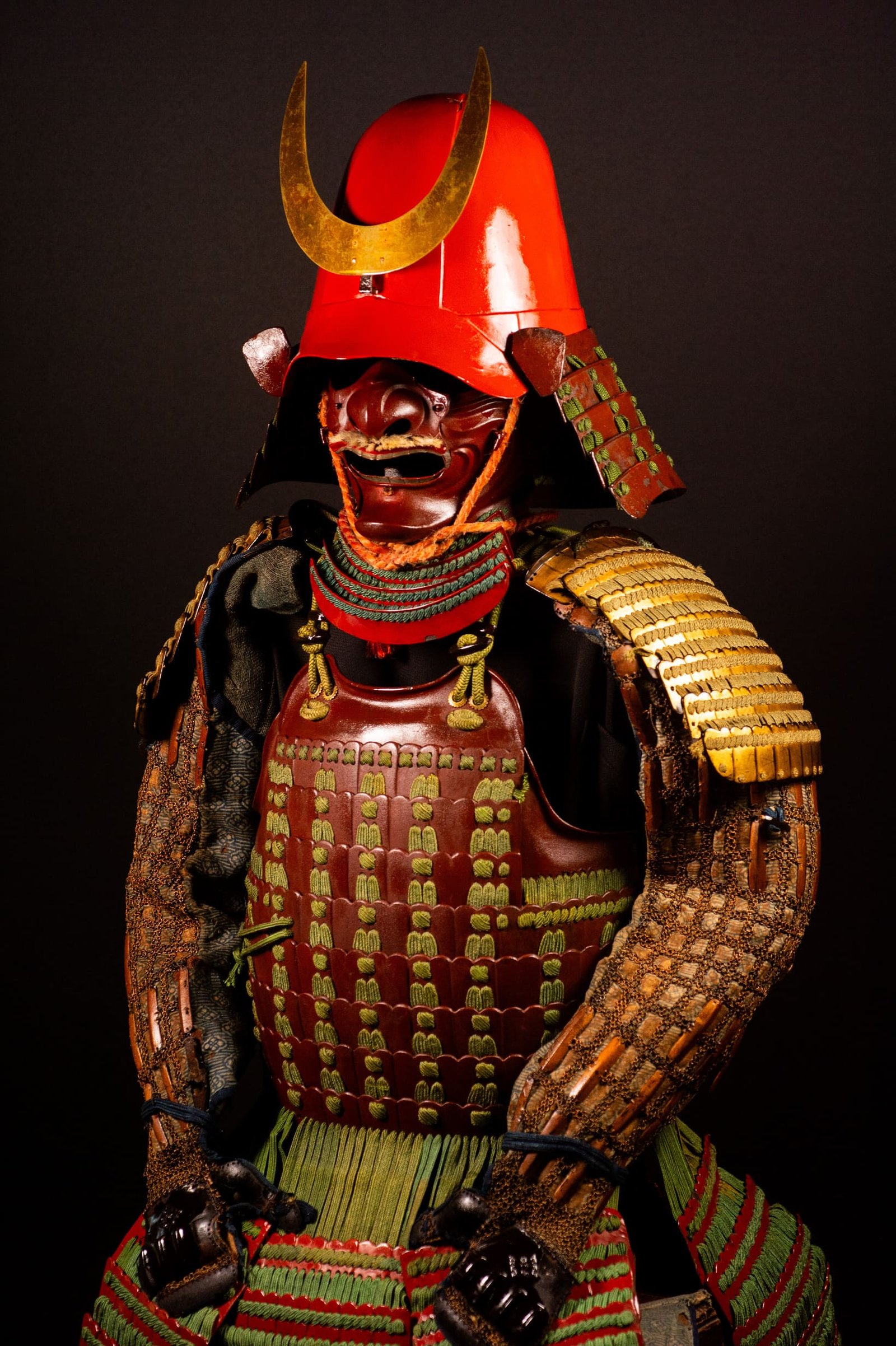
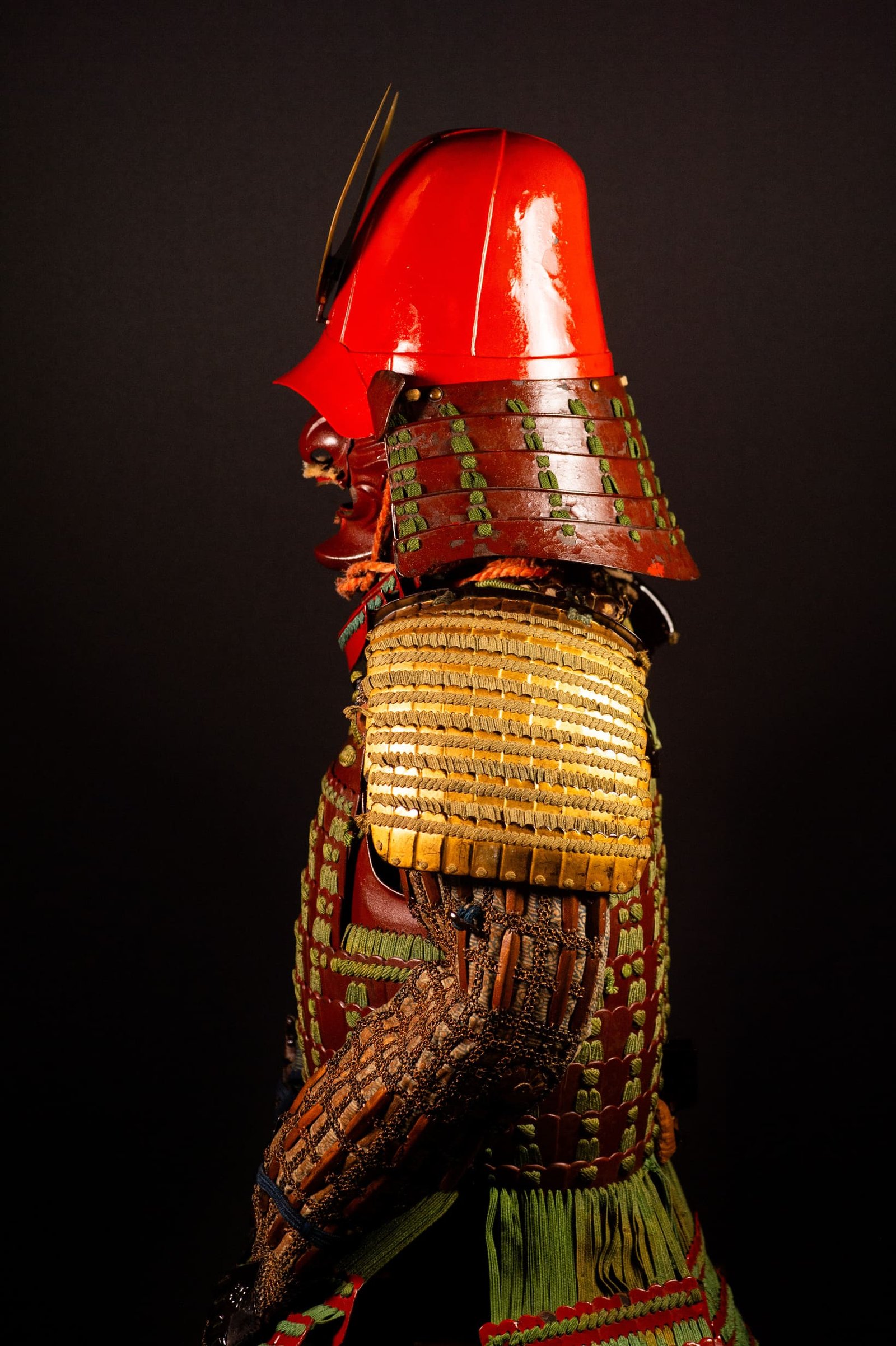
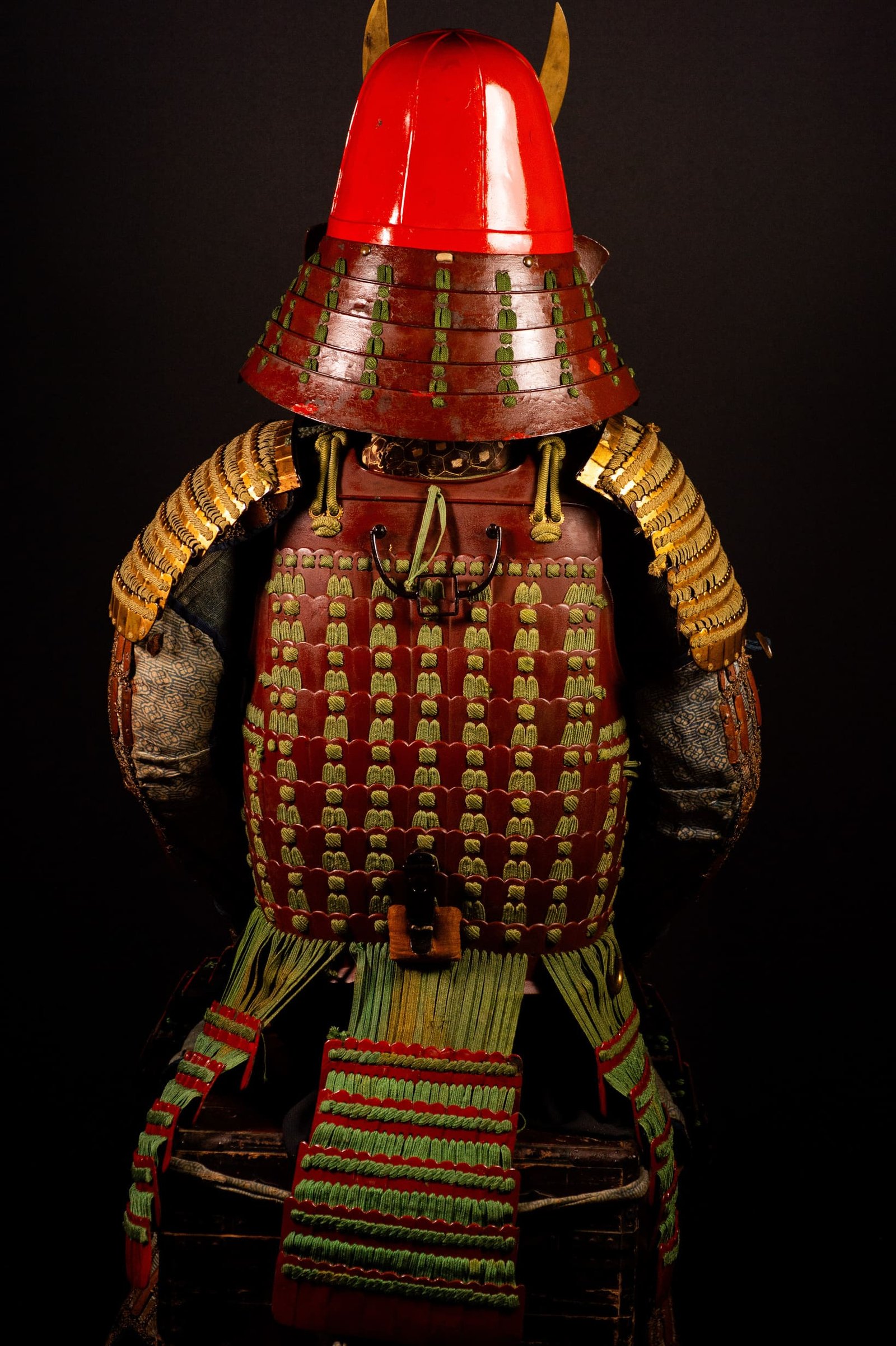
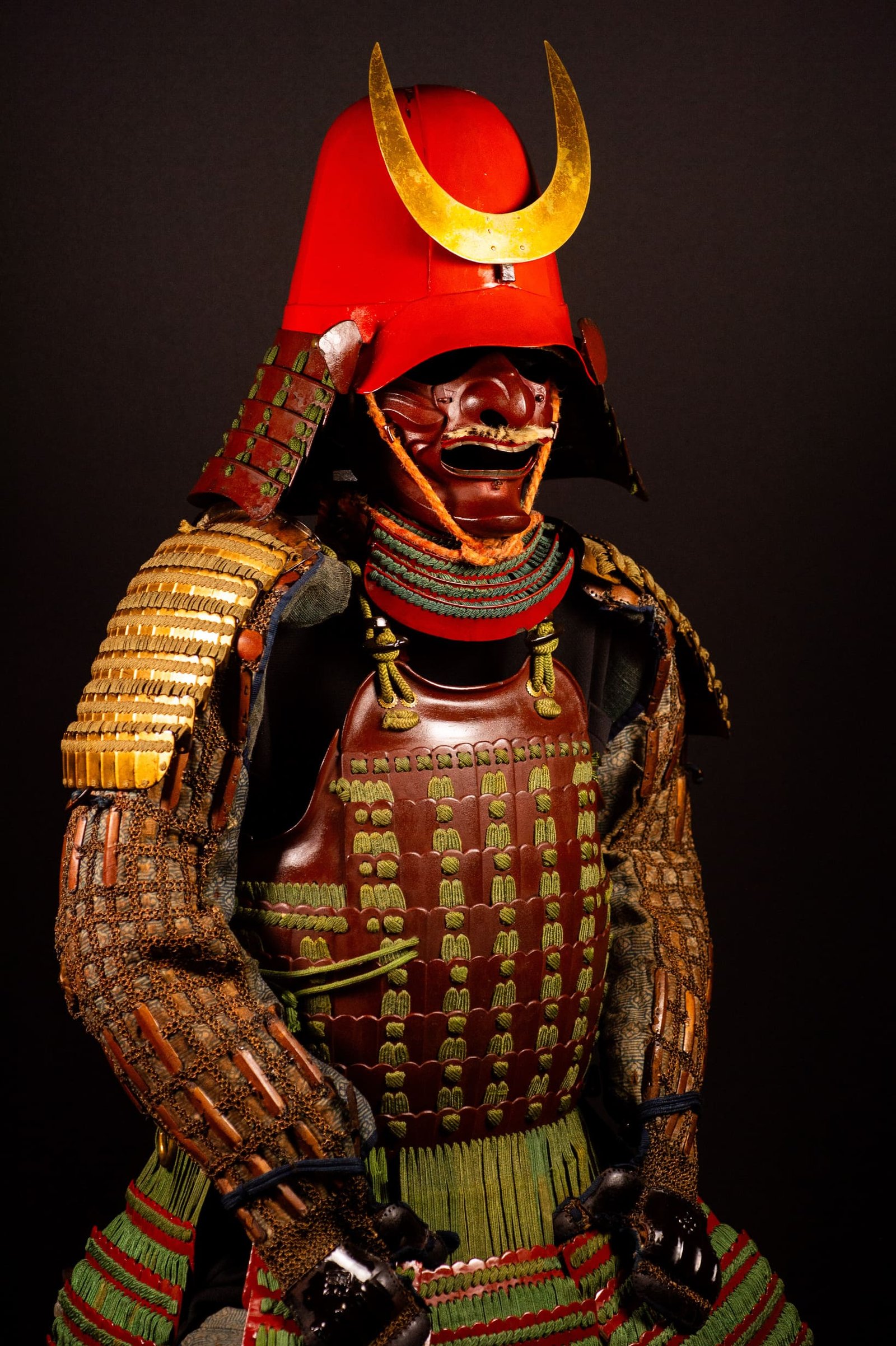
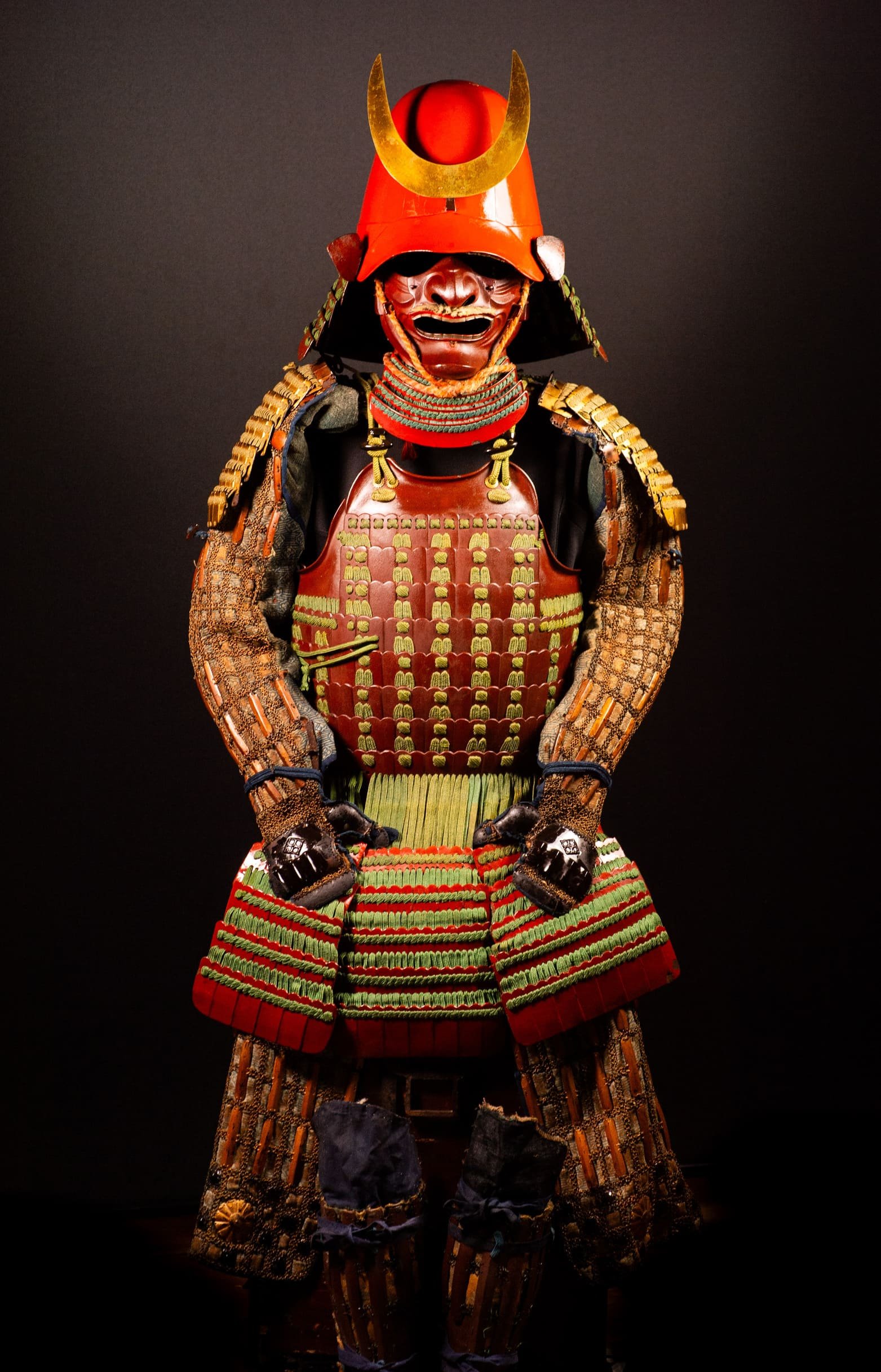
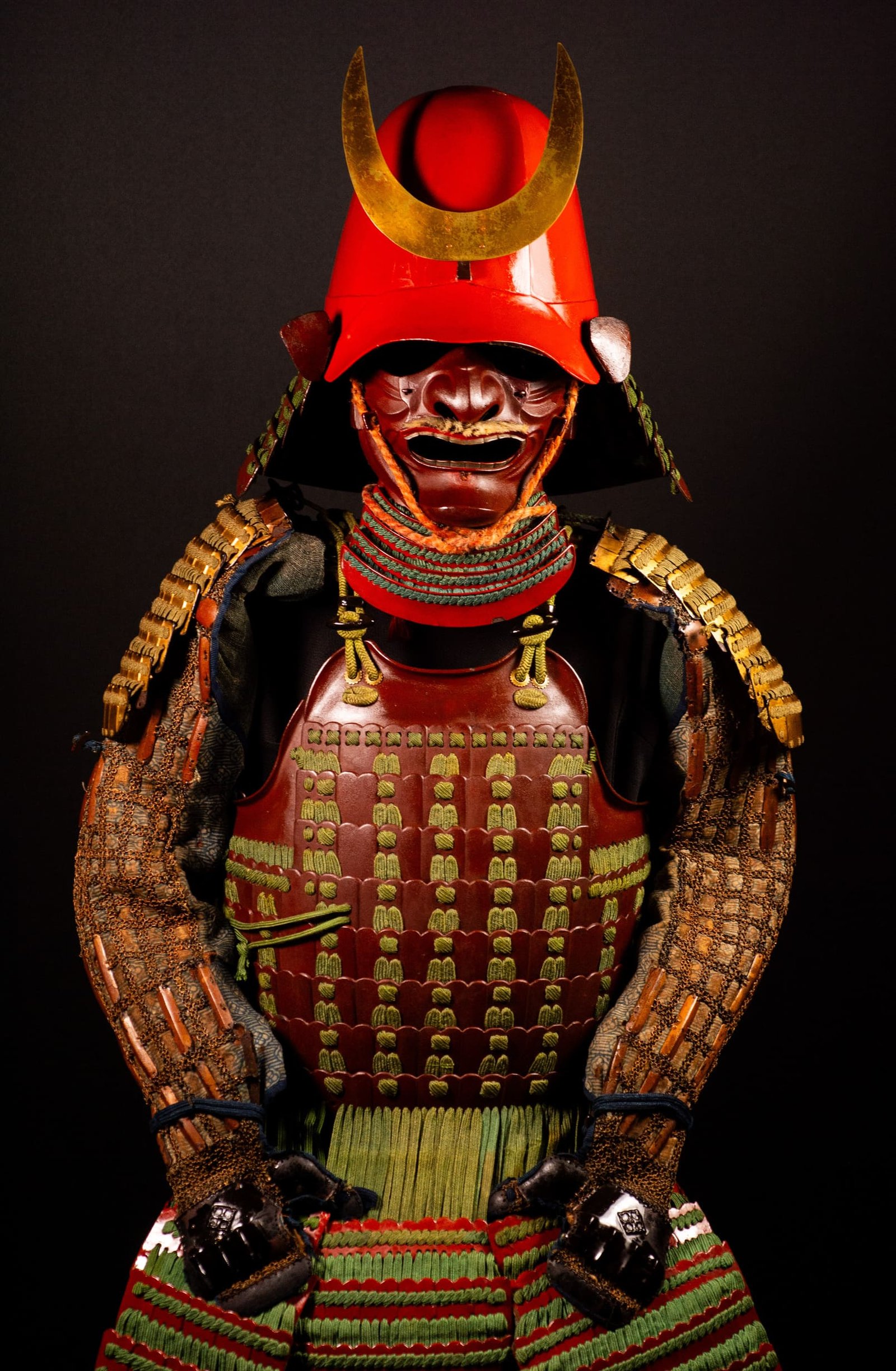
An exceptional complete Japanese samurai armor, or gusoku, dating from the early Edo period and distinguished by its vivid red lacquer, yellow-green moegi silk lacing and traditional two-piece nimai-dō cuirass. Constructed primarily from iron, the armor combines functional defensive engineering with the highly recognizable visual presence associated with red-lacquered samurai equipment.
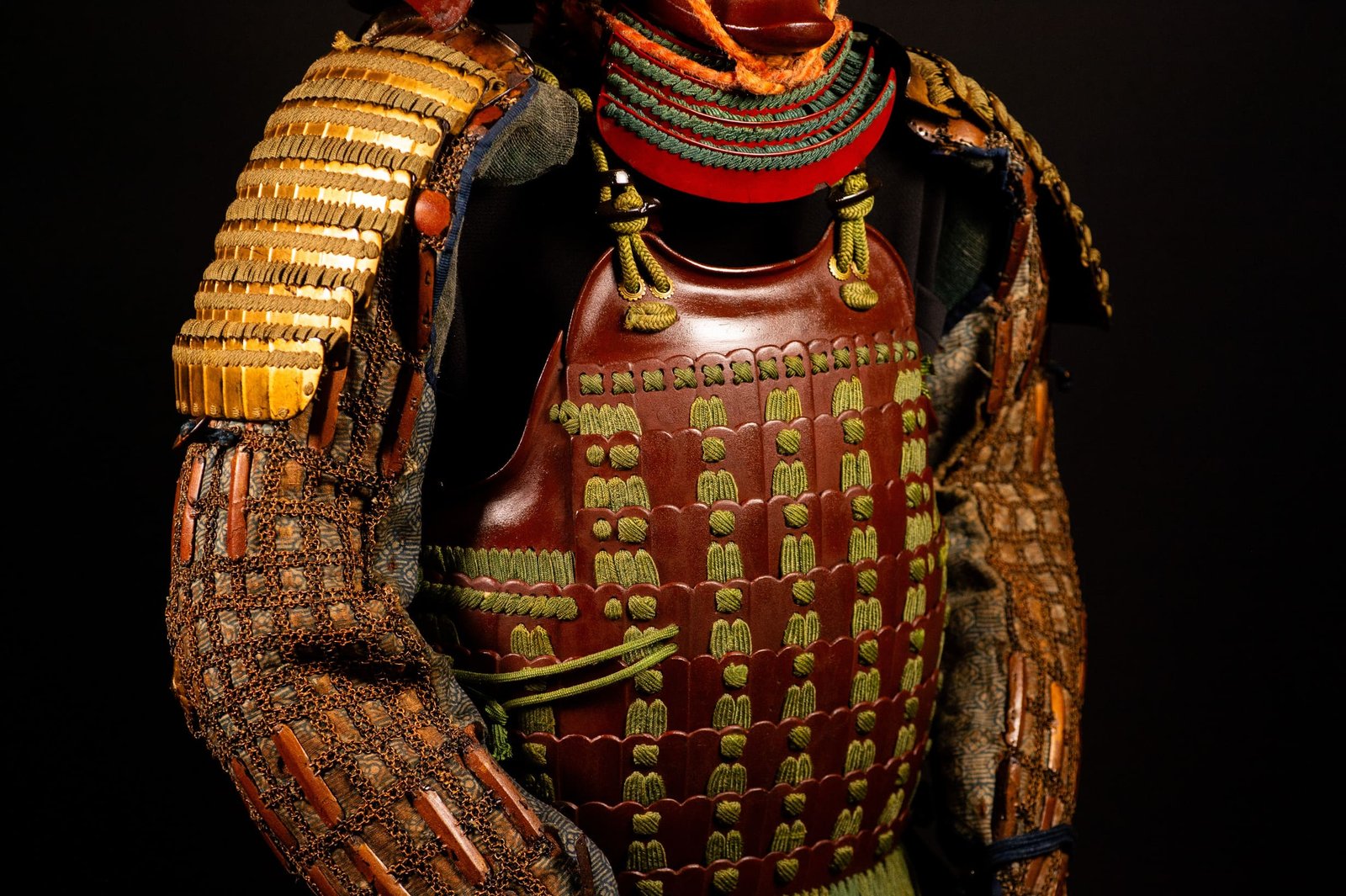
The armor employs kiritsuke iyo-zane construction: solid iron plates shaped, carved and lacquered to reproduce the appearance of rows of individual lamellar scales. These elements are connected by sparse sugake or suken odoshi lacing in yellow-green moegi-ito, creating a striking contrast against the rich red shu-urushi lacquer.
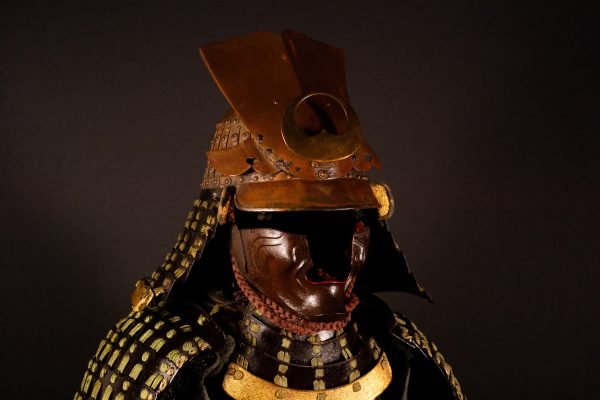
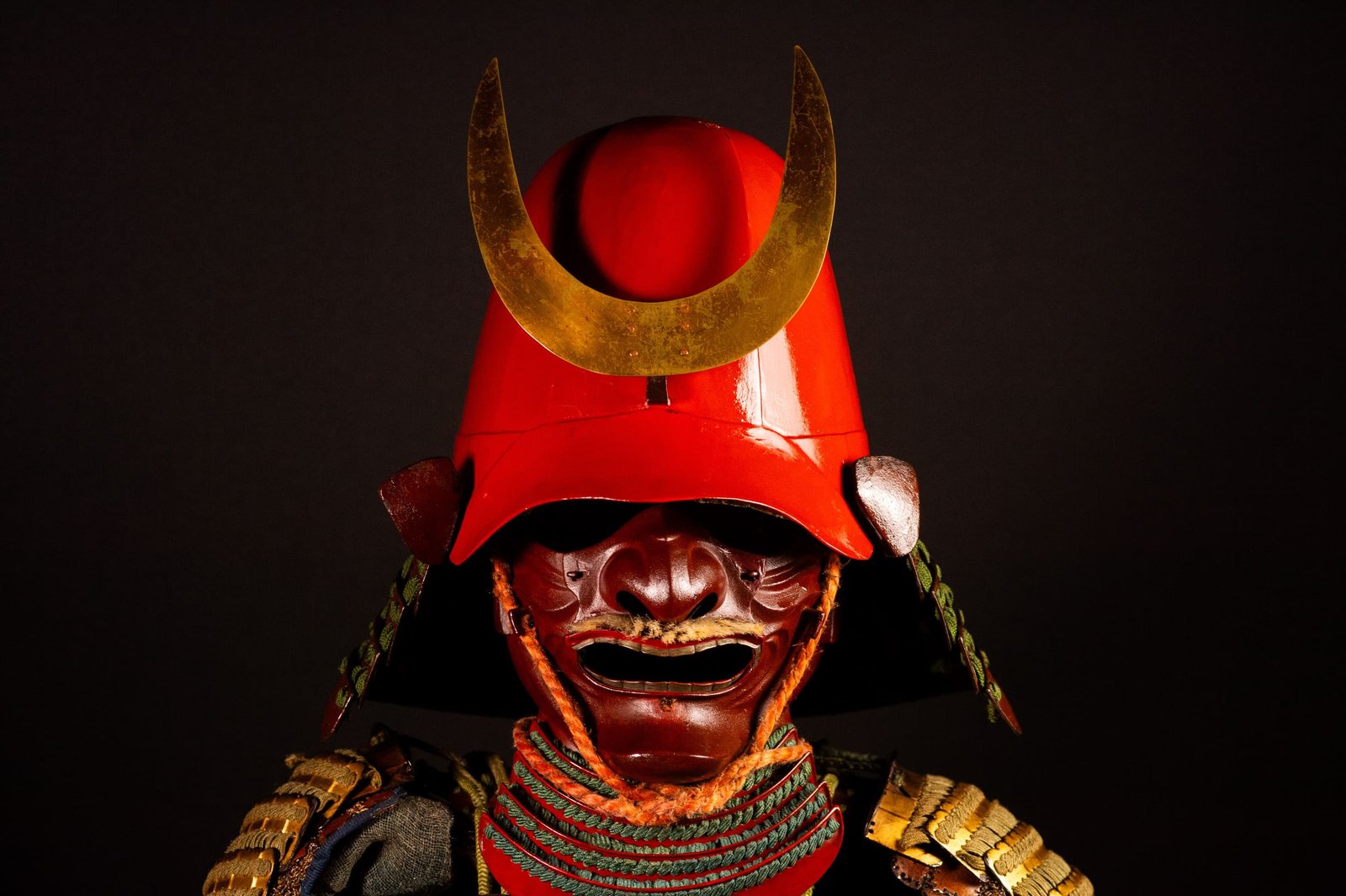
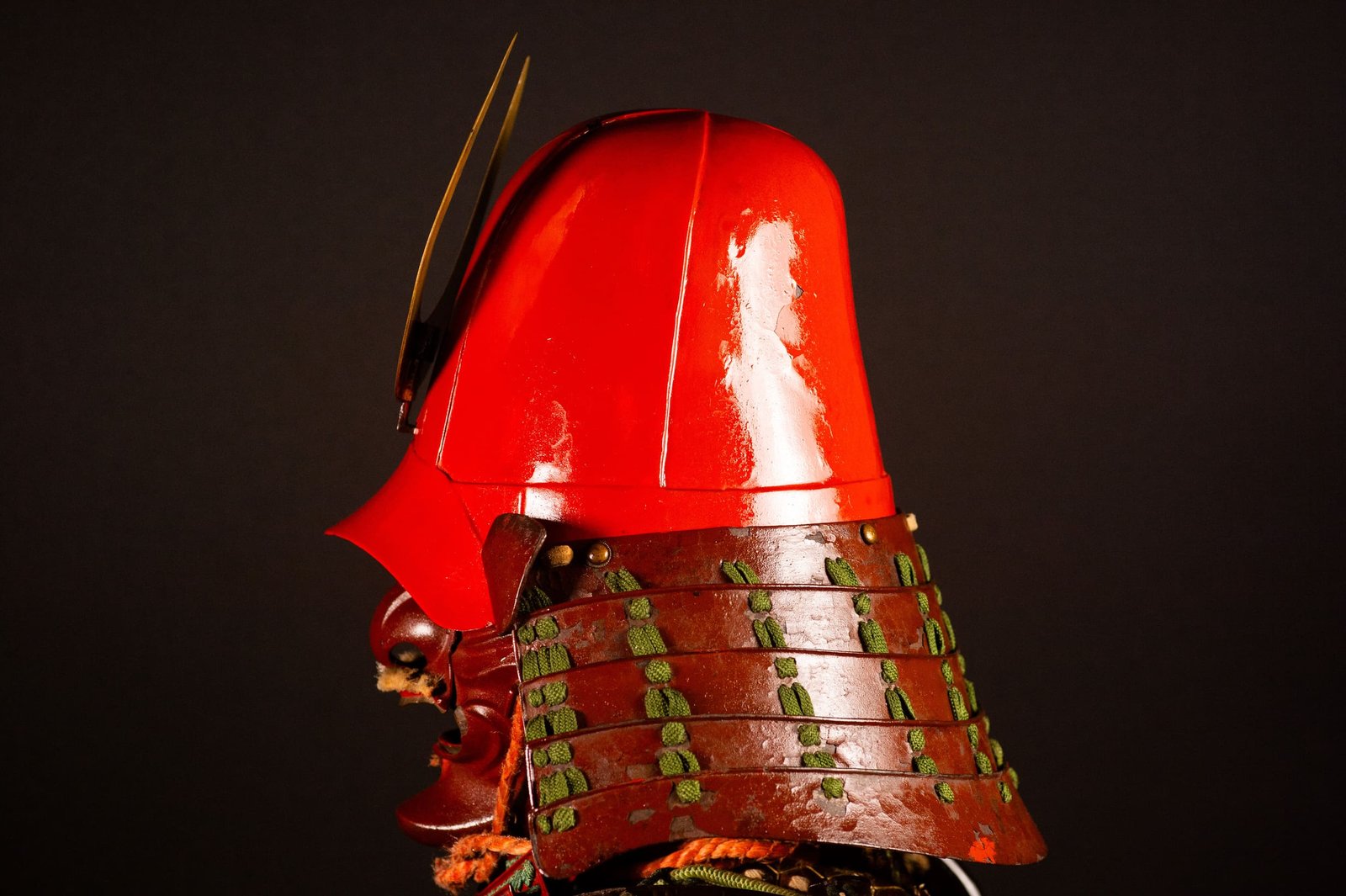
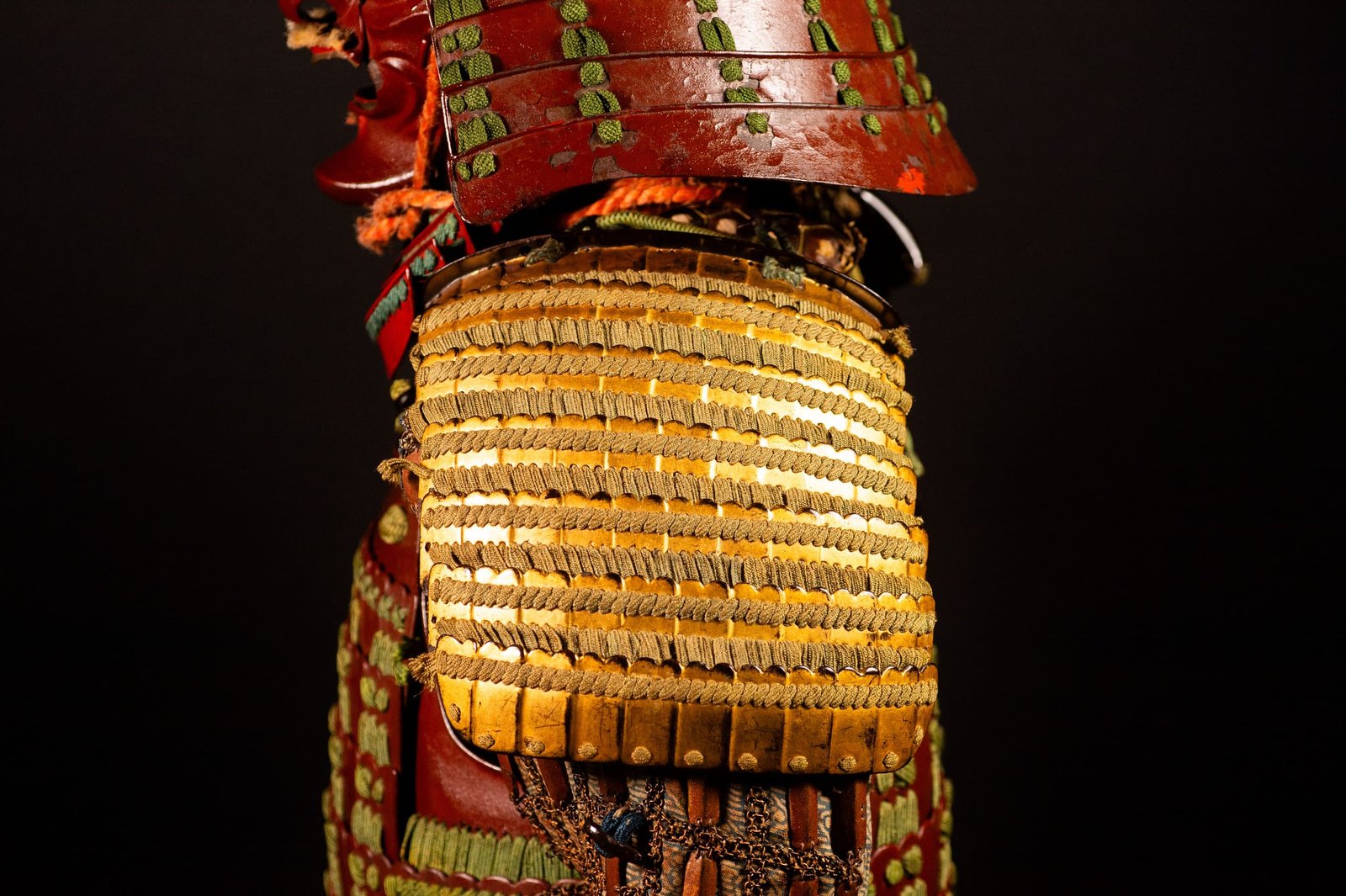
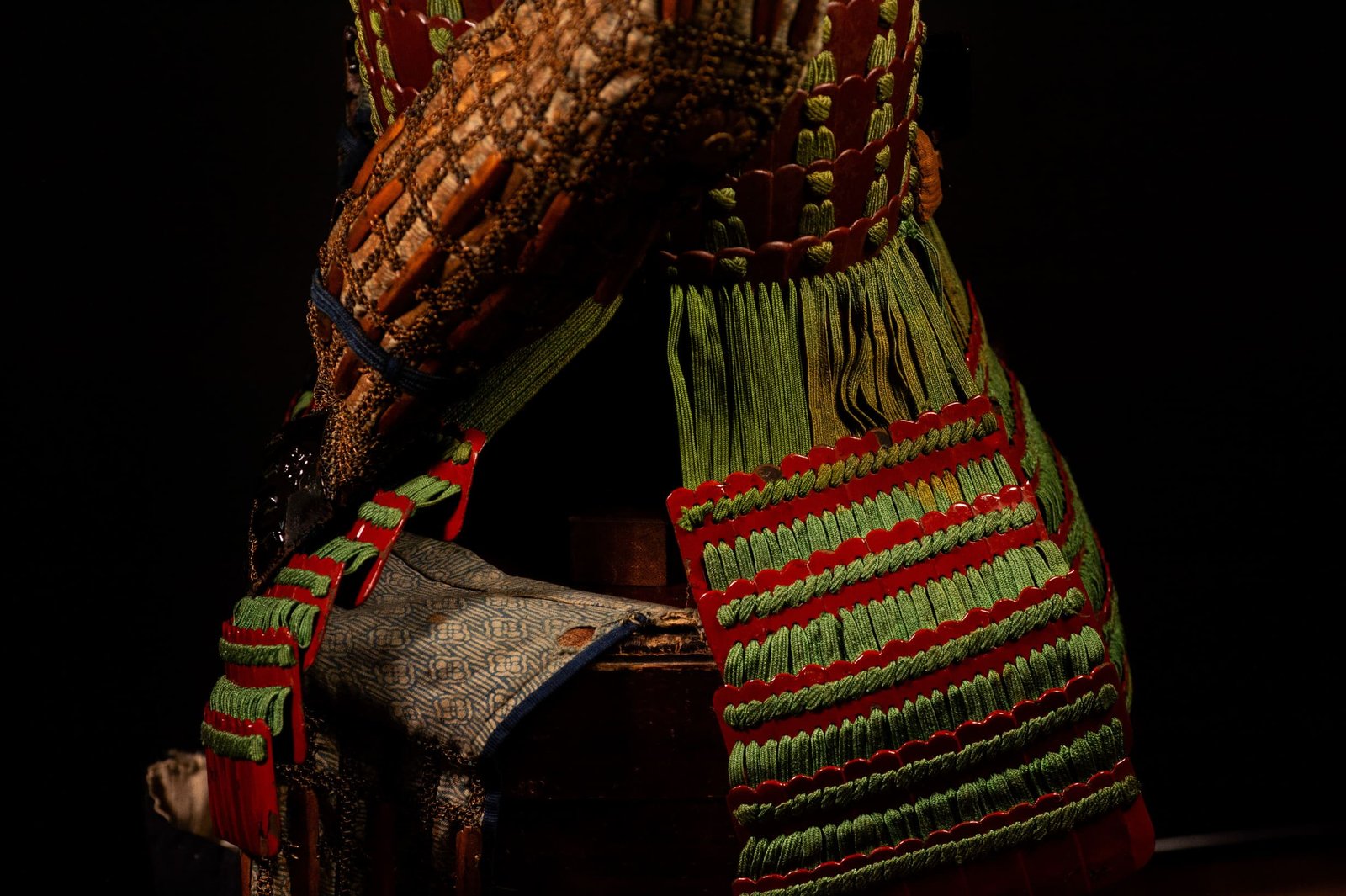
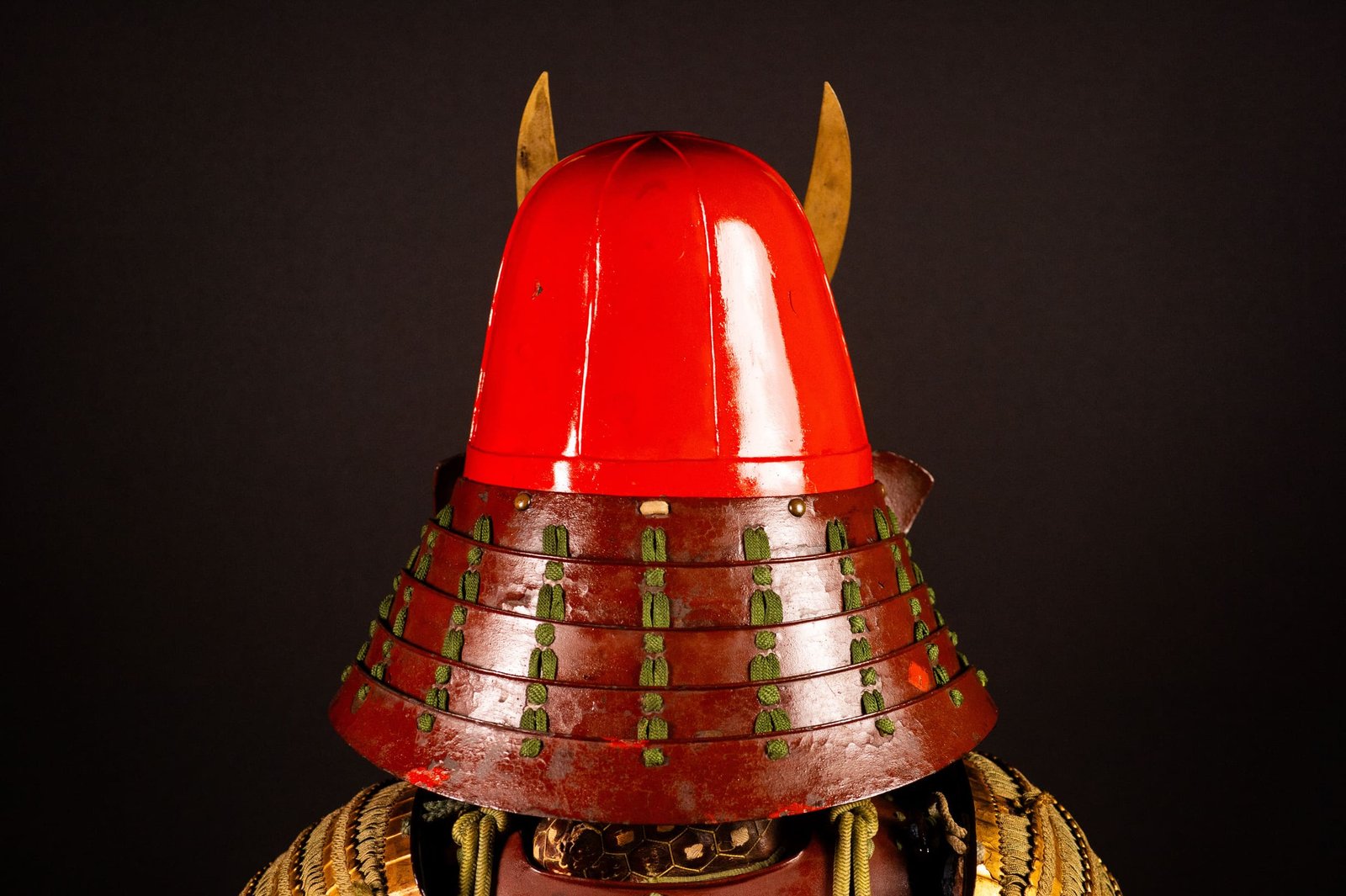
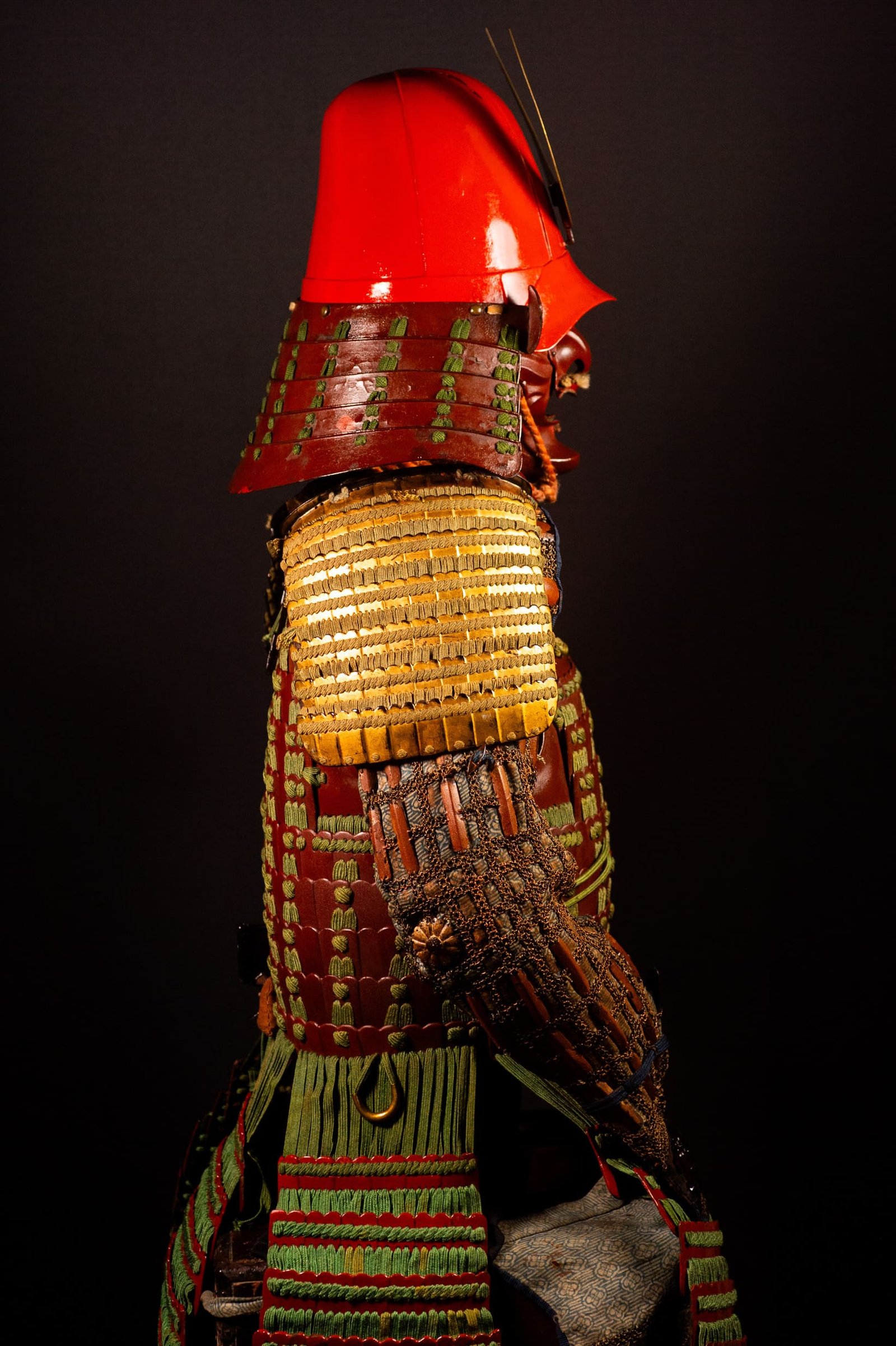
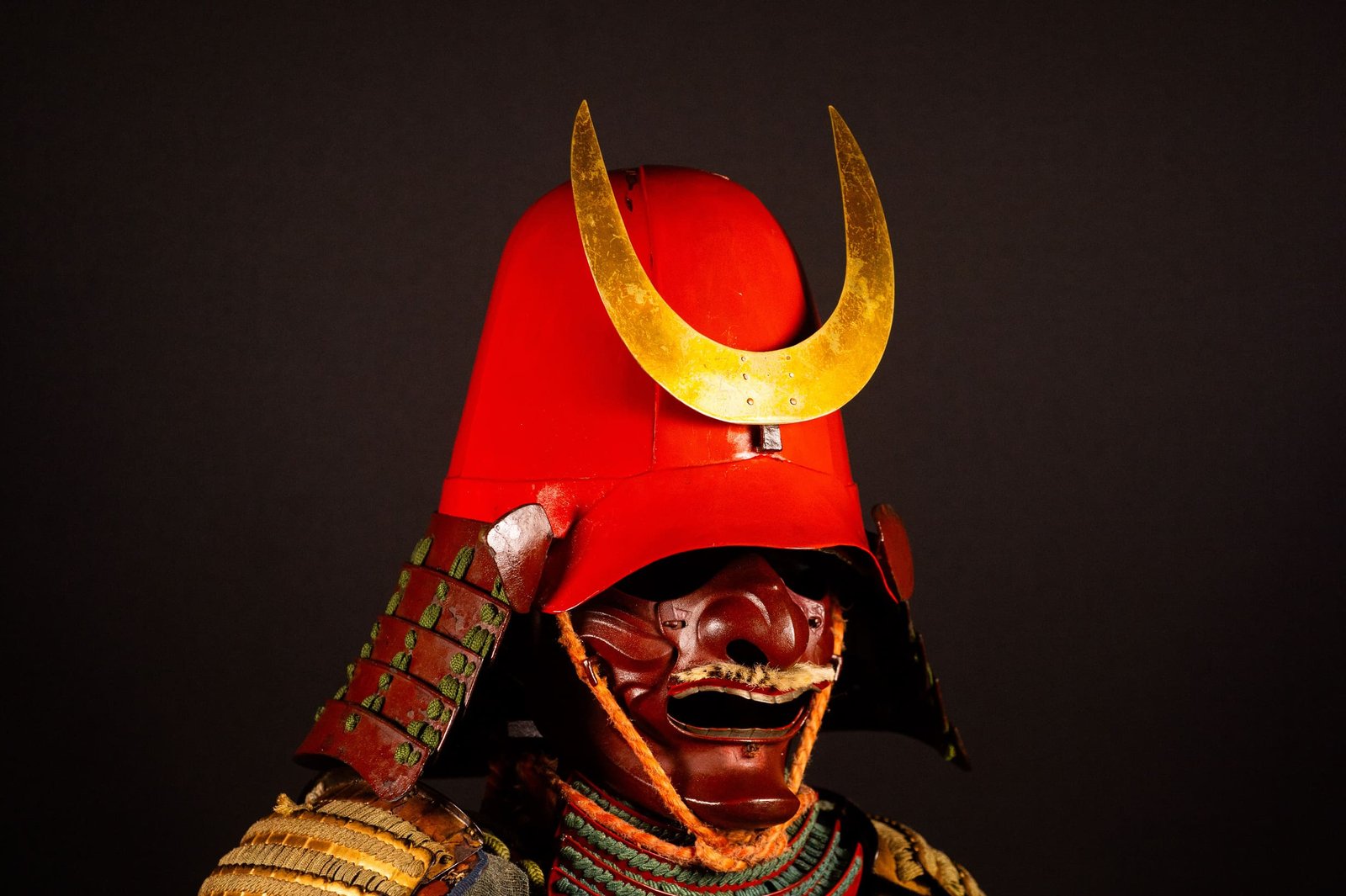
The ensemble includes a smooth red-lacquered kabuto with a crescent-shaped gilt frontal crest, a black-lacquered facial mask with natural-hair moustache, a red-lacquered throat guard, golden-ochre shoulder guards, articulated skirt protection, chainmail sleeves and black-lacquered hand guards bearing a metal-mounted family crest.
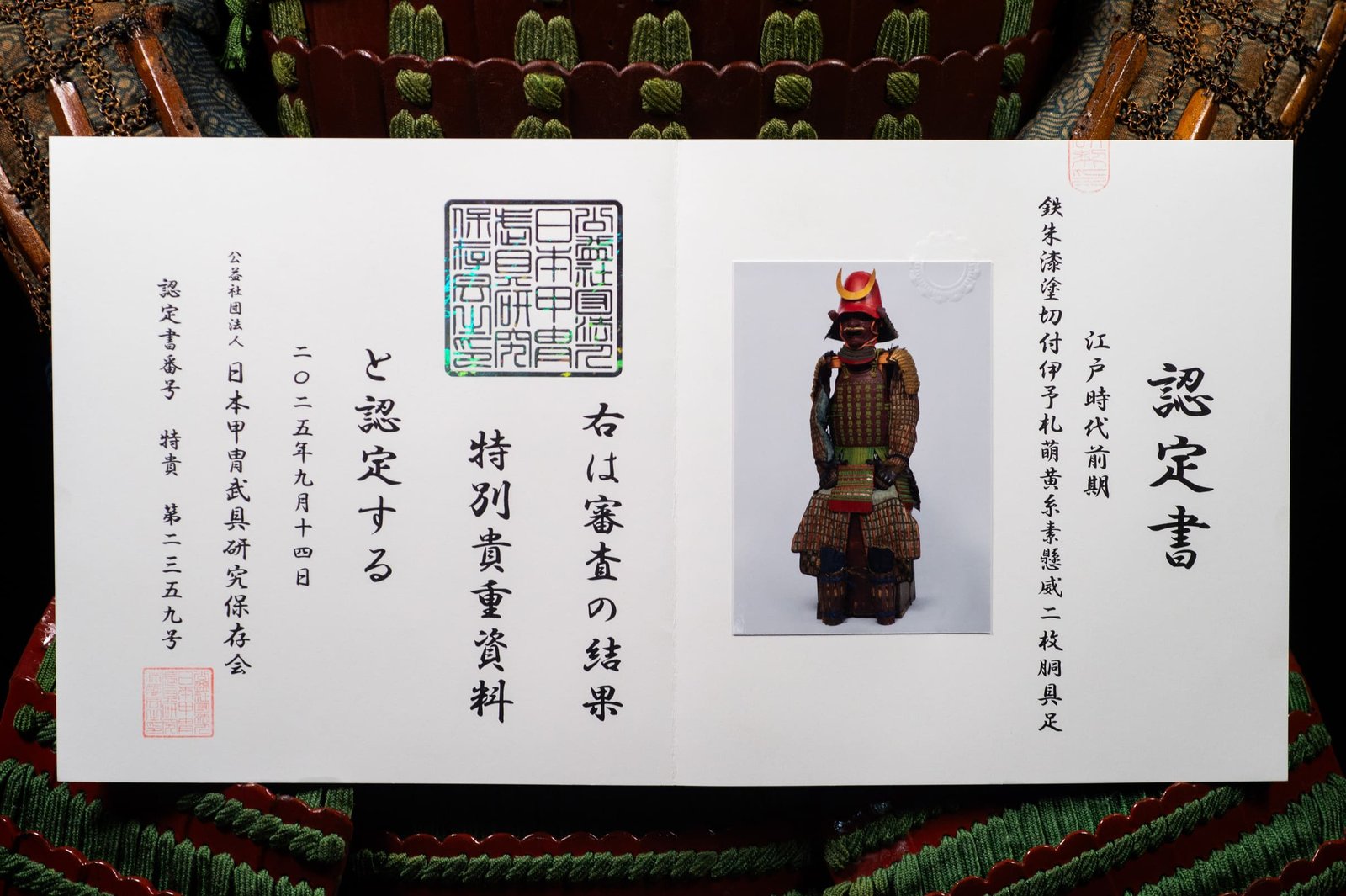
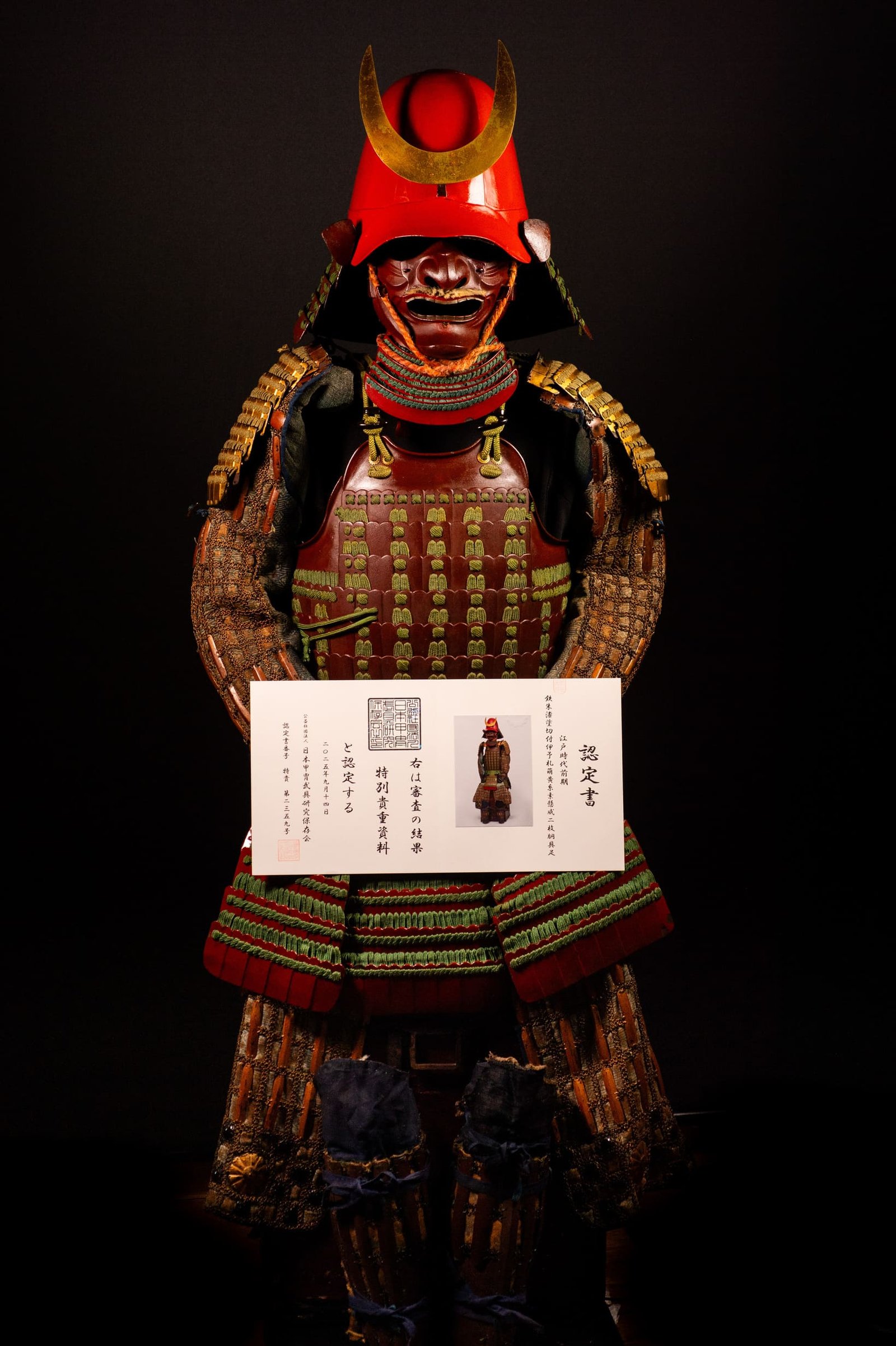
Most importantly, the armor is accompanied by an authentication certificate issued by the 公益社団法人日本甲冑武具研究保存会, the Japan Armor & Arms Research Preservation Society. The armor was graded 特別貴重資料 — Tokubetsu Kichō Shiryō, translated as Especially Valuable Material, under Certificate No. 特貴 2359, dated 14 September 2025.
The complete designation recorded on the certificate is:
鉄朱漆塗切付伊予札萌黄糸素懸威二枚胴具足
Tetsu shu-urushi-nuri kiritsuke iyo-zane moegi-ito suken-odoshi nimai-dō gusoku
This formal designation describes the principal construction and decorative characteristics of the armor:
The certificate designation confirms that the construction, materials, lacing system and principal form of the cuirass were examined as part of the official appraisal.
The armor dates from the early Edo period, the formative decades following the establishment of Tokugawa rule at the beginning of the seventeenth century.
This was a transitional period in the history of Japanese armor. The large-scale warfare of the Sengoku period gradually gave way to the political stability of the Tokugawa shogunate, but the samurai class retained its military identity, social authority and ceremonial obligations.
Armor continued to serve as practical defensive equipment, yet it also became an increasingly powerful expression of rank, lineage and personal identity.
The present gusoku reflects this transition particularly well. Its iron construction and articulated defensive elements preserve the practical principles of battlefield armor, while its vivid red lacquer, contrasting green lacing and gilt helmet crest create a strong and immediately recognizable visual identity.
The dominant characteristic of the ensemble is its extensive use of red shu-urushi lacquer.
The smooth helmet bowl, cuirass and principal lamellar elements are finished in red or dark red lacquer, creating a unified appearance across the armor.
Lacquer served both practical and decorative purposes. Applied over iron and other materials, it helped protect the underlying surfaces from moisture and corrosion while giving armor makers considerable freedom to create distinctive colors and finishes.
Red lacquer was especially effective in producing a powerful martial presence.
Its visibility, intensity and symbolic associations made it one of the most memorable color choices used in Japanese military equipment.
Against this red ground, the yellow-green moegi lacing becomes particularly prominent, producing a sophisticated chromatic contrast that is both martial and decorative.
The armor is constructed using kiritsuke iyo-zane, a technique developed to reproduce the visual rhythm of traditional individual scales while using larger and more structurally unified iron elements.
The surfaces were shaped or carved to suggest rows of separate iyo-zane scales and were subsequently lacquered and laced.
This method allowed armor makers to preserve the refined lamellar appearance associated with earlier forms of Japanese armor while improving manufacturing efficiency and structural stability.
The technique became especially relevant in the development of tōsei gusoku, or modern-style armor, which evolved during the late sixteenth and early seventeenth centuries in response to changing military requirements.
On the present armor, the regular horizontal arrangement of the red-lacquered plates creates a disciplined surface that is visually softened by the sparse green lacing.
The plates are joined using yellow-green moegi-ito cord arranged in a sparse lacing pattern identified on the certificate as suken-odoshi, commonly related to the sugake odoshi style.
Unlike densely packed kebiki odoshi, in which silk braid covers much of the visible surface, sparse lacing leaves wider areas of lacquer exposed.
This produces a cleaner and more architectural appearance while reducing the quantity of cord required.
The use of moegi, a color associated with young leaves and fresh green growth, provides a vivid contrast with the red lacquer.
The combination of red and yellow-green creates one of the armor’s defining visual features and is repeated throughout the cuirass, shoulder guards, throat protection and skirt defenses.
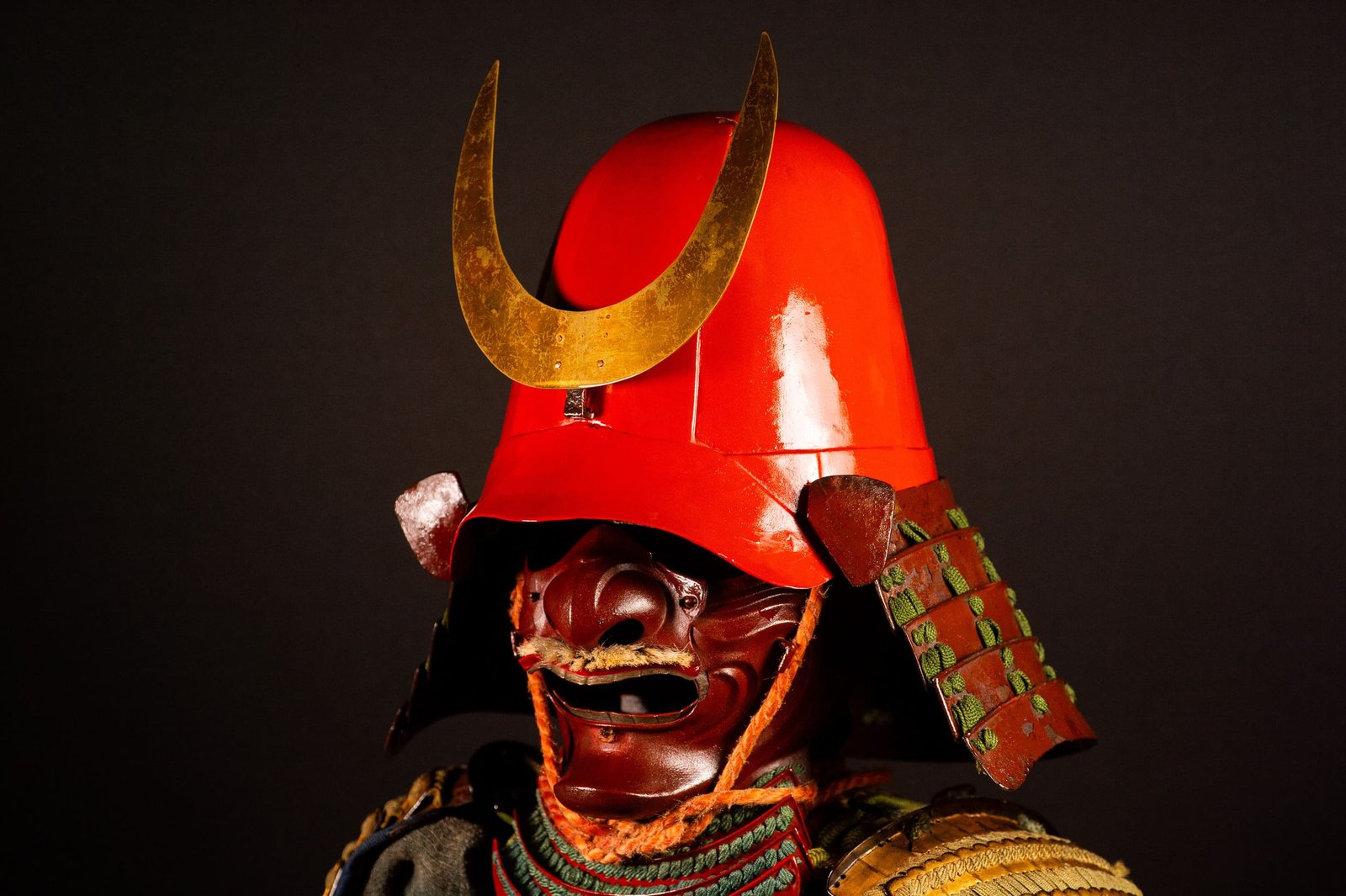
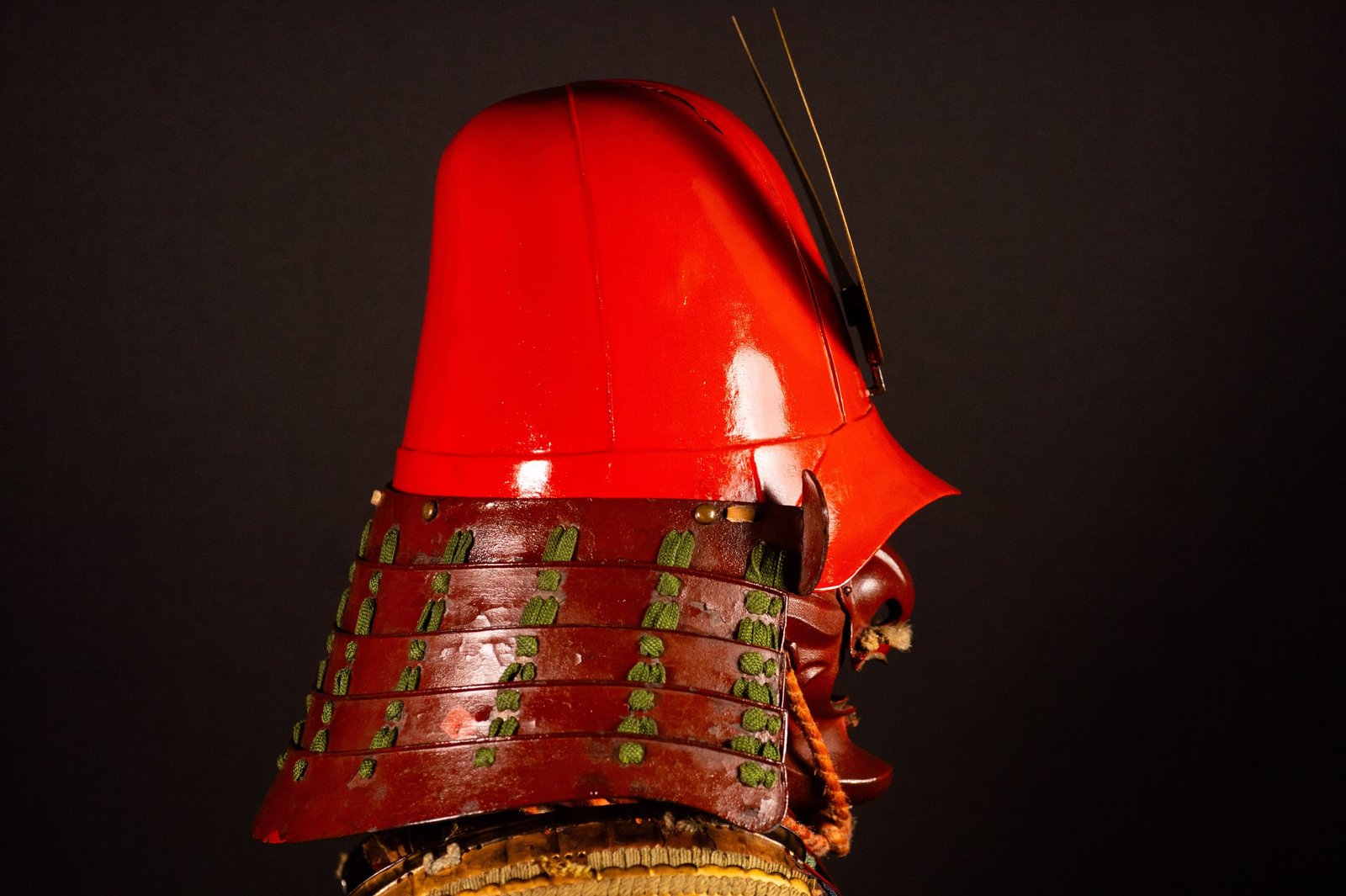
The kabuto is formed as a smooth, brightly red-lacquered bowl with a clean and controlled profile.
Rather than relying upon exposed rivets or complex surface modelling, the helmet derives much of its visual impact from the intense lacquer finish and the prominent frontal ornament.
Mounted at the front is a gilt crescent-shaped maedate.
The crescent creates an elegant upward curve above the helmet and provides a brilliant metallic contrast against the red lacquer.
Crescent-shaped helmet crests were used in different forms by a number of samurai families and individual warriors. They could communicate identity, aspiration, religious symbolism or personal taste.
Without documentary evidence directly linking the crest to a specific historical owner, it should be understood as an important decorative and heraldic element rather than as proof of ownership by a particular clan.
The restrained form of the helmet bowl allows the gilt crescent to become the principal visual focus of the head protection.
The crescent-shaped gilt maedate gives the helmet a recognizable and commanding silhouette.
Helmet crests served both aesthetic and practical functions. On the battlefield, they helped identify important warriors among groups of similarly equipped retainers. During ceremonial use, they reinforced the wearer’s status and personal identity.
The contrast between the metallic gold crescent and the smooth red lacquer is particularly effective.
Rather than overwhelming the helmet, the ornament enhances its clean profile and creates a balanced relationship between color, form and reflective surface.
The helmet is accompanied by a black-lacquered menpō, creating a dramatic contrast with the red kabuto and throat guard.
The facial surface is modelled with deeply carved wrinkles, pronounced contours and an open mouth.
These expressive features give the mask a fierce and imposing appearance, in keeping with the intimidating visual language traditionally used in samurai facial armor.
A natural-hair moustache is attached above the mouth, adding texture, realism and individuality.
Such moustaches contributed to the theatrical transformation of the wearer, reinforcing the impression of maturity, authority and martial severity.
The black lacquer provides a strong visual center between the red helmet and the red-lacquered throat protection below.
The menpō is completed by a red-lacquered yodare-kake, formed from articulated protective lames suspended beneath the mask.
The throat guard protects the vulnerable neck and upper chest while allowing the wearer to turn and lower the head.
Its red lacquer visually reconnects the black facial mask with the helmet and cuirass.
The edges are finished with green cord, continuing the yellow-green moegi color that defines the lacing of the complete armor.
This relationship between black, red and green creates a carefully controlled progression from the helmet to the torso.
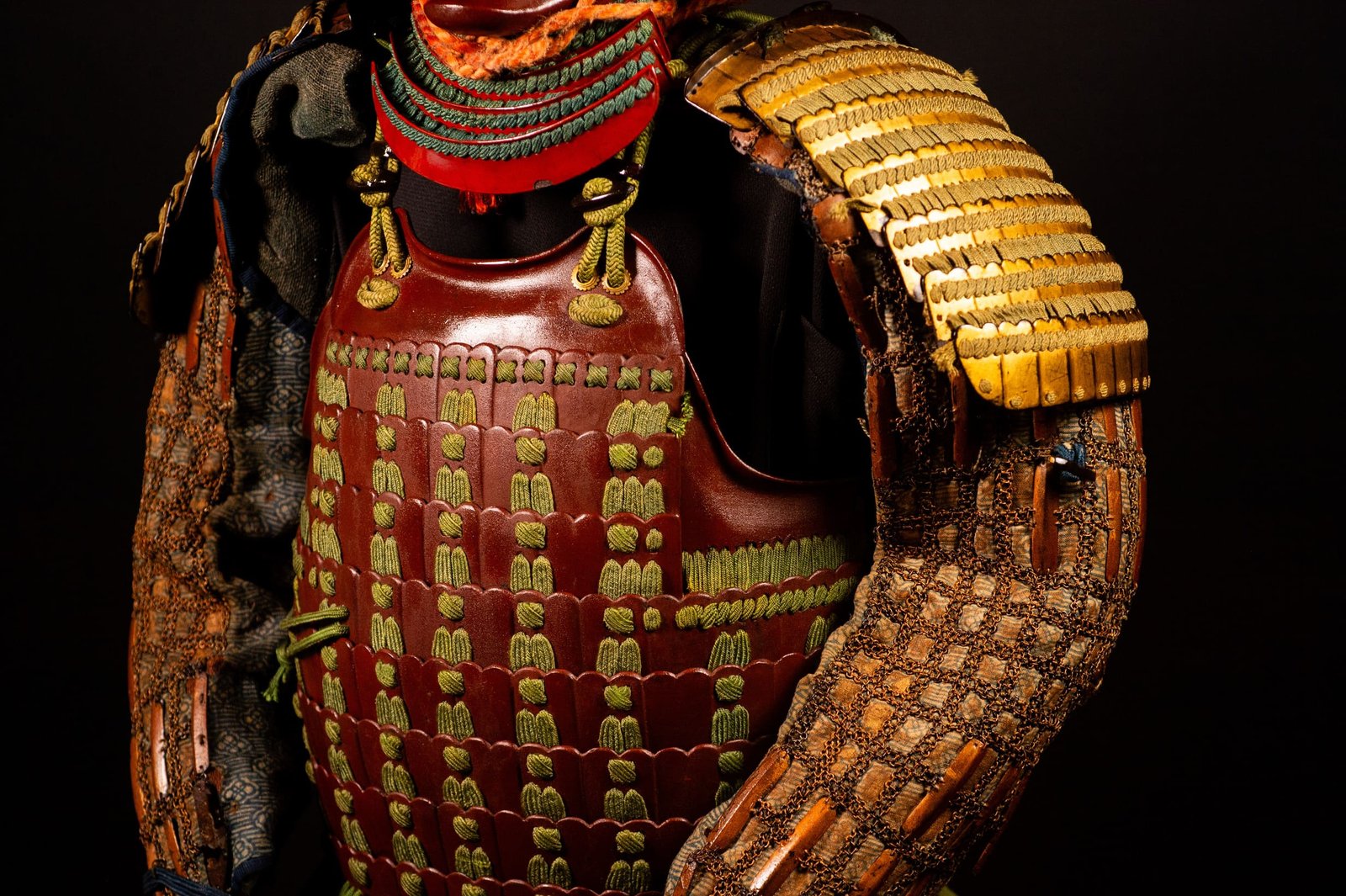
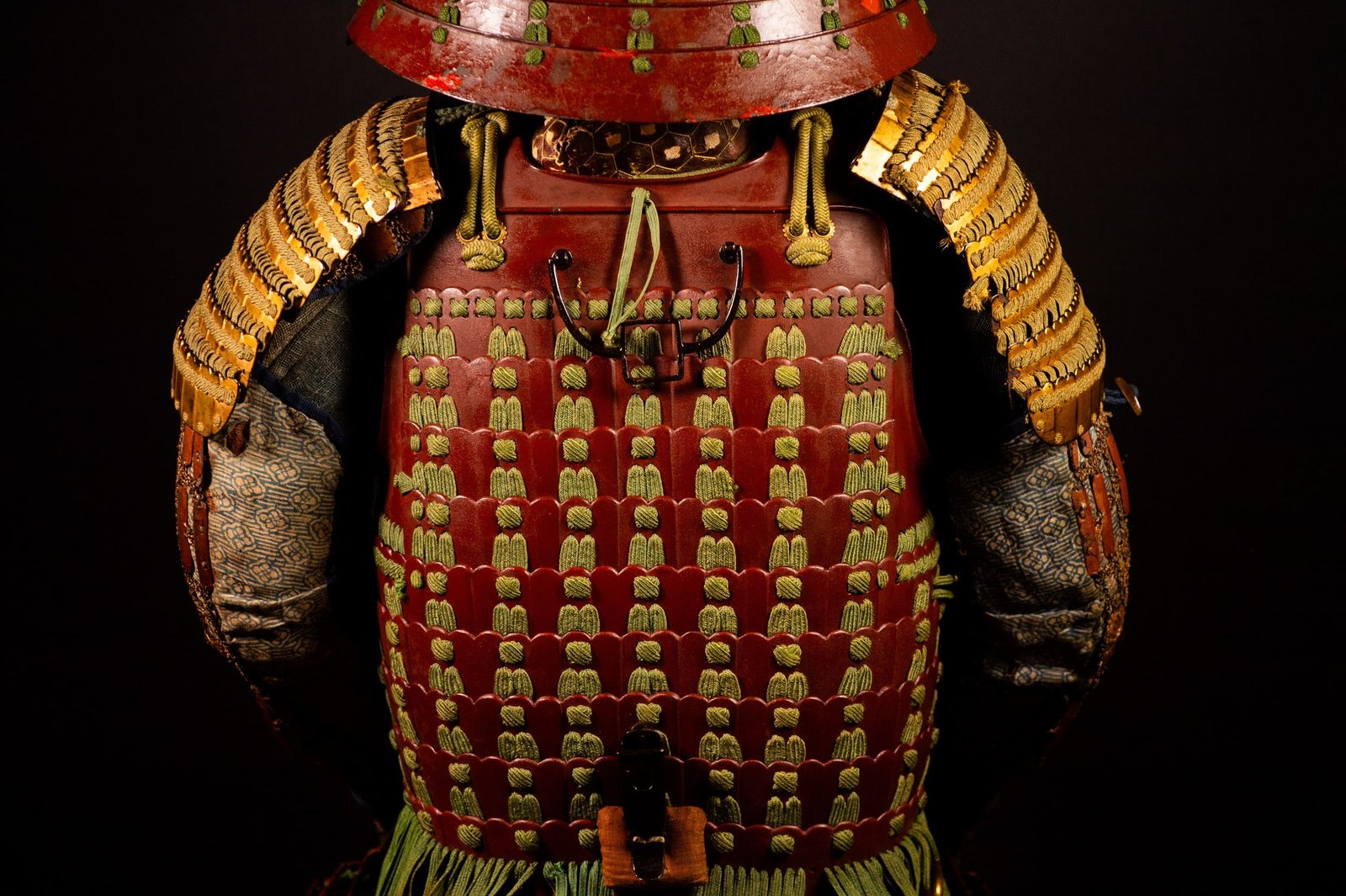
The cuirass is constructed in the traditional nimai-dō form.
A nimai-dō consists of two principal sections joined by hinges at one side and secured at the opposite side.
This construction allowed the cuirass to open sufficiently for dressing while providing a strong and relatively continuous protective shell around the torso.
The present cuirass is formed from dark red-lacquered kiritsuke iyo-zane plates arranged in horizontal rows.
The plates are connected by sparse moegi-green lacing consistent with the certificate designation.
The broader areas of exposed lacquer emphasize the horizontal structure of the cuirass, while the green cord creates measured vertical accents across the red surface.
The result is a visually disciplined torso defense combining practical strength with sophisticated color contrast.
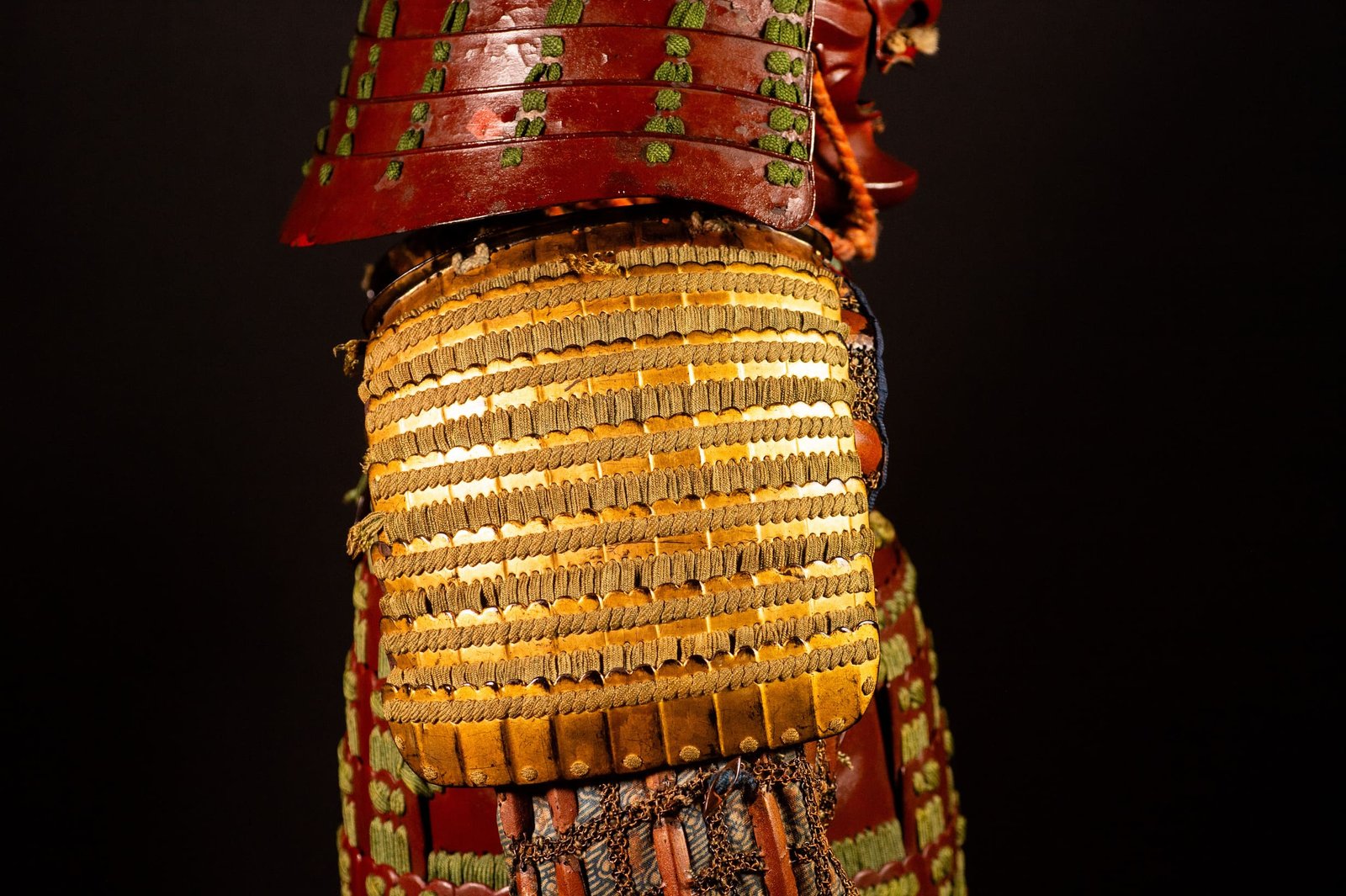
The sode, or shoulder guards, are constructed from successive lamellar plates finished in a golden or ochre-colored lacquer.
They are laced with olive-green cord, harmonizing with the moegi lacing used throughout the remainder of the armor.
The warmer golden tone of the shoulder guards creates a transition between the gilt crescent crest and the darker red cuirass.
Their articulated structure allowed the plates to move with the shoulders while protecting the upper arms from cutting blows.
The combination of golden-ochre lacquer and green cord gives the sode a distinct appearance while remaining chromatically integrated with the complete ensemble.
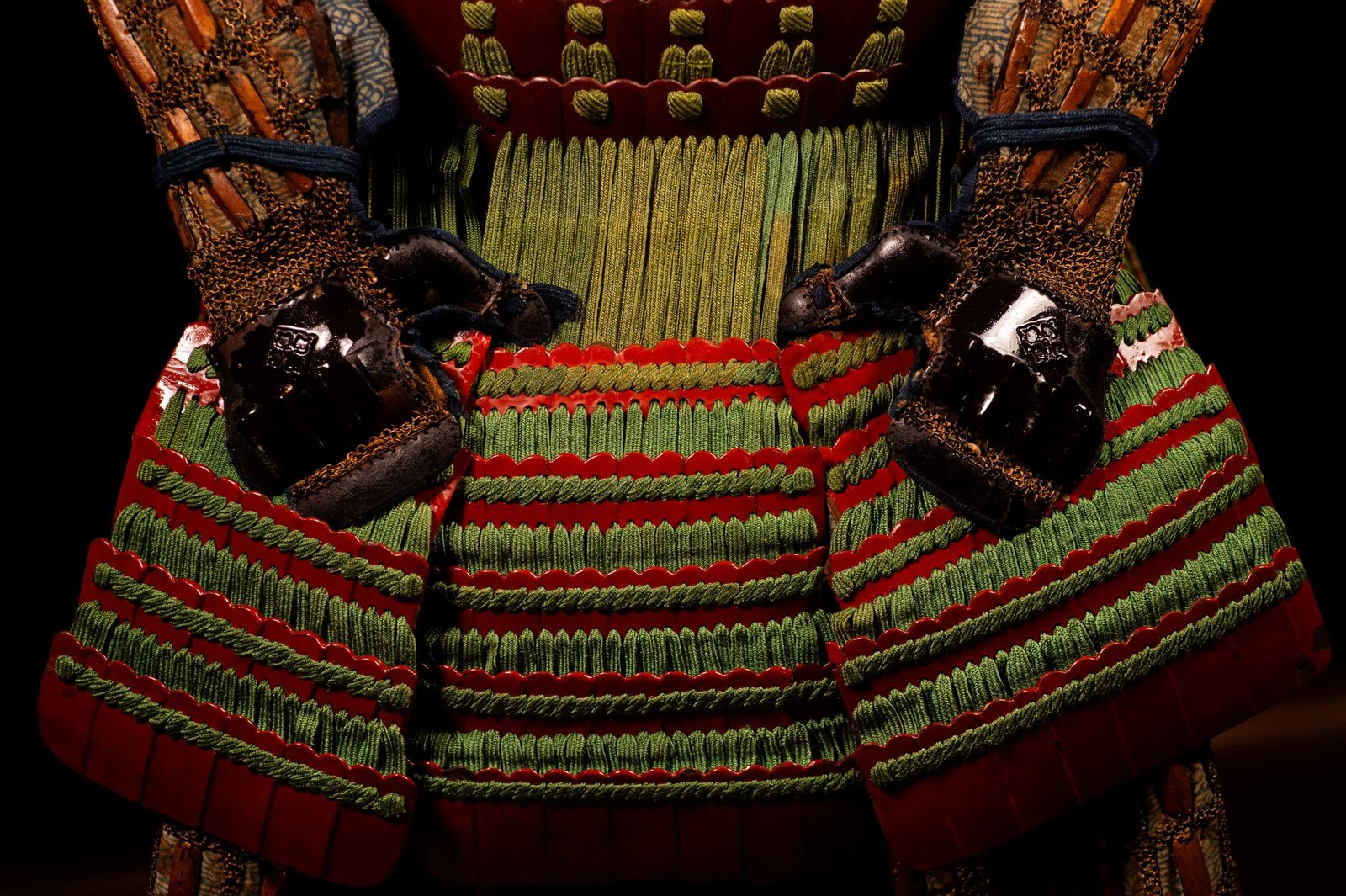
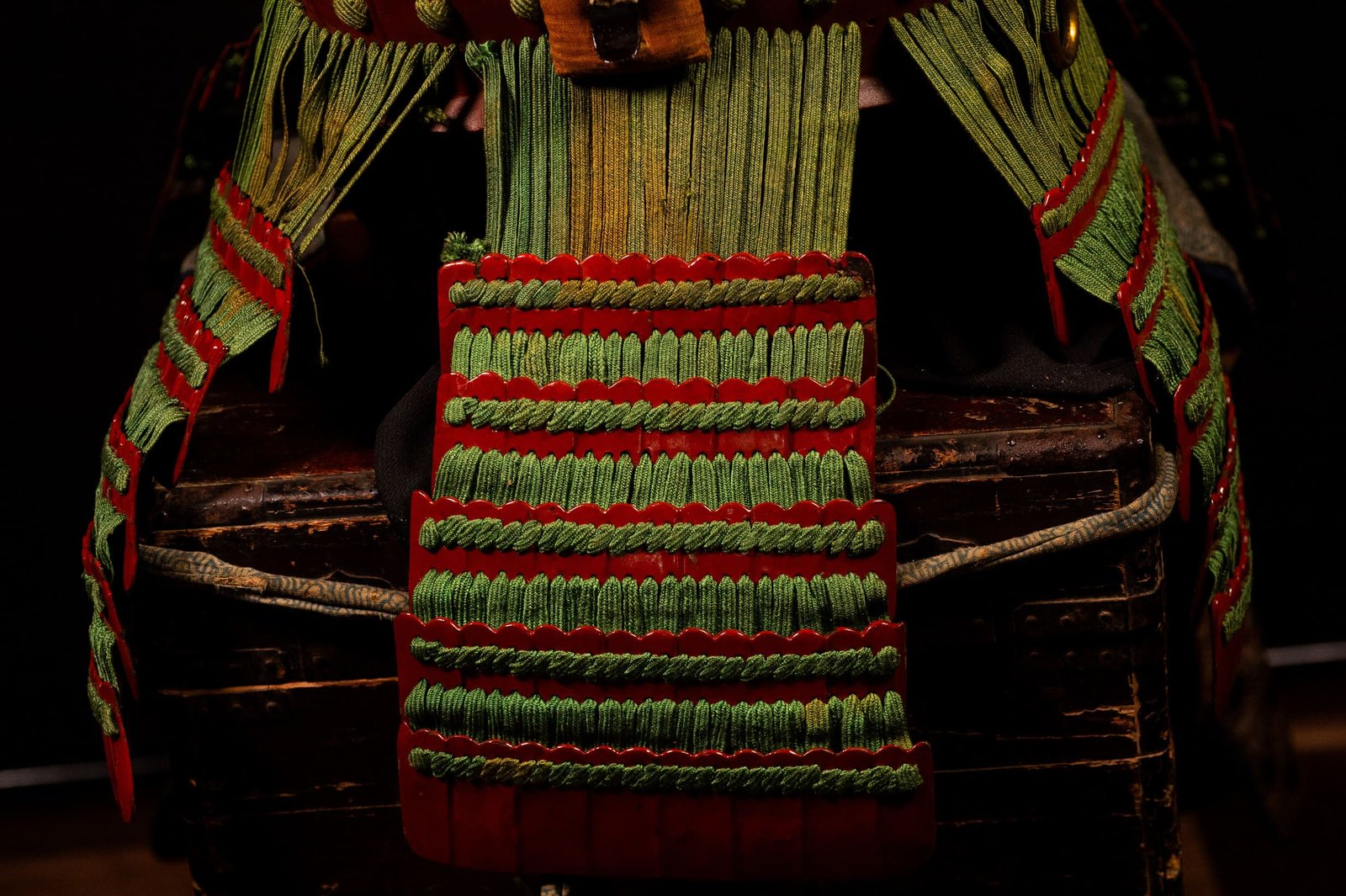
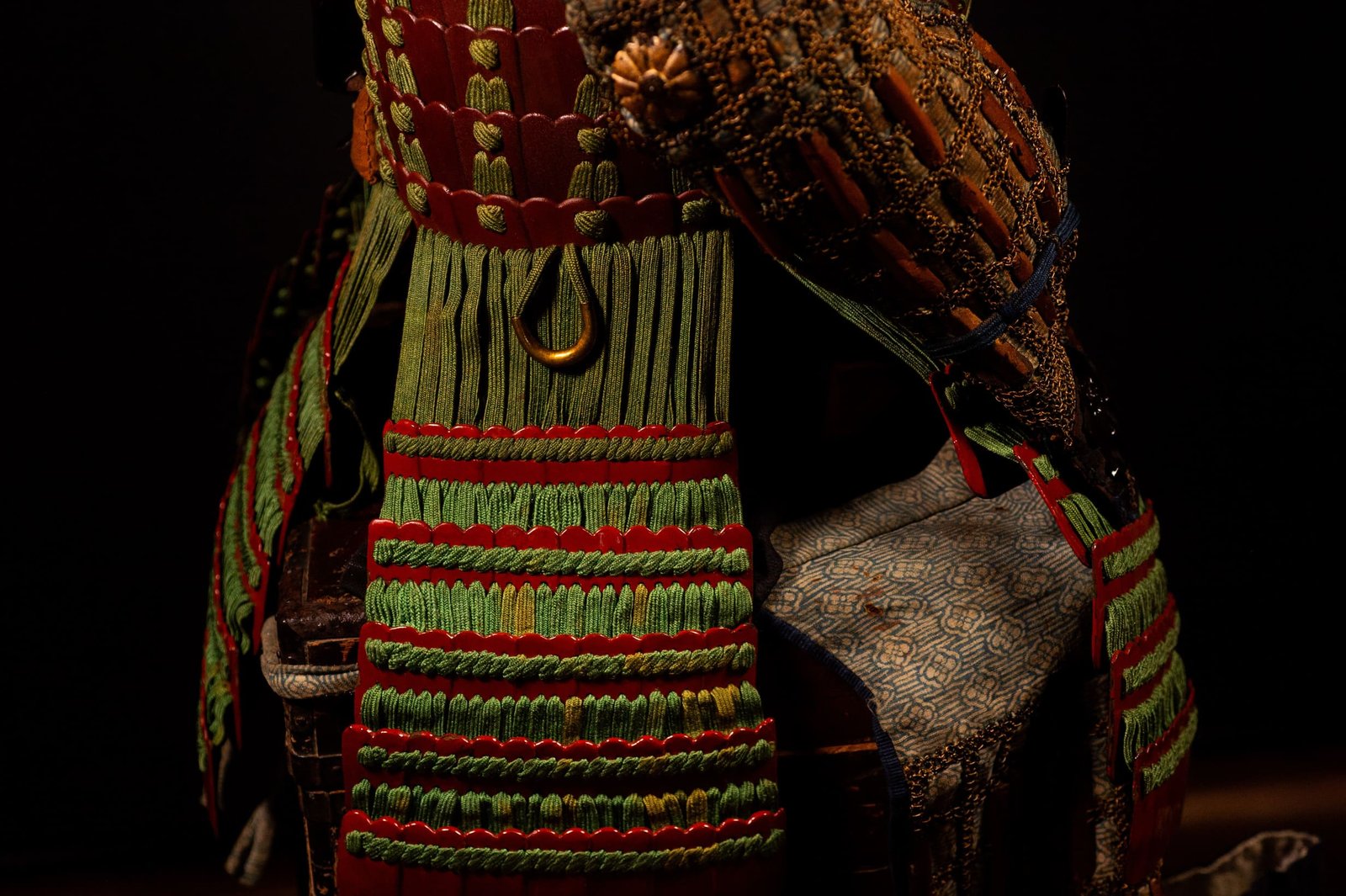
The lower edge of the cuirass is fitted with articulated kusazuri, designed to protect the hips and upper thighs.
The protective plates are joined using alternating red and green lacing.
This alternation creates a more animated decorative rhythm across the lower part of the armor and extends the principal color scheme established by the red lacquer and moegi cord.
The articulated structure allowed the individual sections to move independently as the wearer walked, mounted a horse or changed position during combat.
Although visually decorative, the kusazuri remained an essential functional component of the complete armor.
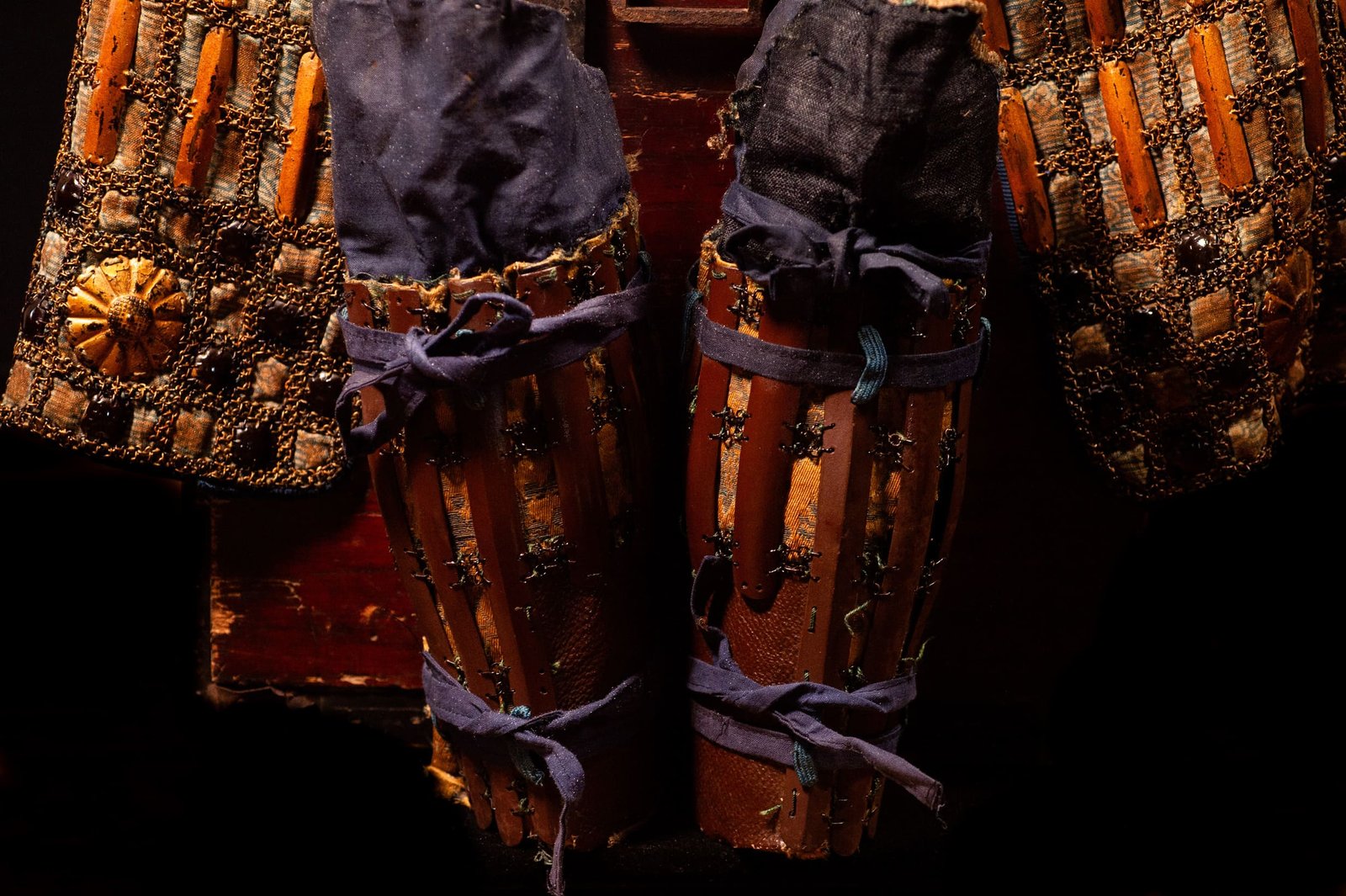
The kote combine flexible iron chainmail, or kusari, with small protective iron plates mounted on indigo-patterned cotton fabric.
This construction provides a balance between flexibility and defensive coverage.
The chainmail protects areas that require frequent movement, particularly around the elbows and joints, while the iron plates reinforce more exposed sections of the arms.
The indigo-patterned textile introduces a restrained decorative surface beneath the iron protection and provides a striking contrast with the red and green colors of the principal armor.
This use of patterned fabric reflects the characteristic Japanese integration of textile design with metal defensive equipment.
The sleeves terminate in black-lacquered fist and hand covers known as tekko.
These elements protect the backs of the hands while allowing sufficient mobility to grip weapons.
Each tekko bears a metal-mounted mon, or family crest.
The presence of a crest indicates a heraldic or identifying function, although a specific clan attribution should not be made without a detailed specialist examination of the design and supporting documentation.
The black lacquer of the hand guards visually connects them with the black menpō, creating subtle continuity between the facial and hand protection.
A metal-mounted family crest appears on the tekko.
Family crests were used throughout Japanese society as symbols of lineage, household identity and affiliation.
On armor, they could appear on metal fittings, textile components, storage boxes, banners and other associated equipment.
The presence of a mon adds an important heraldic dimension to the armor.
However, because the supplied description does not identify the crest and the certificate designation does not establish ownership by a particular family, the emblem should not be used to claim provenance without further specialist research.
Armor finished predominantly or entirely in red is historically associated with the Japanese military tradition known as akazonae (赤備え), meaning “red equipment” or “red-equipped formation.”
An akazonae unit adopted a coordinated red appearance across its armor, helmets, banners and other military equipment.
In some cases, even the equipment of the unit’s horses followed the same visual identity.
The use of red created cohesion within the formation and allowed its members to be recognized immediately on the battlefield.
It also carried a strong psychological effect.
Red-equipped troops were highly visible and could project confidence, discipline and aggression, contributing to an intimidating reputation.
The present armor shares the striking red visual language associated with this broader historical tradition.
This comparison provides cultural and military context only and does not establish that the armor belonged to a documented akazonae formation.
The most famous historical association with red-equipped samurai units is the Ii clan, lords of the Hikone domain.
Following the destruction of the Takeda clan in 1582, Tokugawa Ieyasu incorporated a number of former Takeda retainers into his own military structure.
Some of these warriors carried forward the Takeda tradition of red-equipped troops under the command of Ii Naomasa.
Ii Naomasa was one of the celebrated Tokugawa Shitennō, or Four Guardian Kings of Tokugawa, the leading generals who played an essential role in Ieyasu’s rise to power.
Naomasa’s troops became famous for their red armor and were popularly known as the Ii no Akaoni, or “Red Devils of Ii.”
They fought in major campaigns, including the Battle of Sekigahara in 1600, one of the decisive conflicts that secured Tokugawa political supremacy.
The Hikone domain continued to preserve the red-armor tradition during the Edo period, making the Ii clan the best-known historical example of akazonae identity.
This information is included solely as historical background regarding red samurai armor. It does not constitute a provenance claim or an attribution of the present armor to the Ii clan.
The armor is accompanied by an authentication certificate issued by the:
公益社団法人日本甲冑武具研究保存会
Japan Armor & Arms Research Preservation Society
This certified public-interest association is dedicated to the study, appraisal and preservation of traditional Japanese armor and related military equipment.
The armor received the designation:
特別貴重資料 — Tokubetsu Kichō Shiryō
Especially Valuable Material
The certificate is numbered 特貴 2359 and dated 14 September 2025.
This certification provides substantial documentary support for the historical and material importance of the armor.
It confirms that the piece was submitted for specialist examination and formally recognized within the organization’s appraisal system.
The certificate should be understood according to the exact designation recorded upon it and should not be represented as a higher or different classification.
This armor combines several characteristics particularly valued in complete Japanese gusoku.
Its early Edo dating places it close to the period in which battlefield armor evolved into the sophisticated military and ceremonial equipment of the Tokugawa samurai class.
Its nimai-dō construction reflects an established and practical cuirass form, while the kiritsuke iyo-zane plates demonstrate the continued visual importance of lamellar traditions within later armor construction.
The contrast between red shu-urushi lacquer and yellow-green moegi lacing creates a distinctive and historically appropriate decorative identity.
The gilt crescent maedate, black facial mask, golden shoulder guards, patterned sleeves and heraldic hand guards further enrich the ensemble without obscuring its martial construction.
The accompanying certificate significantly strengthens its documentary value and distinguishes it from uncertified examples based solely on stylistic assessment.
Complete early Edo-period samurai armors combining distinctive construction, strong decorative identity and recognized documentation are increasingly difficult to obtain.
The present gusoku is particularly compelling for the coherence of its red and green color scheme.
The vivid shu-urushi lacquer creates a commanding visual presence, while the yellow-green moegi lacing emphasizes the structure of the armor without concealing the lacquered surfaces.
Its two-piece nimai-dō cuirass and kiritsuke iyo-zane construction reflect the technical evolution of Japanese armor during the transition from the warfare of the late sixteenth century to the more stable society of the early Edo period.
The helmet adds considerable visual distinction.
Its smooth red-lacquered bowl and gilt crescent maedate create a powerful silhouette, complemented by the fierce black-lacquered menpō and red throat guard.
The golden-ochre sode, alternating lacing of the kusazuri, indigo-patterned kote and heraldic tekko provide further material and decorative variety.
The certification as Tokubetsu Kichō Shiryō is one of the armor’s most important attributes.
It provides independent specialist recognition and allows the piece to be presented with a level of documentary confidence unavailable to uncertified armors.
The historical connection between red armor and the akazonae tradition adds significant cultural context, particularly through the celebrated example of the Ii clan and its “Red Devils.”
Nevertheless, the armor is correctly presented without claiming a direct connection to the Ii family or any specific military formation.
A remarkable certified Japanese samurai armor dating from the early Edo period, constructed in iron and finished in vivid red shu-urushi lacquer with contrasting yellow-green moegi silk lacing. Its kiritsuke iyo-zane construction, two-piece nimai-dō cuirass, gilt crescent maedate, expressive black-lacquered menpō, articulated defenses and richly varied textile elements create an ensemble of exceptional historical and visual presence. Accompanied by Tokubetsu Kichō Shiryō certification issued by the Japan Armor & Arms Research Preservation Society, this complete gusoku combines technical importance, documentary value and the powerful visual tradition associated with Japanese red-equipped armor.
| Época | Edo |
|---|

Order above 1.000,00 € gets free shipping.

Secure and hassle-free payment process.

Certificate of authenticity included.

Have questions? Contact us via WhatsApp.
Contact