October 11, 2026
Mokumezuri in ukiyo-e makes the grain of a woodblock visible as part of a printed image. A scientific study of six Kunisada prints documents this effect in two works, using near-infrared imaging to bring out the patterns. Those examples offer a concrete way to understand wood-grain printing without treating every linear texture as proof of the technique.
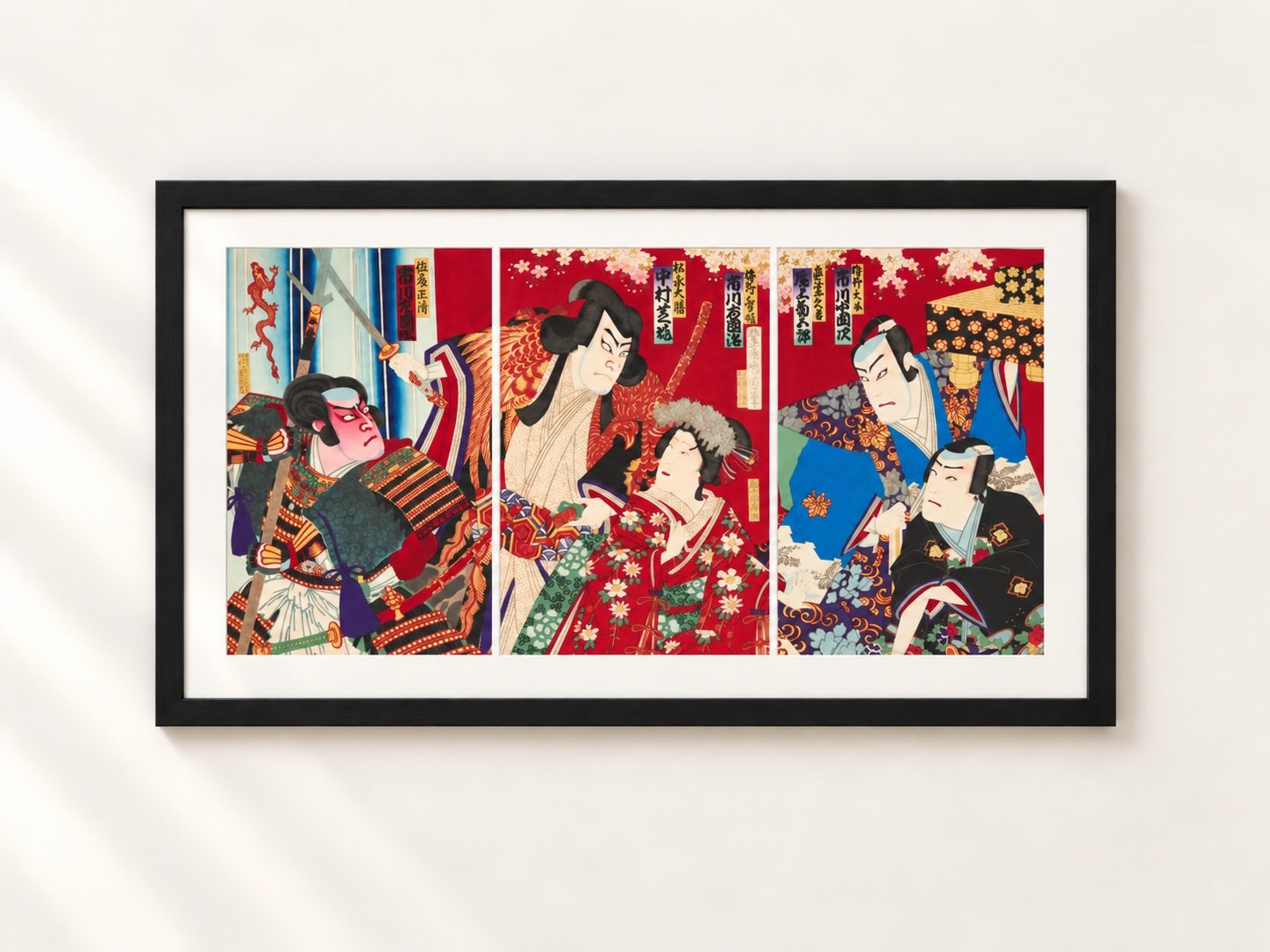
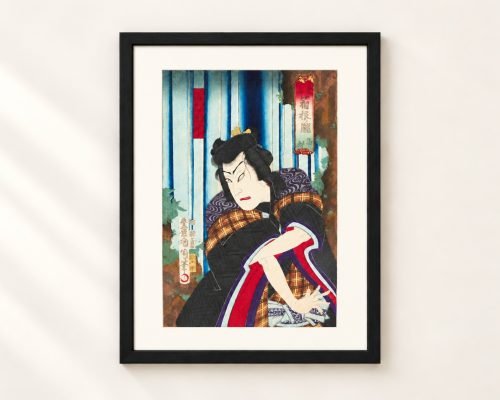
Illustrative ukiyo-e triptych by Toyohara Kunichika, Gion Sairei Shinkōki. This is not one of the Kunisada prints studied, and no mokumezuri effect is identified here.
Explore Japanese woodblock prints in our Ukiyo-e collection.
The researchers describe mokumezuri as a technique that makes wood-grain patterns visible by using different woods for the printing blocks. The texture comes from the material used to print the image. This gives the viewer something different to examine from the outlines of a figure or the choice of a colored area: the surface pattern associated with the block itself.
In this context, recognizing mokumezuri means looking for evidence of that wood pattern. The study supplies specific examples rather than a rule for identifying every textured area in every ukiyo-e. Its observations are tied to particular works in the E. Chiossone Museum collection in Genoa.
The study identifies two details in its Figure 5. One is from print 4, The Imitation Komachi, depicting the actor Sawamura Tanosuke II as Mishima Oesen. The other is from print 2, depicting Iwai Kumesaburō III as Kijin no Omatsu. Both prints were designed by Utagawa Kunisada.
The authors associate the pattern in print 4 with wild cherry wood and the pattern in print 2 with paulownia. The comparison matters because it connects the technique to different block materials in two documented cases. It does not establish that either species was used for every block in either print.
The researchers used near-infrared imaging to enhance the wood patterns in those two details. Their figure outlines the enhanced patterns in red so readers can follow the features being discussed. The red outlines are annotations in the research illustration, rather than an additional color printed on the original works.
This is a useful distinction when comparing a normal photograph with a scientific image. The study presents enhanced details as evidence for its interpretation. It does not offer an ordinary product photograph as a substitute for that examination, or say that every subtle texture can be identified confidently from a listing image.
The same study discusses other printing effects, including karazuri and nunomezuri. Karazuri uses a separate carved block for a blind-printed impression. Nunomezuri uses fabric attached to a shaped woodblock, allowing pressure from the baren to emboss its texture on the paper.
Mokumezuri is described in terms of the wood-grain pattern, while those techniques concern embossed impressions. A textured appearance therefore needs a more precise description before it is assigned a technique. In these examples, the researchers identify the wood patterns separately from the embossed features examined elsewhere in the study.
These two details show how the material of a printing block can contribute to the appearance of an ukiyo-e. They also demonstrate why looking at technique involves more than identifying pigments: a print can contain information about the block surface as well as its coloring materials.
The evidence supports a focused conclusion about the studied Kunisada works. Near-infrared imaging enhanced patterns associated with wild cherry and paulownia blocks. It does not identify the block material, production date, or authenticity of another print simply because a similar pattern seems visible. Those would be separate questions requiring evidence for that object.

CEO of SupeinNihonto, dealer and collector of ancient Japanese art and weapons from Canillo, Andorra.
Contact