
October 4, 2026

Nanban lacquer for the European market is discussed in the V&A’s historical account of Japan’s encounter with Europe. This article follows that account’s comparison between general export production and particular high-quality Dutch commissions, including the Van Diemen Box. It presents the museum’s description of those examples, rather than a survey of all Japanese lacquerware exported to Europe.
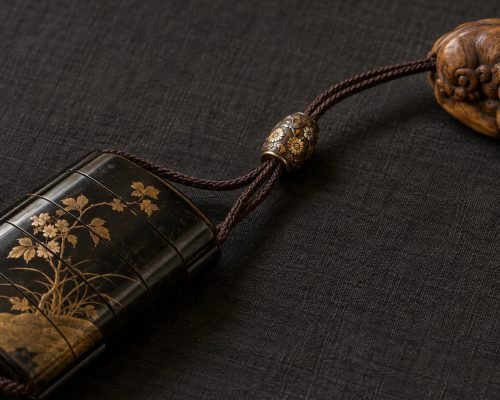
Illustrative Japanese lacquerwork: an inro with a rooster and hen from the Supein Nihonto collection. This object is not identified as nanban export lacquer.
For examples of Japanese lacquerwork in a different object form, explore our Inro collection.
In the V&A’s account, Portuguese traders were attracted to the appearance and decorative possibilities of Japanese lacquer and commissioned objects for European buyers. The term nanban lacquer describes lacquerware intended for that market. It identifies a commercial destination; the word alone does not establish the quality of an individual object or explain every choice made by its maker.
That distinction matters when reading a collection record. An account of who commissioned or received an object answers a different question from a description of its decoration. Keeping those questions separate avoids treating all objects associated with Europe as though they were made for the same customer, occasion, or purpose.
The V&A characterizes nanban lacquer production as involving comparatively less time and care when judged against Japanese standards. This is the museum’s comparative assessment, not evidence that every exported object was poorly made. Its account immediately introduces higher-quality Dutch commissions as an important qualification.
The useful contrast is therefore between a general description of export production and particular documented commissions. Neither side of that comparison should be stretched into an absolute rule. A market label cannot replace examination of the object, its recorded circumstances, and the specific techniques described in its collection entry.
The V&A identifies high-quality work made for Dutch patrons during the 1630s and early 1640s. Its example is a document box made for Anton van Diemen, Governor General of the Dutch East Indies from 1636 to 1645. The museum dates the box to 1636–39 and records it as collection number W.49-1916.
The account highlights elaborate lacquer techniques and decoration drawn from Japanese classical literature. This example supports a precise conclusion: a European commission could involve sophisticated Japanese workmanship and Japanese subject matter. It does not show that every Dutch commission followed this model or that its quality can be inferred from the customer’s nationality alone.
The box’s foreign patron and Japanese literary decoration belong to the same documented object. They need not be treated as competing identities. The commission explains its connection with a European recipient, while the account of its decoration explains a different aspect of the work.
For readers interested in Japanese lacquer, this is a more useful starting point than a simple opposition between export and domestic art. Ask what is actually recorded about the recipient, the form, and the decoration. Where a record is silent, leave that question open rather than supplying an attractive historical explanation.
The discussion here is limited to this published V&A account. It is not a comprehensive study of export lacquer, and it does not establish a production standard for every workshop or commission. Other objects require their own documented histories.

CEO of SupeinNihonto, dealer and collector of ancient Japanese art and weapons from Canillo, Andorra.
Contact