September 25, 2026
A Japanese sword’s blade attracts attention through its shape, steel and tempering pattern. Beside those features, the small metal collar at its base can seem almost incidental.
Yet this component, called the habaki, plays an important role in how the sword fits its mounting and scabbard.
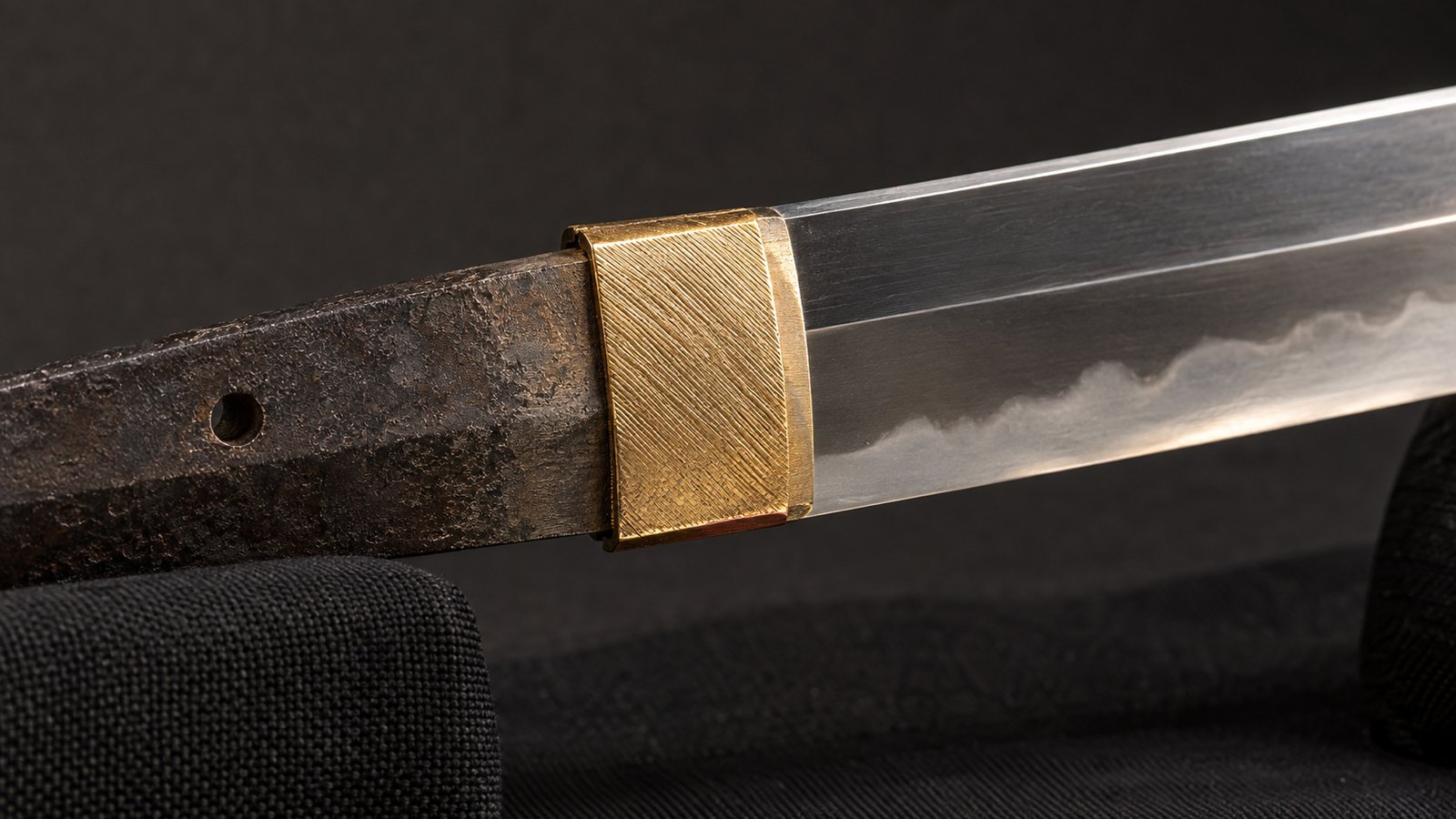
A Japanese sword habaki is a fitted metal collar that sits at the junction between the blade and tang. Its tapered exterior helps retain the blade inside the saya, while its rear face provides a bearing surface for the mounting components behind it. The Northern California Japanese Sword Club identifies these as its two principal functions.
For collectors, the habaki deserves attention because appearance and mechanical fit meet in one compact object. A fine surface is interesting, but understanding how the collar belongs to the blade is more useful than judging it by colour alone.
The habaki surrounds the base of the blade immediately ahead of the guard assembly.
It seats at the transition marked by the ha-machi and mune-machi: the notches on the cutting-edge and back sides of the blade. These establish its position rather than allowing it to slide freely along the steel.
When looking at a mounted sword, distinguish three nearby components:
| Component | Position | What it identifies |
|---|---|---|
| Habaki | Around the base of the blade | The fitted blade collar |
| Tsuba | Between blade and grip | The sword guard |
| Fuchi | At the blade-facing end of the grip | The grip collar |
The fuchi and habaki are particularly easy to confuse because both can be described as collars. However, the Metropolitan Museum of Art defines the fuchi as a fitting at the base of the grip, usually paired with a matching kashira. It surrounds a different part of the sword.
The habaki’s exterior provides a tapered friction fit near the scabbard mouth.
Instead of relying on the cutting edge being squeezed by the wood, the arrangement retains the sword through contact with the fitted collar. Crossed Heart Forge’s account of making a habaki describes securing the blade in its wooden scabbard as the component’s primary purpose.
This explains why the habaki and saya should be considered together.
A collar may appear satisfactory in a photograph while the sword’s actual fit in the scabbard remains unknown. Conversely, an unfamiliar resistance when drawing or sheathing a sword should not immediately be attributed to the collar alone.
For a collector, the useful question is whether the blade, habaki and scabbard work together correctly. That requires more than comparing their general dimensions.
The collar must accommodate the blade’s individual geometry.
Thickness, width and the shape of the transition to the tang influence the work required. In its illustrated making process, Crossed Heart Forge describes creating the collar specifically for the blade through forging, shaping and final adjustments.
Consequently, a detached habaki that looks approximately the right size should not be assumed to fit another sword.
This matters when examining an incomplete mounting or considering a replacement. A visible resemblance is a starting observation, not confirmation of compatibility.
The same principle applies to an attractive antique collar offered separately. It can be studied as an object, but its suitability for a particular blade is a different question.
Habaki can have very different appearances without changing their basic role.
The Northern California Japanese Sword Club illustrates copper examples and collars covered in gold or silver foil. In a gold-covered example, the copper core remains visible at an edge.
Museum records provide further examples. The British Museum documents a katana with a gold-clad habaki and another sword with a two-piece collar made from copper covered with shakudō.
These distinctions are useful when reading a description:
| Description | What needs clarification |
|---|---|
| Copper habaki | The identified base material |
| Gold-covered habaki | The covering and underlying construction |
| Silver-covered habaki | Whether the description refers to a surface layer |
| Dark habaki | The identified material, rather than colour alone |
A gold appearance does not establish solid-gold construction. Likewise, a dark surface should not automatically be labelled shakudō without supporting identification.
Clear material descriptions help collectors understand the object without confusing finish, construction and value.
Collectors may encounter habaki described as one-piece or two-piece.
The Northern California Japanese Sword Club illustrates both configurations, including a two-piece example shown with its sections separated. The British Museum also records a two-piece habaki accompanying a Hizen wakizashi.
A two-piece description refers to a construction feature. It should not be interpreted as evidence that the collar is broken.
However, neither configuration establishes the quality of a blade or the correctness of its present fit. Record the construction, then assess its relationship with the sword separately.
An elaborate collar can add visual interest, but it does not authenticate the blade or determine its attribution.
The habaki and blade are different objects with different questions attached to them. The blade’s maker, age and condition require their own evidence.
Museum catalogues demonstrate the importance of separating the dates of components. The British Museum’s Hizen wakizashi entry records a seventeenth-century blade and nineteenth-century fittings. A sword ensemble can therefore bring together objects from different periods.
For the same reason, avoid assuming that every component is contemporary with the blade simply because it now accompanies it.
An informed description distinguishes what is known about the sword from what is known about its collar and mounting.
Begin with photographs showing the habaki in context rather than only an isolated close-up.
A view of the blade base helps establish its position. Side views can reveal its profile, while close details may show decoration, covering and visible surface changes.
Useful questions include:
These questions help structure an examination. They do not turn a photograph into a mechanical assessment.
Keep descriptions precise. “Visible loss to the covering near an edge” is more informative than an unsupported judgement that a collar is either perfect or unusable.
A sword that sits unusually loosely or resists normal handling needs an assessment of the complete arrangement.
Do not solve an uncertain fit by filing the habaki, bending it or forcing the blade farther into the scabbard. These actions change the relationship between fitted components and can create further problems.
Instead, ask a specialist familiar with Japanese sword mountings to examine the blade, collar and saya together.
The purpose is to identify the cause before deciding on an intervention. A replacement collar, scabbard work or another correction should follow that assessment rather than a guess based on appearance.
The habaki provides a useful lesson in looking at nihontō: a small component can be essential without being visually dominant.
Its surface may reward close observation, but its role is understood through its relationship with the blade and scabbard. Construction, materials and fit belong together.
When exploring Japanese sword mountings, look beyond the most conspicuous decoration. Consider how each fitted component contributes to the ensemble, and keep the blade’s attribution separate from the history of the objects around it.
A habaki is a fitted metal collar around the base of a Japanese sword blade. It helps retain the blade in the scabbard and provides a bearing surface for the mounting components behind it.
No. The habaki surrounds the blade base. The fuchi is a collar at the blade-facing end of the grip.
Not necessarily. Some examples have a copper core covered with gold foil or cladding. Colour alone does not establish construction.
It is a collar constructed with two fitted sections. The term describes its configuration rather than indicating that the object is broken.
Compatibility should not be assumed. Habaki are fitted to individual blade geometry, and a specialist should assess any proposed replacement.
No. The collar’s appearance does not authenticate the blade. The blade and its accompanying components require separate examination and documentation.
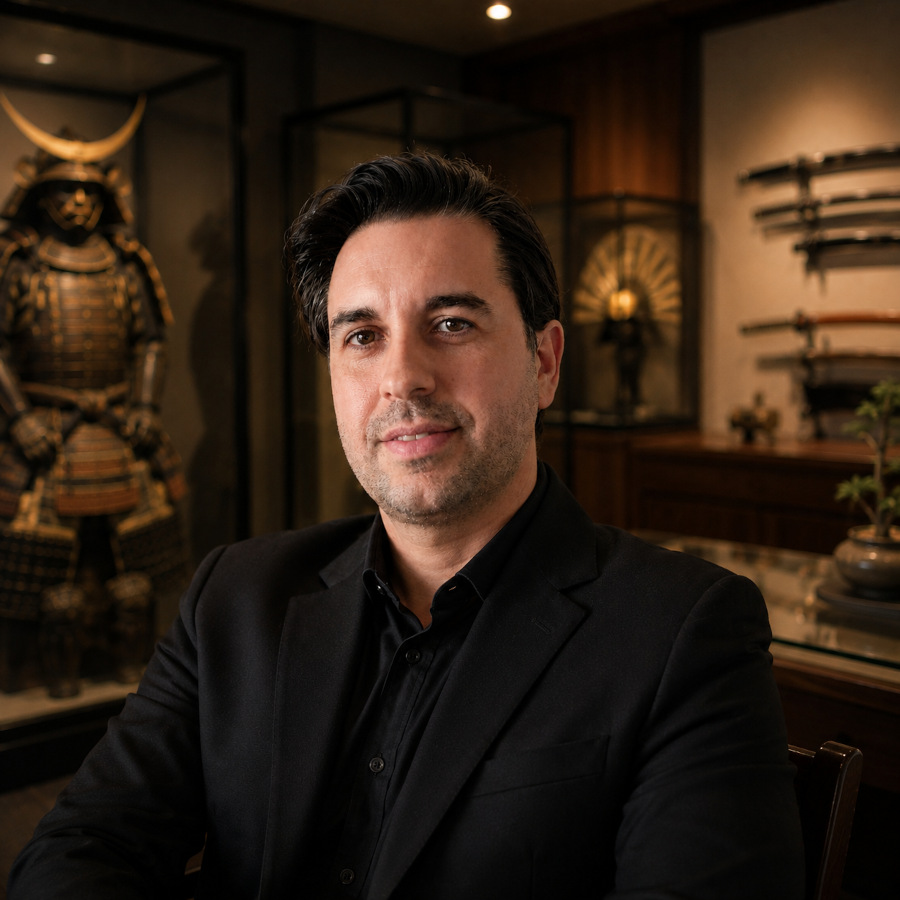
CEO of SupeinNihonto, dealer and collector of ancient Japanese art and weapons from Canillo, Andorra.
Contact