FREE EXPRESS INTERNATIONAL DELIVERY
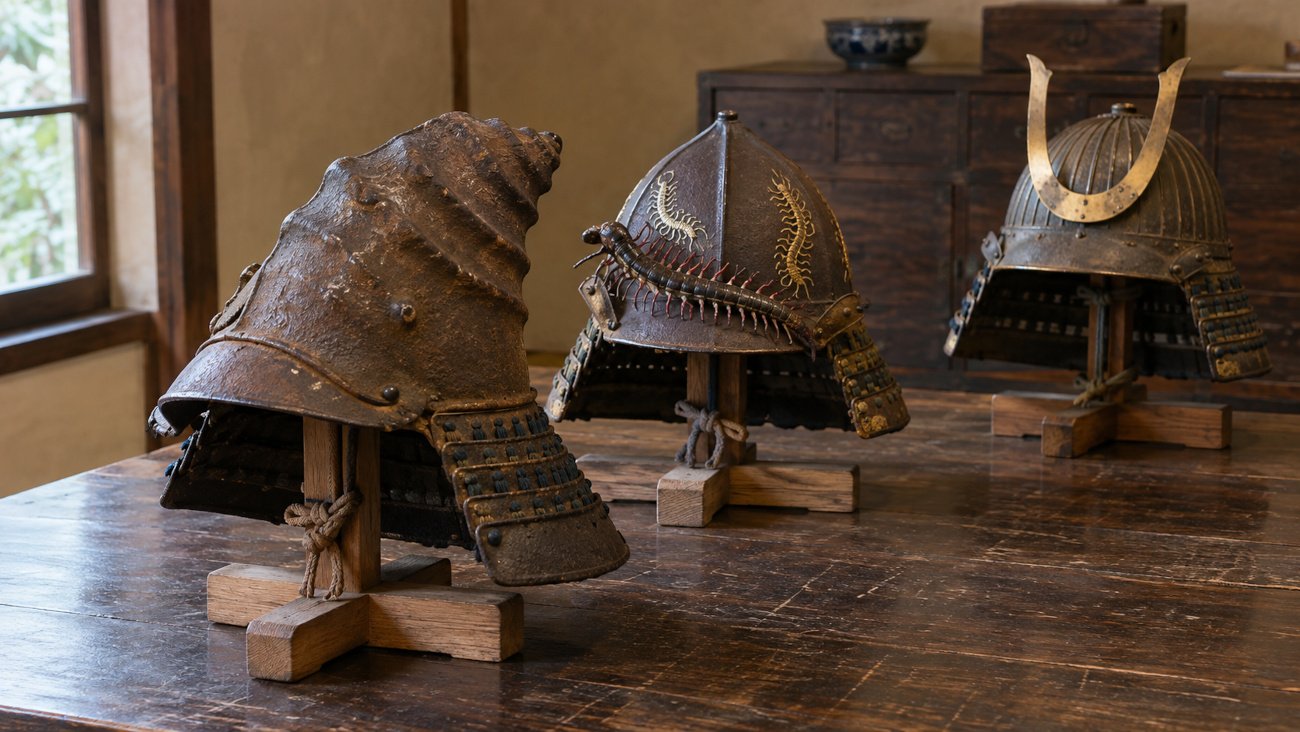
Japanese samurai helmets can range from relatively restrained iron bowls to extraordinary sculptural creations representing animals, waves, shells, court caps and supernatural beings. Among them, a small number of exceptional kabuto have achieved remarkable prices at international auctions.
The most expensive individual kabuto with a clearly documented public auction result was sold by Bonhams in New York for $377,000. However, comparing auction prices requires care. Some widely quoted results refer to a kabuto sold alone, while others correspond to an entire suit of samurai armor in which the helmet was only one component.
This article examines exclusively authentic Japanese kabuto and Japanese armor incorporating kabuto. It does not include European, Roman, Viking or other non-Japanese helmets.
The highest clearly documented public auction result for an individual Japanese kabuto is $377,000, including the buyer’s premium.
The helmet was an eighteenth-century iron kawari kabuto shaped like a conch shell, sold at Bonhams’ Arts of the Samurai auction in New York on 8 October 2013.
This result is especially striking because the helmet was sold as an individual object rather than as part of a complete suit of armor.
The amounts in this article are the original nominal auction results reported by the auction houses and include the buyer’s premium where stated. They have not been adjusted for inflation.
Private transactions are normally confidential. Therefore, “most expensive” in this context refers to the highest publicly documented auction results that can be verified, not to every kabuto that may have changed hands privately.
| Price | Object | Period | Sold as |
|---|---|---|---|
| $377,000 | Iron kawari kabuto in the form of a conch shell | Edo period, 18th century | Individual kabuto |
| $341,000 | Haramaki armor with a kabuto by Masanobu | Edo period, 18th century | Complete armor |
| $40,000 | Armor with a large silver-leaf eboshi kawari kabuto | Late Momoyama period and later | Complete armor |
| $20,000 | Iron momonari kabuto with centipede decoration | Edo period, 17th century | Individual kabuto |
| $16,250 | Kawari kabuto in the form of a crashing wave | Momoyama period, 17th century | Individual kabuto |
| $15,000 | Nanban kabuto inspired by a Spanish cabasset | Early 17th century | Individual kabuto |
| $15,000 | Unaltered kabuto signed Myōchin Nobuie and dated 1563 | Sengoku period | Individual kabuto |
The first result represents a kabuto sold independently. The second and third prices belong to complete armors and must not be interpreted as the value of the helmet alone.
The undisputed highlight is an eighteenth-century iron kawari kabuto constructed in the form of a conch shell, sold by Bonhams for $377,000.
Kawari kabuto—literally “unusual helmets”—became particularly prominent during the late Sengoku and Momoyama periods. Their dramatic forms allowed samurai commanders to project identity, authority and visual presence on the battlefield.
This example transformed iron plates into the spiral form of a large conch. In Japan, the conch or horagai had strong military and religious associations. Conch trumpets were used by yamabushi ascetics and were also employed to transmit signals during military campaigns.
The helmet’s sculptural complexity was combined with practical construction. It was not simply a decorative shell placed over a modern object, but an accomplished work of Japanese armor-making conceived as a functional kabuto.
Its interior was finished in gold lacquer, a costly treatment associated with equipment made for a warrior of high rank. The unusual shape, technical ambition, excellent condition and prestigious provenance all contributed to the final price.
The result greatly exceeded its presale estimate of $40,000–50,000 after prolonged telephone bidding. Bonhams described it as the leading lot of its Arts of the Samurai auction.
View the documented Bonhams auction result
Another exceptional result from the same auction was $341,000 for an eighteenth-century haramaki armor accompanied by an elaborate kabuto attributed to Masanobu.
This price is sometimes relevant when discussing expensive kabuto, but it must be classified correctly: the auction lot was a complete suit of armor, not an individual helmet.
The kabuto consisted of a twenty-four-plate suji-bachi lacquered black and decorated with gilt metal plates, shakudō fittings and finely carved scrolling vines. Its elaborate metalwork included a Buddhist-wheel tehen kanamono, a pierced kuwagata-dai, gilt-copper kuwagata and a striking black-and-gold oni maedate.
The armor also included a russet-iron menpō, haramaki cuirass, sode, kote, haidate and suneate. The remarkably high result therefore reflected the quality and completeness of the entire ensemble.
This distinction matters. It would be inaccurate to claim that the kabuto itself sold for $341,000, even though the helmet was undoubtedly one of the most important elements of the armor.
View the complete armor sold by Bonhams
A late Momoyama-period armor incorporating an imposing eboshi-shaped kawari kabuto sold for $40,000.
The helmet was constructed from iron with a paper-and-leather superstructure shaped like an exceptionally tall eboshi, the formal cap traditionally worn by members of the Japanese court and warrior elite.
Its surface was decorated with silver leaf over lacquer and a large red rising sun. A gold-lacquered seven-lame shikoro and white yak-hair hikimawashi added further visual impact.
As with the $341,000 haramaki, the $40,000 result applied to the complete armor. Nevertheless, its monumental kawari kabuto was the ensemble’s defining feature and demonstrates how extravagant helmet design could transform an entire suit of armor.
View the Momoyama armor and its large kawari kabuto
Among the individual helmets in the documented sale, a seventeenth-century momonari kabuto achieved $20,000.
Momonari means “peach-shaped,” describing the helmet’s distinctive curved profile and pronounced central ridge. This type appeared during a period when Japanese armorers were experimenting with new forms and, in some cases, adapting ideas inspired by imported European armor.
The bowl was assembled from six russet-iron plates. Large centipedes were carved in sunken relief along the sides and finished with silver and gold nunome-zōgan.
The centipede was an appropriate emblem for a warrior. Because it was traditionally believed to move only forward, it became associated with determination, aggression and refusal to retreat.
A later black-and-red lacquer centipede maedate strengthened this symbolism, while silver Tachibana family crests appeared on the fukigaeshi.
View the $20,000 momonari kabuto
A seventeenth-century kawari kabuto designed as a breaking wave, or nami-gashira, sold for $16,250.
The sculptural form was created from lacquered wood and paper over an iron zunari kabuto. This construction method allowed armorers to produce dramatic silhouettes without making the helmet impossibly heavy.
The use of organic materials over an iron foundation should not be mistaken for cheap construction. Paper, leather, textile, wood and lacquer were sophisticated components of Japanese armor. When expertly combined, they created forms that would have been extremely difficult to obtain from forged iron alone.
Wave imagery carried several possible associations, including power, movement, resilience and the ability to overcome obstacles. Its visual energy also made the wearer instantly recognizable.
View the crashing-wave kawari kabuto
A Momoyama-period nanban kabuto sold for $15,000.
The helmet was lacquered in a dark greenish-brown color and shaped to resemble a Spanish cabasset. Japanese armorers encountered European helmets through contact with Portuguese and Spanish traders during the sixteenth and early seventeenth centuries.
Rather than merely copying foreign armor, Japanese craftsmen adapted its silhouette to local tastes and construction traditions. This kabuto incorporated gilt-copper fittings, a cherry-blossom tehen fitting and an ushirodate of white yak hair.
The rear fitting was decorated with the Tokugawa family crest, adding another significant element to the helmet.
Nanban kabuto occupy an important position in the history of Japanese armor because they reveal how foreign forms were absorbed and transformed within the Japanese warrior tradition.
View the nanban kabuto auction record
A rare, substantially unaltered kabuto signed by Myōchin Nobuie and dated 1563 also sold for $15,000.
The helmet was constructed from thirty-two heavy iron plates and retained a sober, functional appearance very different from the more theatrical kawari kabuto.
Its bowl was finished in russet-brown lacquer and fitted with a black-lacquered mabizashi, a simple gilt-brass crest and a three-lame shikoro. It also preserved an internal chain-mail neck guard, a feature associated with northern daimyō during the Sengoku period.
Its importance lies in its signed and dated construction, its state of preservation and its connection with one of the most respected names in Japanese armor-making.
This sale illustrates an important principle: spectacular appearance is not the only path to value. An austere helmet can be highly desirable when it combines an important maker, early date, authenticity and minimal alteration.
View the Myōchin Nobuie kabuto
The market value of an antique kabuto is determined by several factors acting together.
Helmets associated with respected armor-making traditions, including the Myōchin, Saotome and Haruta schools, can attract serious collector interest. A signature is valuable only when it is considered authentic and consistent with the construction of the helmet.
Kabuto from the Muromachi, Sengoku and Momoyama periods are generally scarcer than later examples. Age alone, however, does not guarantee exceptional value. Condition, originality and workmanship remain essential.
Collectors pay close attention to whether the bowl, shikoro, fittings, lacquer, lacing and crest belong together. Many helmets were repaired, relacquered or reassembled during their working lives.
Period modifications can form part of an object’s history, but a heavily reconstructed helmet should not be presented as completely original.
Unusual kawari kabuto can command substantial prices because each design may be unique or survive in extremely small numbers. Animal forms, shells, waves, horns, plants and religious symbols are particularly attractive when the construction is technically accomplished.
Learn more about these sculptural helmets in our guide to the rarest kawari kabuto.
A documented history through respected collections, museum exhibitions or established auction houses can increase confidence and desirability.
Provenance does not automatically prove authenticity, but a continuous and credible ownership history reduces uncertainty and places the object within a broader collecting tradition.
Original lacquer, stable iron, intact shikoro, preserved textiles and period fittings all affect value. Excessive restoration can reduce historical integrity, while severe corrosion or structural damage may make conservation difficult.
A kabuto with reliable documentation connecting it to a particular daimyō, samurai family or historical event may achieve a significant premium. Family crests alone are not sufficient to establish ownership, since mon could be added or reproduced at a later date.
Not necessarily, but they frequently dominate the most spectacular auction results.
A dramatic kawari kabuto has immediate visual appeal and may be unique. However, an early signed helmet by an important armorer can be historically more significant than a larger or more decorative example.
Serious collectors therefore evaluate the complete object rather than judging it only by shape:
The $377,000 conch-shell kabuto combined visual originality, sophisticated iron construction, symbolic meaning, excellent presentation and strong provenance. Its price cannot be explained by its unusual shape alone.
The difference between the $377,000 record and the prices achieved by most other important kabuto is enormous.
This demonstrates that the high-end market is not based on a simple price list. An exceptional object can attract determined competition from collectors and sell far above its estimate, while other authentic and historically important helmets may remain within the five-figure range.
It also shows why asking prices, estimates and completed auction results should never be treated as equivalent:
When comparing expensive kabuto, the same type of figure must be used consistently.
An authentic antique kabuto is both defensive equipment and a work of Japanese metalwork, lacquer art and symbolic design.
Collectors should examine the bowl construction, interior, rivets, lacquer, shikoro, lacing, fittings and evidence of alteration. A convincing assessment rarely depends on a single detail.
At Supein Nihonto, we specialise in authentic Japanese swords, samurai armor and historical objects sourced for collectors. You can explore our selection of authentic Japanese kabuto for sale or contact us if you require additional information about a particular piece.
Essential information about record auction prices, rare kawari kabuto and the factors that determine the value of an authentic Japanese samurai helmet.
The highest clearly documented public auction result for an individual Japanese kabuto is $377,000. The helmet was an eighteenth-century iron kawari kabuto shaped like a conch shell, sold by Bonhams in New York in 2013.
No. The conch-shell kawari kabuto was sold as an individual helmet rather than as part of a complete suit of armor. This makes the result particularly significant when comparing auction prices for Japanese kabuto.
A complete eighteenth-century haramaki armor with an impressive kabuto by Masanobu sold for $341,000. However, that price applied to the entire suit of armor, including the cuirass, mask, sleeves and leg defenses, not to the kabuto alone.
Its value reflected the combination of rarity, sculptural iron construction, symbolic conch-shell form, gold-lacquered interior, condition and provenance. Strong competition between bidders also pushed the final result far above its original auction estimate.
No. Their unusual sculptural forms often attract collectors, but an early signed helmet by an important armorer can be equally significant. Period, maker, originality, condition, provenance and quality of construction must all be considered.
Kabuto associated with respected armor-making traditions such as the Myōchin, Saotome and Haruta schools can be highly desirable. A signature alone does not guarantee value, however, and must agree with the helmet’s construction, period and documented workmanship.
The main factors include age, maker, rarity, originality, condition, provenance and historical significance. Collectors also examine whether the bowl, shikoro, lacquer, fittings, lacing and crest belong together or were assembled or restored at a later date.
No. A mon can indicate an association with a particular family, but crests were sometimes replaced, added or copied. Reliable ownership requires supporting provenance, documentation or other evidence connecting the helmet to a specific samurai or daimyō family.
Usually not. Private-sale prices are commonly confidential. Rankings of the most expensive kabuto can therefore document verified public auction results, but they cannot account for every private transaction between dealers and collectors.
Authentication requires examination of the iron bowl, construction method, rivets, lacquer, shikoro, fittings, signature, restoration and provenance. Important purchases should be supported by detailed documentation and, whenever possible, direct examination by a specialist in Japanese armor.
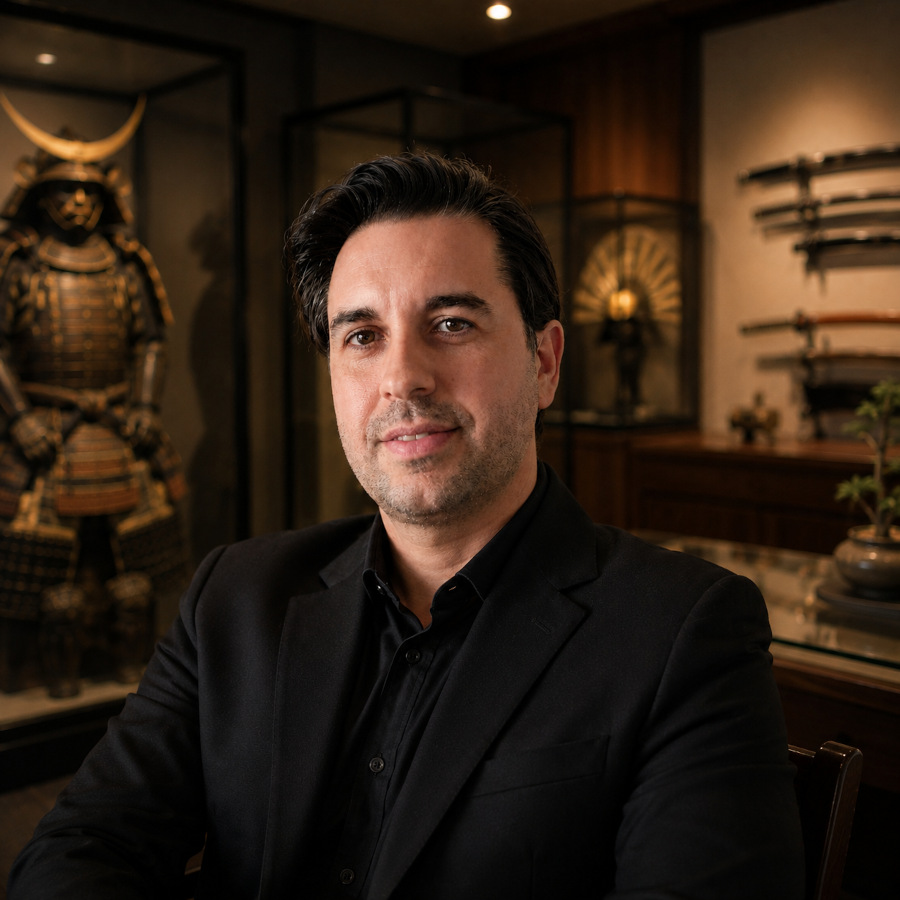
CEO of SupeinNihonto, dealer and collector of ancient Japanese art and weapons from Canillo, Andorra.
Contact